Linking Verbs: Be, Become, Seem

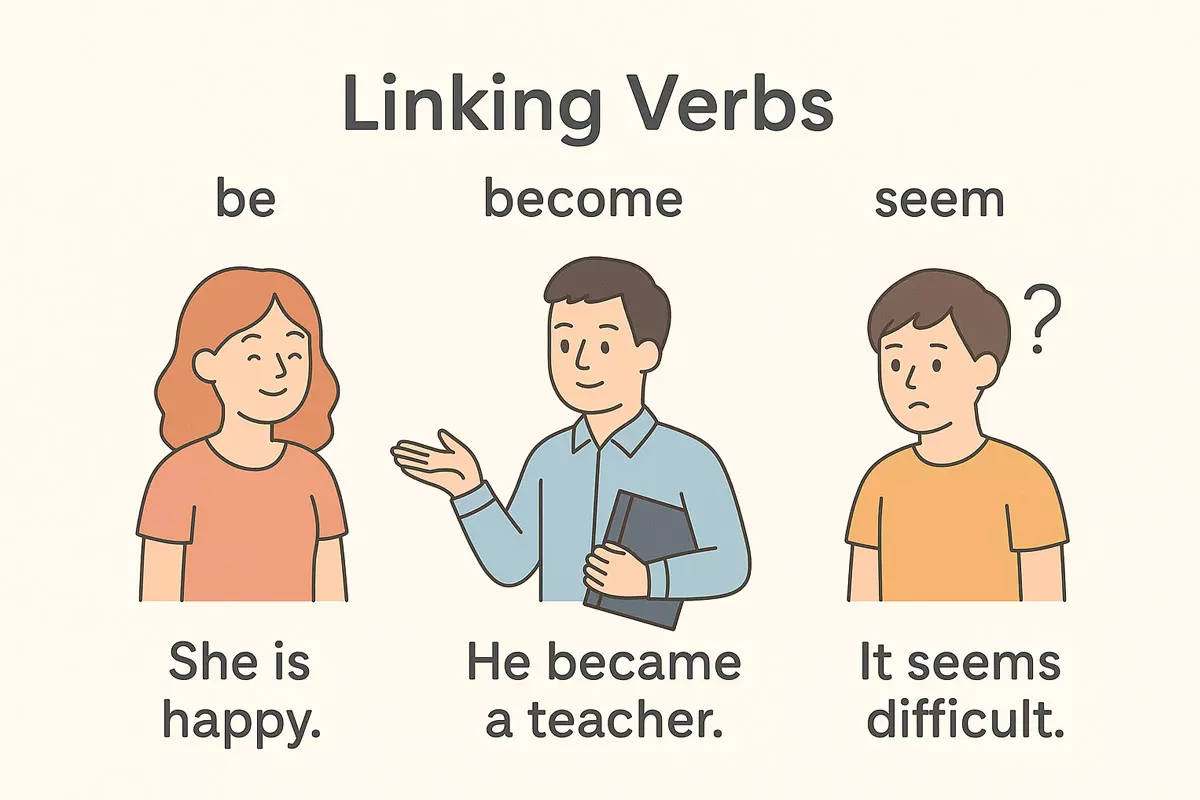 This article explains what linking verbs do, lists main examples, and compares them to action verbs. It covers how adjectives follow linking verbs, highlights common sentence patterns and mistakes, and includes a quick practice section.
Learning how specific verbs link the subject of a sentence to more information can significantly improve the clarity and engagement of your writing. Verbs such as be, become, and seem act as important connectors, allowing writers to express states of being, changes, and perceptions effectively. By recognizing the role these verbs play, you can create sentences that convey precise meanings and foster smoother transitions between ideas, making your overall communication more effective and enjoyable for readers.
What Linking Verbs Do
Linking verbs act as connectors between the subject and additional information about the subject, usually an adjective or noun. Rather than expressing action, these verbs serve to identify, describe, or classify the subject. They provide a bridge, letting us state what something is, how it appears, or what it becomes.
How Linking Verbs Function
In a sentence, a linking verb joins the subject to a subject complement. The complement can be a noun (renaming the subject) or an adjective (describing the subject’s state or quality). For instance, in “She is tired,” the verb “is” links “she” to the adjective “tired,” showing her current condition.
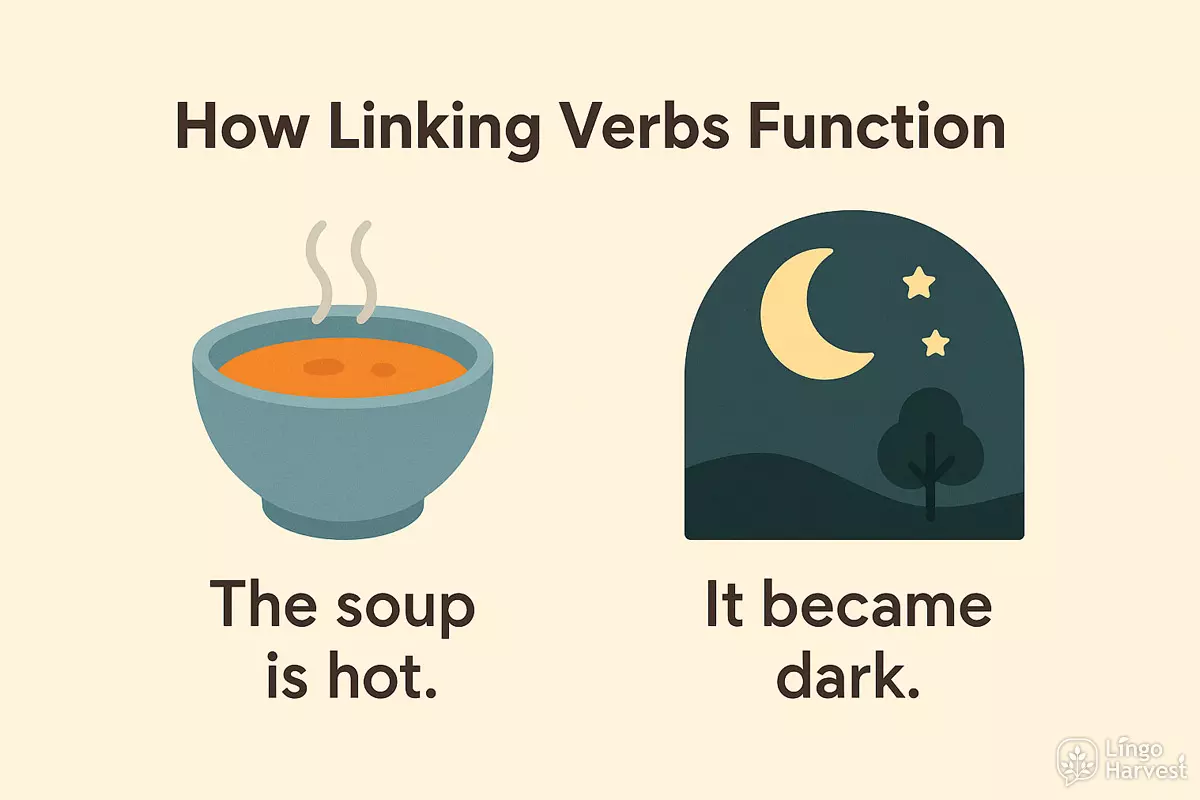
- Be: Used for identity, characteristics, or states (e.g., “He is a teacher.”, “The soup is hot.”).
- Become: Indicates change or transformation (e.g., “They became friends.”, “It became dark.”).
- Seem: Expresses appearance or impression (e.g., “You seem upset.”, “This seems easy.”).
Common Patterns with Linking Verbs
These verbs typically follow a predictable pattern, making them easy to spot. The subject comes first, followed by the linking verb, then a complement. Here are some examples:
- The sky is blue.
- The milk became sour.
- He seems confident.
- My idea was a success.
- The room became quiet.
- She is my friend.
- This seems important.
- It was late.
- The food became cold.
- He is a doctor.
- The answer seems correct.
- The situation became complicated.
- The book was interesting.
- His explanation seems logical.
- My cat is sleepy.
Linking Verbs vs. Action Verbs
It’s important to distinguish between verbs that link and those that show action. Compare these examples:
| Sentence | Verb Type |
|---|---|
| The cake is delicious. | Linking verb: connects subject to description |
| The chef tastes the cake. | Action verb: shows what the chef does |
| The cake became dry. | Linking verb: shows change of state |
| The children seem excited. | Linking verb: expresses impression |
In summary, linking verbs tie the subject to relevant information, helping us describe identity, qualities, and changes without showing direct action. Recognizing how these verbs work makes it easier to build clear, descriptive sentences.
Main Linking Verb List
Understanding which verbs function as connectors between the subject and additional information is essential for building clear sentences. Linking verbs do not show action. Instead, they describe a state or condition, connecting the subject with a word or phrase that gives more detail about it—often an adjective or a noun.
Common English Linking Verbs
A number of verbs serve this connecting role in English. While “be,” “become,” and “seem” are the most common, several others can also act this way in certain contexts. Here’s a broad selection:
- am
- is
- are
- was
- were
- be
- being
- been
- become
- became
- seem
- seemed
- appear
- appear(s)
- grow
- look
- feel
- sound
- taste
- smell
- remain
- stay
- turn
- prove
These verbs often link the subject to a subject complement, which can be a noun (“She became a doctor”) or an adjective (“The soup smells delicious”).
Examples in Sentences
Let’s look at a few of these connectors in action:
- The sky looks blue today.
- He became tired after running.
- This bread tastes fresh.
- The child grew quiet.
- It remains unclear.
How Linking Verbs Differ from Action Verbs
Some verbs, like “look” and “feel,” can function as both linking and action verbs. The difference depends on context. For example:
- Linking: “She looks happy.” (Describes her state)
- Action: “She looks at the painting.” (Describes an action)
Forms of the Verb "Be"
The verb “be” is the most versatile linking verb, appearing in many forms to match tense and subject. Here’s a summary:
| Form | Example Sentence |
|---|---|
| am | I am excited. |
| is | She is ready. |
| are | They are students. |
| was | He was tired. |
| were | We were late. |
| be | It will be cold tomorrow. |
| being | She is being helpful. |
| been | They have been friends for years. |
In summary, linking verbs play a crucial role in describing conditions, states, and identities. Recognizing them helps in both understanding and constructing meaningful sentences.
Linking vs Action Verbs
Understanding how linking verbs differ from action verbs helps clarify sentence structure and meaning. Linking verbs—like be, become, and seem—connect the subject to extra information, such as a state or quality. They do not express an action that the subject performs. In contrast, action verbs describe what someone or something is doing, showing movement, occurrence, or a process.
How Linking Verbs Work
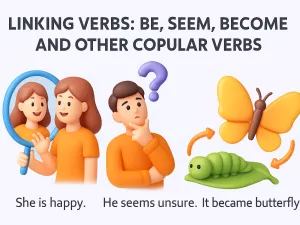
Instead of showing activity, these verbs act as a bridge, connecting the subject to a noun, pronoun, or adjective that describes or identifies it. For example, in “She is happy,” the verb “is” simply links “she” to the adjective “happy.” The subject isn’t performing any action; rather, a state or condition is being described.
Action Verbs Explained
Action verbs, on the other hand, are all about doing. They answer questions like “What did the subject do?” Examples include “run,” “eat,” “think,” and “build.” These verbs can be physical or mental, but they always show something happening.
| Type | Function | Example Sentence |
|---|---|---|
| Linking Verb | Connects subject to a state, quality, or identity | The soup is hot. |
| Action Verb | Shows what the subject does (action or process) | The chef tastes the soup. |
| Linking Verb | Describes a change or result | The sky became dark. |
| Action Verb | Describes a mental or physical action | The student solved the problem. |
Quick Reference: Recognizing Linking Verbs
- Do not show physical or mental action
- Can often be replaced by “equals” without changing the basic meaning
- Common examples: am, is, are, was, were, become, seem, appear, feel, look
- Followed by adjectives or nouns that describe the subject
Quick Reference: Spotting Action Verbs
- Show what the subject does
- Often answer “What is happening?”
- Examples: run, write, jump, think, grow, read, build, paint, swim, decide
- Usually followed by objects or adverbs
Knowing whether a verb links or acts helps with subject-verb agreement and sentence clarity. Linking verbs play a unique role in connecting ideas, while action verbs energize sentences with movement or thought.
Adjectives After Linking Verbs
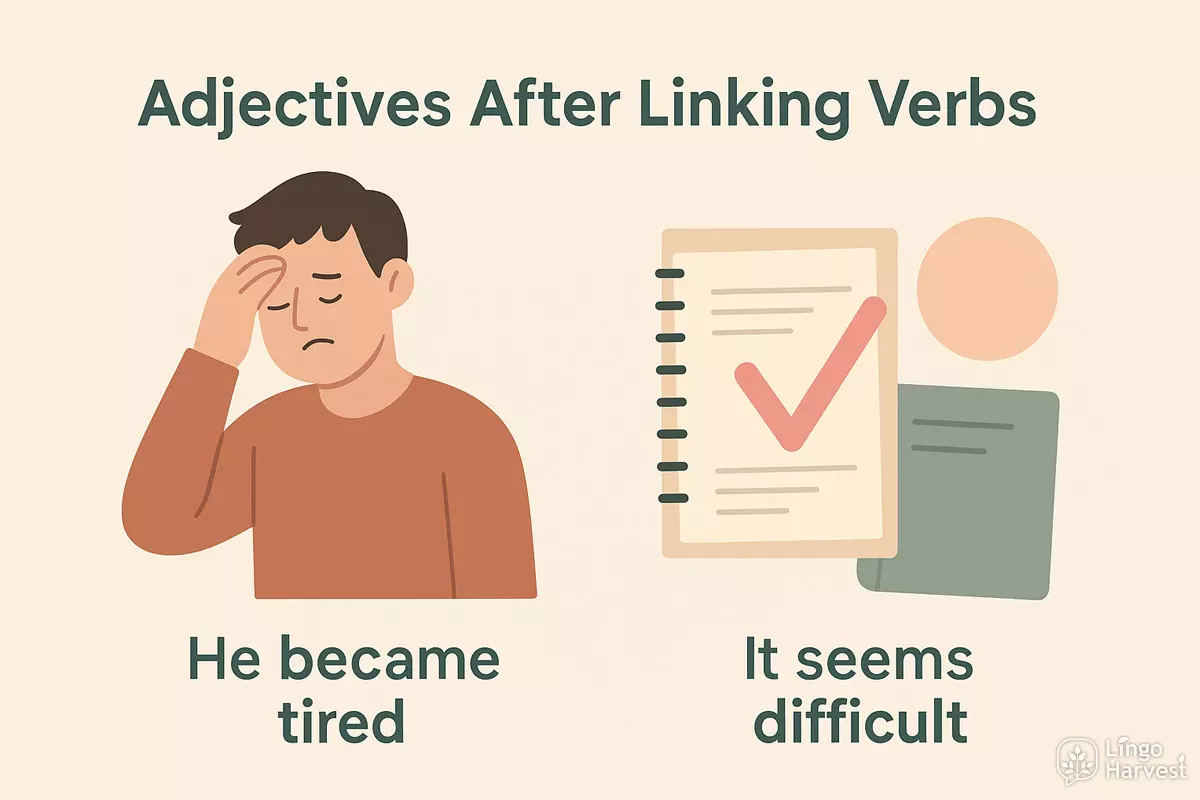
When you use verbs like "be," "become," and "seem," the word that follows often describes or classifies the subject. This word is usually an adjective, not an adverb. For example, in "She is happy," the adjective "happy" describes the subject "she." This pattern is important because using an adverb instead (“She is happily”) would be incorrect in this context.
How Linking Verbs Connect Subjects and Descriptions
Linking verbs act as a bridge between the subject and its description. The adjective after a linking verb tells us about the subject’s state, quality, or identity. Here are some typical structures:
- Subject + be + adjective (e.g., The soup is hot.)
- Subject + become + adjective (e.g., He became tired.)
- Subject + seem + adjective (e.g., It seems difficult.)
Common Mistakes to Avoid
It’s easy to confuse adjectives and adverbs in these sentences. Remember, after linking verbs, use adjectives to describe the subject, not adverbs.
- ✅ The sky looks blue.
- ❌ The sky looks bluely.
- ✅ She became angry.
- ❌ She became angrily.
Useful Adjectives After Linking Verbs
These are some adjectives commonly used after "be," "become," and "seem." Getting familiar with these helps you sound more natural in English.
- happy
- sad
- tired
- hungry
- angry
- ready
- late
- sure
- afraid
- famous
- quiet
- different
- important
- possible
- open
- closed
- clean
- right
- worried
- confident
Patterns: Linking Verbs and Adjective Usage
For a clearer view, here are typical sentence patterns using linking verbs and adjectives:
| Sentence Pattern | Example |
|---|---|
| be + adjective | The room is clean. |
| become + adjective | The weather became cold. |
| seem + adjective | He seems upset. |
| look/feel/sound + adjective | This cake smells delicious. |
Using adjectives after these verbs makes your English clearer and more precise. Keep practicing with different subjects and descriptive words to build confidence.
Common Patterns
When working with linking verbs such as be, become, and seem, there are several typical sentence structures that appear again and again in English. These verbs connect the subject to additional information, usually describing a state, change, or impression. Below are some of the most frequent constructions and useful phrases you’ll encounter.
Typical Sentence Structures
- Subject + linking verb + adjective
She is happy. / The soup became cold. - Subject + linking verb + noun (subject complement)
He became a doctor. / They are students. - Subject + linking verb + prepositional phrase
The keys are on the table. - Subject + linking verb + to-infinitive (with certain adjectives or nouns)
It is important to listen. - Subject + linking verb + like/as if + clause
She seems like she knows the answer. / He looks as if he is tired.
Expanded Examples with "Be", "Become", and "Seem"
- The weather is nice today.
- This cake seems delicious.
- My friend became very quiet.
- It is difficult to decide.
- The story became more interesting.
- He is an engineer.
- She seems upset.
- The room became silent.
- Your idea is perfect.
- The plan seems possible.
- This solution became obvious.
- They are in the garden.
- The answer seems correct.
- It is time to go.
- His explanation became clearer.
- She is like her mother.
- The task seems impossible.
- He became a leader.
- The result is what we expected.
- The food seems ready.
Comparison of Linking Verb Patterns
| Pattern | Example |
|---|---|
| Subject + be + adjective | The sky is blue. |
| Subject + become + noun | She became a teacher. |
| Subject + seem + adjective | He seems tired. |
| Subject + be + prepositional phrase | The book is on the shelf. |
| Subject + seem + like/as if + clause | It seems as if they know each other. |
These sentence structures help clarify how information is linked to the subject in English. By noticing these recurring forms, learners can build more natural sentences and better understand how description, identification, and impression are expressed with these key verbs.
Typical Errors
Learners often confuse linking verbs with action verbs or misuse them in sentences. One frequent issue is adding unnecessary words after these verbs, or using the wrong verb form. Another trouble spot is incorrectly pairing adjectives and adverbs after linking verbs such as "be," "become," and "seem." It's also common to forget subject-verb agreement or to use the wrong tense.
Common Mistakes with Linking Verbs
- Using an adverb instead of an adjective after a linking verb:
❌ She seems happily.
✅ She seems happy. - Confusing action verbs with linking verbs:
❌ He is run fast.
✅ He runs fast.
✅ He is fast. - Incorrect subject-verb agreement:
❌ They is tired.
✅ They are tired. - Using the wrong tense:
❌ She become a doctor last year.
✅ She became a doctor last year. - Adding unnecessary objects:
❌ The soup tastes deliciously.
✅ The soup tastes delicious. - Mixing up "seem" with "look" or "appear":
❌ He seems like tired.
✅ He seems tired. - Incorrect negative forms:
❌ She not is ready.
✅ She is not ready. - Using "become" for temporary states:
❌ He becomes hungry now.
✅ He is becoming hungry now. - Forgetting the verb entirely:
❌ She happy today.
✅ She is happy today. - Using both an adjective and adverb together:
❌ The cake smells sweetly delicious.
✅ The cake smells delicious.
Adjective vs. Adverb after Linking Verbs
It's important to use adjectives, not adverbs, after these verbs. Here is a quick reference:
| Incorrect (Adverb) | Correct (Adjective) |
|---|---|
| He became quickly. | He became quick. |
| The room seems coldly. | The room seems cold. |
| I am happily. | I am happy. |
| She is angrily. | She is angry. |
| The soup tastes badly. | The soup tastes bad. |
Summary Tips
Pay close attention to verb forms and the words that follow them. Linking verbs connect the subject to a descriptive word, usually an adjective. Avoid using adverbs or extra objects in these constructions, and always check for correct tense and agreement. This will help your sentences sound natural and accurate.
Quick Practice
Ready to test your understanding of verbs that link the subject with more information? Try the activities below to reinforce how "be," "become," and "seem" operate in sentences. Focus on how these verbs connect the subject to descriptions, conditions, or states.
Identify the Linking Verb
Read each sentence and decide which word is the linking verb. Write your answer on paper or in your head.
- The soup became cold quickly.
- She is an engineer.
- They seem tired after the trip.
- The weather was perfect for a picnic.
- He became angry during the discussion.
Show answers
- became
- is
- seem
- was
- became
Complete the Sentences
Choose the correct linking verb to fill in each blank. Options: is, seems, became
- The sky ____ very dark before the storm.
- My friend ____ interested in learning French.
- This task ____ easier after some practice.
- The answer ____ obvious now.
- It ____ difficult to explain at first.
Show answers
- became
- is
- seems
- is
- was
Comparing Forms
Linking verbs change form depending on tense. See the chart below for some key forms:
| Base Verb | Past Form | Present Form | Continuous Form |
|---|---|---|---|
| be | was/were | am/is/are | being |
| become | became | become(s) | becoming |
| seem | seemed | seem(s) | seeming |
Spot the Linking Verb—Quick Check
Which of these sentences do not contain a linking verb?
- The cat looked hungry.
- She quickly ran to the store.
- The cake tasted delicious.
- We became friends.
Show answers
- Sentence 2 ("ran" is an action verb, not a linking verb.)