Auxiliary Verbs: Do, Be, Have

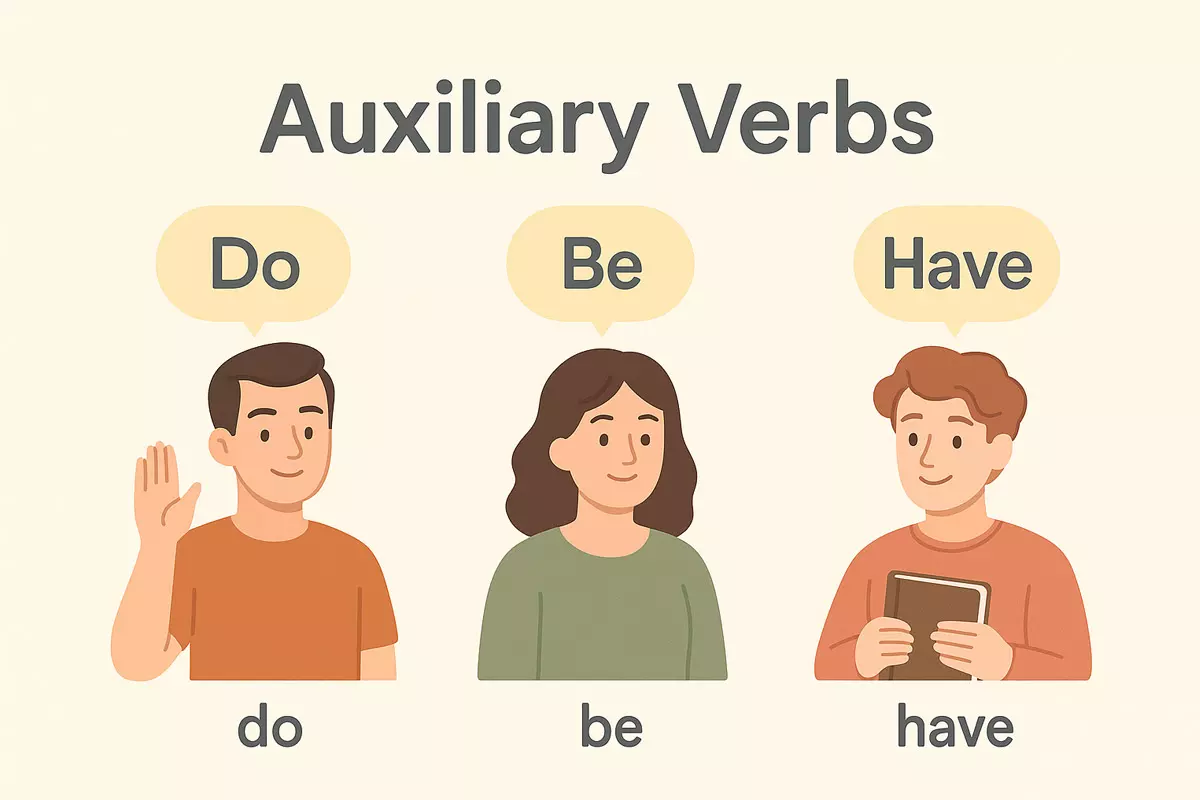 This article explains why auxiliary verbs matter and covers the forms of do, be, and have. It details how to use auxiliaries in questions and negatives, and includes practice sentences to help you understand their practical uses.
Have you ever wondered how English sentences form questions, negatives, or more complex tenses? The answer lies in the use of helping verbs, which are often overlooked but play an essential role in everyday communication. These verbs, such as do, be, and have, help create questions, form negatives, and build various tenses and passive constructions. By understanding how helping verbs function, you can improve your grammar skills and communicate your ideas more clearly and accurately in both writing and speech.
Why Auxiliary Verbs Matter
Supporting verbs like "do," "be," and "have" play a crucial role in English sentence structure. They are not just background helpers; they make it possible to form questions, negatives, and a wide range of tenses. Without these helpers, expressing time, mood, or emphasis would be much more complicated.
Essential for Questions and Negatives
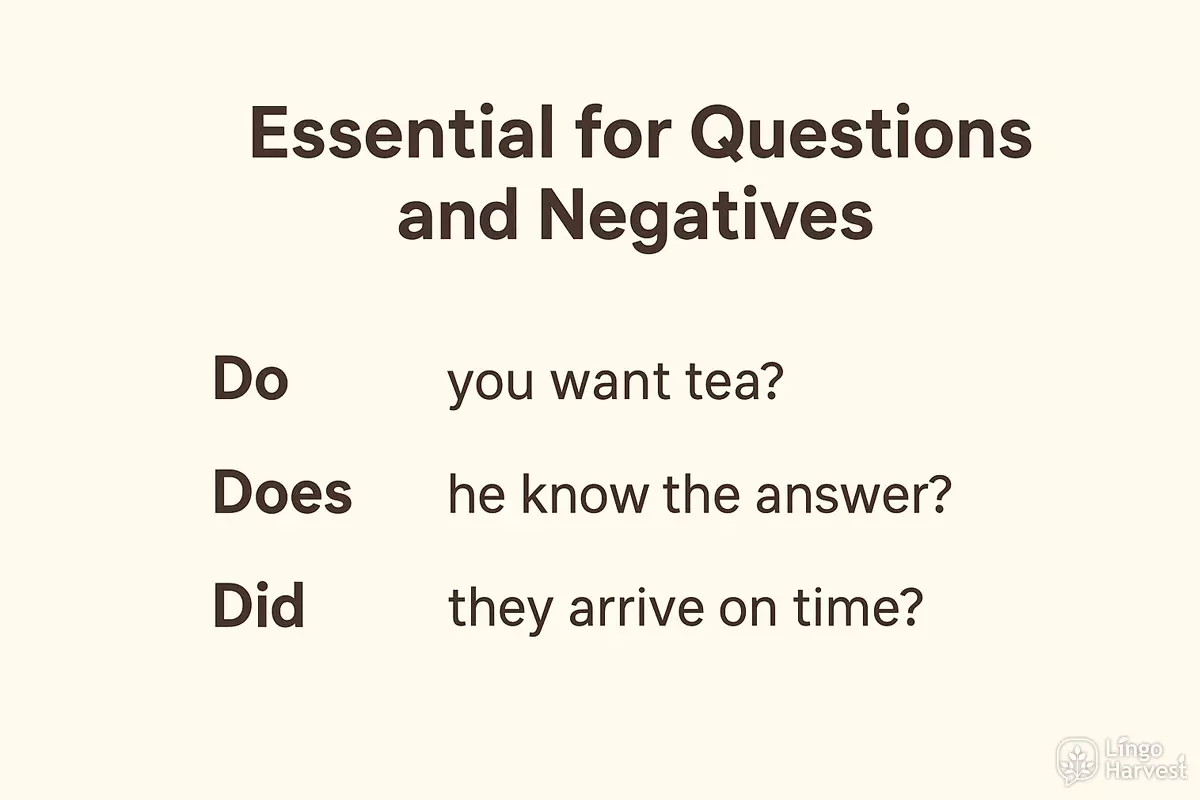
English relies on supporting verbs to create questions and negative statements, especially when no other helper is present. For example, to ask about an action, "Do you play tennis?" uses "do" to turn a statement into a question. To say something isn't happening, "She does not like coffee" uses "does" for negation.
- Do you want tea?
- Does he know the answer?
- Did they arrive on time?
- She is not coming.
- We are waiting.
- Have you finished?
- I have not seen that movie.
- The cake was baked yesterday.
- They were invited.
- Has it started?
- He has not called.
- Did you see the news?
Forming Tenses and Voices
These verbs allow speakers to express different time frames and passive voice. "Be" and "have" are essential for continuous and perfect tenses, while all three are needed to handle passive constructions and emphatic statements.
| Auxiliary | Main Uses | Examples |
|---|---|---|
| Do / Does / Did | Questions, negatives, emphasis (present & past simple) | Do you work here? / She does not agree. / I did finish! |
| Be (am/is/are/was/were) | Continuous tenses, passive voice | We are studying. / The book was written in 1990. |
| Have (have/has/had) | Perfect tenses | They have left. / She had finished before noon. |
Why They’re Irreplaceable
These helpers give English its flexibility. They make speech clear, enable subtle differences in meaning, and allow for precise expression of time and attitude. Mastering their use is essential for fluency and comprehension in both spoken and written English.
Forms of Do
The verb “do” changes its form depending on tense, subject, and whether it’s being used as a main verb or an auxiliary verb. Understanding these variations is crucial for forming questions, negatives, and emphatic statements in English. In the present tense, “do” and “does” serve different subjects, while “did” is used for all subjects in the past tense. The verb “do” also has a participle and gerund form, though these are less common in auxiliary uses.
Present and Past Forms
“Do” adapts to match the subject and tense in a sentence. Here’s how the simple forms look:
| Base Form | Third Person Singular | Past Simple | -ing Form | Past Participle |
|---|---|---|---|---|
| do | does | did | doing | done |
Examples in Sentences
- I do my homework every day. ✅
- She does her chores in the morning. ✅
- They did their best last year. ✅
- He is doing his project now. ✅
- The task is done by noon. ✅
- Do you like coffee? → (question form)
- Does he play tennis? → (question form)
- We did not see the movie. ❌ (negative form)
- She doesn’t understand the instructions. ❌ (negative form)
- Why did you leave early?
- What does this word mean?
- I don’t agree with that idea.
- He did finish his assignment on time. (emphasis)
- They are doing very well in their new jobs.
- The work was done efficiently.
Notes on Usage
When “do” is used as an auxiliary, it helps form negatives and questions in the present simple and past simple tenses. The base form “do” is used with I, you, we, and they, while “does” matches he, she, and it. In the past, “did” is universal for all subjects. “Doing” and “done” appear in continuous and perfect structures, but less so as auxiliaries.
It’s important not to confuse “do” as a main verb (meaning “to perform”) with its role as a helper verb. Mastering these forms will help clarify meaning and structure in English sentences.
Forms of Be
The verb “be” is unique in English because it changes form more than most verbs, depending on tense and subject. As an auxiliary, it helps to create continuous (progressive) tenses and the passive voice. Understanding its variations is crucial for accurate grammar in both spoken and written English.
Present and Past Forms
“Be” has several present and past tense versions. The choice depends on the subject (I, you, he, etc.) and whether the context is singular or plural. This can be confusing, so it’s useful to see all the common forms together:
| Subject | Present Simple | Past Simple | Present Participle / Past Participle |
|---|---|---|---|
| I | am | was | being / been |
| you | are | were | being / been |
| he / she / it | is | was | being / been |
| we / you (plural) / they | are | were | being / been |
Common Uses in Sentences
Auxiliary “be” appears in several key structures in English. Here are some of the most frequent patterns:
- She is reading a book. → Present continuous
- We are waiting for the bus.
- They were playing outside.
- I am being careful.
- The cake was baked yesterday. → Passive voice
- The windows are cleaned every week.
- He is called John.
- You are invited to the party.
- She was being interviewed.
- The letters have been sent.
- We are being watched.
- The homework has been finished.
Notes on Usage
“Be” is irregular, so its forms don’t follow typical verb patterns. It’s also used in contractions (e.g., “I’m”, “they’re”, “he’s”) and questions (“Are you ready?”). Remember that “being” and “been” are not interchangeable: “being” is used for continuous tenses, while “been” is the past participle for perfect tenses and the passive.
Forms of Have
Understanding how "have" changes according to tense, subject, and usage is essential for mastering English auxiliary verbs. The verb "have" serves as both a main verb and an auxiliary, and its forms vary depending on person, number, and tense.
Present and Past Forms
In the present tense, "have" appears as "have" or "has." Use "have" with I, you, we, and they; "has" is used with he, she, and it. In the past, the form "had" is used for all persons, singular and plural. The verb also has a past participle, "had," and a present participle, "having," which are used in perfect tenses and continuous forms, respectively.
Summary Table of Key Forms
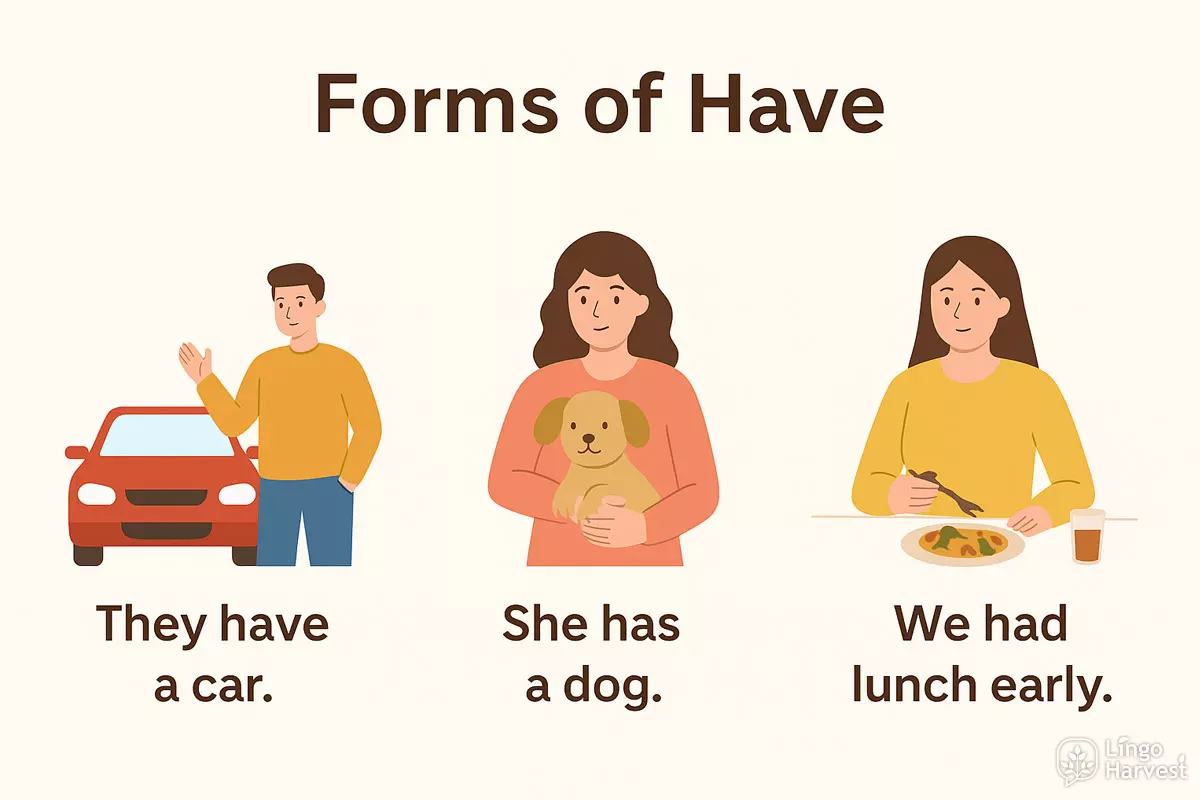
| Form | Example Usage |
|---|---|
| Base form | They have a car. |
| Third person singular | She has a dog. |
| Past simple | We had lunch early. |
| Present participle | Having finished, he left. |
| Past participle | She has had enough. |
Common Uses as an Auxiliary
As an auxiliary, "have" helps form perfect tenses. Here are some typical patterns:
- I have eaten breakfast. (Present perfect)
- She has seen the movie. (Present perfect)
- They had left before noon. (Past perfect)
- We have been waiting for an hour. (Present perfect continuous)
- He had been working all day. (Past perfect continuous)
Contractions and Negative Forms
In spoken and informal written English, contractions are common. "Have" and "has" often contract with pronouns:
- I've (I have)
- You've (You have)
- He's (He has) / She's (She has) / It's (It has)
- We've (We have)
- They've (They have)
Negative forms include "haven't," "hasn't," and "hadn't."
Summary Points
- "Have" changes to "has" in the third person singular present.
- "Had" serves as both the simple past and the past participle.
- The verb is crucial for building perfect and perfect continuous tenses.
- Contractions are frequent in everyday English, especially with pronouns.
- Negative forms are made by adding "not" (haven't, hasn't, hadn't).
By recognizing these forms and their uses, you can understand and use "have" accurately in a range of English sentences.
Auxiliaries in Questions
Forming questions in English often relies on auxiliary verbs: do, be, and have. These helping verbs are essential for inverting the subject and verb, which is a key feature of English interrogative sentences. The choice of auxiliary depends on tense, aspect, and whether the main verb is stative or dynamic.
Using "Do" for Questions
In the simple present and simple past, "do" and its forms ("does," "did") help create yes/no and wh- questions when there’s no other auxiliary. This is called do-support. For example:
- Do you like coffee?
- Does she play the piano?
- Did they finish the project?
- Where do you live?
- Why did he leave early?
Questions with "Be"
When the main verb is a form of "be," or in continuous tenses, "be" itself is used to form the question by placing it before the subject. For example:
- Are you ready?
- Is it raining?
- Were they surprised?
- Where are you going?
- Was the test difficult?
Using "Have" in Interrogatives
For perfect tenses, "have" (or "has," "had") acts as the auxiliary. It comes before the subject in questions:
- Have you finished?
- Has she ever been to Japan?
- Had they left before you arrived?
- What have we missed?
- How long has it been raining?
Comparing Auxiliary Use in Questions
The chart below summarizes typical patterns for forming questions with these helping verbs in English.
| Auxiliary | Example Question | Tense/Structure | Notes |
|---|---|---|---|
| Do / Does / Did | Do you work here? | Simple Present / Past | Used when there’s no other auxiliary |
| Am / Is / Are / Was / Were | Are they coming? | Continuous & "be" as main verb | Auxiliary precedes subject |
| Have / Has / Had | Have you eaten? | Perfect Tenses | Auxiliary precedes subject |
| Modal + Base | Can you help? | Modal Constructions | Modals act as auxiliaries in questions |
Key Patterns for Question Formation
Here are common patterns seen in English questions using auxiliaries:
- Auxiliary + Subject + Main Verb + ...? (Do you understand?)
- Wh-word + Auxiliary + Subject + Main Verb + ...? (Why did she leave?)
- Negative questions: Auxiliary + Subject + not + Main Verb + ...? (Didn’t you see him?)
- Tag questions also rely on auxiliaries: (You’re coming, aren’t you?)
- Short answers repeat the auxiliary: (Yes, I do. / No, she isn’t.)
Understanding how these verbs function in interrogative sentences is crucial for clear, correct English. By mastering the use of "do," "be," and "have" in question structures, you gain flexibility and accuracy in conversation and writing.
Auxiliaries in Negatives
Negation in English relies heavily on auxiliary verbs. In negative sentences, these helping verbs combine with "not" to create the correct structure. The three main auxiliaries—do, be, and have—each follow their own rules for forming negatives, and their use depends on the tense and type of sentence.
How "Do," "Be," and "Have" Form Negatives
- Do/does/did: Used as a helper in simple present and simple past. The main verb stays in its base form, and the negative is made by adding "not" after the auxiliary ("do not," "does not," "did not").
- Be: For continuous and passive forms, "be" takes "not" directly after it ("am not," "is not," "are not," "was not," "were not").
- Have: In perfect tenses, "have" forms the negative by adding "not" after the auxiliary ("have not," "has not," "had not").
Common Patterns and Examples
It's useful to see how these auxiliaries work in negative sentences. Here are some representative examples:
- I do not like coffee. ❌
- She does not play tennis. ❌
- They did not finish the project. ❌
- We are not ready yet. ❌
- He is not at home. ❌
- You were not invited. ❌
- I am not tired. ❌
- She has not called today. ❌
- They have not seen the movie. ❌
- He had not eaten before noon. ❌
- The car is not being repaired. ❌
- It does not work. ❌
- I was not expecting you. ❌
- We are not going to the party. ❌
- You do not need to worry. ❌
- He has not finished yet. ❌
- They had not left when I arrived. ❌
- We were not told about the meeting. ❌
Contractions in Negative Forms
In everyday speech and informal writing, negative forms are often contracted. Here are the most common contractions:
- do not → don't
- does not → doesn't
- did not → didn't
- is not → isn't
- are not → aren't
- was not → wasn't
- were not → weren't
- have not → haven't
- has not → hasn't
- had not → hadn't
- am not is rarely contracted (except in "aren't I?")
Summary Table: Negative Forms with Auxiliaries
| Auxiliary | Negative Example | Contraction |
|---|---|---|
| do/does/did | They do not understand. | don't / doesn't / didn't |
| be (am/is/are/was/were) | He is not coming. | isn't / aren't / wasn't / weren't |
| have/has/had | She has not left. | hasn't / haven't / hadn't |
| be (passive/continuous) | The cake is not being baked. | isn't / aren't / wasn't / weren't |
Understanding how to use these helpers in negative sentences is essential for clear communication. The placement of "not" after the correct auxiliary is a fundamental rule in English grammar, and mastering it will help you express negative ideas accurately.
Practice Sentences
Understanding how "do," "be," and "have" function in English sentences is easier with targeted exercises. Below you'll find example sentences, fill-in-the-blank activities, and a comparison table to help reinforce how these helping verbs are used in statements, questions, and negatives.
Fill in the Blank: Choose the Correct Auxiliary
Insert the correct form of "do," "be," or "have" in each sentence.
- ______ you like coffee?
- She ______ not finished her homework yet.
- We ______ going to the park later.
- ______ they seen the new movie?
- I ______ not understand the question.
- He ______ working on a new project.
- ______ you ever traveled abroad?
- The children ______ playing outside.
- We ______ not have any bread left.
- ______ she know the answer?
Show answers
- Do
- has
- are
- Have
- do
- is
- Have
- are
- do
- Does
Examples in Context
- Do you speak French?
- She is reading a book.
- They have visited London before.
- We are not ready yet.
- He does not eat meat.
- Have you finished your assignment?
- I am listening to music.
- Does it rain often here?
- We have been waiting for an hour.
- You are always on time.
- Has she called you?
- I do not like spicy food.
Quick Reference: Auxiliary Verb Forms
| Auxiliary | Examples | Negative Form | Question Form |
|---|---|---|---|
| Do / Does / Did | They do their homework. Does he play chess? |
do not (don't), does not (doesn't), did not (didn't) | Do you like tea? Did she call? |
| Be (am/is/are/was/were) | I am happy. They are coming. |
am not, is not (isn't), are not (aren't), was not (wasn't), were not (weren't) | Are you ready? Was it cold? |
| Have / Has / Had | She has finished. We have eaten. |
have not (haven't), has not (hasn't), had not (hadn't) | Have they arrived? Had you seen it? |
Short Practice: Correct or Incorrect?
Decide if each sentence is correct (✅) or incorrect (❌). If incorrect, think about why.
- Does she likes pizza?
- They are playing football.
- He have gone home.
- I do not know the answer.
- Has you seen my keys?
Show answers
- ❌ ("Does she like pizza?")
- ✅
- ❌ ("He has gone home.")
- ✅
- ❌ ("Have you seen my keys?")
Reviewing these patterns will help you recognize and use auxiliary verbs accurately in different types of sentences.