Transitive and Intransitive Verbs Explained

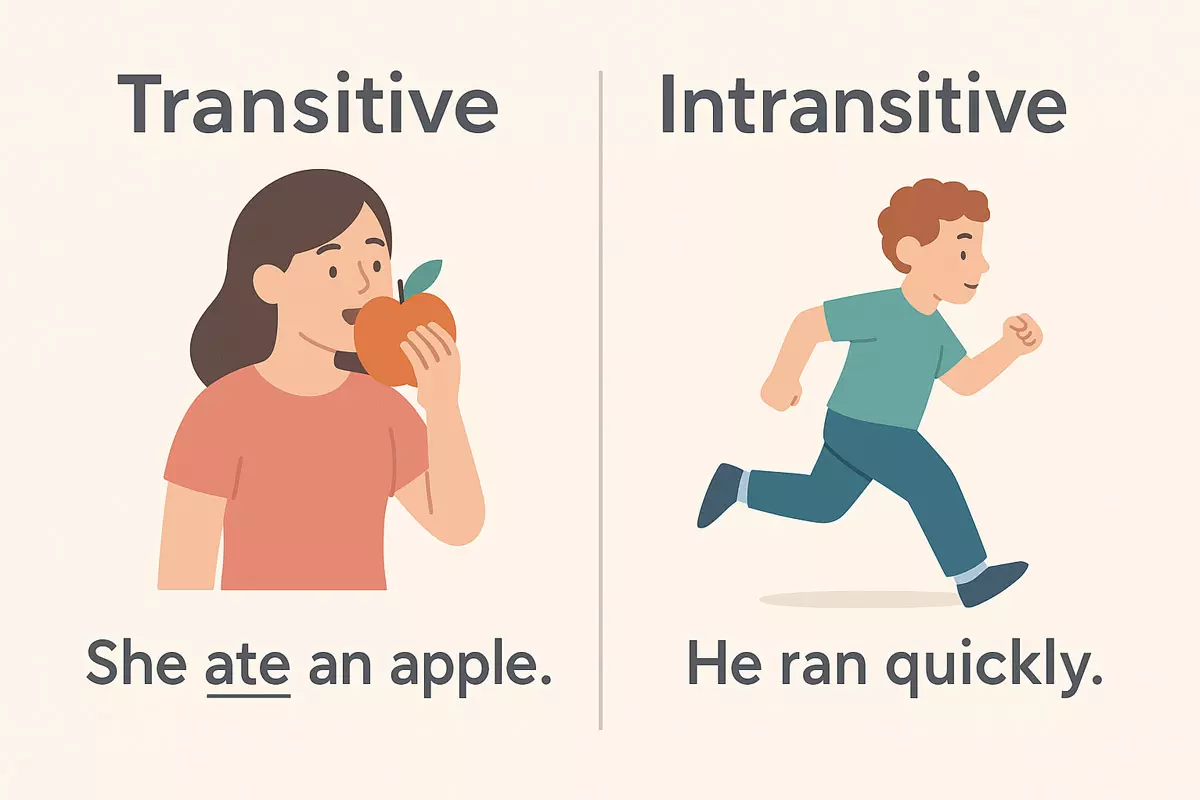 This article explains what transitive verbs need, covers the basics of direct objects, and contrasts them with intransitive verbs. It also shows verbs used both ways, gives practical examples, addresses common confusions, and provides practice items.
Have you ever noticed that some verbs require an object to complete their meaning, while others do not? These differences are important for clear and effective writing. Verbs that need an object are called transitive verbs, such as “eat” in “She eats an apple,” where “apple” is the object. In contrast, intransitive verbs do not take an object, as in “He sleeps.” Recognizing whether a verb is transitive or intransitive helps you construct sentences that are both precise and easy to understand, improving the overall quality of your writing.
What Transitive Verbs Need
Transitive verbs require something specific to complete their meaning: a direct object. Without an object, these verbs leave the listener or reader wondering, “What?” or “Whom?” For example, in the sentence “She reads,” the phrase feels unfinished—reads what? Once you add an object (“She reads books”), the meaning becomes clear.
Direct Object: The Essential Component
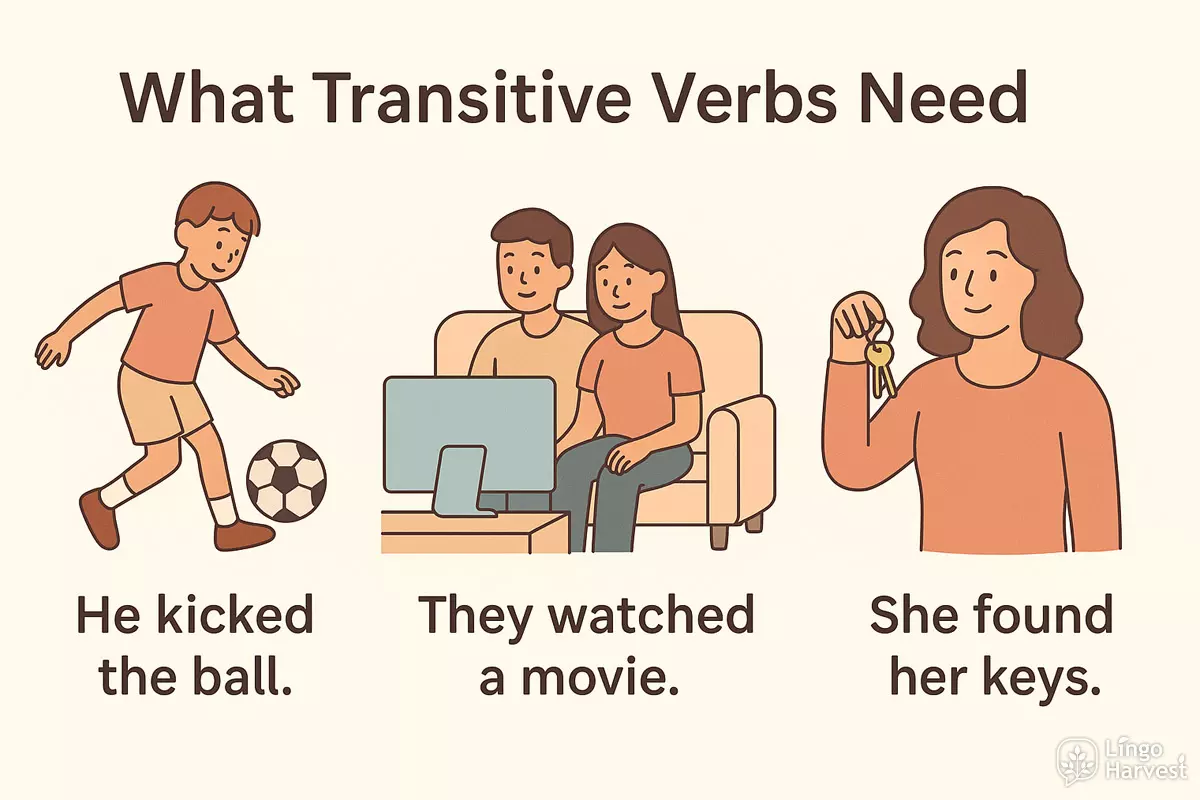
The direct object is the recipient of the action in a sentence with a transitive verb. It answers “what?” or “whom?” after the verb. For example:
- He kicked the ball.
- They watched a movie.
- She found her keys.
In each case, the verb is followed by a noun or pronoun that receives the action.
Common Transitive Verbs in Action
Here are some verbs that typically require an object. Notice how each one needs something or someone to “complete” the idea:
- bring
- eat
- make
- answer
- love
- open
- paint
- call
- fix
- send
- teach
- wear
- write
- choose
- invite
- clean
- build
- carry
If these verbs are used without an object, the sentence often feels incomplete or confusing.
Recognizing Transitive Verbs in Sentences
To identify if a verb is transitive, try asking “what?” or “whom?” after the verb. If the answer makes sense and is present, it’s a transitive verb. For instance:
- She wrote a letter. (Wrote what? A letter.)
- He opened the window. (Opened what? The window.)
- We invited our friends. (Invited whom? Our friends.)
Transitive vs. Incomplete Sentences
Leaving out the direct object with these verbs can create confusion:
- ❌ She bought. (Bought what?)
- ❌ He carried. (Carried what?)
- ❌ They fixed. (Fixed what?)
Adding the object completes the idea and makes the sentence meaningful.
Direct Object Basics
Understanding what a direct object is makes it much easier to spot the difference between transitive and intransitive verbs. In a sentence, the direct object is the word or phrase that receives the action of the verb. It answers the questions “what?” or “whom?” after the verb. For instance, in “She reads books,” the word “books” is what she reads, so it’s the direct object.
How to Identify the Direct Object
To find the direct object, first locate the verb. Then ask “what?” or “whom?” immediately after that verb. If there is a clear answer, that answer is the direct object. If not, the verb is likely intransitive and doesn’t take a direct object.
- He kicked the ball. (What did he kick? The ball.)
- They invited her. (Whom did they invite? Her.)
- We built a sandcastle. (What did we build? A sandcastle.)
- She loves music. (What does she love? Music.)
- The cat caught a mouse. (What did the cat catch? A mouse.)
- He wrote a letter. (What did he write? A letter.)
- We watched the movie. (What did we watch? The movie.)
- They solved the puzzle. (What did they solve? The puzzle.)
- I lost my keys. (What did I lose? My keys.)
- She painted a picture. (What did she paint? A picture.)
Direct Objects vs. Indirect Objects
It’s easy to confuse direct and indirect objects, but they serve different purposes. The direct object receives the action, while the indirect object tells us to whom or for whom the action is done. For example: “She gave her friend a gift.” Here, “a gift” is the direct object (what was given), and “her friend” is the indirect object (to whom it was given).
Common Characteristics of Direct Objects
- Usually a noun or pronoun
- Comes after the verb in English sentences
- Can be a single word, a phrase, or even a clause
- Is required for transitive verbs to complete their meaning
- Can answer “what?” or “whom?” about the verb
Recognizing direct objects is essential for understanding sentence structure and how transitive verbs work. They help clarify who or what is affected by the action, making your communication clearer and more precise.
Intransitive Verbs
Verbs that do not require a direct object to complete their meaning fall into this category. When using them, the action remains with the subject and does not transfer to another noun or pronoun. This means you can finish your sentence with the verb itself, and it still makes sense. Many common actions in English are described this way. For instance, when you say “He sleeps” or “Birds fly,” there’s no need for an object to receive the action; the statement is complete as is. These verbs often answer questions like “How?” or “Where?” but not “What?” or “Whom?”
Common Examples
Here are some frequently used verbs that function without a direct object:
- Arrive
- Go
- Come
- Disappear
- Laugh
- Swim
- Rise
- Fall
- Sleep
- Run
- Grow
- Die
- Shine
- Happen
- Walk
- Stand
- Jump
- Sneeze
- Arrive
- Exist
Usage Patterns
Sentences with these verbs often include adverbs or prepositional phrases to add detail, but not a direct object. For example:
- The sun rises early.
- She laughed loudly.
- They arrived at noon.
- He slept peacefully.
Comparing with Transitive Verbs
Understanding the distinction between verbs that need an object and those that do not is key for clear sentence construction. Here’s a structured comparison:
| Verb Type | Sample Sentence |
|---|---|
| Transitive | She reads a book. |
| Intransitive | She reads quickly. |
| Transitive | They built a house. |
| Intransitive | They built slowly. |
Some verbs can function as either type, depending on context. “Run” is intransitive in “He runs every morning,” but could be transitive in rare uses (“She runs a company”). Recognizing these patterns helps avoid confusion and improves both writing and speaking clarity.
Verbs Used Both Ways
Some verbs in English function flexibly, acting as either transitive or intransitive depending on the context. This means a verb might take a direct object in one sentence, but stand alone in another. Understanding which verbs can switch roles, and how their meaning changes, helps you use them naturally.
How Context Changes Verb Use
Whether a verb needs a direct object often depends on what you want to express. For example, with the verb “run,” you can say “She runs every day” (no object needed) or “She runs a small business” (with an object). The meaning can shift subtly or significantly.
Common Examples of Dual-Use Verbs
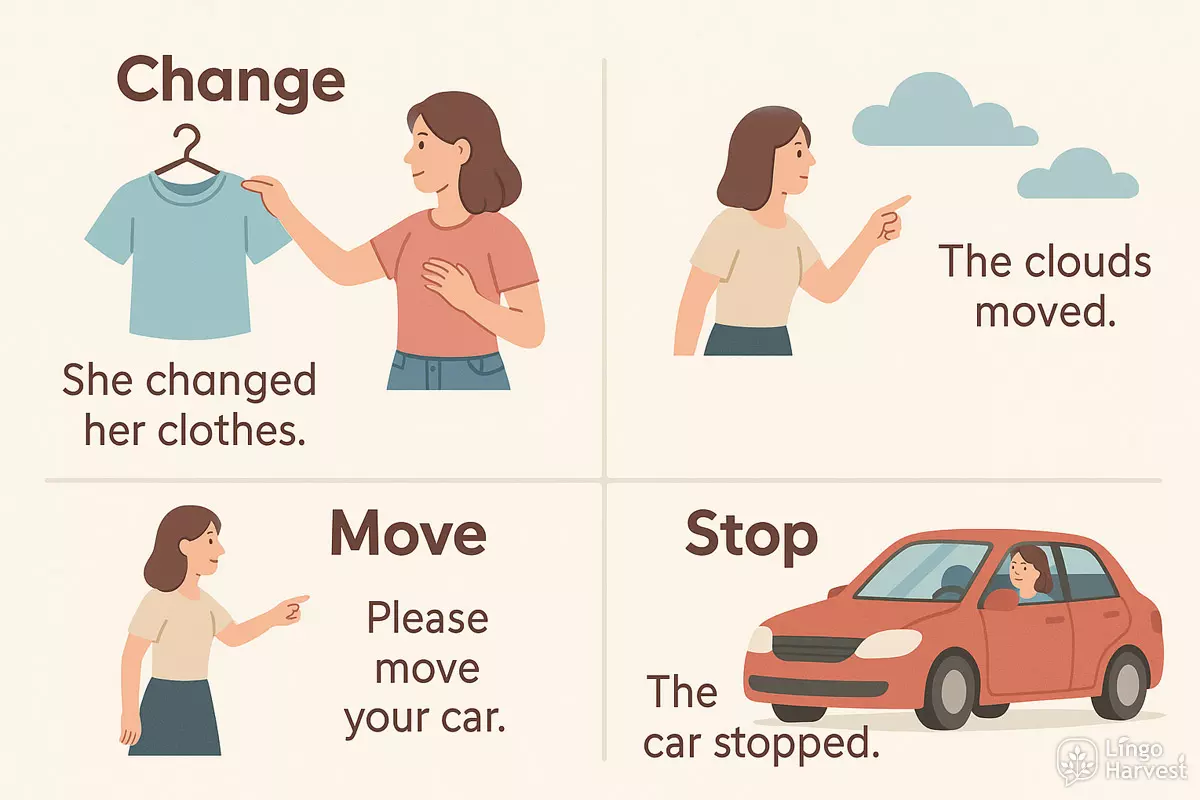
Here are some verbs that are commonly used both with and without a direct object:
- Open — She opened the window. / The window opened.
- Break — He broke the vase. / The vase broke.
- Grow — They grow tomatoes. / Tomatoes grow quickly.
- Change — She changed her clothes. / The weather changed.
- Move — Please move your car. / The clouds moved.
- Stop — She stopped the car. / The car stopped.
- Start — He started the engine. / The show started.
- Increase — They increased the price. / The price increased.
- Close — He closed the door. / The door closed.
- Boil — She boiled the water. / The water boiled.
- Read — He read the book. / He read for hours.
- Ring — She rang the bell. / The bell rang.
- Begin — He began the project. / The project began.
- Burn — They burned the logs. / The logs burned.
- Drop — She dropped the keys. / The keys dropped.
- Finish — He finished the report. / The meeting finished.
- Continue — She continued the story. / The story continued.
- Turn — He turned the page. / The page turned.
- Roll — She rolled the ball. / The ball rolled.
Comparing Sentence Patterns
The difference between using these verbs transitively or intransitively is usually clear from the sentence structure. Here’s a look at how the same verb changes form:
| As Transitive | As Intransitive |
|---|---|
| She broke the glass. ✅ | The glass broke. ✅ |
| They moved the table. | The table moved. |
| He started the car. | The car started. |
| We closed the shop. | The shop closed. |
| She grew flowers. | The flowers grew. |
| He burned the toast. | The toast burned. |
| She finished her homework. | The class finished. |
| They opened the gate. | The gate opened. |
Tips for Recognizing Dual-Use Verbs
Pay attention to whether the verb is followed by a noun that receives the action. If so, it’s being used transitively. If not, or if the action happens to the subject alone, the verb is intransitive. Many of these flexible verbs are common in everyday English, so practicing them will build your confidence in both forms.
Examples in Everyday English
Understanding how transitive and intransitive verbs work can make your sentences clearer and more natural. Let’s look at how these verbs appear in real conversations and writing. Transitive verbs are those that need an object to complete their meaning, while intransitive verbs don’t require an object at all.
Transitive Verbs in Action
Transitive verbs link directly to an object, answering questions like "what?" or "whom?". Here are some common patterns:
- I read the book. → (What did I read? The book.)
- She ate an apple.
- They built a house.
- We watched a movie.
- He lost his keys.
- The teacher explained the lesson.
- Lisa bought a new car.
- She answered the question.
- The dog chased the cat.
- We opened the window.
Intransitive Verbs in Context
Intransitive verbs stand alone without needing a direct object. They often answer "how?", "where?", or "when?".
- He sleeps peacefully.
- They arrived late.
- The baby cried loudly.
- We laughed together.
- The sun rises every morning.
- She swims well.
- My phone rang suddenly.
- The children played outside.
- He fell quickly.
- They waited patiently.
Comparing Transitive and Intransitive Usage
Some verbs can be both transitive and intransitive, depending on how they’re used. Here’s a quick comparison:
| Transitive Example | Intransitive Example | Verb |
|---|---|---|
| She runs a business. | She runs every morning. | run |
| We left the party. | We left early. | leave |
| The boy broke the window. | The window broke suddenly. | break |
| He reads books. | He reads before bed. | read |
By noticing these patterns in everyday language, you can improve your grammar and communication skills. Pay attention to whether a verb takes an object or stands alone—this will help you choose the right words in any situation.
Typical Confusions
Many learners mix up which verbs need objects and which do not, leading to awkward or incorrect sentences. This often happens because some verbs can act as both transitive and intransitive, depending on context, while others are strictly one or the other. Sometimes, confusion arises simply because the verb’s meaning changes subtly with different patterns.
Common Sources of Mistakes
- Using an object with an inherently intransitive verb (e.g., arrive the train ❌).
- Omitting an object where it is required (e.g., She built ❌ instead of She built a house ✅).
- Misinterpreting verbs that look similar but differ in usage (e.g., lay vs. lie).
- Switching between transitive and intransitive without recognizing the change in meaning (e.g., run a company vs. run fast).
- Assuming all verbs can take an object because they do so in another language.
Verbs That Cause the Most Trouble
Some English verbs frequently trip up even advanced learners. Here’s a list of verbs that often change their “object requirement” depending on how they’re used:
- Change (You can change clothes ✅, but you can also change ✅ as in “People change.”)
- Grow (Grow tomatoes vs. grow old)
- Open (Open the door vs. The shop opens at nine)
- Move (Move the chair vs. move to a new city)
- Break (Break a glass vs. The glass broke)
- Stop (Stop the car vs. stop suddenly)
- Close (Close the window vs. The store closes at five)
- Ring (Ring the bell vs. The bell rang)
- Drop (Drop your keys vs. The price dropped)
- Finish (Finish your meal vs. The movie finished)
- Begin (Begin the lesson vs. The lesson began)
- Cook (Cook dinner vs. The rice is cooking)
- Return (Return the book vs. return home)
- Sink (Sink the ship vs. The ship sank)
- Open (used transitively and intransitively as above)
Transitive vs. Intransitive: Sample Errors and Corrections
| Incorrect Usage | Correct Version |
|---|---|
| I arrived the airport late. | I arrived at the airport late. ✅ |
| She explained me the rules. | She explained the rules to me. ✅ |
| The glass dropped. | The glass fell. OR She dropped the glass. ✅ |
| He suggested to go. | He suggested going. OR He suggested that we go. ✅ |
| Can you enter to the room? | Can you enter the room? OR Can you go into the room? ✅ |
| She married with him last year. | She married him last year. OR She got married to him last year. ✅ |
Paying attention to whether a verb expects an object, or stands on its own, can help you avoid these typical pitfalls. If in doubt, check example sentences or a reliable dictionary to see how the verb is commonly used.
Practice Items
Put your understanding of action words to the test with these exercises. You'll encounter a range of sentences and tasks designed to help you distinguish between verbs that require a direct object and those that do not. Read each sentence carefully, and decide whether the highlighted verb is functioning with or without a direct object.
Identify: Does the Verb Need an Object?
- She reads every morning.
- The dog slept on the sofa.
- They built a sandcastle.
- He laughed loudly at the joke.
- Maria opened the window.
- The baby cried all night.
- We watched a movie yesterday.
- Birds fly south in winter.
- She enjoys classical music.
- The child fell quickly.
Show answers
- 1. Transitive (object: every morning)
- 2. Intransitive
- 3. Transitive (object: a sandcastle)
- 4. Intransitive
- 5. Transitive (object: the window)
- 6. Intransitive
- 7. Transitive (object: a movie)
- 8. Intransitive
- 9. Transitive (object: classical music)
- 10. Intransitive
Verb Usage: Complete the Sentences
Fill in each blank with an appropriate action word. Some require a direct object, others do not.
- She ________ her friend a letter.
- The children ________ in the playground.
- He ________ the ball over the fence.
- The sun ________ brightly today.
- We ________ the answer correctly.
Show answers
- 1. wrote (transitive)
- 2. played (intransitive)
- 3. threw (transitive)
- 4. shines (intransitive)
- 5. guessed (transitive)
Compare: Transitive vs. Intransitive Forms
Some verbs can be both transitive and intransitive, depending on context. Review the examples in the table below to see how the meaning changes.
| Verb in a Sentence | Type & Explanation |
|---|---|
| She runs every morning. | Intransitive – No direct object; "every morning" is an adverbial phrase, not an object. |
| She runs a bakery. | Transitive – "a bakery" is the direct object of "runs." |
| He opened the door. | Transitive – "the door" is the direct object. |
| The door opened suddenly. | Intransitive – No direct object; the door is the subject performing the action. |
Quick Check: Spot the Direct Object
- Identify the direct object in each sentence, if there is one.
- If no direct object exists, note "none."
- 1. The teacher explained the lesson.
- 2. The flowers bloomed.
- 3. He fixed the car.
- 4. The crowd cheered loudly.
Show answers
- 1. the lesson
- 2. none
- 3. the car
- 4. none