Dynamic vs Stative Verbs: Classification

 This article explains dynamic and stative verbs, how statives work in continuous forms, and which verbs have dual meanings. It includes practical examples, common mistakes to avoid, and a short practice exercise.
Have you ever noticed that some verbs describe actions happening over time, such as running or growing, while others refer to states or conditions, like knowing or believing? Being able to tell the difference between verbs that show movement or change and those that indicate a static situation is important for mastering English grammar. This distinction helps you use tenses and sentence structures correctly, making your communication clearer and more effective. Recognizing these differences will improve both your writing and speaking skills.
Meaning of Dynamic Verbs
Dynamic verbs describe actions, processes, or activities that can be started and stopped. These verbs express something that happens—either physically, mentally, or emotionally—and generally show change or movement over time. Because they refer to activities or events, they are often used with continuous (progressive) tenses to highlight ongoing or repeated actions.
What Makes a Verb “Dynamic”?
Verbs in this category indicate that someone or something is doing an action. Unlike stative verbs, which refer to states or conditions, dynamic verbs focus on what is happening rather than what simply “is.” For example, “run,” “think,” and “build” all show processes that can begin, continue, and end.
- Actions (e.g., run, jump, write, eat)
- Processes (e.g., grow, change, develop, improve)
- Activities (e.g., play, work, travel, cook)
- Physical movements (e.g., swim, dance, walk, climb)
- Mental actions (e.g., decide, consider, plan, study)
- Social interactions (e.g., talk, argue, negotiate, help)
- Creation or destruction (e.g., build, destroy, paint, fix)
- Acquisition (e.g., buy, collect, gain, earn)
- Communication (e.g., say, ask, tell, explain)
- Experiencing (e.g., try, explore, taste, feel—when referring to actions, not states)
Main Features of Dynamic Verbs
Dynamic verbs have several key characteristics:
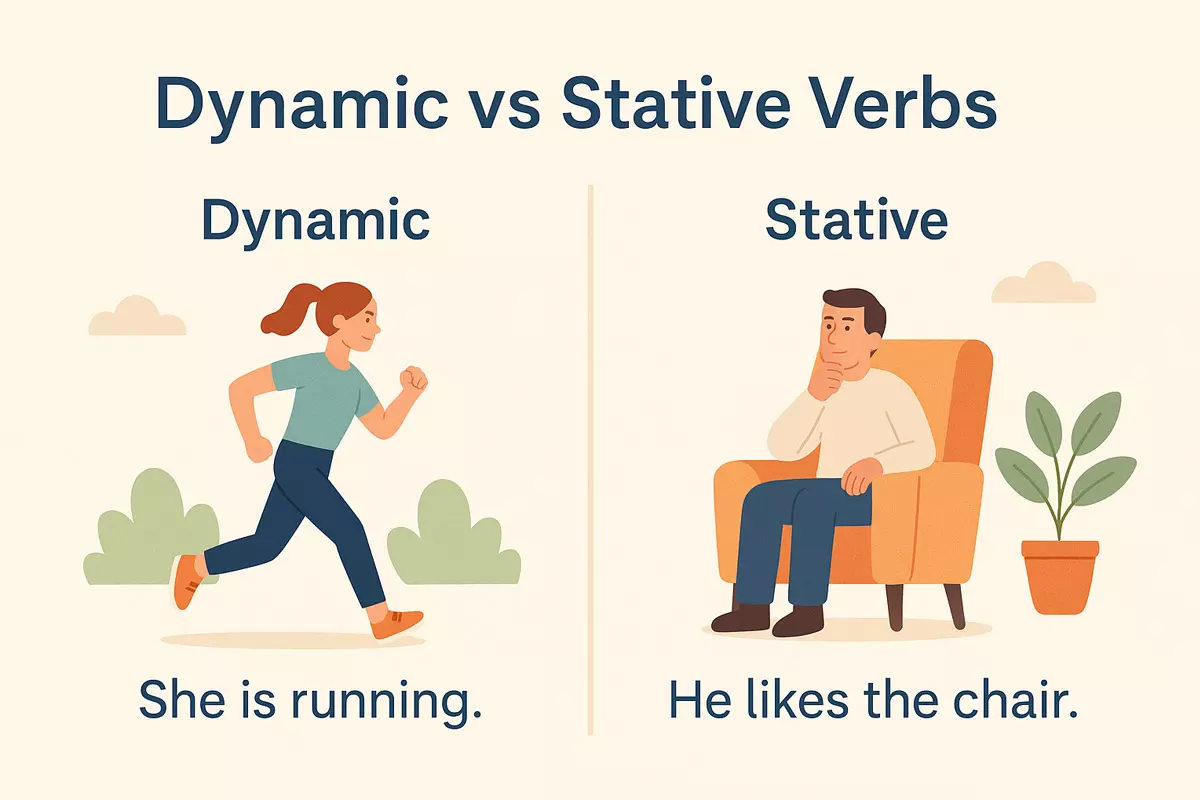
- They can be used with continuous tenses (e.g., “She is running” ✅).
- They show an action that has a clear beginning and end.
- They often answer the questions “What is happening?” or “What did someone do?”
- They can be voluntary or involuntary actions.
Examples in Sentences
- He is writing a letter.
- The children are playing outside.
- I walk to school every day.
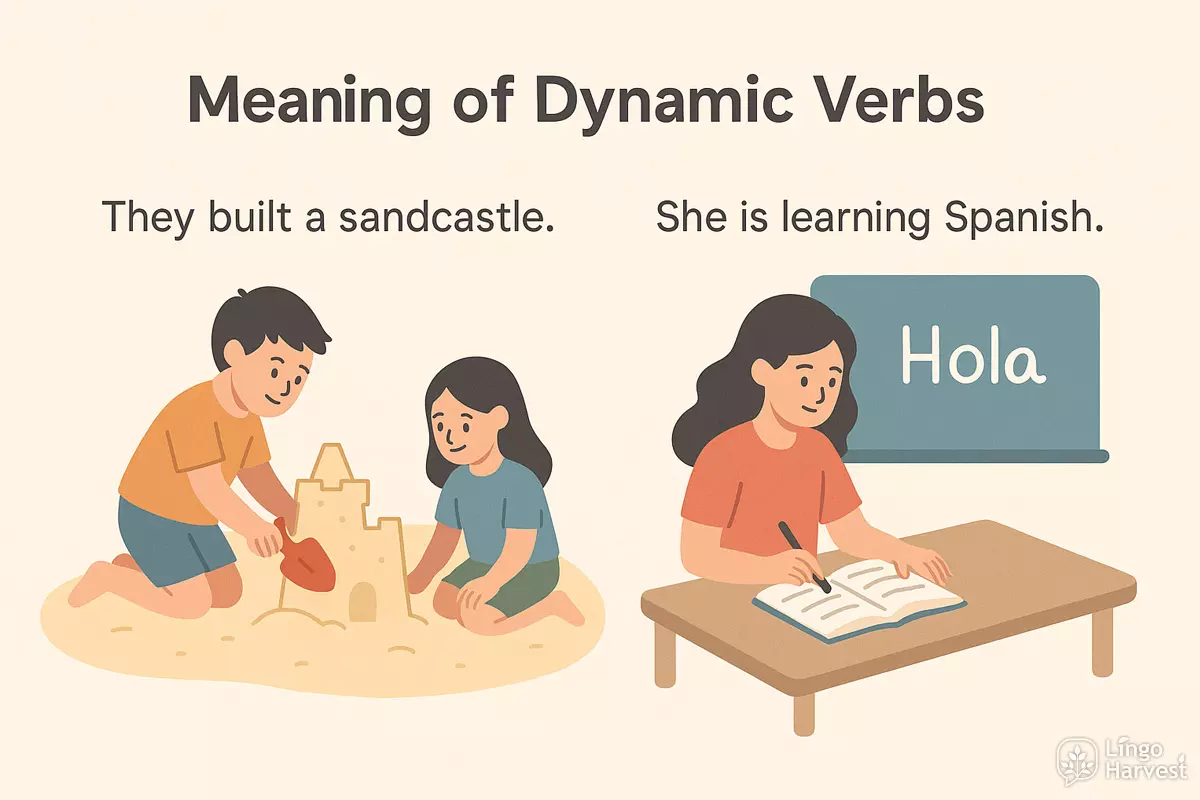
- They built a sandcastle.
- She is learning Spanish.
- We talked for hours.
Quick Comparison: Dynamic vs. Stative Verbs
| Dynamic Verbs | Stative Verbs |
|---|---|
| Express actions or processes (run, write, eat) |
Express states or conditions (know, love, belong) |
| Can be used in continuous tenses (is running, are eating) |
Rarely used in continuous tenses (is knowing ❌, is loving ❌) |
| Show change or movement | Show existence or possession |
| Describe something happening | Describe something that simply is |
Dynamic verbs are essential for describing actions and events, making them a fundamental part of communication in English. Recognizing them helps learners form correct sentences, especially when choosing verb tenses.
Meaning of Stative Verbs
Stative verbs describe conditions, situations, or states of being rather than actions or processes. Unlike dynamic verbs, which express activities that start and stop, these verbs indicate something static—such as emotions, thoughts, possession, or senses. They often refer to situations that continue over time without a clear beginning or end.
What Do Stative Verbs Express?
These verbs typically convey:
- Feelings and emotions (e.g., love, hate, prefer)
- Mental states (e.g., know, believe, remember)
- Possession or relationships (e.g., own, belong, have)
- Sensory perceptions (e.g., see, hear, smell)
- Existence or being (e.g., be, seem, appear)
One key feature is that they rarely appear in continuous (progressive) forms. For example, "I know the answer" is correct, but "I am knowing the answer" is not. This is because stative verbs do not describe actions unfolding over time, but rather a stable condition.
Common Examples of Stative Verbs
Here are some widely used stative verbs, grouped by category:
- Emotion: like, love, dislike, hate, prefer
- Thinking: know, believe, understand, remember, forget
- Possession: have, own, possess, belong
- Senses: see, hear, smell, taste, feel (when not referring to an action)
- Being/Existence: be, seem, appear, exist, consist, contain
Some verbs can be both stative and dynamic depending on context. For example, "think" can express a state ("I think it's true" → opinion) or an action ("I'm thinking about it" → mental process).
Comparison: Stative vs Dynamic Verb Usage
| Stative Verb Example | Dynamic Verb Example |
|---|---|
| I know the answer. ✅ | I am writing the answer. ✅ |
| She has two cats. ✅ | She is feeding the cats. ✅ |
| This cake tastes sweet. ✅ | He is tasting the cake. ✅ |
| I see your point. ✅ | I am looking at the board. ✅ |
To sum up, stative verbs are essential for describing unchanging situations, feelings, and states. Recognizing them helps ensure correct verb forms—especially avoiding unnecessary continuous tenses.
Statives and Continuous Forms
Many English verbs describe states rather than actions. These “state verbs” (or statives) usually refer to thoughts, emotions, relationships, senses, possession, or being. A key feature is that they generally don’t appear in continuous (progressive) forms like “am knowing” or “is loving,” because states are seen as ongoing by nature.
Why Continuous Forms Are Rare with Stative Verbs
Continuous tenses express temporary or changing actions. Since stative verbs already convey a lasting or unchanging situation, using them with -ing forms often sounds odd or ungrammatical. For example, “I am knowing the answer” isn’t idiomatic; “I know the answer” is standard. However, some verbs can be dynamic or stative depending on meaning. For instance, “think” can describe an opinion (“I think it’s true” – state) or an action (“I’m thinking about the problem” – process).
Common Stative Verbs (Rarely Used in Continuous Tenses)
- believe
- belong
- consist
- contain
- depend
- doubt
- hate
- hear
- imagine
- know
- like
- love
- mean
- need
- own
- prefer
- remember
- seem
- suppose
- understand
- want
Comparison: Stative vs. Dynamic Uses
Some verbs shift between static and dynamic roles, changing their grammar and meaning. Here’s how they differ:
| Verb | Stative Use (Simple) | Dynamic Use (Continuous) |
|---|---|---|
| have | I have a car. (possession) |
I’m having lunch. (doing) |
| see | I see the mountains. (perceive) |
I’m seeing the doctor. (meeting) |
| think | I think it’s wrong. (opinion) |
I’m thinking about it. (considering) |
| be | He is rude. (character) |
He is being rude. (temporary behavior) |
| taste | The soup tastes great. (has flavor) |
She’s tasting the soup. (sampling) |
Exceptions and Stylistic Choices
Sometimes stative verbs appear in continuous forms for emphasis or stylistic effect, especially in informal speech: “I’m loving this song!” or “Are you understanding me?” These uses are marked as non-standard, creative, or colloquial and are not typical in formal writing. In summary, most verbs expressing states avoid progressive forms, but context and meaning can sometimes override this pattern. Recognizing these exceptions helps learners use English more naturally and accurately.
Verbs with Two Meanings
Some English verbs can act as both dynamic and stative, depending on their context and meaning. This flexibility often leads to confusion for learners, since the same word may be used in very different grammatical environments. The meaning shift typically depends on whether the verb is describing an action or a state.
How Context Changes Verb Type
Whether a verb is considered dynamic or stative can depend on the situation or the intended message. For example, the verb "have" can indicate possession (a state) or an activity (an action). Understanding the difference is essential for correct tense usage, especially with continuous forms.
Common Examples of Dual-Function Verbs
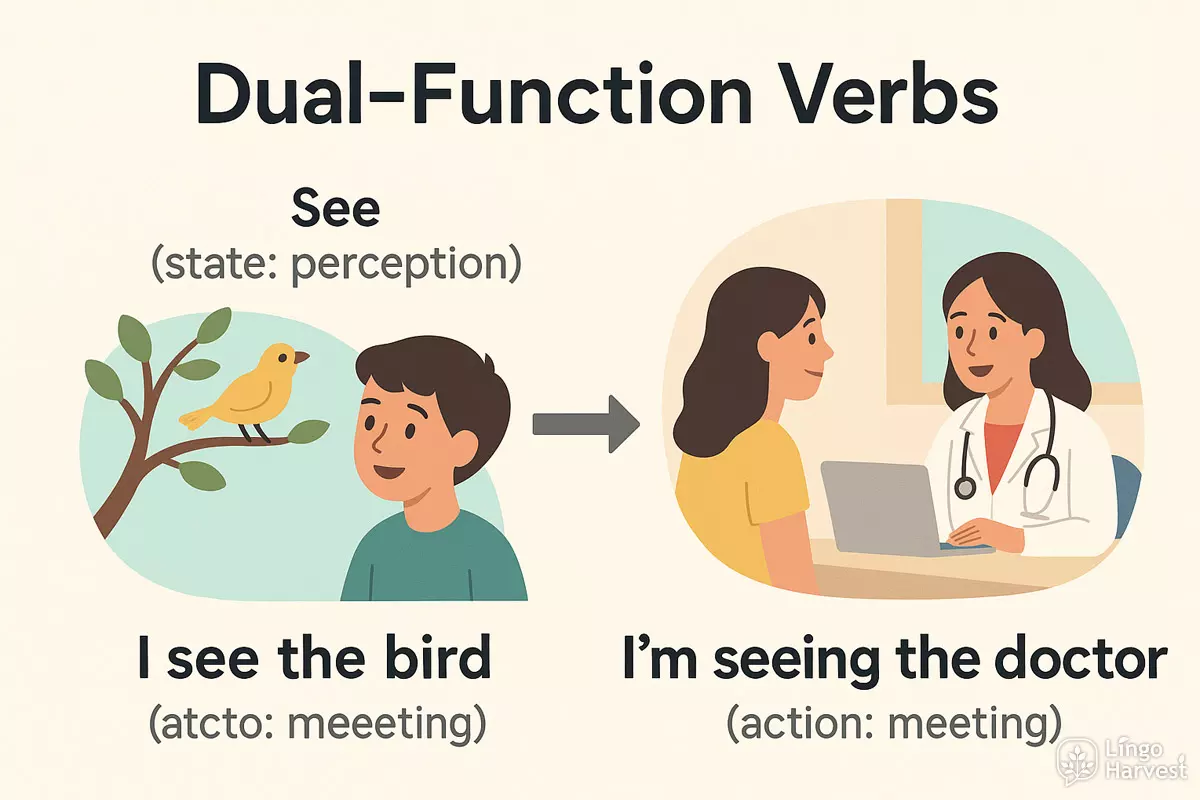
Here are several verbs that frequently shift between describing actions and states. Their interpretation depends on context:
- Think: I think you’re right (state: believe) → I’m thinking about the problem (action: considering)
- Have: She has a car (state: possession) → She’s having lunch (action: eating/experiencing)
- See: I see the bird (state: perception) → I’m seeing the doctor (action: meeting)
- Be: He is rude (state: personality trait) → He’s being rude (action: behaving rudely now)
- Smell: The soup smells good (state: has an odor) → He’s smelling the soup (action: sniffing)
- Taste: This tastes sweet (state: has a flavor) → She’s tasting the sauce (action: sampling)
- Feel: The blanket feels soft (state: has a texture) → I’m feeling the blanket (action: touching)
- Appear: She appears tired (state: seems) → She’s appearing in a play (action: performing)
- Look: You look happy (state: seem) → He’s looking at the painting (action: observing)
- Weigh: The box weighs 10 kg (state: has weight) → He’s weighing the box (action: measuring weight)
- Fit: These shoes fit me (state: are the right size) → The tailor is fitting the dress (action: adjusting)
- Measure: The room measures 20 meters (state: has a size) → I’m measuring the room (action: finding size)
- See: I see what you mean (state: understand) → We’re seeing friends tonight (action: meeting)
- Expect: I expect good results (state: believe) → We’re expecting guests (action: waiting for arrival)
- Think: I think so (state: opinion) → I’m thinking of moving (action: considering)
Quick Reference for Dual-Meaning Verbs
The following table highlights some verbs with their stative and dynamic uses, along with example sentences for each context:
| Verb | Stative Example | Dynamic Example |
|---|---|---|
| Have | I have a headache. | I’m having a great time. |
| See | I see your point. | She’s seeing a therapist. |
| Be | He is generous. | He’s being generous today. |
| Think | I think it’s true. | I’m thinking about my future. |
| Smell | The flowers smell wonderful. | She’s smelling the perfume. |
| Taste | The soup tastes salty. | He’s tasting the dish. |
| Feel | This fabric feels smooth. | I’m feeling the fabric. |
| Appear | The car appears new. | The actor is appearing in a film. |
Recognizing when a verb’s meaning is stative or dynamic helps you choose the right tense and avoid common mistakes. If you’re unsure, check whether the verb is describing a state (unchanging situation) or an action (something happening or performed).
Useful Examples
Understanding the difference between verbs that describe actions and those that express states is much easier with practical samples. Below, you’ll find a variety of sentences and verb forms to illustrate how each type functions in context. This will help clarify how to recognize and use both kinds of verbs accurately.
Action-Oriented Verbs in Sentences
- She runs every morning before breakfast.
- They built a treehouse last summer.
- We are learning Spanish this year.
- The dog chased the ball across the yard.
- I am writing an email right now.
- He drives to work every day.
State-Describing Verbs in Context
- I know the answer.
- She feels tired today.
- This cake tastes delicious.
- They believe in honesty.
- He owns three guitars.
- We understand your concerns.
Side-by-Side Comparison
To make the distinction clearer, here’s a table comparing forms and patterns for both verb types. Note how certain verbs can shift meaning depending on context.
| Verb | Dynamic Use (Action) | Stative Use (State) |
|---|---|---|
| Think | I am thinking about dinner. (considering) | I think it’s going to rain. (opinion) |
| Have | She is having lunch. (eating) | She has a new car. (possesses) |
| See | I am seeing the doctor tomorrow. (meeting) | I see your point. (understand) |
| Be | You are being silly. (behaving) | You are silly. (characteristic) |
| Smell | He is smelling the flowers. (action) | The soup smells good. (state) |
Common Mistakes to Watch Out For
- ❌ Incorrect: I am knowing the answer. → Correct: I know the answer.
- ❌ Incorrect: She is owning a car. → Correct: She owns a car.
- ❌ Incorrect: This soup is tasting great. → Correct: This soup tastes great.
These sample sentences and the comparison table should help you confidently identify and use both types of verbs in your own writing and speech.
Avoiding Common Mistakes
Misclassifying verbs can cause confusion in both writing and speech. One of the most frequent issues is using verbs that describe states as if they were actions, or vice versa. This leads to sentences that sound unnatural or are grammatically incorrect.
Mixing Up State and Action
Some English verbs can be both dynamic and stative, depending on context. For instance, "think" can describe a mental process (I’m thinking about lunch) or a state (I think you’re right). Understanding the difference helps you choose the correct tense.
- Using continuous forms with stative verbs: “I am knowing the answer” ❌ should be “I know the answer” ✅
- Assuming all verbs can be dynamic: Verbs like believe, prefer, belong usually don’t take the -ing form.
- Overgeneralizing verb use: Not all verbs fit neatly into just one category. Context matters.
Common Verbs Often Misused
Here are some verbs that frequently cause trouble, along with notes on how they are typically used:
- Have: stative when indicating possession (I have a car), dynamic when used as an action (I’m having lunch).
- See: stative for perception (I see the mountain), dynamic for meeting (I’m seeing the doctor).
- Think: stative for opinion (I think it’s true), dynamic for considering (I’m thinking about it).
- Smell: stative for senses (This smells nice), dynamic for action (I’m smelling the flowers).
- Love, hate, prefer: almost always stative.
- Appear: stative for “seems” (She appears tired), dynamic for “perform” (She’s appearing in a play).
- Taste: stative for flavor (This tastes sweet), dynamic for trying food (I’m tasting the soup).
- Weigh: stative for describing weight (The bag weighs 2kg), dynamic for action (I’m weighing the bag).
- Be: stative for identity/condition (He is happy), occasionally dynamic for behavior (You are being silly).
- Feel: stative for emotions (I feel tired), dynamic for physical action (I’m feeling the fabric).
- Look: stative for appearance (You look great), dynamic for action (I’m looking at the sky).
Quick Reference Table: Typical Usage
| Verb | Stative Usage | Dynamic Usage |
|---|---|---|
| Think | I think you’re right. | I’m thinking about lunch. |
| Have | I have a cat. | I’m having a shower. |
| See | I see your point. | I’m seeing a friend tonight. |
| Taste | This tastes bitter. | I’m tasting the cake. |
| Be | He is clever. | You are being rude. |
| Feel | I feel cold. | I’m feeling the fabric. |
| Look | You look tired. | I’m looking at the map. |
Tips for Correct Usage
- Check if the verb describes a state (feeling, possession, opinion) or an action (process, change).
- Be careful with present continuous; most stative verbs rarely use it.
- When unsure, look up example sentences to see typical forms.
- Practice by rewriting sentences with problematic verbs in both forms.
Understanding how context changes the function of certain verbs will make your English clearer and more natural. Remember, exceptions exist, so exposure to real language use is key.
Mini Practice
Let's put your understanding of action and state verbs to the test with some engaging exercises. Identify which verbs describe actions and which express conditions or states. Remember: some verbs can function differently depending on context.
Sort the Verbs
Read the following list and decide whether each one is typically used for actions (dynamic) or for states (stative). Some may be tricky!
- run
- believe
- think
- enjoy
- own
- hear
- forget
- eat
- want
- see
- know
- make
- prefer
- smile
- contain
- remember
- sing
- love
- feel
- read
Show answers
- Dynamic: run, enjoy, eat, make, smile, sing, read
- Stative: believe, own, hear, forget, want, see, know, prefer, contain, remember, love
- Both (context-dependent): think, feel
Spot the Error
Some sentences below use verbs incorrectly in continuous forms. Find and correct them.
- I am knowing the answer now.
- She is wanting a new phone.
- They are eating lunch.
- He is believing your story.
- We are having a good time.
Show answers
- 1. I know the answer now.
- 2. She wants a new phone.
- 3. Correct as is.
- 4. He believes your story.
- 5. Correct as is (in this context, "having" is dynamic).
Compare Usage
Some verbs can be both action or state verbs, depending on meaning. Here’s a comparison:
| Verb | Stative Example | Dynamic Example |
|---|---|---|
| think | I think it will rain. (opinion) | I am thinking about my trip. (mental process) |
| have | I have a car. (possession) | I am having lunch. (activity) |
| see | I see your point. (understand) | I am seeing the doctor. (meeting) |
| feel | I feel tired. (state) | She is feeling the fabric. (action) |
Quick Check
Decide if these sentences use the correct form. If not, suggest the right one:
- He is loving this song.
- I am seeing the manager at 3pm.
- They know the answer.
- She is owning two houses.
Show answers
- He loves this song. ("Love" is stative; "is loving" is usually incorrect, except in informal/slang contexts.)
- Correct as is. ("Seeing" means "meeting" here, which is dynamic.)
- Correct.
- She owns two houses. ("Own" is stative.)
Review your answers and read the explanations to deepen your grasp of how action and state verbs function in English.