Bare Infinitive vs To-Infinitive: Theoretical Rules

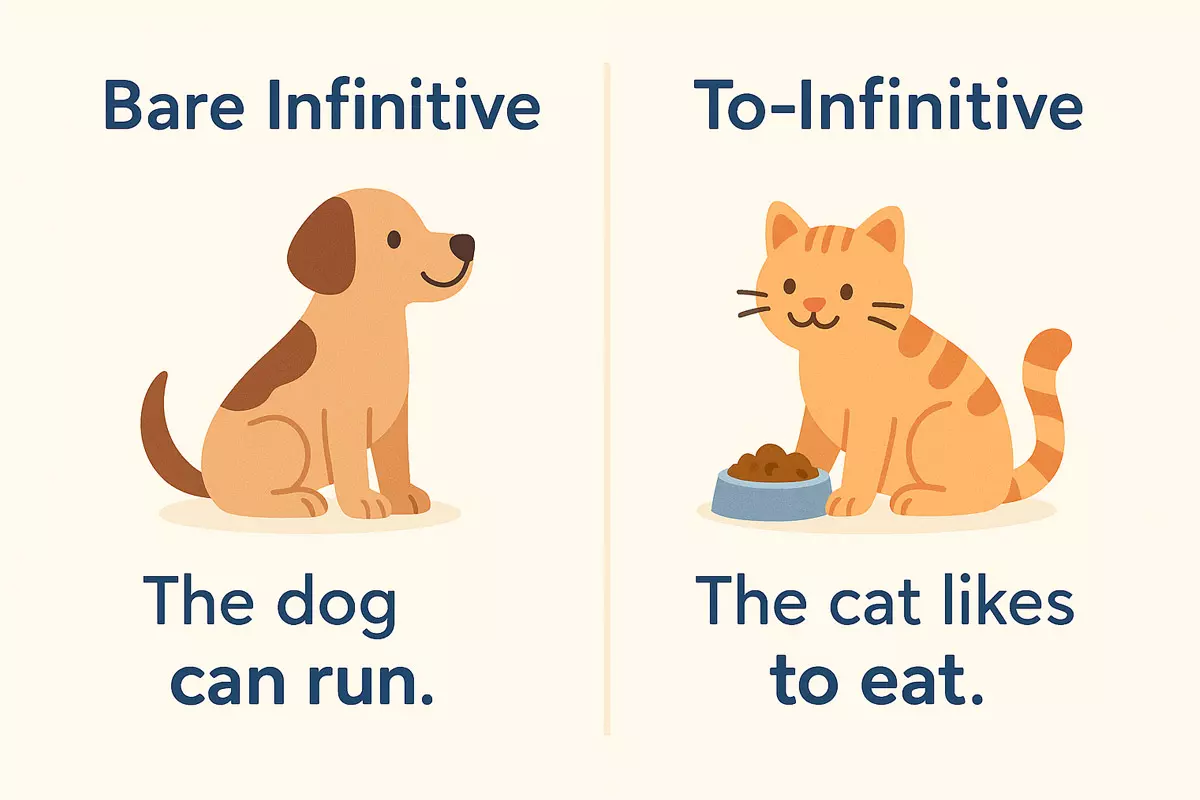 The article explains the difference between bare and to-infinitive forms, lists verbs that use each, and discusses their use after modals and let/make. It also highlights common errors and includes practice exercises to help you master the topic.
Deciding when to use the infinitive with or without "to" often confuses even advanced English learners, as the rules can be subtle and exceptions are common. Mastering these distinctions is important for expressing ideas clearly and accurately, whether in writing or conversation. For example, certain verbs like "want" require "to" before the infinitive, as in "want to go," while others like "let" are followed by the base form, as in "let go." Developing an awareness of these patterns helps improve fluency and confidence in English.
Meaning of Bare Infinitive
When we talk about the bare infinitive in English grammar, we're referring to the base form of a verb—like go, see, or make—used without the particle to. This form appears in certain grammatical structures where the infinitive is required, but the to is omitted. Recognizing when and why this happens helps clarify many common English constructions.
Where the Bare Infinitive Is Used
The bare infinitive often follows specific verbs, modal verbs, and certain expressions. You’ll notice it in sentences after words like can, let, make, help, and with verbs of perception. Here are typical contexts:
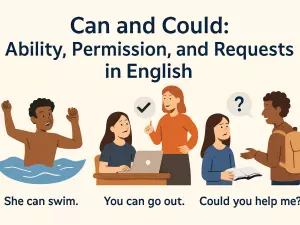
- After modal verbs: She can swim very fast.
- After let, make, and sometimes help: They made me laugh.
- With verbs of perception (see, hear, feel, etc.): I heard him sing.
- After would rather, had better: You had better leave now.
- In certain idiomatic expressions: All I did was ask.
Examples of Bare Infinitive in Context
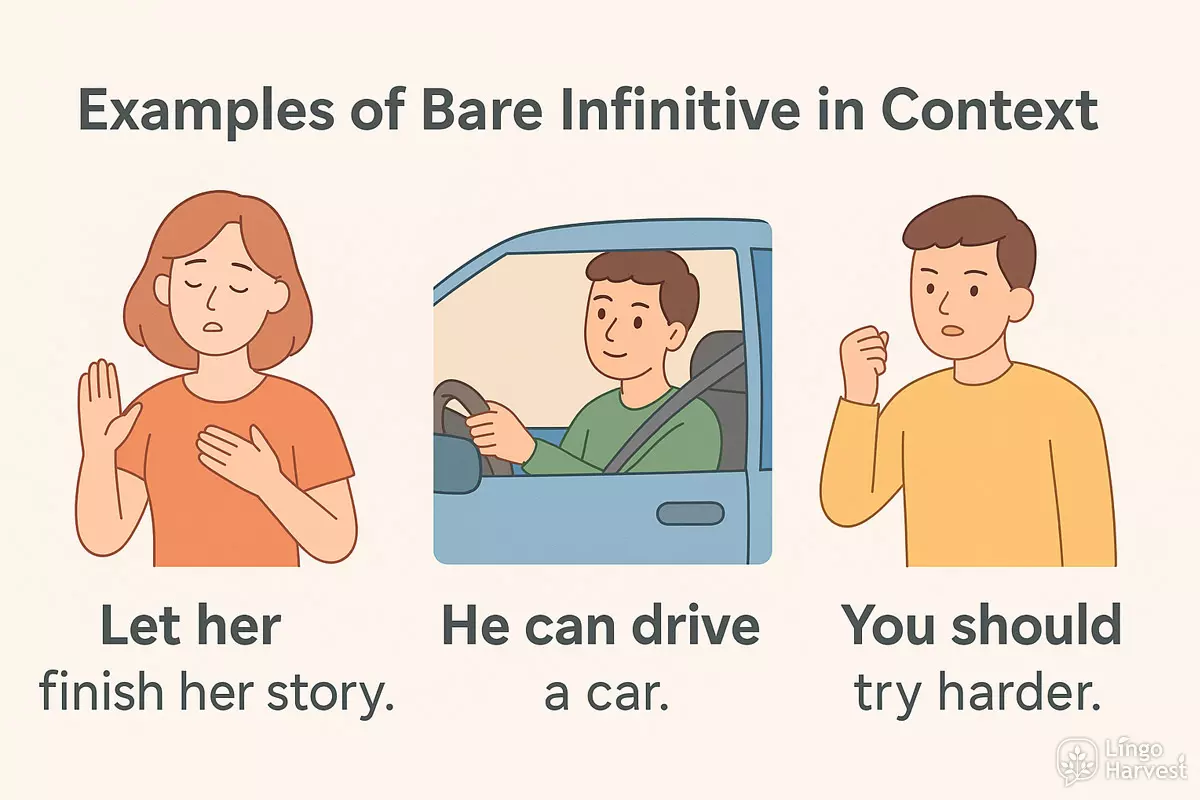
- Let her finish her story.
- He can drive a car.
- I saw them arrive late.
- We made them apologize.
- You should try harder.
- She helped me find my keys.
- They watched the sun set.
- Would you rather stay or go?
- I felt the ground shake.
- He had better call soon.
- All she did was smile.
- We heard the baby cry.
- Please let me explain.
- You must remember this.
- She saw him leave the room.
Comparing Bare Infinitive and To-Infinitive
| Structure | Example Sentence |
|---|---|
| Modal verb + base verb | You can come early. ✅ |
| To-infinitive (with "to") | You want to come early. ❌ (not bare) |
| After "make/let" + object + base verb | They let him go. ✅ |
| After "help" + base or to-infinitive | She helped me carry (or to carry) the bags. ✅ |
To sum up, the bare infinitive is a key part of English syntax, appearing after certain verbs and in set structures. Understanding its proper use helps avoid mistakes and makes your English sound more natural.
Meaning of To-Infinitive
The to-infinitive is a common English verb form that consists of the word to followed by the base form of a verb (for example, to eat, to go, to learn). This structure is used in a wide range of contexts, often to express purpose, intention, or a potential action. Unlike the bare infinitive, the to-infinitive frequently introduces the reason or goal behind an action, or describes something yet to happen.
Core Uses and Functions
- Expressing purpose or intent: She went to study.
- Describing future or possible actions: I hope to travel next year.
- Functioning as a noun, adjective, or adverb in a sentence.
- Following certain verbs (e.g., want, need, decide, plan).
- Used after adjectives to explain reactions or feelings: happy to help.
- Appearing after question words: what to do, where to go.
- After certain nouns: a chance to win, permission to leave.
- To express obligation or necessity, often with have or need: have to finish.
- Negative form: not to tell, not to forget.
- Often used in reported speech: He told me to wait.
Examples in Context
- She hopes to join the team.
- We need to leave now.
- It's important to listen carefully.
- He promised to call me.
- They agreed to meet at noon.
- He was the first to arrive.
- I have a lot to learn.
- Remember to lock the door.
- Don't forget to bring your ID.
- She asked me to help her.
Form and Structure
The to-infinitive is formed by placing to directly before the base form of the verb. It does not change for person or tense, making it a non-finite verb form. This construction is distinct from the bare infinitive, which omits to in certain grammatical contexts.
| Pattern | Example |
|---|---|
| Verb + to-infinitive | She wants to go home. |
| Adjective + to-infinitive | He is eager to start. |
| Noun + to-infinitive | It was a chance to win. |
| Question word + to-infinitive | I don't know what to say. |
| Negative to-infinitive | Try not to make mistakes. |
| Reported speech | She told him to wait. |
While the to-infinitive often signals a goal or potential, it can also appear after certain adjectives, nouns, and question words, expanding its role in conveying meaning and intention within English sentences.
Verbs Followed by Bare Form
Many English verbs are directly followed by a verb in its base form, without "to." This structure is common in certain grammatical patterns, especially after modal verbs and some causative or perception verbs. Understanding which verbs take the bare infinitive helps learners avoid common mistakes and use more natural English.
Common Verbs That Take the Bare Infinitive
Some verbs are typically followed by another verb in its base form. Here are several key examples:
- Modal verbs: can, could, may, might, must, shall, should, will, would
- Causative verbs: make, let, have (in causative sense)
- Perception verbs: see, hear, feel, notice, watch (when referring to the complete action)
- Help: help (optionally can take "to" as well, but bare form is common)
Typical Usage Patterns
After certain verbs, the infinitive appears without "to." For example:
- She made him apologize.
- I saw her leave the room.
- You must finish your homework.
- Let me try.
- We heard them sing a song.
- He helped me carry the boxes.
- She felt the ground shake.
- They would rather stay home.
- I would sooner walk.
- We watched the birds fly away.
Comparison: Bare Infinitive vs To-Infinitive
The choice between the base form and "to" + infinitive often depends on the main verb. Here’s a quick look at the difference in usage:
| Main Verb | Pattern Example |
|---|---|
| can (modal) | You can go now. ✅ You can to go now. ❌ |
| make (causative) | She made him cry. ✅ She made him to cry. ❌ |
| want (regular verb) | I want to eat. ✅ I want eat. ❌ |
| see (perception) | We saw her dance. ✅ We saw her to dance. ❌ |
| hope (regular verb) | They hope to win. ✅ They hope win. ❌ |
Summary of Key Points
Bare infinitives are required after modal verbs, causative verbs like "make" and "let," and perception verbs when talking about complete actions. In contrast, many other verbs—such as "want," "hope," or "decide"—require "to" before the infinitive. Using the correct form makes your English sound fluent and precise.
Verbs Followed by To-Infinitive
Many English verbs require the to-infinitive form after them, rather than a bare infinitive. This pattern is especially frequent with verbs that express intentions, plans, preferences, and certain mental processes. Knowing which verbs take the to-infinitive helps avoid common mistakes and creates more natural-sounding sentences.
Common Verbs That Take the To-Infinitive
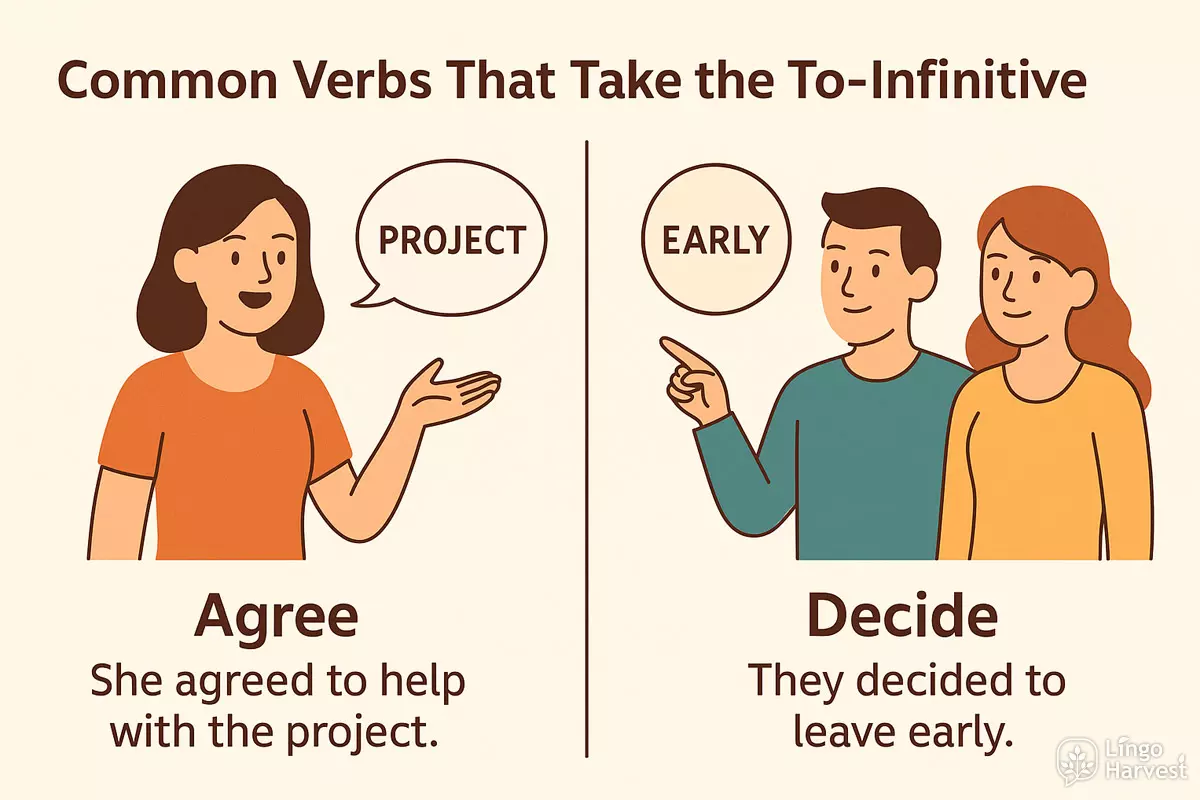
Some verbs almost always need to be followed by "to" plus the base form of the verb. Here are several widely used examples:
- agree – She agreed to help with the project.
- decide – They decided to leave early.
- hope – I hope to see you soon.
- learn – He learned to swim as a child.
- promise – You promised to call me.
- plan – We plan to travel next month.
- offer – She offered to drive us home.
- refuse – He refused to answer the question.
- fail – She failed to finish on time.
- want – I want to learn French.
- manage – He managed to solve the problem.
- expect – They expect to win the match.
- afford – We can't afford to buy a new car.
- attempt – She attempted to explain the issue.
- prepare – He prepared to leave early.
- fail – The plan failed to work as expected.
- wish – I wish to speak with the manager.
- offer – He offered to help us move.
Usage Patterns and Meaning
Using the to-infinitive often suggests purpose, intention, or a future action. For example, "She hopes to visit Italy" expresses a desire for something that has not yet happened. This form can also follow adjectives ("happy to help") and certain nouns, but with verbs, the pattern is especially regular.
| Verb | Example with To-Infinitive |
|---|---|
| plan | They plan to visit Paris next year. |
| refuse | She refused to cooperate with the team. |
| hope | We hope to achieve our goals. |
| offer | He offered to carry the bags. |
| manage | She managed to finish early. |
| wish | I wish to participate in the meeting. |
| decide | He decided to stay at home. |
| expect | They expect to receive news soon. |
Tips for Learners
To master these patterns, pay attention to which verbs are naturally followed by the to-infinitive. Reading and listening to authentic English will help reinforce these structures. If unsure, consulting a reliable verb list or grammar reference can clarify which verbs require this form. Over time, using the correct verb + to-infinitive combinations will become automatic and improve both accuracy and fluency.
After Modals and Let/Make
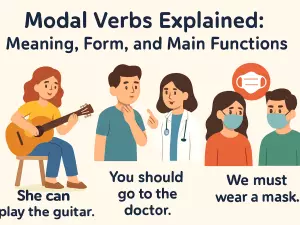
In English grammar, certain verbs create a special environment for the infinitive form: they require the base form of the verb without "to." This is especially true after modal verbs (like can, must, should) and the causative verbs let and make. Understanding when to use the bare infinitive (the verb without "to") instead of the to-infinitive helps your sentences sound natural and correct.
Modals and the Bare Infinitive
Modal verbs are always followed directly by the main verb in its base form, never by "to." This rule is consistent across all modal verbs and is a reliable pattern in English. For example:
- She can swim.
- You must finish your work.
- They should study more.
- I might go later.
- We could see the mountains.
- He will call you.
- You may leave now.
- It won't rain.
- She would help if she could.
- He shall return.
Notice that in every example, the verb after the modal is in its simple form, with no "to."
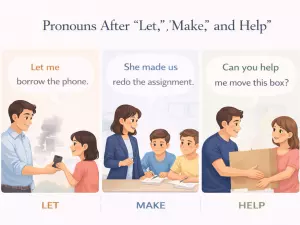
Let and Make: Special Causative Verbs
The verbs let and make also take the bare infinitive after an object. This pattern is different from most verbs, which usually require "to" before the infinitive:
- They let him go.
- She let the children play outside.
- The teacher made us write the essay again.
- His parents made him apologize.
With let and make, the structure is: subject + let/make + object + base verb.
Summary Table: Bare Infinitive Patterns
| Trigger Verb | Example (Bare Infinitive) |
|---|---|
| can | You can see the stars. |
| should | We should start now. |
| must | You must try harder. |
| let | Let me help you. |
| make | They made her cry. |
| may | You may leave. |
| would | I would prefer tea. |
| might | She might come later. |
| could | He could run fast. |
| shall | We shall see. |
Note that most other verbs (such as want, decide, hope) require the "to-infinitive" instead. Only with modals and the causatives let and make do we consistently use the bare form.
Common Problems
Learners frequently mix up when to use the bare infinitive and when to choose the to-infinitive. This confusion often comes from subtle differences in usage, verb patterns, and exceptions that don’t always follow a clear logic.
Mixing Up Verb Patterns
One recurring challenge is remembering which verbs require the to-infinitive and which take the bare infinitive. For example, after certain verbs like “let” or “make,” English uses the base form without “to,” while others such as “want” or “decide” need “to” before the verb. This can lead to errors like “He let me to go” (incorrect) instead of “He let me go.”
After Modal Verbs and Auxiliary Verbs
Another source of mistakes is the use of the base form after modal verbs (can, must, should, etc.). Learners sometimes mistakenly add “to” after a modal: “She can to swim” (incorrect) instead of the correct “She can swim.”
Confusion with Object + Infinitive Constructions
Some verbs allow both patterns, but with a shift in meaning or usage. For example, “help” can be followed by either form (“help me do” or “help me to do”), but many other verbs are stricter. The table below helps clarify which verbs typically take which form:
| Verb | Correct Pattern |
|---|---|
| let, make, see, hear, feel | bare infinitive (e.g., “She made me cry.”) |
| want, decide, hope, plan, agree | to-infinitive (e.g., “They decided to leave.”) |
| help | either form (“He helped me find / to find my keys.”) |
| modals (can, should, must, etc.) | bare infinitive (“You must try.”) |
Typical Mistakes and How to Avoid Them
Misapplication can show up in many forms, including the following:
- Adding “to” after modals:
❌ “She must to go.” → ✅ “She must go.” - Omitting “to” after certain verbs:
❌ “I want eat.” → ✅ “I want to eat.” - Using “to” after causative verbs:
❌ “They made me to laugh.” → ✅ “They made me laugh.” - Incorrect form after verbs of perception:
❌ “I heard him to sing.” → ✅ “I heard him sing.” - Confusing “help” patterns:
✅ Both “She helped me finish” and “She helped me to finish” are correct. - Overusing the to-infinitive after verbs like “let”:
❌ “Let him to try.” → ✅ “Let him try.” - Using bare infinitive after verbs that require “to”:
❌ “They promised come.” → ✅ “They promised to come.” - Forgetting to use “to” after adjectives:
❌ “It’s important finish.” → ✅ “It’s important to finish.” - Incorrect infinitive after question words:
❌ “I don’t know what do.” → ✅ “I don’t know what to do.” - Using “to” after “make someone do”:
❌ “She made me to clean.” → ✅ “She made me clean.”
Summary
Because there are many exceptions and special cases, it’s easy to get tripped up. Paying attention to verb patterns and practicing with examples helps build the intuition needed to choose the correct form. Reviewing common verbs and their preferred infinitive structures can make a significant difference in accuracy.
Practice Exercises
Test your understanding of when to use the bare infinitive and when to select the to-infinitive. These tasks provide a mix of fill-in-the-blanks and sentence rewriting to reinforce the theoretical rules explained earlier.
Fill in the Blank
Complete each sentence by writing either the base form (bare infinitive) or the to-infinitive of the verb in parentheses. Pay attention to the structure and context.
- She made him ______ (apologize) for his mistake.
- I want ______ (visit) the new museum this weekend.
- Let’s ______ (go) to the park after lunch.
- They promised ______ (help) with the project.
- We watched them ______ (play) football in the rain.
- He decided ______ (leave) early to avoid the traffic.
- My parents let me ______ (choose) my own clothes.
- The teacher asked the student ______ (answer) the question.
- Can you ______ (pass) the salt, please?
- She hopes ______ (travel) abroad next year.
Show answers
- apologize
- to visit
- go
- to help
- play
- to leave
- choose
- to answer
- pass
- to travel
Identify the Correct Form
Choose whether each sentence should use the bare infinitive or the to-infinitive. Rewrite only the verb phrase in parentheses with the correct form.
- They made her (sing) at the party.
- He forgot (lock) the door.
- We heard the baby (cry) last night.
- She wants (buy) a new laptop.
Show answers
- sing
- to lock
- cry
- to buy
Common Verbs and Their Infinitive Patterns
Some verbs are typically followed by a bare infinitive, others by the to-infinitive. Review this table of common examples to consolidate your knowledge.
| Verb | Typical Infinitive Pattern |
|---|---|
| Let | Bare infinitive (e.g. let him go) |
| Make | Bare infinitive (e.g. make her laugh) |
| Ask | To-infinitive (e.g. ask to leave) |
| Want | To-infinitive (e.g. want to help) |
| Help | Both patterns possible (help do/help to do) |
| Hear | Bare infinitive (e.g. hear him sing) |
| Decide | To-infinitive (e.g. decide to stay) |
| Watch | Bare infinitive (e.g. watch them play) |
| Promise | To-infinitive (e.g. promise to call) |
| Let | Bare infinitive (e.g. let me try) |
Sentence Transformation
Rewrite these sentences so that the verbs use the correct infinitive form:
- He asked me help him with his homework.
- My parents made me to apologize to my sister.
- She hopes find a new job soon.
- Can you to open the window?
Show answers
- He asked me to help him with his homework.
- My parents made me apologize to my sister.
- She hopes to find a new job soon.
- Can you open the window?
Practicing with these varied tasks will help you internalize when to use each infinitive form in English sentences. Review the table and your answers to deepen your understanding of the patterns and exceptions.