Pronouns After “Let”, “Make”, and “Help”

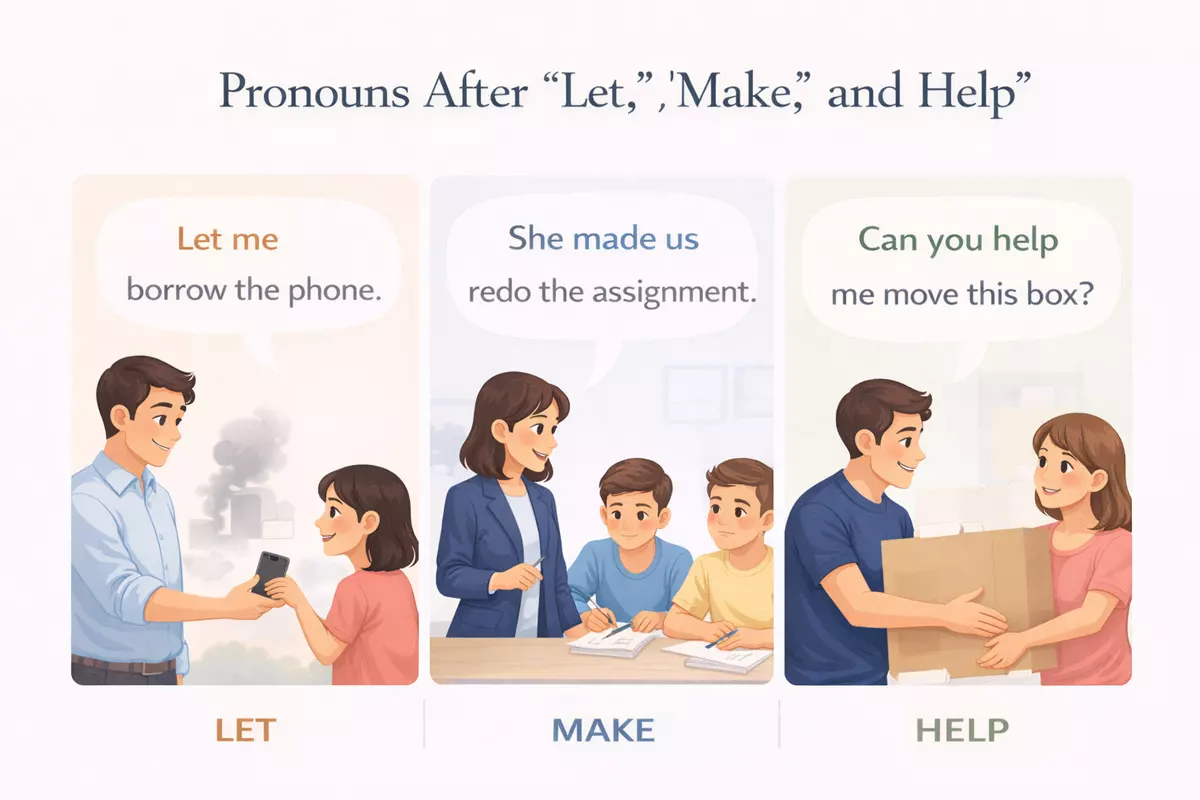 Here we how to use let, make, and help with correct verb patterns and object pronouns, including the difference between bare and to-infinitive after help, correct word order, passive forms, common mistakes, and provides practice with examples.
- Verb patterns with let, make, and help
- Object pronouns after causative verbs
- Bare infinitive vs to-infinitive after help
- Word order with pronouns and objects
- Common learner errors with these verbs
- Pronouns in passive forms of let and make
- Natural spoken examples
- Practice: complete sentences with correct pronouns
Choosing the correct pronoun after verbs such as allow, force, and assist can be challenging for English learners, as the rules are not always obvious. Generally, these verbs are followed by an object pronoun, like him, her, or them, rather than a subject pronoun such as he, she, or they. For example, we say "allow him to leave" or "assist her in completing the task." This guideline helps ensure sentences are both grammatically correct and easy to understand, supporting clearer and more confident communication.
Verb patterns with let, make, and help
Understanding how “let,” “make,” and “help” are used with other verbs and pronouns is essential for speaking and writing naturally in English. These verbs are called causative verbs because they describe one person causing another person to do something. The structure changes slightly depending on which of these verbs you use, especially when it comes to the verb form that follows and how pronouns fit into the pattern.
Typical Structures
Each causative verb follows its own pattern. Here’s a quick summary:
- Let: [subject] + let + [object/pronoun] + base verb
- Make: [subject] + make + [object/pronoun] + base verb
- Help: [subject] + help + [object/pronoun] + base verb or infinitive (to + verb)
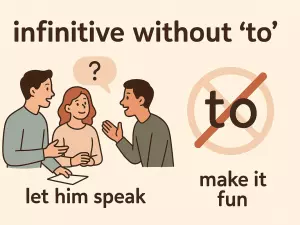
Notice that after “let” and “make,” we always use the base form of the verb (no “to”). With “help,” both the base form and the infinitive are acceptable, though the base form is more common in American English.
Example Patterns with Pronouns
Here are some practical examples showing how pronouns fit into these constructions:
- Let me go.
- Let him finish.
- Let them try.
- Make her laugh.
- Make us wait.
- Make me smile.
- Help me (to) understand.
- Help them (to) decide.
- Help him (to) learn.
- Help us (to) remember.
- Let us know.
- Make them stop.
- Help her (to) recover.
Comparing Usage: Let, Make, and Help
| Verb | Pattern Example | Notes |
|---|---|---|
| Let | Let him go | Base verb only; no “to” |
| Make | Make her laugh | Base verb only; expresses force or requirement |
| Help | Help me (to) find | Base verb or “to” + verb; both forms are correct |
Key Points to Remember
- Use object pronouns (me, him, her, us, them) directly after “let,” “make,” and “help.”
- Never use subject pronouns (I, he, she, we, they) in these patterns.
- After “let” and “make,” always use just the base form of the verb (not the infinitive).
- “Help” can be followed by either the base form or the infinitive.
Mastering these patterns makes your English sound more fluent and prevents common mistakes, especially with pronoun choice and verb forms.
Object pronouns after causative verbs
Causative verbs like “let,” “make,” and “help” are followed by an object, which can be a noun or a pronoun. When using a pronoun as the object of these verbs, it must be in the object form (me, you, him, her, it, us, them), not the subject form (I, he, she, etc.). This usage is important for making your English sound natural and correct.
Which pronouns to use after “let,” “make,” and “help”

After these causative verbs, always choose the object pronoun, not the subject pronoun. For example, say “Let him finish,” not “Let he finish.” The same pattern applies for all personal pronouns.
| Subject Pronoun (incorrect) | Object Pronoun (correct) |
|---|---|
| Let I go | Let me go |
| Make she laugh | Make her laugh |
| Help we study | Help us study |
| Let they stay | Let them stay |
| Make he work | Make him work |
| Help she carry | Help her carry |
| Let he try | Let him try |
| Make I wait | Make me wait |
| Help they understand | Help them understand |
| Let we know | Let us know |
Quick tips for remembering object pronouns
- After “let,” “make,” or “help,” use me, you, him, her, it, us, them.
- Never use subject pronouns (I, he, she, we, they) after these verbs.
- This pattern is the same for both people and things: “Let it go.”
- Always check the pronoun’s form if you’re unsure—object form follows causative verbs.
Choosing the correct pronoun form is a small detail, but it makes a big difference in sounding fluent and accurate. Native speakers notice these errors quickly, so practicing with examples helps reinforce the right pattern. If you’re ever uncertain, try replacing the pronoun with a name to check what sounds natural: “Let John go” → “Let him go.”
Bare infinitive vs to-infinitive after help
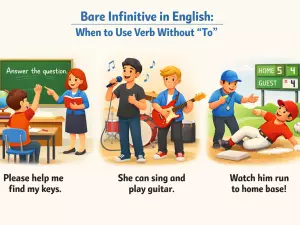
The verb “help” is unusual in English because it can be followed by either the base form of a verb (bare infinitive) or the “to” form (to-infinitive). Both patterns are grammatically correct and commonly used, but there are subtle differences in preference and style.
Usage with “help”
When you use “help” with another verb, you can choose between these two forms:
- Help + person + base verb (bare infinitive): She helped me carry the bags.
- Help + person + to + base verb (to-infinitive): She helped me to carry the bags.
Both sentences are correct and mean the same thing. In everyday conversation, especially in American English, the bare infinitive is more common and sounds a bit more natural. The “to-infinitive” tends to sound slightly more formal or is sometimes preferred in British English, but the difference is minor.
Examples of both forms
Here are some typical sentences showing both structures:
- Can you help me find my keys?
- Can you help me to find my keys?
- He helped her finish the project.
- He helped her to finish the project.
- They helped us move last weekend.
- They helped us to move last weekend.
- The teacher helped him understand the problem.
- The teacher helped him to understand the problem.
- I’ll help you solve this puzzle.
- I’ll help you to solve this puzzle.
- We helped the children paint the wall.
- We helped the children to paint the wall.
- Could you help me open this jar?
- Could you help me to open this jar?
Quick comparison
| Form | Example |
|---|---|
| Bare infinitive | She helped me carry the bags. |
| To-infinitive | She helped me to carry the bags. |
| Bare infinitive | He helped us move the furniture. |
| To-infinitive | He helped us to move the furniture. |
Points to remember
- Both forms are correct after “help”; the meaning does not change.
- Bare infinitive is more common in conversational English.
- To-infinitive can sound slightly more formal or traditional, but is still widely accepted.
- The choice does not affect the pronoun used after “help”; you can use object pronouns (me, him, her, us, them) with either verb form.
- There are no strict rules—use whichever form feels more natural to you or fits the tone of your writing.
In summary, both “help someone do something” and “help someone to do something” are standard in English, and the choice often comes down to regional preference or personal style.
Word order with pronouns and objects
After “let,” “make,” and “help,” English follows a specific pattern for arranging pronouns and objects. These causative and permissive verbs require careful attention to what comes immediately after them, especially when you use pronouns like “him,” “her,” “them,” or object nouns. The basic structure is: verb + person/object + base form of verb. This means you should place the pronoun or noun directly after “let,” “make,” or “help,” and before the main verb.
Patterns with pronouns and nouns
- Let her go.
- Let them finish.
- Let the children play.
- Make him apologize.
- Make me laugh.
- Make the team run.
- Help me understand.
- Help her cook.
- Help the students learn.
- Help us move.
When using pronouns, never place the verb directly after “let,” “make,” or “help.” For example, “Let go him” or “Make apologize her” are incorrect. Always insert the pronoun (or noun) between the causative verb and the main verb.
Summary of correct and incorrect word order
| Correct | Incorrect |
|---|---|
| Let him try | Let try him |
| Make her listen | Make listen her |
| Help them study | Help study them |
| Let the dog out | Let out the dog |
Notice that with these verbs, the object (whether a pronoun or a noun) always comes before the main verb. This order is fixed and doesn’t change, even in questions or negatives (e.g., “Don’t let him leave,” “Did you make them wait?”). Keeping this structure helps your sentences sound natural and clear.
Common learner errors with these verbs
Learners often find it tricky to use pronouns correctly after “let”, “make”, and “help.” These verbs have unique grammar patterns, and it’s easy to mix up objects, pronouns, and verb forms. Below, you’ll find common mistakes and tips to help you avoid them.
Confusing object and subject pronouns
One frequent issue is using the wrong pronoun form after these verbs. “Let,” “make,” and “help” require object pronouns (me, him, her, us, them), not subject pronouns (I, he, she, we, they).
- ❌ Incorrect: Let I go.
- ✅ Correct: Let me go.
- ❌ Incorrect: She made we laugh.
- ✅ Correct: She made us laugh.
Using “to” with the base verb
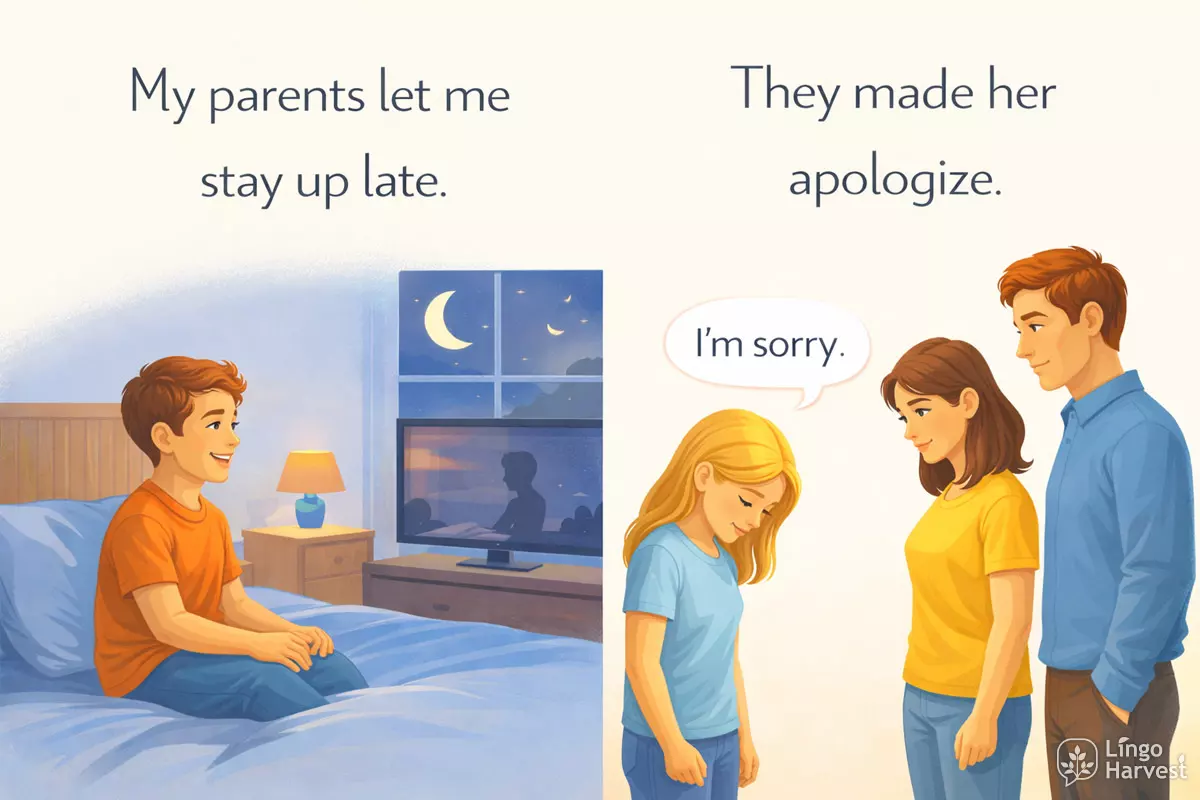
Another common error is adding “to” before the base verb after “let” and “make.” In English, these verbs are followed directly by the base form of the verb (no “to”).
- ❌ Incorrect: My parents let me to stay up late.
- ✅ Correct: My parents let me stay up late.
- ❌ Incorrect: They made her to apologize.
- ✅ Correct: They made her apologize.
Verb form after “help”
With “help,” both the base form and the “to” infinitive are acceptable, but learners often overgeneralize or mix up patterns.
- ✅ Correct: He helped me move the table.
- ✅ Correct: He helped me to move the table.
- ❌ Incorrect: He helped I move the table.
Missing the object pronoun
Forgetting to include the object pronoun after “let”, “make”, or “help” can make a sentence unclear or grammatically incorrect.
- ❌ Incorrect: Let go.
- ✅ Correct: Let him go.
- ❌ Incorrect: She made cry.
- ✅ Correct: She made him cry.
Summary of correct patterns
To help you spot the forms at a glance, here’s a quick comparison table:
| Verb | Correct Pattern | Example |
|---|---|---|
| let | let + object pronoun + base verb | Let him finish. |
| make | make + object pronoun + base verb | She made me laugh. |
| help | help + object pronoun + (base verb / to + verb) | He helped us (move / to move). |
Other common pitfalls
Learners sometimes use double objects, choose the wrong pronoun, or use the passive voice incorrectly. Watch for these mistakes:
- Using “let” or “make” in the passive voice can be awkward or wrong (e.g., I was let go is correct for “fired,” but I was made cry is not standard).
- Doubling the object: “Let me me try” ❌
- Using “to” inconsistently with “help” and not at all with “let/make”.
Understanding these patterns will help you avoid the most frequent errors and express yourself more clearly when using these causative verbs with pronouns.
- Passive with “let” and “make”
- Wrong: I was made cry. ❌
- Correct: I was made to cry. ✅
- Correct: I was let go. ✅ (fixed expression meaning “fired”)
- Better: I was allowed to leave. ✅ (preferred instead of passive “let”)
- No doubled object after “let”
- Wrong: Let me me try. ❌
- Correct: Let me try. ✅
- Wrong: Let her her speak. ❌
- Correct: Let her speak. ✅
- “Help” can use to, but “let/make” do not
- Correct: Help me carry this. ✅
- Correct: Help me to carry this. ✅
- Wrong: Let me to go. ❌
- Correct: Let me go. ✅
- Wrong: Make him to apologize. ❌
- Correct: Make him apologize. ✅
- Wrong: I was let to leave. ❌
- Better: I was allowed to leave. ✅
Pronouns in passive forms of let and make
When “let” and “make” are used in passive voice, the structure and pronoun choices change significantly compared to their active forms. In the active voice, these verbs are followed by an object and a base verb (e.g., “Let him go,” “Make her laugh”). However, when you switch to passive, the pattern shifts, and pronouns in the object position take on a different role.
How the passive forms work
The passive form of “let” is “be allowed to,” and for “make,” it’s “be made to.” The original object becomes the subject of the passive sentence, and the verb form includes “to.” For pronouns, this means using the subject form (I, you, he, she, we, they) at the start of the sentence.
- He was allowed to leave. (active: “They let him leave.”)
- She was made to apologize. (active: “They made her apologize.”)
- We were allowed to participate. (active: “The coach let us participate.”)
- I was made to wait. (active: “They made me wait.”)
- You were allowed to stay. (active: “The teacher let you stay.”)
- They were made to run. (active: “The coach made them run.”)
- He was allowed to explain. (active: “The manager let him explain.”)
- She was made to work late. (active: “The boss made her work late.”)
- We were allowed to choose. (active: “The organizers let us choose.”)
- I was made to clean up. (active: “Mom made me clean up.”)
Common patterns and pronoun changes
Notice that in the passive, the pronoun at the beginning is always in the subject form, even though it was the object in the active sentence. Also, the verb “to” is required after the passive form of “make” and “let” (as “be made to” / “be allowed to”), whereas in the active voice, “to” is not used.
| Active Voice | Passive Voice | Pronoun Used |
|---|---|---|
| They let him leave. | He was allowed to leave. | He (subject form) |
| The teacher made us write. | We were made to write. | We (subject form) |
| Mom let me stay up. | I was allowed to stay up. | I (subject form) |
| The boss made her redo it. | She was made to redo it. | She (subject form) |
Quick tips
- After “be allowed to” and “be made to,” always use the subject pronoun (I, you, he, she, we, they).
- Don’t forget to add “to” before the verb in the passive form.
- The agent (the person who lets or makes) is often omitted or added with “by”: “He was made to wait by the manager.”
Understanding these shifts makes it easier to form clear passive sentences and choose the right pronouns. This is especially useful in formal writing or when you want to focus on the person affected rather than the one causing the action.
Natural spoken examples
In everyday conversations, people often use pronouns after verbs like “let,” “make,” and “help.” These verbs are followed by either object pronouns (me, him, her, us, them) or names. Spoken English sometimes differs from formal grammar, so it's helpful to see how native speakers actually use these patterns.
Common patterns in speech
- Let me know if you’re coming.
- Can you let him finish his story?
- Let us help you with that.
- Don’t let them distract you.
- She made me do my homework.
- My parents made us clean our rooms.
- Why did you make her cry?
- The teacher made them write an essay.
- Can you help me carry these bags?
- She helped him find his keys.
- They helped us move last weekend.
- Please help them understand the instructions.
Spoken choices: “help” + object + (to) verb
In conversation, “help” is flexible: both “help me do” and “help me to do” are possible, but most speakers drop “to” for brevity. Here are some authentic-sounding examples:
- Can you help me fix this?
- She helped him to get a job. (less common in casual speech)
- They helped us move.
- Will you help them prepare?
Comparing object pronoun use after “let,” “make,” and “help”
| Verb | Typical Spoken Example |
|---|---|
| let | Let me try. |
| make | She made him apologize. |
| help | Help us find our seats. |
| let | Don’t let them leave early. |
| make | They made her laugh. |
| help | Can you help me understand? |
Occasionally, in informal speech, speakers might drop the object pronoun if the context is obvious (“Let finish first”), but this is rare and can sound incomplete. For clarity, including the pronoun is the norm in spoken English.
Practice: complete sentences with correct pronouns
Understanding which pronoun to use after verbs like “let,” “make,” and “help” can be tricky, especially since the rules differ from standard subject-verb-object patterns. In English, these verbs are typically followed by object pronouns (like “me,” “him,” “her,” “us,” “them”), not subject pronouns (“I,” “he,” “she,” “we,” “they”). Practicing with real sentences helps build confidence and accuracy.
Choose the correct pronoun
Below are sentences where you need to select the appropriate pronoun after “let,” “make,” or “help.” Focus on the meaning and structure of each verb.
- Can you let ____ know if the meeting is canceled? (I / me)
- The teacher made ____ do the project again. (we / us)
- Please help ____ carry these boxes. (they / them)
- My parents let ____ stay out late on weekends. (she / her)
- Did your boss make ____ work overtime? (he / him)
- Let ____ finish the report before you leave. (me / I)
- He helped ____ with our homework. (we / us)
- The manager let ____ take a break early. (they / them)
- Why did you make ____ apologize? (she / her)
- Would you help ____ find my keys? (me / I)
Show answers
- me
- us
- them
- her
- him
- me
- us
- them
- her
- me
Common patterns after “let,” “make,” and “help”
Let’s review some typical sentence structures to reinforce how these verbs work with pronouns. Notice the use of object pronouns after each verb.
- Let me explain.
- Make him listen carefully.
- Help her understand the instructions.
- Let them try first.
- Make us a reservation.
- Help me solve this problem.
- Let her join the team.
- Make them clean up.
- Help him get started.
- Let us know your decision.
Quick reference: Subject vs. object pronouns
For a clear comparison, here’s a table showing common pronoun forms. Use object pronouns after “let,” “make,” and “help.”
| Subject Pronoun | Object Pronoun |
|---|---|
| I | me |
| he | him |
| she | her |
| we | us |
| they | them |
Fill in the blanks with object pronouns
Try another short activity. Insert the correct object pronoun for each blank.
- Could you let ____ borrow your notes?
- The movie made ____ cry.
- Can you help ____ with this form?
- Let ____ know if you’re coming.
- My parents let ____ stay up late.
- The teacher made ____ rewrite the paragraph.
- Could you help ____ carry these boxes?
- Please let ____ in when you arrive.
- This song always makes ____ laugh.
- Can you help ____ choose a good topic?
Show answers
- me
- her
- them
- us
- me
- him
- us
- me
- them
- her
With regular practice, these patterns become automatic. Keep referring to examples and try creating your own sentences using the correct pronouns after "let," "make," and "help".