Gerunds as Verbals: Theory

 This article explains what gerunds are, details their forms, and shows how they function as subjects, after prepositions, and after certain verbs. It also covers basic differences between gerunds and infinitives, with practice exercises.
Examining how words ending in -ing evolve from indicating simple actions to functioning as nouns reveals intriguing aspects of English grammar. This transformation highlights the process by which verbs can take on new roles, often acting as gerunds within sentences. By understanding this shift, we gain insight into the flexibility and complexity of English, as well as the important principles that govern how verb-based forms operate in various grammatical contexts, enhancing both our comprehension and use of the language.
What Gerunds Are
A gerund is a word formed by adding -ing to a verb, and it functions as a noun within a sentence. Unlike simple verbs, these forms do not express tense or subject directly. Instead, they allow actions or states to be discussed as things or concepts. For example, in the sentence "Swimming is fun," the word "swimming" acts as the subject, not as a verb.
Gerunds are a type of verbal—words derived from verbs that do not function as verbs in a sentence. While they look similar to present participles (also ending in -ing), their grammatical role is different. Gerunds always act as nouns, whereas participles usually serve as adjectives or form verb tenses.
Main Features of Gerunds
- Always end with -ing (e.g., "reading," "dancing," "thinking")
- Can be used as subjects, objects, or complements
- May take objects or modifiers, forming gerund phrases ("writing letters," "driving quickly")
- Retain some properties of verbs, such as the ability to take direct objects
- Do not show tense or person
Common Uses in Sentences
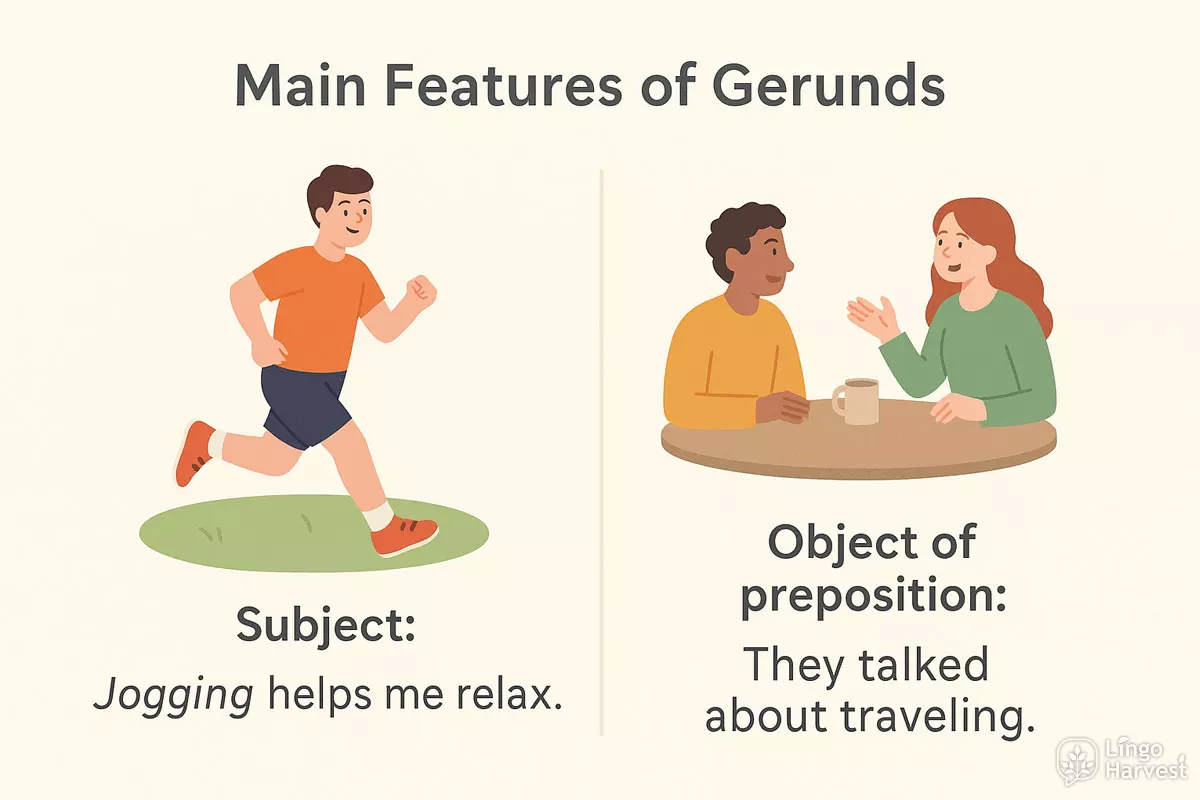
- Subject: "Jogging helps me relax."
- Object: "She enjoys painting."
- Object of preposition: "They talked about traveling."
- Subject complement: "His favorite hobby is fishing."
Gerunds vs. Present Participles
It's easy to confuse these two forms since both end in -ing. However, their functions set them apart. The comparison below highlights the differences:
| Gerund | Present Participle |
|---|---|
| Acts as a noun | Acts as an adjective or helps form verb tenses |
| Can be a subject or object ✅ "Swimming is healthy." |
Describes a noun or forms continuous tenses ✅ "The swimming child waved." |
| Can follow prepositions ✅ "After eating, we left." |
Used with auxiliary verbs ✅ "She is eating now." |
| Never shows tense | Part of verb phrase showing tense → "was running" |
Examples of Gerunds
- Swimming
- Reading
- Cooking
- Running
- Traveling
- Writing
- Listening
- Drawing
- Gardening
- Learning
- Hiking
- Shopping
- Playing
- Sleeping
- Painting
- Jogging
- Dancing
- Fishing
- Singing
- Teaching
Recognizing these forms and their roles is crucial for understanding how actions can be discussed as abstract concepts or activities within sentences.
Gerund Forms
Understanding how gerunds are constructed is essential for anyone studying English grammar. At their core, these verbals are created by adding "-ing" to the base form of a verb. This simple transformation allows a verb to function as a noun within a sentence, opening up a range of syntactic possibilities.
Basic Construction
Forming a gerund is straightforward for most regular verbs. Simply attach "-ing" to the infinitive without "to." For example:
- read → reading
- walk → walking
- swim → swimming
- write → writing
- play → playing
However, some verbs require minor spelling changes before adding "-ing." For example, if a verb ends in "e," the "e" is usually dropped: "make" becomes "making." For one-syllable verbs ending in consonant-vowel-consonant, the final consonant is often doubled: "run" becomes "running."
Spelling Patterns and Adjustments
The table below outlines common rules and exceptions for forming gerunds from different verb types:
| Verb Type | Gerund Example | Rule/Note |
|---|---|---|
| Most regular verbs | talk → talking | Add "-ing" directly |
| Verbs ending in "e" | write → writing | Drop the "e" before "-ing" |
| One-syllable, CVC ending | run → running | Double the final consonant |
| Verbs ending in "ie" | die → dying | Change "ie" to "y" + "-ing" |
| Verbs ending in "y" | enjoy → enjoying | No change to the base |
Common Examples
Gerund forms are found in countless English verbs. Here are some frequently used ones:
- eating
- going
- studying
- listening
- traveling
- meeting
- hoping
- beginning
- shopping
- working
- drawing
- leaving
- fixing
- exploring
- fishing
Compound and Passive Gerunds
Gerunds can also appear in more complex forms, such as the perfect gerund ("having finished") or passive gerund ("being seen"). These forms allow for even greater flexibility in expressing time and voice relationships:
- having eaten (perfect gerund)
- being followed (passive gerund)
- having been told (perfect passive gerund)
Grasping these patterns helps in recognizing and using gerunds correctly in various contexts, making your English more natural and accurate.
Gerunds as Subjects
When a gerund appears at the beginning of a sentence, it frequently functions as the main topic or “doer” of the action. In this role, the -ing form of a verb acts like a noun, referring to an activity or process in a general sense. This construction is common in both spoken and written English, making it a practical way to talk about actions as abstract concepts.
Usage and Nuances
Using a gerund in this way emphasizes the activity itself, not the person performing it. For instance, “Swimming is good exercise” draws attention to the act of swimming rather than to any specific swimmer. This pattern is especially useful for discussing rules, habits, and general truths.
Common Patterns
Some verbs and expressions are typically followed by gerunds when they serve as the subject. Here are some frequent ways these forms appear at the start of sentences:
- Describing hobbies or activities: Reading helps you learn new words.
- Expressing general truths: Smoking causes health problems.
- Stating preferences or opinions: Traveling broadens your perspective.
- Giving advice or warnings: Driving too fast is dangerous.
- Highlighting outcomes: Eating late can disrupt sleep.
Expanded Examples
Below is a selection of sentences where the main action, expressed as a gerund, takes center stage:
- Running improves cardiovascular health.
- Listening carefully leads to better understanding.
- Learning new languages opens doors.
- Cooking at home saves money.
- Watching documentaries increases awareness.
- Saving money requires discipline.
- Joking at work lightens the mood.
- Walking to school gives you exercise.
- Waiting in line tests patience.
- Practicing daily ensures progress.
- Exploring new places brings excitement.
- Volunteering helps communities.
- Making mistakes teaches valuable lessons.
- Planning ahead prevents problems.
- Writing regularly sharpens skills.
- Forgetting appointments causes confusion.
- Borrowing money creates obligations.
- Repeating instructions reinforces learning.
Comparison: Gerund vs. Infinitive as Subject
Sometimes, an infinitive can also act as the subject. The choice between the two can affect the tone or focus. Here’s a comparison of both forms in subject position:
| Gerund Subject | Infinitive Subject |
|---|---|
| Reading before bed relaxes me. | To read before bed relaxes me. |
| Eating vegetables is healthy. | To eat vegetables is healthy. |
| Exercising daily reduces stress. | To exercise daily reduces stress. |
| Learning from mistakes is important. | To learn from mistakes is important. |
| Traveling alone builds confidence. | To travel alone builds confidence. |
While both structures are grammatically correct, native speakers tend to prefer the -ing form for everyday statements. The infinitive version can sound more formal or philosophical.
Summary
Choosing the gerund at the start of a sentence allows for concise, natural statements about actions or experiences. Recognizing and using this structure will help you express ideas more smoothly and understand authentic English texts.
Gerunds After Prepositions
Understanding how to use gerund forms after prepositions is essential for writing and speaking naturally in English. Whenever a preposition appears, the action that follows is usually expressed with the -ing form, not the base form or infinitive. This pattern applies across a wide range of contexts, from casual conversation to formal writing.
Common Prepositions That Require Gerunds
Certain prepositions are nearly always followed by an -ing form. Here are some of the most frequent pairings:
- before going
- after finishing
- without knowing
- about learning
- in making
- on arriving
- by studying
- for helping
- instead of waiting
- with understanding
- from working
- at finding
- of reading
- to getting (note: "to" is a preposition in certain expressions, not in the infinitive form)
Why the -ing Form Follows Prepositions
The -ing form acts as a noun in these constructions, serving as the object of the preposition. For example, in "She left without saying goodbye," "saying" is the noun (object) of "without." This rule applies regardless of whether the preposition comes at the end, middle, or start of a phrase.
Prepositions vs. Infinitives: Key Distinctions
A common learner mistake is using the infinitive ("to" + base verb) after prepositions, but English requires the -ing form instead. For instance, "I'm interested in to learn" is incorrect; the correct form is "I'm interested in learning."
| Preposition | Correct Example | Incorrect Example |
|---|---|---|
| after | after eating | after to eat |
| before | before leaving | before to leave |
| without | without asking | without to ask |
| in | in solving | in to solve |
| on | on arriving | on to arrive |
Set Expressions and Idioms
Many everyday phrases use this structure. Examples include:
- look forward to meeting
- be good at drawing
- be afraid of flying
- thank you for coming
- be interested in learning
- be worried about missing
- apologize for being late
- complain about working overtime
- be responsible for organizing
- be tired of waiting
Mastering the use of -ing forms after prepositions helps make your English sound more fluent and natural. If in doubt, remember: after a preposition, use the gerund, not the infinitive.
Gerunds After Certain Verbs
Some English verbs are naturally followed by a verb in the –ing form, also known as a gerund. This pattern is not arbitrary; it is based on longstanding usage and often must be memorized. Choosing a gerund versus an infinitive can change the meaning or make a sentence ungrammatical. Familiarity with these verbs helps learners avoid common errors.
Common Verbs That Take Gerunds
A number of frequently used verbs require the next verb to be in gerund form. Here are some of the most common ones:
- enjoy
- consider
- admit
- suggest
- avoid
- deny
- imagine
- finish
- practice
- miss
- risk
- postpone
- keep
- mind
- recommend
- discuss
- quit
- delay
- appreciate
- mention
Examples in Sentences
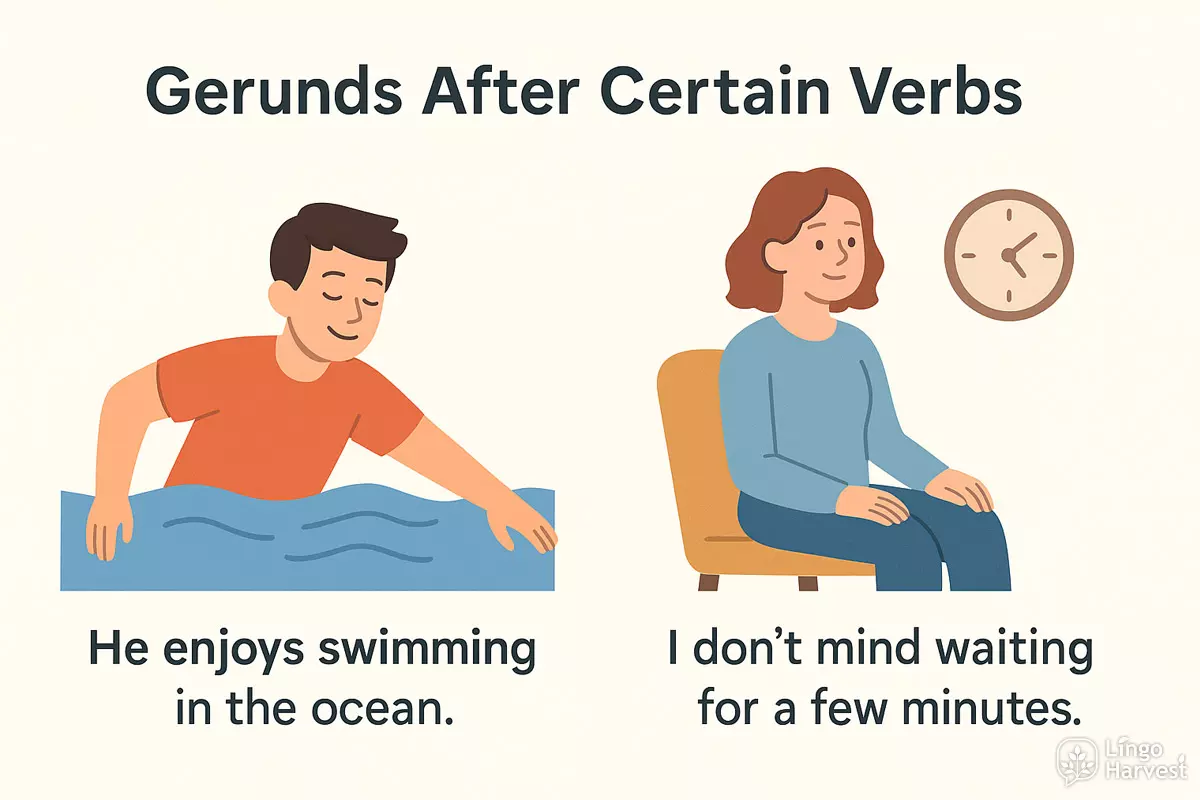
Here are some sample sentences illustrating how these verbs work with gerunds:
- He enjoys swimming in the ocean.
- They avoided talking about the issue.
- She suggested meeting earlier.
- I don’t mind waiting for a few minutes.
- We finished eating and left the restaurant.
Comparison: Gerund vs. Infinitive After Certain Verbs
Some verbs can be followed by either a gerund or an infinitive, but the meaning may change. Others require one form exclusively. The table below compares several cases where the choice matters:
| Verb | Gerund Example | Infinitive Example |
|---|---|---|
| remember | I remember locking the door. ✅ (past action) | I remembered to lock the door. ✅ (future action) |
| stop | He stopped smoking. ✅ (quit the habit) | He stopped to smoke. ✅ (paused to do it) |
| try | Try restarting the computer. ✅ (experiment with action) | Try to restart the computer. ✅ (attempt the action) |
| forget | She’ll never forget meeting you. ✅ (memory of past event) | Don’t forget to meet her. ✅ (task to do) |
Why Memorize These Patterns?
Not every verb can be paired with a gerund. Learning which verbs require this structure is essential for natural, accurate English. Native speakers rarely think about these rules consciously, but non-native learners benefit from practicing and internalizing these combinations. Over time, recognizing these patterns becomes second nature.
Gerund vs Infinitive Basics
Understanding when to use a gerund or an infinitive can be tricky, but the difference lies mainly in function and meaning. Both forms act as verbals, allowing verbs to serve as nouns, adjectives, or adverbs, but they are used in different grammatical contexts.
What Are Gerunds and Infinitives?
A gerund is the -ing form of a verb that functions as a noun (for example, swimming is fun). An infinitive is the base form of a verb, usually preceded by to (such as to swim is enjoyable). Both can act as subjects, objects, or complements in sentences.
Common Usage Patterns
Certain verbs, adjectives, and expressions are typically followed by either a gerund or an infinitive, but not both. Here are some patterns:
- Enjoy, avoid, consider, suggest, and finish are followed by gerunds: She enjoys reading.
- Decide, hope, plan, want, and promise are followed by infinitives: He decided to leave.
- Some verbs can be followed by either form, but the meaning may change (e.g., remember doing vs. remember to do).
Key Differences at a Glance
| Gerund (Verb + -ing) | Infinitive (to + Verb) |
|---|---|
| Acts as a noun → Swimming relaxes me. |
Also acts as a noun → To swim is healthy. |
| Follows certain verbs: enjoy, avoid, admit, deny, suggest, finish, mind, miss, risk, consider |
Follows certain verbs: agree, decide, expect, hope, learn, need, offer, plan, promise, want |
| Used after prepositions: ✅ She’s good at singing. |
Used after adjectives: ✅ It’s easy to understand. |
| Can express general activities or hobbies | Often refers to specific actions or intentions |
Examples of Typical Verbs
Some verbs are almost always followed by a gerund, while others require an infinitive. Here’s an expanded list for reference:
- Gerund after: admit, avoid, consider, delay, deny, dislike, enjoy, finish, imagine, involve, keep, mention, mind, miss, postpone, practice, prevent, risk, suggest
- Infinitive after: agree, appear, arrange, attempt, choose, decide, expect, fail, hope, learn, manage, offer, plan, prepare, promise, refuse, seem, tend, want, wish
Summary
Mastering when to use gerunds and infinitives comes down to memorizing patterns and practicing with real sentences. Pay attention to which verbs, adjectives, or expressions are followed by each form, and remember that meaning can shift depending on your choice.
Practice: Choose Correct Form
Applying your understanding of gerunds as verbals can be challenging, especially when distinguishing them from infinitives or regular verbs. Below, you’ll find a set of exercises designed to test your ability to select the appropriate gerund form in real sentences. Read each sentence, then decide which form fits best. Pay close attention to the verbs and prepositions that require a gerund.
Fill in the Blank: Gerund or Not?
- She is interested in ________ (learn) new languages.
- They talked about ________ (move) to another city.
- He avoided ________ (answer) the question.
- We finished ________ (paint) the fence yesterday.
- Do you mind ________ (open) the window?
- I enjoy ________ (read) before bed.
- She suggested ________ (go) for a walk.
- He admitted ________ (make) a mistake.
- They denied ________ (steal) the money.
- We discussed ________ (meet) earlier next week.
Show answers
- learning
- moving
- answering
- painting
- opening
- reading
- going
- making
- stealing
- meeting
Choose the Correct Option
Select the correct form for each sentence below. Only one option is correct in each case.
- He kept (to talk / talking) during the movie.
- They are excited about (to travel / traveling) abroad.
- Would you mind (to help / helping) me?
- The children practiced (to sing / singing) all afternoon.
Show answers
- talking
- traveling
- helping
- singing
Common Verbs Followed by Gerunds
Some English verbs are consistently followed by a gerund. Familiarize yourself with these verbs to improve your fluency.
- enjoy
- suggest
- avoid
- admit
- deny
- discuss
- finish
- mind
- practice
- consider
- recommend
- imagine
- postpone
- risk
- miss
- keep
- quit
- delay
Comparing Gerunds and Infinitives
Some verbs can be followed by either a gerund or an infinitive, but the meaning may change. The table below compares typical usage patterns.
| Verb | Followed by Gerund | Followed by Infinitive |
|---|---|---|
| remember | remember doing (recall a past action) | remember to do (not forget to do in the future) |
| stop | stop doing (cease an activity) | stop to do (pause in order to do something else) |
| try | try doing (experiment with an action) | try to do (attempt to accomplish something) |
| forget | forget doing (not recall a past action) | forget to do (fail to remember to do) |
Short Error Correction
Identify and correct the mistake in each sentence.
- She suggested to meet at noon.
- I enjoyed to watch the movie.
- They avoided to answer the question.
- He admitted to make a mistake.
Show answers
- She suggested meeting at noon.
- I enjoyed watching the movie.
- They avoided answering the question.
- He admitted making a mistake.