Participles as Verbals: Present and Past

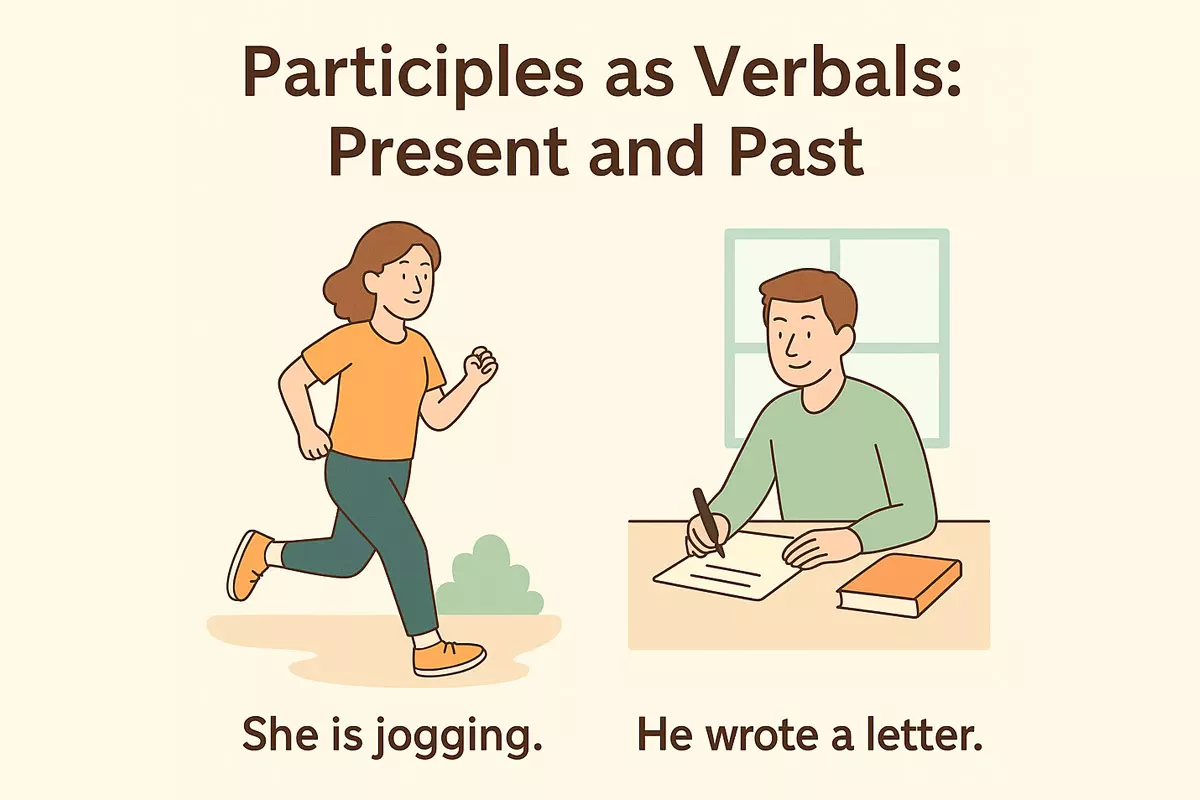 The article defines participles, explains present and past participle forms, and details their roles in continuous tenses and passive voice. It also covers how participles act as adjectives and includes practice tasks to help you master these concepts.
Participles are unique verb forms that function as modifiers, effectively bridging action and description within sentences. By transforming verbs into participles, writers and speakers add detail and nuance, making language more expressive and precise. For example, in the phrase running water, the participle running describes the noun water, giving more information about its state or quality. Mastery of participles not only enriches communication but also enhances clarity, allowing ideas to flow more smoothly and vividly in both spoken and written language.
What Participles Mean
Participles function as forms of verbs that can act like adjectives or sometimes as parts of verb phrases. They capture aspects of action, time, and state, blending the qualities of verbs and adjectives. Understanding their sense is key for recognizing how they add detail and nuance to communication.
Core Ideas Expressed by Participles
Present participles (ending in -ing) and past participles (often ending in -ed, -en, or irregular forms) both describe actions, but their meanings differ:
- Present participles suggest an ongoing, active process or state that is happening at the same time as the main verb.
- Past participles refer to a completed action or a state resulting from a prior action. They can express passive or active meaning depending on context.
Examples of What Participles Convey
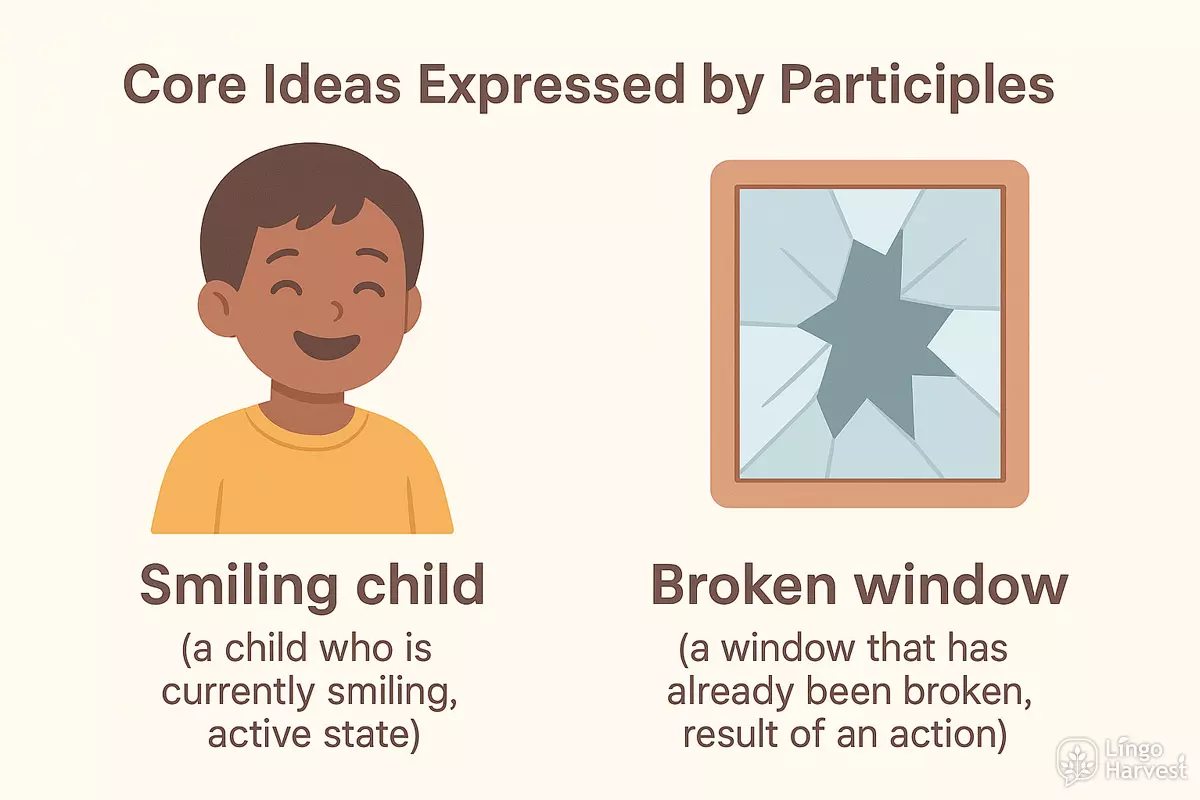
To clarify how participles shape meaning, consider the following examples:
- Smiling child (a child who is currently smiling, active state)
- Broken window (a window that has already been broken, result of an action)
- Running water (water that is in motion)
- Baked bread (bread that has already been baked)
- Excited audience (audience that has become excited)
- Falling leaves (leaves that are in the process of falling)
- Chosen candidate (candidate who has been selected)
- Laughing friends (friends who are laughing now)
- Written message (message that has been written)
- Rising sun (sun that is currently rising)
- Closed door (door that is not open because it has been shut)
- Burning candle (candle that is actively burning)
- Forgotten password (password that someone forgot)
- Flying bird (bird that is in flight)
- Painted fence (fence that has had paint applied)
- Sleeping baby (baby that is asleep now)
- Broken promise (promise that was not kept)
- Flowing river (river that is moving)
Comparison of Participles: Present vs. Past
| Form | Meaning | Example |
|---|---|---|
| Present participle (-ing) |
Describes ongoing or simultaneous action | The singing bird |
| Past participle (-ed, -en, irregular) |
Indicates completed action or resulting state | A broken vase |
Participles often convey more than just time—they can add subtle shades of meaning such as cause, manner, or condition. For example, in “Surprised by the news, she gasped,” the past participle introduces a reason for the reaction. In summary, these verb forms enrich language by compactly expressing timing, state, and description, allowing for more vivid and precise communication.
Present Participle Forms
The –ing form of English verbs serves a variety of grammatical functions, but when it acts as a participle, it describes ongoing action or serves as an adjective. Forming this verbal is straightforward: add “-ing” to the base form of the verb, with a few spelling adjustments for certain endings. This participle is used in continuous tenses, as modifiers, and in participial phrases.
How to Form the –ing Participle
For most verbs, simply attach “-ing” to the infinitive, but there are some spelling patterns to be aware of:
- For verbs ending in a silent “e,” drop the “e” before adding “-ing” (e.g., make → making).
- For one-syllable verbs ending in a single vowel plus a consonant, double the final consonant (e.g., run → running).
- Verbs ending in “ie” change “ie” to “y” (e.g., die → dying).
- Simply add “-ing” for most other verbs (e.g., eat → eating).
Common Uses and Examples
The –ing participle can describe an action happening at the same time as the main verb, or act as an adjective to give more information about a noun. Here are some typical examples:
- The boiling water spilled on the stove.
- Walking quickly, she caught the bus.
- He heard someone singing outside.
- Running late, I skipped breakfast.
- They watched the rising sun.
- The children were laughing loudly.
- I saw him fixing the car.
- We found the dog sleeping in the garden.
- The crying baby woke everyone.
- Reading before bed helps me relax.
- The artist is painting a portrait.
- Listening carefully, she answered correctly.
- The movie was exciting.
- He enjoys cooking Italian food.
- They left the engine running.
- The falling leaves covered the ground.
Summary of Spelling Patterns
| Verb Ending | Present Participle Example |
|---|---|
| Simple base | talk → talking |
| Silent “e” | write → writing |
| One syllable, vowel + consonant | swim → swimming |
| “ie” ending | lie → lying |
Understanding these patterns helps you use –ing verbals correctly, whether you’re describing a process, an ongoing action, or modifying a noun. They add detail and nuance to both written and spoken English.
Past Participle Forms
Understanding how verbs change to indicate completed actions is essential in English. The past participle is one of the most versatile verbals, often used to form perfect tenses, passive voice, and as adjectives. Unlike the present participle, which always ends in “-ing,” the past participle varies: it can end in “-ed” for regular verbs, but irregular verbs have unique forms that must be memorized.
Regular and Irregular Variations
For regular verbs, you simply add “-ed” to the base form. However, many common verbs are irregular and do not follow this pattern. Learning these is crucial for accurate communication. Some verbs remain unchanged, while others take on entirely new spellings.
- walk → walked
- play → played
- finish → finished
- go → gone
- write → written
- eat → eaten
- see → seen
- break → broken
- choose → chosen
- build → built
- bring → brought
- take → taken
- drive → driven
- swim → swum
- teach → taught
- find → found
- be → been
- become → become
Usage in Sentences
Past participles are often found in passive constructions (“The letter was written”) or perfect tenses (“She has eaten lunch”). They also serve as descriptive words, as in “a broken window” or “freshly baked bread.”
| Base Verb | Past Participle | Example Sentence |
|---|---|---|
| write | written | The story was written by Sam. |
| go | gone | He has gone home. |
| break | broken | The vase is broken. |
| choose | chosen | A winner has been chosen. |
| eat | eaten | The cake was eaten quickly. |
| build | built | The house was built last year. |
Key Points to Remember
- Regular forms end in “-ed,” but many verbs are irregular. - These verbals are used with “have/has/had” for perfect tenses and with “be” for passive voice. - Some participles double as adjectives, describing nouns directly. Mastering these forms helps you create more precise and varied sentences, especially when describing actions that are finished or states resulting from actions.
Participles in Continuous Tenses
When discussing continuous verb forms, the present participle plays a central role. This "-ing" form appears in all progressive tenses, working with auxiliary verbs to show ongoing action or events in progress. Understanding how these participles function helps clarify both their grammatical role and their connection to time frames.
How Present Participles Build Progressive Tenses
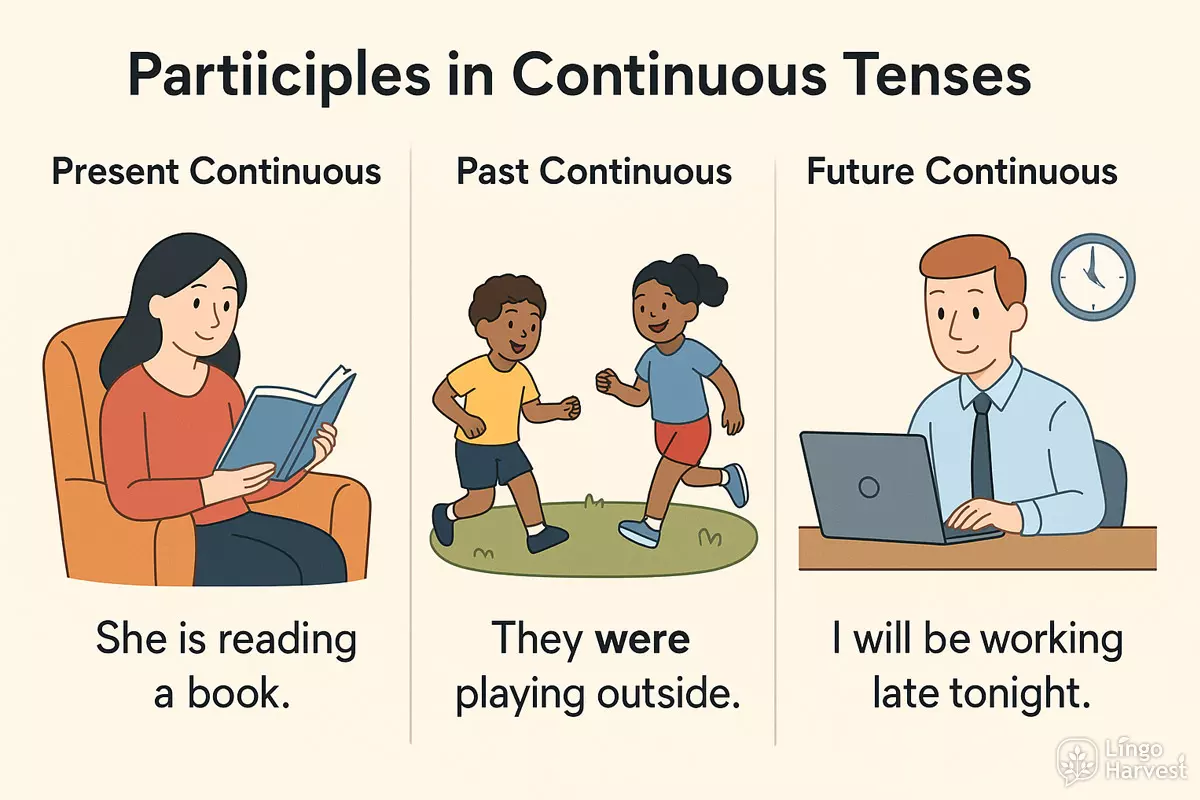
In English, continuous (progressive) tenses combine a form of the verb "to be" with the present participle. This structure signals that an action is happening over a period, not just a single moment. These constructions apply in the present, past, and future, as well as in perfect forms.
| Continuous Tense | Example Sentence | Explanation |
|---|---|---|
| Present Continuous | She is reading a book. | Describes an action in progress right now. |
| Past Continuous | They were playing outside. | Refers to an activity ongoing at a specific past moment. |
| Future Continuous | I will be working late tonight. | Indicates an action that will be ongoing in the future. |
| Present Perfect Continuous | We have been waiting for hours. | Shows an action started in the past and still continuing. |
| Past Perfect Continuous | He had been studying before the test. | Describes a continuous action completed before another past event. |
| Future Perfect Continuous | By noon, she will have been driving for six hours. | Highlights duration of an action up to a point in the future. |
Quick Reference: Recognizing Present Participles in Action
- Formed by adding "-ing" to the base verb: walking, singing, running
- Always paired with a "be" verb to form a continuous tense
- Never take tense or number themselves; auxiliaries carry tense
- Can express simultaneous actions: Listening to music, he finished his homework.
- Irregular verbs may have spelling changes: swim → swimming, run → running
- Do not confuse with gerunds, which act as nouns
- Used to show an action in progress at a particular time
- Appear in both active and passive continuous forms: The house is being built.
- Can express temporary actions or situations
- May be used in reported speech: She said she was leaving.
In summary, present participles are crucial for expressing ongoing activities across different time frames. Their partnership with auxiliary verbs allows English speakers to convey nuance about the timing and duration of actions with clarity and flexibility.
Participles in Passive Voice
The passive voice often relies on participles to show that the subject of the sentence is acted upon, rather than performing the action. In English, the past participle is typically used after forms of the verb “to be” to create passive constructions. For example, in “The book was written by the author,” “written” is the past participle showing the passive nature of the action.
How Passive Structures Use Participles
Passive sentences use a form of “to be” plus the past participle of the main verb. This pattern shifts the focus from the doer to the receiver of the action. The present participle is rarely used in passive voice, except in progressive passive forms (e.g., “is being written”).
- The cake was eaten (by someone).
- The windows were cleaned yesterday.
- The homework is being completed right now.
- The results have been announced.
- The song will be sung at the event.
- The packages are delivered every morning.
- The work had been finished before noon.
- The room is painted blue.
- The movie was directed by a famous filmmaker.
- The decision will have been made by then.
- The letter is being written now.
- The project has been delayed.
- The bills should be paid today.
- The car was repaired last week.
- The garden is watered every day.
- The answer was given quickly.
- The invitations have been sent.
- The house is being renovated.
- The story had been told before.
- The test will be taken tomorrow.
Forming Passive Voice with Participles
The essential structure for passive forms involves:
- Form of “to be” (am, is, are, was, were, be, being, been)
- Past participle of the main verb (e.g., eaten, cleaned, written)
This construction can be used in various tenses, which impacts both the auxiliary verb and sometimes the participle.
| Active Voice | Passive Voice |
|---|---|
| The chef cooks the meal. | The meal is cooked (by the chef). |
| They will finish the project. | The project will be finished (by them). |
| Someone has repaired the car. | The car has been repaired. |
| People are writing letters. | Letters are being written. |
| The manager was announcing the results. | The results were being announced. |
| They had built the bridge. | The bridge had been built. |
| She cleans the room. | The room is cleaned. |
| They sent the invitations. | The invitations were sent. |
Key Points to Remember
- Past participles are essential for forming most passive constructions in English.
- Only transitive verbs (those that take a direct object) can be used in the passive.
- The agent (the performer of the action) is often omitted or placed after “by.”
- Progressive passive forms combine “being” and the past participle (e.g., “is being watched”).
- In some cases, passive structures can make writing more formal or objective.
Understanding how participles function in these contexts helps clarify sentence meaning and allows for more nuanced expression in both writing and speech.
Adjective Use of Participles
Participles often take on the role of adjectives in English, describing or qualifying nouns much like traditional adjectives do. Both present and past participles can be used this way, but they bring different nuances. A present participle (ending in -ing) usually expresses an active, ongoing quality or characteristic, while a past participle (often ending in -ed, -en, or irregular forms) tends to describe a passive state or a completed action. When using participles to modify nouns, context determines which form is appropriate. For example, a "barking dog" is a dog that is actively barking, whereas a "barked order" is an order that has been barked (shouted). Understanding this distinction helps writers and speakers add precision and vividness to their language.
Common Patterns and Examples
Here are some common ways participles function as adjectives in sentences:
- The crying baby kept everyone awake. (present participle: the baby is crying)
- A broken window let in the cold air. (past participle: the window has been broken)
- We admired the sparkling lake in the morning.
- She handed me a written invitation.
- The boiling water spilled over the pot.
- Lost in thought, he missed his stop. ("Lost" describes his state)
- The excited crowd cheered for the team.
- The confusing instructions made assembly difficult.
- He picked up the fallen leaves.
- The shining stars lit up the sky.
- A tired traveler rested on the bench.
- The freezing rain made driving dangerous.
- The chosen candidate gave a speech.
- The rolling hills stretched for miles.
- They found a missing child in the park.
- The damaged goods were returned.
- She wore a glittering dress to the party.
- The burnt toast was inedible.
- A frightened kitten hid under the couch.
- The rising sun warmed the valley.
Comparing Present and Past Participles as Modifiers
The form you choose changes the meaning. Consider the following comparison:
| Present Participle (Active/Ongoing) | Past Participle (Passive/Completed) |
|---|---|
| A boring lecture (the lecture causes boredom) |
A bored student (the student experiences boredom) |
| The running water (water that is flowing) |
The run water (water that has been run, less common) |
| A shocking story (the story shocks people) |
A shocked audience (the audience has been shocked) |
| The inviting aroma (the aroma invites) |
The invited guests (guests who have been invited) |
Placement and Usage Tips
Participial adjectives can appear before a noun ("the fallen tree"), after a linking verb ("the tree is fallen"), or within participial phrases ("trees fallen by the storm"). When choosing between present and past participle forms, consider whether the noun is performing the action or receiving it. This helps ensure clarity and avoids confusion for readers and listeners.
Practice Tasks
Working with participles in English helps you understand how actions and descriptions connect in sentences. Below, you'll find activities to identify, transform, and use present and past participles as verbals. These exercises will clarify how participles function as adjectives and parts of verb phrases, as well as how they differ from each other in meaning and use.
Identify the Participle
Read each sentence and underline the participle. Then, specify whether it is a present or past participle.
- The boiling water spilled on the counter.
- Exhausted from the hike, he sat down to rest.
- She found her lost keys hidden under the couch.
- The laughing children ran through the park.
- Finished with his homework, Tom watched TV.
Show answers
- boiling – present participle
- Exhausted – past participle
- hidden – past participle
- laughing – present participle
- Finished – past participle
Transform the Sentences
Rewrite each sentence by changing the participial phrase from present to past, or vice versa, while keeping the meaning clear.
- The barking dog annoyed the neighbors.
- Surprised by the news, she dropped her cup.
- The broken window let in cold air.
- Running down the street, he waved at his friend.
Show answers
- The barked-at dog annoyed the neighbors. (or: The dog, barked at by strangers, annoyed the neighbors.)
- Having been surprised by the news, she dropped her cup.
- The breaking window let in cold air. (or: The window, breaking in the storm, let in cold air.)
- Having run down the street, he waved at his friend.
Comparing Present and Past Participles
The table below summarizes key differences in form and function between present and past participles. Use it as a reference for the tasks that follow.
| Form | Example | Function | Meaning |
|---|---|---|---|
| Present Participle (-ing) |
smiling child | Describes an ongoing action | Active (the subject is doing the action) |
| Past Participle (-ed/-en, irregular) |
broken chair | Describes a completed action or state | Usually passive (the subject receives the action) |
Expand Your Vocabulary: Common Participles
Review the following list of frequent present and past participles. Try using each in your own sentence:
- growing
- fallen
- exciting
- tired
- singing
- burned
- shining
- closed
- rolling
- chosen
- flying
- forgotten
- rising
- painted
- waiting
- torn
- dripping
- frightened
Quick Quiz: Spot the Verbal
For each sentence, choose whether the highlighted word is a participle used as a verbal or not:
- The crying baby woke up everyone.
- I have eaten breakfast already.
- The opened book lay on the desk.
- He was running late.
Show answers
- Participle as verbal (adjective)
- Participle as part of verb phrase (verbal)
- Participle as adjective (verbal)
- Participle as part of verb phrase (verbal)