Verb Valency: How Many Arguments a Verb Takes

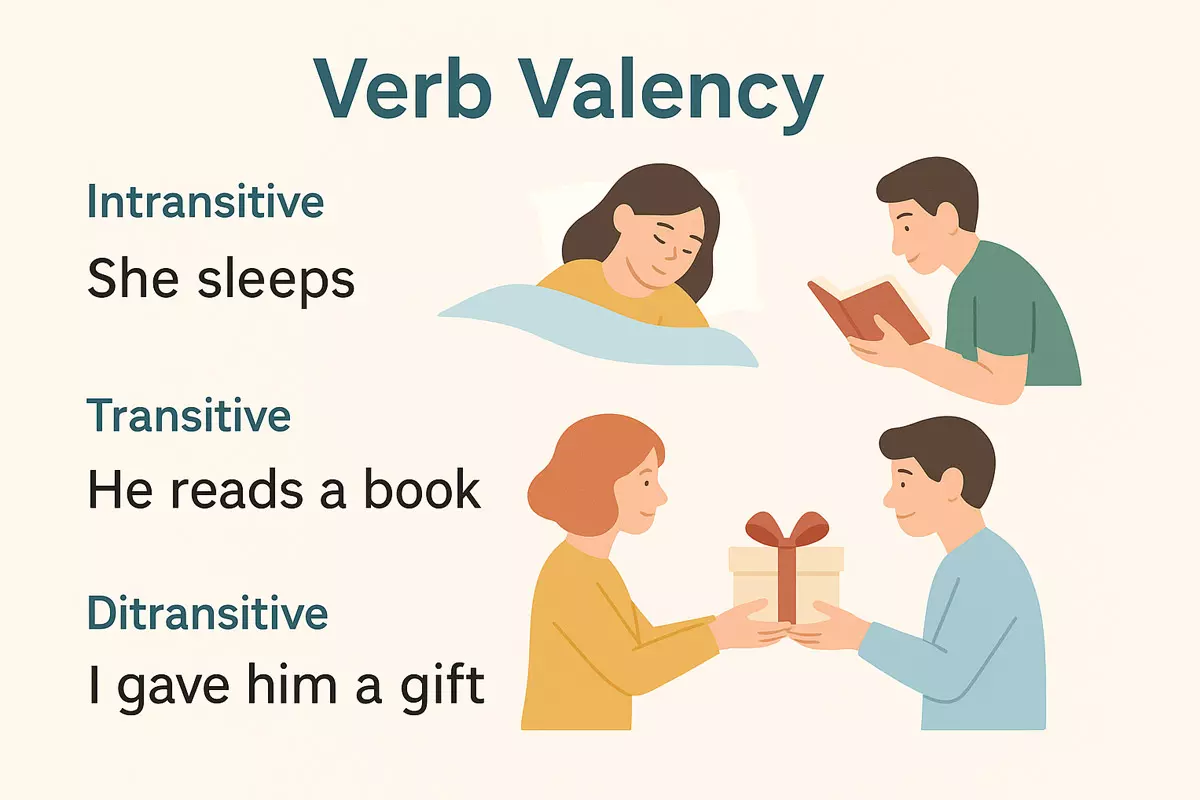 This article explains verb valency, covering intransitive, transitive, and ditransitive verbs. It includes common verb patterns, clear examples, and a short practice section to help you understand how verbs interact with other sentence elements.
Have you ever noticed that some verbs require more participants in a sentence than others? This difference is due to the number of elements, or arguments, that a verb connects to, which reveals interesting patterns in language structure. By understanding how many participants a verb needs—such as a subject, an object, or even two objects—we gain insight into how verbs influence the overall meaning and organization of sentences. This knowledge helps us appreciate the complexity and variety found in language.
What Valency Means
In linguistics, valency describes how many participants a verb naturally connects with in a sentence. This concept helps us understand why some verbs require additional words to make sense, while others stand alone. For example, "sleep" makes a complete thought with just a subject ("She sleeps"), but "give" needs a subject, an object, and often a recipient ("She gives him a book"). The idea is similar to how atoms bond in chemistry—the verb's "valency" sets the number of other elements it can join with to form a grammatical sentence.
Types of Verb Valency
Different verbs have different capacities for combining with other sentence elements. Here are common valency types, each with its own pattern:
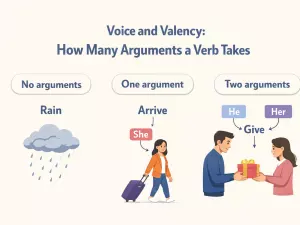
- Impersonal (zero-valent): No subject or object is required (e.g., "It rains").
- Intransitive (monovalent): Only a subject is needed (e.g., "Birds fly").
- Transitive (divalent): Requires both a subject and a direct object (e.g., "She reads books").
- Ditransitive (trivalent): Needs a subject, a direct object, and an indirect object (e.g., "He gave her flowers").
- Complex valency: Some verbs take even more arguments (e.g., "They bet him ten dollars that he would win").
Common Verb Patterns by Valency
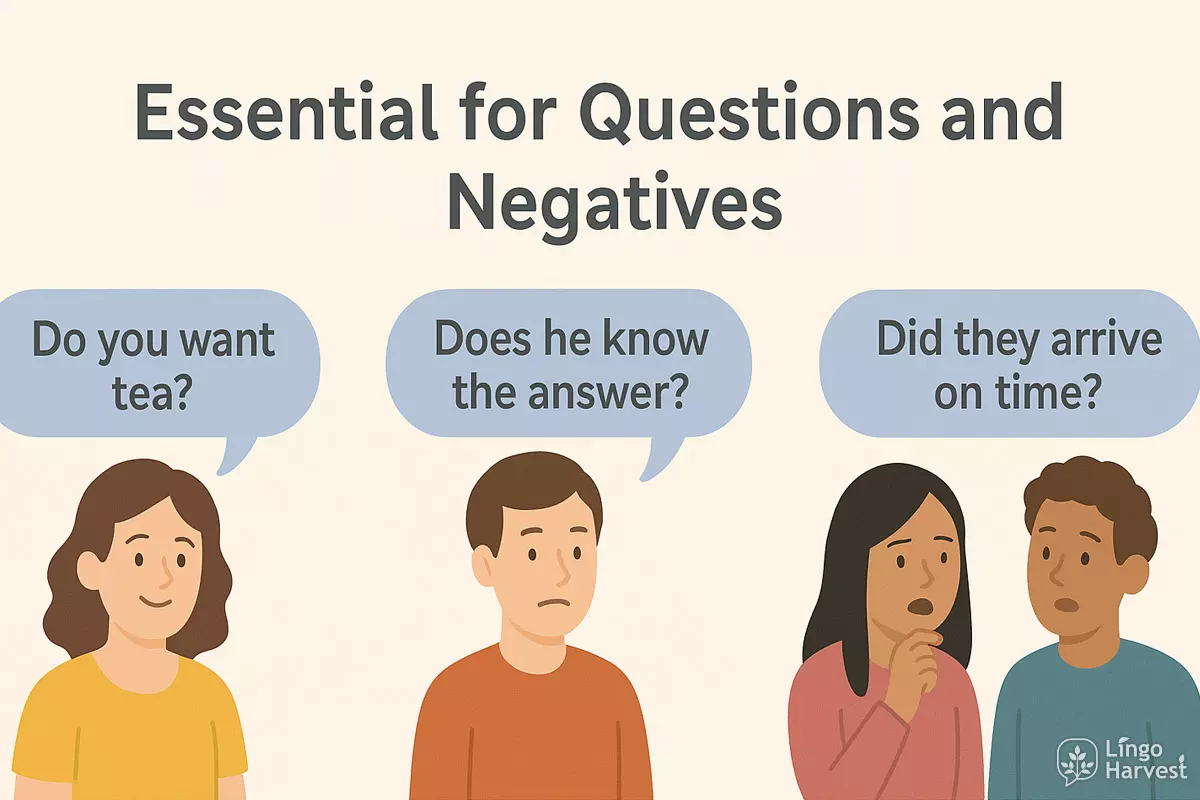
To illustrate how verbs differ in their requirements, here are examples of verbs grouped by how many core elements they combine with:
- Rain (no participants needed beyond dummy subject): "It rains."
- Arrive (subject only): "The train arrived."
- Eat (subject and object): "She eats an apple."
- Show (subject, direct object, indirect object): "She showed him the letter."
- Make (subject, object, object complement): "They made her president."
- Tell (subject, object, indirect object): "He told me a story."
- Cost (subject, object, value): "It cost me fifty dollars."
- Call (subject, object, object complement): "They called him a genius."
- Give (subject, object, recipient): "She gave her friend a gift."
- Promise (subject, recipient, thing): "He promised her a trip."
Why Understanding Valency Matters
Recognizing how many arguments a verb can take helps with sentence formation, translation, and language learning. For example, some languages allow verbs to drop certain arguments, while others require them for grammaticality. Knowing a verb’s valency can prevent mistakes like leaving out needed objects or adding too many elements.
Intransitive Valency
Verbs that require only a subject and do not take a direct object are called intransitive. These verbs express actions or states that are complete without needing anything beyond the subject. For example, in “She sleeps,” the verb “sleeps” does not have an object; the action is performed solely by the subject. This pattern is common across many languages and is essential for understanding how verb argument structures work.
Common Intransitive Verbs
Some verbs naturally occur without objects. Here are several English examples:
- arrive
- fall
- die
- laugh
- run
- swim
- sneeze
- exist
- sleep
- disappear
- cry
- grow (intransitive: “The plant grows.”)
- shout
- rise
- occur
- wait
- wander
- collapse
- work
- smile
How Intransitive Verbs Function
The main feature of these verbs is that they do not accept a direct object. Instead, they may be followed by adverbs, prepositional phrases, or nothing at all. For example:
- He laughed loudly. (adverb)
- The bird flew over the lake. (prepositional phrase)
- The sun rises. (no extra elements)
Adding a direct object to an intransitive verb would make the sentence ungrammatical: *She sleeps the bed ❌.
Comparison with Other Verb Types
It is helpful to contrast these verbs with transitive and ditransitive ones. The table below summarizes the differences in argument structure:
| Verb Type | Required Arguments | Example |
|---|---|---|
| Intransitive | Subject only | The child sleeps. |
| Transitive | Subject + Direct Object | She reads a book. |
| Ditransitive | Subject + Direct Object + Indirect Object | He gave her a gift. |
Notes on Ambitransitive Verbs
Some English verbs can be used both with and without a direct object, depending on context, such as "eat" or "read." When these verbs appear without an object, they function intransitively (“He eats.”), but their ability to take an object distinguishes them from strictly intransitive verbs. Understanding which verbs are limited to a subject alone helps with sentence construction and comprehension, especially when learning new languages or analyzing syntax.
Transitive Valency
Verbs that require both a subject and a direct object are known as transitive. This means the action they express must "carry over" to something or someone else in the sentence. For example, in "She reads books," the verb "reads" needs both the person doing the action and the thing being read. Without a direct object, such verbs often sound incomplete or awkward.
What Makes a Verb Transitive?
A verb is considered transitive if it takes at least two core arguments: the agent (doer) and the patient (receiver of the action). In English, this typically means the verb is followed by a noun or pronoun. Some verbs can be exclusively transitive, while others may alternate between transitive and intransitive forms depending on context.
- eat – She eats apples.
- find – They found a wallet.
- build – We built a house.
- see – I see birds.
- write – He writes letters.
- hold – She held the baby.
- send – I sent a message.
- bring – Please bring your ID.
- paint – They painted the fence.
- fix – He fixed the car.
- open – She opened the door.
- answer – He answered the question.
- break – She broke the glass.
- choose – They chose a winner.
- carry – He carried the box.
- lose – I lost my keys.
- meet – We met her friend.
- call – She called her mother.
- catch – He caught the ball.
- buy – They bought a ticket.
Transitive vs. Intransitive Usage
Some verbs can function as both transitive and intransitive depending on how they're used. For example, "run" is usually intransitive ("She runs daily"), but can be transitive in "She runs a business."
| Verb | Transitive Example | Intransitive Example |
|---|---|---|
| run | She runs a company. | She runs (no object) every morning. |
| change | He changed the tire. | He changed (no object) quickly. |
| open | She opened the window. | The window opened (no object) suddenly. |
| break | He broke the vase. | The vase broke (no object). |
Key Points
- Transitive predicates require an object to complete their meaning.
- Many English verbs can shift between needing an object and not, depending on context.
- Recognizing whether a verb is transitive helps with sentence construction and clarity.
Ditransitive Verbs
Verbs that take three participants—a subject, a direct object, and an indirect object—are known for their ability to express giving, showing, or transferring something from one entity to another. In English, these verbs typically describe actions where something is given or communicated to someone else. For example, in the sentence “She gave her friend a gift,” “gave” connects the subject (“She”), the direct object (“a gift”), and the indirect object (“her friend”).
Common Patterns and Examples
Most languages have a set of verbs that naturally fit this pattern. Here are several English verbs that regularly take both a direct and an indirect object:
- give
- send
- show
- offer
- bring
- teach
- tell
- lend
- read (to someone)
- pass
- promise
- write
- sell
- throw (to someone)
- pay
- hand
- grant
- award
Notice that these verbs can often be used in two syntactic constructions: “She gave her friend a gift” (double object construction) and “She gave a gift to her friend” (prepositional object construction).
How Ditransitive Structures Work
The key feature of this verb type is the presence of two objects. One object typically refers to a thing (the direct object), while the other refers to a person or recipient (the indirect object). The order and marking of these objects can vary by language. English usually places the recipient before the thing in the double object construction, but other languages may use case markings, word order, or prepositions to signal the roles.
Comparison with Other Verb Types
To better understand how these verbs fit into the larger system of verb valency, consider the following comparison:
| Verb Type | Number of Arguments | Example Sentence |
|---|---|---|
| Intransitive | 1 (subject) | He sleeps. |
| Transitive | 2 (subject + direct object) | She reads a book. |
| Ditransitive | 3 (subject + direct object + indirect object) | They sent her a letter. |
Key Points to Remember
- These verbs require both a direct and an indirect object to complete their meaning.
- Not all verbs can take three arguments; those that do are relatively specialized.
- Syntax and marking of participants can differ widely between languages.
- Understanding the structure helps in learning new languages and in analyzing sentence patterns.
By recognizing how these verbs function, you can better identify argument structure and interpret complex sentences across languages.
Verb Patterns
How a verb connects to its arguments—such as subjects, objects, and complements—depends on its grammatical structure. These configurations, sometimes called constructions, play a crucial role in how we express actions and relationships in sentences. By understanding these frameworks, learners can predict what kinds of words or phrases typically follow certain verbs.
Common Patterns and Examples
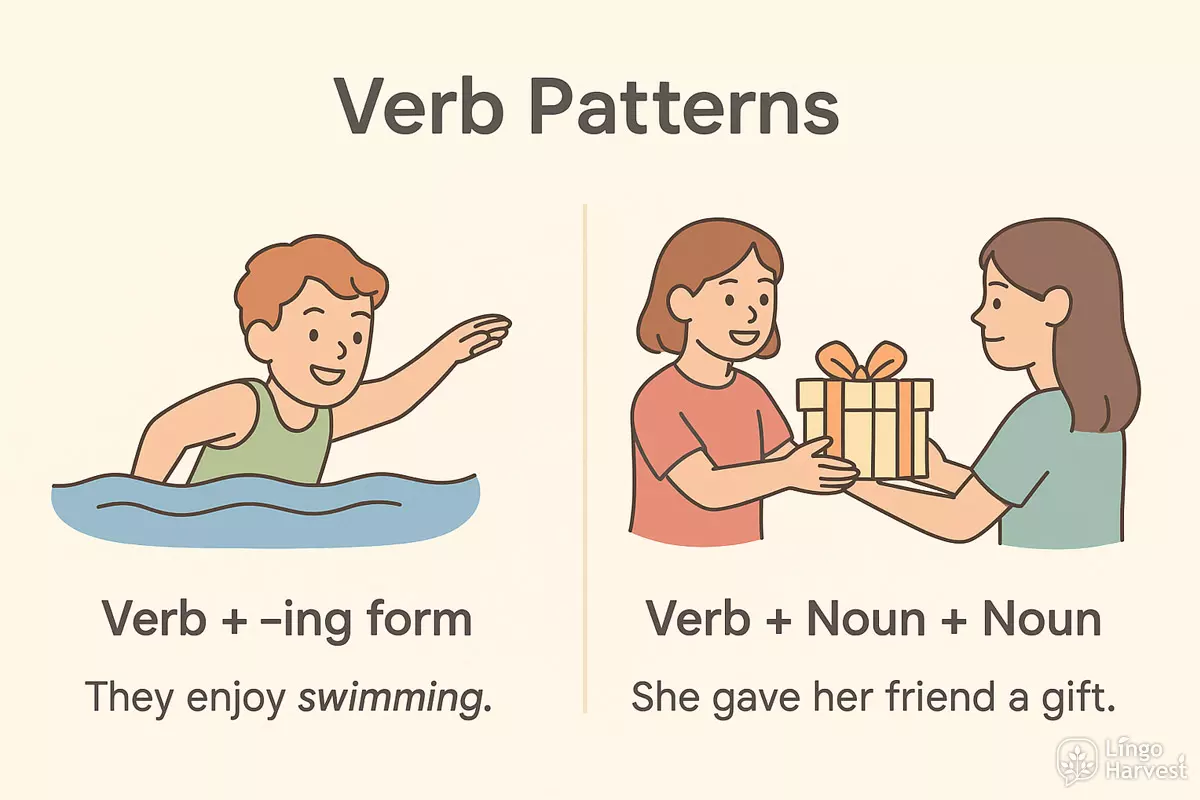
Different verbs require different structures. Here are some widely used ways verbs combine with other elements:
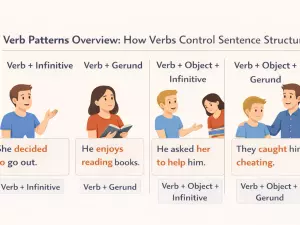
- Verb + Noun: She reads books.
- Verb + to-infinitive: He wants to leave.
- Verb + -ing form: They enjoy swimming.
- Verb + Noun + Noun: She gave her friend a gift.
- Verb + Noun + to-infinitive: I asked him to help.
- Verb + Noun + -ing form: We caught him cheating.
- Verb + that-clause: She thinks that he’s right.
- Verb + wh-clause: I know what you mean.
- Verb + prepositional phrase: She looked at the painting.
- Verb + adjective: The soup tastes delicious.
- Verb + noun + adjective: They painted the wall blue.
- Verb + object + bare infinitive: We made them leave.
- Verb + object + past participle: She had her car repaired.
Valency and Its Effects
The number of participants a verb can take—its valency—directly determines which of these constructions are possible. For instance, intransitive verbs need only a subject (She laughs), while ditransitive verbs require a subject and two objects (He sent her a message). Some verbs are flexible and can fit into multiple arrangements, while others are quite fixed.
Comparison of Verb Structures
Below is a summary showing how different types of verbs typically combine with arguments:
| Verb Type | Typical Structure | Example |
|---|---|---|
| Intransitive | Verb + (Subject) | The baby cried. |
| Monotransitive | Verb + Object | She opened the door. |
| Ditransitive | Verb + Indirect Object + Direct Object | He gave her a book. |
| Complex Transitive | Verb + Object + Complement | We elected her president. |
| Linking | Verb + Subject Complement | The soup smells good. |
Why Patterns Matter
Choosing the correct structure isn’t just a matter of grammar rules—it can change the whole meaning of a sentence. For example, compare “She stopped to eat” (she paused in order to eat) and “She stopped eating” (she ceased the activity of eating). Noticing which patterns verbs allow helps with both understanding and producing clear, accurate sentences.
Clear Examples
Understanding how many participants a verb requires is easier with practical illustrations. Let's look at how different verbs function depending on their argument structure, moving from those that need no additional elements to those that require several.
Common Patterns by Valency
- Zero-argument (Impersonal) verbs: It rains. (No subject or object referring to a real entity.)
- One-argument (Intransitive) verbs: The baby laughs. (Only a subject is present.)
- Two-argument (Transitive) verbs: She reads books. (Subject and direct object.)
- Three-argument (Ditransitive) verbs: He gave her flowers. (Subject, direct object, and indirect object.)
- Four-argument (Complex verbs, rare): They bet him ten dollars on the race. (Subject, two objects, and a prepositional phrase.)
Valency at a Glance
| Verb | Arguments Required | Example Sentence |
|---|---|---|
| rain | 0 | It rains. |
| sleep | 1 | She sleeps. |
| eat | 2 | He eats an apple. |
| give | 3 | They gave her a gift. |
| put | 3 | She put the book on the table. |
| bet | 4 | He bet her five dollars on the game. |
More Example Sentences
- Arrive: The train arrived. ✅ (Needs only a subject.)
- Kick: She kicked the ball. → (Subject + object.)
- Show: They showed us their project. (Subject + direct object + indirect object.)
- Resemble: This plant resembles a cactus. (Subject + object.)
- Disappear: The cat disappeared. (Subject only.)
- Write: I wrote a letter. (Subject + object.)
- Tell: She told him the news. (Subject + indirect object + direct object.)
- Boil: The water boils. (Subject only.)
- Borrow: He borrowed a pen from me. (Subject + object + source.)
- Teach: She taught the students math. (Subject + indirect object + direct object.)
These examples highlight how the number and type of required elements can vary greatly from one verb to another, which is central to understanding argument structure in language.
Mini Practice
Exploring how verbs interact with their arguments helps clarify sentence structure. Try these activities to reinforce your understanding of how many elements a verb requires to form a complete idea.
Identify the Number of Arguments
For each verb below, decide whether it typically takes zero, one, two, or three arguments. (Arguments can be subjects, direct objects, or indirect objects.)
- run
- give
- sleep
- eat
- put
- rain
- show
- arrive
- tell
- grow
Show answers
- run – 1 (subject)
- give – 3 (subject, direct object, indirect object)
- sleep – 1 (subject)
- eat – usually 2 (subject, object), but can be 1 if object is omitted
- put – 3 (subject, object, location)
- rain – 0 (impersonal, no argument needed; sometimes 1 if subject is used idiomatically)
- show – 3 (subject, object, recipient)
- arrive – 1 (subject)
- tell – 3 (subject, object, recipient)
- grow – 1 (subject; can be 2 in causative constructions)
Match the Verb to Its Typical Argument Pattern
Look at the verbs and the types of arguments they typically take. Match each verb to the correct argument structure.
| Verb | Typical Argument Pattern |
|---|---|
| sleep | subject only |
| give | subject + direct object + indirect object |
| eat | subject + (object) |
| rain | none (impersonal) |
| put | subject + object + location |
| see | subject + object |
| arrive | subject only |
| show | subject + object + recipient |
| grow (intransitive) | subject only |
| grow (transitive/causative) | subject + object |
Show answers
- sleep – subject only
- give – subject + direct object + indirect object
- eat – subject + (object)
- rain – none (impersonal)
- put – subject + object + location
- see – subject + object
- arrive – subject only
- show – subject + object + recipient
- grow (intransitive) – subject only
- grow (transitive/causative) – subject + object
Practice: Create Sentences
Write one sentence for each pattern below, using any verb you like. Focus on showing the correct number of required elements.
- A verb that needs only a subject.
- A verb that requires a subject and a direct object.
- A verb that takes a subject, a direct object, and an indirect object or location.
- An impersonal verb (no true subject).
Show answers
- I slept. (subject only)
- She reads books. (subject + object)
- He gave her a gift. / She put the book on the table. (subject + object + recipient/location)
- It rains. (impersonal)
These tasks should help you recognize different verb patterns and how arguments fit into sentences. Try creating your own examples with new verbs to deepen your understanding.