Regular vs Irregular Verbs: Morphological Difference

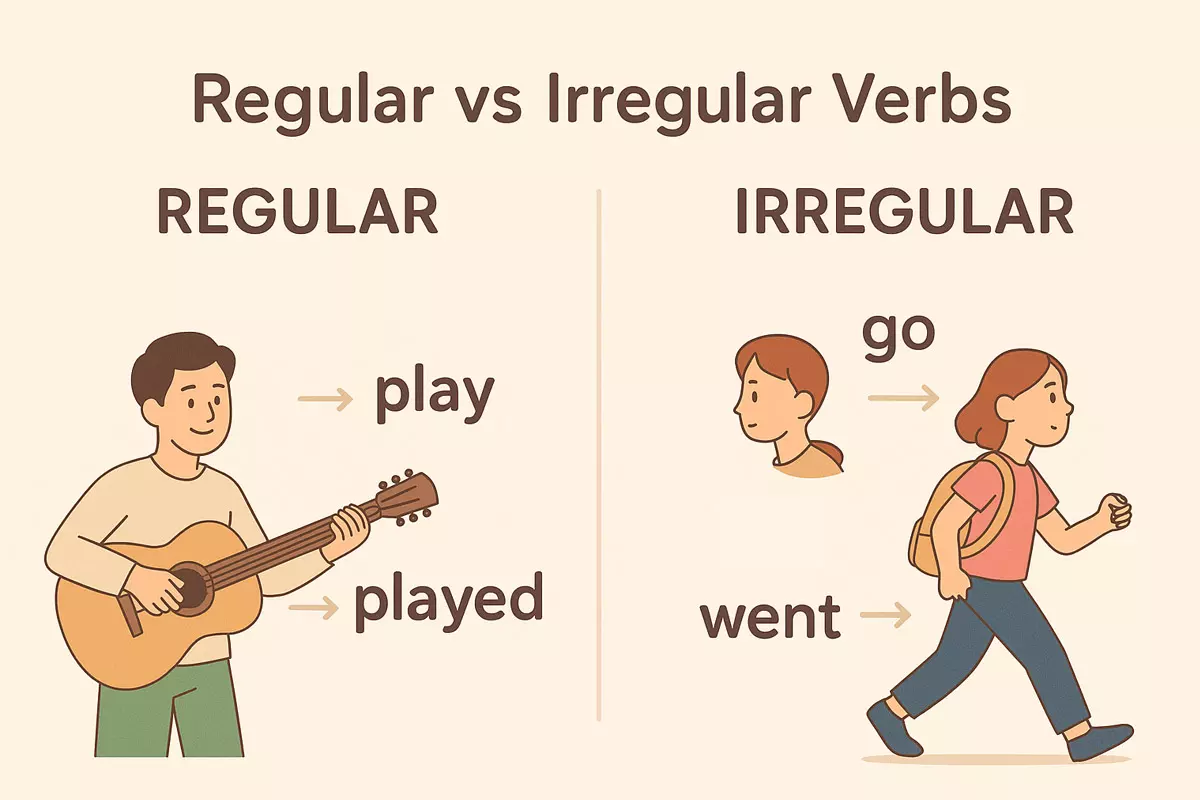 The article defines regular verbs and their ed pattern, outlines groups and examples of irregular verbs, gives pronunciation tips, highlights frequent mistakes, and provides a practice list for review. It’s a practical guide based strictly on these key topics.
Have you ever wondered why some English verbs follow regular patterns while others seem to break all the rules? The way verbs form their past tense and past participle can reveal a lot about the structure and history of the English language. Regular verbs simply add -ed to form the past tense, making them easy to recognize and use. Irregular verbs, on the other hand, often change their spelling in unpredictable ways, such as “go” becoming “went.” Learning these patterns helps improve both writing and speaking skills.
Meaning of Regular Verbs
Regular verbs are those whose past tense and past participle forms follow a predictable pattern, typically by adding -ed (or sometimes -d or -ied) to the base form. This pattern makes it easy to identify and use them, especially for learners and in systematic grammar explanations. The consistency in their formation is what separates them from verbs with irregular changes.
How Regular Verbs Form Their Past Tenses
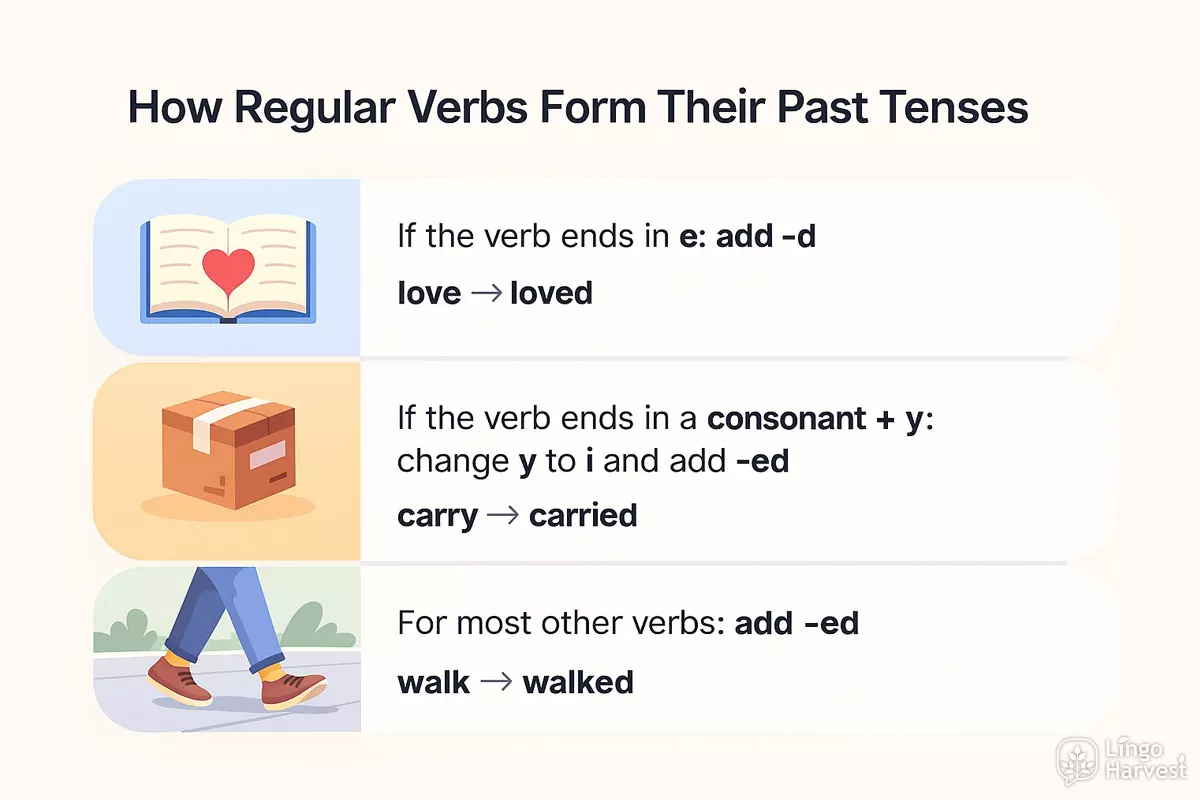
The defining feature of this group lies in their endings. Most simply add -ed to the base, but spelling rules may apply:
- If the verb ends in e: add -d (e.g., love → loved).
- If the verb ends in a consonant + y: change y to i and add -ed (e.g., carry → carried).
- For most other verbs: add -ed (e.g., walk → walked).
Common Examples of Regular Verbs
Here are some everyday verbs that follow this straightforward pattern:
- work → worked
- play → played
- talk → talked
- clean → cleaned
- open → opened
- jump → jumped
- visit → visited
- help → helped
- start → started
- call → called
- listen → listened
- live → lived
- arrive → arrived
- close → closed
- study → studied
- stop → stopped
- cook → cooked
- watch → watched
- answer → answered
- turn → turned
Summary of Regular Verb Pattern
The predictable construction of these verbs makes them easier to learn and use. Here’s a quick overview of the typical transformation:
| Base Form | Past Simple / Past Participle |
|---|---|
| play | played |
| clean | cleaned |
| study | studied |
| arrive | arrived |
| stop | stopped |
In summary, verbs in this category share a reliable way of forming their past tense, which sets them apart from those that change unpredictably. This regularity is a key morphological difference in English verb conjugation.
-ed Pattern
Regular verbs in English are recognized by their predictable method of forming the past tense and past participle: by adding the suffix -ed to the base form. This consistent system stands in contrast to the unpredictable changes seen in irregular verbs. Understanding this pattern is essential for clear communication and for learners aiming to master verb forms efficiently.
How Regular Verbs Form Their Past Tense
For most verbs, simply attach -ed to the base form. However, there are a few spelling adjustments depending on the ending of the verb:
- If the verb ends with e, only d is added: love → loved.
- For verbs ending in a consonant plus y, change y to i and add ed: carry → carried.
- Verbs with a single vowel followed by a single consonant often double the final consonant: stop → stopped.
Examples of Regular Verb Forms
Here are some commonly used verbs and their past tense and past participle forms:
- walk → walked
- play → played
- jump → jumped
- clean → cleaned
- talk → talked
- open → opened
- start → started
- call → called
- need → needed
- want → wanted
- work → worked
- move → moved
- help → helped
- live → lived
- finish → finished
- watch → watched
- wait → waited
- close → closed
- arrive → arrived
- show → showed
Spelling Rules and Pronunciation
The -ed ending can be pronounced in three ways: /t/ (as in walked), /d/ (as in played), or /ɪd/ (as in wanted). The pronunciation depends on the final sound of the base verb, not the spelling.
Comparison: Regular vs Irregular Forms
The main difference is predictability. With regular verbs, both the past simple and past participle are formed by the same addition. In contrast, irregular verbs often use unique forms that must be memorized.
| Base Form | Past Simple & Past Participle |
|---|---|
| work | worked |
| clean | cleaned |
| close | closed |
| play | played |
| arrive | arrived |
| finish | finished |
| wait | waited |
| call | called |
Mastering this system allows speakers and writers to form a wide range of verb tenses with ease, making regular verbs a reliable foundation in English grammar.
Irregular Verb Groups
Understanding the main patterns among non-standard verbs helps learners recognize and remember their forms. While these verbs do not follow the typical "-ed" ending for the past tense, they often fall into a few broad families based on how their forms change. Some verbs remain unchanged, others change vowels, and a few alter completely or follow less common shifts.
Common Patterns Among Non-Regular Verbs
Many of these verbs can be categorized by the way their base, past simple, and past participle forms relate. Here are some of the most frequent types:
- No change: The base, past, and participle forms are identical (e.g. put, cut, shut).
- Vowel change: Only the internal vowel shifts (e.g. sing – sang – sung, drink – drank – drunk).
- Ending in -t: Some verbs change their ending to -t (e.g. keep – kept – kept, build – built – built).
- Mixed changes: A few verbs combine vowel and consonant changes (e.g. bring – brought – brought, buy – bought – bought).
- Unique forms: Several verbs form past and participle with unique endings or irregularities (e.g. go – went – gone, be – was/were – been).
Examples of Major Irregular Verb Families
Below is a selection of verbs, grouped by how their forms change, to illustrate these patterns:
| Pattern | Examples (Base – Past Simple – Past Participle) |
|---|---|
| No Change | put – put – put cut – cut – cut shut – shut – shut let – let – let |
| Vowel Change | begin – began – begun sing – sang – sung swim – swam – swum ring – rang – rung |
| -t Ending | keep – kept – kept sleep – slept – slept build – built – built feel – felt – felt |
| Mixed/Unique Change | go – went – gone have – had – had be – was/were – been do – did – done |
Further Examples of Non-Standard Forms
Some additional frequently used verbs with unpredictable forms include:
- make – made – made
- find – found – found
- take – took – taken
- write – wrote – written
- see – saw – seen
- break – broke – broken
- choose – chose – chosen
- teach – taught – taught
- catch – caught – caught
- stand – stood – stood
- understand – understood – understood
- leave – left – left
- meet – met – met
- lose – lost – lost
- send – sent – sent
Recognizing these groupings and their typical changes makes mastering non-regular verbs less overwhelming. While memorization is still necessary, noticing patterns can help learners predict forms more confidently.
Common Irregular Verbs
Irregular verbs in English don’t follow the predictable "-ed" ending pattern when forming their past tense or past participle forms. Instead, their changes often involve vowel shifts, unique endings, or even completely different words. Understanding some of the most frequently used examples can help learners recognize and use them correctly in everyday communication.
Typical Patterns Found in Irregular Verbs

Many verbs in this category exhibit similar irregularities. Some change internal vowels (like "sing" becoming "sang"), while others remain the same in all forms (such as "cut"). A few have entirely unique transformations. Below, you’ll find a selection of widely used irregular verbs organized by their base, past simple, and past participle forms:
| Base Form | Past Simple | Past Participle |
|---|---|---|
| go | went | gone |
| see | saw | seen |
| eat | ate | eaten |
| take | took | taken |
| begin | began | begun |
| write | wrote | written |
| find | found | found |
| give | gave | given |
| come | came | come |
| run | ran | run |
| break | broke | broken |
| choose | chose | chosen |
| drink | drank | drunk |
| drive | drove | driven |
| fall | fell | fallen |
| know | knew | known |
| swim | swam | swum |
| catch | caught | caught |
| teach | taught | taught |
| build | built | built |
Noteworthy Features and Usage Tips
Some verbs never change form (e.g., "put" → "put" → "put"), while others only change spelling slightly (like "buy" → "bought"). Learning these exceptions is essential for fluency. The verbs listed above are especially important because they appear frequently in both spoken and written English. Practice using them in sentences to internalize their unique forms and avoid common mistakes.
Pronunciation Tips
Understanding how to say past tense forms correctly helps avoid common mistakes, especially since regular and irregular verbs differ not only in spelling but also in sound. English learners often stumble over the past tense endings, so let’s break down the main pronunciation patterns.
Regular Verbs: The -ed Ending
For regular verbs, the past tense is formed by adding -ed to the base form. However, the way -ed is pronounced depends on the final sound of the verb:
- If the verb ends in a voiceless sound (like p, k, f, s, sh, ch), -ed is pronounced as /t/.
Examples: walked (/wɔːkt/), laughed (/læft/). - If the verb ends in a voiced sound (like b, g, v, z, l, m, vowels), -ed is pronounced as /d/.
Examples: played (/pleɪd/), lived (/lɪvd/). - If the verb ends in t or d sounds, -ed is pronounced as /ɪd/ or /əd/.
Examples: wanted (/ˈwɒntɪd/), needed (/ˈniːdɪd/).
Irregular Verbs: Unique Challenges
Irregular verbs often change their internal vowel, final sound, or both, and do not follow a predictable pattern. This means their pronunciation must be memorized individually. Some common shifts include:
- eat → ate (/iːt/ → /eɪt/)
- go → went (/ɡəʊ/ → /wɛnt/)
- buy → bought (/baɪ/ → /bɔːt/)
- sing → sang (/sɪŋ/ → /sæŋ/)
- find → found (/faɪnd/ → /faʊnd/)
- take → took (/teɪk/ → /tʊk/)
- break → broke (/breɪk/ → /brəʊk/)
- catch → caught (/kætʃ/ → /kɔːt/)
- see → saw (/siː/ → /sɔː/)
- run → ran (/rʌn/ → /ræn/)
Comparing Past Tense Endings
Below is a comparison of how regular and irregular verbs handle past tense pronunciation:
| Regular Verb Example | Irregular Verb Example | Pronunciation |
|---|---|---|
| talked | went | /tɔːkt/ vs /wɛnt/ |
| needed | ran | /ˈniːdɪd/ vs /ræn/ |
| played | bought | /pleɪd/ vs /bɔːt/ |
| watched | sang | /wɒtʃt/ vs /sæŋ/ |
Tips for Practice
- Listen to native speakers and pay attention to the endings.
- Practice saying regular and irregular forms aloud to notice the differences.
- Record yourself and compare with correct pronunciations.
- Group verbs by similar pronunciation rules to make them easier to remember.
Mastering these sound patterns will help you speak with greater confidence and clarity.
Frequent Mistakes
Learners often stumble when distinguishing between regular and irregular verb forms, especially in the past simple and past participle. The confusion usually stems from overgeneralizing patterns, misapplying endings, or mixing up verb classes. Understanding these common pitfalls can help you avoid them in your own writing and speech.
Over-regularization
One of the most widespread issues is adding -ed to verbs that are actually irregular. This happens when students try to apply the regular formation rules to all verbs, even those that have unique forms. Here are some examples:
- “goed” instead of went
- “buyed” instead of bought
- “catched” instead of caught
- “runned” instead of ran
Incorrect Irregular Forms
Sometimes, learners choose the wrong irregular form or confuse similar verbs. This can happen with verbs that look alike or have unusual changes:
- “bringed” for brought
- “teached” for taught
- “swimmed” for swam
- “drived” for drove
Mixing Past Simple and Past Participle
Another frequent error is using the past simple form instead of the past participle (or vice versa), especially with irregular verbs:
- “I have went” instead of I have gone
- “She has ate” instead of She has eaten
- “They have saw” instead of They have seen
- “He has wrote” instead of He has written
Confusing Regular and Irregular Patterns
It’s also common to misclassify verbs, believing they belong to one group when they actually belong to the other. Below is a structured comparison of regular and irregular verb forms that often cause confusion:
| Base Form | Incorrect Past | Correct Past | Type |
|---|---|---|---|
| go | goed ❌ | went ✅ | Irregular |
| walk | walkt ❌ | walked ✅ | Regular |
| catch | catched ❌ | caught ✅ | Irregular |
| play | play ❌ | played ✅ | Regular |
| eat | eated ❌ | ate ✅ | Irregular |
| study | studieded ❌ | studied ✅ | Regular |
| run | runned ❌ | ran ✅ | Irregular |
| find | finded ❌ | found ✅ | Irregular |
Confusion with Spelling Changes
Regular verbs sometimes require spelling adjustments before adding -ed. Missing these changes is another source of error:
- “stoped” instead of stopped
- “planed” instead of planned
- “cryed” instead of cried
- “tryed” instead of tried
Summary Tips
To reduce mistakes:
- Memorize common irregular verbs and their forms.
- Check the spelling rules for regular verbs ending in -y or with double consonants.
- Practice with both past simple and past participle forms.
- Review verbs with similar patterns to avoid confusion.
Awareness of these typical issues will help you use verb forms more accurately and confidently.
Practice List
Understanding how regular and irregular verbs differ in their forms is essential for mastering English verb morphology. Here you’ll find categorized examples, exercises, and a structured comparison to help reinforce these distinctions.
Common Regular Verbs
- walk → walked
- play → played
- jump → jumped
- clean → cleaned
- open → opened
- talk → talked
- visit → visited
- call → called
- work → worked
- start → started
Common Irregular Verbs
- go → went
- eat → ate
- see → saw
- take → took
- come → came
- find → found
- make → made
- buy → bought
- begin → began
- swim → swam
Comparison: Regular vs Irregular Verb Forms
| Infinitive | Past Simple (Regular) | Past Simple (Irregular) |
|---|---|---|
| walk | walked | - |
| play | played | - |
| go | - | went |
| eat | - | ate |
| make | - | made |
| call | called | - |
Exercise: Identify the Verb Type
For each verb below, decide if it is regular or irregular.
- travel
- drink
- study
- run
- help
- sing
Show answers
- travel – regular
- drink – irregular
- study – regular
- run – irregular
- help – regular
- sing – irregular
Fill in the Past Form
Write the past simple form for each verb:
- stop
- write
- plan
- give
- watch
- leave
Show answers
- stopped
- wrote
- planned
- gave
- watched
- left
Reviewing these examples and exercises will help you internalize the morphological patterns that set these two verb types apart. Practice regularly to become comfortable with both predictable and unpredictable verb forms in English.