Regular and Irregular Verbs: Basics You Must Know

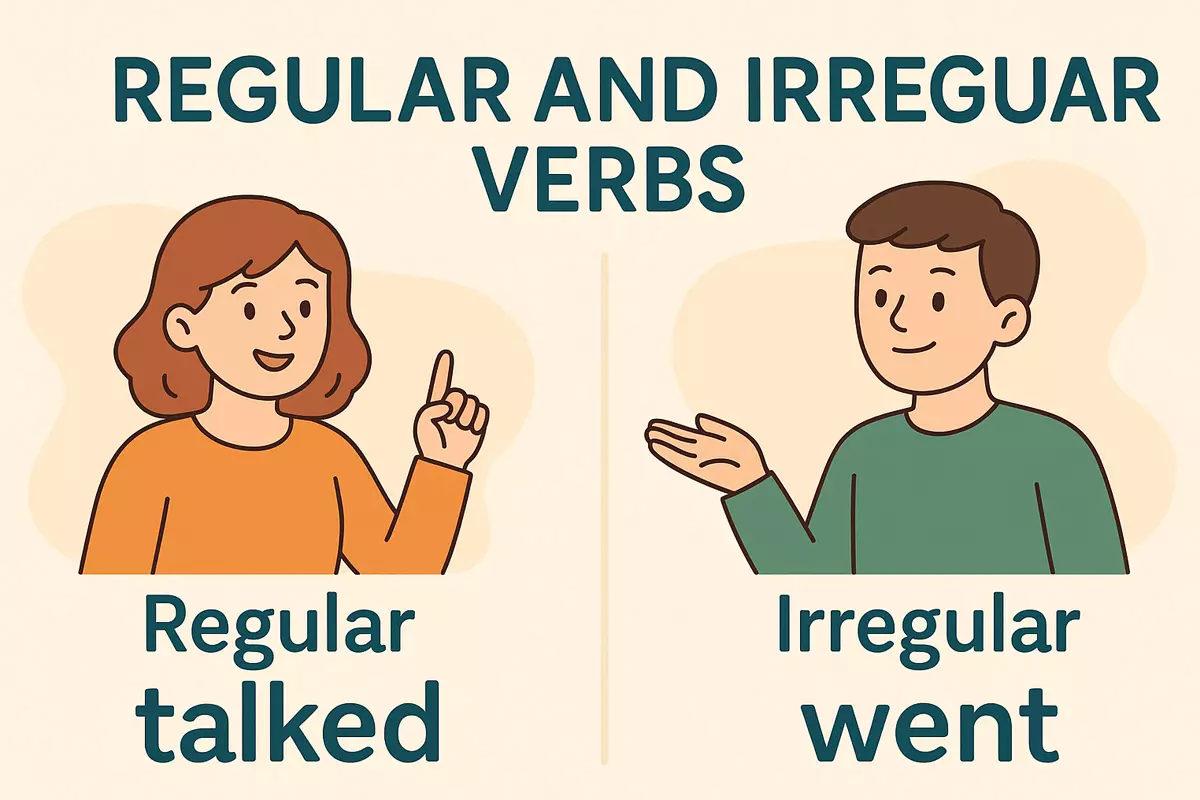 Here we the difference between regular and irregular verbs, explains ed ending rules for both pronunciation and spelling, lists the most common irregular verb forms, gives tips to learn them faster, points out common mistakes, and provides practice.
Mastering the difference between standard and irregular verb forms is crucial for clear communication in English, as these verbs often change in unexpected ways depending on the tense. By learning how verbs shift between present, past, and past participle forms, you can express yourself more accurately and confidently. This knowledge not only strengthens your writing but also helps you avoid common mistakes when speaking, making your overall use of the language more effective and precise.
What Are Regular Verbs?
Regular verbs are action words that follow a predictable pattern when changing from their base form to past tense and past participle. In English, these verbs typically form both their past simple and past participle by adding -ed (or -d if the verb ends in e) to the end of the base form. This makes them much easier to learn and use compared to verbs that don’t follow these rules.
How Regular Verbs Change Form
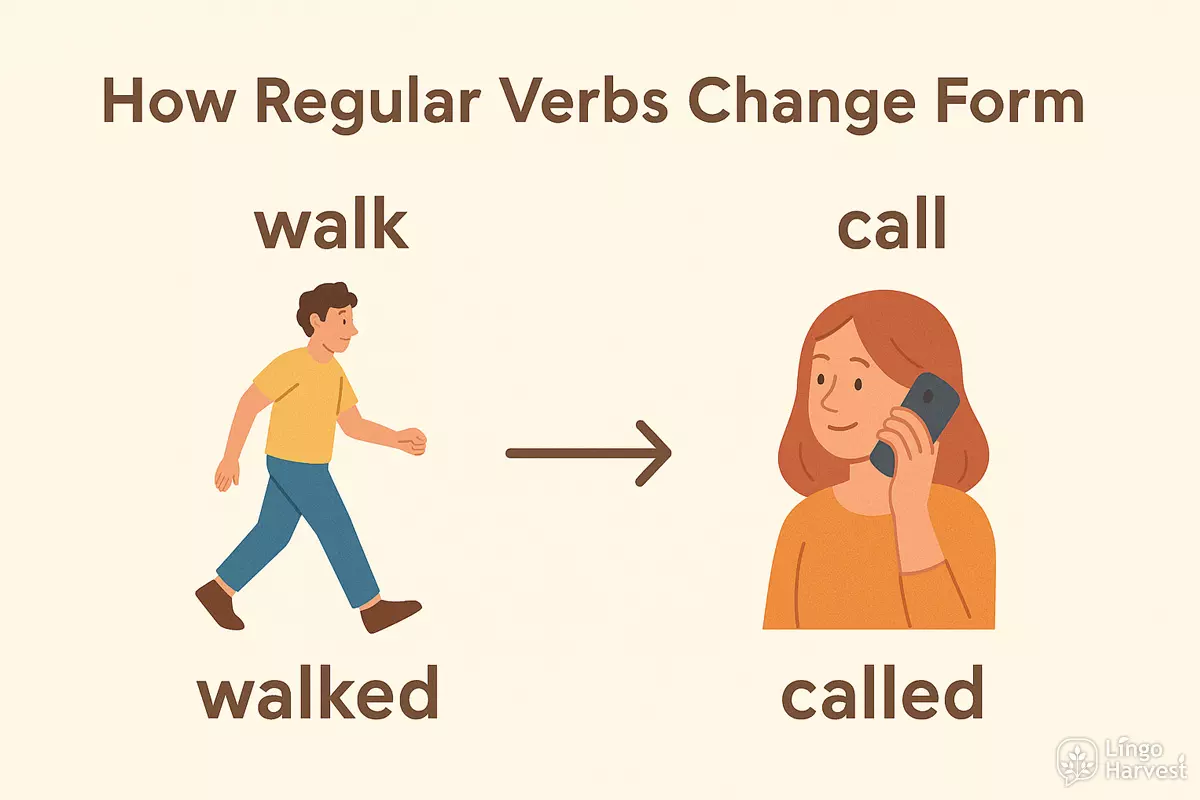
To form the past tense and past participle, just apply the standard ending. For example, “walk” becomes “walked,” and “call” becomes “called.” There are some spelling rules to remember, but the structure stays the same for all verbs in this group.
- Add -ed: For most verbs (e.g., “play” → “played”)
- Add -d: If the verb already ends with “e” (e.g., “live” → “lived”)
- Double the final consonant: For some short verbs ending with consonant-vowel-consonant (e.g., “stop” → “stopped”)
- Change -y to -ied: If the verb ends with a consonant + “y” (e.g., “carry” → “carried”)
Common Examples of Regular Verbs
Here are some frequently used regular verbs and their forms:
- work → worked
- talk → talked
- clean → cleaned
- open → opened
- play → played
- wait → waited
- cook → cooked
- need → needed
- call → called
- ask → asked
- close → closed
- help → helped
- move → moved
- start → started
- rain → rained
- want → wanted
- finish → finished
- jump → jumped
- live → lived
- smile → smiled
Regular Verb Patterns
The predictability of regular verbs makes them straightforward to use in writing and speech. Unlike their irregular counterparts, there is no need to memorize unique past forms for each word; just apply the standard rules. This consistency helps English learners build confidence when communicating in the past tense.
-ed Ending Rules (pronunciation and spelling)
Understanding how to add -ed to regular verbs is essential for clear communication in English. Both spelling and pronunciation follow certain patterns, though there are exceptions. Let’s break down these patterns so you can use them confidently.
Spelling Guidelines for Regular Verbs
When forming the past simple or past participle of regular verbs, the -ed ending is added, but the spelling can change depending on the verb’s ending:
- If the verb ends in e: just add d (e.g., love → loved).
- If the verb ends in a consonant + y: change the y to i and add ed (e.g., cry → cried).
- If the verb ends in a vowel + y: simply add ed (e.g., play → played).
- If the verb is a one-syllable verb ending with consonant-vowel-consonant (except w, x, y): double the final consonant and add ed (e.g., stop → stopped).
- For most other verbs, just add ed (e.g., work → worked).
Pronunciation Patterns
The -ed ending can be pronounced in three different ways, depending on the final sound of the verb. Here’s a quick guide:
| Ending Sound of Verb | Pronunciation of -ed | Examples |
|---|---|---|
| Voiceless consonants (e.g., k, p, s, f, sh) | /t/ | worked, stopped, washed, laughed |
| Voiced consonants (e.g., b, g, l, m, n, v, z, r) or vowel sounds | /d/ | played, cleaned, called, loved, moved |
| Ends with /t/ or /d/ sounds | /ɪd/ or /əd/ | wanted, added, needed, started |
Quick Reference Examples
Here are common verbs showing these rules:
- Jump → jumped (/t/)
- Open → opened (/d/)
- End → ended (/ɪd/)
- Miss → missed (/t/)
- Live → lived (/d/)
- Shout → shouted (/ɪd/)
- Walk → walked (/t/)
- Plan → planned (double n, /d/)
- Stop → stopped (double p, /t/)
- Hurry → hurried (change y to i, /d/)
Paying attention to these details will help you avoid common mistakes and make your spoken English sound more natural.
What Are Irregular Verbs?
Irregular verbs are verbs that do not follow the standard pattern of adding -ed to form their past simple and past participle. Instead, their forms can change unpredictably, sometimes altering vowels, consonants, or changing completely. This means you often have to memorize each form individually, as the usual rules for regular verbs don’t apply.
How Irregular Verbs Differ From Regular Verbs
The main difference lies in how their past forms are constructed. While regular verbs simply add -ed (like walk → walked), irregular verbs may change their spelling in unique ways or not change at all. Some verbs remain the same in all forms, while others alter their vowels or have distinct endings.
Common Patterns and Examples
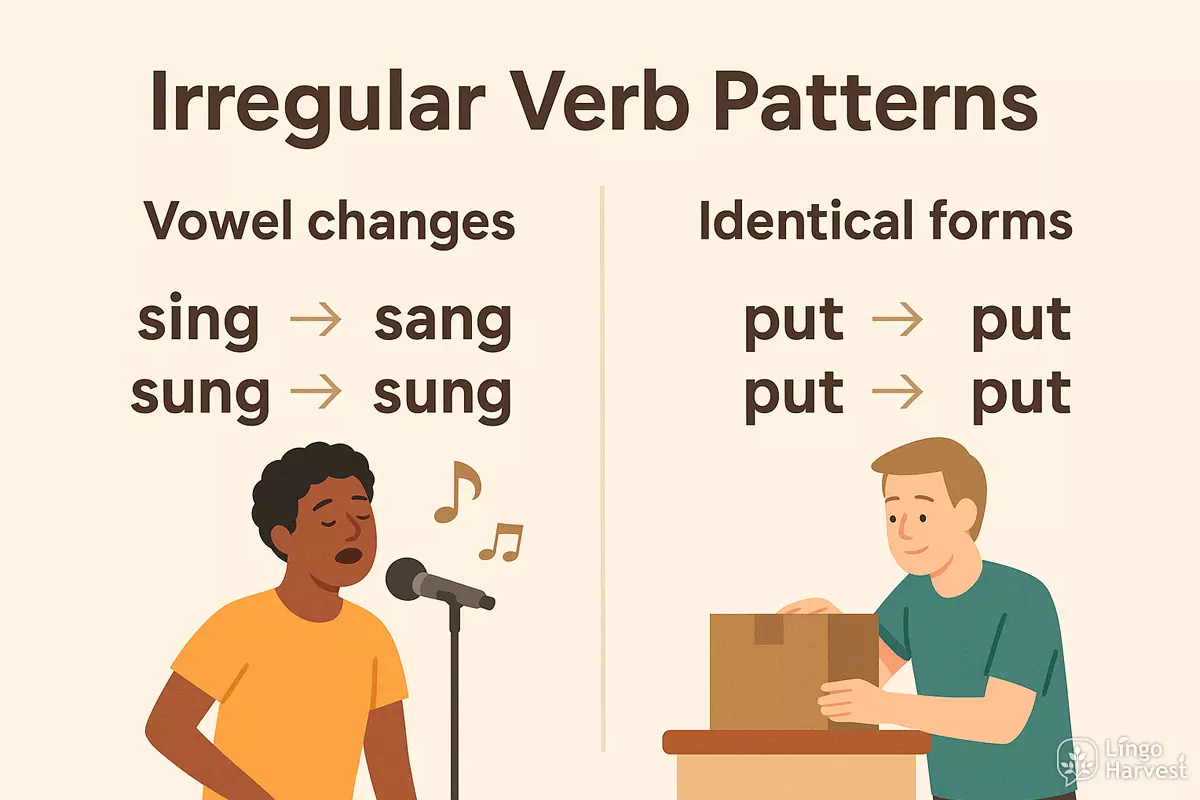
Although there’s no single rule for all irregular verbs, certain patterns do appear. Here are some of the most frequent types:
- Vowel changes: sing → sang → sung
- Identical forms: put → put → put
- Completely different forms: go → went → gone
- Adding -t instead of -ed: keep → kept → kept
Irregular Verb Forms at a Glance
To help you spot the variety, here are some of the most frequently used irregular verbs in English and their main forms:
| Base Form | Past Simple | Past Participle |
|---|---|---|
| be | was/were | been |
| begin | began | begun |
| break | broke | broken |
| choose | chose | chosen |
| do | did | done |
| eat | ate | eaten |
| go | went | gone |
| have | had | had |
| see | saw | seen |
| take | took | taken |
| write | wrote | written |
| put | put | put |
Learning these verbs is essential because they often appear in everyday conversation and writing. There’s no shortcut: practice and exposure are the best ways to become familiar with their unique forms.
Most Common Irregular Verb Forms
Irregular verbs can be confusing because they don’t follow predictable patterns when you form their past tense or past participle. Instead of simply adding “-ed,” you often have to memorize their unique forms. Knowing these is important for speaking and writing English accurately.
Typical Patterns of Change
Some irregular verbs change only a vowel, while others change completely or stay the same in all forms. For example, “begin” becomes “began” (past) and “begun” (past participle), while “cut” remains “cut” in every form. These differences make it essential to learn them individually.
Key Examples You’ll Encounter Often
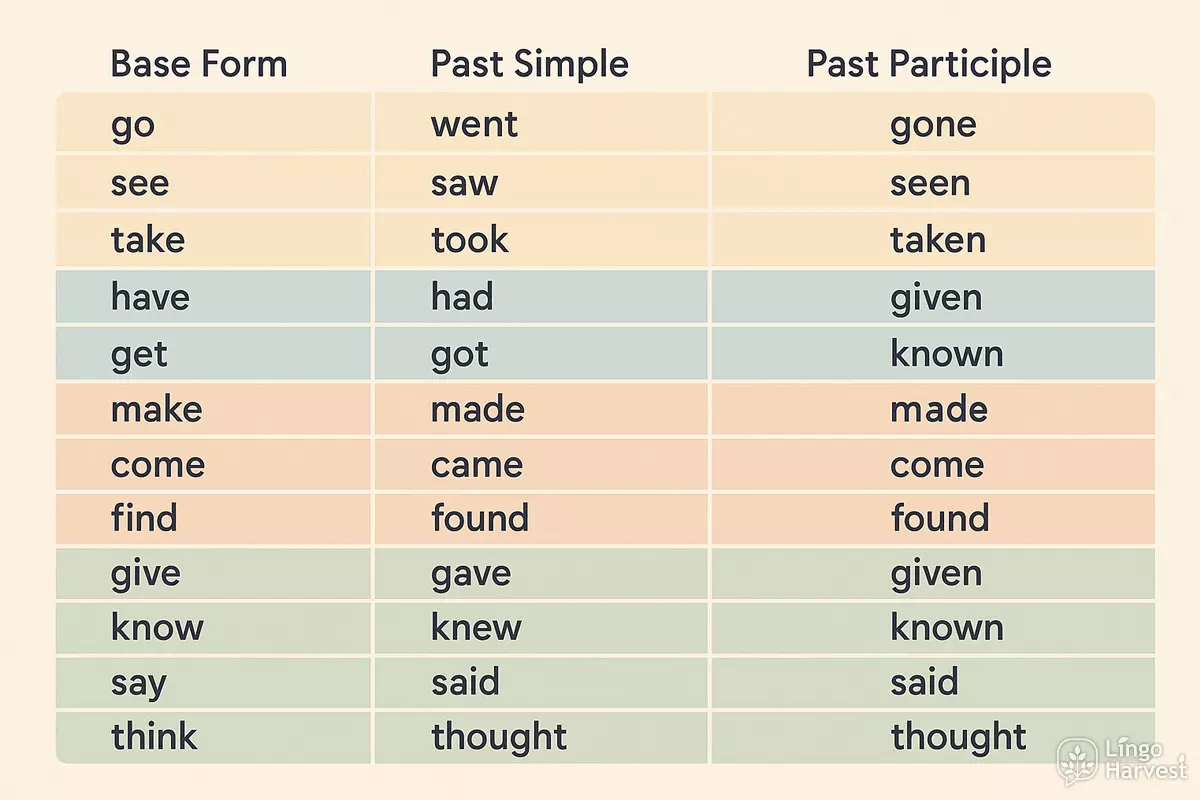
Here are some irregular verbs you’ll see frequently, along with their past simple and past participle forms:
| Base Form | Past Simple | Past Participle |
|---|---|---|
| go | went | gone |
| see | saw | seen |
| take | took | taken |
| have | had | had |
| get | got | got/gotten |
| make | made | made |
| come | came | come |
| find | found | found |
| give | gave | given |
| know | knew | known |
| say | said | said |
| think | thought | thought |
| begin | began | begun |
| run | ran | run |
| write | wrote | written |
| drink | drank | drunk |
| eat | ate | eaten |
| bring | brought | brought |
| catch | caught | caught |
| choose | chose | chosen |
Tips for Remembering Irregular Verb Forms
Instead of memorizing a long list all at once, focus on groups of similar verbs. For example, “bring/brought/brought” and “buy/bought/bought” share a pattern. Practice using these words in sentences to reinforce your memory. Reading and listening to English regularly will also help you become more familiar with these exceptions. Irregular verbs are common in daily communication. By recognizing their patterns and practicing them, you’ll become more comfortable and confident using English in any context.
Tips to Learn Irregular Verbs Faster
Mastering irregular verbs can seem challenging, but using the right techniques can make the process much smoother. Unlike regular verbs, these often don’t follow predictable patterns, so it helps to adopt a variety of learning strategies. Below are practical approaches and actionable ideas to help you recall these tricky forms more effectively.
Group Irregular Verbs by Patterns
Many non-regular verbs share similarities in their past tense and past participle forms. Sorting verbs into groups based on these patterns makes memorization less overwhelming. For example, some verbs have the same form for all three tenses, while others change only a vowel or have unique endings.
| Verb | Base Form | Past Simple | Past Participle |
|---|---|---|---|
| Same Form | put | put | put |
| Vowel Change | begin | began | begun |
| Ending in -t | send | sent | sent |
| Unique Forms | go | went | gone |
Create and Use Mnemonics
Memory aids or mnemonics can help you remember more difficult verb forms. For example, associating the word “sing-sang-sung” with a tune or rhythm makes it stick. Visual cues, rhymes, or even silly sentences can reinforce recall.
Practice with Real Sentences
Instead of rote memorization, use the verbs in context. Write short sentences or stories using different tenses. This not only helps you remember the forms but also shows how they function in real communication.
Focus on the Most Common Irregular Verbs
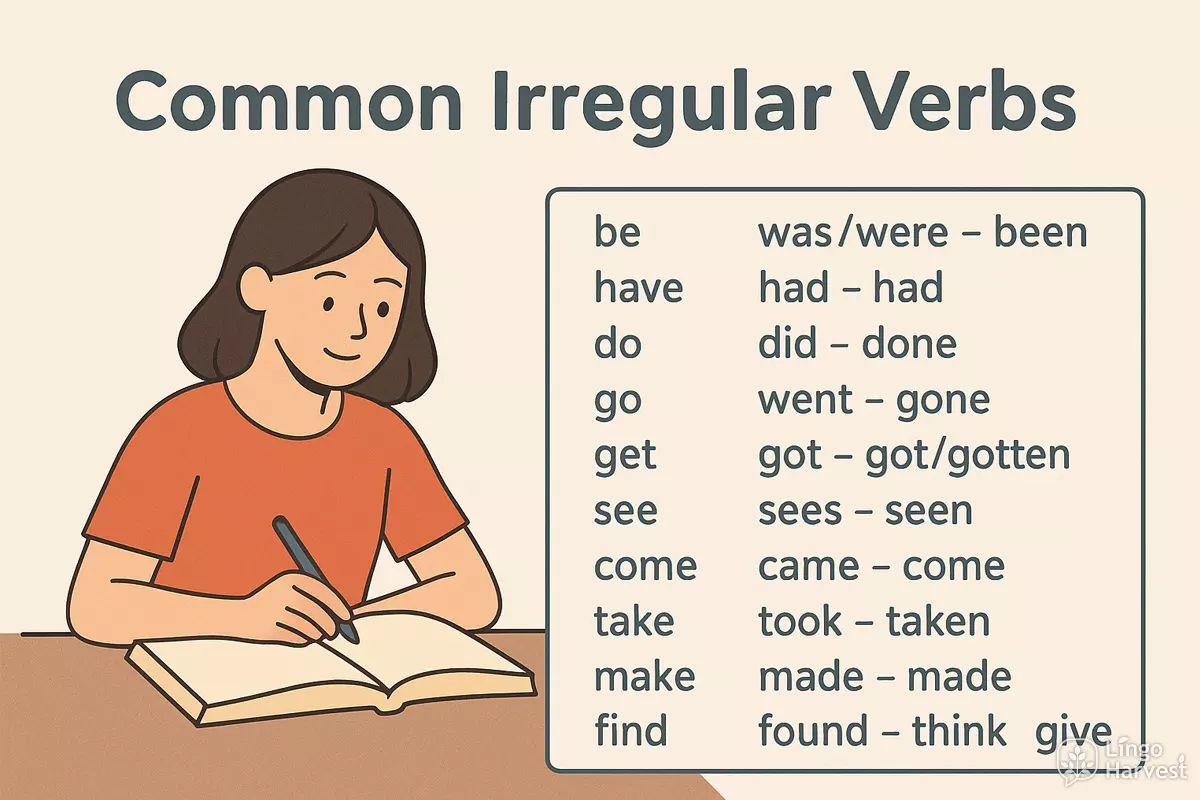
Start by learning the verbs you encounter most often. Here are some frequently used irregular verbs worth prioritizing:
- be – was/were – been
- have – had – had
- do – did – done
- go – went – gone
- get – got – got/gotten
- see – saw – seen
- come – came – come
- take – took – taken
- make – made – made
- find – found – found
- think – thought – thought
- give – gave – given
- tell – told – told
- become – became – become
- show – showed – shown
- leave – left – left
- feel – felt – felt
- put – put – put
- bring – brought – brought
- begin – began – begun
Use Spaced Repetition
Reviewing verbs at increasing intervals reinforces long-term memory. Flashcards and spaced repetition apps can be especially effective for this kind of practice.
Read and Listen Actively
Exposure to authentic English—books, podcasts, movies—helps you see and hear non-regular verbs in action. Make a habit of noting new forms as you encounter them and try to use them in your own speech or writing.
By combining these techniques—grouping, mnemonics, context practice, and regular review—you can make learning irregular verbs much less daunting and more effective.
Common Mistakes to Avoid
Mixing up regular and irregular verb forms can lead to awkward or incorrect sentences. Understanding how these verbs change in the past tense and past participle is essential for clear communication. Many learners stumble over patterns or exceptions, so it’s helpful to know where errors commonly occur.
Confusing Regular and Irregular Patterns
One frequent issue is applying the regular -ed ending to verbs that actually have an irregular form. For example, saying “buyed” instead of “bought” is a typical slip-up. Similarly, some assume all verbs change in the same way, but irregular verbs don’t follow predictable rules.
Incorrect Spelling of Regular Verbs
Regular verbs often require spelling changes when adding -ed. Watch out for these:
- Adding -ed to verbs ending in e: love → loved (not loveed)
- Doubling the final consonant for short vowels: stop → stopped
- Changing y to i: carry → carried
Using the Wrong Past Tense Form
Choosing the incorrect form of a verb can change the meaning of your sentence or make it unclear. Here’s a helpful comparison of some commonly confused verbs:
| Base Form | Correct Past Simple | Incorrect Form (Often Seen) |
|---|---|---|
| go | went | goed |
| eat | ate | eated |
| run | ran | runned |
| begin | began | beginned |
| bring | brought | bringed |
| catch | caught | catched |
| make | made | maked |
| see | saw | seed |
| take | took | taked |
| write | wrote | writed |
Overgeneralizing Irregularity
Some learners mistakenly use irregular forms for verbs that are actually regular. For instance, saying “sended” instead of “sent”, or “costed” instead of “cost” (which doesn’t change in the past tense).
Omitting the Auxiliary in Perfect Tenses
Forgeting to use “have” or “has” with the past participle is another pitfall. For example, “I ate already” (simple past) is fine, but “I eaten already” is incorrect. The correct form is “I have eaten already.”
Tips for Fewer Errors
- Review lists of irregular verbs and practice their forms regularly.
- Pay close attention to spelling changes for regular verbs.
- Listen to native speakers for natural verb usage.
- Double-check verb forms when writing, especially for less familiar words.
- Remember that some verbs don’t change at all (e.g., put → put).
By being aware of these stumbling blocks and practicing consistently, you’ll strengthen your grasp of both regular and irregular verbs and communicate more clearly in English.
Practice
Understanding how to use both predictable and unpredictable verb forms is essential for clear communication. Let's explore hands-on exercises and examples to help you master these essential patterns.
Identify the Verb Type
For each of the verbs below, decide if it follows a regular or irregular pattern when changing tenses. Write "regular" or "irregular" next to each word.
- walk
- go
- play
- eat
- jump
- run
- study
- see
- work
- write
Show answers
- walk – regular
- go – irregular
- play – regular
- eat – irregular
- jump – regular
- run – irregular
- study – regular
- see – irregular
- work – regular
- write – irregular
Form the Past Simple
Convert each verb to its past simple form:
- talk
- begin
- finish
- swim
- help
- drink
- listen
- break
Show answers
- talk → talked
- begin → began
- finish → finished
- swim → swam
- help → helped
- drink → drank
- listen → listened
- break → broke
Common Patterns: Comparison Table
Notice how the forms change for both types in the present, past simple, and past participle. This overview can help you spot patterns and exceptions at a glance:
| Verb | Present | Past Simple | Past Participle | Type |
|---|---|---|---|---|
| work | work | worked | worked | regular |
| play | play | played | played | regular |
| go | go | went | gone | irregular |
| take | take | took | taken | irregular |
| study | study | studied | studied | regular |
| see | see | saw | seen | irregular |
| jump | jump | jumped | jumped | regular |
| eat | eat | ate | eaten | irregular |
Fill in the Blanks
Choose the correct past form for the verbs in parentheses:
- Yesterday, I ______ (see) a movie.
- She ______ (dance) at the party last night.
- They ______ (take) the bus to school.
- We ______ (finish) our homework early.
Show answers
- saw
- danced
- took
- finished
Practice using these verbs in your own sentences, and pay attention to the patterns in spelling and pronunciation. The more you work with both regular and irregular verb forms, the more natural they will become in your speaking and writing.