Regularization of Irregular Verbs Over Time

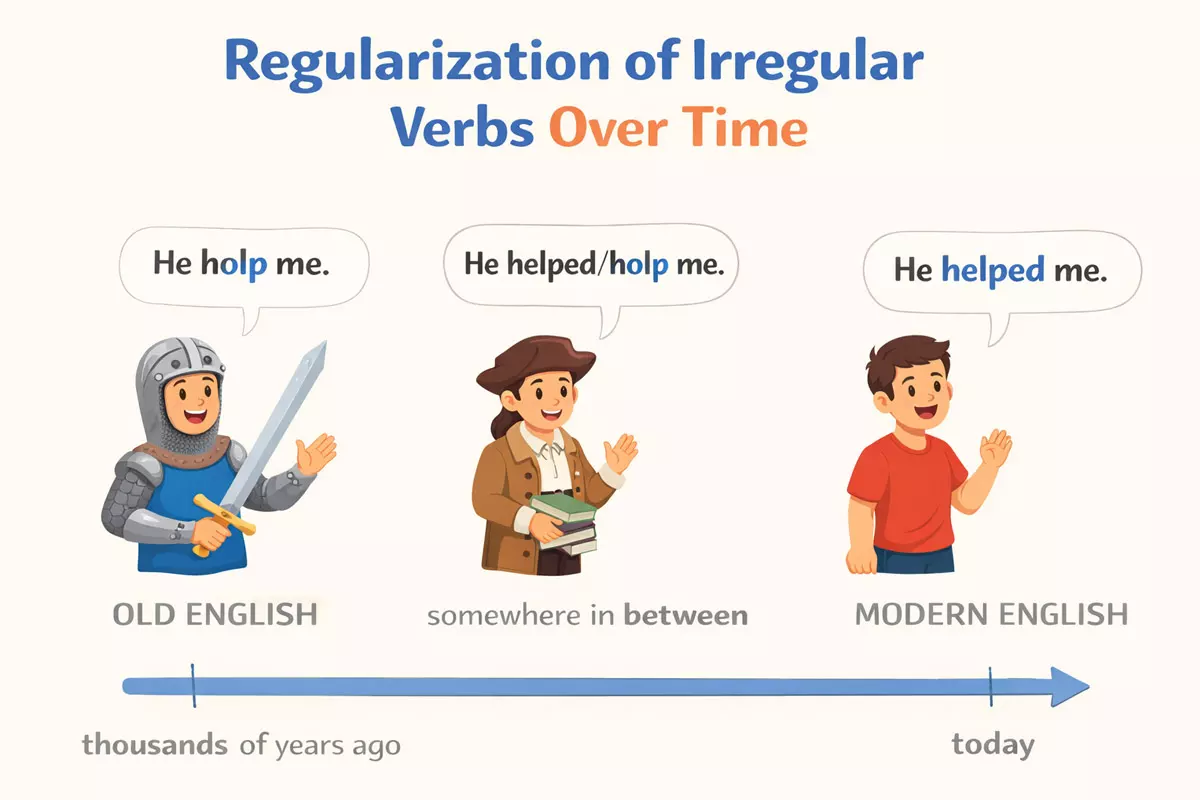 Here we why English irregular verbs tend to regularize, key patterns like -ed endings and vowel changes, historical examples, regional variations, what remains irregular, and includes practice on spotting and rewriting regularized verbs.
- What regularization means in English verbs
- Why irregular verbs tend to regularize
- Common patterns: -t forms, vowel changes, -ed
- Examples of verbs changing historically
- Regional variation and competing forms
- Regularization in modern spoken English
- What stays irregular and why
- Homework: regularization spotting and rewriting
Language is constantly evolving, and one interesting trend is the gradual shift of irregular verb forms toward more regular patterns. Over time, verbs that were once unpredictable often become standardized, making them easier to use and learn. This process highlights how speakers collectively reshape language for efficiency and clarity, reflecting the natural tendency to simplify complex rules and adapt communication to changing needs. Such changes offer insight into the dynamic nature of language and its ongoing development.
What regularization means in English verbs
In the context of English grammar, regularization describes a process where verbs that once had irregular past tense or past participle forms gradually shift to adopt the standard pattern—usually by adding -ed. This phenomenon is common in the history of English, as speakers often prefer simpler, more predictable patterns. Over time, verbs that originally had unique or unpredictable forms lose these quirks and become easier to learn and use.
Understanding Regular and Irregular Verbs
Regular verbs follow a set pattern for their past tense and past participle forms. Typically, you just add -ed to the base form (for example, walk becomes walked). Irregular verbs, on the other hand, change in less predictable ways (sing becomes sang, go becomes went). When an irregular verb shifts to the regular pattern, it is said to have been "regularized."
Why Do Verbs Become Regular?
Language tends to evolve toward simplicity and efficiency. As English speakers encounter less common irregular verbs, they may unconsciously apply the regular pattern to them. This is especially true for verbs that are used less frequently, as people are less likely to remember their unusual forms. Over generations, the regular forms can become accepted and standard.
Examples of Regularization in Action
Here are some verbs that have undergone or are undergoing this change:
- Help (originally holp, now helped)
- Climb (once clomb, now climbed)
- Dream (historically dreamt, now often dreamed)
- Burn (formerly burnt, now frequently burned)
- Learn (learnt vs. learned)
- Spell (spelt vs. spelled)
- Smell (smelt vs. smelled)
- Leap (leapt vs. leaped)
- Light (lit vs. lighted)
- Gild (gilt vs. gilded)
- Wed (wedded replacing wed in some contexts)
- Work (archaic wrought, now only worked)
- Row (old rowed and row, now always rowed)
- Shove (once shove, now shoved)
- Wend (originally went, now wended)
Comparison of Irregular and Regularized Forms
| Base Verb | Historic Irregular Form | Modern Regular Form |
|---|---|---|
| Climb | clomb | climbed |
| Help | holp | helped |
| Dream | dreamt | dreamed |
| Burn | burnt | burned |
| Learn | learnt | learned |
| Smell | smelt | smelled |
| Leap | leapt | leaped |
| Light | lit | lighted |
| Spill | spilt | spilled |
| Spoil | spoilt | spoiled |
| Spell | spelt | spelled |
| Kneel | knelt | kneeled |
| Shine | shone | shined |
| Dive | dove | dived |
| Plead | pled | pleaded |
| Creep | crept | creeped |
| Weep | wept | weeped |
| Wake | woke | waked |
Regularization is an ongoing process. Some verbs exist in both forms, and preferences may vary by region (for example, British English often favors learnt and burnt, while American English prefers learned and burned). This shift illustrates how living languages adapt to the needs and habits of their speakers over time.
Why irregular verbs tend to regularize
Over time, many verbs that once had unpredictable past tense or participle forms have shifted toward more uniform, rule-based patterns. This tendency is driven by several factors that shape how languages evolve and simplify over generations.
Language Learners and Ease of Use
Speakers, especially children and non-native learners, often favor simpler, more predictable patterns. Regular conjugations are easier to remember and apply, so irregular verbs are frequently reformed to match the dominant -ed ending in English. This process is called analogical leveling, where less common forms are replaced by more regular ones for consistency.
Frequency and Exposure
Verbs that are used less frequently are more susceptible to change. Highly irregular verbs like be or go tend to resist regularization because they are encountered and reinforced often. However, rarer verbs such as cleave or smite have mostly adopted regular forms due to limited exposure.
Examples of Regularization in English

The following list shows verbs that historically had irregular forms but have largely become regular in modern usage:
- help (holp → helped) → He helped his friend with the homework.
- burn (brent → burned/burnt) → The fire burned all night.
- dream (dreamt → dreamed) → She dreamed about traveling abroad.
- smell (smelt → smelled) → The soup smelled delicious.
- spell (spelt → spelled) → He spelled the word correctly.
- spill (spilt → spilled) → She spilled coffee on the table.
- kneel (knelt → kneeled) → He kneeled to tie his shoes.
- learn (learnt → learned) → They learned a lot from the course.
- leap (leapt → leaped) → The cat leaped onto the wall.
- climb (clomb → climbed) → We climbed the mountain before sunset.
- wield (weld → wielded) → He wielded considerable influence.
- gild (gilt → gilded) → The artist gilded the frame.
- melt (molt → melted) → The ice melted quickly.
- mow (mowed → mowed/mown) → He mowed the lawn yesterday.
- row (rowed → rowed) → They rowed across the lake.
- flow (flowed → flowed) → The river flowed through the valley.
- show (showed → shown/showed) → She showed me the results.
- rue (rowed → rued) → He rued the decision almost immediately.
Analogy and Pattern Pressure
Regularization is often motivated by analogy, where verbs align with the most common conjugation patterns. In English, the -ed suffix dominates, so less frequent or newly borrowed verbs are rapidly brought into this system. This creates a feedback loop: the more verbs follow the rule, the stronger the pressure for others to conform.
Comparing Present and Past Forms
Some verbs still retain both forms, but regular variants are increasingly favored. Here’s a comparison of traditional and regularized forms:
| Base Form | Historic Irregular Past | Modern Regular Past |
|---|---|---|
| burn | brent | burned |
| dream | dreamt | dreamed |
| spill | spilt | spilled |
| kneel | knelt | kneeled |
| smell | smelt | smelled |
| leap | leapt | leaped |
| climb | clomb | climbed |
Social and Cultural Influence
Social trends and prescriptive grammar also play a role. Standardized education and widespread literacy encourage the adoption of regular forms, especially in formal writing. Over time, this institutional pressure accelerates the shift toward regularity.
In summary, the movement from irregular to regular forms reflects the human preference for ease, predictability, and analogy. Language changes as speakers opt for patterns that are simpler to learn and use, especially when irregular forms are rare or seldom reinforced.
Common patterns: -t forms, vowel changes, -ed
When irregular verbs shift toward regular forms, several recognizable trends emerge. These include adopting the -ed ending, altering vowel patterns, or switching between -t and -ed past forms. Understanding these trends helps explain why some verbs change over time while others resist regularization.
Adoption of -ed Endings
The most widespread development is the replacement of irregular past tense forms with the standard -ed suffix. This shift simplifies verb conjugation and brings consistency across the language. For example, "dreamt" now often appears as "dreamed," and "leapt" as "leaped." The move toward -ed endings is especially common in American English, though both variants may coexist for decades.
- burnt → burned — both used today (burned more common in AmE)
- spilt → spilled — both used today (spilled dominant)
- learnt → learned — both used today (learned dominant)
- spelt → spelled — both used today (spelled dominant)
- dwelt → dwelled — both used today (dwelled more common in AmE)
- smelt → smelled — both used today (smelled dominant)
- leapt → leaped — both used today (leaped dominant)
- dreamt → dreamed — both used today (dreamed dominant)
- knelt → kneeled — both used today (kneeled dominant)
- spoilt → spoiled — both used today (spoiled dominant)
- lit → lighted — both used today (lighted common in formal/technical use)
- dove → dived — both used today (dove common in AmE, dived neutral)
- shone → shined — both used today (meaning-dependent)
- leant → leaned — both used today (leaned dominant)
- holp → helped — historical only
- clomb → climbed — historical only
- molt → melted — historical only
- weld (past of wield) → wielded — historical only
- gilt (as past of gild) → gilded — historical only
- spake → spoke — historical / archaic
- clew → clawed — obsolete
Switching Between -t and -ed Forms
Some verbs retain both -t and -ed forms, with usage depending on dialect, register, or even speaker preference. Over time, however, the -ed version often becomes more dominant, especially in less formal contexts. This duality can be seen in verbs like "spelled/spelt" or "burned/burnt."
| Verb | Traditional Irregular (-t) | Modern Regular (-ed) |
|---|---|---|
| spell | spelt | spelled |
| burn | burnt | burned |
| learn | learnt | learned |
| dream | dreamt | dreamed |
| leap | leapt | leaped |
Vowel Changes and Their Decline
Many historically irregular verbs once formed their past tense by changing the vowel in the stem. Over centuries, some of these have shifted to the regular -ed pattern, while others remain irregular. For instance, "help" used to have the past tense "holp," but now follows the standard "helped." Most verbs with vowel changes, such as "sing/sang" or "swim/swam," have not yet regularized, but the general trend leans toward simplification.
- help/holp → helped
- work/wrought → worked
- climb/clomb → climbed
- mow/mowed/mown → mowed
- show/showed/shown → showed
Overall, the evolution of English verbs demonstrates a clear preference for uniformity. The spread of -ed endings and the decline of vowel alternation or -t forms reflect ongoing linguistic change, influenced by usage, dialect, and the drive for simplicity.
Examples of verbs changing historically
Throughout the history of English, many verbs that were once irregular have shifted toward regular forms. This change typically happens over centuries as speakers gravitate toward more predictable patterns, especially in past tense and past participle forms. Looking at real-world cases helps illustrate how these verbs have evolved and continue to do so.
Notable verbs that have regularized
Some verbs that were irregular in Old or Middle English have adopted the standard "-ed" ending for their past tense. Here are several prominent examples:
- Bake: Old English "bacan" had "boc" as past, now "baked."
- Climb: Once "clomb" or "climbed," now always "climbed."
- Help: Formerly "holp" (past), now "helped."
- Laugh: Middle English "lough," now "laughed."
- Learn: "Learnt" (irregular past) persists in British English, but "learned" is now widespread.
- Dream: "Dreamt" and "dreamed" coexist, but the regular "-ed" form is increasingly common.
- Burn: Both "burnt" and "burned" exist, with "burned" dominating in American English.
- Wield: Old forms included "wold," now "wielded."
- Work: Used to have "wrought" as a past form, now "worked."
- Starve: From "starved" replacing the older "starf."
- Row: Past "rowed" now standard, replacing "rew."
- Show: "Showed" is now common; "shewed" was used historically.
- Snow: "Snowed" replaced the older "snew."
- Flow: "Flowed" is used instead of "flew" (not to be confused with "fly/flew").
- Move: Now always "moved," but once had "moved" and "moveden" forms.
- Weep: "Wept" remains, but "weeped" appears in some dialects.
- Leap: Both "leapt" and "leaped" exist, with the regular form gaining ground.
- Spoil: "Spoiled" has overtaken "spoilt" in many varieties of English.
- Smell: "Smelled" is more common now, though "smelt" is still in use.
Patterns in regularization
The drive toward regularity often targets verbs with less frequent usage, as familiar verbs like "go" or "be" tend to resist change. Many verbs that now end in "-ed" once belonged to larger classes of strong (irregular) verbs. As these patterns shifted, speakers gradually adopted the more common weak (regular) verb endings.
| Old Irregular Form | Modern Regular Form | Notes |
|---|---|---|
| clomb (past of "climb") | climbed | Now exclusively regular |
| holp (past of "help") | helped | Irregular form obsolete |
| laughed/lough | laughed | Irregular "lough" now archaic |
| snew (past of "snow") | snowed | Replaced by regular form |
| rowed/rew | rowed | Irregular "rew" no longer used |
| starf (past of "starve") | starved | Regular "-ed" form fully adopted |
| shewed (past of "show") | showed | Modern English prefers "showed" |
| burnt | burned | Regular form is standard in US English |
These changes illustrate the natural tendency of English to simplify and regularize verb conjugations over time. While some irregular verbs persist due to frequency or idiomatic usage, many less common verbs have shifted toward predictability, reflecting broader patterns in language evolution.
Regional variation and competing forms
The process of regularizing irregular verbs does not occur uniformly across all English-speaking regions. Local dialects, national standards, and even social factors influence whether an older, irregular form survives or a new, regularized variant takes hold. Some forms are entrenched in particular varieties of English, while others have faded from common use or coexist with regular alternatives.
Geographical differences in verb forms
Certain verbs exhibit distinct patterns depending on where English is spoken. For instance, verbs like "learn," "dream," and "spell" often take -ed endings in American English ("learned," "dreamed," "spelled"), while British English may prefer the irregular forms ("learnt," "dreamt," "spelt"). These variations are not only regional but can also reflect differences in formality, written versus spoken usage, and generational preferences.
Coexistence and competition
Many verbs currently exist in both regular and irregular forms, with usage fluctuating over time. This competition can persist for decades or even centuries, with both forms considered acceptable in certain contexts. Social prestige, educational norms, and prescriptive grammar rules can influence which variant is favored.

- Burn: burned → burnt → The wood was burned completely / The toast was slightly burnt.
- Dream: dreamed → dreamt → She dreamed about the future / He dreamt of becoming a pilot.
- Lean: leaned → leant → He leaned against the wall / She leant closer to hear better.
- Spell: spelled → spelt → The child spelled the word correctly / The name was spelt differently.
- Smell: smelled → smelt → The soup smelled wonderful / The room smelt of smoke.
- Learn: learned → learnt → She learned a new skill / He learnt English quickly.
- Spoil: spoiled → spoilt → The weather spoiled our plans / The food was spoilt.
- Dive: dived → dove → He dived into the pool / She dove from the board.
- Forecast: forecasted → forecast → They forecasted heavy rain / The storm was forecast.
- Light: lighted → lit → The street was lighted at night / She lit a candle.
- Wed: wedded → wed → They were wedded in June / The couple wed quietly.
- Hang: hanged → hung → The criminal was hanged / She hung the picture on the wall.
- Quit: quitted → quit → He quitted the job formally / She quit immediately.
- Fit: fitted → fit → The tailor fitted the suit / The dress fit perfectly.
- Sneak: sneaked → snuck → He sneaked out at night / The cat snuck inside.
- Shine: shined → shone → He shined his shoes / The sun shone brightly.
- Stink: stunk → stank → The trash has stunk all day / The room stank of gas.
- Wake: waked → woke → She waked the child gently / He woke up early.
- Weave: weaved → wove → She weaved a basket / He wove a complex story.
- Wed: wedded → wed → They were wedded by tradition / They wed last summer.
Comparison of selected verb forms by region
| Verb | American English | British English | Notes |
|---|---|---|---|
| Learn | learned | learnt | Both accepted; "learned" more common in US |
| Dream | dreamed | dreamt | Irregular form more frequent in UK |
| Burn | burned | burnt | Both used, but "burned" prevails in US |
| Dive | dove | dived | "Dove" is a US innovation |
| Sneak | snuck | sneaked | "Snuck" is informal/regional in US |
| Spell | spelled | spelt | Both forms recognized; "spelled" dominates in US |
| Light | lighted/lit | lit | Contextual preference (e.g., "lighted candle") |
| Fit | fit | fitted | "Fit" as past tense is chiefly American |
In summary, the evolution of verb forms is shaped by a complex interplay of regional norms, historical inertia, and language contact. This results in a patchwork of accepted forms, often reflecting both tradition and innovation within the English-speaking world.
Regularization in modern spoken English
Many once-irregular verbs are gradually adopting regular past tense forms in everyday speech. This trend is especially noticeable in informal contexts and among younger speakers. Linguists have documented both the spread of regular forms and the persistence of certain irregular patterns, creating a dynamic landscape in the evolution of verb morphology.
Common patterns of verb regularization
Speakers often apply the standard -ed ending to verbs that historically had irregular past tense forms. This process simplifies conjugation and aligns with the most common English pattern. Here are some verbs where regularization is frequently observed in conversation:
- Dream: dreamt → dreamed
- Learn: learnt → learned
- Burn: burnt → burned
- Spell: spelt → spelled
- Leap: leapt → leaped
- Smell: smelt → smelled
- Spoil: spoilt → spoiled
- Spill: spilt → spilled
- Kneel: knelt → kneeled
- Wed: wed → wedded
- Shine: shone → shined (when meaning "to polish")
- Lean: leant → leaned
- Cling: clung → clinged (rare, but sometimes heard)
- Sneak: snuck → sneaked (and vice versa)
- Light: lit → lighted
- Quit: quit → quitted (rare in American English)
- Hang: hung → hanged (in some contexts)
Factors influencing regularization
Frequency of use and exposure to both forms play a key role. Less common verbs tend to regularize more rapidly, while highly frequent irregulars (like "go" or "be") are more resistant to change. Regional dialects, education, and even media can accelerate or slow this process, leading to coexistence of both forms in some cases.
Comparison of irregular and regular forms in use
| Verb | Traditional Irregular Past | Regularized Past | Notes / Current Usage |
|---|---|---|---|
| Dream | dreamt | dreamed | Both common; "dreamed" preferred in US English ✅ |
| Burn | burnt | burned | "Burned" is standard in North America; "burnt" persists in UK English |
| Sneak | snuck | sneaked | Both used; "snuck" is informal but widespread |
| Spill | spilt | spilled | Both forms found; "spilled" more common overall |
| Learn | learnt | learned | "Learned" is dominant in American English |
| Light | lit | lighted | "Lit" is far more common, but "lighted" survives in some expressions |
| Leap | leapt | leaped | Regional variation; both accepted in modern usage |
| Spell | spelt | spelled | "Spelled" is standard in US; both forms in UK |
Persistence of irregular verbs
Despite the ongoing shift, many irregular verbs remain unchanged in everyday speech, especially those used most frequently (e.g., "come," "run," "find," "drink"). Some even show signs of increased irregularity or innovation, such as the spread of "snuck" as the past tense of "sneak." This demonstrates that while simplification is a strong force, linguistic diversity and tradition also shape the trajectory of English verb forms.
What stays irregular and why
Some verbs resist regularization even as language changes. These persistent exceptions usually share certain features: they are among the most commonly used verbs, have deep historical roots, or form part of patterns that speakers unconsciously reinforce. Linguists have observed that words used frequently in everyday speech are more likely to keep their irregular forms, since speakers hear and use them often enough to remember the exceptions.
Traits of Persistently Irregular Verbs
- High frequency: Words like "be", "have", and "go" are so common that their irregular forms remain stable over centuries.
- Historical inertia: Some verbs have been irregular for hundreds or thousands of years, making change less likely.
- Phonological patterns: Irregular forms sometimes fit into recurring sound patterns (e.g., "sing/sang/sung", "ring/rang/rung") that help them persist as a group.
- Cultural/literary significance: Certain verbs keep their nonstandard forms because they appear in set phrases, proverbs, or classic texts.
Examples of Irregular Verbs That Endure
Here's a list of verbs that have stubbornly retained their irregular forms in modern English:
- be – was/were – been
- have – had – had
- go – went – gone
- do – did – done
- see – saw – seen
- take – took – taken
- come – came – come
- give – gave – given
- find – found – found
- get – got – got/gotten
- think – thought – thought
- know – knew – known
- make – made – made
- say – said – said
- tell – told – told
- sit – sat – sat
- run – ran – run
- write – wrote – written
- break – broke – broken
- begin – began – begun
Patterns That Help Irregular Forms Survive
Many irregular verbs cluster into recognizable groups based on how their forms change. This clustering helps speakers remember them as types rather than isolated exceptions. For instance, the pattern of vowel change is common among several verbs, as shown below:
| Base Form | Past Simple | Past Participle | Pattern |
|---|---|---|---|
| sing | sang | sung | i–a–u vowel shift |
| ring | rang | rung | i–a–u vowel shift |
| begin | began | begun | i–a–u vowel shift |
| drink | drank | drunk | i–a–u vowel shift |
| swim | swam | swum | i–a–u vowel shift |
Because these verbs share similar changes, learners and speakers are less likely to regularize them. In summary, verbs that are frequent, historically entrenched, or supported by existing patterns are the ones most likely to remain irregular, even as others gradually become regular over time.
Homework: regularization spotting and rewriting
Exploring how irregular verbs become regular over time is a great way to understand language change in action. For practice, students can search for examples of verbs that have shifted from irregular to regular forms, or that show signs of such a shift in current usage. Identifying these patterns helps build an intuitive sense of how English adapts its grammar rules, sometimes slowly and unevenly.
Spotting Regularization in English Verbs
To get started, try to find verbs in modern English that have both irregular and regular past tense forms in use, or that have recently settled on a regular form. Consider investigating the following verbs, which have shown variation or change over time:
- Dream (dreamed/dreamt)
- Learn (learned/learnt)
- Burn (burned/burnt)
- Spill (spilled/spilt)
- Leap (leaped/leapt)
- Dive (dived/dove)
- Light (lighted/lit)
- Spell (spelled/spelt)
- Smell (smelled/smelt)
- Spoil (spoiled/spoilt)
- Cling (clung/clinged – rare, but sometimes heard)
- Hang (hanged/hung – context dependent)
- Wend (went/wended – archaic vs. modern regularization)
- Wed (wedded/wed)
- Forecast (forecasted/forecast)
- Broadcast (broadcasted/broadcast)
- Quit (quitted/quit)
- Shine (shined/shone – depends on meaning)
Rewriting Practice: Irregular to Regular
For each verb you identify, try rewriting sample sentences using both the irregular and regular forms. This exercise highlights how both versions may appear in real-world English, and prompts you to consider which is more widely accepted or natural in different contexts. For example:
- "She dreamed of traveling the world." vs. "She dreamt of traveling the world."
- "They spilled the juice." vs. "They spilt the juice."
- "He dived into the pool." vs. "He dove into the pool."
Comparison Table: Regularized and Irregular Past Tense Forms
| Verb | Irregular Past | Regular Past | Notes |
|---|---|---|---|
| Learn | learnt | learned | Both forms common; "learned" dominates in US English |
| Dream | dreamt | dreamed | Variation by region; "dreamed" more frequent overall |
| Dive | dove | dived | "Dove" common in North America, "dived" elsewhere |
| Burn | burnt | burned | Both forms accepted; "burned" is standard in US |
| Spell | spelt | spelled | "Spelled" is standard in American English |
| Wend | went | wended | Irregular form replaced by regular in modern usage |
| Forecast | forecast | forecasted | Both forms occur; "forecast" more common |
By closely examining these examples and rewriting sentences, you’ll become more attuned to the subtle shifts in how English verbs are used. Notice regional preferences, historical patterns, and the influence of analogy on verb forms. This hands-on approach makes the process of regularization tangible and memorable.