Phrasal Verbs: Verb + Particle Structure

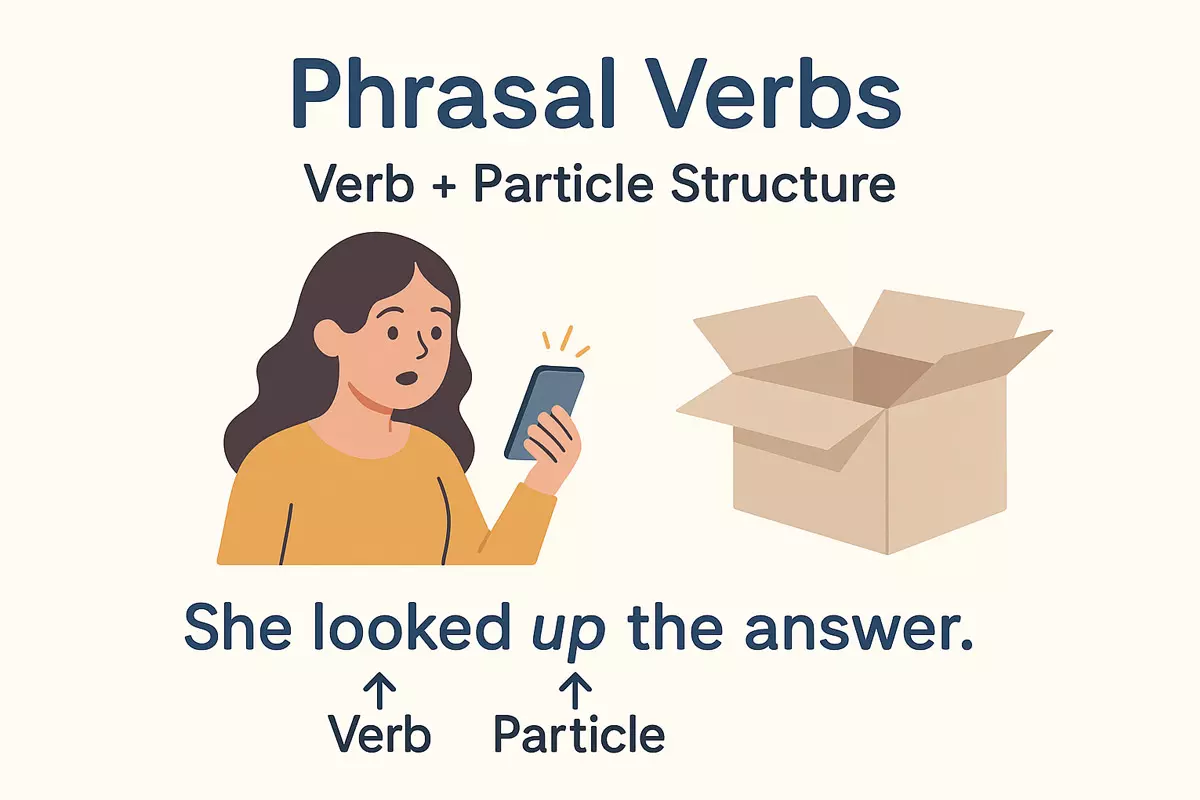 This article explains what phrasal verbs are, the basics of verb and particle combinations, and the difference between separable and inseparable verbs. It also covers common examples, usage problems, and provides a short practice section.
Learning to use combinations of verbs with short words such as prepositions or adverbs is essential for achieving fluency and sounding natural in everyday English. These verb combinations, often called phrasal verbs, can have meanings that are not directly related to the words themselves, which can make them confusing and challenging for learners. However, by practicing and noticing these expressions in context, you can gradually become more comfortable with them and improve your ability to understand and communicate effectively in real-life conversations.
What Phrasal Verbs Are
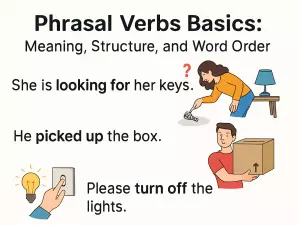
Phrasal verbs are multi-word expressions that combine a base verb with one or more particles, often a preposition or adverb. These combinations create meanings that are frequently different from the original verb alone. For example, “give up” doesn’t simply mean “give” plus “up”—it means “to quit.” This unique structure is a key feature in English, making these expressions essential for everyday communication.
Structure of Phrasal Verbs
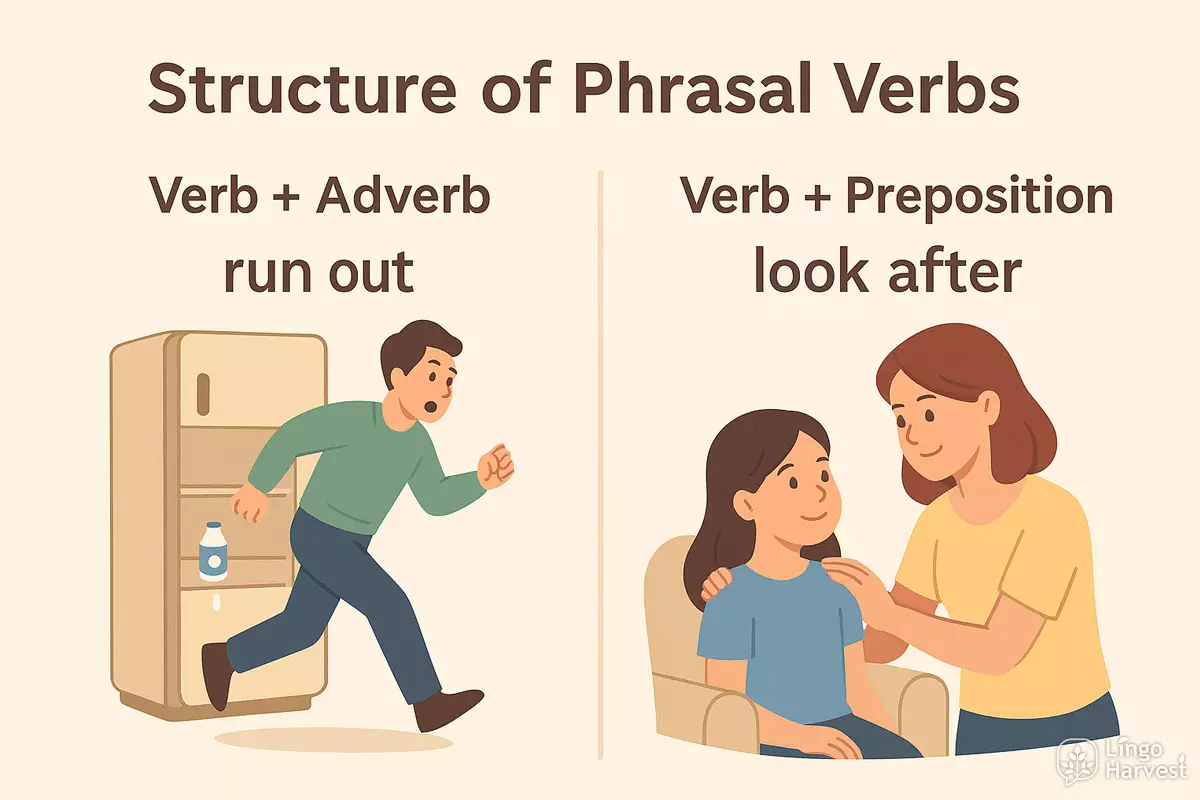
A typical phrasal expression consists of a main verb followed by a particle. The particle can be an adverb (like “out” or “away”) or a preposition (such as “on” or “over”). Sometimes, both are used together, forming three-word combinations (“look forward to”).
- Verb + Adverb: “pick up,” “run out,” “turn off”
- Verb + Preposition: “look after,” “come across,” “get over”
- Verb + Adverb + Preposition: “put up with,” “get away with,” “look forward to”
Why Are They Important?
These multi-part verbs are common in spoken and informal English. Understanding them helps with both comprehension and fluency. Their meanings often cannot be guessed from the individual words, so learning them as fixed phrases is useful.
Examples of Common Verb + Particle Combinations
- break down (stop functioning)
- bring up (mention a topic)
- call off (cancel)
- carry on (continue)
- check out (investigate or leave a hotel)
- fill in (complete a form)
- find out (discover)
- get along (be friendly)
- give up (stop trying)
- look after (take care of)
- make up (invent or reconcile)
- put off (postpone)
- run into (meet unexpectedly)
- set up (arrange or establish)
- take off (remove or depart)
- turn down (refuse)
- wake up (stop sleeping)
- work out (exercise or solve)
Literal vs. Idiomatic Meaning
Some verb + particle pairs have a literal sense (“sit down” simply means to take a seat), while others have idiomatic meanings that are not obvious from the words themselves (“give in” meaning to surrender). Recognizing the difference is crucial for correct usage.
Verb + Particle Basics
Phrasal verbs combine a main verb with a short word—often a preposition or adverb—known as a particle. This pairing creates new meanings that often differ from the original verb. For example, “look up” can mean “search for information,” which is quite different from simply “look.” Understanding how these combinations work is key to using them naturally in conversation and writing.
What Is a Particle?
A particle is a small word that, when joined with a verb, changes or expands its meaning. These are usually prepositions (like “in,” “on,” “at”) or adverbs (such as “up,” “out,” “away”). The new meaning may be literal, but it’s often idiomatic.
Common Patterns
Verb + particle structures can be:
- Literal: sit down (to move into a sitting position)
- Idiomatic: give up (to stop trying)
- Separable: turn off the light or turn the light off
- Inseparable: run into someone (cannot be “run someone into”)
| Verb + Particle | Meaning |
|---|---|
| pick up | to lift or collect |
| turn off | to deactivate |
| give up | to quit or surrender |
| look after | to take care of |
| run out of | to have no more of something |
| bring up | to mention or raise a topic |
| set up | to arrange or establish |
| find out | to discover |
| carry on | to continue |
| take off | to remove or depart (for planes) |
| put off | to postpone |
| get along | to have a good relationship |
How Meaning Changes
The particle can totally shift the sense of the verb. For instance, “take” means to grab or accept, but “take off” can mean to remove clothing or for a plane to leave the ground. Context determines the specific interpretation, so it’s important to learn these combinations as unique expressions.
Quick Tips for Learners
- Don’t translate word-for-word; learn each phrasal verb as a whole.
- Practice with real examples to remember their meanings.
- Watch for particles that change the intent dramatically.
- Notice if the object can go between the verb and particle or must come after.
Separable Verbs
When certain multi-word verbs allow their particle (such as up, out, off, or in) to move away from the main action word, we call them "separable." This flexibility in word order is a notable feature of English, especially when an object is involved. The object can be placed between the verb and the particle, or after the full phrase, depending on whether the object is a noun or a pronoun.
Word Order Rules
If the object is a noun, you can put it either after the whole phrase or between the verb and the particle. However, when using a pronoun (like "him," "it," "them"), it must go between the verb and the particle. For example:
- Turn off the light. → Turn the light off.
- Turn it off. ❌ ~Turn off it.~
Common Examples
Here are some widely used verb + particle combinations that follow this pattern:
- Pick up (e.g., pick up the phone / pick the phone up)
- Put off (e.g., put off the meeting / put the meeting off)
- Give back (e.g., give back the book / give the book back)
- Turn down (e.g., turn down the offer / turn the offer down)
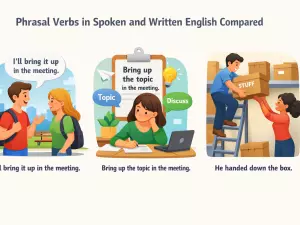
- Bring up (e.g., bring up a topic / bring a topic up)
- Take off (e.g., take off your shoes / take your shoes off)
- Call up (e.g., call up your friend / call your friend up)
- Write down (e.g., write down the number / write the number down)
- Fill out (e.g., fill out the form / fill the form out)
- Hand in (e.g., hand in your assignment / hand your assignment in)
- Turn on (e.g., turn on the radio / turn the radio on)
- Look up (e.g., look up the word / look the word up)
- Make up (e.g., make up a story / make a story up)
- Set up (e.g., set up the equipment / set the equipment up)
- Take out (e.g., take out the trash / take the trash out)
- Try on (e.g., try on the shoes / try the shoes on)
- Put on (e.g., put on your coat / put your coat on)
- Switch off (e.g., switch off the light / switch the light off)
- Pick out (e.g., pick out a dress / pick a dress out)
- Pay back (e.g., pay back the money / pay the money back)
Quick Reference: Placement with Objects
| Pattern | Example |
|---|---|
| Verb + Object (noun) + Particle | Turn the TV off. |
| Verb + Particle + Object (noun) | Turn off the TV. |
| Verb + Object (pronoun) + Particle | Turn it off. |
| Verb + Particle + Object (pronoun) | ❌ Turn off it. |
Usage Tips
Pay attention to the position of pronouns. Separating the verb and its particle is not just a matter of style, but a grammatical necessity with pronouns. This distinction helps avoid awkward or incorrect sentences. For clearer communication, practice rearranging sentences with both nouns and pronouns as objects.
Inseparable Verbs
Some phrasal verbs have a fixed structure: the verb and its particle (preposition or adverb) cannot be separated by the object. This means that if you use an object, it must always come after the entire phrase, never between the verb and the particle. These constructions are particularly common in English, and recognizing them helps avoid common word order mistakes.
How to Recognize Non-Separable Structures
The main clue is that if you try to put a noun or pronoun between the verb and the particle, the sentence sounds unnatural or is simply incorrect. For example, "run into a problem" ✅ (correct), but "run a problem into" ❌ (incorrect).
Common Examples and Usage Patterns
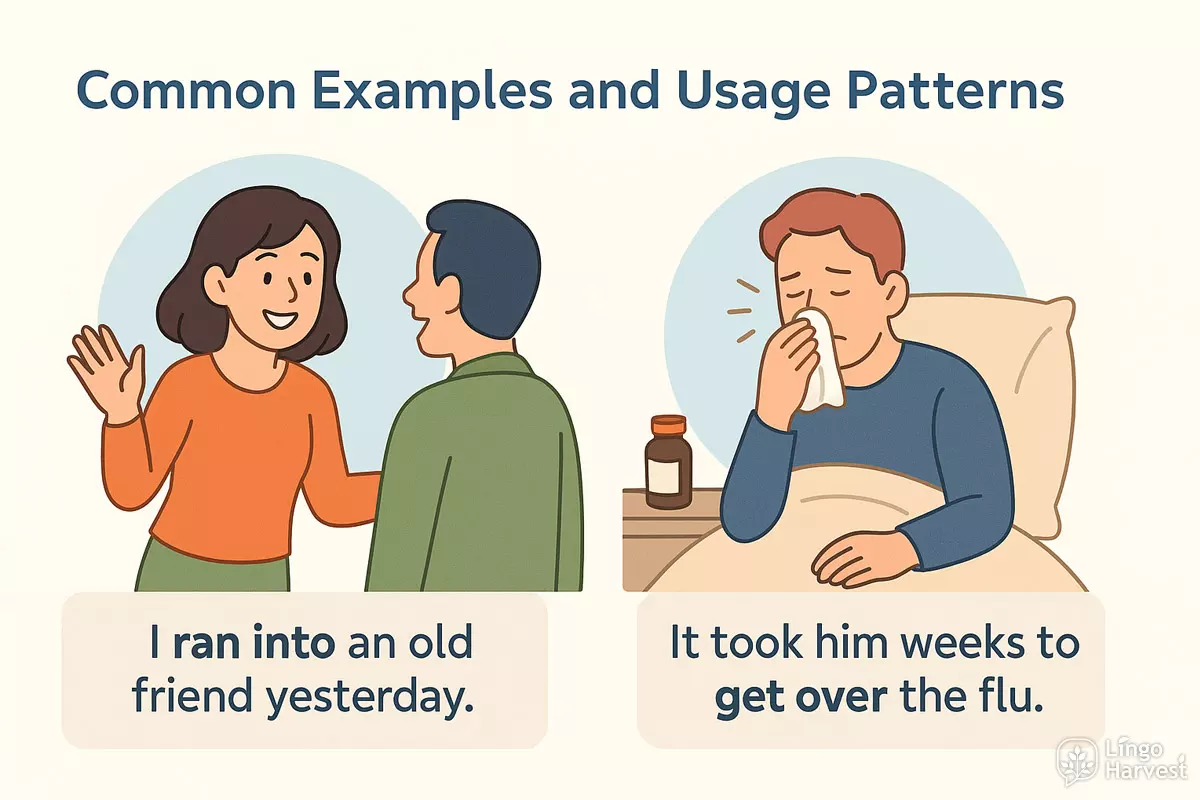
Here are some widely-used phrasal combinations where the parts always stay together. Notice that even if you use a pronoun as the object, it comes after the full phrase:
- look after (someone/something): She looks after her younger brother.
- run into (someone/something): I ran into an old friend yesterday.
- get over (something): It took him weeks to get over the flu.
- come across (something/someone): I came across an interesting article.
- call on (someone): The teacher called on me to answer.
- stand for (something): What does "UN" stand for?
- deal with (something/someone): Can you deal with this complaint?
- rely on (someone/something): We rely on our team’s support.
- look into (something): The police are looking into the case.
- go through (something): She went through a tough time.
- run out of (something): We ran out of milk.
- come up with (something): He came up with a great idea.
- take after (someone): She takes after her mother.
- get on with (someone): Do you get on with your boss?
- look forward to (something): I look forward to hearing from you.
- put up with (something/someone): I can’t put up with the noise.
- catch up with (someone): I need to catch up with my classmates.
- run away from (something/someone): He ran away from home.
- come down with (something): She came down with a cold.
- break into (something): Someone broke into their house.
Word Order and Pronouns
If you use a pronoun as the object, it still follows the entire structure. For instance, "She looks after him," not "She looks him after." This rule is consistent for all non-separable combinations.
Comparison: Separable vs. Non-Separable
| Type | Word Order Rule | Example (with pronoun) |
|---|---|---|
| Separable | Object can go between verb and particle | Turn it off / Turn off the light |
| Non-Separable | Object always follows the full phrase | Look after him / Look after the baby |
Understanding which verb + particle combinations are fixed in order helps you use natural, fluent English and avoid common mistakes in writing and conversation.
Common Everyday Verbs
In daily English, certain verbs frequently combine with particles (prepositions or adverbs) to form phrasal verbs. These combinations often carry meanings that differ from the original verb alone. Understanding how these verbs work with particles is key to sounding natural and fluent. Below are some verbs that regularly appear in phrasal structures, each bringing its own set of common meanings.
Frequently Used Verbs in Phrasal Structures
- Get — often used for movement or obtaining: get up, get by, get along, get over.
- Take — used for acceptance or removal: take off, take up, take out, take over.
- Go — related to movement or continuation: go on, go out, go back, go over.
- Put — for placement or action: put on, put off, put out, put up with.
- Make — for creation or action: make up, make out, make over, make off.
- Turn — about change or direction: turn on, turn off, turn up, turn down.
- Come — for arrival or movement: come in, come out, come up, come across.
- Look — often for perception or attention: look after, look up, look into, look forward to.
- Set — for starting or arrangement: set up, set out, set off, set aside.
- Bring — about movement or cause: bring up, bring in, bring out, bring back.
- Run — for movement or operation: run out, run into, run over, run by.
- Break — about separation or interruption: break up, break down, break in, break out.
- Pick — often for selection or lifting: pick up, pick out, pick on, pick apart.
- Give — for transfer or yielding: give up, give in, give out, give away.
Comparing Core Meanings: Base Verb vs. Phrasal Verb
| Base Verb | Phrasal Verb Example | Meaning |
|---|---|---|
| Take | take off | to remove or (for planes) to leave the ground |
| Get | get over | to recover from something (illness, setback) |
| Run | run into | to meet unexpectedly |
| Turn | turn down | to reject or reduce volume |
| Look | look after | to take care of |
| Bring | bring up | to mention a topic or raise a child |
| Break | break down | to stop functioning or become very emotional |
| Put | put off | to postpone or delay |
Each verb above can combine with a range of particles, producing new meanings that may not be immediately obvious. Context usually determines the exact sense, so it's helpful to learn these as fixed expressions. Mastering these combinations will make your English sound more authentic and less formal.
Usage Problems
Phrasal verbs often cause confusion for learners due to their unpredictable meanings and flexible word order. Since the meaning of the entire phrase is rarely obvious from the verb and the particle alone, memorizing combinations can be challenging. Additionally, many such constructions have multiple senses, which adds to the ambiguity.
Common Mistakes with Verb + Particle Structures
It’s easy to misuse these expressions by choosing the wrong particle, using a literal translation from another language, or placing the object incorrectly. Some phrasal verbs are separable, allowing the object to come between the verb and particle, while others are not. This distinction is not always intuitive.
- Misplacing the object: “Turn off the light” vs. “Turn the light off” (both correct), but “Turn off it” is incorrect; it should be “Turn it off”.
- Choosing the wrong particle: “Look up” (search for information) vs. “Look after” (take care of).
- Misunderstanding idiomatic meaning: “Give up” means to quit, not to physically hand something upward.
Separable vs. Inseparable Patterns
Some constructions allow the object between the verb and particle, while others do not. This can be a source of mistakes, especially with pronouns.
| Phrasal Verb | Correct Usage | Incorrect Usage |
|---|---|---|
| Turn off | Turn off the TV Turn the TV off Turn it off |
Turn off it |
| Look after | Look after the baby Look after him/her |
Look the baby after |
| Put up with | Put up with noise Put up with it |
Put it up with |
| Give up | Give up smoking Give it up |
Give up it |
Frequent Confusing Phrasal Verbs
Learners often mix up similar-sounding combinations. Here are some that commonly cause trouble:
- Take off → to remove (clothes), or for planes to leave the ground
- Set up → to arrange or establish
- Break down → to stop functioning
- Run into → to meet by chance
- Carry on → to continue
- Pick up → to collect or lift
- Get over → to recover from
- Look forward to → to anticipate with pleasure
- Check out → to examine or leave a hotel
- Fill in → to complete (a form)
- Give in → to surrender
- Make up → to invent or reconcile
- Turn up → to appear or increase (volume)
- Back up → to support or reverse
- Come across → to find unexpectedly
- Take after → to resemble a family member
- Work out → to solve or exercise
Tips to Avoid Errors
To use verb-particle structures accurately, memorize common combinations, pay attention to context, and notice word order with pronouns. When in doubt, consult usage examples in trusted sources, and practice regularly to build intuition.
Mini Practice
Understanding verb + particle combinations takes practice. Let’s try some short exercises to help you remember the structure and meaning of these expressions.
Choose the Best Option
For each sentence, pick the correct particle to form a common two-word phrase.
- Can you look ___ this document for errors?
- She always gets ___ with her coworkers.
- I need to turn ___ the lights when I leave.
- They ran ___ of time during the test.
- He will pick ___ his sister from school.
Show answers
- look over
- gets along
- turn off
- ran out
- pick up
Common Patterns: Verb + Particle
Here are some typical expressions with this structure. Notice how the meaning often changes from the original verb:
- bring up (mention a topic)
- carry on (continue)
- give up (stop trying)
- find out (discover)
- break down (stop working, e.g. a car)
- take off (leave the ground, e.g. a plane)
- put off (postpone)
- set up (arrange)
- call off (cancel)
- show up (arrive)
- look after (take care of)
- turn up (appear unexpectedly)
- run into (meet by chance)
- get over (recover from)
- check out (examine or leave a hotel)
- hold on (wait)
- fill in (complete, e.g. a form)
- make up (invent or reconcile)
Match the Meanings
Match each group to its description.
| Expression | Meaning |
|---|---|
| give up | stop trying |
| bring up | mention a topic |
| carry on | continue |
| run into | meet by chance |
| set up | arrange |
| put off | postpone |
Short Transformation Task
Rewrite the sentences using the correct two-word phrase:
- He invented a story. → He ___ a story.
- Can you complete this form? → Can you ___ this form?
- We postponed the meeting. → We ___ the meeting.
Show answers
- made up
- fill in
- put off
Practicing these combinations helps you understand the structure and meaning of these useful expressions in context. Try making your own sentences with some of the phrases above to reinforce your learning.