Separable and Inseparable Phrasal Verbs Explained

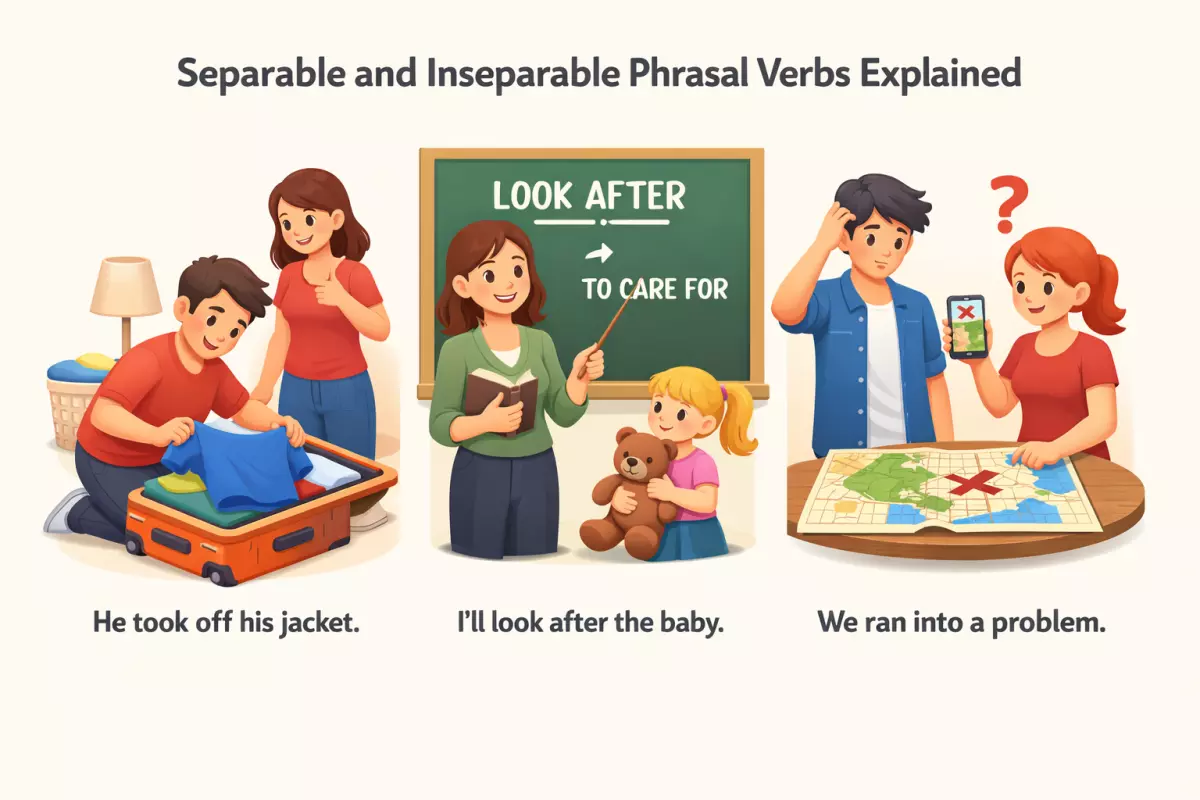 This article explains what separable and inseparable phrasal verbs mean, how to place objects, and why pronouns must go in the middle. It lists common inseparable verbs, shows meaning changes when you split, flags typical mistakes, gives word order tips, and ends with homework practice.
Some verb-and-particle combinations can be separated, while others must stay together, and knowing the difference quickly makes your English sound more natural. You might hear turn the light off or turn off the light, but not every phrasal verb allows that shift. This guide helps you recognize which patterns work, place objects correctly, and avoid common mistakes in everyday speech.
What separable and inseparable mean
In phrasal verbs, the key question is whether the object can go between the verb and the particle (the short word like up, out, off). If it can, the phrasal verb is separable. If it cannot, it is inseparable. This affects word order, especially with pronouns (me, it, them).
Separable phrasal verbs (object can split the verb + particle)
With separable forms, you have two common patterns when there is an object:
- Verb + particle + object: “Turn off the light.”
- Verb + object + particle: “Turn the light off.”
- Pronoun rule: when the object is a pronoun, it almost always goes in the middle: ✅ “Turn it off.” ❌ “Turn off it.”
- Longer objects often sound more natural at the end: “She handed in the application she worked on for weeks.” (more natural than splitting it)
- In questions, the same options apply: “Did you pick up the package?” / “Did you pick the package up?”
- In passive voice, the object becomes the subject, so separation is not the issue: “The light was turned off.”
Common separable examples (showing both word orders):
- turn off: “Turn off the TV.” / “Turn the TV off.”
- turn on: “Turn on the oven.” / “Turn the oven on.”
- pick up: “Pick up the kids.” / “Pick the kids up.”
- put down: “Put down the bag.” / “Put the bag down.”
- throw away: “Throw away the receipt.” / “Throw the receipt away.”
- fill out: “Fill out the form.” / “Fill the form out.”
- hand in: “Hand in the assignment.” / “Hand the assignment in.”
- write down: “Write down the address.” / “Write the address down.”
- set up: “Set up the meeting.” / “Set the meeting up.”
- take off (remove): “Take off your shoes.” / “Take your shoes off.”
- put on (wear): “Put on a jacket.” / “Put a jacket on.”
- look up (information): “Look up the word.” / “Look the word up.”
Inseparable phrasal verbs (object cannot split the verb + particle)
With inseparable forms, the object must come after the particle. Putting the object in the middle is incorrect.
- Fixed pattern: Verb + particle + object: “Look after the baby.”
- No splitting: ❌ “Look the baby after.”
- Pronouns stay after the particle: “Look after him.” (not “Look him after.”)
- Many of these are followed by a preposition-like particle (after, into, for, with), which behaves more like a preposition than a movable adverb.
Common inseparable examples (object always after the particle):
- look after: “Look after the kids.”
- run into: “I ran into an old friend.”
- get over: “She got over the flu.”
- come across: “He came across a great deal.”
- deal with: “We’ll deal with the problem.”
- go through: “They went through a background check.”
- apply for: “She applied for the job.”
- believe in: “They believe in the plan.”
- rely on: “You can rely on me.”
- pay for: “He paid for the tickets.”
- listen to: “Listen to the instructions.”
- wait for: “Wait for the bus.”
A quick usage check
- If a noun object can move between the two parts (“turn the light off”), it’s a separable pattern.
- If moving the object sounds wrong (“look the baby after”), it’s an inseparable pattern.
- When you use a pronoun object, separable verbs usually require the middle position (“turn it off”), while inseparable verbs keep the pronoun after the particle (“look after it”).
Object placement rules
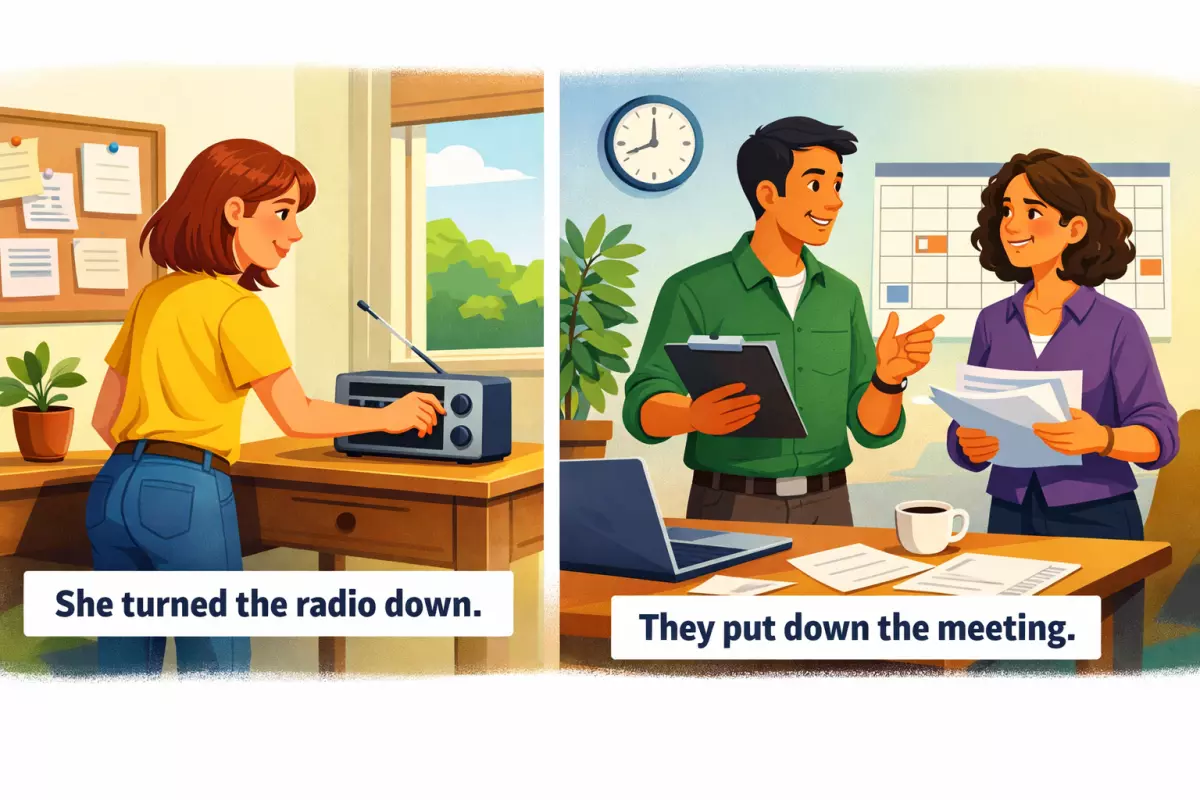
Where you put the object depends on two things: whether the phrasal verb is separable or inseparable, and whether the object is a noun phrase (the report, my keys) or a pronoun (it, them). These patterns are predictable, and learning them prevents the most common word-order errors.
Core placement patterns
- Separable + noun object: you can place the object either between the verb and particle or after the particle.
- ✅ She turned the radio down. / She turned down the radio.
- ✅ They put the meeting off. / They put off the meeting.
- Separable + pronoun object: the pronoun must go between the verb and particle.
- ✅ She turned it down. ❌ She turned down it.
- ✅ They put it off. ❌ They put off it.
- Inseparable + any object: the object must come after the particle (no splitting).
- ✅ We ran into an old friend. / We ran into her.
- ✅ He looked after the kids. / He looked after them.
When one position sounds more natural
- Long noun objects usually go after the particle to keep the sentence easy to follow:
- ✅ She put off the meeting with the regional managers from three departments.
- Less natural: She put the meeting with the regional managers from three departments off.
- Short noun objects often go in the middle (especially in speech):
- ✅ Turn the TV down.
- ✅ Pick your shoes up.
- To emphasize the particle’s meaning (result/direction), speakers often place the noun after it:
- ✅ She gave up coffee. (focus on quitting)
- ✅ He handed in the form. (focus on submitting)
Common verb-by-verb patterns to memorize
- Separable (noun can split; pronoun must split):
- turn down: Turn the music down. / Turn it down.
- pick up: Pick the book up. / Pick it up.
- put off: Put the trip off. / Put it off.
- bring back: Bring the files back. / Bring them back.
- take off (remove): Take your jacket off. / Take it off.
- throw away: Throw the receipt away. / Throw it away.
- fill out: Fill the form out. / Fill it out.
- hand in: Hand the assignment in. / Hand it in.
- set up: Set the equipment up. / Set it up.
- call off: Call the game off. / Call it off.
- Inseparable (never split):
- look after: Look after the dog. / Look after it.
- run into: Run into an old friend. / Run into her.
- get over: Get over the flu. / Get over it.
- deal with: Deal with the problem. / Deal with it.
- look into: Look into the complaint. / Look into it.
- come across: Come across a useful article. / Come across it.
- apply for: Apply for the job. / Apply for it.
- rely on: Rely on your team. / Rely on them.
- agree with: Agree with the plan. / Agree with it.
- belong to: Belong to my sister. / Belong to her.
Quick error checks
- If the object is a pronoun and you placed it after the particle, it is almost certainly wrong with a separable verb: ❌ pick up it → ✅ pick it up.
- If you tried to split an inseparable verb, the sentence will sound unnatural or incorrect: ❌ look the kids after → ✅ look after the kids.
- If both placements are possible, choose the one that keeps the object close to what it refers to and avoids a heavy “split” with long phrases.
Pronouns with separable phrasal verbs
When the object is a pronoun (me, you, him, her, it, us, them), it usually has a fixed position with separable phrasal verbs: it goes between the verb and the particle. This is one of the most reliable patterns in phrasal-verb word order.
Core rule: pronoun goes in the middle
- ✅ Turn it off. → ❌ Turn off it.
- ✅ Pick them up. → ❌ Pick up them.
- ✅ Put it on. → ❌ Put on it.
- ✅ Write it down. → ❌ Write down it.
- ✅ Hand it in. → ❌ Hand in it.
Why this happens (usage pattern)
Pronouns are short and “light,” so English places them earlier in the verb phrase. With separable combinations, that means the pronoun object slots in after the main verb and before the particle (up, out, off, on, away, back, etc.). With noun objects, you often have a choice; with pronoun objects, you usually don’t.
Common separable verbs: pronoun placement examples
- Bring it back (not: bring back it)
- Call him back
- Fill it out
- Figure it out
- Give it away
- Hold it up
- Let her in
- Look it up
- Pay it back
- Point it out
- Send it back
- Set it up
- Show them around
- Take it off
- Throw it away
- Try it on
- Turn it down
- Wake him up
Pronouns in questions, negatives, and imperatives
- Questions: Did you turn it off? / Can you pick them up?
- Negatives: Don’t turn it on. / I didn’t write it down.
- Imperatives: Put it away. / Hand it in by Friday.
Two quick cautions
- Inseparable phrasal verbs: if the verb is inseparable, the pronoun cannot go in the middle (e.g., ✅ Look after her. → ❌ Look her after.).
- Meaning changes: some verb + particle combinations change meaning depending on whether they’re phrasal verbs or literal directions; keep the pronoun pattern only when it’s functioning as a separable phrasal verb (e.g., Turn it down = reduce volume; turn it down can’t be reordered).
Common inseparable phrasal verbs
With these multi-word verbs, the object cannot go between the verb and the particle (preposition/adverb). The typical pattern is verb + particle + object, and if you insert the object in the middle, the sentence becomes ungrammatical.
Usage pattern to remember
- Correct: ✅ look after + object → “She looks after her little brother.”
- Incorrect: ❌ “She looks her little brother after.”
- Correct: ✅ run into + object → “I ran into an old friend.”
- Incorrect: ❌ “I ran an old friend into.”
Everyday inseparable phrasal verbs (with examples)
- look after (take care of) → “Could you look after my bag for a minute?”
- run into (meet by chance) → “We ran into our neighbors at the market.”
- get over (recover from) → “It took her weeks to get over the flu.”
- deal with (handle) → “I’ll deal with the complaint tomorrow.”
- depend on (rely on) → “It depends on the weather.”
- believe in (accept as true/support) → “He believes in equal opportunities.”
- care for (look after; also “like,” in some contexts) → “She cares for her elderly aunt.”
- listen to (pay attention to sound/advice) → “Please listen to the instructions carefully.”
- wait for (remain until someone/something arrives) → “We’re waiting for the bus.”
- apply for (request formally) → “She applied for a new passport.”
- ask for (request) → “He asked for a receipt.”
- belong to (be owned by) → “This jacket belongs to my sister.”
- focus on (concentrate on) → “Let’s focus on the main problem.”
- pay for (cover the cost of) → “I’ll pay for dinner.”
- rely on (trust/depend on) → “You can rely on her to be on time.”
- agree with (share an opinion; also “suit” for food/climate) → “I agree with your point.”
- approve of (think something is acceptable) → “Her parents don’t approve of the plan.”
- hear about (learn news of) → “Did you hear about the new policy?”
Common learner traps
- Pronouns don’t change the rule: “Look after him” (not “look him after”).
- Many are verb + preposition: these often behave like inseparable units (e.g., “depend on,” “belong to,” “approve of”).
- Passive voice is possible for some: “The children are looked after by trained staff.” (The particle stays with the verb.)
Meaning changes with separation

Some phrasal verbs allow both word orders, but the choice is not always neutral. In a few common cases, placing the object between the verb and particle creates a different sense (or a different emphasis) than keeping the particle next to the verb. Learning these as “paired patterns” helps you avoid sentences that sound natural but mean the wrong thing.
Common pairs where word order affects the sense
- pick up
- ✅ “Pick up the package.” (collect; go and get)
- ✅ “Pick the package up.” (same meaning; more focus on the object)
- ✅ “Pick up Spanish quickly.” (learn informally)
- ❌ “Pick Spanish up quickly.” can be fine, but it often sounds more deliberate or “this specific thing,” not a general skill.
- take off
- ✅ “The plane took off.” (depart; intransitive, no object)
- ✅ “Take off your shoes.” / “Take your shoes off.” (remove)
- Pattern note: with clothing, both orders work; with “depart,” separation is impossible because there is no object.
- turn in
- ✅ “Turn in the report.” / “Turn the report in.” (submit)
- ✅ “Turn in early.” (go to bed; intransitive)
- Usage tip: “Turn in” + noun is usually “submit,” while “turn in” with no object is “go to bed.”
- take in
- ✅ “Take in the view.” (absorb; notice)
- ✅ “Take the dress in.” (make clothing tighter)
- Pattern note: the “alter clothing” meaning strongly prefers an object and often sounds more natural with separation.
- make up
- ✅ “Make up a story.” / “Make a story up.” (invent)
- ✅ “Make up with your friend.” (reconcile; requires with, and is not the separable pattern)
- Watch the structure: “make up” (invent) is separable; “make up with” (reconcile) is a different verb pattern.
- work out
- ✅ “Work out the answer.” / “Work the answer out.” (solve)
- ✅ “Work out three times a week.” (exercise; intransitive)
- Meaning cue: object present → “solve”; no object → “exercise.”
- bring up
- ✅ “Bring up the topic.” / “Bring the topic up.” (mention)
- ✅ “Bring up a child.” (raise; care for)
- Context matters more than position here, but “bring up a child” is a fixed, frequent collocation that learners should recognize.
- call off
- ✅ “Call off the meeting.” / “Call the meeting off.” (cancel)
- ✅ “Call off your dog.” / “Call your dog off.” (order it to stop attacking/chasing)
- Same mechanics, different sense; the object often signals which meaning is intended.
- put down
- ✅ “Put down the glass.” / “Put the glass down.” (place on a surface)
- ✅ “Put down an idea.” (write it)
- ✅ “Put someone down.” (insult; criticize)
- Position is flexible, but the meaning can shift with the type of object (thing vs. idea vs. person).
- set up
- ✅ “Set up the equipment.” / “Set the equipment up.” (arrange; prepare)
- ✅ “Set someone up.” (trick; frame) or (help them get a date/job connection)
- Tip: with people as the object, “set up” often points to “arrange for them” or “trap them,” not physical setup.
- take back
- ✅ “Take back the shirt.” / “Take the shirt back.” (return to a store)
- ✅ “Take back what you said.” / “Take what you said back.” (retract)
- Both orders work, but the meaning changes depending on whether the object is a thing (return) or words (retract).
- hand in
- ✅ “Hand in your assignment.” / “Hand your assignment in.” (submit)
- ✅ “Hand in your notice.” (resign)
- These senses are closely related; the object (“assignment” vs. “notice”) clarifies the intent more than the placement.
How to choose the safer pattern
- Use the “verb + particle + noun” order when you want the action to feel like a single unit: “turn in the report,” “work out the answer.”
- Use separation to spotlight the object, especially if it is long: “She worked the solution to the final problem out.”
- When the object is a pronoun, separation is typically required: ✅ “Turn it in.” ❌ “Turn in it.”
- If the same phrasal verb has an intransitive meaning, remember that no-object uses cannot be separated: “turn in,” “work out,” “take off.”
- When you learn a new verb, record it with an example object that matches the intended meaning (a “report” for submit, “shoes” for remove, “a story” for invent).
Typical learner mistakes
Many errors come from mixing up where the object can go, especially when a pronoun is involved, and from assuming all verb + particle combinations follow the same word order. Watch for patterns: whether the phrasal verb is separable or inseparable, whether the object is a noun or pronoun, and whether the “particle” is actually a preposition that must keep its object after it.
- Putting a pronoun after the particle with separable verbs
❌ Please turn off it. → ✅ Please turn it off.
Rule: with separable forms, pronoun objects (it, them, him, her, this, that) go between the verb and particle. - Assuming inseparable verbs can be split
❌ She looked the word up in the dictionary. → ✅ She looked up the word in the dictionary.
Note: look up (meaning “search for information”) is separable; but look after is inseparable: ❌ look the kids after → ✅ look after the kids. - Confusing “phrasal verb + preposition” patterns
❌ Who are you looking? → ✅ Who are you looking for?
Some combinations require an extra preposition (look forward to, get away with, put up with). The preposition cannot be moved away from its object. - Misplacing long noun objects in separable verbs
❌ She turned off quickly the old machine in the corner. → ✅ She turned off the old machine in the corner quickly.
With long objects, placing the noun after the particle can sound awkward; many learners over-separate in the wrong place. - Overusing separation because “it sounds more advanced”
❌ He filled the form in online. → ✅ He filled in the form online / He filled the form in online (possible, but less natural in many contexts).
Some separable verbs allow both orders with nouns, but one order is more common in everyday usage. - Forgetting that some verbs change meaning depending on separability
Example: take off can be “remove” (separable) or “leave the ground” (inseparable in meaning).
✅ He took off his jacket. (remove) / ✅ The plane took off. (depart) - Using the wrong particle because of literal translation
Learners often swap particles (up/out/off/on) based on their first language rather than usage patterns.
❌ I will discuss about it. → ✅ I will discuss it. (not a phrasal verb; no preposition needed) - Mixing up “up” as completion vs. direction
✅ clean up (finish cleaning) vs. ✅ climb up (movement).
Mistake: treating every “up” as physical direction and choosing the wrong verb in context. - Dropping the particle entirely
❌ Can you pick the kids? → ✅ Can you pick up the kids?
The particle often carries the core meaning; removing it can make the sentence incomplete or change the meaning. - Adding an object to intransitive combinations
❌ The meeting ran out time. → ✅ The meeting ran out of time / We ran out of time.
Some forms don’t take a direct object, or they require a preposition (run out of + noun). - Placing adverbs in the wrong position
❌ She turned quickly off the light. → ✅ She quickly turned off the light / She turned the light off quickly.
Keep the verb + object relationship clear; avoid inserting adverbs between the particle and a pronoun. - Using a noun instead of a pronoun (or vice versa) and keeping the same word order
✅ Turn off the TV / Turn the TV off, but: ✅ Turn it off (not “Turn off it”).
Switching object type often forces a different placement. - Confusing phrasal verbs with “verb + prepositional phrase”
❌ She sat down on. → ✅ She sat down. / She sat on the chair.
“Sit down” is complete without an object; “sit on” needs an object after the preposition. - Incorrect passive forms with separable verbs
❌ The lights were turned. → ✅ The lights were turned off.
In passive voice, keep the particle: the meaning is incomplete without it. - Using the wrong pronoun placement in questions and relative clauses
❌ The jacket that I took off it was wet. → ✅ The jacket that I took off was wet.
If the object is already expressed (the jacket), don’t add a pronoun copy. - Not learning common fixed expressions as chunks
Phrases like put up with, look forward to, get on with behave predictably once memorized as a unit. Errors happen when learners try to “rebuild” them word by word.
Quick self-check before you speak or write
- Is the object a pronoun? If yes, and the verb is separable, place it between verb and particle.
- Does the combination require a preposition (for, to, with, of)? If yes, keep that preposition before its object.
- Would removing the particle change or break the meaning? If yes, don’t drop it in passive or questions.
- Is the object long? If yes, prefer the more natural order (often verb + particle + long object, but check the specific verb).
Word order tips for fluency
Natural-sounding phrasal verbs depend on where you place the object (the thing you “turn on,” “look up,” “pick up,” etc.). The key is to notice whether the verb is separable or inseparable, and whether the object is a noun phrase or a pronoun, because those two factors control most word-order choices.
1) Decide: separable or inseparable
- Separable: the object can go between the verb and particle or after the particle (depending on the object type). Example pattern: verb + object + particle or verb + particle + object.
- Inseparable: the object must come after the whole phrasal verb. Example pattern: verb + particle + object only.
2) Pronouns go in the middle (for separable verbs)
- ✅ turn it off → pronoun object between verb and particle
- ❌ turn off it → unnatural/incorrect for standard usage
- ✅ pick them up
- ❌ pick up them
- Useful shortcut: if the object is it / him / her / them / this / that, place it between the two parts.
3) Noun objects can often move (but choose the smoother option)
- With many separable phrasal verbs, both orders are possible: turn off the lights / turn the lights off.
- Long noun phrases usually sound better at the end (end-weight): ✅ turn off the lights in the living room (often smoother than splitting a long object).
- Short noun phrases are flexible: turn off the TV / turn the TV off.
- If you want extra emphasis on the object, placing it between can highlight it: I turned the TV off (not the radio).
4) Don’t split inseparable phrasal verbs
- ✅ look after the baby
- ❌ look the baby after
- ✅ run into an old friend
- ❌ run an old friend into
- ✅ get over the flu
- ❌ get the flu over
5) Watch out for two-object patterns
- Some phrasal verbs commonly take an object plus another complement. Keep the core phrasal verb together unless it is clearly separable: ✅ put the meeting off until Friday.
- With a pronoun object, keep the pronoun in the middle: ✅ put it off until Friday.
- Avoid separating an inseparable verb from its particle even if more information follows: ✅ look into the issue more carefully, not look the issue into.
6) Use these quick “placement tests” while speaking
- If the object is a pronoun, place it between (only works for separable verbs): verb + pronoun + particle.
- If the phrasal verb is inseparable, never put the object in the middle: verb + particle + object only.
- If the object is long, prefer placing it after the particle to keep the sentence easy to process.
- If you add an adverb (quickly, right away), it usually goes after the object or at the end: turn it off right away, turn off the lights quickly (avoid inserting adverbs between verb and particle as a default).
7) Practice set: choose the natural order
- ✅ write it down ❌ write down it
- ✅ hand it in ❌ hand in it
- ✅ figure it out ❌ figure out it
- ✅ set it up ❌ set up it
- ✅ take your shoes off / take off your shoes (noun object allows both in many contexts)
- ✅ look after your sister ❌ look your sister after
- ✅ run into my teacher ❌ run my teacher into
- ✅ get over the breakup ❌ get the breakup over
Homework: phrasal verb separation practice
Focus on where the object goes: after the whole verb (keep it together) or between the verb and particle (split it). Work through the tasks in order, and say each sentence out loud to check what sounds natural.
1) Place the object: split or keep together
Rewrite each sentence in the other correct form when possible. If only one form is natural/grammatical, keep it and do not force a rewrite.
- She turned off the lights.
- Please fill out this form.
- They looked after the kids.
- He picked up the package.
- I ran into an old friend.
- We put off the meeting.
- Can you hand in your assignment?
- She set up a new account.
- He got over the flu.
- They called off the trip.
Show answers
- She turned the lights off.
- Please fill this form out.
- They looked after the kids. (inseparable; no split form)
- He picked the package up.
- I ran into an old friend. (inseparable; no split form)
- We put the meeting off.
- Can you hand your assignment in?
- She set a new account up.
- He got over the flu. (inseparable; no split form)
- They called the trip off.
2) Pronoun rule drill (it/them/me/us)
Replace the object with a pronoun and rewrite the sentence. Pay attention to the common pattern: with separable verbs, pronouns usually go in the middle; with inseparable verbs, pronouns stay after the particle.
- Turn off the computer. (replace: the computer → it)
- Pick up the kids. (replace: the kids → them)
- Put on your jacket. (replace: your jacket → it)
- Look after my dog. (replace: my dog → him)
- Run into Sarah and Tom. (replace: Sarah and Tom → them)
- Hand in the forms. (replace: the forms → them)
- Get over the mistake. (replace: the mistake → it)
- Call off the game. (replace: the game → it)
Show answers
- Turn it off.
- Pick them up.
- Put it on.
- Look after him.
- Run into them.
- Hand them in.
- Get over it.
- Call it off.
3) Choose the correct word order (one is wrong)
Select the sentence that follows normal usage. If both are acceptable, choose the more natural option for everyday speech.
- A) ✅ Please turn it off.
B) ❌ Please turn off it. - A) ✅ We put the meeting off.
B) ✅ We put off the meeting. - A) ✅ She looked after them.
B) ❌ She looked them after. - A) ✅ He ran into her yesterday.
B) ❌ He ran her into yesterday. - A) ✅ They called it off.
B) ❌ They called off it. - A) ✅ Can you fill it out now?
B) ❌ Can you fill out it now? - A) ✅ I’ll pick you up at 7.
B) ✅ I’ll pick up you at 7. - A) ✅ He got over it quickly.
B) ❌ He got it over quickly.
Show answers
- A
- Both (B is slightly more common in neutral writing; A is very common in speech)
- A
- A
- A
- A
- A (B is generally unnatural; pronouns usually go between verb and particle for separable verbs)
- A
4) Production task: write your own sentences
Create one sentence for each item. Use the required object type (noun or pronoun) and follow the usual placement pattern.
- turn down + noun object (example topic: volume, offer, invitation)
- turn down + pronoun object
- set up + noun object (example topic: account, meeting, device)
- set up + pronoun object
- look into + noun object (inseparable; example topic: problem, complaint)
- look into + pronoun object (inseparable)
- take off + noun object (example topic: shoes, jacket)
- take off + pronoun object
- get along with + noun object (inseparable; example topic: coworker, neighbor)
- get along with + pronoun object (inseparable)
Self-check before you finish:
- If the object is a pronoun and the verb is separable, place it between the verb and particle (turn it down, set it up, take them off).
- If the verb is inseparable, keep the particle with the verb and put the object after it (look into it, get along with them).
- If you used a long noun phrase, try both positions for separable verbs and choose the smoother one (often the split version sounds clearer).