Phrasal Verbs Basics: Meaning, Structure, and Word Order

 Learn what phrasal verbs are, how verb + particle works, and how meanings can be literal or idiomatic. Covers separable vs inseparable patterns, pronoun placement, beginner examples, common mistakes, and basic homework practice.
Phrasal verbs can seem tricky at first, but they get easier once you notice how a small particle can shift the meaning of a verb. This guide covers common patterns, how to form and recognize them, and how to place the object correctly so your sentences sound natural in everyday conversation. You will also practice choosing the right verb and particle for the situation and learn tips to avoid typical mistakes.
What phrasal verbs are
A phrasal verb is a verb combined with one or more short particles (most often an adverb or preposition) that works as a single unit of meaning. The combination often creates a sense that is different from the base verb alone, so you learn it as a chunk rather than translating word by word.
In everyday English, these multi-word verb units are common in conversation, emails, instructions, and storytelling. They can express actions (stand up), changes (calm down), starting or stopping (set off, give up), and relationships between people (get along).
Core structure
Most patterns follow one of these shapes:
- Verb + particle: sit down, wake up, move on
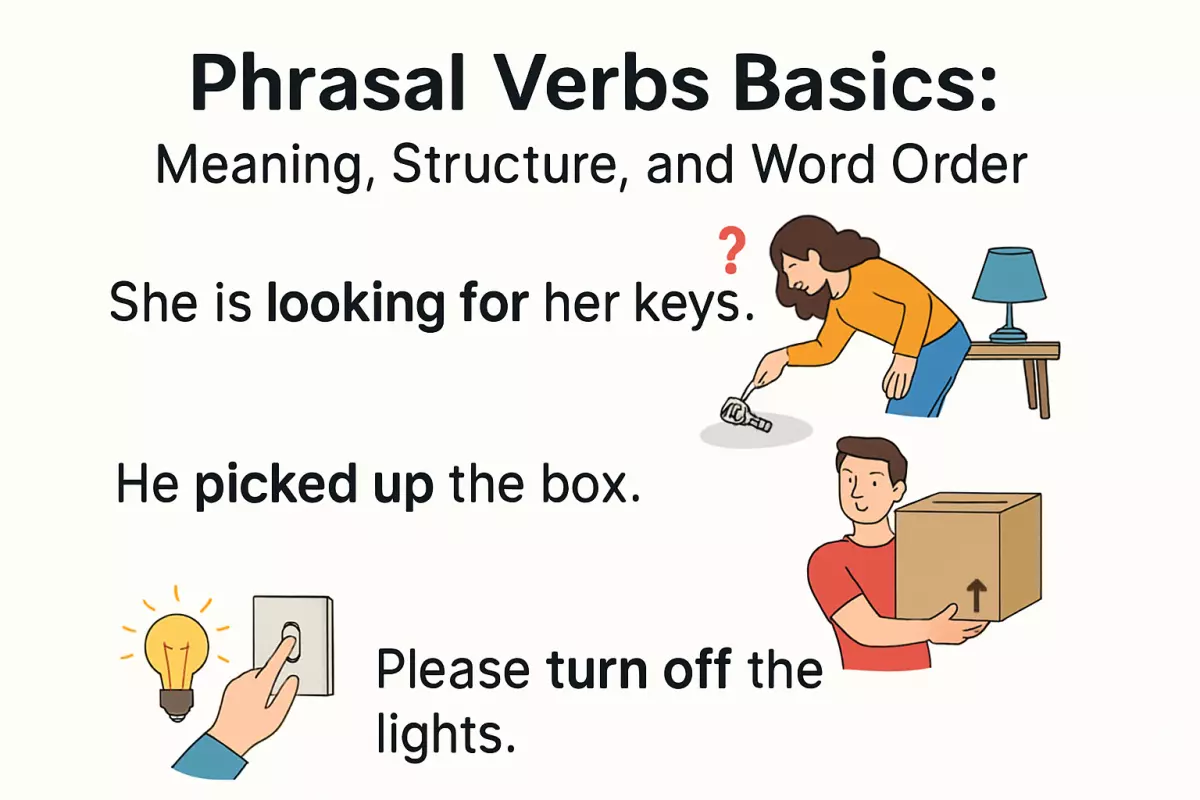
- Verb + particle + object: turn off the light, pick up the package
- Verb + particle + preposition + object: put up with noise, look forward to the weekend
Meaning: literal vs. idiomatic
Some combinations are fairly literal: the particle keeps its basic sense of direction or position. Others are idiomatic: the meaning is not predictable, so context matters.
- More literal: walk in (enter), go out (leave home / go outside), climb up (move upward)
- More idiomatic: figure out (understand), run into (meet unexpectedly), bring up (mention)
Why particles matter
Particles such as up, out, off, and on often add a recurring “flavor,” even when the final meaning is idiomatic. Recognizing these tendencies helps you guess meaning and remember usage.
- up often suggests completion or increase: use up, speed up, set up
- out often suggests emergence or discovery: find out, work out, point out
- off often suggests separation or stopping: take off, cut off, call off
- on often suggests continuation or attachment: carry on, hold on, put on
Common examples to notice as “chunks”
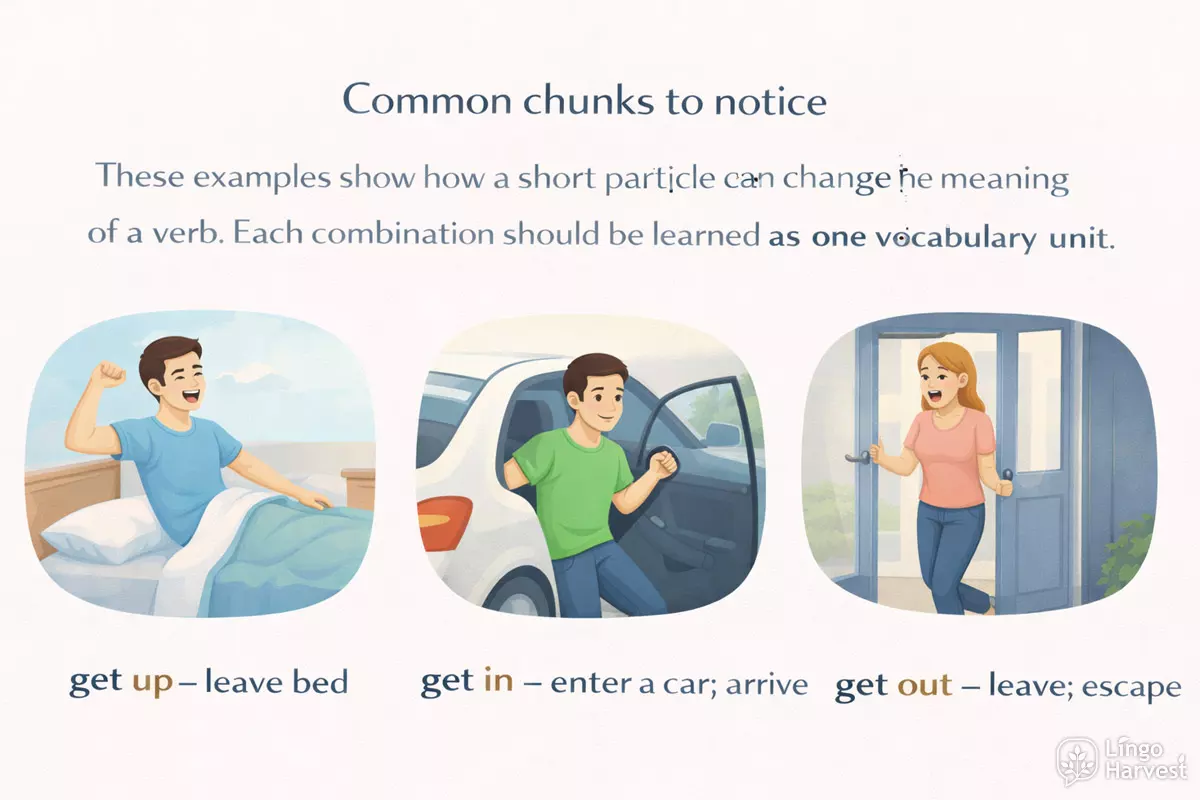
These items show how one short particle can change the verb’s meaning. Treat each as a single vocabulary unit:
- get up (leave bed)
- get in (enter a car / arrive)
- get out (leave; escape)
- get back (return)
- take off (remove; depart by plane)
- take on (accept work/responsibility)
- take up (start a hobby; use space/time)
- turn down (reduce; reject)
- turn up (increase; appear)
- put off (delay)
- put on (wear; gain weight; pretend)
- bring up (mention; raise a child)
- look after (take care of)
- look into (investigate)
- run out of (have no more)
- come across (find by chance; seem)
Because these verb-particle combinations behave like single meanings, the key skill is noticing the whole pattern in context: the verb, the particle, and any object that follows. This prepares you for the next sections on structure and word order.
Verb + particle structure explained
Many phrasal verbs are built from a main verb plus a short “helper” word that changes or sharpens the meaning. That second part is usually a particle (often identical in form to a preposition or adverb), such as up, out, off, or in. Together, the two parts act like one unit of meaning: pick up (lift/collect), turn down (reject/lower), run into (meet by chance).
In this pattern, the verb carries tense and agreement, while the particle stays the same. That’s why you change turn to turned or turns, but you keep down: turn down, turns down, turned down.
Core pattern: verb changes, particle stays fixed
- Verb shows tense: call → called → calling; particle does not change: call back, called back, calling back.
- Particle is typically one word: up, down, in, out, off, on, away, back, over, through.
- The combination often creates a meaning you cannot predict from the verb alone: give up (quit) vs. give (hand).
- Some combinations are fairly literal: sit down, stand up, go out.
Common meaning “families” created by particles
- up often suggests completion or increase: finish up, speed up, heat up, use up.
- out often suggests removal, discovery, or distribution: throw out, find out, hand out, run out.
- off often suggests separation or stopping: take off, cut off, call off, switch off.
- on often suggests continuation or activation: carry on, keep on, turn on, move on.
- in often suggests entering or inclusion: check in, join in, hand in, fill in.
- back often suggests return or response: come back, pay back, call back, fight back.
Usage patterns you can rely on
- Verb + particle + no object (intransitive): Wake up. / The plane took off. / Time ran out.
- Verb + particle + object (transitive): Pick up the package. / Turn down the offer. / Write down the address.
- Verb + particle + object often allows two word orders when the object is a noun phrase: pick up the package = pick the package up.
- Pronoun objects usually go between the verb and the particle: ✅ pick it up; ❌ pick up it.
- Some combinations are not separable, especially when the second word behaves like a true preposition: ✅ look after the kids; ❌ look the kids after.
Quick examples (verb + particle as a single meaning unit)
- bring up = mention: She brought up a good point.
- set up = arrange/create: They set up a meeting.
- break down = stop working: The car broke down.
- work out = solve/understand: We worked out the answer.
- put off = postpone: They put off the trip.
- take over = assume control: She took over the project.
- figure out = understand: He figured out the problem.
- check out = leave a hotel / examine: We checked out at noon. / Check out this report.
- get along = have a good relationship: They get along well.
- come across = find by chance: I came across an old photo.
- turn up = appear/increase volume: He turned up late. / Turn up the music.
- give in = stop resisting: They finally gave in.
- hold on = wait: Hold on a second.
- show up = arrive: No one showed up.
- put on = wear/organize: Put on your jacket. / They put on a show.
Literal vs idiomatic meanings
Phrasal verbs can communicate either a straightforward, physical idea or a figurative one that must be learned as a unit. The same verb + particle combination may even allow both readings, so context is the main clue for choosing the intended sense.
Two common meaning types
- Concrete (literal) sense: the particle keeps a clear spatial or directional meaning (up, down, in, out, away, back). The overall meaning is often predictable from the parts.
- Figurative (idiomatic) sense: the combination functions like a single vocabulary item. The meaning is not fully predictable, so it is best learned with examples and typical objects.
How to recognize which meaning is intended
- Look at the object: physical objects often support a concrete reading (coat, box, shoes), while abstract nouns often signal a figurative one (idea, issue, relationship).
- Ask “Can I picture the action?” If you can easily visualize the movement or position, it is likely a direct sense.
- Check for synonyms: figurative uses often match a single-word verb (discover, tolerate, postpone, invent).
- Notice fixed pairings: some combinations strongly prefer one meaning in everyday usage (make up = invent, find out = discover).
- Watch for ambiguity: some sentences allow both readings until more context appears (e.g., “take off”).
Common pairs: direct vs figurative
| Phrasal verb | Concrete use (example) | Figurative use (example) |
|---|---|---|
| take off | He took off his jacket. | The plane took off at 6 a.m. |
| pick up | She picked up the keys. | He picked up Spanish quickly. |
| put down | Put down the box here. | Don’t put her down in front of others. |
| turn down | Turn down the volume. | They turned down the offer. |
| bring up | Bring up the chairs from the basement. | She brought up an important point. |
| run into | The car ran into a pole. | I ran into an old friend downtown. |
| work out | They worked out at the gym. | We finally worked out a solution. |
| look after | She looked after the garden all summer. | Can you look after the kids tonight? |
| set up | Set up the chairs in rows. | They set up a new business. |
| get over | He got over the fence. | She got over the breakup. |
Usage notes that affect meaning
- Stress and emphasis: in speech, stress can highlight the particle and make the action feel more physical (“Pick up the bag”), while neutral stress often suits figurative uses.
- Pronouns push word order: with separable forms, pronouns usually go in the middle (✅ “turn it down”), which can make the expression feel more like a single unit in fast speech.
- Particles can drift from space to abstraction: “up” often suggests completion or improvement (clean up, speed up), and “out” often suggests discovery or distribution (find out, hand out). These patterns help, but they do not replace learning each meaning.
- Context resolves ambiguity: “She took off” is unclear alone; adding a noun or situation clarifies (took off her shoes vs the business took off).
Separable and inseparable patterns overview
Many multi-word verbs follow predictable word-order rules. The key question is whether the object can go between the verb and the particle, or whether it must come after the whole unit. Knowing the pattern helps you place nouns and pronouns correctly and avoid sentences that sound unnatural.
Core patterns and where the object goes
| Pattern type | Basic structure | With a noun object | With a pronoun object | Notes |
|---|---|---|---|---|
| Separable (transitive) | verb + particle + object | Both orders often work: turn off the light / turn the light off | Pronoun usually goes in the middle: turn it off ✅ / turn off it ❌ | Common in everyday speech; the “split” form is especially natural with short pronouns. |
| Inseparable (transitive) | verb + particle + object | Object stays after the particle: look after the kids ✅ | Pronoun also stays after: look after them ✅ | The particle is tightly linked to the verb; do not place the object between them. |
| Three-part (usually inseparable) | verb + particle + preposition + object | Object comes last: put up with the noise ✅ | Pronoun comes last: put up with it ✅ | Because there are two particles, splitting is not used in standard word order. |
| Intransitive (no object) | verb + particle | No object: wake up, show up | No object: pronouns are not relevant | These can look “separable,” but there is nothing to move because no direct object follows. |
| Separable with long objects (preference) | verb + object + particle | Split form often preferred: turn the lights in the hallway off | Still: turn them off | When the object is long, placing it after the verb can improve clarity and rhythm. |
Usage tips that prevent common word-order mistakes
- Pronouns are the fastest test. If “verb + particle + it” sounds wrong, the verb is probably separable and needs the pronoun in the middle (for example, pick it up, not pick up it).
- Meaning can change with the pattern. Some verbs have both a literal and an idiomatic use, and the idiomatic meaning may be tied to a specific structure. Compare: take off (leave the ground) vs. take off your coat (remove).
- Keep inseparable units intact. With verbs like look after, run into, and get over, place the object after the particle every time, whether it is a noun or a pronoun.
- Three-part verbs keep the object at the end. In forms like look forward to and get away with, the final preposition must be followed by its object, so nothing is inserted between the parts.
Pronoun placement rules
When a phrasal verb takes an object, the object can be a noun (the book, my keys) or a pronoun (it, them, him). Where you put a pronoun is not flexible in the same way as a noun object, so learning the patterns prevents many common word-order errors.
1) Separable phrasal verbs: pronouns go in the middle
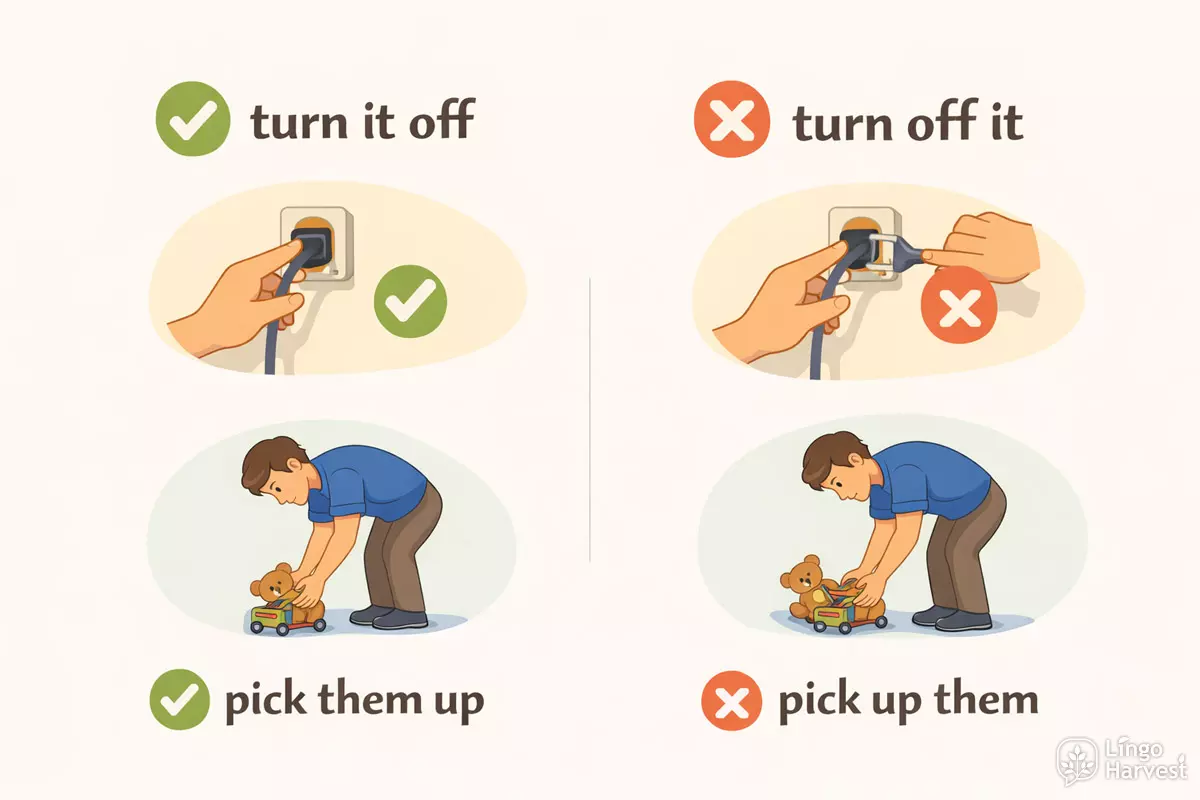
With separable phrasal verbs (verb + particle), a noun object can usually go either after the particle or between the verb and particle. A pronoun, however, almost always goes between the verb and the particle.
- ✅ turn it off → ❌ turn off it
- ✅ pick them up → ❌ pick up them
- ✅ put it on → ❌ put on it
- ✅ take it back → ❌ take back it
- ✅ bring it up → ❌ bring up it
- ✅ write it down → ❌ write down it
- ✅ call him back → ❌ call back him
- ✅ hand it in → ❌ hand in it
- ✅ give it away → ❌ give away it
- ✅ throw it out → ❌ throw out it
- ✅ fill it in → ❌ fill in it
- ✅ look it up → ❌ look up it
- ✅ set it up → ❌ set up it
- ✅ sort it out → ❌ sort out it
- ✅ figure it out → ❌ figure out it
2) Inseparable phrasal verbs: pronouns cannot split the verb and particle
With inseparable combinations, the particle stays attached to the verb, so the object (including a pronoun) comes after the whole phrasal verb. You cannot place a pronoun between the verb and particle.
- ✅ look after her → ❌ look her after
- ✅ run into them → ❌ run them into
- ✅ get over it → ❌ get it over
- ✅ come across it → ❌ come it across
- ✅ look into it → ❌ look it into
- ✅ go through it → ❌ go it through
- ✅ get along with him → ❌ get along him with
- ✅ put up with it → ❌ put it up with
- ✅ look forward to it → ❌ look forward it to
- ✅ catch up with them → ❌ catch up them with
3) Quick checks that help you choose the right position
Use these practical tests to decide where a pronoun should go in a sentence.
- If you can say “verb + noun + particle” and “verb + particle + noun,” it is likely separable, and a pronoun must go in the middle (pick the kids up / pick up the kids → pick them up).
- If moving the noun sounds wrong, treat it as inseparable and keep the object after the full unit (look after the baby → look after her).
- Keep pronouns short and early, especially in spoken English: turn it off, write it down, hand it in.
- Don’t separate multi-word particles, such as up with or forward to; the pronoun comes after the whole phrase (put up with it, look forward to it).
- In questions and negatives, the same placement rule applies: Did you turn it off? / Don’t bring it up.
Common beginner phrasal verbs
Start with high-frequency verb + particle combinations that show up in everyday instructions, routines, and simple conversations. Many of these are intransitive (no object) or take a clear object you can easily move (a book, the TV, your shoes). Pay attention to two patterns: (1) whether the phrasal verb needs an object, and (2) if it’s separable, where the object and pronoun go.
Everyday actions and routines
- get up (intransitive) → wake and leave bed: I get up at 7.
- sit down (intransitive) → take a seat: Please sit down.
- stand up (intransitive) → rise to your feet: Everyone stood up.
- go out (intransitive) → leave home / socialize: We went out on Friday.
- come back (intransitive) → return: Come back soon.
- get in (intransitive) → enter a car/building: Get in the car.
- get out (intransitive) → leave a car/building: Get out of the taxi.
- turn up (intransitive) → arrive (often unexpectedly): He turned up late.
- stay in (intransitive) → not go out: We stayed in tonight.
- look after (transitive, inseparable) → take care of: She looks after her brother.
Simple “do/stop/continue” meanings
- put on (transitive, separable) → wear clothing: Put on your jacket. / Put it on.
- take off (transitive, separable) → remove clothing: Take off your shoes. / Take them off.
- pick up (transitive, separable) → lift or collect: Pick up the bag. / Pick it up.
- put down (transitive, separable) → place on a surface: Put down the glass. / Put it down.
- give back (transitive, separable) → return something: Give back my pen. / Give it back.
- throw away (transitive, separable) → discard: Throw away the old papers. / Throw them away.
- find out (transitive, separable) → discover information: Find out the answer. / Find it out. (less common than Find out it ❌)
- try on (transitive, separable) → test clothing size: Try on the shoes. / Try them on.
- fill in (transitive, separable) → complete a form: Fill in this form. / Fill it in.
- write down (transitive, separable) → record in writing: Write down the address. / Write it down.
Word order shortcuts that prevent common mistakes
Use these quick rules to keep word order natural:
- Pronoun objects go in the middle with separable forms: ✅ Turn it off. ❌ Turn off it.
- Noun objects can go in two places (separable): ✅ Turn off the TV. / Turn the TV off.
- Inseparable forms keep the object after the particle: ✅ Look after the kids. ❌ Look the kids after.
- Don’t force separation when the object is long: prefer ✅ Pick up the bag you left on the bus. over Pick the bag you left on the bus up.
Typical learner mistakes and tips
Most problems come from mixing up word order, treating the second part as a normal preposition, or choosing the wrong level of formality. Focus on patterns: whether the verb is separable, whether it needs an object, and whether the “particle” changes meaning in an idiomatic way.
Word order errors (especially with objects)
A common trap is placing the object in the wrong position. With many separable combinations, you can put a noun object either before or after the particle, but pronouns usually must go in the middle.
- ❌ Turn off it. → ✅ Turn it off.
- ✅ Turn off the light. / ✅ Turn the light off.
- ❌ Pick up them. → ✅ Pick them up.
- ✅ Pick up the kids. / ✅ Pick the kids up.
- ❌ Put on it. → ✅ Put it on.
- ✅ Put on your coat. / ✅ Put your coat on.
- ❌ Write down it. → ✅ Write it down.
- ✅ Write down the address. / ✅ Write the address down.
- ❌ Call up her. → ✅ Call her up.
- ✅ Call up your friend. / ✅ Call your friend up.
- Tip: if the object is long, the “verb + particle + object” order often sounds clearer: She put off the meeting that everyone had been planning for weeks.
Separable vs. inseparable: guessing instead of checking
Another frequent mistake is separating a combination that cannot be split, or keeping together one that is normally split with pronouns. When you learn a new item, learn it with a short pattern note: inseparable, separable, and whether it is transitive (needs an object) or intransitive (no object).
- ❌ Look the word up in the dictionary. → ✅ Look up the word in the dictionary. (separable)
- ❌ Look the word up in. → ✅ Look up the word in the dictionary. (particle is not a preposition here)
- ❌ Run the problem into. → ✅ Run into the problem. (inseparable)
- ❌ Get the flu over. → ✅ Get over the flu. (inseparable)
- Tip: if the second word is followed by its own object, it is often a preposition and cannot be separated: look after + noun, run into + noun, get over + noun.
Confusing particles with prepositions
Learners often treat every “verb + word” as the same structure. But particles behave differently from prepositions. Prepositions must have an object, and that object comes right after them. Particles can move (in separable cases) and may not take an object at all.
- ✅ She looked up the word. (particle; can be separated)
- ✅ She looked up. (intransitive; no object)
- ✅ She looked after the child. (preposition; object required)
- ❌ She looked the child after. → ✅ She looked after the child.
- Tip: test it: if you can move the noun object between the verb and the second word, you are likely dealing with a particle.
Over-literal meanings and wrong verb choice
Many combinations are idiomatic, so translating word-by-word leads to unnatural or incorrect meanings. Learn them as single vocabulary items, and notice which nouns commonly follow them.
- ❌ Can you make the TV louder? Turn up it. → ✅ Turn it up.
- ❌ I will discover the information. (possible, but often less natural) → ✅ I will find out the information.
- ❌ Please continue the form. → ✅ Please fill out the form.
- ❌ We will postpone it to next week. (fine) → ✅ We will put it off until next week. (more conversational)
- Tip: record each item with a typical object: find out + the truth/answer, fill out + a form, put off + a meeting/decision.
Register problems: too informal in formal writing
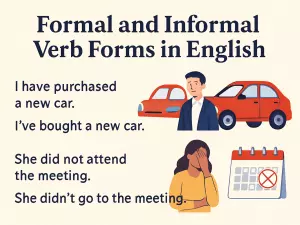
Some multi-word verbs are neutral, but many sound informal. In essays, reports, or business emails, consider a more formal single-word alternative when appropriate.
- put off → postpone
- find out → discover / determine
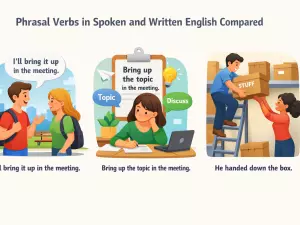
- bring up (a topic) → raise (a topic)
- help out → assist
- go on → continue
Quick practice routine (pattern-first)
- Learn each item with a label: separable or inseparable, plus one example sentence.
- Add a pronoun test sentence to force correct placement: turn it off, pick them up, write it down.
- Group by particle to notice meaning tendencies: up (increase/complete), off (stop/postpone), out (discover/appear), but confirm each meaning with examples.
- Prefer short, high-frequency combinations first; accuracy with common ones matters more than memorizing rare items.
Homework: basic phrasal verb practice
Use these tasks to build accuracy with meaning, structure, and word order. Focus on three patterns: intransitive (no object), transitive separable (object can go in the middle), and transitive inseparable (object must come after the phrasal verb). Pay special attention to pronouns: when a phrasal verb is separable, a pronoun usually goes between the verb and the particle (e.g., “turn it off”).
1) Choose the best completion (meaning + structure)
Complete each sentence with the correct option (A, B, or C).
- I can’t hear the TV. Could you turn it ____?
A) up B) out C) on - We need to set ____ early to avoid traffic.
A) up B) off C) out - She ran ____ her old teacher at the station.
A) into B) off C) over - Please fill ____ this form and sign at the bottom.
A) in B) out C) up - I’ll look ____ the word in the dictionary.
A) after B) up C) over - They put ____ the meeting until Friday.
A) off B) up C) on - My phone battery ran ____ during the call.
A) out B) into C) over - He took ____ his jacket because it was hot.
A) off B) up C) out - Could you pick me ____ at 6?
A) up B) out C) on - Let’s go ____ the plan one more time.
A) over B) out C) off
Show answers
- A
- B
- A
- B
- B
- A
- A
- A
- A
- A
2) Fix the word order (separable vs inseparable)
Rewrite each sentence correctly. Keep the meaning the same.
- Turn off it, please.
- She looked the number up it.
- We ran our neighbors into yesterday.
- Put your shoes on them.
- Could you fill out it before you sit down?
- He took off it and hung it on the chair.
- I’ll pick up you at the airport.
- They put off it because they were busy.
Show answers
- Turn it off, please.
- She looked it up.
- We ran into our neighbors yesterday.
- Put them on.
- Could you fill it out before you sit down?
- He took it off and hung it on the chair.
- I’ll pick you up at the airport.
- They put it off because they were busy.
3) Build sentences from prompts (use the correct pattern)
Write one complete sentence for each prompt. Use the phrasal verb in parentheses and choose a natural object if needed.
- (wake up) → intransitive
- (get up) → intransitive
- (sit down) → intransitive
- (turn on) → transitive separable + pronoun object
- (turn off) → transitive separable + noun object
- (look up) → transitive separable + pronoun object
- (fill out) → transitive separable + noun object
- (pick up) → transitive separable + pronoun object
- (run into) → transitive inseparable + person
- (look after) → transitive inseparable + person/thing
- (get over) → transitive inseparable + problem/illness
- (go over) → transitive inseparable + plan/details
4) Error spotting (usage and meaning)
Each sentence has one problem (wrong particle, wrong meaning, or wrong structure). Correct it.
- I’m going to look after the new word in the dictionary.
- Can you turn up the lights? It’s too loud.
- She ran out her boss at lunch.
- We put on the meeting until next week.
- He filled in the form online (meaning: completed it).
- Please go out the instructions before you start.
- I can’t get up this flu yet.
- Pick me out at 7, please.
Show answers
- I’m going to look up the new word in the dictionary.
- Can you turn up the lights? It’s too dark.
- She ran into her boss at lunch.
- We put off the meeting until next week.
- Please fill out the form online.
- Please go over the instructions before you start.
- I can’t get over this flu yet.
- Pick me up at 7, please.
5) Quick self-check rules (use while reviewing)
- If the object is a pronoun and the verb is separable: place it in the middle (✅ “turn it off” / ❌ “turn off it”).
- If the phrasal verb is inseparable: keep verb + particle together (✅ “run into her” / ❌ “run her into”).
- If you are unsure about meaning, test with a simple synonym: “postpone” → “put off”; “review” → “go over”; “meet by chance” → “run into”.