Verb Forms in English: Base, Simple, Participle

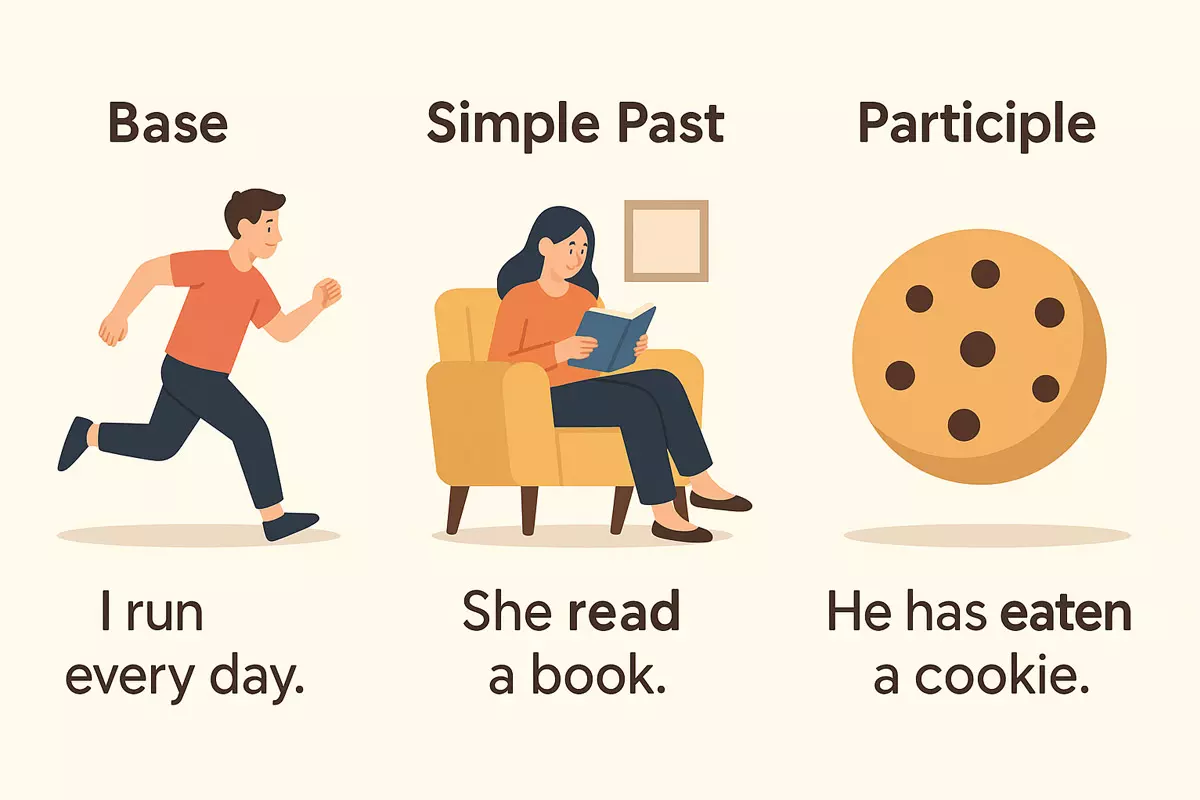 This article explains the base, simple present, simple past, past participle, and present participle forms of English verbs. It covers when to use each form, provides examples, and includes a practice section to help you identify verb forms.
Mastering the various ways verbs change is essential for clearer and more dynamic English communication. By understanding how action words shift forms—whether in their basic state, when altered for tense, or when made more complex—speakers can express ideas more accurately and effectively. This knowledge not only makes it easier to convey meaning but also helps avoid common mistakes, resulting in more confident and fluent use of English in both writing and conversation.
Base Form
The most essential version of a verb in English is its plain, unconjugated state. This is the form you’ll find in dictionaries, used for commands, and after modal verbs. Unlike other variations, it doesn’t include endings like -s, -ed, or -ing. For example, in phrases like “They run” or “Can you help?”, the verbs appear in their original structure.
Where It Appears in Sentences
- After modal verbs: She can swim.
- In imperatives: Go home.
- Dictionary entries: to eat, to write
- Forming simple present with plural subjects: They play chess.
Main Features
This version of the verb is not marked for tense, person, or number. It’s the foundation for creating other forms, such as the past or present participle. Notably, some verbs are irregular, but their dictionary form remains the same as their most basic version.
Common Examples
- run
- make
- sing
- eat
- drive
- read
- work
- see
- begin
- find
- bring
- choose
- leave
- take
- feel
- give
- think
- write
- sit
- stand
Comparison with Other Verb Forms
| Verb | Base | Past Simple | Past Participle | Present Participle |
|---|---|---|---|---|
| go | go | went | gone | going |
| make | make | made | made | making |
| eat | eat | ate | eaten | eating |
| play | play | played | played | playing |
| see | see | saw | seen | seeing |
Understanding this root form helps when learning conjugations and constructing correct sentences. Whether you’re studying grammar or just want to improve your usage, focusing on this essential structure is a practical starting point.
Simple Present Form
English verbs in their base form often serve as the foundation for expressing regular actions, habits, and general truths. This tense is especially useful for talking about routines, facts, and repeated events. The structure is generally straightforward, though there are a few important details to remember, particularly with the third person singular.
How It’s Formed
For most verbs, the base form is used with all subjects except for the third person singular (he, she, it), where an -s or -es ending is added. Here are the key rules:
- I/You/We/They use the base verb: work, play, read.
- He/She/It adds -s or -es: works, plays, reads.
- Verbs ending in -ch, -sh, -x, -ss, -o usually add -es: watches, goes, fixes.
- For verbs ending in consonant + y, change y to ies: carries, studies.
- Modal verbs (can, must, should) do not change for person.
Examples in Context

Here are some common sentences illustrating how this verb form works in everyday English:
- I walk to school every day.
- She eats breakfast at 8 o’clock.
- The sun rises in the east.
- We play chess on weekends.
- He watches TV after dinner.
- They study English together.
- Water boils at 100°C.
- The store opens at nine.
- You read very quickly.
- It rains a lot in April.
- My cat sleeps all afternoon.
- Birds fly south in winter.
- She carries her bag to work.
- He fixes his bike himself.
- We enjoy music festivals.
- My brother always forgets his keys.
- The train leaves at six.
- Children like ice cream.
Affirmative, Negative, and Question Patterns
| Sentence Type | Pattern Example |
|---|---|
| Affirmative | She works here. |
| Negative | They do not (don’t) eat meat. |
| Yes/No Question | Do you like coffee? |
| Wh- Question | Where does he live? |
In summary, this verb form is essential for describing facts, routines, and universal statements. Pay attention to the subject and verb agreement, especially for the third person singular, to ensure accuracy in your sentences.
Simple Past Form
The simple past tense is used to describe actions or events that took place and finished at a specific time in the past. In English, regular verbs form this tense by adding -ed to the base form, while irregular verbs use unique forms that often need to be memorized. This tense is essential for storytelling, recounting experiences, and stating facts from earlier times.
How Regular Verbs Change
Most verbs in English are regular, which means their past tense is straightforward. Simply add -ed to the verb. For example:
- walk → walked
- play → played
- cook → cooked
- jump → jumped
- clean → cleaned
If a verb ends in e, only -d is added: like → liked.
Spelling Changes for Regular Verbs
Some verbs require spelling adjustments before adding -ed:
- stop → stopped (double the final consonant after a short vowel)
- cry → cried (change y to i)
- plan → planned
- study → studied
Irregular Verb Patterns
Irregular verbs do not follow the -ed pattern. Their forms vary, so it's useful to see a selection side by side:
| Base Form | Past Simple |
|---|---|
| go | went |
| see | saw |
| make | made |
| take | took |
| have | had |
| eat | ate |
| find | found |
| write | wrote |
| come | came |
| buy | bought |
Forming Negatives and Questions
To make negatives or questions in this tense, use did (the past form of "do") with the base form of the verb:
- You did not finish your homework. (negative)
- Did she call you yesterday? (question)
Notice that after "did" or "did not," the verb returns to its base form.
Usage Examples
Here are sentences showing this tense in action:
- They watched a movie last night.
- I met your friend at the café.
- We didn’t go to the park.
- Did you see the game?
- She studied French in college.
Understanding both regular and irregular patterns is key to using this tense accurately in conversation and writing.
Past Participle Form
The third form of English verbs is widely used in perfect tenses, passive voice, and as adjectives. Regular verbs follow a predictable pattern: simply add -ed to the base. However, irregular verbs vary greatly, so it's important to memorize their unique forms. This participle often appears with auxiliary verbs like have, has, had, is, and was.
How It’s Used
You’ll encounter this form in several common constructions:
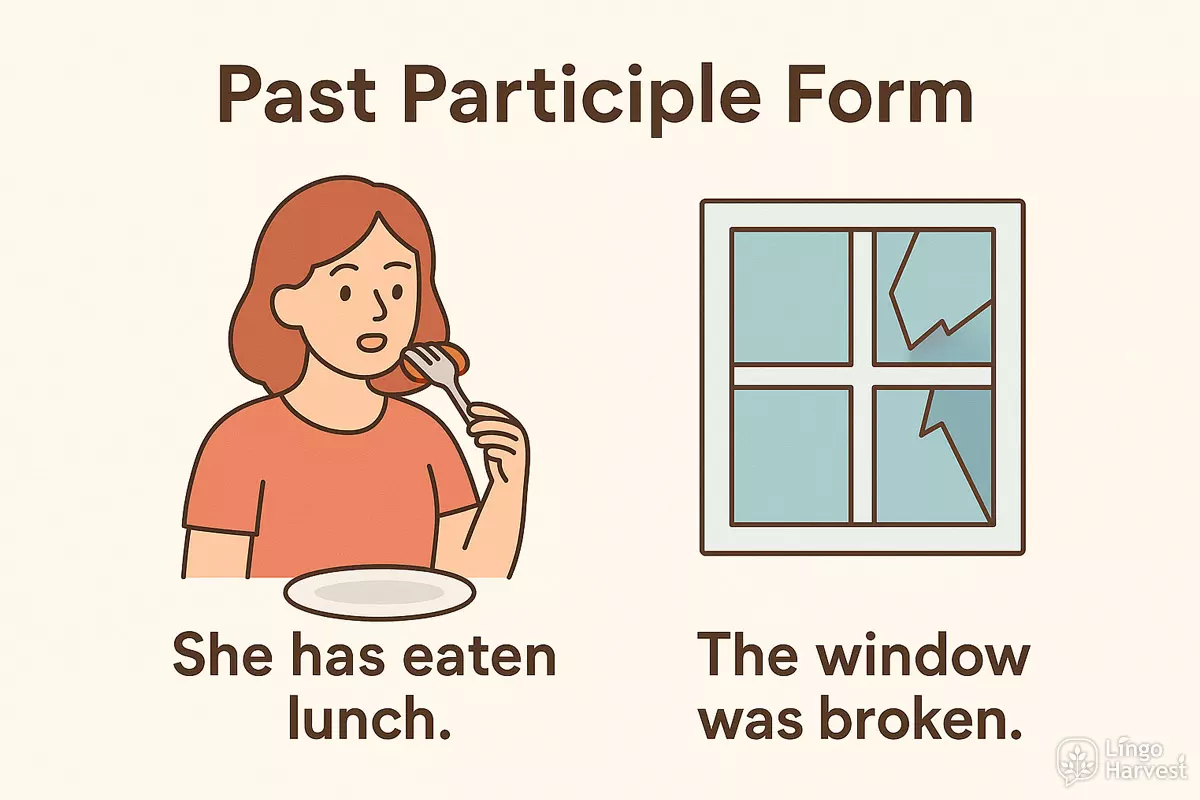
- With have/has/had in perfect tenses: She has eaten lunch.
- In passive sentences: The window was broken.
- As an adjective: A finished project
Common Regular and Irregular Examples
While regular verbs are straightforward, irregular ones require special attention. Here’s a helpful overview:
| Base Form | Simple Past | Third Form (Participle) |
|---|---|---|
| walk | walked | walked |
| write | wrote | written |
| go | went | gone |
| see | saw | seen |
| make | made | made |
| choose | chose | chosen |
| break | broke | broken |
| take | took | taken |
| give | gave | given |
| find | found | found |
| bring | brought | brought |
| come | came | come |
| run | ran | run |
| sing | sang | sung |
| begin | began | begun |
| eat | ate | eaten |
| swim | swam | swum |
| drive | drove | driven |
| fall | fell | fallen |
| catch | caught | caught |
Quick Tips for Mastery
- Learn irregular forms as vocabulary—there’s no universal rule.
- Notice pronunciation differences, especially with -ed endings.
- Practice by forming sentences in perfect and passive structures.
Recognizing and using the correct third form is key to sounding natural in English, especially in writing and formal speech.
Present Participle Form
The –ing form of a verb is widely used in English for continuous tenses, adjectives, and gerunds. This form is created by adding “-ing” to the base verb, but spelling changes can occur depending on the verb’s ending. For example, “run” becomes “running,” and “make” turns into “making.” The –ing form is essential for expressing ongoing actions. In sentences like “She is reading,” or “They were swimming,” the participle helps form progressive aspects. It also functions as an adjective: “The crying baby woke up.” Additionally, it acts as a noun (gerund): “Swimming is fun.”
How to Form the –ing Version
Most verbs simply take “-ing,” but certain spelling rules apply:
- Verbs ending with a silent “e”: Drop the “e” (write → writing, dance → dancing)
- One-syllable verbs ending in consonant-vowel-consonant: Double the last consonant (run → running, sit → sitting)
- Verbs ending in “ie”: Change “ie” to “y” (die → dying, lie → lying)
- Simply add “-ing” to most verbs (play → playing, jump → jumping)
Examples of Common Verbs and Their –ing Forms
Here are some frequently used verbs transformed into their –ing versions:
- go → going
- eat → eating
- read → reading
- write → writing
- begin → beginning
- run → running
- swim → swimming
- shop → shopping
- plan → planning
- study → studying
- fix → fixing
- travel → traveling
- move → moving
- sing → singing
- enjoy → enjoying
- carry → carrying
- stop → stopping
- make → making
Uses in Sentences
The –ing participle appears in several contexts:
- Continuous tenses: “They are playing outside.”
- Adjectives: “The barking dog was loud.”
- Gerunds: “Reading improves your vocabulary.”
| Base Verb | -ing Form |
|---|---|
| run | running |
| write | writing |
| swim | swimming |
| plan | planning |
| travel | traveling |
| lie | lying |
| make | making |
| stop | stopping |
Understanding these forms will help you recognize and use them correctly in everyday English, whether you’re describing ongoing actions, forming adjectives, or turning verbs into nouns.
When Each Form Is Used
Understanding where each verb form fits makes English sentences clear and accurate. The base, simple, and participle forms each play a unique role in expressing time, aspect, and grammatical function. Below, you'll find a breakdown of typical contexts for these verb forms, along with practical examples.
Base Form
The base form—also called the infinitive without "to"—is used in several key situations:
- Forming the present simple tense (except for third person singular): They work every day.
- After modal verbs: She can swim.
- Imperatives (commands): Close the door.
- In subjunctive structures: We suggest that he study more.
- With auxiliary "do" in questions and negatives: Do you like tea?
Simple (Past) Form
The simple past form is used to describe completed actions or events in the past. Here’s when you’ll see it:
- Describing finished events: She walked to school yesterday.
- Storytelling or recounting past experiences: We watched a movie last night.
- After "if" in unreal past conditionals: If he tried, he might succeed.
- With time expressions like "ago," "last week," "in 2010": I visited Paris in 2010.
Participle Forms
English verbs have two participles: present participle (ending in -ing) and past participle (typically -ed or irregular). Both are essential for building continuous and perfect tenses, as well as passive voice.
| Form | Typical Uses | Examples |
|---|---|---|
| Present Participle (-ing) |
|
|
| Past Participle (-ed or irregular) |
|
|
Quick Reference: Common Patterns
- Base: go, take, read
- Simple Past: went, took, read (pronounced "red")
- Present Participle: going, taking, reading
- Past Participle: gone, taken, read
Choosing the correct verb form depends on sentence structure and meaning. Each form helps convey precise timing, aspect, and voice, so paying attention to context ensures your language is both natural and correct.
Practice: Identify the Form
Understanding how to recognize the base, simple, and participle forms of verbs is essential for mastering English grammar. The following exercises will help you distinguish between these verb forms in different contexts. Read each sentence or verb form carefully and consider which grammatical structure is being used.
Task 1: Spot the Verb Form in Sentences
For each sentence below, identify whether the highlighted verb is in its base form, simple past, present participle (-ing), or past participle (-ed/-en or irregular). Write your answers before checking them.
- She runs every morning.
- He was swimming in the lake.
- They have eaten breakfast.
- We build houses.
- I wrote a letter yesterday.
- The window was broken by the wind.
- Please call me when you arrive.
- The children are playing outside.
- She drives to work every day.
- He had seen the movie before.
Show answers
- Simple present (third person singular)
- Present participle (“swimming”)
- Past participle (“eaten”)
- Base form (“build”)
- Simple past (“wrote”)
- Past participle (“broken”)
- Base form (“call”)
- Present participle (“playing”)
- Simple present (third person singular, “drives”)
- Past participle (“seen”)
Task 2: Match the Verb with Its Forms
Below are some common verbs. Write out their base form, simple past, present participle, and past participle. This activity helps you see patterns and irregularities.
| Verb | Base Form | Simple Past | Present Participle | Past Participle |
|---|---|---|---|---|
| Go | go | went | going | gone |
| Eat | eat | ate | eating | eaten |
| Build | build | built | building | built |
| See | see | saw | seeing | seen |
| Call | call | called | calling | called |
| Write | write | wrote | writing | written |
| Drive | drive | drove | driving | driven |
| Break | break | broke | breaking | broken |
| Play | play | played | playing | played |
| Swim | swim | swam | swimming | swum |
Task 3: Classify the Verb Forms
Identify the correct form for each verb below by choosing from: base, simple past, present participle, or past participle.
- eaten
- playing
- went
- build
- driven
- wrote
- calling
- seen
- swam
- broken
Show answers
- eaten – past participle
- playing – present participle
- went – simple past
- build – base form
- driven – past participle
- wrote – simple past
- calling – present participle
- seen – past participle
- swam – simple past
- broken – past participle
By analyzing and practicing with real examples, you strengthen your ability to distinguish among the main verb forms used in English. Continue to look for patterns, especially with irregular verbs, and test yourself with new sentences whenever possible.