What Are Adjectives? Complete Definition

 This article explains what adjectives describe, where they appear in sentences, and the main types and forms you’ll encounter. It also covers how adjectives differ from adverbs, common beginner mistakes, and offers short practice tasks.
Words have the remarkable ability to bring descriptions to life in sentences, adding color, detail, and personality to our language. By using descriptive terms, we can paint vivid pictures in the minds of our listeners or readers, making our ideas clearer and more engaging. Whether we are telling a story, giving instructions, or simply having a conversation, the right words help us communicate more effectively and make our messages memorable. Descriptive language enriches our everyday interactions and allows us to express ourselves with greater precision and creativity.
What Adjectives Describe
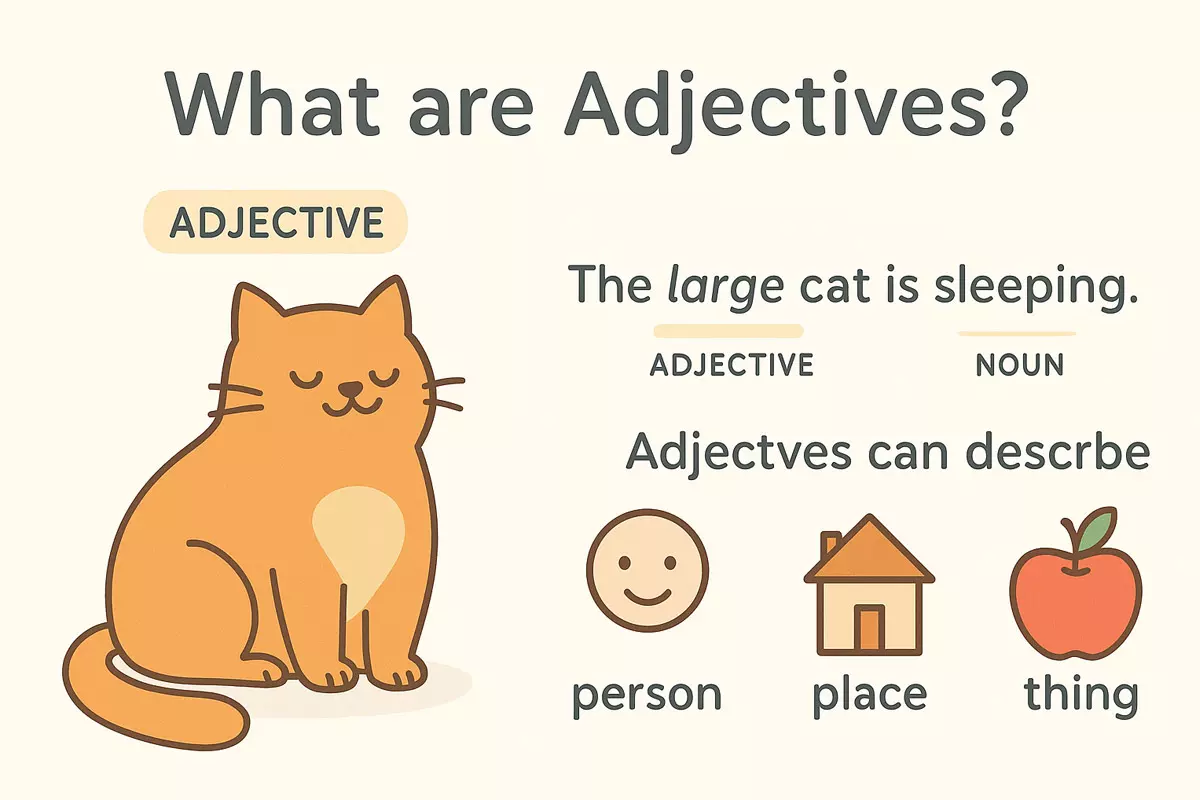
Adjectives are words that provide more information about nouns and pronouns, helping to clarify exactly which person, place, thing, or idea is being discussed. They answer questions like "What kind?", "Which one?", "How many?", and "Whose?" By using descriptive words, speakers and writers can paint a clearer picture, specify details, and add nuance to their communication.
Types of Information Adjectives Convey
Adjectives can express a wide range of details about the words they modify. Common categories include:
- Color: red apple, blue sky
- Size: tiny kitten, enormous building
- Shape: round table, square box
- Age: ancient artifact, young child
- Origin: French bread, Asian cuisine
- Material: wooden chair, silk scarf
- Opinion: lovely view, boring movie
- Quantity: several books, few options
- Temperature: cold drink, hot soup
- Emotional state: happy child, anxious moment
- Condition: broken vase, fresh bread
- Purpose: sleeping bag, wedding dress
Examples of What Adjectives Modify
Descriptive words most commonly modify nouns, but they can also clarify pronouns or noun phrases. For example:
- Adjective + noun: green grass
- Adjective + noun phrase: three old wooden chairs
- Adjective + pronoun (less common): unfortunate him
Different Aspects Highlighted by Adjectives
The following table illustrates how adjectives can describe various features of a noun, making meaning more precise:
| Aspect | Sample Adjectives |
|---|---|
| Color | crimson, turquoise, golden, beige |
| Size | gigantic, petite, medium, vast |
| Shape | oval, rectangular, spiral, flat |
| Opinion | interesting, dull, wonderful, awful |
| Origin | Italian, African, local, foreign |
| Material | leather, plastic, cotton, metal |
Key Questions Answered by Adjectives
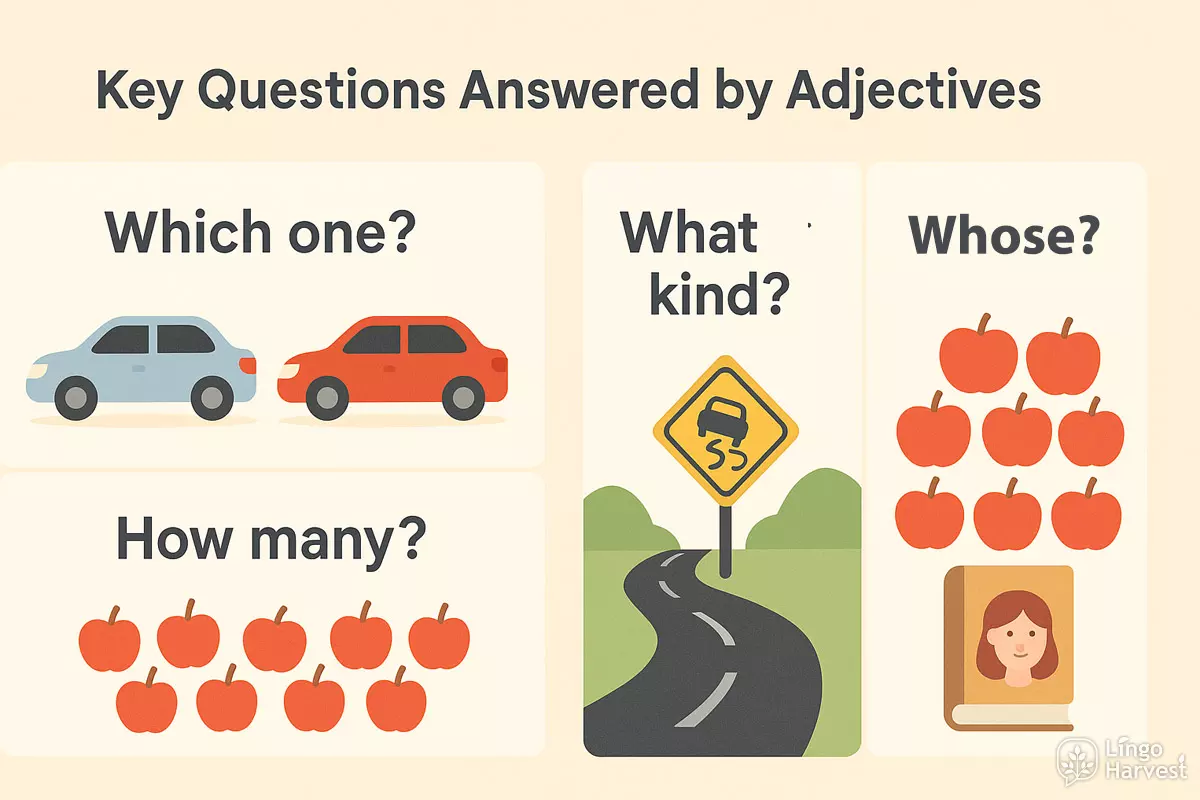
Descriptive words typically address one or more of the following:
- Which one? (the first car, the main course)
- What kind? (a dangerous road, a tropical climate)
- How many? (ten apples, several chances)
- Whose? (her book, John’s idea)
In short, adjectives enrich our language by specifying qualities, distinguishing one thing from another, and providing vivid details about the world around us.
Where Adjectives Appear
Adjectives usually sit close to the nouns or pronouns they modify, providing details that describe, specify, or quantify. In most English sentences, these descriptive words are placed directly before the noun they change, as in "a red apple" or "three large dogs." However, their position can shift depending on the sentence structure and the type of adjective used.
Common Positions for Adjectives
- Before the noun: This is the most typical location. Examples include "happy child," "old book," or "blue sky."
- After linking verbs: Adjectives can follow verbs like "be," "seem," "become," or "feel" to describe the subject. For example: "The soup is hot." "She seems tired."
- After certain nouns: In some cases, especially with expressions like "something," "nothing," or "anyone," adjectives come after the noun: "Anything useful," "someone special."
- In adjective phrases: Adjectives may be part of longer phrases, often following the noun: "A man proud of his achievements."
Examples of Adjective Placement
Here are a variety of ways descriptive words can be positioned within sentences:
- Quiet street
- The street is quiet.
- Something interesting
- A cake made fresh
- The roses smell sweet.
- People eager to help
- A solution possible
- The answer seems correct.
- Books old and dusty
- Find anything new?
- A journey unforgettable
- This tea tastes bitter.
- Someone helpful
- He remained silent.
- A building tall and narrow
- Something blue
Order When Multiple Adjectives Are Used
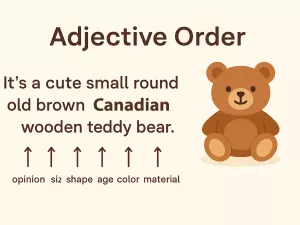
When more than one adjective modifies a noun, English generally follows a specific order: quantity, opinion, size, age, shape, color, origin, material, purpose, then noun. For example, "three beautiful small old round red Spanish wooden fishing boats."
| Adjective Category | Example |
|---|---|
| Quantity | Two, several, many |
| Opinion | Lovely, horrible, interesting |
| Size | Small, huge, tiny |
| Age | New, ancient, young |
| Shape | Round, flat, square |
| Color | Red, green, golden |
| Origin | French, African, American |
| Material | Wooden, plastic, metal |
| Purpose | Fishing (as in "fishing boat"), sleeping (as in "sleeping bag") |
Understanding these placement rules helps sentences sound natural and clear. While English is flexible, following these patterns makes communication smoother and more precise.
Common Adjective Types
Adjectives come in many forms, each serving a distinct purpose in describing nouns or pronouns. Understanding the main categories makes it easier to identify and use them effectively in sentences. Below, you'll find explanations and examples of the most widely used adjective types in English.
Descriptive Adjectives
These are the words most people think of when they imagine adjectives. They provide information about qualities such as color, size, shape, and other characteristics. For example:
- blue
- tall
- ancient
- delicious
- quiet
- round
- shiny
- fragile
Quantitative Adjectives
Quantitative adjectives indicate the amount or quantity of something, answering “how much?” or “how many?” Some typical examples include:
- several
- few
- many
- all
- some
- much
- hundred
- numerous
Demonstrative Adjectives
These specify which noun is being referred to. Words like this, that, these, and those are common examples. For instance:
- this
- that
- these
- those
Possessive Adjectives
Possessive adjectives show ownership or belonging. They come before a noun to clarify who owns something. Examples include:
- my
- your
- his
- her
- its
- our
- their
Interrogative Adjectives
These are used in questions to modify nouns. The most common are:
- which
- what
- whose
Proper Adjectives
Proper adjectives are derived from proper nouns and are always capitalized. They typically refer to nationality, place, or a specific name, such as:
- American
- Shakespearean
- Victorian
- French
- Asian
Comparative and Superlative Adjectives
These forms are used to compare two or more things. The comparative form compares two things, while the superlative form compares three or more. Here's a comparison of some common forms:
| Base Form | Comparative | Superlative |
|---|---|---|
| small | smaller | smallest |
| happy | happier | happiest |
| beautiful | more beautiful | most beautiful |
| bad | worse | worst |
| good | better | best |
These examples highlight the variety and flexibility of adjectives in English. Recognizing each type helps you choose the right word for clear and effective communication.
Basic Forms
When describing nouns, modifiers generally appear in a few core shapes. Most commonly, these are single words positioned just before the thing they describe, such as “blue sky” or “happy child.” While many are simple, there are also multi-word varieties and those that change form to match comparison.
Single-Word Adjectives
The most familiar type is a single descriptive word. These can refer to color, size, age, emotion, and more. Here are some everyday examples:
- tall
- old
- green
- quick
- friendly
- loud
- sharp
- brave
- bright
- gentle
- empty
- modern
- rich
- silent
- dangerous
- ancient
- curly
- wide
Compound and Multi-Word Forms
Not all descriptors are just one word. Compound forms combine two or more words, often linked with a hyphen (e.g., “well-known author,” “open-minded student”). Multi-word types can also appear after the noun, such as “the car is very fast,” where “very fast” is the full modifier.
Comparison: Degrees of Adjectives
Many modifiers can show different levels or degrees, indicating comparison between things. These forms are called positive, comparative, and superlative.
| Form | Example | Usage |
|---|---|---|
| Positive | small | Describes one noun (“a small cat”) |
| Comparative | smaller | Compares two (“this cat is smaller”) |
| Superlative | smallest | Shows the highest degree (“the smallest cat”) |
Placement in Sentences
Describing words often come right before the noun (“blue dress”), but can also appear after linking verbs (“the sky is blue”). In both positions, they add details or qualities to nouns. Understanding these structures helps with both recognizing and using descriptive language effectively in everyday writing and speech.
Adjectives vs Adverbs
Understanding the distinction between adjectives and adverbs helps clarify how English sentences are built. Both word types add information, but they describe different things and behave differently in a sentence. Adjectives modify nouns and pronouns, providing details like size, color, or quantity. In contrast, adverbs typically modify verbs, adjectives, or even other adverbs, often answering questions like how, when, where, or to what extent.
How Adjectives and Adverbs Work
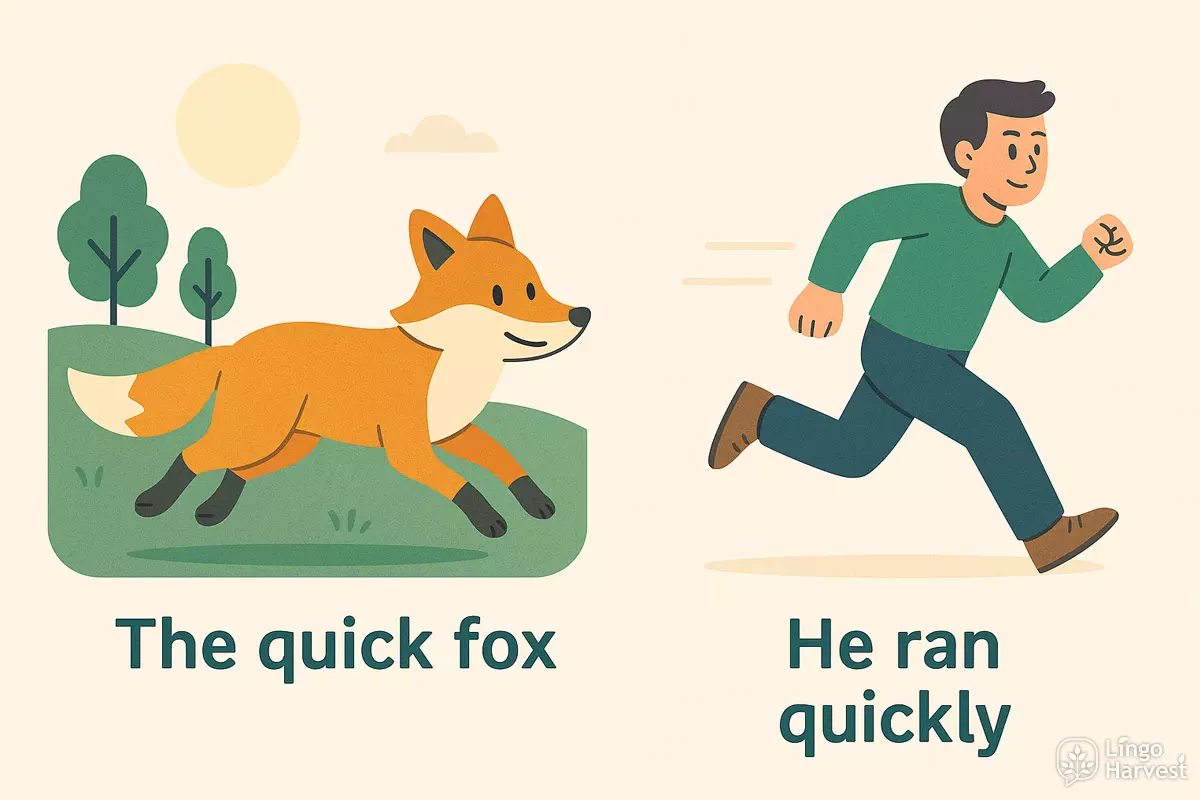
Adjectives usually appear directly before the noun they describe, or after linking verbs such as be, seem, or become. Adverbs, on the other hand, are more flexible in placement and often end in -ly (though not always). They modify actions, qualities, or even entire clauses.
| Modifier Type | What It Modifies | Example | Typical Question Answered |
|---|---|---|---|
| Adjective | Noun or pronoun | The quick fox | What kind? Which one? |
| Adverb | Verb, adjective, or adverb | He ran quickly | How? When? Where? To what extent? |
| Adjective | Noun | A beautiful painting | What kind? |
| Adverb | Adjective | A very beautiful painting | How much? |
Common Examples and Patterns
- Adjective: happy child → Adverb: happily singing
- Adjective: loud music → Adverb: play loudly
- Adjective: slow car → Adverb: drive slowly
- Adjective: careful driver → Adverb: drive carefully
- Adjective: easy task → Adverb: solve easily
- Adjective: fast runner → Adverb: run fast (note: some adverbs have the same form as adjectives)
- Adjective: good student → Adverb: study well (irregular form)
- Adjective: hard worker → Adverb: work hard
- Adjective: late arrival → Adverb: arrive late
- Adjective: daily routine → Adverb: check daily
Some words can function as both, depending on context. For example, fast is both an adjective (a fast car) and an adverb (drive fast). However, most adverbs are formed by adding -ly to the adjective. Watch out for exceptions like good (adjective) and well (adverb).
In summary, adjectives focus on describing people, places, or things, while adverbs describe actions, qualities, or other modifiers. Knowing the difference can help you write clearer, more precise sentences.
Typical Beginner Mistakes
Understanding how to use descriptive words correctly can be tricky when first learning about them. Many people struggle with issues like incorrect placement, confusing different types of modifiers, or trying to apply rules from their native language. Below are some of the most frequent pitfalls and misconceptions, along with practical examples and guidance.
Misplacing Descriptive Words
One common error is putting modifiers in the wrong spot within a sentence. In English, these words usually come before the noun they describe. For example, saying “car red” instead of “red car” can cause confusion.
- Incorrect: She has a dog big.
- Correct: She has a big dog.
- Incorrect: I bought a shirt blue.
- Correct: I bought a blue shirt.
Mixing Up Adjectives and Adverbs
It’s easy to confuse words that describe nouns with those that modify verbs. Remember, “quick” describes a thing (a quick fox), while “quickly” modifies an action (run quickly).
- Incorrect: She sings beautiful.
- Correct: She sings beautifully.
- Incorrect: He is a quickly runner.
- Correct: He is a quick runner.
Overusing or Doubling Up
Adding too many descriptive words or repeating similar meanings can make sentences awkward. Stick to what is necessary for clarity.
- Incorrect: The tiny little kitten slept.
- Correct: The tiny kitten slept.
Comparative and Superlative Confusion
Beginners often mix up forms like “more better” or “most fastest.” Only one comparative or superlative form is needed.
| Incorrect Form | Correct Form |
|---|---|
| more better | better |
| most fastest | fastest |
| more happier | happier |
| most beautifulest | most beautiful |
Forgetting Agreement or Using Invariable Forms
Unlike some languages, English does not require agreement in gender or number between adjectives and nouns. Adding unnecessary endings is a frequent slip.
- Incorrect: She has a reds dress.
- Correct: She has a red dress.
Using Uncommon or Awkward Descriptive Words
Choosing words that are too rare or don’t fit the context can make speech sound unnatural. Aim for commonly used and appropriate terms.
Summary of Key Issues
- Placing modifiers after nouns instead of before
- Confusing adverbs with descriptive words for nouns
- Adding unnecessary or repetitive modifiers
- Incorrect comparative/superlative forms
- Trying to match endings with nouns
- Using unfamiliar or odd-sounding words
- Omitting descriptive words where needed for clarity
- Overusing them, making sentences cluttered
- Not recognizing irregular forms (like “good” → “better”)
- Translating patterns directly from another language
By being aware of these issues, learners can avoid confusion and communicate more clearly. Practice and careful attention to examples in context will help build confidence and accuracy.
Short Practice Tasks
Looking to solidify your understanding of describing words? Try these varied exercises to apply what you've learned. Each activity helps you recognize, use, and compare these important parts of speech in everyday language.
1. Identify the Describing Words
In each sentence, spot the word that tells us more about a noun.
- The tall tree stood in the garden.
- She wore a red dress to the party.
- We found a broken toy under the sofa.
- The delicious cake disappeared quickly.
- He read an interesting book.
Show answers
- tall
- red
- broken
- delicious
- interesting
2. Add a Descriptive Word
Fill in the blank with a suitable word that describes the noun in each sentence.
- The ________ cat slept on the sofa.
- She has a ________ smile.
- We visited a ________ museum.
- It was a ________ day at the beach.
- He gave me a ________ gift.
Show answers
- Possible answers: fluffy, sleepy, black, playful
- Possible answers: bright, warm, lovely, big
- Possible answers: famous, large, local, interesting
- Possible answers: sunny, rainy, windy, beautiful
- Possible answers: wonderful, special, small, thoughtful
3. Comparative and Superlative Forms
Practice changing basic describing words to their comparative and superlative forms. Notice the spelling patterns and how some words change completely.
| Base Form | Comparative | Superlative |
|---|---|---|
| small | smaller | smallest |
| happy | happier | happiest |
| beautiful | more beautiful | most beautiful |
| bad | worse | worst |
| old | older | oldest |
| good | better | best |
4. Spot the Odd One Out
In each group, select the word that does not describe a noun.
- blue, quickly, bright, cold
- heavy, careful, green, noisy
- slow, fast, run, tall
- angry, happy, sing, sad
Show answers
- quickly
- careful
- run
- sing
Try using at least five new descriptive words in your own sentences. Practicing with different forms and contexts helps you become more confident in recognizing and using them effectively.