Types of Adjectives: Descriptive, Quantitative, Demonstrative

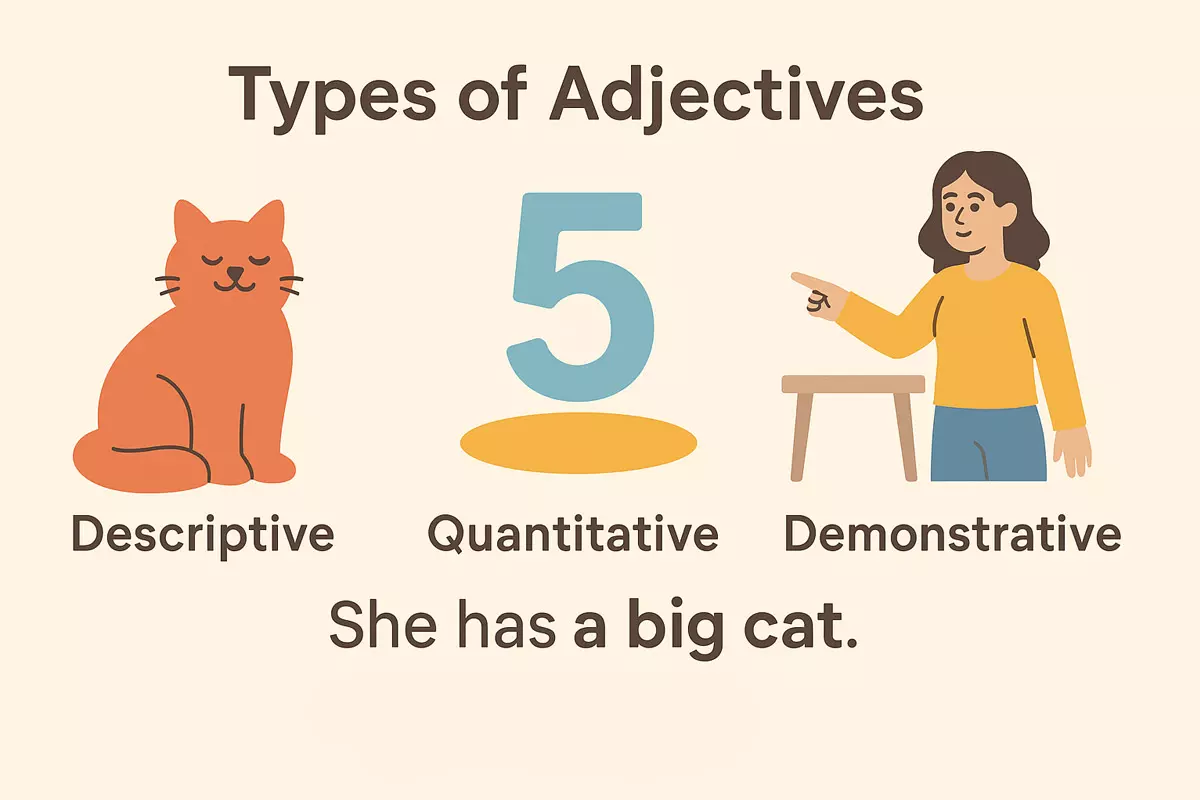 Here we descriptive, quantitative, and demonstrative adjectives, explains how each type functions, gives sentence examples, points out common mistakes, and offers a short practice section to help you use these adjectives correctly.
Modifiers such as colorful, several, and those play a crucial role in shaping our sentences by adding detail, quantity, or specificity to nouns. By understanding how different types of modifiers work—whether they describe qualities, indicate amounts, or point out particular items—you can make your writing more precise and engaging. Learning to use modifiers effectively helps convey your ideas more clearly and allows readers to visualize and comprehend your message with greater ease.
Descriptive Adjectives
Words that tell us more about the qualities or characteristics of nouns fall into this category. These modifiers help paint a clearer picture by specifying what kind, what sort, or what type something is. For example, they can describe color, size, shape, material, or other distinguishing traits.
Common Uses and Examples
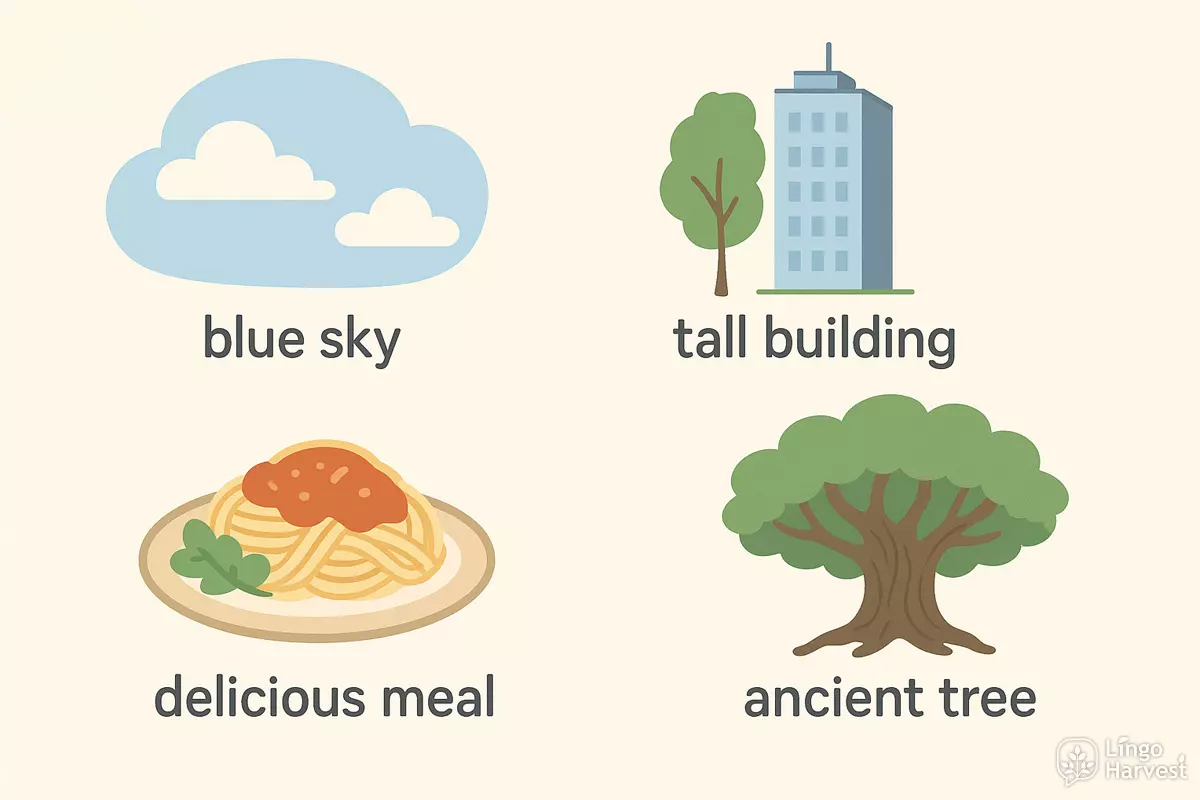
People use these describing words every day, often without noticing. Here are some familiar examples that highlight different qualities:
- blue sky
- tall building
- delicious meal
- ancient tree
- narrow street
- fluffy cat
- silent room
- shiny car
- gentle breeze
- broken window
- friendly neighbor
- rough surface
- brave firefighter
- tiny insect
- heavy box
- smart student
- messy desk
How They Function in Sentences
These adjectives usually come directly before the noun they modify, but they can also appear after linking verbs like "be" or "seem." For instance:
- The old castle is haunted.
- This soup tastes spicy.
Their placement and form help give more detail, making communication richer and more precise.
Types of Qualities Described
They can refer to a wide range of qualities, such as:
- Color: red, green, golden
- Shape: round, square, oval
- Size: large, tiny, enormous
- Texture: smooth, rough, sticky
- Origin: Italian, American, ancient
- Material: wooden, plastic, metallic
- Emotion: happy, nervous, excited
Comparative and Superlative Forms
Many of these adjectives can change form to compare two or more things. Here’s a look at how some common ones are modified:
| Base Form | Comparative | Superlative |
|---|---|---|
| small | smaller | smallest |
| bright | brighter | brightest |
| happy | happier | happiest |
| interesting | more interesting | most interesting |
| dangerous | more dangerous | most dangerous |
These forms help show degrees of a quality, such as comparing the brightness of two lamps or identifying the most interesting book in a series.
Why They Matter
Choosing the right descriptive word can add depth and clarity to both spoken and written language. Whether talking about a person, place, thing, or idea, these adjectives allow us to express ourselves more vividly and accurately.
Quantitative Adjectives
When describing the amount or quantity of something, English uses specific words to answer “how much?” or “how many?” These modifiers help clarify the number or portion of nouns, whether the quantity is definite or indefinite. They’re especially useful for making statements more precise, such as in “several options,” “no time,” or “enough money.”
What Do These Adjectives Express?
These words can refer to both countable and uncountable nouns. For countable items, they indicate numbers or portions (like “twelve apples” or “few friends”). For uncountables, they express amounts (“little water,” “much information”). Their use brings clarity and specificity to communication.
Common Words Indicating Quantity
Here are some frequent terms used to specify number or amount:
- some
- any
- much
- many
- little
- few
- several
- all
- no
- enough
- each
- every
- whole
- most
- half
- plenty of
- dozens of
- hundreds of
- more
- less
- fewer
Usage Patterns and Examples
These adjectives typically appear before the noun they modify. For example:
- “Several students participated.”
- “We have enough chairs.”
- “Much patience is required.”
- “He spent all his money.”
- “No sugar remains.”
Countable vs. Uncountable Nouns
It’s important to choose the correct word based on whether the noun is countable or not. Here’s a quick comparison:
| Countable Nouns | Uncountable Nouns |
|---|---|
| many (e.g., many books) | much (e.g., much sand) |
| few (e.g., few coins) | little (e.g., little hope) |
| several (e.g., several chairs) | less (e.g., less noise) |
| fewer (e.g., fewer problems) | more (e.g., more water) |
Tips for Clarity
When choosing words to indicate amount, consider whether you’re referring to a specific number or a general idea of quantity. For instance, “a few” versus “few” changes the meaning, as does “some” versus “any.” Precision in these choices helps your listener or reader understand exactly what you mean.
Demonstrative Adjectives
Words like “this,” “that,” “these,” and “those” help us point out specific people, places, or things. These terms always come before the noun they describe and clarify which particular item or items we mean. For example, in “that book is interesting,” the word “that” singles out a particular book from others.
Common Forms and Usage
There are four main forms in English, and each one signals whether the noun is near or far, as well as singular or plural. Here’s how they are generally used:
- This (singular, near): this chair, this idea
- That (singular, far): that mountain, that answer
- These (plural, near): these apples, these shoes
- Those (plural, far): those cars, those questions
Quick Reference Table
| Form | Example Phrase | Distance | Number |
|---|---|---|---|
| This | This cat | Near | Singular |
| That | That tree | Far | Singular |
| These | These pencils | Near | Plural |
| Those | Those houses | Far | Plural |
When to Use Each Form
Choosing between “this/these” and “that/those” depends on both distance and count. Use “this” or “these” for things close to you (physically or in thought), and “that” or “those” for things farther away or less immediate.
Expanded Examples
Here are a variety of phrases using these pointing words:
- This problem
- This morning
- That street
- That decision
- These friends
- These ideas
- Those memories
- Those shoes
- This painting
- These instructions
- That song
- Those mistakes
- This question
- These opportunities
- That movie
- Those results
Tips for Recognizing and Using Them
These modifiers always come directly before a noun and never stand alone. If you see “this,” “that,” “these,” or “those” right before a noun, it’s likely serving this role. Remember: if the word stands alone (without a noun following), it’s probably a pronoun, not an adjective. For example:
- Correct: Those books are new. ✅
- Incorrect: Those are new. (Here, “those” is a pronoun.) ❌
These modifiers make speech and writing clearer, letting us identify exactly which item or group we mean in a conversation or text.
How Each Type Works
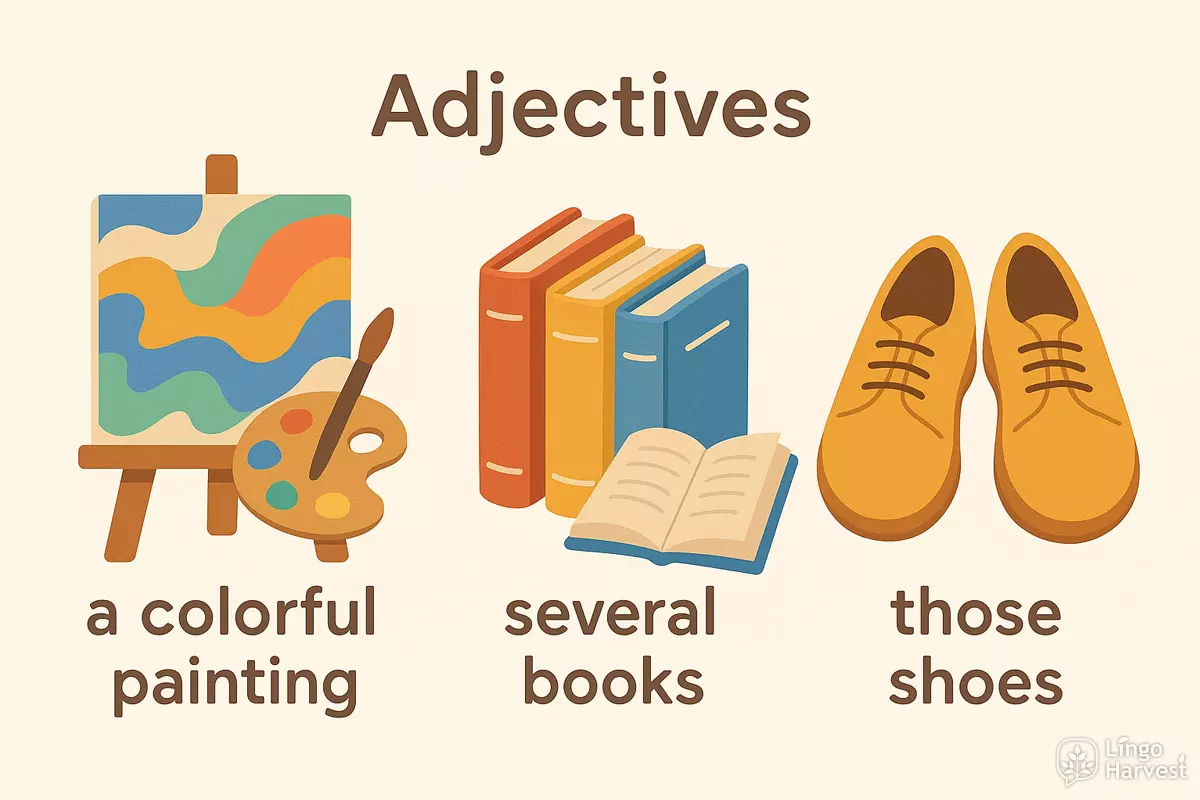
Adjectives play different roles depending on their category. Each group modifies nouns in its own way, bringing clarity, quantity, or specificity to language. Understanding the distinctions among these categories helps you use them with precision and variety.
Descriptive Adjectives
Descriptive adjectives provide information about the qualities or characteristics of a noun. They answer questions like "What kind?" or "Which one?" and are the most common type found in writing and speech. These words help paint a vivid picture or convey specific traits.
- colorful (as in "a colorful painting")
- ancient ("an ancient temple")
- brave ("a brave firefighter")
- quiet ("a quiet room")
- tall ("a tall building")
- friendly ("a friendly neighbor")
- delicious ("a delicious meal")
- shiny ("a shiny coin")
- narrow ("a narrow path")
- gentle ("a gentle breeze")
These modifiers add detail, making descriptions more engaging and specific.
Quantitative Adjectives
Quantitative adjectives indicate the amount or quantity of a noun, answering "How much?" or "How many?" They are useful when you want to express number, measure, or degree. These words often precede the noun they modify.
- several ("several books")
- few ("few options")
- many ("many reasons")
- some ("some water")
- all ("all students")
- no ("no time")
- much ("much effort")
- enough ("enough space")
- each ("each person")
- every ("every chance")
These adjectives don’t describe qualities, but rather the quantity or extent of something.
Demonstrative Adjectives
Demonstrative adjectives point out specific nouns and clarify which one(s) you mean. They help identify particular items from a group, answering "Which one?" Common demonstrative adjectives include:
- this ("this book")
- that ("that car")
- these ("these apples")
- those ("those shoes")
These words are always followed by the noun they modify and are essential for clear, direct communication.
| Type | How It Modifies the Noun |
|---|---|
| Descriptive | Adds details about qualities, appearance, or characteristics (e.g., "bright star") |
| Quantitative | Indicates amount or number (e.g., "three cats", "much excitement") |
| Demonstrative | Specifies which noun is meant, pointing out particular items (e.g., "those cookies") |
In summary, each adjective type serves a unique purpose: adding description, expressing quantity, or clarifying reference. Recognizing these differences helps you choose the best words for clearer, more effective sentences.
Sentence Examples
To see how descriptive, quantitative, and demonstrative adjectives work in real sentences, let’s look at each category in context. These examples clarify the differences and show how the words add detail, quantity, or specificity.
Descriptive Adjectives in Context
Descriptive adjectives give more information about the qualities or characteristics of a noun. Here are several ways they can be used:
- The blue sky looked calm.
- She wore a beautiful dress to the party.
- Our new neighbor is very friendly.
- The old house creaked in the wind.
- He has a quick mind.
Quantitative Adjectives in Sentences
Quantitative adjectives indicate the amount or quantity of something, whether definite or indefinite:
- There are seven apples in the basket.
- She drank some water before the run.
- I have enough time to finish this project.
- They need many volunteers for the event.
- He ate half the cake.
Demonstrative Adjectives in Action
Demonstrative adjectives point out specific items or people. Here are several ways they appear:
- This book is my favorite.
- Can you hand me those papers?
- That car is very fast.
- I prefer these shoes over the others.
- That answer is correct. ✅
Comparing the Three Types
To highlight the contrast between descriptive, quantitative, and demonstrative adjectives, examine the table. Each row includes a noun modified by all three types, showing how their meanings change:
| Descriptive Example | Quantitative Example | Demonstrative Example |
|---|---|---|
| A tall building | Several buildings | Those buildings |
| A delicious meal | Two meals | This meal |
| A happy child | Many children | That child |
| A quiet street | Few streets | These streets |
| A shiny coin | One coin | This coin |
Through these examples, you can see how each adjective type adds its own layer of meaning to a sentence. Try substituting different adjectives to notice shifts in nuance.
Common Errors
Mixing up different types of adjectives can lead to confusing or incorrect sentences. It's easy to misunderstand which modifier to use, especially when distinguishing between descriptive, quantitative, and demonstrative words. Paying attention to their specific roles helps keep writing clear and precise.
Misplacing Adjectives in a Sentence
Placing an adjective in the wrong position often creates awkward or incorrect sentences. For example, saying “three blue big cars” instead of “three big blue cars” disrupts the natural adjective order in English.
- Incorrect: I have some these books. ❌
- Correct: I have these books. ✅
- Incorrect: She wore red two dresses. ❌
- Correct: She wore two red dresses. ✅
Confusing Descriptive and Quantitative Modifiers
A common slip is using a descriptive word when quantity is intended, or vice versa. For instance, writing “many beautiful” when only the amount or number should be described.
- Incorrect: I have beautiful apples. (if you mean quantity)
- Correct: I have many apples.
- Incorrect: Several honest men attended. (if you mean their character, not how many)
- Correct: Honest men attended.
Overusing Demonstrative Adjectives
Using too many demonstratives (“this,” “that,” “these,” “those”) in a single sentence can sound repetitive or unclear. Choose one and use it appropriately.
- Incorrect: These those apples are tasty. ❌
- Correct: These apples are tasty. ✅
Mixing Up Adjective Types
Sometimes, writers combine different adjective types incorrectly or redundantly. Below is a table that shows common mix-ups and their improved forms:
| Problematic Example | Better Version |
|---|---|
| Those five red these cars | Those five red cars |
| Three this beautiful books | These three beautiful books |
| Some that old chairs | Those old chairs |
| Many those interesting stories | Those interesting stories |
| This two large dogs | These two large dogs |
Summary of Typical Mistakes
Writers often:
- Use more than one demonstrative modifier together.
- Place quantity words after descriptive ones (“blue three cars” instead of “three blue cars”).
- Forget to match singular/plural forms (e.g., “this apples” instead of “these apples”).
- Omit the adjective order: demonstrative → quantitative → descriptive.
- Overuse adjectives and make sentences cluttered.
- Use adjectives with uncountable nouns incorrectly (“many water” instead of “much water”).
- Choose a descriptive word when a number or amount is needed, or vice versa.
- Double up on similar adjectives (“two several books”).
Understanding how each modifier works and their correct placement helps avoid these pitfalls and improves overall clarity.
Mini Practice
Test your understanding of descriptive, quantitative, and demonstrative adjectives with the following tasks. Apply what you’ve learned to identify, sort, and use different kinds of modifiers in real sentences. Read each instruction carefully, and try to answer before checking the explanations below.
1. Identify the Adjective Type
Read each sentence and decide whether the highlighted word is a descriptive, quantitative, or demonstrative adjective.
- The blue sky was clear.
- He bought three books yesterday.
- That chair is broken.
- She wore a beautiful dress.
- There are many reasons to celebrate.
Show answers
- Descriptive
- Quantitative
- Demonstrative
- Descriptive
- Quantitative
2. Fill in the Blank
Choose the correct adjective from the options given in brackets to complete each sentence.
- Do you want (this / much) apple?
- We saw (ten / big) elephants at the zoo.
- (Those / green) apples look tasty.
- He solved (all / red) the problems easily.
- It was a (cold / some) evening.
Show answers
- this
- ten
- Those
- all
- cold
3. Sort the Adjectives
Below is a list of adjectives. Group them into three categories: descriptive, quantitative, and demonstrative.
- red, several, these, old, twelve, that, beautiful, some, this, noisy, few, those, smart, all
Show answers
- Descriptive: red, old, beautiful, noisy, smart
- Quantitative: several, twelve, some, few, all
- Demonstrative: these, that, this, those
4. Practice Sentences
Use one descriptive, one quantitative, and one demonstrative adjective to create your own sentence. Try to be creative!
Show answers
Example: Those three fluffy cats are sleeping.
5. Quick Reference Table
See how different adjectives function in example phrases:
| Type | Example Adjective | Sample Phrase |
|---|---|---|
| Descriptive | happy | happy child |
| Quantitative | many | many students |
| Demonstrative | those | those books |
| Descriptive | tall | tall building |
| Quantitative | few | few chances |
| Demonstrative | this | this moment |