Compound Adjectives: Structure and Rules

 This article explains compound adjectives, covering how they're formed, basic hyphen rules, common patterns, and combinations of meaning. It includes real examples, highlights typical errors, and offers quick practice to reinforce your understanding.
Learning how to skillfully combine two or more words to create precise descriptions can significantly improve your writing. These multi-word modifiers enhance clarity and bring nuance to your sentences, helping you communicate ideas more effectively. By using them thoughtfully, you can make your writing both more engaging and easier for readers to understand, ensuring your message is delivered with both style and accuracy.
What Compound Adjectives Are
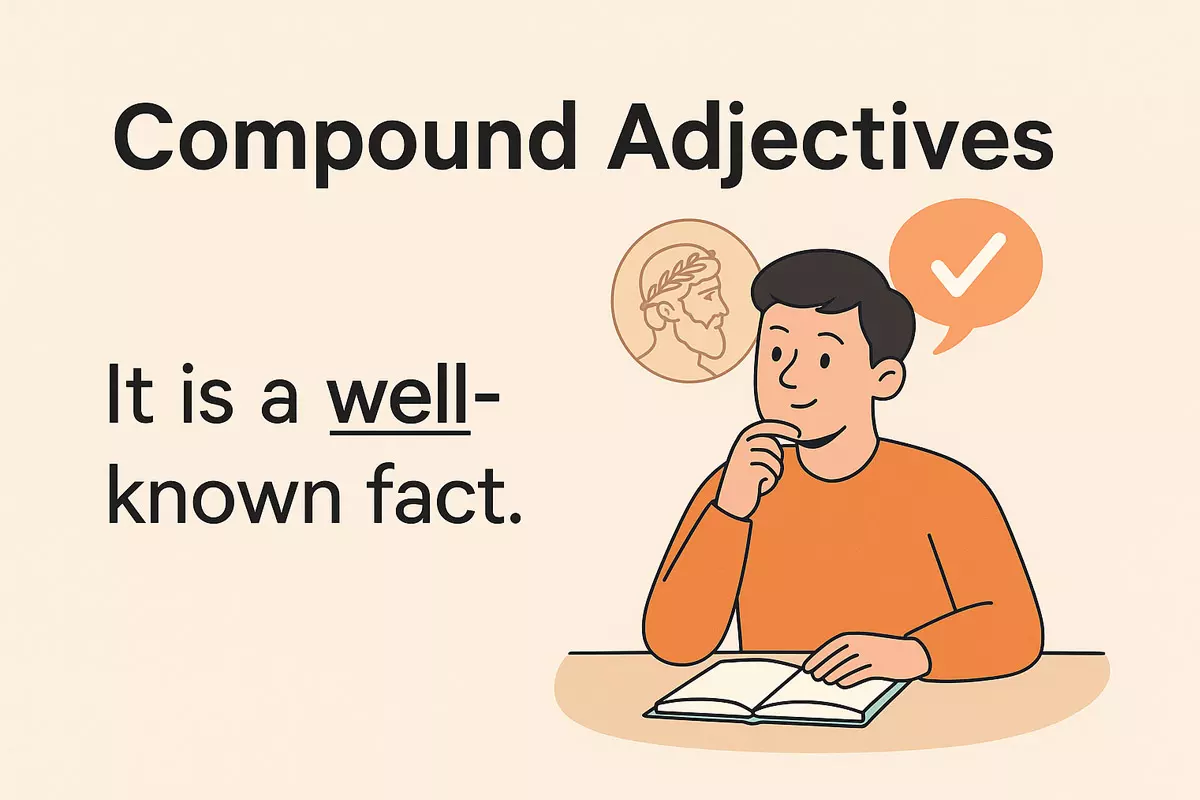
Compound adjectives are multi-word modifiers created by joining two or more words (often with a hyphen) to describe a noun more precisely. Instead of using a single descriptive word, these combinations allow for more nuanced or specific meanings. For example, the phrase “well-known author” uses a compound adjective to clarify what kind of author is being discussed.
How Compound Adjectives Are Formed
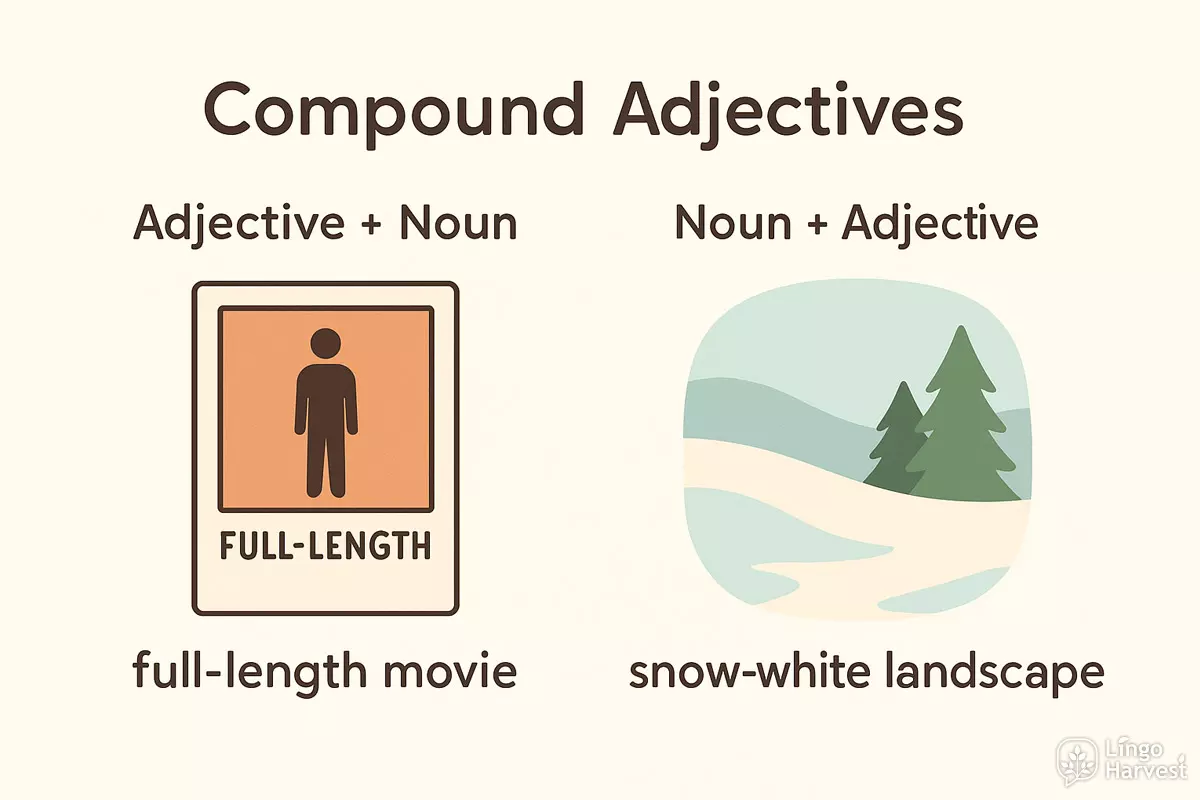
The most common way to build these modifiers is by linking words such as adjectives, nouns, participles, or adverbs. Here are some typical constructions:
- Adjective + Noun: full-length movie
- Noun + Adjective: snow-white landscape
- Adverb + Past Participle: well-written essay
- Adjective + Past Participle: old-fashioned idea
- Number + Noun: five-minute break
- Noun + Present Participle: heart-breaking story
- Adjective + Present Participle: good-looking actor
- Adverb + Adjective: highly-educated staff
Purpose and Usage
These modifiers make descriptions more vivid and concise. Instead of a longer phrase, a hyphenated adjective phrase can clarify meaning efficiently. For instance, “a brightly-lit room” is more precise than “a room that is brightly lit.” Writers often use them before nouns, and they are usually hyphenated to avoid confusion.
Common Examples
Here’s a list of popular compound modifiers found in everyday English:
- Long-term
- Part-time
- Open-minded
- Cold-hearted
- State-of-the-art
- User-friendly
- One-way
- Full-time
- Never-ending
- Old-fashioned
- Four-legged
- Blue-eyed
- Well-known
- High-speed
- All-inclusive
- Self-made
- Wide-ranging
- Short-sighted
- Low-cost
- Brand-new
Types of Compound Adjectives
Some compound modifiers use different word types or structures. The table below outlines several common patterns and examples:
| Pattern | Example |
|---|---|
| Noun + Past Participle | sun-dried (sun-dried tomatoes) |
| Number + Noun | ten-year (ten-year plan) |
| Adverb + Past Participle | well-behaved (well-behaved child) |
| Adjective + Noun | high-speed (high-speed train) |
| Noun + Present Participle | time-saving (time-saving tip) |
These combinations help bring clarity and detail to writing, making descriptions both efficient and expressive. Using them correctly can make your language more dynamic and precise.
Hyphen Use Basics
Understanding when and how to connect words with a hyphen is essential for clarity in English writing. Hyphens are most commonly used to join words that work together as a single idea before a noun, ensuring readers grasp the intended meaning without confusion.
When to Use a Hyphen
Hyphens are inserted between words to create a compound modifier that describes a noun. This is especially important when the meaning would be unclear or ambiguous without the connector. Consider these situations:
- Before a noun: well-known author, full-length mirror
- To avoid ambiguity: small-business owner (not a small owner of a business)
- With numbers and units used as adjectives: five-year plan, ten-cent coin
- For clarity with participles: fast-moving vehicle, high-pitched sound
When Hyphens Are Not Needed
Not every pair of words needs a hyphen. Guidelines include:
- When the compound follows the noun: The plan is five years old.
- With adverbs ending in -ly: highly skilled worker
- Common phrases or terms: grade point average, real estate agent
Common Patterns in Hyphenation
Writers often wonder whether to join, separate, or hyphenate words. The following chart offers a reference for some frequent compound adjective structures:
| Compound Adjective | Example Usage |
|---|---|
| Number + Noun | three-day weekend |
| Adjective + Past Participle | open-ended question |
| Adverb (not -ly) + Adjective | well-known artist |
| Adjective + Noun | full-length movie |
| Noun + Present Participle | mouth-watering dish |
| Color + Noun | blue-green algae |
| Noun + Adjective | cost-effective solution |
| Adjective + Adjective | bitter-sweet memory |
| Noun + Past Participle | sun-dried tomato |
| Compound with Prefix | ex-president |
Quick Tips for Hyphen Clarity
- Read the phrase aloud; if it forms a single idea before a noun, it probably needs a hyphen.
- Check if omitting the hyphen changes the meaning or makes the phrase unclear.
- Consult a good dictionary for established compounds or usage notes.
- Remember that style guides (APA, Chicago, etc.) may have specific preferences.
Mastering these conventions helps your writing stay precise and easy to read, especially when combining multiple words to describe something.
Common Patterns
When forming multi-word modifiers, certain structures appear frequently in English. These structures help create clear, concise descriptions and are widely accepted in both formal and informal writing. Most combinations involve hyphens to link the words, ensuring the meaning is understood as a single descriptor before a noun.
Typical Structures for Multi-Word Modifiers
Writers often use predictable combinations to form these modifiers. Here are some of the most widespread formats:
- Adjective + Noun: long-term, high-speed, full-length
- Noun + Adjective: snow-white, world-famous, sugar-free
- Noun + Participle: time-saving, heart-breaking, record-breaking
- Adjective + Participle: open-ended, old-fashioned, high-powered
- Number + Noun: five-minute (break), ten-year (plan), three-month (trial)
- Adverb + Participle: well-known, brightly-lit, highly-respected
- Noun + Noun: part-time, coffee-table, user-friendly
- Adjective + Adjective: bitter-sweet, red-hot, icy-cold
- Adverb + Adjective: well-dressed, best-known, most-wanted
- Number + Adjective: single-use, double-sided, one-way
Hyphenation Rules
Modifiers that appear before a noun are typically hyphenated to prevent misreading. If the compound comes after the noun (predicative position), the hyphen is usually omitted unless needed for clarity.
Examples by Pattern
Here is a structured overview of frequent forms, showing how elements combine to create clear descriptions:
| Pattern | Example |
|---|---|
| Adjective + Noun | full-length movie, high-speed train |
| Noun + Participle | record-breaking score, heart-warming story |
| Number + Noun | ten-year contract, five-star hotel |
| Adverb + Participle | well-known author, highly-anticipated event |
| Noun + Noun | coffee-table book, part-time job |
Notes on Usage
Compound modifiers often appear before the noun they describe, especially in written English. Hyphens are less common when the phrase follows the noun or when the meaning is already clear. Numbers combined with units (such as "ten-year plan") nearly always use hyphens when used as a single descriptor. By recognizing these frequent patterns, writers can confidently create clear, effective multi-word modifiers that enhance their sentences.
Meaning Combinations
Understanding how two or more words combine to create a single descriptive unit is essential for mastering compound adjectives. These expressions often merge ideas in creative ways, resulting in a fresh meaning that isn’t a simple sum of the parts. Whether you’re describing color, time, function, or shape, the logic behind the combination can vary.
Common Patterns and Their Logic
Different word classes can be joined to form compound adjectives, each pattern suggesting a distinct relationship. Here are some of the most frequent types:
- Noun + Adjective: “snow-white” (as white as snow)
- Adjective + Noun: “full-length” (having the complete length)
- Number + Noun: “five-star” (rated with five stars)
- Noun + Present Participle: “mouth-watering” (causing the mouth to water)
- Noun + Past Participle: “hand-made” (made by hand)
- Adjective + Past Participle: “old-fashioned” (in an old style)
- Adverb + Past Participle: “well-known” (known well)
- Adverb + Present Participle: “fast-growing” (growing fast)
- Noun + Noun: “part-time” (working part of the time)
- Number + Past Participle: “single-spaced” (spaced with a single gap)
- Number + Present Participle: “two-seater” (seating two)
- Adjective + Noun: “high-speed” (of high speed)
- Adjective + Adjective: “bitter-sweet” (both bitter and sweet)
How Meaning Shifts in Combinations
The meaning of a compound adjective isn’t always predictable from its parts. Some combinations are literal, while others are idiomatic or metaphorical. For instance, “red-hot” usually means “very hot” or “exciting,” not just “the color red and hot.” This is why context is crucial.
Overview of Typical Combinations
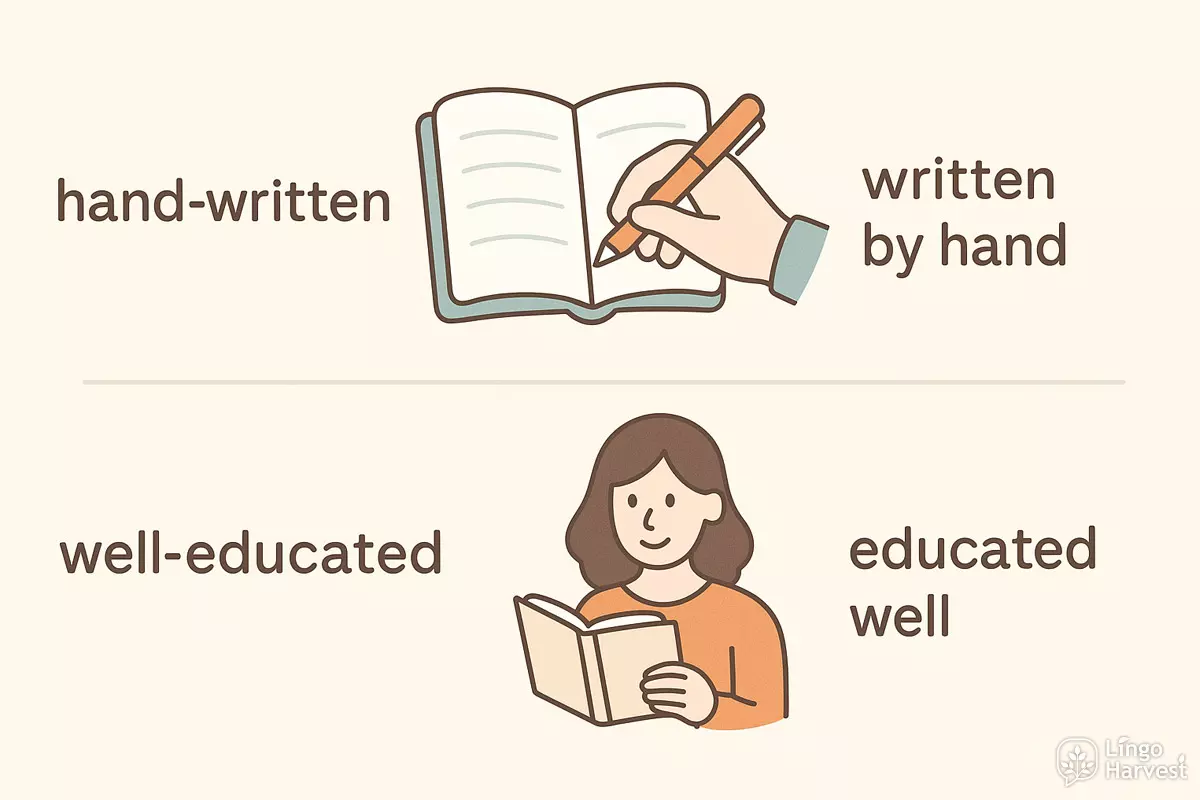
| Pattern | Example & Explanation |
|---|---|
| Noun + Past Participle | “Hand-written” → written by hand |
| Adverb + Past Participle | “Well-educated” → educated well |
| Number + Noun | “Three-day” (as in “three-day weekend”) → lasting three days |
| Noun + Present Participle | “Record-breaking” → breaking a record |
| Adjective + Noun | “High-speed” → of high speed |
| Adjective + Past Participle | “Old-fashioned” → in an old style |
Notes on Ambiguity and Clarity
Some compounds can be ambiguous if not placed carefully or if the context is unclear. For example, “small-animal hospital” means a hospital for small animals, not a small hospital for animals. Hyphens help to signal the intended relationship, clarifying which words are joined. In summary, blending words to form descriptive expressions allows for concise, vivid, and flexible language use. Recognizing the typical patterns and the logic behind their meanings helps writers and speakers avoid misunderstandings and create more effective descriptions.
Real Examples
Understanding how these multi-word modifiers appear in everyday English can clarify their structure and usage. They often combine adjectives, nouns, or numbers with participles, and typically use a hyphen when placed before a noun. Here are several sample phrases that illustrate these patterns:
- well-known author
- high-quality materials
- full-length mirror
- five-year-old child
- open-minded discussion
- part-time job
- blue-eyed cat
- fast-growing company
- state-of-the-art technology
- old-fashioned recipe
- user-friendly interface
- one-way street
- long-term project
- world-famous singer
- hard-working employee
- English-speaking guide
- well-behaved dog
- last-minute decision
- red-haired girl
- cold-hearted villain
Compound Adjectives: Before vs. After Nouns
Placement matters. When these descriptive phrases come before a noun, a hyphen is usually required. If the same words follow the noun, the hyphen is typically omitted. Compare the structures below:
| Before the Noun | After the Noun |
|---|---|
| She gave a well-written report. | Her report was well written. |
| He is a high-spirited child. | The child is high spirited. |
| They live in a ten-storey building. | The building is ten storeys high. |
| It was a last-minute change. | The change was last minute. |
Common Patterns to Notice
Compound modifiers can be formed in several ways:
- Adjective + Noun: full-length movie
- Adverb + Past Participle: well-known artist
- Number + Noun: three-day event
- Noun + Present Participle: English-speaking country
- Noun + Past Participle: sun-dried tomatoes
Seeing these constructions in real sentences helps you apply the rules more confidently in your own writing.
Typical Errors
Writers often stumble over the rules for forming and using compound adjectives, leading to confusion or even a change in meaning. Understanding where these mistakes arise can make your writing clearer and more precise.
Common Pitfalls in Compound Adjective Formation
Many issues stem from uncertainty about when to use a hyphen and how to order words. Here are some frequent missteps:
- Omitting the hyphen when two or more words work together before a noun (well known author instead of well-known author).
- Adding unnecessary hyphens when the compound comes after the noun (The author is well-known instead of The author is well known).
- Confusing adverb-adjective combinations and using a hyphen incorrectly (highly-anticipated event should be highly anticipated event).
- Forgetting that numbers and units need a hyphen when modifying a noun (10 year old boy instead of 10-year-old boy).
- Placing words in the wrong order, which can reverse or obscure the meaning (friendly looking dog vs. looking-friendly dog).
- Using plural forms incorrectly (six-feet-tall man instead of six-foot-tall man).
- Hyphenating phrases with “very” or adverbs ending in -ly (very-talented singer instead of very talented singer).
- Leaving out hyphens in color combinations (blue green dress instead of blue-green dress).
- Applying the hyphen when the phrase is not acting as a modifier (She is a part-time working instead of She works part time).
- Hyphenating established compound adjectives that are now standard as single words (email-based communication vs. email based communication).
Comparing Correct and Incorrect Usage
The table below highlights some of the most frequent mistakes side by side with their correct forms, making it easier to spot and fix these issues in your writing.
| Incorrect Form | Correct Form |
|---|---|
| well known artist | well-known artist |
| five years old child | five-year-old child |
| quickly-prepared meal | quickly prepared meal |
| blue green shirt | blue-green shirt |
| full time job | full-time job |
| six-feet-tall man | six-foot-tall man |
| very-talented musician | very talented musician |
| user friendly interface | user-friendly interface |
| late night snack | late-night snack |
| state of the art design | state-of-the-art design |
Tips for Avoiding Mistakes
To prevent these errors, remember:
- Use a hyphen when two or more words jointly modify a noun before it.
- Do not hyphenate if the phrase comes after the noun.
- Never hyphenate adverbs ending in -ly or phrases with “very.”
- Check if the compound is a commonly recognized single word.
- When in doubt, consult a reputable dictionary or style guide.
With careful attention, these patterns become second nature and help keep your writing both accurate and polished.
Quick Practice
Ready to test your understanding of how multi-word adjectives are formed and used? Try these exercises to reinforce the core rules and patterns. Remember, these modifiers often appear before nouns and are usually hyphenated, but not always—context matters.
Identify the Correct Form
Choose the correctly formed descriptive phrase for each sentence below:
- We visited a (well known / well-known) artist in Paris.
- She wore a (bright red / bright-red) dress to the party.
- This is a (ten-minute / ten minute) test.
- They took a (last-minute / last minute) decision.
- He is a (world-famous / world famous) chef.
Show answers
- well-known
- bright red
- ten-minute
- last-minute
- world-famous
Build Your Own Modifiers
Combine the given words to create a compound adjective. Use hyphens where needed.
- (high, speed) train
- (full, length) mirror
- (part, time) job
- (blue, eyed) actor
- (well, behaved) child
Show answers
- high-speed train
- full-length mirror
- part-time job
- blue-eyed actor
- well-behaved child
Common Patterns Reference
Here are some typical structures for multi-word modifiers, showing how different word types combine:
| Pattern | Example |
|---|---|
| Adjective + Noun | old-fashioned |
| Noun + Past Participle | sun-dried |
| Adverb + Past Participle | well-known |
| Number + Noun | two-hour |
| Noun + Adjective | snow-white |
| Adjective + Present Participle | good-looking |
| Noun + Noun | part-time |
Spot the Error
Decide if the following sentences use hyphens correctly. Mark with ✅ (correct) or ❌ (incorrect):
- A five star hotel
- A well-dressed gentleman
- An up to date report
- A sugar-free snack
- A brightly-lit room
Show answers
- ❌ (should be five-star)
- ✅
- ❌ (should be up-to-date)
- ✅
- ✅