Double Quantifiers: Why They Are Usually Grammatically Wrong

 The article defines double quantifiers, explains why English avoids them, highlights typical mistakes and their causes, distinguishes emphasis from errors, presents rare acceptable cases, and provides guidance and practice for correcting double quantifier usage.
- What double quantifiers are
- Why English avoids stacking quantifiers
- Common examples of incorrect double quantifiers
- Difference between emphasis and grammatical error
- Rare acceptable patterns and fixed expressions
- Typical learner errors and their causes
- How to rewrite sentences correctly
- Examples of wrong vs corrected usage
- Practice: identifying and fixing double quantifiers
Have you ever wondered why phrases such as every all students sound awkward? In English, combining two quantifiers within a single phrase often leads to grammatical confusion because each quantifier serves a specific purpose and they are not meant to be used together. For instance, every is typically used with singular nouns to refer to individual members of a group, while all is used with plural nouns to refer to the group as a whole. Knowing when and how to use these words correctly helps eliminate common errors and improves the clarity and precision of your writing.
What double quantifiers are
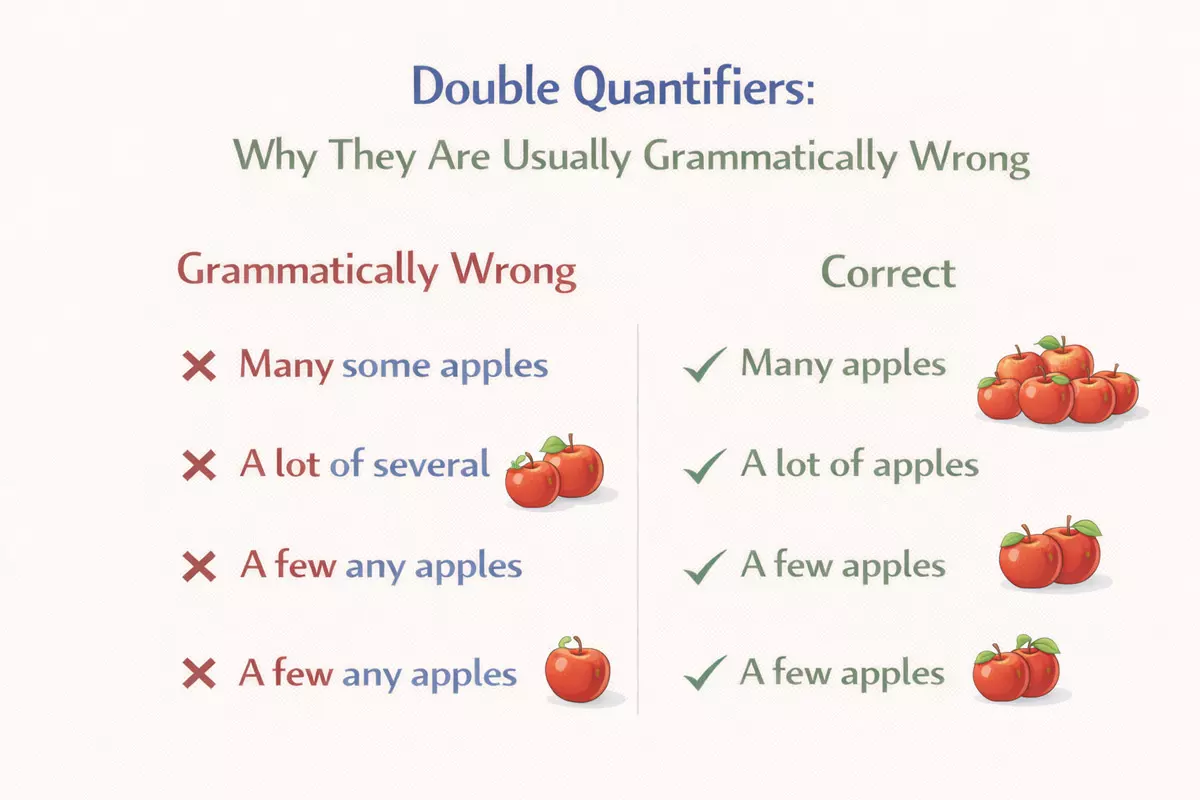
In English grammar, "double quantifiers" refers to the use of two quantifying words or phrases together when only one is needed. Quantifiers are words like some, any, many, much, few, all, and each—they indicate amounts or quantities. When two such words are placed before the same noun, the result is usually ungrammatical or awkward, because English does not typically stack quantifiers in this way.
How quantifiers work in English
Normally, a single quantifier is used to show how much or how many of something there is. For example, you might say "many books" or "some water." Adding a second quantifier, such as "many some books" or "all every student," creates confusion and disrupts the expected structure of the sentence.
Common double quantifier mistakes
Here are some examples of incorrect combinations that result from doubling up on quantifiers:
- all every (e.g., "all every student")
- many some (e.g., "many some people")
- each every (e.g., "each every time")
- much any (e.g., "much any information")
- few several (e.g., "few several reasons")
- some any (e.g., "some any suggestions")
- all both (e.g., "all both options")
- every each (e.g., "every each attempt")
- many much (e.g., "many much effort")
- few any (e.g., "few any choices")
- most all (e.g., "most all questions")
- several few (e.g., "several few answers")
Why double quantifiers cause confusion
Stacking quantifiers can make the meaning of a sentence unclear. Since each quantifier tries to specify quantity in its own way, combining them can lead to ambiguity about which one should be followed. For instance, "all every student" leaves the reader unsure whether you mean every student individually or the entire group collectively.
Single quantifier alternatives
Instead of using two quantifiers, choose the one that best fits your intended meaning:
- Use all for totality: "all students"
- Choose each or every for individuals within a group: "each student" or "every student"
- Pick many, few, some, or several for less precise amounts
Summary of correct vs. incorrect usage
| Incorrect (Double Quantifier) | Correct (Single Quantifier) |
|---|---|
| all every student | all students / every student |
| many some people | many people / some people |
| each every time | each time / every time |
| few several reasons | few reasons / several reasons |
| most all questions | most questions / all questions |
In summary, English grammar expects only one quantifier at a time before a noun. Using more than one is usually unnecessary and often results in sentences that sound unnatural or are simply incorrect.
Clear examples: double quantifiers vs correct usage
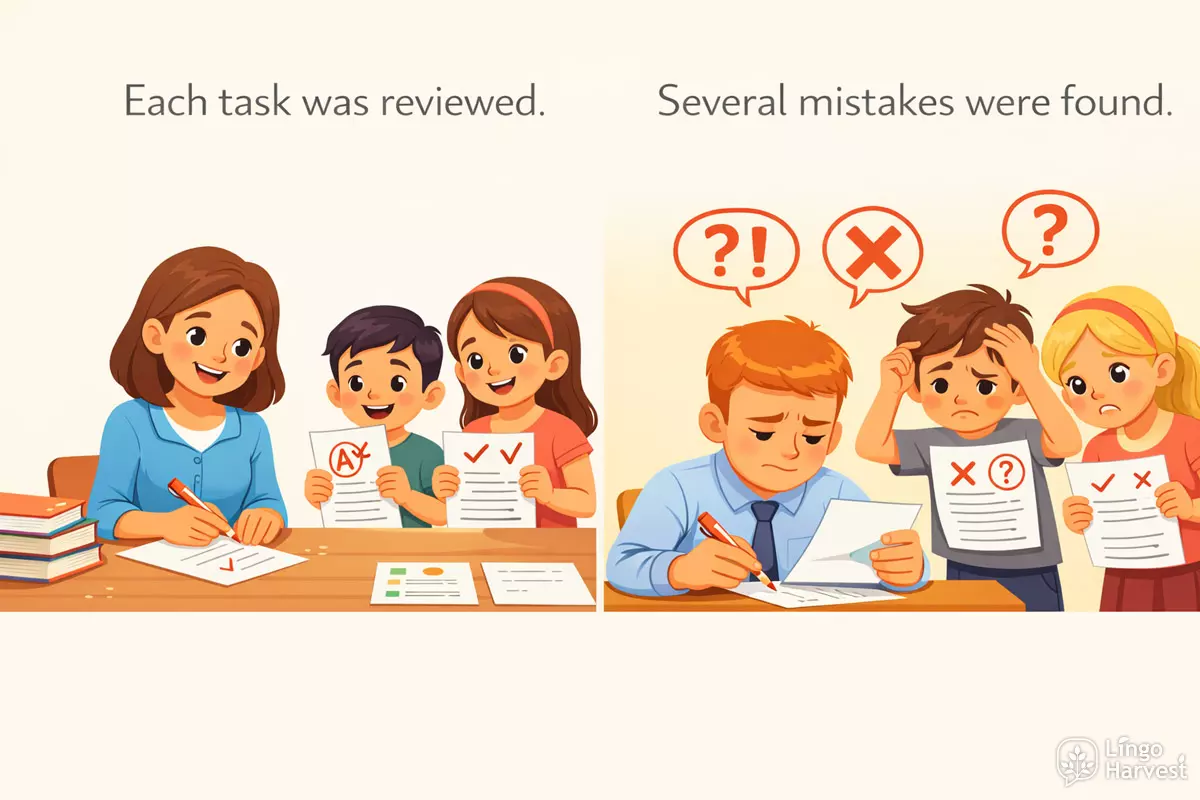
- ❌ All every student must register → ✅ All students must register.
- ❌ Many some people disagreed → ✅ Many people disagreed.
- ❌ Each every task was reviewed → ✅ Each task was reviewed.
- ❌ Few several mistakes were found → ✅ Several mistakes were found.
- ❌ Most all questions were answered → ✅ Most questions were answered.
- ❌ Much any information was shared → ✅ Much information was shared.
- ❌ All both options are valid → ✅ Both options are valid.
- ❌ Many much effort is required → ✅ Much effort is required.
Practice: Fix the double quantifier
Each sentence below contains a double quantifier. Rewrite it using only one correct quantifier.
- All every employee received the email.
- Many some students failed the test.
- Each every question was answered.
- Few several reasons were mentioned.
- Most all people agree with this idea.
- Much any information is available online.
- All both solutions are acceptable.
- Many much effort is needed to finish.
- Several few options remain.
- Every each mistake was corrected.
Show answers
- All employees received the email. / Every employee received the email.
- Many students failed the test. / Some students failed the test.
- Each question was answered. / Every question was answered.
- Several reasons were mentioned. / Few reasons were mentioned.
- Most people agree with this idea. / All people agree with this idea.
- Much information is available online.
- Both solutions are acceptable.
- Much effort is needed to finish.
- Several options remain. / Few options remain.
- Every mistake was corrected. / Each mistake was corrected.
Why English avoids stacking quantifiers
English speakers rarely put two quantifiers together directly, such as saying many every student or all some books. This isn't just a matter of style—it's built into the grammar of the language. Double quantifiers often cause confusion because they make it unclear which group is being referred to, or how the quantities relate to each other.
Ambiguity and Processing Difficulty
When two quantifiers appear together, sentences can become ambiguous. For example, if someone says, "All some students passed," it's unclear whether they're talking about all students from a certain group, or just some students from all groups. English avoids this kind of confusion by requiring extra words or rephrasing.
How English Expresses Multiple Quantities
Instead of stacking quantifiers, English typically uses one quantifier per noun phrase, or separates the ideas into different clauses. Here are some common strategies:
- Using a single quantifier: All students passed.
- Splitting into clauses: All of the students who took the test passed.
- Adding prepositional phrases: Some of the books on every shelf.
- Employing relative clauses: Every student who read some books.
Comparison with Non-English Patterns
Some languages allow double quantifiers more freely, but this can produce confusion in English. The following table highlights different approaches:
| Pattern | Acceptability in English | Example |
|---|---|---|
| Single quantifier per noun | ✅ Grammatical | All students passed. |
| Stacked quantifiers | ❌ Ungrammatical | All some students passed. |
| Quantifier + relative clause | ✅ Grammatical | Every student who read some books... |
| Preposition to separate quantifiers | ✅ Grammatical | Some of every group won. |
Why This Matters in Communication
Clear communication is a core goal of English sentence structure. By avoiding double quantifiers, speakers prevent misunderstandings and keep their meaning transparent. Instead of stacking, English relies on coordination, subordination, or prepositions to convey complex relationships between groups and amounts.
- One quantifier per noun phrase simplifies interpretation.
- Listeners can easily identify the scope of each quantifier.
- Writers avoid accidental ambiguity that could change the meaning.
- Readers process information more efficiently without backtracking.
In sum, the language's structure encourages clarity by not allowing quantifier stacking. This pattern helps everyone understand who and what is being talked about, and in what quantities, without extra mental gymnastics.
Common examples of incorrect double quantifiers
Using more than one quantifying word in a single noun phrase often leads to ungrammatical or awkward constructions in English. Double quantifiers occur when two words that both indicate amount or quantity are stacked together, even though standard English only requires one. This mistake tends to confuse meaning and disrupts the natural flow of a sentence.
Frequent patterns of double quantifier errors
Writers and speakers often combine quantifiers out of habit, translation interference, or for emphasis, but this usually creates errors. Some of the most common missteps involve pairing words like all, both, many, some, or any with another quantifier such as every, each, much, or few.
- All every — All every student passed the test. ❌ (Correct: All students or Every student)
- Many much — Many much work remains to be done. ❌ (Correct: Much work or Many tasks)
- Both each — Both each answer was correct. ❌ (Correct: Both answers or Each answer)
- Any some — Any some information is helpful. ❌ (Correct: Any information or Some information)
- Every all — Every all the books are missing. ❌ (Correct: All the books or Every book)
- Much many — Much many people attended. ❌ (Correct: Many people or Much excitement)
- Few some — Few some problems remain. ❌ (Correct: Few problems or Some problems)
- Several many — Several many reasons were given. ❌ (Correct: Several reasons or Many reasons)
- Each every — Each every child received a gift. ❌ (Correct: Each child or Every child)
- Any every — Any every attempt failed. ❌ (Correct: Any attempt or Every attempt)
- Some all — Some all students participated. ❌ (Correct: Some students or All students)
- All both — All both options are available. ❌ (Correct: Both options or All options)
- Much each — Much each advice was useful. ❌ (Correct: Each piece of advice or Much advice)
- Some few — Some few tickets are left. ❌ (Correct: Some tickets or Few tickets)
How double quantifiers confuse meaning
Stacking two quantifiers in one phrase can make the sentence unclear. For example, is all every student referring to every single student or only a group? These structures force the listener or reader to guess the intended meaning. When in doubt, choose just one quantifier that fits the context.
Summary of incorrect and correct forms
| Incorrect Double Quantifier | Correct Alternative |
|---|---|
| All every student | All students / Every student |
| Both each answer | Both answers / Each answer |
| Many much work | Many tasks / Much work |
| Few some problems | Few problems / Some problems |
| Several many reasons | Several reasons / Many reasons |
| Each every child | Each child / Every child |
| All both options | All options / Both options |
| Some all students | Some students / All students |
Avoiding these combinations makes your writing clearer and more grammatically accurate. When you notice two quantifiers side by side, try removing one and reading the sentence aloud; the correct version will almost always sound more natural.
Difference between emphasis and grammatical error
Sometimes, English speakers double up on words like quantifiers (“any,” “ever,” “much,” “anymore”) to make a point. However, there’s a clear distinction between using repetition for emphasis and making an actual mistake in grammar. Understanding where this line falls can help writers and speakers avoid awkward or incorrect sentences.
Emphasis: When Doubling Is Acceptable
In informal speech, it’s common to repeat words for dramatic effect or to stress a point. Consider these examples:
- “I don’t have any, any idea what you’re talking about.” (emphasizing confusion)
- “He never, ever listens to advice.” (intensifying “never”)
- “Did you really, really see it happen?” (heightening doubt or surprise)
Here, repetition is deliberate and accepted in conversation. The structure remains grammatically sound because the repeated word isn’t part of a single required grammatical slot—rather, it’s a stylistic addition.
Grammatical Error: When Doubling Is Incorrect
Problems arise when two quantifiers are used together in a way that English grammar doesn’t permit. This isn’t about style or emphasis—it’s simply wrong. For example:
- “I don’t have any no money.” ❌ (Incorrect double quantifier)
- “She doesn’t want none.” ❌ (Nonstandard double negative)
- “He hasn’t ever never tried it.” ❌ (Improper negative stacking)
These mistakes usually happen when two negative or limiting words are used together, creating confusion or an ungrammatical structure. Standard English requires only one quantifier or negative in these contexts.
Key Contrasts
| Emphatic Repetition | Grammatical Error |
|---|---|
| “I never, ever want to leave.” | “I don’t never want to leave.” |
| “He really, really likes pizza.” | “He doesn’t like no pizza.” |
| Used for style or emotion | Breaks standard grammar rules |
| Accepted in both speech and writing (informally) | Considered incorrect in standard English |
Common Double Quantifier Errors to Avoid
- Don’t use “any” and “no” together: “I don’t have any no idea.” ❌
- Avoid pairing “never” with “ever” in the same clause: “He hasn’t ever never…” ❌
- Skip “no” with “none”: “I don’t want none.” ❌
- Don’t use “nothing” with “don’t”: “I don’t want nothing.” ❌
- Steer clear of “no” with “nobody”: “There isn’t no nobody here.” ❌
- Never stack “any” and “never”: “I never saw any never birds.” ❌
- Don’t pair “any” and “none”: “I don’t have any none.” ❌
- Avoid “never” and “no”: “He never said no nothing.” ❌
- Don’t mix “no” with “nothing”: “I can’t find no nothing.” ❌
- Don’t use “never” with “nobody”: “Never saw nobody.” ❌
In summary, using repetition for emphasis is a matter of style and is often clear in intent. But combining multiple quantifiers or negatives in the same grammatical slot creates errors that should be avoided in standard English.
Rare acceptable patterns and fixed expressions
While most cases of using two quantifiers together are ungrammatical, there are a few exceptions where this construction is accepted, often because the phrase has become fixed in usage or because the meaning is clear and idiomatic. These exceptions are relatively uncommon and usually limited to set phrases, literary style, or highly specific contexts.
Fixed expressions and idioms
Some phrases with what look like double quantifiers are actually considered idiomatic or are so established that they no longer sound awkward to native speakers. Here are several such expressions:
- All too often (e.g., "All too often, mistakes go unnoticed.")
- Many a time ("Many a time have I told you...")
- Much too much ("He ate much too much dessert.")
- Somewhat of a ("She is somewhat of a perfectionist.")
- Every single ("Every single person agreed.")
- Quite a few ("Quite a few people showed up.")
- More than one ("More than one student was late.")
- Too many a ("Too many a time I've seen this happen.")
- So much as ("If you so much as blink, you'll miss it.")
- Little to no ("There was little to no response.")
- More than enough ("We have more than enough supplies.")
- No fewer than ("No fewer than ten people attended.")
- Much less ("He can't run a mile, much less a marathon.")
- Few if any ("Few if any students understood the problem.")
Literary or rhetorical uses
Writers sometimes combine quantifiers for emphasis or stylistic effect, especially in poetry or older texts. While these uses are not standard in everyday speech, they may be encountered in literature or creative writing. Examples might include:
- "All the many faces of the crowd"
- "Too much of anything is bad"
- "Any and all options are on the table"
Comparing standard and nonstandard patterns

To clarify which patterns are accepted and which are not, here's a quick reference for some common combinations:
| Pattern | Status | Example |
|---|---|---|
| All too often | ✅ Accepted | All too often, people forget their keys. |
| Much too many | ❌ Not Standard | Much too many people arrived. (Incorrect) |
| More than one | ✅ Accepted | More than one student was absent. |
| Many of the most | ❌ Not Standard | Many of the most people agreed. (Incorrect) |
| Quite a few | ✅ Accepted | Quite a few errors were found. |
| Too much few | ❌ Not Standard | Too much few options. (Incorrect) |
In summary, while double quantifiers are usually avoided in standard English, certain established phrases and idiomatic expressions break the rule and sound perfectly natural. Familiarity with these exceptions can help avoid mistakes and improve both formal and informal communication.
Typical learner errors and their causes
Many English learners struggle with double quantifiers because they can be confusing and are often influenced by patterns in other languages or by misunderstanding the function of quantifiers. Misuse tends to occur when learners try to add emphasis, translate directly from their native tongue, or are unaware that English generally allows only one quantifier per noun phrase.
Common mistakes with double quantifiers
Some of the most frequent errors involve stacking two quantity words before a noun. This often happens with words like "many," "much," "some," "any," "few," "several," and "all." In most cases, only one is needed or grammatically correct, but learners may combine them unintentionally.
- Incorrect: Many several people attended the meeting. Correct: Many people attended the meeting. / Several people attended the meeting.
- Incorrect: Much all the water leaked out. Correct: All the water leaked out. / Much of the water leaked out.
- Incorrect: Some any questions remain. Correct: Some questions remain. / Are there any questions remaining?
- Incorrect: Few little time was left. Correct: Little time was left. / Not much time was left.
- Incorrect: All every student passed the test. Correct: All students passed the test. / Every student passed the test.
- Incorrect: Several many options are available. Correct: Several options are available. / Many options are available.
- Incorrect: Most all of the cake is gone. Correct: Most of the cake is gone. / Almost all of the cake is gone.
- Incorrect: Much some advice was given. Correct: Some advice was given. / Much advice was given.
- Incorrect: Every each answer counts. Correct: Every answer counts. / Each answer counts.
- Incorrect: Any all help is appreciated. Correct: Any help is appreciated. / All help is appreciated.
Why do these mistakes happen?
- Direct translation: In some languages, using two quantifiers is acceptable or even required. Learners may carry this habit into English.
- Desire for emphasis: Adding a second quantifier can feel like it strengthens the statement, but it usually results in ungrammatical phrases.
- Uncertainty about quantifier meanings: Learners may not fully understand the subtle differences between quantifiers, leading to unnecessary doubling.
- Lack of awareness: Some students may not realize that only one quantifier should modify a noun in English.
How native-like usage differs
Native speakers instinctively avoid double quantifiers and use only one per noun phrase. Here’s a comparison of incorrect and correct forms:
| Incorrect (Double Quantifier) | Correct (Single Quantifier) |
|---|---|
| Many several options | Several options |
| All every student | Every student |
| Few little time | Little time |
| Some any questions | Any questions |
| Much all the water | All the water |
| Every each answer | Each answer |
Summary of causes
Errors with double quantifiers arise mainly from interference from other languages, overemphasis, or uncertainty about the rules. Awareness and practice with authentic English patterns can help learners avoid these pitfalls and use quantifiers correctly.
How to rewrite sentences correctly
Avoiding double quantifiers in your writing is important for clarity and correctness. Double quantifiers occur when two quantity words (like many and some, or all and every) are used together unnecessarily, resulting in awkward or grammatically incorrect sentences. To improve your writing, it helps to recognize these patterns and know how to revise them.
Common double quantifier mistakes
Writers often combine two quantifying words thinking it adds emphasis, but this usually leads to redundancy or confusion. Here are some frequent examples:
- All of every student ❌ (should be every student or all students)
- Many some people ❌ (choose many people or some people)
- Much all the work ❌ (use all the work or much of the work)
- Every each day ❌ (corrected to every day or each day)
- Few several times ❌ (pick few times or several times)
- Some any options ❌ (use some options or any options)
- Most all students ❌ (choose most students or all students)
- Each every reason ❌ (should be each reason or every reason)
- Much some advice ❌ (use much advice or some advice)
- Any all information ❌ (pick any information or all information)
Steps to improve your sentences
- Identify any quantifiers used together (such as all and every).
- Ask yourself which one expresses the intended meaning best.
- Remove the unnecessary quantifier and reread the sentence for clarity.
- Check for similar errors elsewhere in your writing.
Examples: Double quantifiers and their corrections
| ❌ Incorrect Sentence | ✅ Corrected Sentence |
|---|---|
| All of every student passed the test. | Every student passed the test. |
| Many some people like chocolate. | Many people like chocolate. |
| Every each option has benefits. | Each option has benefits. |
| Most all members agreed. | Most members agreed. |
| Few several times we met late. | Several times we met late. |
| Much some advice was useful. | Some advice was useful. |
| Some any options are available. | Some options are available. |
| Each every reason matters. | Every reason matters. |
| Any all information is confidential. | All information is confidential. |
| Much all the work was done. | All the work was done. |
Quick tips for avoiding double quantifiers
- Use only one quantifier per noun phrase.
- Read sentences aloud; redundancy often becomes obvious.
- If unsure, check a reliable grammar resource or rephrase for simplicity.
- Practice by editing sample sentences with double quantifiers until the correction feels natural.
By focusing on clear and concise wording, you can eliminate unnecessary double quantifiers and strengthen your writing. Recognizing these patterns takes practice, but with careful revision, your sentences will become smoother and more grammatically accurate.
Examples of wrong vs corrected usage
Understanding how double quantifiers lead to errors is best achieved by comparing sentences that misuse them with their proper alternatives. Double quantifiers typically involve using two words expressing quantity together, where standard English only calls for one. This can make sentences confusing or unnecessarily wordy. Below are some common patterns where mistakes occur, followed by the appropriate way to phrase the idea. This should help clarify how to avoid this grammatical pitfall in everyday writing and speech.
- ❌ Incorrect: "He didn’t see no one at the station."
✅ Correct: "He didn’t see anyone at the station." - ❌ Incorrect: "She has more better ideas than him."
✅ Correct: "She has better ideas than him." - ❌ Incorrect: "I can’t hardly wait for the concert."
✅ Correct: "I can hardly wait for the concert." - ❌ Incorrect: "There isn’t any nothing left."
✅ Correct: "There isn’t anything left." - ❌ Incorrect: "Nobody didn’t answer the phone."
✅ Correct: "Nobody answered the phone." or "No one answered the phone." - ❌ Incorrect: "We don’t need no help."
✅ Correct: "We don’t need any help." - ❌ Incorrect: "You can’t see nothing in the dark."
✅ Correct: "You can’t see anything in the dark." - ❌ Incorrect: "She doesn’t have no experience."
✅ Correct: "She doesn’t have any experience." - ❌ Incorrect: "He has less fewer friends now."
✅ Correct: "He has fewer friends now." - ❌ Incorrect: "I haven’t got no money."
✅ Correct: "I haven’t got any money." - ❌ Incorrect: "We don’t never go out on Mondays."
✅ Correct: "We never go out on Mondays." - ❌ Incorrect: "They didn’t see nobody leave."
✅ Correct: "They didn’t see anybody leave."
Recognizing Patterns of Double Quantifiers
It’s helpful to be alert for combinations like "not any nothing," "no one didn’t," or the pairing of two comparative words (e.g., "more better," "less fewer"). These constructions typically arise from informal speech or regional dialects but are considered incorrect in standard English.
| Common Double Quantifier Error | Standard English Correction |
|---|---|
| I didn’t see no dogs. | I didn’t see any dogs. |
| She doesn’t have no friends. | She doesn’t have any friends. |
| We can’t find none. | We can’t find any. |
| He hasn’t got no time. | He hasn’t got any time. |
In all these instances, using a single quantifier is clearer and more grammatically accurate. Being mindful of these patterns will help you avoid common mistakes and write with greater precision.
Practice: identifying and fixing double quantifiers
Understanding how to recognize and correct sentences with double quantifiers is essential for producing clear, standard English. Double quantifiers occur when two words expressing quantity are unnecessarily used together before a noun, resulting in awkward or ungrammatical constructions. This section offers hands-on exercises to help you spot and fix these errors.
Common Double Quantifier Patterns
When editing your writing, watch for these frequent patterns where two quantifiers appear together. The table below highlights some typical mistakes and their corrected forms.
| Incorrect (Double Quantifiers) | Corrected Version |
|---|---|
| Many several options | Many options / Several options |
| All every student | All students / Every student |
| Much too many problems | Too many problems / Much trouble |
| Few little time | Little time / Few moments |
| Some any suggestions | Any suggestions / Some suggestions |
| Each every day | Each day / Every day |
| Most all people | Most people / All people |
| Every single each example | Every single example / Each example |
| Much all the information | All the information / Much information |
| Several many reasons | Several reasons / Many reasons |
Spot the Double Quantifier
Try identifying and correcting the double quantifier errors in the sentences below. Consider which quantifier is most appropriate and remove the unnecessary one.
- She received all every invitation to the event.
- We have much too many assignments this week.
- He solved few little puzzles during the contest.
- Most all teachers agreed with the plan.
- They found several many problems with the software.
- All both solutions were rejected.
- Each every student must submit the form.
- Much too little time was given for the task.
- Some any questions remain unanswered.
- Many much effort was required to finish.
Show answers
- She received every invitation to the event. / She received all invitations to the event.
- We have too many assignments this week. / We have much homework this week.
- He solved few puzzles during the contest.
- Most teachers agreed with the plan. / All teachers agreed with the plan.
- They found many problems with the software. / They found several problems with the software.
- Both solutions were rejected.
- Each student must submit the form. / Every student must submit the form.
- Too little time was given for the task.
- Some questions remain unanswered. / Are there any questions remaining?
- Much effort was required to finish.
Quick Self-Check: Double Quantifier Traps
Here are some phrases. Decide if they contain a double quantifier (❌) or are correct (✅):
- Each single person
- All the information
- Some any ideas
- Few people
- Much too little time
- Several solutions
- All every student
- Many much work
- Every each answer
- Most all options
Show answers
- Each single person ❌ → Each person / Every single person
- All the information ✅
- Some any ideas ❌ → Some ideas / Any ideas
- Few people ✅
- Much too little time ✅
- Several solutions ✅
- All every student ❌ → All students / Every student
- Many much work ❌ → Much work / A lot of work
- Every each answer ❌ → Every answer / Each answer
- Most all options ❌ → Most options / All options
Tips for Avoiding Double Quantifiers
- Use only one quantifier before a noun, unless it is a fixed phrase (e.g., "every single").
- Review your writing for stacked quantity words and choose the one that fits best.
- If in doubt, check if both quantifiers are necessary—usually, only one is needed.
- Practice rewriting sentences with multiple quantifiers for clarity.