Degree of Adjectives: Positive, Comparative, Superlative

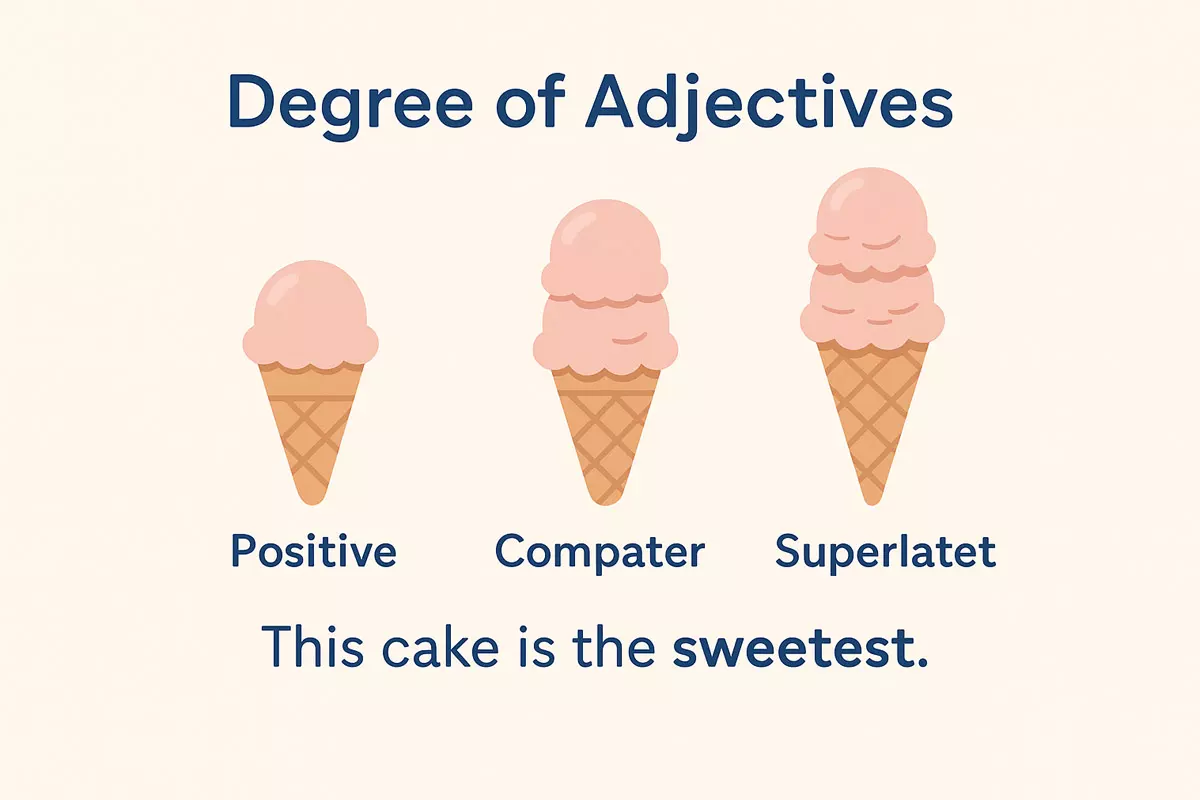 Here we the positive, comparative, and superlative degrees of adjectives, explains how to form them including irregular forms, provides practical examples, and concludes with a brief practice exercise to help you apply what you've learned.
Describing qualities precisely is vital for effective communication, and knowing how to use comparative and superlative forms like tall, taller, and tallest allows us to make clear distinctions between people, places, or things. By understanding these word forms, we can compare attributes accurately and express differences or similarities more clearly. Mastery of such language tools not only improves our ability to convey ideas but also enhances our overall communication skills in both casual and formal settings.
Positive Degree
The most basic form of an adjective is its original, unmodified version, used simply to describe a noun without any comparison. This form tells us about a quality or characteristic, but does not indicate whether it is more or less than another. For instance, when you say "The sky is blue," "blue" is in its simplest descriptive form. This is the version you will find in a dictionary entry for any given adjective.
How the Basic Form Functions
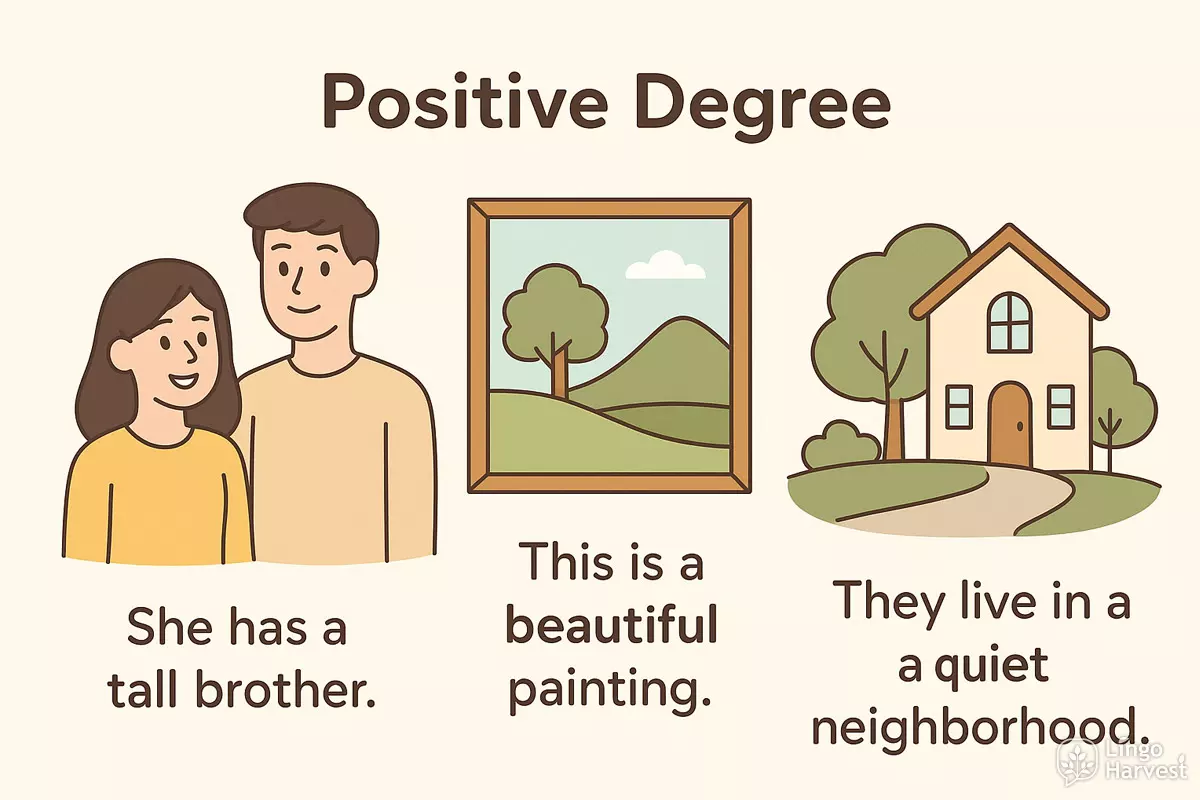
When adjectives are used in their initial state, they provide information about the noun but do not compare it to anything else. In English, this pattern is straightforward. For example:
- She has a tall brother.
- This is a beautiful painting.
- They live in a quiet neighborhood.
In these cases, the adjectives simply describe, without suggesting that anyone or anything is taller, more beautiful, or quieter.
Common Examples in Context
A wide variety of adjectives appear in this base form in everyday speech and writing. Here are some more examples to illustrate:
- fast
- old
- kind
- happy
- strong
- young
- cold
- soft
- smart
- brave
- funny
- rich
- busy
- clean
- bright
- fresh
- loud
- dark
Each of these words can stand alone to describe something, without any sense of comparison.
Usage in Sentences
The base adjective is often used with articles ("a," "an," "the"), demonstratives ("this," "that"), or possessives ("my," "your") to specify the noun being described. For example:
- He drives a fast car.
- It’s a cold day.
- We met a kind stranger.
Notice how the adjective stays in its original form, regardless of the noun it describes.
Overview Table: Forms of Adjectives
To see how the unmodified form relates to its comparative and superlative counterparts, here’s a table showing the three degrees for some common adjectives:
| Base Form | Comparative | Superlative |
|---|---|---|
| small | smaller | smallest |
| happy | happier | happiest |
| bright | brighter | brightest |
| expensive | more expensive | most expensive |
| interesting | more interesting | most interesting |
In summary, the basic adjective form is essential for simple descriptions, establishing qualities without any comparison. It serves as the foundation for constructing more complex adjective forms.
Comparative Degree
When describing how one thing differs from another in terms of a quality, English uses a special form of adjectives. This form helps us compare two people, objects, or ideas, showing that one has “more” or “less” of a particular characteristic than the other. It’s a key part of everyday conversation, from talking about weather (“warmer”) to preferences (“more interesting”).
How to Form Comparisons
Most adjectives change their shape or add a word to express this contrast:
- For short adjectives (typically one syllable), add -er: fast → faster
- If the adjective ends in -y, change -y to -ier: happy → happier
- With longer adjectives (two syllables or more), use more before the adjective: beautiful → more beautiful
Spelling Changes and Exceptions
Certain adjectives need extra attention:
- Double the final consonant if the adjective ends in consonant-vowel-consonant: big → bigger
- Irregular forms: some adjectives change completely, such as good → better and bad → worse
Usage Patterns
This form is often followed by “than” to make the comparison clear. For example, “This book is shorter than that one.” Below is a table showing common adjectives and their comparative forms for reference.
| Adjective (Base Form) | Comparative Form |
|---|---|
| small | smaller |
| old | older |
| easy | easier |
| hot | hotter |
| good | better |
| bad | worse |
| interesting | more interesting |
| expensive | more expensive |
| far | farther / further |
| happy | happier |
Summary of Key Points
- Use this adjective form when comparing two things.
- Short adjectives add -er; longer ones use more.
- Remember irregular forms and spelling rules.
- The word “than” often follows to clarify the comparison.
This structure helps express differences clearly and efficiently in English, making communication more precise.
Superlative Degree
When comparing three or more things, English adjectives can take a form that expresses the highest or lowest degree of a quality. This form is typically created by adding -est to short adjectives, or by using most (or least) before longer adjectives. The result highlights one item as having the greatest or smallest extent of a characteristic within a group.
How to Form Superlatives
For one-syllable adjectives, simply add -est (e.g., "fast" becomes "fastest"). If the adjective ends in -e, just add -st. For adjectives ending in a consonant-vowel-consonant pattern, double the final consonant before adding -est ("big" → "biggest"). Adjectives with two or more syllables generally take most or least in front ("beautiful" → "most beautiful"). Irregular adjectives have unique forms.
Common Superlative Patterns
- Short: tall → tallest
- Short: old → oldest
- Short (ending in -y): happy → happiest
- Short (double consonant): hot → hottest
- Long: intelligent → most intelligent
- Long: careful → most careful
- Irregular: good → best
- Irregular: bad → worst
- Irregular: far → farthest/furthest
- Long: interesting → most interesting
- Short: thin → thinnest
- Short: large → largest
- Short: small → smallest
- Long: comfortable → most comfortable
- Long: expensive → most expensive
- Irregular: little → least
When to Use
This form is used when you want to single out one member of a group as having the highest (or lowest) level of a quality. For example: "She is the smartest student in the class," or "This is the most difficult exam I've taken." The article "the" typically precedes superlatives.
Comparison Table
| Adjective | Comparative | Superlative | Example |
|---|---|---|---|
| cold | colder | coldest | This is the coldest day of the year. |
| happy | happier | happiest | She is the happiest person here. |
| expensive | more expensive | most expensive | That was the most expensive meal. |
| good | better | best | He is the best player on the team. |
| bad | worse | worst | This is the worst movie I've seen. |
| little | less | least | It is the least important rule. |
Quick Tips
- Always use "the" before the superlative form.
- Remember irregular forms like "best" and "worst".
- For adjectives with two syllables ending in -y, change -y to -i and add -est.
- Use "most" or "least" for adjectives with three or more syllables.
Using the superlative form allows you to clearly identify the standout among three or more options. This is essential in both spoken and written English for making effective comparisons.
Formation Rules
Understanding how adjectives change to express different degrees is essential for clear and precise communication. English adjectives typically have three forms: the base (positive), a form to compare two things (comparative), and another to show the highest degree among three or more (superlative). The methods for creating these forms depend on the adjective’s length and spelling.
Regular Patterns for Forming Degrees
Most adjectives follow predictable patterns when shifting between positive, comparative, and superlative forms:
- For most one-syllable adjectives, add -er for the comparative and -est for the superlative.
Example: small → smaller → smallest - If the adjective ends in -e, just add -r and -st.
Example: large → larger → largest - For adjectives ending in a consonant + y, change y to i and add -er or -est.
Example: happy → happier → happiest - Adjectives with a single vowel followed by a single consonant double the consonant before adding -er or -est.
Example: big → bigger → biggest - For adjectives with two or more syllables (except some two-syllable words ending in -y), use more for the comparative and most for the superlative.
Example: modern → more modern → most modern
Overview Table: Adjective Degree Formation
| Adjective Type | Comparative / Superlative Pattern | Example |
|---|---|---|
| One-syllable | Add -er / -est | fast → faster → fastest |
| Ends in -e | Add -r / -st | nice → nicer → nicest |
| Ends in consonant + y | Change y to i, add -er / -est | easy → easier → easiest |
| Two+ syllables | Add more / most before adjective | interesting → more interesting → most interesting |
| Short vowel + consonant ending | Double consonant, add -er / -est | big → bigger → biggest |
Irregular Comparisons
Some adjectives don’t follow standard rules and must be memorized. Here are several common irregulars:
- good → better → best
- bad → worse → worst
- far → farther/further → farthest/furthest
- little → less → least
- many/much → more → most
- old → older/elder → oldest/eldest
Key Points to Remember
Use more and most with almost all adjectives of three or more syllables, and with many two-syllable adjectives (except those ending in -y, -er, -le, or -ow, which often take -er/-est). Never mix more with -er, or most with -est (❌ more better or most easiest). Spelling changes, such as doubling consonants or dropping final -y, are essential for correct forms. By following these patterns and exceptions, you can confidently create comparative and superlative forms for most adjectives in English.
Irregular Forms
Some adjectives in English do not follow the regular pattern of adding "-er" or "-est" or using "more" and "most" for their comparative and superlative degrees. Instead, they have unique forms that must be memorized, as they do not follow predictable rules. Recognizing these exceptions is important for both writing and speaking accurately. The most frequently encountered adjectives with non-standard comparative and superlative forms include words like "good," "bad," and "far." There are also a few others that learners often encounter in everyday English. Below is a structured overview of common adjectives with their irregular degree forms:
| Base (Positive) | Comparative | Superlative |
|---|---|---|
| good | better | best |
| bad | worse | worst |
| far | farther / further | farthest / furthest |
| little (amount) | less | least |
| many / much | more | most |
| old | older / elder | oldest / eldest |
| late | later | latest / last |
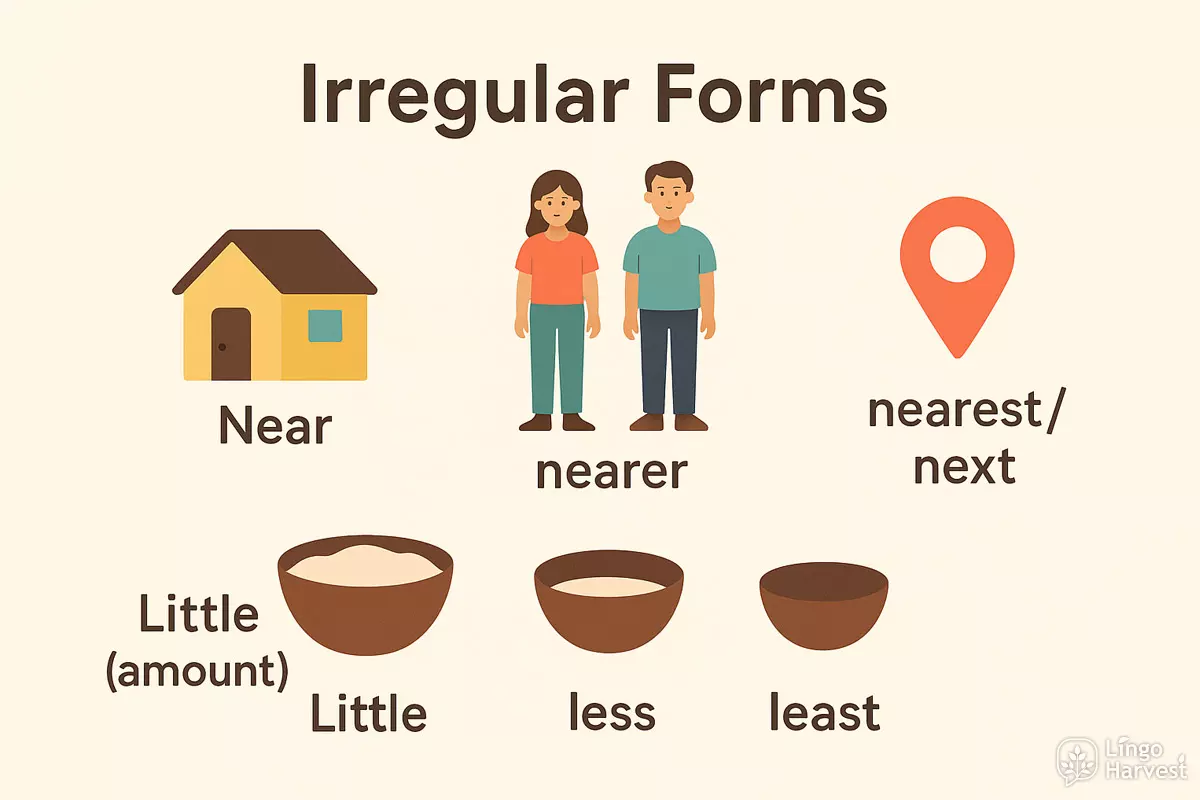
| near | nearer | nearest / next |
| well (adjective/health) | better | best |
| badly (adverb) | worse | worst |
Some adjectives, such as "farther" and "further," can have slightly different meanings or be preferred in different contexts. "Farther" usually refers to physical distance, while "further" can also mean "additional" or "to a greater extent." Similarly, "elder" and "eldest" are mainly used when referring to people, especially family relationships.
- Old → older/elder → oldest/eldest (use “elder/eldest” mainly for people, especially family members)
- Late → later → latest/last (“latest” = most recent; “last” = final in a sequence)
- Near → nearer → nearest/next (“nearest” for physical distance; “next” for order or position)
- Well → better → best (when “well” means “healthy,” not the adverb)
- Badly → worse → worst (irregular comparison of the adverb)
- Little (amount) → less → least (different from “small → smaller → smallest,” which is regular)
- Much/Many → more → most (shared comparative/superlative forms, but used with different noun types)
- Far → farther/further → farthest/furthest (“farther” for distance; “further” also for “additional” or “more deeply”)
- Fore → former → foremost/first (formal and literary; e.g., “foremost duty”)
- Hind → hinder → hindmost (very rare; mostly in older texts meaning “the one at the back”)
- In → inner/inside → innermost/ inmost (used for parts located deepest within something: “innermost thoughts”)
- Out → outer/outside → outermost/outmost (for things located farthest on the outside: “outermost layer”)
- Up → upper → uppermost (mostly in physical or hierarchical descriptions: “uppermost level”)
- Down → nether → nethermost (archaic, appears in older or poetic English: “nethermost regions”)
Usage Notes
Understanding which adjectives have exceptional forms is essential for speaking and writing naturally. For example, saying "gooder" or "baddest" would be incorrect (❌), while "better" and "worst" are the accepted forms (✅). When in doubt, check if the adjective is among these exceptions before applying regular comparative or superlative endings.
Useful Everyday Examples
Adjectives change their form depending on what they describe and how they compare things. In daily conversations, you’ll often hear different forms used to show qualities, make comparisons, or identify extremes. Let’s explore how these forms naturally appear in real-life situations.
Common Situations Using Positive, Comparative, and Superlative Forms
- Describing people: "Anna is tall. Ben is taller. Carlos is the tallest in the class."
- Comparing prices: "This shirt is cheap, but that one is cheaper. The one on sale is the cheapest."
- Talking about weather: "Today is cold. Yesterday was colder, but last week was the coldest."
- Describing difficulty: "This puzzle is easy. That one is easier. The crossword is the easiest."
- Discussing speed: "My old laptop was slow. My new one is faster. The gaming PC is the fastest."
- Sharing preferences: "Pizza is good, sushi is better, but homemade lasagna is the best."
- Comparing distances: "The park is far. The museum is farther. The mountains are the farthest."
- Evaluating quality: "This book is interesting. That one is more interesting. The biography is the most interesting."
- Talking about age: "My brother is young. I am younger. My cousin is the youngest."
- Describing happiness: "She is happy. He is happier. Their dog is the happiest."
Quick Reference Table: Adjective Forms in Action
| Positive | Comparative | Superlative | Example Sentence |
|---|---|---|---|
| small | smaller | smallest | "This bag is small, that one is smaller, but the blue one is the smallest." |
| busy | busier | busiest | "Monday is busy. Tuesday is busier. Friday is the busiest." |
| beautiful | more beautiful | most beautiful | "The garden is beautiful. The lake is more beautiful. The mountain view is the most beautiful." |
| bad | worse | worst | "His score was bad. Mine was worse. Hers was the worst." |
| old | older | oldest | "My car is old. My uncle's is older. My grandfather's is the oldest." |
These patterns appear everywhere: at home, at work, in shops, and in friendly chats. Whether you’re comparing sizes, qualities, or experiences, knowing these forms helps you express comparisons naturally and clearly.
Mini Practice
Test your understanding of adjective forms by completing the following exercises. Focus on recognizing and forming positive, comparative, and superlative structures. You’ll work with both regular and irregular adjectives.
Fill in the blanks
- My house is __________ (big) than yours.
- This test is the __________ (easy) of all.
- Tom is __________ (tall) than Jerry.
- Of the three cars, this one is the __________ (fast).
- She is as __________ (smart) as her brother.
- Winter is __________ (cold) than autumn.
- This is the __________ (good) movie I have seen.
- His explanation was __________ (clear) than mine.
Show answers
- bigger
- easiest
- taller
- fastest
- smart
- colder
- best
- clearer
Choose the correct form
- This puzzle is (more difficult / most difficult) than the last one.
- He is the (oldest / older) student in the class.
- She sings (better / best) than anyone else.
- Today is (hotter / hottest) than yesterday.
Show answers
- more difficult
- oldest
- better
- hotter
Common Adjective Forms
Review some frequently used adjectives and their comparative/superlative forms:
| Positive | Comparative | Superlative |
|---|---|---|
| small | smaller | smallest |
| happy | happier | happiest |
| interesting | more interesting | most interesting |
| bad | worse | worst |
| far | farther/further | farthest/furthest |
| busy | busier | busiest |
| beautiful | more beautiful | most beautiful |
| friendly | friendlier/more friendly | friendliest/most friendly |
| old | older/elder | oldest/eldest |
| little | less | least |
Spot the error
Identify and correct the mistakes in these sentences:
- This is the more expensive phone in the store.
- He is the most tallest player on the team.
- My sister is more younger than me.
Show answers
- This is the most expensive phone in the store.
- He is the tallest player on the team.
- My sister is younger than me.