Adjectives as Complements After Linking Verbs

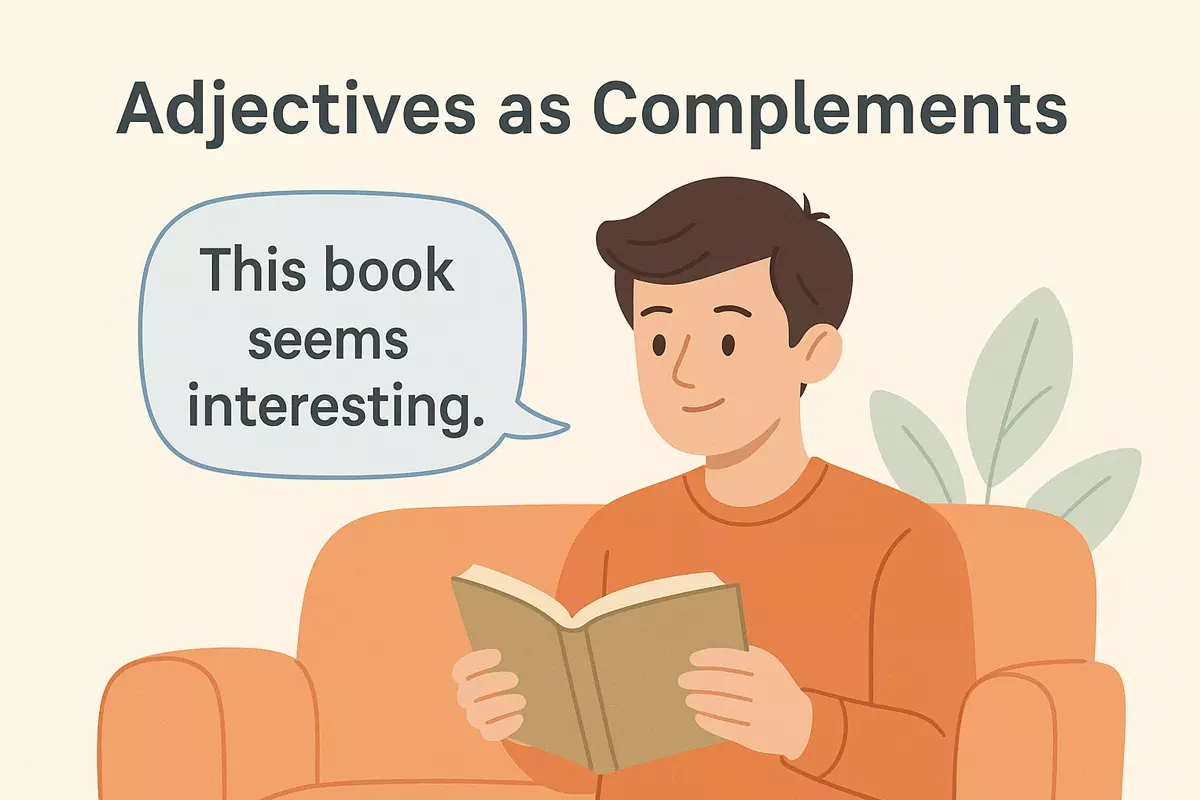 The article defines complements, lists common linking verbs, and explains how adjectives follow verbs like be, seem, and feel. It also covers typical sentence patterns, frequent mistakes, and provides a short practice section.
Descriptive words, or modifiers, play a crucial role in English by providing additional information about the subject, particularly after linking verbs such as "is," "seem," or "become." These modifiers help clarify and enrich the message, making sentences more precise and engaging. By learning how to use them effectively in these positions, you can improve both the clarity and expressiveness of your communication, ensuring your ideas are conveyed accurately and your writing or speech becomes more vivid and impactful.
What Complements Are
In grammar, a complement is a word or group of words that completes the meaning of a sentence after a verb. When you use linking verbs like "be," "seem," or "become," the sentence often needs something extra to make sense—this is where complements come in. They provide important information about the subject, describing or identifying it further.
Types of Complements After Linking Verbs
Linking verbs don’t show action; instead, they connect the subject to more information about itself. The most common types of complements after linking verbs are:
- Adjective complements – describe the subject (e.g., She is tired.)
- Noun complements – rename or identify the subject (e.g., He became a teacher.)
- Prepositional phrases – sometimes, these can act as complements (e.g., The room is in use.)
How Complements Differ from Other Sentence Parts
Complements are different from objects. While objects receive the action of a verb, complements follow linking verbs and give more details about the subject itself. For example, in "The soup tastes delicious," "delicious" is an adjective complement that tells us about "the soup," not something the soup is acting upon.
Common Linking Verbs That Take Complements
Here are some frequent linking verbs that are typically followed by a complement:
- be (am, is, are, was, were)
- seem
- become
- appear
- feel
- look
- sound
- remain
- grow
- turn
- stay
Examples of Complements in Sentences
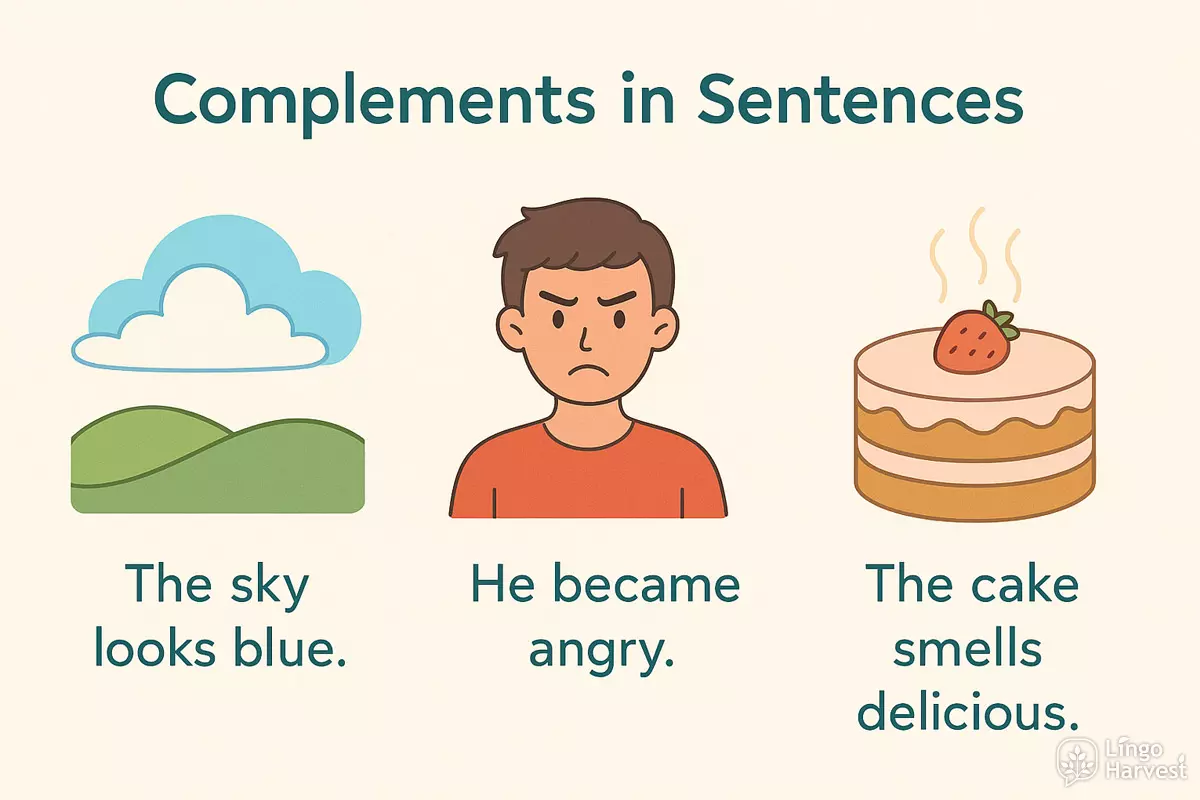
Below are sample sentences illustrating different types of complements after linking verbs:
- The sky looks blue.
- He became angry.
- The cake smells delicious.
- The winner is her.
- They seem happy.
- The weather remains cold.
- She grew tired.
- The idea sounds interesting.
- His answer was a surprise.
- The soup tastes salty.
Comparison: Complements vs. Objects
| Complements | Objects |
|---|---|
| Follow linking verbs | Follow action verbs |
| Describe or identify the subject | Receive the action of the verb |
| Example: She is friendly. | Example: She likes pizza. |
| Can be adjectives or nouns | Usually a noun or pronoun |
Understanding complements is key to using linking verbs naturally and making your sentences clear. They help tie the subject to a new description or identity, ensuring your meaning comes across accurately.
Common Linking Verbs
Many English verbs serve the purpose of connecting the subject with information about its state or qualities, rather than showing an action. These verbs act as bridges, allowing adjectives to describe or modify the subject. They are essential for forming sentences where the subject is being identified, described, or classified, rather than performing a straightforward action. Some of the most frequent verbs in this group are forms of “to be,” but several others are also widely used in everyday communication. Recognizing these verbs helps you identify when an adjective can follow, acting as a complement.
- am, is, are, was, were (forms of be)
- become
- seem
- appear
- feel
- look
- sound
- smell
- taste
- remain
- grow
- stay
- get
- turn
- prove
These verbs can be followed by adjectives that describe the subject. For example, in the sentence “The soup smells delicious,” “smells” links the subject “soup” to the adjective “delicious.” Not all verbs can work this way; only those that do not express a direct action but rather a state or change in state.
Comparison: Linking vs. Action Use
Some verbs may act as linkers in one context and as action verbs in another. Here’s a comparison to clarify the difference:
| Verb in Linking Role | Verb in Action Role |
|---|---|
| The cake smells wonderful. ✅ | She smells the flowers. ❌ |
| He looks tired. ✅ | She looks at the painting. ❌ |
| The milk turned sour. ✅ | He turned the page. ❌ |
| The idea seems interesting. ✅ | — |
Understanding which verbs can link a subject to its description is crucial for building sentences with adjectives as complements. This knowledge helps avoid mistakes, especially with verbs that change their function based on context. Practice spotting these verbs in sentences to strengthen your grammatical intuition.
Adjectives After Be
When the verb "be" appears in a sentence, it often links the subject to a describing word. These describing words, or adjectives, tell us more about the subject’s state, appearance, or qualities. Unlike verbs that show action, "be" works as a connector, making it essential for expressing conditions or characteristics.
How "Be" Connects Subjects and Adjectives
The verb "be" (am, is, are, was, were, etc.) acts as a bridge between the subject and its description. This structure is common in everyday English, allowing speakers to share information about people, places, things, or feelings. For example:
- The soup is hot.
- My friends are helpful.
- The weather was terrible.
- Our teacher is patient.
Notice that the adjective follows the form of "be," not the subject directly. This pattern makes it easy to describe or identify something.
Common Adjectives Used with "Be"
Certain adjectives frequently follow forms of "be" to describe a wide range of subjects. Here are some examples:
- tired
- hungry
- ready
- late
- happy
- open
- closed
- busy
- safe
- different
- famous
- easy
- important
- new
- broken
- clean
- full
- available
- afraid
- sure
Position and Agreement
Adjectives that follow "be" do not change form for singular or plural subjects. The form of "be" changes to match the subject, but the adjective stays the same:
- He is tall. ✅
- They are tall. ✅
- She is excited. ✅
- We are excited. ✅
It would be incorrect to say "He is talls" or "They are talles." The adjective remains unchanged.
Examples of Sentences Using "Be" + Adjective
| Subject + Be | Adjective | Full Example |
|---|---|---|
| I am | happy | I am happy. |
| The book is | interesting | The book is interesting. |
| They are | ready | They are ready. |
| The rooms were | clean | The rooms were clean. |
| It is | broken | It is broken. |
Key Points to Remember
- Place the adjective directly after the form of "be."
- The adjective describes the subject, not the verb.
- Adjectives do not take plural forms in this position.
- Using "be" with adjectives is a clear way to state facts, feelings, or characteristics.
By understanding this pattern, you can share information about people and things more precisely and naturally in English.
Adjectives After Seem/Feel
When we use verbs like "seem" and "feel" in English, they often need a word to complete their meaning. In most cases, this word is an adjective, and it describes either the subject’s condition or how something appears. For example, in "The soup tastes delicious," "delicious" tells us more about the soup. Similarly, "He seems tired" uses "tired" to describe "he." These linking verbs act as bridges between the subject and its state or quality. After "seem" and "feel," adjectives function as subject complements, not as modifiers of objects. This is why we say "She seems happy" instead of "She seems happily." The role of the adjective is to provide information about the subject, not about the action itself.
Common Adjectives Used with "Seem" and "Feel"
These verbs are often followed by a wide variety of adjectives. Here are some of the most frequent choices:
- happy
- sad
- angry
- tired
- cold
- warm
- nervous
- confident
- hungry
- excited
- unwell
- ready
- afraid
- safe
- calm
- lost
- relaxed
- hopeful
Patterns and Sentence Structure
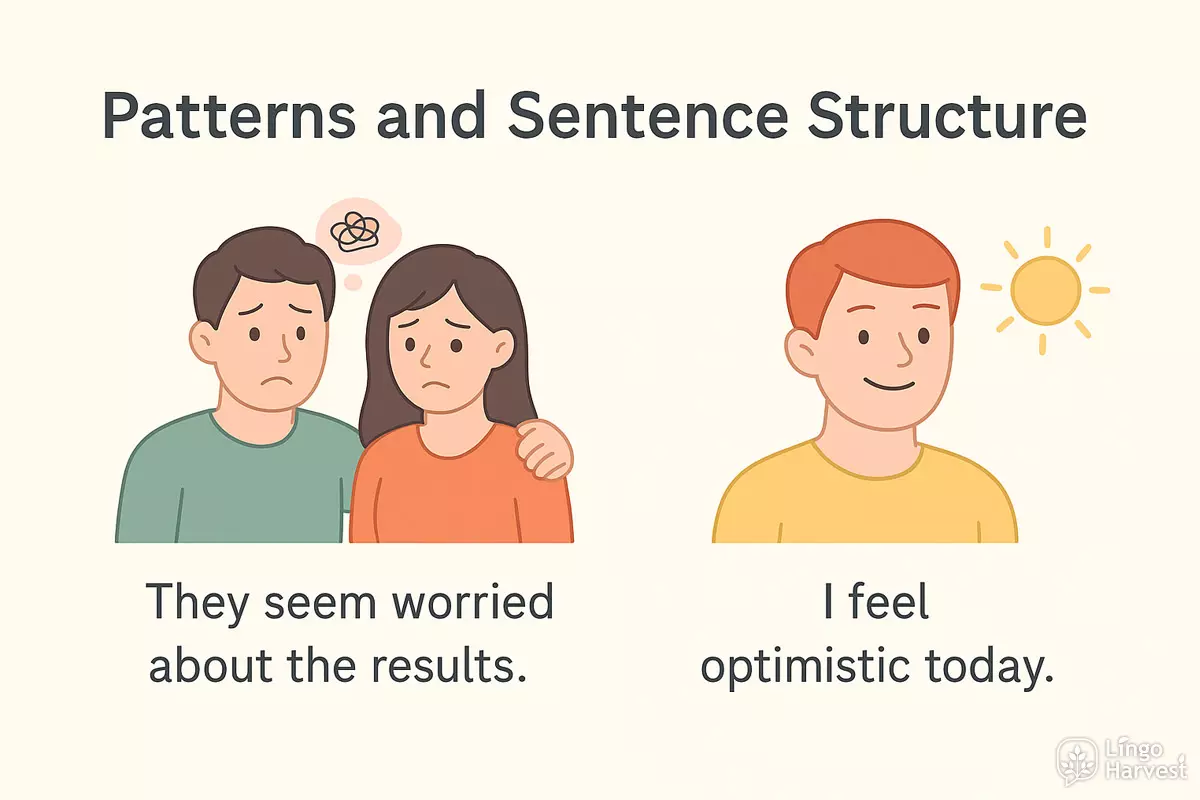
The typical pattern is: Subject + seem/feel + adjective. Here are a few examples:
- They seem worried about the results.
- I feel optimistic today.
- The weather feels chilly.
- She seemed annoyed at the noise.
- He feels comfortable in his new job.
Notice that these adjectives always relate back to the subject of the sentence.
Comparing "Seem" and "Feel" with Adjectives
These verbs are similar, but there are subtle differences. "Feel" is often used for personal, physical, or emotional states, while "seem" is more about appearances or impressions, often from an outside perspective.
| Verb | Typical Context |
|---|---|
| Seem | Used when giving an impression or opinion about someone or something. Example: "He seems nervous." |
| Feel | Used to describe internal emotions or physical sensations. Example: "I feel cold." |
Common Mistakes
Learners sometimes use adverbs instead of adjectives after these verbs (e.g., "She seems happily"). Remember, only adjectives are correct in this position:
- ✅ Correct: "He feels sad."
- ❌ Incorrect: "He feels sadly."
Adjectives following "seem" and "feel" play a key role in expressing opinions, sensations, and states. Mastering this pattern helps make your English sound natural and accurate.
Common Patterns
When adjectives follow linking verbs, they serve to describe or identify the subject in a sentence. This usage is extremely common in English, and understanding the structures that allow adjectives to function this way can help learners create more natural and precise sentences.
Typical Linking Verbs
Most often, adjectives appear after verbs that do not show action but instead connect the subject to more information. These verbs are called linking verbs. The most frequent ones include:
- Be (am, is, are, was, were)
- Seem
- Become
- Appear
- Feel
- Look
- Taste
- Sound
- Remain
- Stay
- Grow
- Turn
- Get
- Prove
These verbs are followed by adjectives, not adverbs, to describe the subject’s state or qualities.
Sentence Structures
The most straightforward structure is: Subject + Linking Verb + Adjective For example:
- The soup tastes delicious.
- He looks tired.
- The weather became cold.
- Our plan seems risky.
- The children got excited.
Common Adjectives Used as Complements
Certain adjectives are especially common after linking verbs. Here’s a list of adjectives frequently used in this position:
- happy
- sad
- angry
- hungry
- afraid
- late
- ready
- sure
- wrong
- right
- open
- closed
- asleep
- awake
- alive
- dead
- well
- ill
- married
- single
Comparison: Adjective vs. Adverb After Linking Verbs
It’s important to distinguish when an adjective is needed instead of an adverb. After linking verbs, adjectives are correct, while adverbs are not. The table below illustrates this distinction:
| Correct (Adjective) | Incorrect (Adverb) |
|---|---|
| The music sounds beautiful. | The music sounds beautifully. ❌ |
| She feels bad. | She feels badly. ❌ |
| He looks calm. | He looks calmly. ❌ |
| The room stayed clean. | The room stayed cleanly. ❌ |
Summary
Linking verbs connect the subject with descriptive adjectives, not adverbs. Recognizing these patterns helps in forming clear, grammatically correct sentences that express states, qualities, or changes.
Frequent Mistakes
Many learners find it tricky to use adjectives as complements after linking verbs, often confusing them with adverbs or using unsuitable forms. Understanding some of the most common pitfalls can help you avoid awkward or incorrect sentences.
Mixing Up Adjectives and Adverbs
A typical error is using an adverb instead of an adjective after a linking verb. Linking verbs (like "be," "seem," "become," "feel," "look," "sound," and "appear") require an adjective to describe the subject, not an adverb. For example:
- ❌ She looks happily. (Incorrect)
- ✅ She looks happy. (Correct)
- ❌ The soup tastes well. (Incorrect)
- ✅ The soup tastes good. (Correct)
Using Nouns or Verbs Instead of Adjectives
Sometimes, a noun or verb is mistakenly placed after a linking verb. This can make the sentence confusing or grammatically incorrect:
- ❌ The room became darkness. (Incorrect)
- ✅ The room became dark. (Correct)
- ❌ He is success. (Incorrect)
- ✅ He is successful. (Correct)
Incorrect Use of Comparative and Superlative Forms
Learners sometimes choose the wrong adjective form after linking verbs, especially with comparatives and superlatives. Pay attention to the correct structure:
- ❌ This cake tastes more better than that one. (Incorrect)
- ✅ This cake tastes better than that one. (Correct)
- ❌ He seems most happiest today. (Incorrect)
- ✅ He seems the happiest today. (Correct)
Confusing Linking Verbs with Action Verbs
Not all verbs that connect subjects to other words are linking verbs. Using an adjective after an action verb is incorrect:
- ❌ She sings beautiful. (Incorrect)
- ✅ She sings beautifully. (Correct)
Summary Table: Common Linking Verbs and Correct Complements
| Linking Verb | Correct Complement Example | Incorrect Example |
|---|---|---|
| be | The sky is blue. | The sky is bluely. |
| seem | It seems strange. | It seems strangely. |
| feel | I feel tired. | I feel tiredly. |
| look | You look confused. | You look confusedly. |
| become | He became angry. | He became angrily. |
Other Common Issues to Watch For
- Forgetting to change irregular adjectives (e.g., "good" not "well" after "feel": "I feel good," not "I feel well" unless talking about health).
- Using double negatives or unnecessary intensifiers ("She is very much happy" → "She is very happy").
- Applying adjectives that do not match the subject in number or meaning.
By being aware of these patterns, you can produce clearer, more accurate sentences when describing subjects after linking verbs.
Short Practice
Applying adjectives after linking verbs is a practical way to describe states, feelings, or characteristics. Let's reinforce your understanding by analyzing some common linking verbs and practicing with a variety of sentences.
Recognizing Linking Verbs with Adjective Complements
Some verbs connect the subject to a descriptive word, not an action. Here are frequent linking verbs that take adjectives as complements:
- be (am, is, are, was, were)
- seem
- become
- feel
- look
- appear
- sound
- get
- remain
- stay
Choose the Correct Adjective
Complete each sentence using a suitable adjective:
- The soup tastes .
- He seems today.
- The flowers look after the rain.
- My hands feel in winter.
- She became after the news.
Show answers
- delicious / salty / bland
- tired / happy / upset
- fresh / beautiful / bright
- cold / dry / numb
- angry / excited / sad
Identify the Adjective Complement
For each sentence, highlight the word that describes the subject after the linking verb:
- The sky is blue.
- They became worried.
- This cake smells amazing.
- You look tired.
- The water feels cold.
Show answers
- blue
- worried
- amazing
- tired
- cold
Common Linking Verbs and Adjective Examples
Here is a comparison of linking verbs with possible adjective complements:
| Linking Verb | Example with Adjective |
|---|---|
| be | The room is quiet. |
| seem | She seems nervous. |
| feel | I feel confident. |
| look | He looks confused. |
| become | The weather became stormy. |
Practicing with sentences like these helps you master using adjectives after linking verbs. Try making your own sentences to describe people, things, or situations using this pattern.