Types of Adverbs: Manner, Place, Time, Frequency, Degree

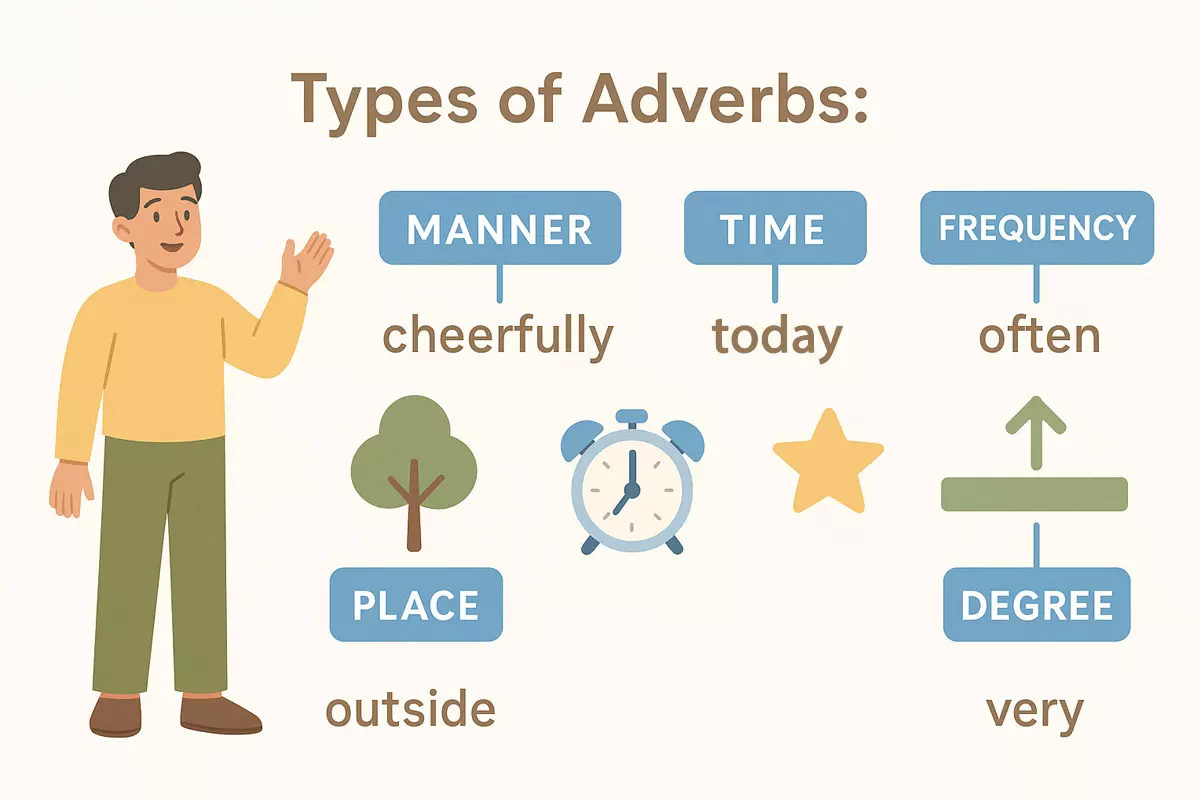 This article explains adverbs of manner, place, time, frequency, and degree. It offers usage notes and a quick practice section, helping you understand how adverbs clarify actions, locations, timing, frequency, and intensity in sentences.
Words play a crucial role in shaping the details of our conversations by describing aspects such as how, where, when, how often, or to what extent something occurs. These useful modifiers, known as adverbs, bring clarity and vividness to our sentences, allowing us to express ourselves more precisely. By carefully choosing the right words, we can make our communication not only clearer but also more engaging for our listeners or readers, ensuring that our intended meaning is conveyed effectively.
Adverbs of Manner
How actions are carried out in English is often described using a special group of words. These modifiers tell us the way something happens, adding detail to verbs. They answer questions like "How does she sing?" or "In what way did they work?"
How They Are Formed
Most often, these words are made by adding -ly to adjectives: "quick" becomes "quickly," "slow" becomes "slowly." However, there are exceptions and irregular forms. For example, "good" becomes "well," not "goodly." Some words, like "fast" or "hard," keep the same form for both adjective and adverb uses.
Common Examples
- quickly
- carefully
- easily
- loudly
- happily
- badly
- gently
- quietly
- politely
- hard
- well
- fast
- honestly
- bravely
- angrily
- patiently
- softly
- neatly
- rudely
- eagerly
Placement in Sentences
Usually, these modifiers go right after the verb or after the object if there is one. For example: "She answered politely." or "He finished the task quickly." In some cases, especially for emphasis, they might appear at the beginning or end of a sentence: "Carefully, he painted the wall."
Comparison of Forms
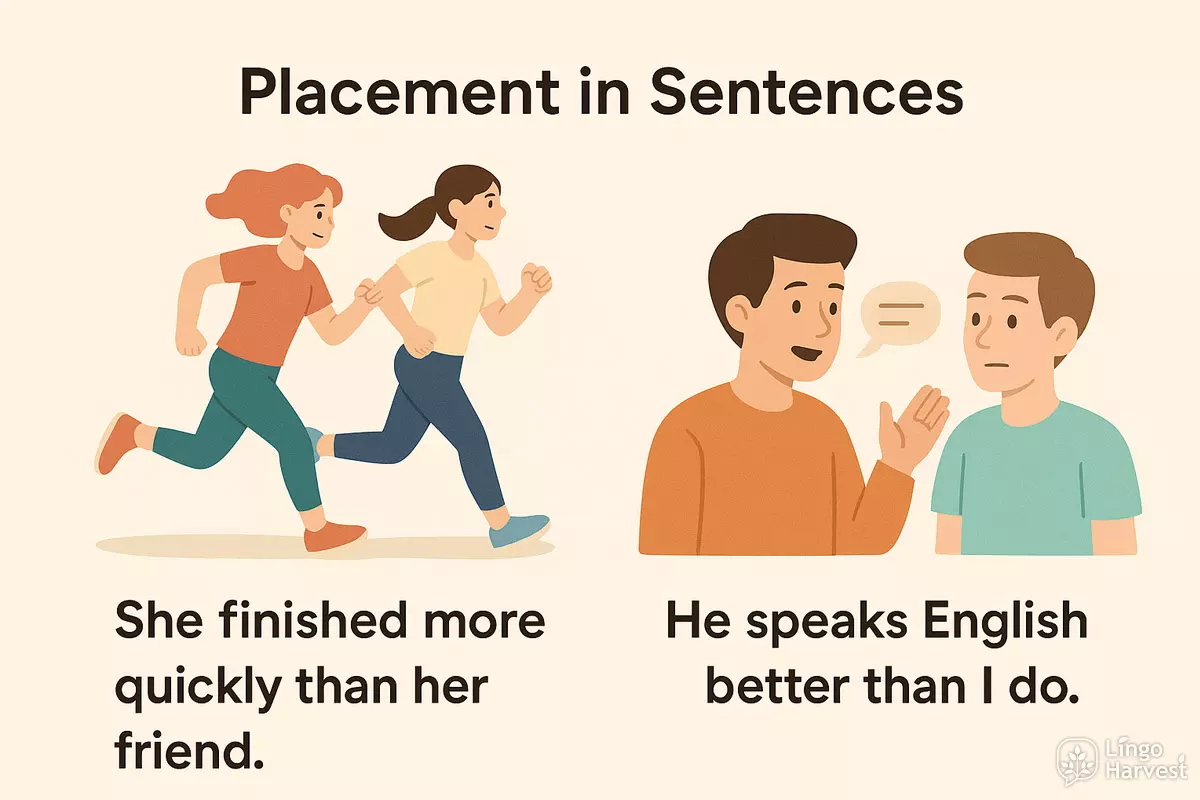
Some can change to show degree (more/less), especially those with irregular or short forms. Here’s a comparison of several key examples:
| Base Form | Comparative | Superlative | Example Sentence |
|---|---|---|---|
| quickly | more quickly | most quickly | She finished more quickly than her friend. |
| well | better | best | He speaks English better than I do. |
| badly | worse | worst | They performed worse than expected. |
| hard | harder | hardest | She worked harder than everyone else. |
| fast | faster | fastest | The train arrived fastest of all. |
Irregularities and Pitfalls
Some expressions do not follow the standard pattern. For instance, "late" as an adverb does not become "lately" (which means "recently" rather than "in a late manner"). Similarly, avoid using "goodly" for manner; "well" is correct. Watch for words that look similar but have different meanings. In summary, this type of modifier brings precision and color to descriptions of action. Mastering their use helps make your language richer and more accurate.
Adverbs of Place
When you want to describe where something happens, adverbs that indicate location or direction come into play. These words add detail by clarifying position, movement, or distance in relation to an action. They answer questions like "Where?", "To where?", or "From where?" and often appear after the main verb, but sometimes at the end of a sentence for emphasis.
Common Examples
Many expressions in this group refer to specific or general locations, directions, or distances. Here are some frequently used ones:
- here
- there
- everywhere
- nowhere
- anywhere
- outside
- inside
- nearby
- abroad
- upstairs
- downstairs
- home
- away
- back
- up
- down
- around
- behind
- above
- below
Usage Patterns
Most adverbs in this category directly follow the verb or verb phrase they modify. In some cases, they can be used at the beginning of a sentence for stylistic effect or emphasis. For example: “Outside, the wind howled all night.”
Forming Location Expressions
Sometimes, phrases are built using prepositions plus nouns to show location or direction. For instance:
- in the park
- at home
- to the left
- on the roof
While these are technically adverbial phrases, they serve the same function as single-word adverbs by specifying “where.”
Comparison Table: Location, Direction, and Distance
| Location | Direction | Distance |
|---|---|---|
| here, there, outside, inside | up, down, away, back | nearby, far, close, a long way |
| abroad, home, everywhere | around, along, across | near, a mile away, just here |
| above, below, behind | forward, backward, onward | nowhere (implies absence of distance) |
| overseas, downtown | towards, past | anywhere (non-specific distance) |
Key Points to Remember
- These modifiers never change form, regardless of tense or subject.
- Some, like "home" or "abroad," are used without a preposition: “She went home.”
- Others, especially those that are prepositional phrases, require a preposition: “He lives in Paris.”
By mastering this group of words, you can make your descriptions much more precise and vivid, ensuring that your listener or reader always knows exactly where the action is taking place.
Adverbs of Time
Words and phrases that tell us when something happens are essential for describing the timing of events or actions. These expressions can indicate specific points in time, durations, or sequences. By adding them to sentences, speakers and writers provide clear information about the moment or period an action occurs, whether it is in the past, present, or future.
Common Types and Examples
Some of the most frequently used timing-related adverbs include both single words and multi-word phrases. Here are several examples that show the range of possibilities:
- Yesterday
- Today
- Tomorrow
- Now
- Later
- Already
- Recently
- Soon
- Still
- Yet
- Eventually
- Finally
- Just
- Nowadays
- Next week
- Last year
- In the morning
- At night
- All day
- For a while
How These Words Work in Sentences
Placement is usually flexible, but these expressions often appear at the beginning or end of a sentence. For example:
- Now she is studying for her exams.
- We will visit the museum tomorrow.
- Recently, he has started jogging every morning.
- He finished his homework already.
Comparing Specificity and Use
Some of these modifiers are precise, while others are more general. For instance, "at 8 o'clock" pinpoints an exact time, while "soon" gives only a vague sense. The table below compares a few common expressions according to how specific or general they are:
| Specific Expressions | General Expressions |
|---|---|
| At 6 pm | Soon |
| On Monday | Nowadays |
| Last year | Eventually |
| In January | Recently |
| Next week | Later |
Tips for Usage
When using temporal adverbs, consider what information your listener or reader needs. If the timing is crucial, choose a more specific word or phrase. If the general sequence is enough, a broader term is fine. Also, be aware that some of these words, such as "still" or "yet," can change meaning depending on their position in the sentence or the tense used. In summary, these words are vital for expressing when things happen and for making communication clearer and more precise. By mastering a variety of these terms, you can convey both exact and approximate timing with ease.
Adverbs of Frequency
Words that describe how often something happens allow us to talk about routines, habits, and repeated actions. These modifiers help indicate whether an event is regular, occasional, or rare. They are commonly placed before the main verb in a sentence, but after the verb “to be.”
Common Frequency Words
- Always
- Usually
- Frequently
- Often
- Sometimes
- Occasionally
- Seldom
- Rarely
- Hardly ever
- Never
These expressions range from describing things that happen all the time to things that never occur. By choosing the right term, speakers can be precise about the regularity of an action.
Placement in Sentences
Most frequency words are placed directly before the main verb:
- She usually drinks coffee in the morning.
- We rarely eat out on weekdays.
But with the verb “to be,” they follow the verb:
- He is always cheerful.
- The train is often late.
Frequency Words and Their Meanings
| Frequency Word | Approximate Meaning |
|---|---|
| Always | 100% of the time |
| Usually | Around 80–90% of the time |
| Often | About 60–70% of the time |
| Sometimes | Roughly 40–50% of the time |
| Occasionally | About 20–30% of the time |
| Rarely | Less than 10% of the time |
| Never | 0% of the time |
Examples in Context
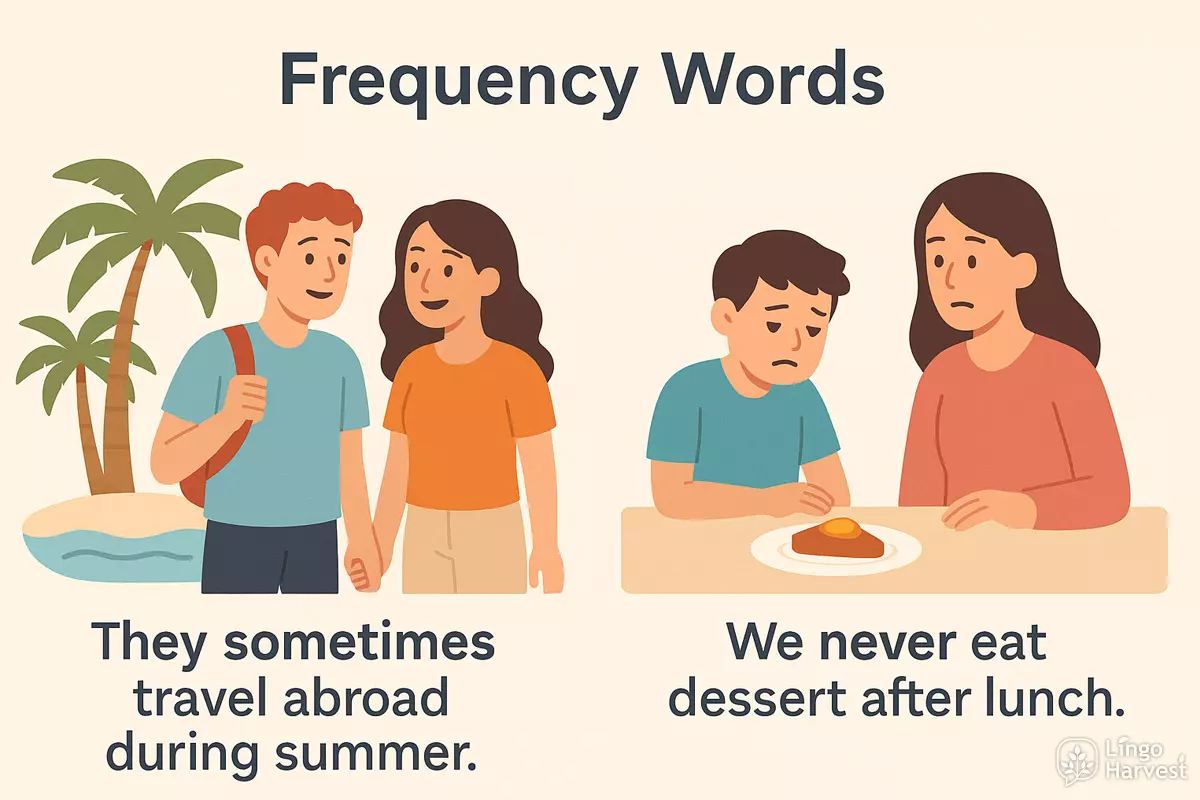
- I always brush my teeth before bed.
- They sometimes travel abroad during summer.
- We never eat dessert after lunch.
- She rarely watches television.
- He often forgets his keys.
Choosing the right term for regularity can make your statements clearer and more specific. These modifiers are essential for everyday conversation, storytelling, and giving instructions about routines or schedules.
Adverbs of Degree
Words in this group help express the intensity or extent of an action, adjective, or another adverb. They answer questions like “how much?”, “to what extent?”, or “how little?” and are essential for adding nuance to sentences. By using these modifiers, speakers can clarify whether something is complete, partial, strong, or weak.
Common Examples and Usage
Some frequently used words in this category include: very, quite, almost, too, enough, just, barely, completely, absolutely, extremely, hardly, nearly, totally, so, rather, fairly, scarcely, partly, somewhat, and utterly. These words typically appear before adjectives or other adverbs, but some, like enough, follow the word they modify.
- She is very happy. (modifies adjective)
- He almost finished his work. (modifies verb)
- This coffee is too hot. (modifies adjective)
- She sings quite well. (modifies adverb)
- The room is big enough. (follows adjective)
- We barely noticed the change.
- They are completely exhausted.
- He’s just arrived.
- I nearly missed the train.
- She is utterly alone.
Position in a Sentence
Most intensifiers and minimizers are placed directly before the word they modify. However, a few, such as enough, come after the adjective or adverb. When modifying verbs, their position can vary depending on emphasis and clarity.
Degrees of Intensity: A Comparison
To show a range from low to high intensity, English uses a variety of these modifiers. Here’s a comparison of common choices, moving from weaker to stronger:
| Low Degree | Medium Degree | High Degree | Absolute Degree |
|---|---|---|---|
| slightly | fairly | very | absolutely |
| somewhat | quite | extremely | completely |
| barely | rather | so | totally |
| hardly | enough | too | utterly |
Choosing the right intensifier depends on how strong the speaker wants the description to be. For example, “slightly tired” suggests only a little fatigue, while “completely exhausted” signals the maximum.
Special Notes
Not all modifiers of degree are interchangeable; some work only with adjectives, others with verbs, and a few with both. For instance, too often implies excess, while enough indicates sufficiency. Being aware of these subtle differences helps create precise, natural-sounding sentences.
Usage Notes
Understanding how and when to use different adverbs can improve clarity and nuance in communication. Each category—such as manner, place, time, frequency, and degree—follows its own patterns and can appear in various positions in a sentence. Here are some important considerations and practical tips for using these modifiers effectively.
Position in Sentences
Adverbs can shift meaning depending on their placement. For example, words expressing manner (like "quickly") typically follow the verb or verb phrase, while those indicating time or frequency often come at the end or beginning of a sentence. Degree modifiers usually appear before the word they modify.
- He spoke softly (manner, after verb)
- Sometimes she reads before bed (frequency, at the start)
- She is almost finished (degree, before adjective)
- They went outside (place, after verb)
- We will meet tomorrow (time, at the end)
Common Errors
Speakers sometimes misplace adverbs or use them redundantly. For instance, using two adverbs of frequency together ("always usually") is incorrect. Overusing degree adverbs like "very" can also weaken your writing.
- Incorrect: She always usually arrives late.
- Correct: She usually arrives late.
- Overuse: The movie was very very interesting.
Examples by Category
Below is a selection of adverbs, organized by type, to illustrate their variety and usage:
| Type | Sample Adverbs & Usage |
|---|---|
| Manner | quickly, gently, loudly, silently, carefully She answered quickly. |
| Place | here, there, everywhere, outside, nearby The cat is outside. |
| Time | now, soon, yesterday, today, later We’ll leave soon. |
| Frequency | always, sometimes, rarely, never, often He often visits us. |
| Degree | very, almost, completely, too, quite She is quite talented. |
Notes on Formality and Tone
Some adverbs are more formal or informal than others. For instance, "perhaps" is often more formal than "maybe." The choice can subtly affect the tone of your sentence.
- Perhaps we should reconsider. (formal)
- Maybe we should reconsider. (informal)
Summary Tips
- Check adverb position for clarity.
- Avoid unnecessary repetition.
- Match tone and formality to context.
- Use a range of adverbs for richer expression.
Quick Practice
Understanding how adverbs function in sentences is best achieved through targeted exercises. Below, you’ll find a series of tasks to reinforce your knowledge of different types of adverbs: manner, place, time, frequency, and degree.
Identify the Adverb Type
Read each sentence and decide what kind of adverb is used (manner, place, time, frequency, or degree):
- She sings beautifully.
- We will meet tomorrow.
- The cat is sleeping upstairs.
- He almost finished his homework.
- They rarely eat out.
Show answers
- Manner
- Time
- Place
- Degree
- Frequency
Fill in the Blank
Choose an appropriate adverb from the list to complete each sentence. Use each adverb only once: quickly, always, very, here, yesterday
- She arrived ________ for the meeting.
- I ________ brush my teeth before bed.
- He was ________ tired after his run.
- Can you leave your bag ________?
- We went to the museum ________.
Show answers
- quickly
- always
- very
- here
- yesterday
Common Adverbs by Type
Explore this list of frequently used adverbs, grouped by category. Notice how each group conveys a different aspect of meaning.
- Manner: slowly, loudly, carefully, badly, well
- Place: nearby, outside, everywhere, above, below
- Time: soon, now, yesterday, already, later
- Frequency: never, often, sometimes, seldom, usually
- Degree: quite, too, almost, enough, barely
Adverb Placement Practice
Decide where the adverb fits best in each sentence. Place the adverb in the correct position:
- He (always) goes to the gym after work.
- We will meet (there) for lunch.
- She finished her assignment (quickly).
- I have (already) eaten dinner.
- The movie was (quite) interesting.
Show answers
- He always goes to the gym after work.
- We will meet there for lunch.
- She finished her assignment quickly.
- I have already eaten dinner.
- The movie was quite interesting.
Compare Adverbs by Type
Here’s a structured overview of sample adverbs in each category for quick reference:
| Type | Examples |
|---|---|
| Manner | gently, happily, carelessly, quietly |
| Place | here, there, anywhere, nearby |
| Time | today, soon, just, lately |
| Frequency | always, never, sometimes, rarely |
| Degree | almost, extremely, hardly, completely |
Practicing with real examples helps solidify your understanding of how these modifiers function in everyday English. Review the tasks above to spot patterns and improve your accuracy.