Comparative and Superlative Adverbs

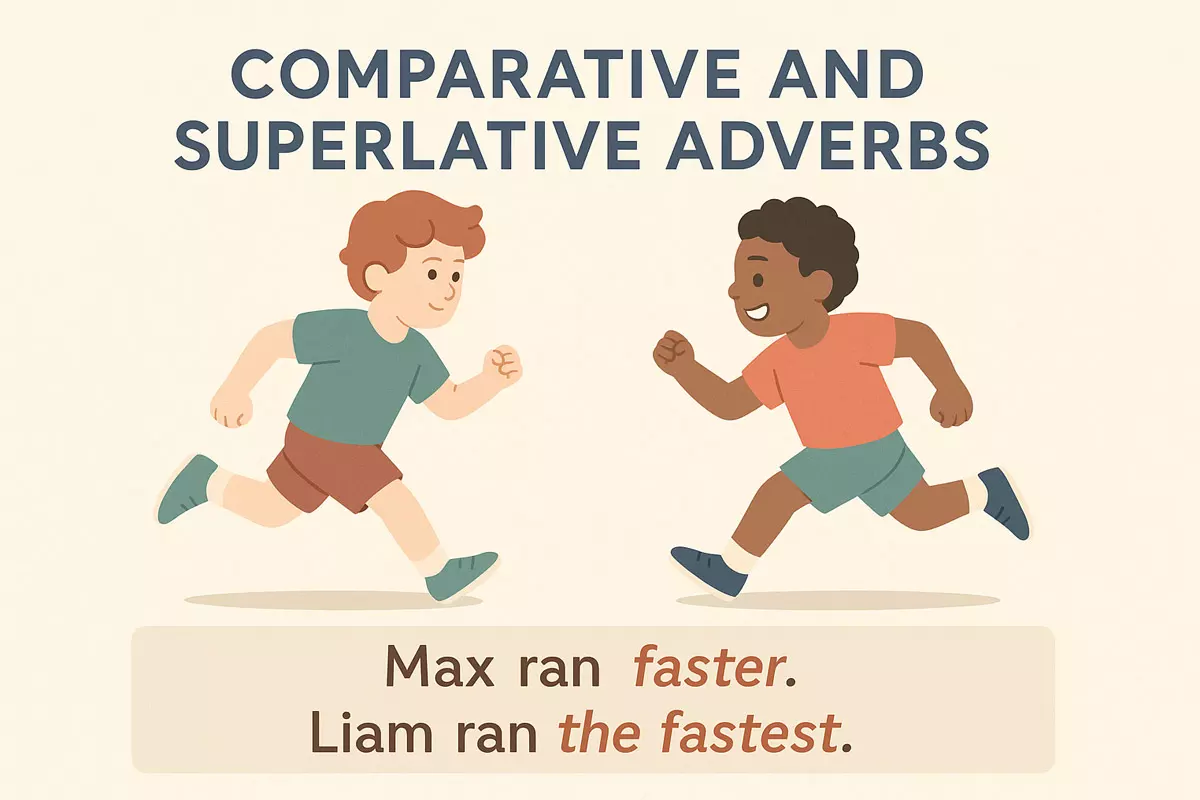 This article explains how to compare actions in English by forming adverb comparatives and superlatives. It covers regular and irregular forms, usage notes, example sentences, and includes a mini practice section for review.
Understanding how to express degrees of comparison for adverbs allows you to clearly highlight actions that are more skillful, faster, or more impressive than others. By using comparative and superlative forms, such as more quickly or most carefully, you can make your writing and speech more precise and engaging. Mastering these forms not only improves your ability to communicate differences in action, but also adds emphasis and clarity to your descriptions, making your ideas stand out more effectively in any context.
Why Compare Actions
Comparing how people or things perform tasks is a natural part of language. We often want to show differences or similarities in the way something is done, whether it’s to highlight improvement, competition, or efficiency. Using comparative and superlative adverbs allows us to clearly express these distinctions. For example, knowing who runs faster or who speaks more fluently can be essential in both everyday conversations and academic contexts.
Communicating Differences and Similarities
Comparative adverbs help us describe how two actions differ. Superlative forms allow us to point out the highest or lowest degree within a group. This is especially useful when evaluating performance, making decisions, or giving feedback. For instance, teachers may say, “Anna finished her test more quickly than Ben,” or, “Of all the students, Maria wrote most neatly.”
Common Situations for Comparing Actions
- Describing progress (“She learns faster now.”)
- Evaluating performance (“He plays chess better than before.”)
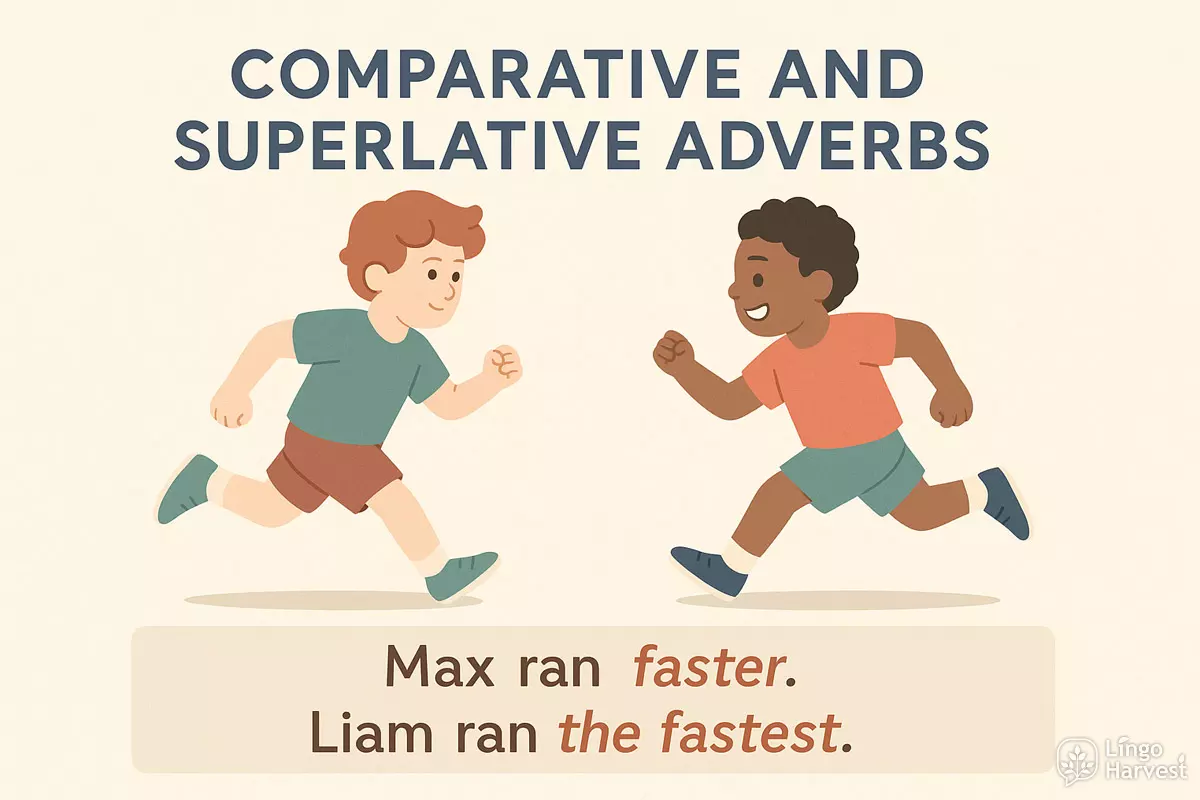
- Giving advice (“Try to work more carefully.”)
- Making choices (“Which team solved the problem most efficiently?”)
- Describing habits (“They arrive earlier than us.”)
- Discussing changes over time (“He drives less recklessly lately.”)
- Ranking abilities (“She sings best in the group.”)
- Comparing methods (“This solution works more smoothly.”)
- Reporting results (“The experiment succeeded more easily this time.”)
- Expressing preferences (“I sleep better with the window open.”)
Examples of Comparative and Superlative Adverbs in Use
| Base Adverb | Comparative | Superlative | Example Sentence |
|---|---|---|---|
| fast | faster | fastest | She runs faster than her brother. |
| carefully | more carefully | most carefully | He paints more carefully than I do. |
| well | better | best | She drives best of all the team. |
| late | later | latest | They arrived later than expected. |
| easily | more easily | most easily | This task can be done most easily online. |
Comparing actions isn’t just about grammar; it’s about sharing information in a precise way. Whether you’re telling a story, giving feedback, or making choices, these forms help you communicate more effectively and clearly.
Forming Comparatives
Understanding how to create comparative forms of adverbs is essential for describing actions in relation to one another. In English, most adverbs can be made comparative in two main ways: by adding -er to the end, or by using the word more before the adverb. The method depends on the length and structure of the adverb itself.
Short Adverbs: Adding -er
For adverbs that are just one syllable and end in -ly (such as fast or hard), simply add -er to form the comparative. This pattern is straightforward and easy to remember.
- fast → faster
- hard → harder
- late → later
- soon → sooner
Long Adverbs: Using more
When dealing with adverbs that end in -ly and have two or more syllables, the comparative is formed by placing more before the adverb. This is especially common with words like quickly or beautifully.
- quickly → more quickly
- carefully → more carefully
- quietly → more quietly
- easily → more easily
Irregular Comparative Adverbs
Some adverbs do not follow the typical patterns and must be memorized. These are called irregular forms.
| Base Adverb | Comparative Form |
|---|---|
| well | better |
| badly | worse |
| far | farther / further |
| little | less |
| much | more |
Usage Notes
Some adverbs, such as early and late, can be both adjectives and adverbs. Their comparative forms are the same for both uses. Always check if the adverb is regular or irregular before forming its comparative. If you are unsure, using more is usually safe with longer adverbs. To summarize, forming the comparative form of an adverb depends on its length and structure. Short adverbs often take -er, while longer ones use more. Irregular adverbs must be learned individually. This system allows you to compare actions clearly and accurately.
Forming Superlatives
When expressing the highest or lowest degree of an action, English uses superlative adverbs. These forms allow us to compare three or more actions or states, highlighting which stands out the most. The method for creating these forms depends on the adverb’s structure.
Rules for Regular Adverbs
Adverbs that are formed by adding -ly to adjectives (such as "quickly," "carefully," "slowly") typically use "most" or "least" before the adverb to indicate the superlative degree. For example, "most quickly," "least carefully." This pattern is standard for most adverbs of manner. For short adverbs—usually those without an -ly ending, like "fast," "hard," or "late"—the superlative is formed by adding -est to the base form. However, not all adverbs follow this pattern, and some have irregular forms.
Irregular Superlative Adverbs
Some adverbs have unique superlative forms that do not follow the standard rules. These must be memorized, as they are commonly used in both spoken and written English.
| Adverb | Superlative Form |
|---|---|
| well | best |
| badly | worst |
| far | farthest / furthest |
| little | least |
| much | most |
Examples of Superlative Adverbs in Sentences
- Of all the students, Maria finished the test most quickly.
- He spoke least politely during the meeting.
- This athlete runs fastest in the team.
- She worked hardest on the project.
- Out of everyone, he arrived latest.
- Sarah sings best in her choir.
- Tom drives worst among his friends.
- Of all the options, this costs the least.
- The mountain is farthest from the city.
- She contributes most to the discussion.
Points to Remember
- Do not use double forms (e.g., most fastest ❌); choose either fastest or most quickly, depending on the adverb.
- When in doubt, use "most" or "least" for adverbs ending in -ly.
- Irregular forms are common and should be learned as fixed expressions.
Mastering these patterns will help you compare actions effectively and clearly in English.
Irregular Forms
Not all adverbs follow the standard rules for forming the comparative and superlative. Some common adverbs change their form entirely, so you can’t simply add “-er,” “-est,” “more,” or “most.” These exceptions are frequent in everyday English, making them important to recognize and use correctly.
Common Irregular Adverbs
A handful of adverbs have unique comparative and superlative forms that do not correspond to their adjective counterparts. Memorizing these helps you avoid mistakes in both writing and speech. Here are some of the most frequently used ones:
- well → better, best
- badly → worse, worst
- far → farther/further, farthest/furthest
- little → less, least
- much → more, most
- late → later, latest
- early → earlier, earliest
- soon → sooner, soonest
- often → more often, most often
- hard → harder, hardest
- near → nearer, nearest
- fast → faster, fastest
Irregular Adverb Forms: Quick Reference Table
| Base Adverb | Comparative | Superlative |
|---|---|---|
| well | better | best |
| badly | worse | worst |
| far | farther / further | farthest / furthest |
| little | less | least |
| much | more | most |
Usage Tips
When using these adverbs, remember that “better” and “best” refer to actions done well, while “worse” and “worst” describe poor performance. The forms “farther” and “further” are often used for physical and figurative distance, respectively, but both are widely accepted. “Less” and “least” indicate a smaller amount or degree. For example:
- She runs faster than her brother. (not "more fast")
- He arrived earlier than expected.
- They worked harder to meet the deadline.
- This solution worked better than the last one.
These special adverb forms are common in both spoken and written English. Using them correctly will help your comparisons sound natural and accurate.
Usage Notes
Understanding how to form and use comparative and superlative adverbs helps clarify meaning and avoids common mistakes. These forms often signal how actions differ in degree, frequency, or manner.
Forming Comparatives and Superlatives
Comparative adverbs usually compare two actions, while superlative adverbs highlight the extreme among three or more. Short adverbs often add -er and -est, but longer adverbs use more and most. Some adverbs have irregular forms that must be memorized.
| Base Adverb | Comparative | Superlative | Example Sentence |
|---|---|---|---|
| fast | faster | fastest | She runs faster than he does. |
| early | earlier | earliest | He arrived earlier than expected. |
| carefully | more carefully | most carefully | Read the instructions more carefully next time. |
| well | better | best | She sings better than her brother. |
| badly | worse | worst | He performed worse on the test. |
| far | farther/further | farthest/furthest | They traveled farther than we did. |
Common Usage Patterns
- Use comparatives when discussing two entities or actions: He works faster than me.
- Superlatives are used to show the highest or lowest degree among three or more: She finished most quickly of all.
- Adverbs ending in -ly usually form comparatives and superlatives with more and most (e.g., more quietly, most slowly).
- Some adverbs are not used in comparative or superlative forms (e.g., always, never).
- Irregular adverbs like well and badly have unique forms (better/best, worse/worst).
Quick Tips and Pitfalls
- ✅ Use than with comparatives: He speaks more clearly than his brother.
- ❌ Don’t double up: avoid more faster or most quickest.
- ✅ For adverbs with the same form as adjectives (e.g., hard), context will clarify meaning.
- ✅ Some adverbs (e.g., soon, late) take -er/-est endings: sooner, latest.
- ❌ Avoid using comparative or superlative forms with adverbs that do not express degree or manner.
Expanded Examples for Practice
- He drives more slowly than his sister.
- Of all the runners, she finished the earliest.
- This method works best for small groups.
- Who can jump the highest?
- Try to speak more politely in meetings.
- He arrived later than usual.
- She laughed the loudest at the joke.
- Can you finish your work faster?
- They responded most promptly to the email.
- The river flows more rapidly in spring.
- He studies less diligently than before.
- Of all the players, she trains the hardest.
- This team works most efficiently under pressure.
- She finished her meal more quickly than everyone else.
- He performed worst in the competition.
Mastering these points will help you use comparative and superlative adverbs accurately in both writing and conversation.
Example Sentences
When learning how to use comparative and superlative adverbs, seeing them in real sentences can make the rules much clearer. These sample sentences demonstrate how adverbs change form to compare actions, either between two things (comparative) or among three or more (superlative).
Comparative Adverbs in Context
- She runs faster than her brother.
- Could you please speak more quietly during the meeting?
- He finished the project sooner than expected.
- The dog barked louder when the mail arrived.
- My friend answered the question more accurately than I did.
Superlative Adverbs in Sentences
- This road is the one we travel most frequently.
- She solved the puzzle most quickly of all the participants.
- He responded least politely to the criticism.
- Out of all the students, Linda arrived earliest.
- Among the candidates, he spoke most confidently.
Comparing Regular and Irregular Forms
| Base Adverb | Comparative | Superlative | Sample Sentence |
|---|---|---|---|
| fast | faster | fastest | He types fastest in his class. |
| well | better | best | She sings better than anyone here. |
| badly | worse | worst | He behaved worst at the party. |
| early | earlier | earliest | We arrived earlier than usual. |
| loudly | more loudly | most loudly | The alarm rang most loudly at noon. |
Notice that some adverbs, especially those ending in -ly, form the comparative with more and the superlative with most (e.g., “more quietly,” “most quietly”). Others, like fast or early, take -er and -est endings. Irregular adverbs such as well and badly use unique forms (better, best, worse, worst).
Mini Practice
Get comfortable distinguishing and forming comparative and superlative adverbs by working through these short tasks. These exercises focus on both regular and irregular forms, as well as correct usage in sentences. Read each instruction carefully and try to apply the patterns you’ve learned.
Identify the Correct Form
For each sentence below, choose the best adverb form from the options in parentheses:
- She finished the test (quicklier / more quickly / most quickly) than her classmates.
- Of all the runners, Tom ran (fastest / more fast / fastlier).
- He speaks French (better / more well / gooder) than I do.
- This software loads (slowliest / more slowly / slowlier) than the previous version.
- Who can jump (highest / more highly / highliest) in your group?
Show answers
- more quickly
- fastest
- better
- more slowly
- highest
Transform the Adverb
Rewrite each adverb below in both its comparative and superlative forms:
- early
- carefully
- badly
- hard
- far
- loudly
- well
- late
- happily
- little
Show answers
- early → earlier, earliest
- carefully → more carefully, most carefully
- badly → worse, worst
- hard → harder, hardest
- far → farther/further, farthest/furthest
- loudly → more loudly, most loudly
- well → better, best
- late → later, latest
- happily → more happily, most happily
- little → less, least
Comparative and Superlative Adverb Patterns
Review these common adverbs and their forms for quick reference:
| Adverb | Comparative | Superlative |
|---|---|---|
| fast | faster | fastest |
| well | better | best |
| carefully | more carefully | most carefully |
| badly | worse | worst |
| early | earlier | earliest |
| late | later | latest |
| hard | harder | hardest |
| loudly | more loudly | most loudly |
| far | farther/further | farthest/furthest |
| little | less | least |
Sentence Correction
Some of the sentences below contain mistakes with comparative or superlative adverbs. Find and correct them:
- She answered most quickly than anyone else in the room.
- He can run more faster than his brother.
- Of all the players, Maria played the bestest.
- Jack arrived later than Tom, but earlier than Sara.
- Who can draw most neatly in the class?
Show answers
- She answered more quickly than anyone else in the room.
- He can run faster than his brother.
- Of all the players, Maria played the best.
- (Correct as written.)
- Who can draw the most neatly in the class?