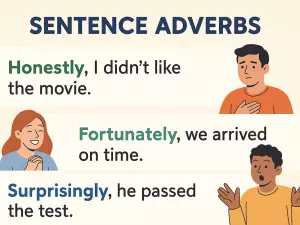
Adverb Position in English Sentences (Theoretical Rules)

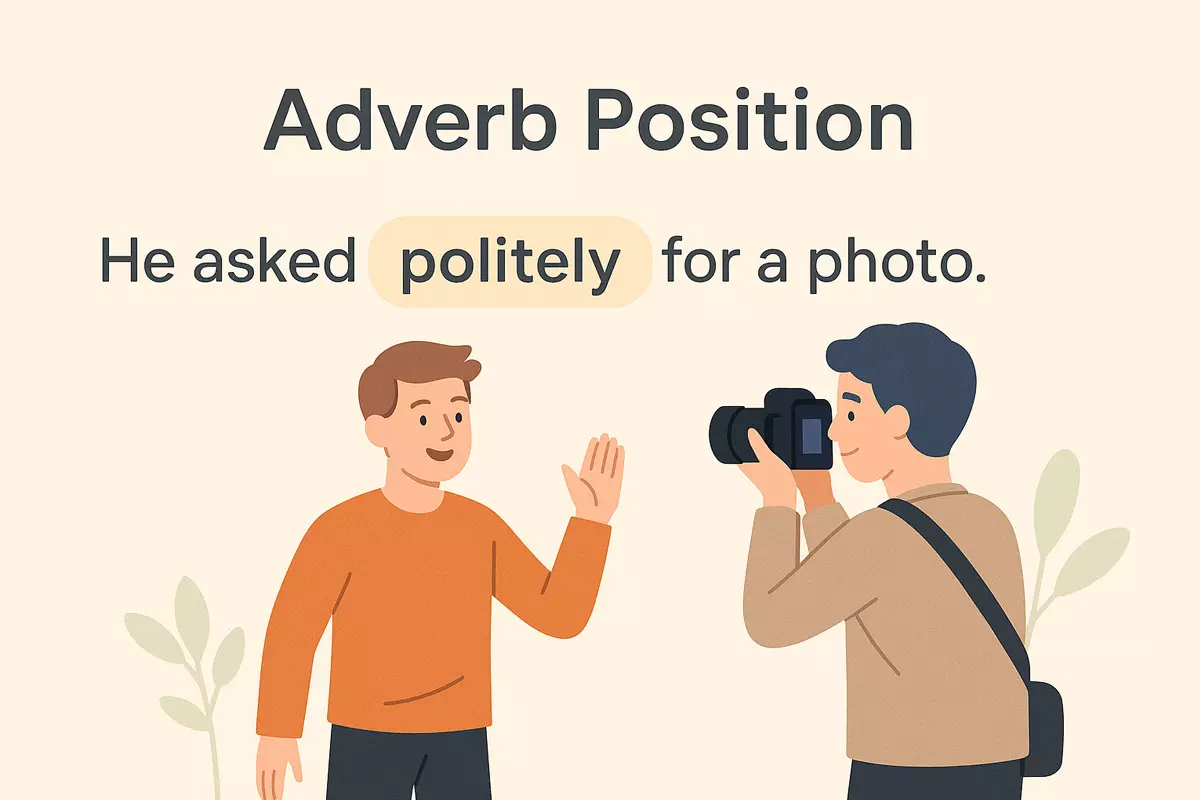 The article explains how to place adverbs at the front, mid, and end of sentences, discusses special cases and verb pattern rules, gives examples, and offers a quick practice section to help you master adverb placement.
Knowing where to place modifiers such as quickly or always in a sentence can be challenging for both English learners and native speakers. Correct placement is important because it ensures that sentences are clear and easy to understand. By learning the general rules for modifier placement, you can make your writing more effective and avoid confusion. For example, adverbs that modify verbs usually come before or after the main verb, while those modifying adjectives or other adverbs are placed directly before the word they describe.
Front Position
Placing adverbs at the beginning of a sentence is a common way to highlight information or set the context before the main clause. This placement is especially typical for linking adverbs, adverbs of time, and adverbs used for emphasis or contrast. By starting with an adverb, writers and speakers can guide the listener’s attention or clarify when, how, or why something happens.
Types of Adverbs Often Used at the Start
Different types of adverbials frequently appear at the head of a sentence. Here are some common categories and examples:
- Adverbs of time: yesterday, today, soon, recently, finally
- Adverbs of frequency: sometimes, often, rarely
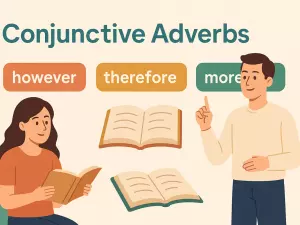
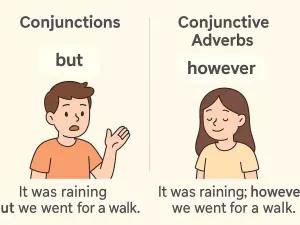
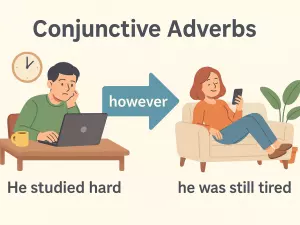
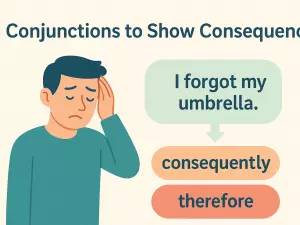
- Linking or conjunctive adverbs: however, therefore, moreover, consequently, meanwhile
- Comment or viewpoint adverbs: unfortunately, personally, honestly, surprisingly
- Adverbs of place: outside, nearby, everywhere
Functions and Effects
Starting a sentence with an adverbial element can:
- Set the scene or give background information (e.g., Last week, we visited the museum.)
- Provide a smooth transition between ideas (e.g., Moreover, the results were conclusive.)
- Add emphasis or express attitude (e.g., Frankly, I disagree.)
- Signal contrast or consequence (e.g., However, the experiment failed.)
Punctuation and Structure
When an adverb or adverbial phrase is placed at the start, it is usually followed by a comma, especially if it’s long or used for linking or contrast. Short time adverbs (like Today or Now) may omit the comma in informal contexts.
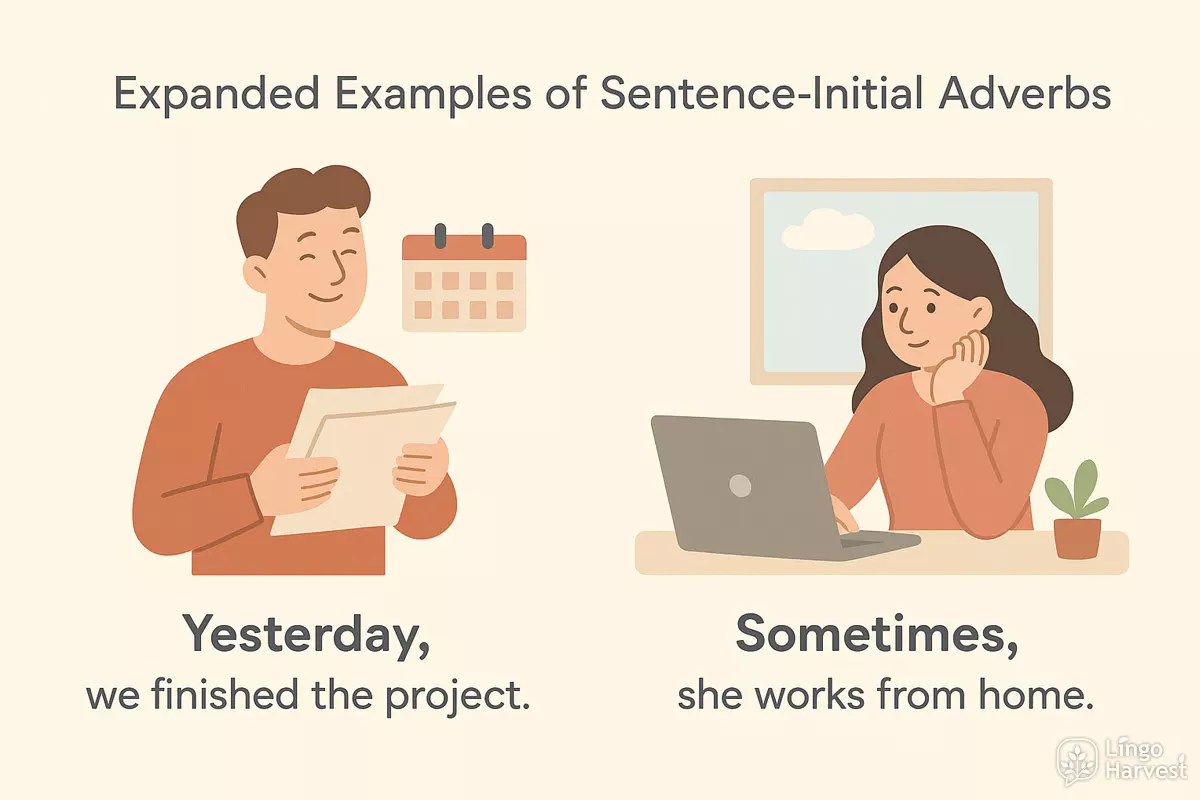
Expanded Examples of Sentence-Initial Adverbs
- Suddenly, the lights went out.
- Honestly, I didn’t expect that result.
- Yesterday, we finished the project.
- Sometimes, she works from home.
- Consequently, the plan was revised.
- Meanwhile, the children played outside.
- Recently, scientists discovered a new method.
- Occasionally, mistakes happen.
- Fortunately, nobody was injured.
- First, mix the dry ingredients.
- Outside, a storm was brewing.
- Therefore, we must reconsider our options.
- Usually, I take the bus.
- In fact, he had already left.
- Later, we discussed the results.
- Regrettably, the report was lost.
- Now, let’s look at the data.
- Next, add the eggs.
- Luckily, we found a solution.
Comparing Sentence-Initial Adverb Usage
| Purpose | Example (Sentence-Initial Adverb) |
|---|---|
| Time reference | Yesterday, I met her at the station. |
| Linking/transition | However, the answer was incorrect. |
| Emphasis (attitude) | Surprisingly, nobody objected. |
| Sequencing | Finally, we reached the summit. |
| Place (rare) | Outside, the birds were singing. |
In summary, positioning an adverb at the start of a sentence is a flexible tool to organize information, create flow, and shape meaning in English. This strategy is especially effective for transitions, time cues, and expressing the speaker’s viewpoint.
Mid Position
In English sentences, many adverbs are placed between the subject and the main verb, or immediately after auxiliary verbs such as "be," "have," or "will." This central location is especially common for adverbs of frequency, degree, and certain focusing adverbs. Placing these words in this spot helps clarify which part of the sentence the adverb modifies, often emphasizing the action or state rather than the subject or the entire clause.
Typical Placement Patterns
Adverbs like "often," "never," "just," "already," "still," "almost," and "probably" frequently appear here. With a single verb, they usually come after the subject:
- He usually walks to work.
- She never eats breakfast.
When auxiliary verbs are present, these adverbs generally follow the first auxiliary:
- They have already left.
- We will probably arrive late.
- I am still waiting.
Common Adverbs in Central Position
Here are some of the most frequently used adverbs in this location:
- always
- usually
- often
- sometimes
- rarely
- never
- almost
- already
- just
- still
- quite
- hardly
- barely
- probably
- certainly
- simply
- even
- also
Word Order with Multiple Verbs
When a verb phrase includes more than one verb (such as modal + auxiliary + main verb), the adverb is placed after the first auxiliary or modal:
- She can never remember my name.
- They have just finished.
- He will always help you.
| Sentence Structure | Example |
|---|---|
| Subject + adverb + main verb | She often visits her parents. |
| Subject + auxiliary + adverb + main verb | We have already eaten. |
| Subject + modal + adverb + main verb | He will probably call you. |
| Be verb + adverb | I am usually early. |
Notes on Usage
Some adverbs, especially those of frequency and degree, sound unnatural if placed elsewhere. However, exceptions exist for emphasis or style, particularly in literary or creative contexts. It's also important to avoid overusing these words in a single sentence, which can confuse meaning. For clarity, place only one central adverb per verb phrase when possible.
End Position
In English sentences, placing an adverb at the end is often the most natural and neutral choice, especially when describing how, when, or where something happens. This placement is common for adverbs of manner, frequency (with some limitations), time, and place. It’s a useful position when the adverb modifies the verb or the entire action, and it typically follows the object of the verb, if there is one.
Typical Adverbs Placed After the Object
Many adverbs sound most idiomatic when used after the main verb's object. Here are some common examples:
- He finished his homework quickly.
- She reads books every night.
- We met our friends at the park.
- You answered the question correctly.
- The train leaves soon.
- They will arrive tomorrow.
- He spoke quietly.
- I saw her yesterday.
- She waited patiently.
- The dog barked outside.
- We worked late.
- He travels abroad.
- She replied immediately.
- I will call you later.
- The children played together.
Order of Multiple Adverbs in Final Position
When more than one adverb is present at sentence end, there is a preferred order: manner → place → time. This order helps the sentence remain clear and natural.
| Manner | Place | Time |
|---|---|---|
| He spoke softly | in the library | yesterday |
| She worked hard | at home | last night |
| They danced beautifully | on the stage | during the festival |
| I finished quickly | in my office | this morning |
Restrictions and Preferences
While this position is common, some adverbs (like frequency adverbs: always, usually, never) typically appear before the main verb and rarely at the end, except for emphasis. Similarly, sentence adverbs (such as "fortunately" or "honestly") are more natural at the beginning or before the main verb, although they are sometimes found at the end for rhetorical effect.
Stylistic and Emphatic Uses
Placing a modifier at the conclusion of a sentence can add emphasis or contrast, especially in spoken English. For example, "He answered the question correctly," highlights the manner more than "He correctly answered the question." However, too many adverbs at the end can make a sentence feel crowded, so it's best to limit them to two or three, following the preferred order above. In summary, ending your sentences with adverbs is a flexible and widely accepted structure in English, particularly for describing how, where, or when an action occurs. This position often provides a smooth, natural flow to your statements.
Special Cases
Certain adverbs in English don’t follow the most common placement rules and require special attention. These exceptions often depend on the type of adverb, the verb tense, or the structure of the sentence.
Adverbs with Auxiliary Verbs
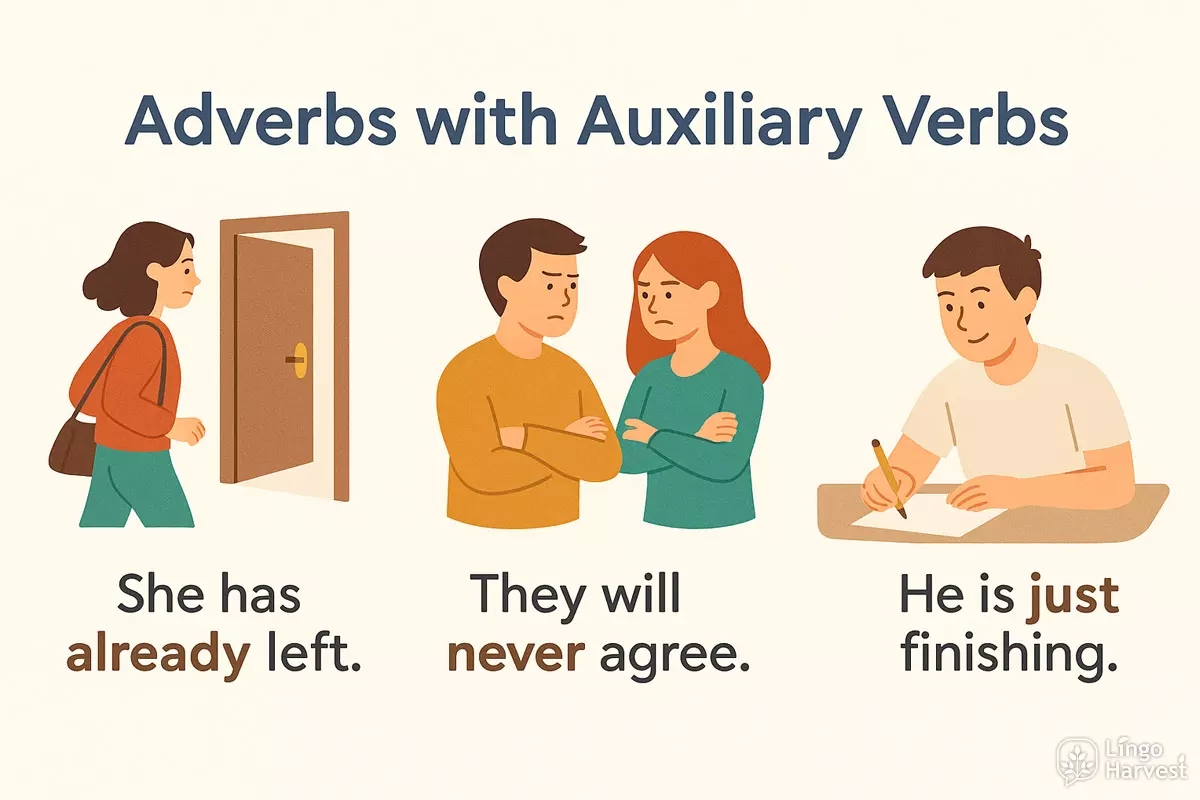
When using auxiliary verbs (such as have, be, will), the most natural position for adverbs like never, already, or just is between the auxiliary and the main verb. For example:
- She has already left.
- They will never agree.
- He is just finishing.
Negative and Limiting Adverbs at the Start
Some negative or limiting adverbs (e.g., never, rarely, only, seldom, hardly) can begin a sentence for emphasis. In such cases, subject-verb inversion occurs:
- Never have I seen such chaos.
- Seldom do we eat out.
- Only then did he understand.
Adverbs Modifying Entire Sentences
Certain adverbs (like fortunately, hopefully, surprisingly) comment on the whole statement and typically go at the beginning or sometimes the end:
- Unfortunately, the show was canceled.
- The meeting ended early, surprisingly.
Fixed Expressions and Idiomatic Usage
Some adverbial phrases have fixed positions in idioms or set expressions:
- By and large, the results were positive.
- I see him from time to time.
- She did it on purpose.
Comparing Adverb Placement with Adjective Placement
Adverbs and adjectives sometimes occupy similar positions, but their rules are not always parallel. The table below highlights some differences:
| Type | Typical Placement |
|---|---|
| Adverbs of Frequency (e.g., always) | Before main verb: She always eats breakfast. |
| Adjectives | Before noun or after linking verb: A beautiful day, The sky is blue |
| Sentence Adverbs (e.g., luckily) | Usually at the start: Luckily, it didn’t rain. |
| Adverbs of Manner (e.g., quickly) | After the verb or object: He ran quickly. |
Common Adverbs with Unique Placement Patterns
Some adverbs are notorious for their unusual positions. Here are examples worth noting:
- Still often comes before the main verb: She still lives here.
- Yet usually appears at the end: Have you finished yet?
- Even precedes the word it modifies: She even remembered my birthday.
- Too and either are typically used at the end: I like it too. I don't like it either.
- Perhaps and maybe generally start the sentence: Perhaps he knows. Maybe she’ll call.
- Much is rarely used before the verb in positive sentences: We much appreciate it ❌; We appreciate it very much ✅.
- Enough follows the word it modifies: She is old enough.
- Only is placed directly before the word or phrase it limits: Only John saw the accident. John only saw the accident.
- Already and just precede the main verb in present perfect: She has already eaten.
- Hardly and barely come before the main verb: He hardly knows her.
Attending to these nuances will help you place adverbs more naturally and avoid common mistakes in English sentence construction.
Verb Pattern Rules
Understanding how verbs interact with adverbs is essential for crafting clear English sentences. The placement of adverbs often depends on the type of verb and the structure of the clause. Certain verb patterns naturally attract adverbs to specific positions, while others allow for more flexibility. Becoming familiar with these patterns can help you avoid awkward constructions and ensure your meaning is precise.
Adverb Placement in Simple Verb Structures
In simple tenses with a single verb (like "run," "eat," or "sleep"), adverbs such as "often," "rarely," or "quickly" typically appear before the main verb, but after the subject. For example:
- She always eats breakfast.
- They rarely watch television.
However, adverbs of manner (how something is done) usually come after the object or the verb if there is no object:
- He plays piano beautifully.
- She sang loudly.
Complex Verb Structures: Auxiliary and Modal Verbs
When auxiliary verbs (like "have," "be," "do") or modal verbs ("can," "should," "will") are present, adverbs generally go between the auxiliary/modal and the main verb:
- I have never seen that movie.
- You should always check your work.
- He is usually working late.
Multiple-Verb Constructions
With more complex verb phrases, such as perfect continuous or passive forms, adverbs usually follow the first auxiliary:
- She has always been interested in art.
- The book was quickly read by the class.
Summary of Common Patterns
The following table gives an overview of typical adverb placement with different verb patterns in English sentences:
| Structure | Example (adverb in bold) |
|---|---|
| Subject + main verb | She often walks to work. |
| Subject + auxiliary/modal + main verb | They can easily solve the problem. |
| Subject + verb + object + adverb | He reads books quickly. |
| Subject + have/has + adverb + past participle | I have never tried sushi. |
| Subject + be + adverb + verb-ing | She is always talking. |
Special Considerations and Exceptions
Some adverbs, especially those of frequency (like "sometimes" and "usually"), can also appear at the beginning or end of a sentence for emphasis, though mid-position is most standard. Placement can also shift for style or to highlight certain information. For phrasal verbs, adverbs often come after the particle: "He looked up the word quickly."
Key Takeaways for Accurate Adverb Use
- Most adverbs of frequency fit before the main verb but after the verb "to be."
- Adverbs of manner are typically placed after the object or main verb.
- Multiple auxiliaries? Place the adverb after the first one.
- Sentence-initial or -final adverbs are possible for emphasis, but less common in neutral statements.
- Be cautious with split infinitives: "to quickly finish" is informal but widely accepted.
Mastering these patterns will make your English clearer and more natural, especially when expressing how, when, or how often actions occur.
Examples
Understanding where to place adverbs can make English sentences clearer and more natural. Placement often depends on the type of adverb and what it modifies. Below are sample sentences and common patterns that illustrate how different adverb types fit into statements, questions, and commands.
Typical Adverb Placements in Sentences
- She quickly finished her homework. (Adverb before the main verb)
- He has always loved music. (Adverb between auxiliary and main verb)
- They will probably arrive late. (Adverb between modal and main verb)
- Tomorrow, we are leaving for Paris. (Adverb at the beginning)
- I read the book carefully. (Adverb at the end, modifying the verb)
- We almost missed the train. (Adverb before the main verb)
- She completely forgot my birthday. (Adverb before the main verb)
- We have just eaten lunch. (Adverb between auxiliary and main verb)
- Occasionally, he visits his grandparents. (Adverb at the beginning)
- I have never seen that movie. (Adverb between auxiliary and main verb)
- He answered the question correctly. (Adverb at the end, after the object)
- Usually, I walk to work. (Frequency adverb at the beginning)
- She only drinks coffee in the morning. (Adverb before the verb it modifies)
- He rarely complains about anything. (Frequency adverb before the main verb)
- They are definitely coming to the party. (Adverb between auxiliary and main verb)
- He spoke softly to the baby. (Manner adverb at the end)
- I will see you later. (Time adverb at the end)
- Suddenly, the lights went out. (Sentence adverb at the beginning)
- She sometimes forgets her keys. (Frequency adverb before the main verb)
- We almost finished the project. (Degree adverb before the main verb)
Comparison of Adverb Positions
| Sentence Position | Sample Sentence |
|---|---|
| Initial (start of sentence) | Hopefully, the weather will improve. |
| Mid (before main verb/after auxiliary) | She has already left. |
| End (after verb or object) | He finished the exam quickly. |
| Before infinitive | I want to really understand this topic. |
Quick Practice
Understanding where adverbs fit in English sentences is key to expressing meaning clearly. Try these exercises and study the examples to check your grasp of adverb placement rules.
Identify the Correct Position
For each sentence below, choose the best place for the adverb (in parentheses):
- She (quickly) finished her homework.
- They (never) eat meat.
- He has (already) left for work.
- We will (probably) see you at the party.
- The train (always) arrives on time.
Show answers
- She quickly finished her homework.
- They never eat meat.
- He has already left for work.
- We will probably see you at the party.
- The train always arrives on time.
Practice: Find the Error
Spot and correct the misplaced adverb in each sentence:
- He eats breakfast usually at 7 a.m.
- I have seen never such a beautiful painting.
- We all must finish quietly the exam.
- She speaks English fluently always.
Show answers
- He usually eats breakfast at 7 a.m.
- I have never seen such a beautiful painting.
- We must all finish the exam quietly.
- She always speaks English fluently.
Common Adverb Types & Positions
Review these sample sentences showing typical placement for different adverb types:
| Adverb Type | Example Sentence |
|---|---|
| Manner (how?) | He sang beautifully. |
| Frequency (how often?) | She always drinks coffee in the morning. |
| Time (when?) | I will call you tomorrow. |
| Degree (how much?) | It was extremely cold yesterday. |
| Place (where?) | The children are playing outside. |
Challenge: Create Your Own Sentences
Write sentences using the following adverbs. Try different positions, but keep the sentences natural:
- rarely
- gently
- almost
- here
- completely
- yesterday
- soon
- nearly
- upstairs
- carefully
Show answers
- I rarely watch television.
- She spoke gently to the child.
- I almost missed the bus.
- Your shoes are here.
- The project is completely finished.
- We met yesterday.
- The package will arrive soon.
- He nearly fell.
- The cat is sleeping upstairs.
- Please read the instructions carefully.