Morphology of Adverbs: -ly and Non-ly Forms

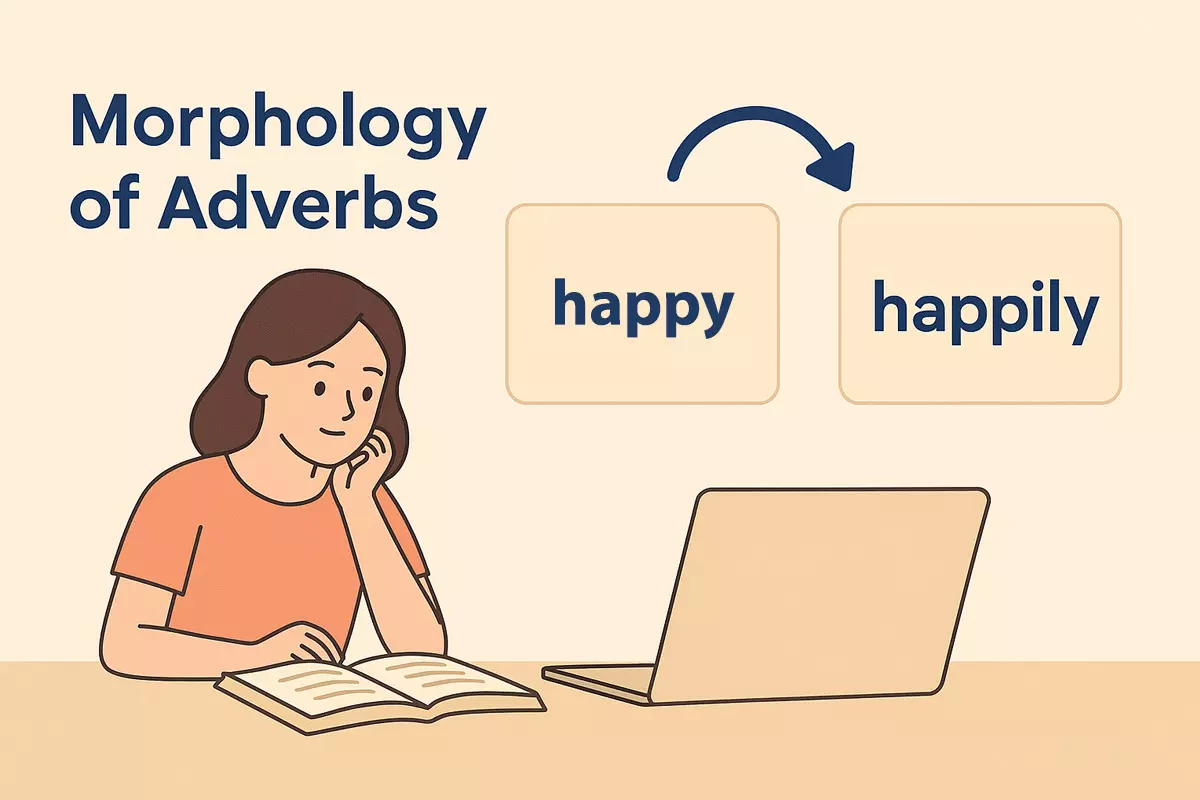 Here we how to form adverbs in English, both with and without -ly, important spelling rules, and meaning differences. It also provides common examples, highlights beginner mistakes, and offers short practice exercises.
Are you interested in how words such as quickly and fast describe actions? Exploring the formation of adverbs, including those with common endings and those that do not follow typical patterns, offers valuable insights into the adaptability and richness of English grammar. This area of study highlights the ways in which the language allows for creative expression, demonstrating that even small changes in word forms can significantly impact meaning and clarity in communication.
-ly Formation Basics
Adverbs in English often develop from adjectives by adding the suffix -ly. This process is one of the most productive ways to form adverbs, allowing speakers to modify verbs, adjectives, or even other adverbs with precision. The transformation typically involves attaching -ly to the base adjective, but there are several patterns and exceptions that learners should be aware of.
Standard Formation Patterns
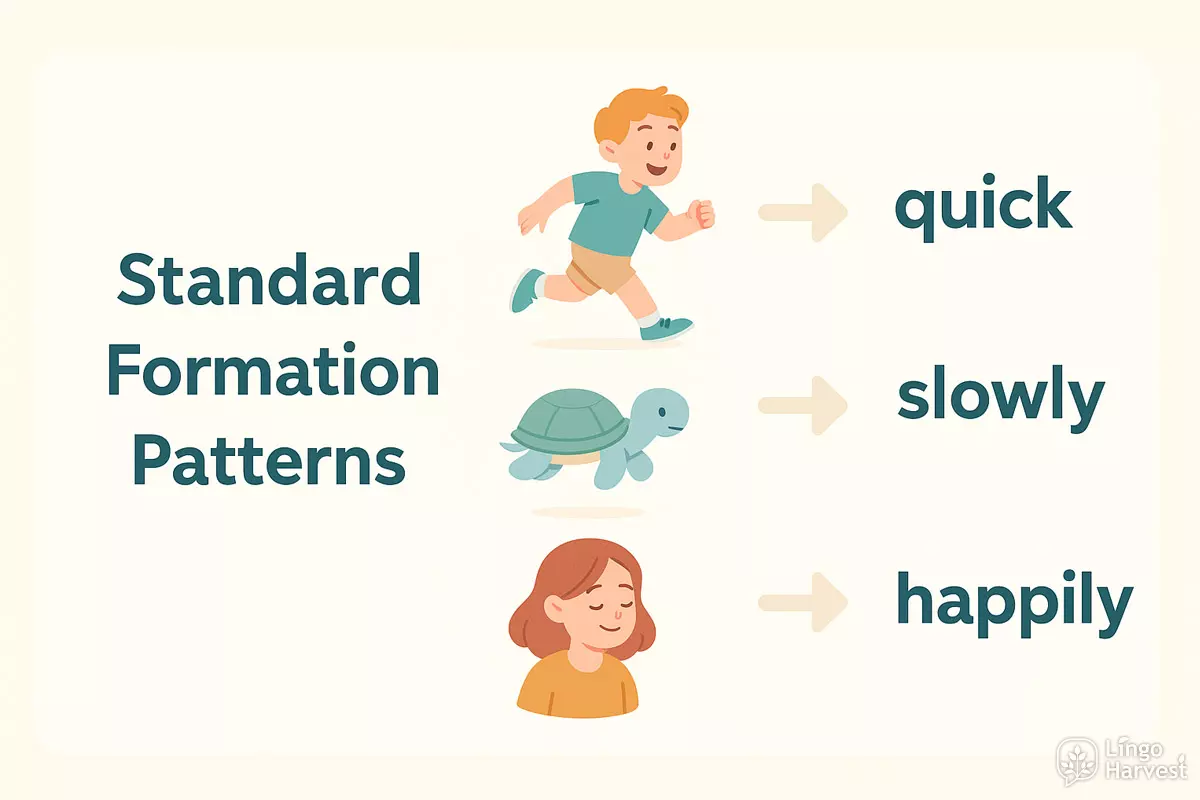
Most adjectives simply take -ly without much change:
- quick → quickly
- slow → slowly
- happy → happily
- careful → carefully
- quiet → quietly
- hopeful → hopefully
- sad → sadly
- real → really
- final → finally
- exact → exactly
- patient → patiently
- fortunate → fortunately
- usual → usually
- immediate → immediately
- safe → safely
- brief → briefly
- careless → carelessly
- serious → seriously
- nervous → nervously
- polite → politely
Spelling Adjustments
Some adjectives require small changes before adding -ly:
- If the adjective ends in -y, change y to i: happy → happily
- Adjectives ending in -le often replace -le with -ly: simple → simply, gentle → gently
- For adjectives ending in -ic, add -ally instead: basic → basically, automatic → automatically
Common Exceptions
Not every word follows the standard formation. Some adjectives have irregular adverb forms or do not use -ly at all. For example:
- good → well (not "goodly")
- fast → fast (no change)
- hard → hard (not "hardly" in the sense of "with effort")
- late → late (not "lately" for time of arrival)
Overview of -ly Derivation
The table below organizes adjectives and their typical adverbial forms, highlighting typical patterns and notable exceptions.
| Adjective | Adverb Form | Notes |
|---|---|---|
| quick | quickly | Standard addition of -ly |
| happy | happily | Change y to i |
| simple | simply | Drop -le, add -ly |
| automatic | automatically | Add -ally |
| good | well | Irregular |
| fast | fast | No change |
| hard | hard | No change for meaning "with effort" |
| careful | carefully | Standard |
| rare | rarely | Standard |
| real | really | Standard |
Summary
Understanding how -ly adverbs are formed helps in both writing and comprehension. While most cases follow predictable patterns, paying attention to exceptions and spelling changes is key for accuracy.
Non-ly Adverbs
Many English adverbs do not end with the familiar “-ly” suffix. These words often share their form with adjectives, which can make them tricky to spot. They typically modify verbs, adjectives, or other adverbs, providing information about manner, time, frequency, place, or degree—just like their "-ly" counterparts.
Common Types and Examples
Some adverbs without "-ly" are among the most frequently used in English. They often answer questions such as “when?”, “how often?”, or “where?”. Here are several examples that illustrate their variety:
| Category | Examples |
|---|---|
| Adverbs of Manner | fast, hard, late, early, well, straight, right, wrong, tight, deep, high |
| Adverbs of Time | now, then, today, yesterday, tomorrow, soon |
| Adverbs of Frequency | always, often, sometimes, never, seldom |
| Adverbs of Place | here, there, inside, outside, abroad, upstairs, downstairs |
| Adverbs of Degree | quite, very, too, almost, just, still, rather, pretty |
| Directional / Movement Adverbs | back, forward, downward, upward, away |
Adjective vs. Adverb: Identical Forms
A unique feature of many such adverbs is that their spelling is indistinguishable from adjectives. For example, "fast" describes both a quick runner ("He is a fast runner" – adjective) and how someone runs ("He runs fast" – adverb). Context is essential for telling them apart.
| Word | As Adjective | As Adverb |
|---|---|---|
| fast | A fast car | She runs fast |
| hard | A hard surface | He works hard |
| late | A late train | He arrived late |
| early | An early start | We woke up early |
| straight | A straight line | Go straight ahead |
Irregular Forms and Exceptions
Some adverbs not only lack "-ly" but also have irregular forms. For instance, "good" is the adjective, while "well" is the adverb (e.g., "She sings well"). These exceptions are important to learn, as using the adjective form as an adverb can lead to errors.
Usage and Placement
These adverbs can appear in various positions within a sentence, depending on their function. For example, frequency adverbs like "often" or "never" usually come before the main verb (“He often visits”), while manner adverbs like "fast" or "hard" typically follow the verb (“She works hard”). In summary, adverbs without "-ly" are an essential and diverse part of English morphology. Recognizing their forms and uses helps avoid common mistakes and enriches both written and spoken expression.
Spelling Rules
Forming adverbs in English often means attaching -ly to an adjective, but the process comes with some spelling patterns and exceptions worth noting. Understanding these patterns helps avoid common mistakes and makes writing clearer.
Typical -ly Formation
Most adjectives simply add -ly to create the adverb:
- quick → quickly
- happy → happily
- careful → carefully
- loud → loudly
- slow → slowly
- rare → rarely
- real → really
- usual → usually
- final → finally
- bad → badly
These are direct and rarely cause trouble.
Special Endings and Changes
Some adjectives require a spelling adjustment before adding -ly:
- Adjectives ending in -y: change y to i
(easy → easily, angry → angrily) - Words ending in -le: drop the e
(simple → simply, gentle → gently) - Adjectives ending in -ic: add -ally
(basic → basically, tragic → tragically) - Adjectives ending in -ll: just add -y
(full → fully, dull → dully)
Irregular and Non-ly Forms
Not all adverbs end in -ly. Some retain the same form as the adjective, while others are entirely irregular:
- fast (adjective and adverb)
- hard (adjective and adverb)
- late (adjective and adverb)
- straight (adjective and adverb)
- well (adverb form of "good")
- early (adjective and adverb)
- high (adjective and adverb)
- far (adjective and adverb)
- long (adjective and adverb)
- low (adjective and adverb)
Common Confusions: Adjective vs. Adverb
Some words look similar but serve different roles. Compare these pairs:
| Adjective | Adverb |
|---|---|
| good | well |
| hard | hard |
| late | late |
| fast | fast |
| easy | easily |
| careful | carefully |
| real | really |
| full | fully |
Special Cases and Exceptions
A handful of adverbs have unique forms or are exceptions to the typical patterns. For example, "public" becomes "publicly" (not "publically"), and "true" becomes "truly" (not "truely"). Watch out for these less predictable forms. In summary, while most adverbs follow straightforward patterns, several variations and exceptions exist, especially among non-ly adverbs and adjectives with special endings. Being aware of these helps ensure accuracy in both spelling and usage.
Meaning Differences
Adverbs in English often appear in both -ly and non-ly forms, but these variations can signal subtle or even significant shifts in meaning. Sometimes, the -ly version is simply the adverbial form of an adjective, but in other cases, each form has a distinct nuance or usage. Understanding these contrasts can clarify both spoken and written communication.
Shifts in Emphasis or Focus
Some pairs differ in what they modify or the nuance they convey. For example, "hard" and "hardly" are not interchangeable: "hard" means with effort, while "hardly" means barely or almost not. Similarly, "late" (after the expected time) and "lately" (recently) have clear functional differences.
- Hard (with effort) vs. Hardly (barely)
- Near (close by) vs. Nearly (almost)
- Late (not on time) vs. Lately (recently)
- Right (directly, exactly) vs. Rightly (justifiably)
- Short (suddenly) vs. Shortly (soon)
- Direct (without stopping) vs. Directly (immediately)
- Pretty (rather) vs. Prettily (in a pretty manner)
- Wide (fully open) vs. Widely (to a great extent)
- Free (without cost/restraint) vs. Freely (without restriction)
- High (at a great height) vs. Highly (very, extremely)
- Sharp (exactly, suddenly) vs. Sharply (in a sharp manner)
- Clean (completely) vs. Cleanly (in a clean way)
- Deep (a long way down) vs. Deeply (profoundly)
- Loud (with high volume, informal) vs. Loudly (in a loud manner)
- Wrong (incorrectly, informal) vs. Wrongly (in an unjust manner)
- Close (near in space) vs. Closely (with attention or detail)
Table of Common Non-ly and -ly Adverb Pairs
| Non-ly Form | -ly Form | Typical Meaning/Usage |
|---|---|---|
| Hard | Hardly | With great effort → Barely, almost not |
| Late | Lately | After the expected time → Recently |
| Near | Nearly | Close by → Almost |
| Short | Shortly | Suddenly, abruptly → Soon, in a short time |
| Wide | Widely | Fully open → To a great extent |
| High | Highly | At a great height → Very, extremely |
| Deep | Deeply | A long way down → Profoundly |
| Free | Freely | Without cost → Without restriction |
| Right | Rightly | Exactly, directly → Justifiably, correctly |
| Close | Closely | Near in space → With attention/detail |
Stylistic and Register Considerations
Sometimes, the choice between forms is about tone or formality. For example, "quick" as an adverb is rare and informal; "quickly" is standard. "Wrong" as an adverb is used in casual speech ("You did it wrong"), while "wrongly" appears in more formal writing.
Summary
Choosing between -ly and non-ly adverbs is rarely arbitrary. Each form can carry unique shades of meaning or fit different contexts. When in doubt, check the specific pair, as the distinction can affect clarity and nuance in your communication.
Common Examples
Many English adverbs are formed by attaching -ly to adjectives, but there are also plenty of adverbs that do not follow this pattern. Recognizing both types helps with understanding and using them correctly in sentences.
-ly Adverbs
Most frequently, adverbs are created by adding -ly to the base form of an adjective. Here are some familiar words that demonstrate this pattern:
- quickly
- happily
- loudly
- sadly
- carefully
- easily
- slowly
- angrily
- softly
- neatly
- politely
- brightly
These forms are usually straightforward: add -ly to the adjective, sometimes making minor spelling changes (such as "happy" → "happily").
Comparing -ly and Non-ly Forms
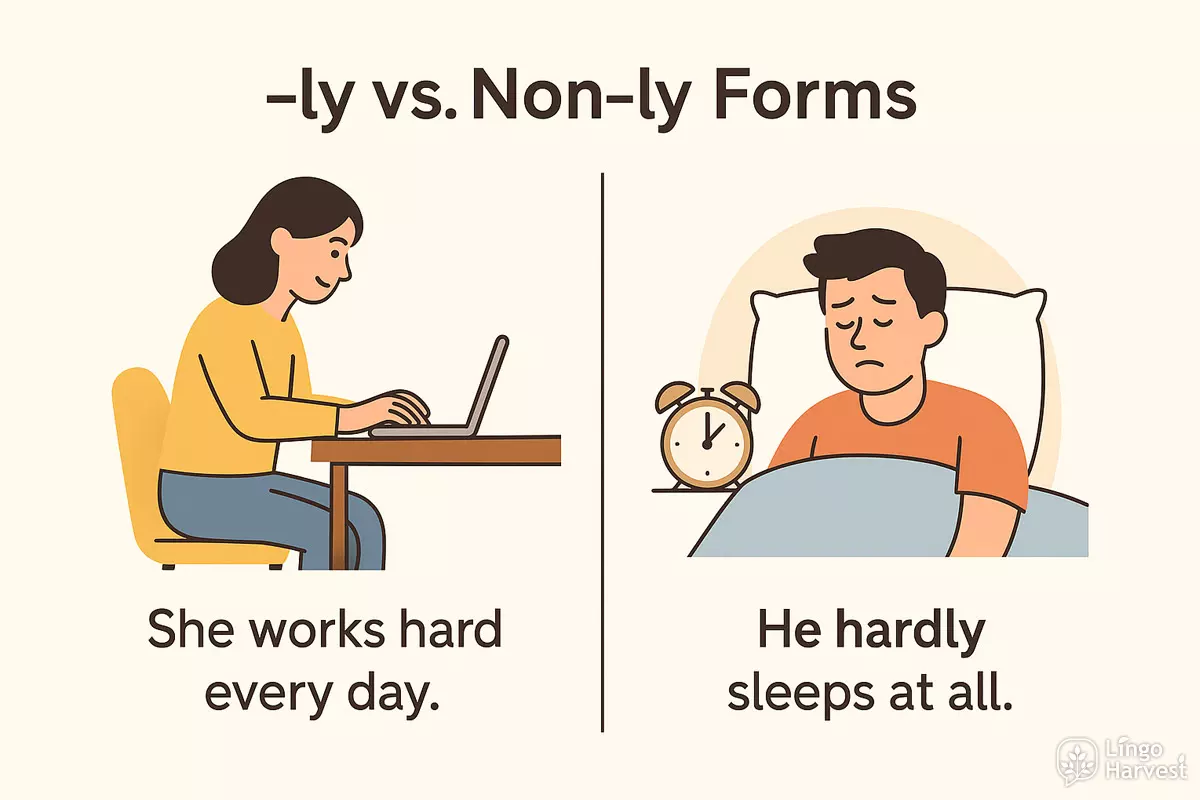
Sometimes, both forms exist but mean different things. For example, "hard" and "hardly" or "late" and "lately" are not interchangeable. The following table highlights some pairs that can cause confusion:
| Form | Meaning & Example |
|---|---|
| hard | With effort: "She works hard every day." |
| hardly | Almost not: "He hardly sleeps at all." |
| late | After the expected time: "They arrived late." |
| lately | Recently: "Have you seen him lately?" |
| near | Close by: "She sat near." |
| nearly | Almost: "We nearly missed the train." |
These distinctions illustrate why it’s important to pay attention to both the form and the context when using adverbs in English.
Beginner Mistakes
Many learners confuse adverbs with adjectives, especially when dealing with words ending in -ly or those that do not follow the typical pattern. This confusion often leads to errors in sentence construction and word choice, especially in writing.
Confusing Adjectives and Adverbs
A common slip is using adjectives in place of adverbs, or vice versa. This usually happens because both can be formed from the same root word, but their functions differ:
- Incorrect: She sings beautiful. ❌ (Adjective used instead of adverb)
- Correct: She sings beautifully. ✅
- Incorrect: He runs quick. ❌
- Correct: He runs quickly. ✅
Forgetting Irregular or Non-ly Adverbs
Not all adverbs end in -ly. Some words keep the same form as their adjective or have unique adverb forms. This can trip up learners who expect every adverb to follow the standard rule. For example:
- fast (not "fastly")
- hard (not "hardly" when meaning "with effort")
- late (not "lately" for "not on time")
- early
- well (from "good")
- far
- high
- straight
- long
- wrong
Misusing -ly Words That Aren’t Adverbs
Some words ending in -ly are not adverbs but adjectives. Beginners can easily misuse these, leading to unclear or incorrect sentences. Examples include:
- friendly
- lovely
- lonely
- elderly
- costly
These are adjectives, not adverbs, so they don’t modify verbs.
Comparing Regular and Irregular Adverb Forms
To further illustrate, here's a comparison of regular and irregular adverb forms that often lead to mistakes:
| Adjective | Correct Adverb | Incorrect Form |
|---|---|---|
| quick | quickly | quick |
| good | well | goodly |
| hard | hard | hardly |
| late | late | lately |
| fast | fast | fastly |
Overgeneralizing the -ly Rule
Assuming every adverb must end in -ly is a frequent pitfall. English contains many exceptions, so it’s important to check a dictionary if unsure. Relying solely on the pattern can create words that don’t exist or misuse existing words. By being aware of these patterns and exceptions, learners can avoid the most typical traps in forming and using adverbs.
Short Practice
Understanding how adverbs are formed and used is essential for clear communication. In English, some adverbs are created by adding -ly to adjectives, while others do not follow this pattern. To reinforce this, try the following tasks that encourage you to identify, form, and use both types of adverbial forms.
Identify the Adverb Type
Read the following sentences. For each, decide whether the adverb is a regular -ly form or a non--ly form.
- He ran quickly to catch the bus.
- She sings well.
- The child spoke softly.
- They arrived late.
- He drives fast.
Show answers
- quickly – -ly adverb
- well – non--ly adverb
- softly – -ly adverb
- late – non--ly adverb
- fast – non--ly adverb
Form Adverbs from Adjectives
Transform the following adjectives into their adverbial forms. Some adjectives will require adding -ly, while others stay the same or change irregularly.
- happy
- good
- hard
- careful
- late
- easy
- fast
- angry
- early
- loud
Show answers
- happy → happily
- good → well
- hard → hard
- careful → carefully
- late → late
- easy → easily
- fast → fast
- angry → angrily
- early → early
- loud → loudly
Compare -ly and Non-ly Adverbs
The table below contrasts some common adverbs that either take the -ly ending or remain unchanged. Observe the differences and note any irregular forms.
Compare -ly and Non-ly Adverbs
The table below contrasts common English adjectives with their adverb forms. Some adverbs take the -ly ending, while others remain unchanged or have irregular meanings.
| Adjective | Adverb (-ly form) | Adverb (non-ly / irregular) |
|---|---|---|
| quick | quickly | — |
| good | — | well |
| hard | hardly (different meaning) | hard |
| late | lately (different meaning) | late |
| easy | easily | — |
| fast | — | fast |
| early | — | early |
| careful | carefully | — |
| angry | angrily | — |
| loud | loudly | loud (informal) |
| high | highly (different meaning) | high (manner) |
| near | nearly (meaning: “almost”) | near |
| deep | deeply (emotional/figurative) | deep (manner) |
| close | closely (figurative) | close (physical proximity) |
| free | freely | free (meaning: “without restriction”) |
| right | rightly (formal; meaning: “justifiably”) | right (manner: “correctly”) |
| wrong | wrongly (formal) | wrong (informal) |
| sure | surely | sure (informal adverb: “certainly”) |
| tight | tightly | tight |
| clean | cleanly | clean (informal/manner) |
Short Writing Task
Write three sentences using at least one -ly adverb and one non--ly adverb in each sentence. Try to use different words from the lists above.
Show answers
- She answered the question easily and finished early.
- He spoke loudly but finished late.
- The dog barked angrily and ran fast.