Adverbs Modifying Adjectives and Other Adverbs

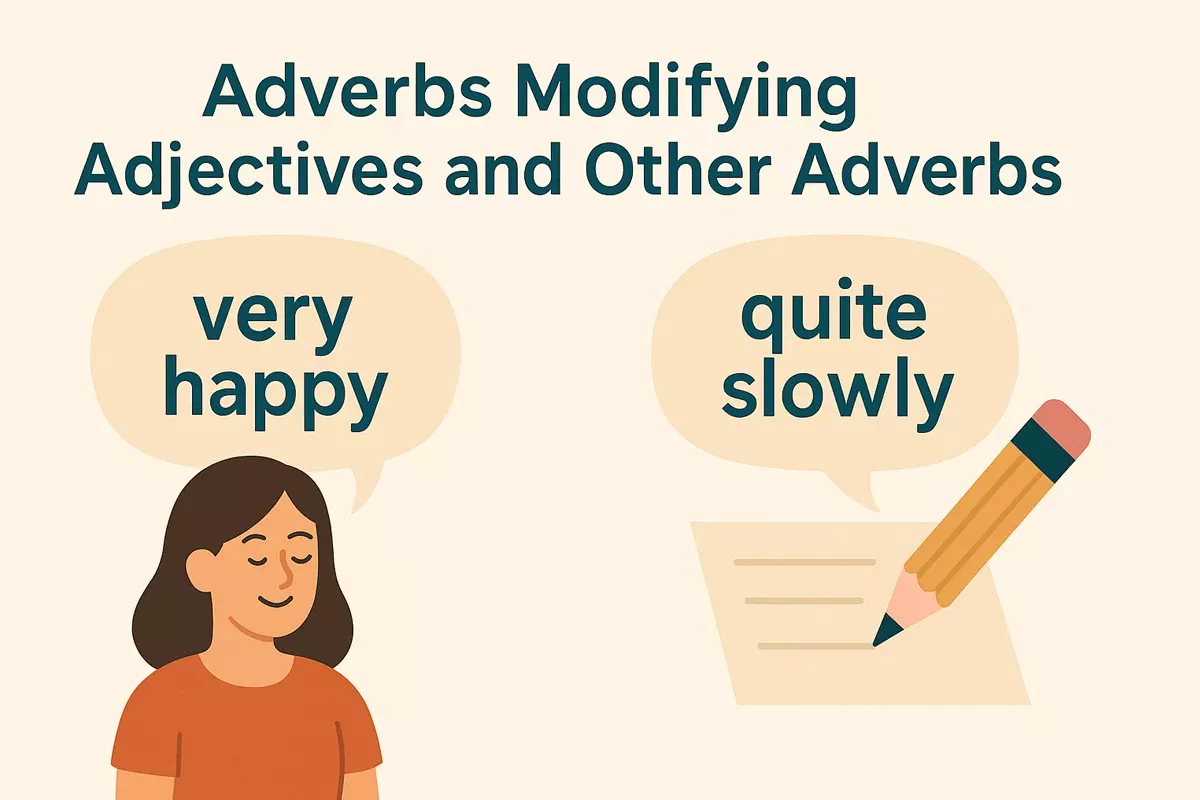 Here we how adverbs are used before adjectives and other adverbs, lists common intensifiers with their strength levels, gives real examples, points out typical errors, and includes practice sentences for better understanding.
Modifiers play a key role in enriching our language by allowing us to adjust the strength and detail of what we say. Words like very, quite, or extremely can intensify adjectives and adverbs, providing nuance and precision to our descriptions. By carefully choosing modifiers, we can convey subtle distinctions in meaning, making our communication more vivid and expressive. Understanding how these words function helps us use English more effectively, whether we are writing or speaking, and adds depth to our everyday conversations.
Adverbs Before Adjectives
Placing an adverb right before an adjective is a common way to show the intensity, degree, or manner of the adjective's meaning. This structure helps to clarify or modify the adjective, making the description more precise or expressive. For example, saying "incredibly fast" emphasizes the speed much more than just "fast."
Common Adverbs Used with Adjectives
Some adverbs are frequently paired with adjectives to express varying degrees. Here are some widely used options:
- Very (very happy)
- Extremely (extremely cold)
- Quite (quite difficult)
- Fairly (fairly easy)
- Too (too expensive)
- Really (really interesting)
- So (so tired)
- Rather (rather unusual)
- Absolutely (absolutely certain)
- Almost (almost ready)
- Totally (totally different)
- Completely (completely silent)
- Pretty (pretty good)
- Nearly (nearly impossible)
- Just (just right)
- Somewhat (somewhat unclear)
- Perfectly (perfectly normal)
- Entirely (entirely false)
How Adverbs Alter Meaning
Adding an adverb before an adjective can subtly or dramatically change the meaning. For instance, "slightly annoyed" suggests a mild irritation, while "deeply annoyed" implies a much stronger feeling. The choice of adverb allows speakers to communicate feelings and descriptions more accurately.
| Adverb + Adjective | Meaning / Effect |
|---|---|
| Completely wrong | Totally incorrect, no doubt |
| Quite helpful | Moderately or very useful |
| Absolutely necessary | Essential, no exceptions |
| Rather strange | Somewhat unusual, but not extreme |
| Nearly impossible | Very difficult, but not totally |
| Just perfect | Exactly right, nothing lacking |
Placement Rules and Tips
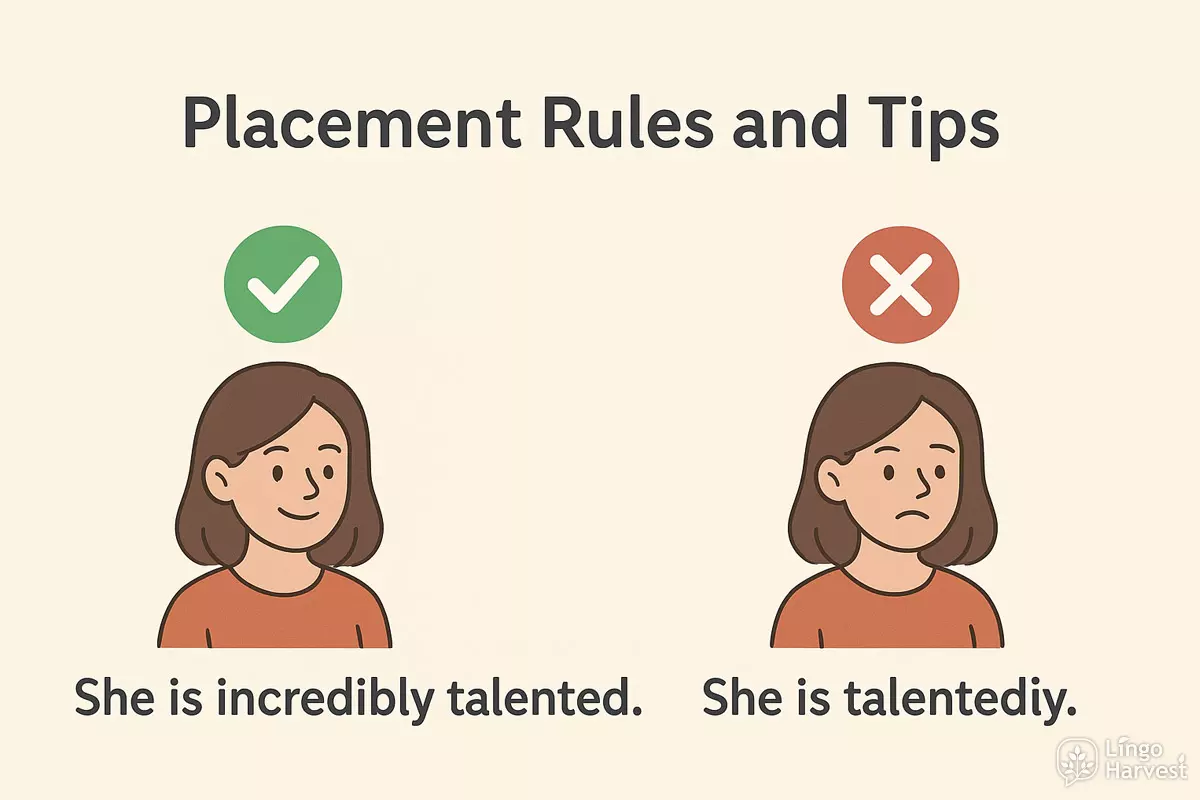
The modifying word typically comes directly before the adjective it describes. Avoid placing adverbs that modify adjectives elsewhere in the sentence, as this can cause confusion or awkward phrasing. For example:
- ✅ She is incredibly talented.
- ❌ She is talented incredibly.
Many adverbs—especially those of degree—are almost exclusively used in this position. Practice and exposure help you develop a natural sense for which adverbs sound right before adjectives.
Adverbs Before Adverbs
Placing one adverb in front of another is a common way to add nuance or intensity to a description. In English, this stacking usually involves a degree adverb (like "very" or "quite") modifying another adverb, which in turn modifies a verb, adjective, or even another adverb. This layering helps speakers express subtle differences in manner, frequency, or intensity.
How Stacking Works
Degree adverbs—such as "extremely," "rather," "almost," and "too"—often come before another adverb to modify its strength or meaning. For example, in the phrase "very quickly," "very" enhances the adverb "quickly," showing a higher speed. This pattern is common in both spoken and written English.
- He responded incredibly politely to the criticism.
- The dog barked quite loudly at the stranger.
- She finished the race almost effortlessly.
- They worked really well together.
- The child spoke surprisingly clearly for her age.
- He answered too abruptly for my taste.
- You can type far faster than I can.
- The team reacted somewhat nervously to the news.
- She completed the puzzle fairly easily.
- He drives exceedingly carefully in bad weather.
- The bird sang unusually sweetly this morning.
- She dances almost perfectly every time.
- He apologized rather awkwardly.
- The train arrived just barely on time.
- She completed the assignment so quickly!
- The cat moved exceptionally quietly.
- He answered remarkably confidently.
- The audience laughed especially loudly.
Common Patterns and Placement
The first adverb (the modifier) typically comes directly before the main adverb. Not all adverbs can modify others: degree adverbs are the most frequent modifiers in this position. Frequency and manner adverbs rarely stack in this way.
| Degree Adverb (Modifier) | Adverb Being Modified |
|---|---|
| very | quickly |
| almost | always |
| incredibly | carefully |
| quite | easily |
| really | well |
| too | abruptly |
| rather | awkwardly |
| so | quickly |
Usage Tips
- Not every adverb pair sounds natural; some combinations are awkward or ungrammatical (❌ "very yesterday"). - Degree adverbs are safest for modifying other adverbs (✅ "extremely well"). - Overuse of stacked adverbs can make writing wordy or unclear—use them for emphasis or precision. Stacking adverbs can add precision, but it’s important to select combinations that flow naturally and clearly for your audience.
Common Intensifiers
When describing how adverbs strengthen or modify adjectives and other adverbs, certain words appear frequently in English. These words help speakers express degrees of strength, emotion, or emphasis. By placing these intensifying adverbs before adjectives or other adverbs, we can make descriptions much more vivid or precise.
Typical Words That Add Emphasis
Some adverbs are especially popular for heightening the meaning of another word. For example, in "incredibly easy" or "extremely well," the adverbs "incredibly" and "extremely" sharpen the impact of the adjective or adverb that follows. Here are several widely used intensifiers:
- very
- really
- so
- too
- absolutely
- completely
- totally
- utterly
- highly
- deeply
- particularly
- quite
- fairly
- pretty
- extremely
- incredibly
- remarkably
- especially
- awfully
- somewhat
These words are often placed directly before the adjective or adverb they modify: "absolutely certain," "pretty fast," or "especially difficult." Their exact effect depends on context and the word they intensify.
Usage Patterns and Nuances
Some of these adverbs can only be used with gradable adjectives (e.g., "very happy"), while others pair better with non-gradable adjectives (e.g., "absolutely impossible" ✅, not "very impossible" ❌). "Highly," "utterly," and "completely" often emphasize adjectives that do not have degrees, such as "unique" or "perfect." By contrast, "quite" and "fairly" typically soften rather than strengthen.
| Intensifier | Example Usage |
|---|---|
| very | very cold, very quickly |
| absolutely | absolutely sure, absolutely silent |
| quite | quite interesting, quite early |
| incredibly | incredibly fast, incredibly small |
| utterly | utterly exhausted, utterly ridiculous |
| pretty | pretty good, pretty late |
| too | too difficult, too soon |
| remarkably | remarkably talented, remarkably simple |
Practical Considerations
Choosing the right intensifying adverb depends on both the adjective/adverb being modified and the speaker’s intent. For strong, non-gradable adjectives, words like "completely" or "utterly" are preferred. For more moderate emphasis, "fairly" or "quite" are suitable. These intensifiers are essential for adding nuance and clarity to both spoken and written English.
Strength Levels
Understanding how adverbs intensify or weaken the meaning of adjectives and other adverbs helps make your language more precise. Some adverbs amplify the intensity, while others reduce it. These modifiers can be subtle but have a significant effect on the overall tone and clarity of a sentence.
Common Intensifiers and Diminishers
When describing qualities, speakers often use specific adverbs to show varying degrees of emphasis. Here are some frequent choices, ranging from strong to mild:
- Extremely (e.g., extremely cold)
- Incredibly (e.g., incredibly fast)
- Totally (e.g., totally wrong)
- Absolutely (e.g., absolutely certain)
- Very (e.g., very tall)
- Quite (e.g., quite helpful)
- Fairly (e.g., fairly easy)
- Somewhat (e.g., somewhat tired)
- Rather (e.g., rather unusual)
- Just (e.g., just enough)
- Almost (e.g., almost ready)
- Nearly (e.g., nearly impossible)
- Hardly (e.g., hardly visible)
- Barely (e.g., barely awake)
- Slightly (e.g., slightly better)
Comparing Degrees of Modification
To illustrate differences in effect, here’s a table showing how various adverbial modifiers adjust the strength of adjectives and other adverbs:
| Adverb | Example Phrase |
|---|---|
| Absolutely | absolutely sure |
| Very | very interesting |
| Fairly | fairly simple |
| Slightly | slightly annoyed |
| Hardly | hardly visible |
| Completely | completely silent |
| Rather | rather late |
| Almost | almost full |
Patterns to Notice
Different types of adverbs can modify the strength or weakness of an adjective or adverb. Here are the main groups:
- Strong intensifiers – words like absolutely, completely, totally are used with extreme adjectives (e.g., “absolutely impossible”).
- Softer degree adverbs – words such as slightly, fairly, somewhat show a moderate or minor degree (e.g., “slightly cold,” “fairly easy”).
- Limiting or minimising adverbs – words like hardly, barely, scarcely indicate almost zero degree (e.g., “hardly visible”).
Understanding these differences helps you choose modifiers that precisely match the intensity or subtlety you want to express.
Real Examples
When adverbs interact with adjectives or even with other adverbs, they often change the intensity, degree, or nuance of meaning in a sentence. Seeing how this works in practice can clarify the patterns and help you use these modifiers confidently.
How Adverbs Modify Adjectives
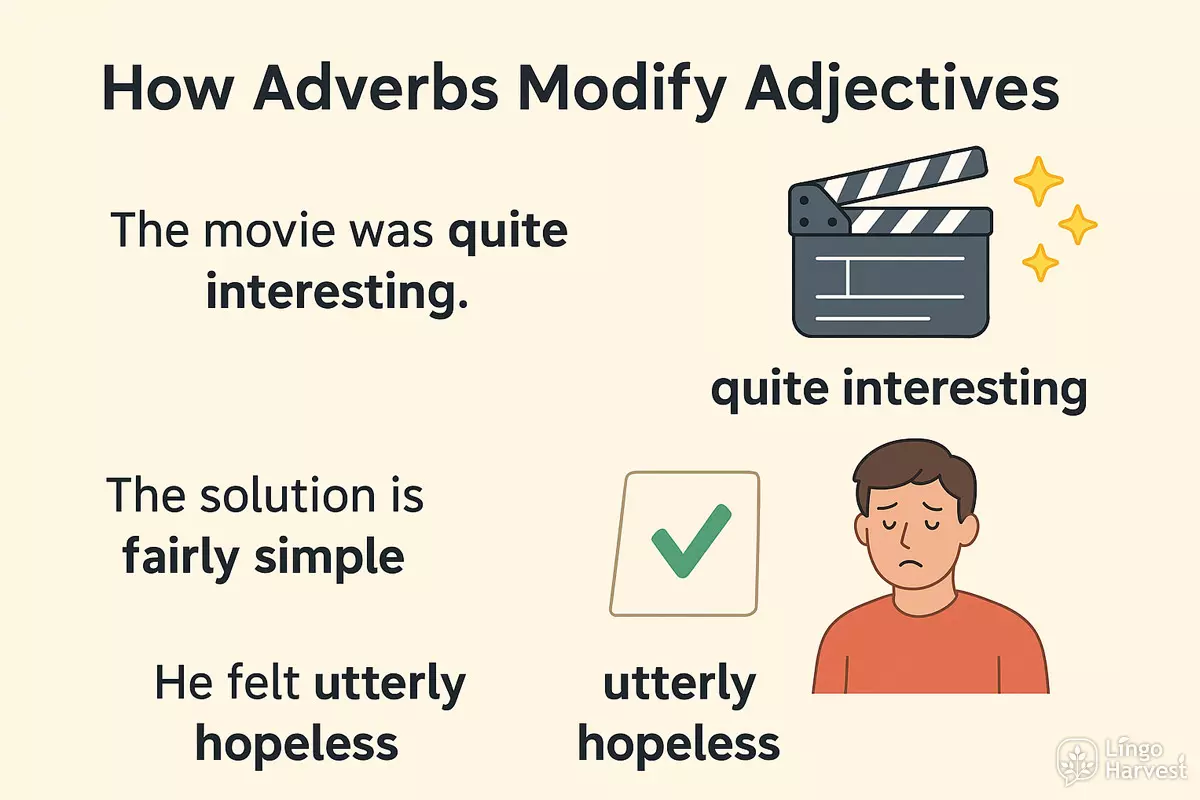
Adverbs commonly appear before adjectives to change their strength or degree. Here are several everyday instances:
- She is extremely talented.
- This coffee is incredibly hot.
- It was a remarkably easy exam.
- The movie was quite interesting.
- The solution is fairly simple.
- He felt utterly hopeless.
- The sky is partly cloudy.
- Your answer is almost correct.
- This book is surprisingly good.
- The water is too cold.
Notice how each adverb changes the adjective’s meaning, from “fairly simple” (less intense) to “incredibly hot” (very intense).
Adverbs Modifying Other Adverbs
Sometimes, adverbs themselves get modified to show degree or manner. Here are some practical illustrations:
- She ran very quickly.
- He spoke quite softly.
- The train arrived almost immediately.
- You answered too abruptly.
- They worked exceptionally hard.
- She sings remarkably well.
- The dog barked rather loudly.
- He reacted extremely calmly.
Side-by-Side Comparison
To highlight how these modifiers work, here’s a comparison of sentences where adverbs change either adjectives or other adverbs:
| Adverb + Adjective | Adverb + Adverb |
|---|---|
| deeply concerned | deeply regrettably |
| completely silent | completely unexpectedly |
| fairly common | fairly easily |
| totally wrong | totally unfairly |
| absolutely necessary | absolutely always |
Key Takeaways
Whether you’re boosting an adjective’s impact or fine-tuning another adverb, these modifiers help you express yourself more precisely. Try experimenting with different combinations to develop a natural sense for what sounds right in context.
Typical Errors
Missteps often occur when learners try to use adverbs with adjectives or with other adverbs. A common pitfall is choosing the wrong adverb form or misplacing it in a sentence, leading to awkward or unclear expressions. Understanding where and how these modifiers fit can make sentences clearer and more natural.
Frequent Misuses and Confusions
- Using adjectives instead of adverbs (e.g., “She runs quick” instead of “She runs quickly”).
- Placing the adverb too far from the word it modifies, which can confuse meaning.
- Using “more” or “most” incorrectly with adverbs that already have comparative or superlative forms (e.g., “more quickly” vs. “quicker”).
- Omitting the adverb altogether, resulting in an incomplete description (e.g., “He spoke soft” instead of “He spoke softly”).
- Confusing “good” (adjective) with “well” (adverb): “She sings good” ❌ instead of “She sings well” ✅.
- Double negatives with adverbs (e.g., “He didn’t hardly try”).
- Using “too” instead of “very” or vice versa (“She is too happy” when “She is very happy” is intended).
- Incorrectly modifying adjectives with adverbs that don’t fit the context (e.g., “completely happy” is correct, but “completely tall” is not).
- Overusing intensifiers (“very,” “really,” “so”) with adverbs or adjectives that don’t need them.
- Mixing up “much” and “many” when modifying adjectives or other adverbs (e.g., “much better” vs. “many better”).
- Using “hard” vs. “hardly”: “He works hard” (a lot) vs. “He hardly works” (almost not at all).
- Inserting adverbs between auxiliary and main verbs incorrectly (“She has quickly finished” is correct; “She quickly has finished” is awkward).
- Placing adverbs at the end of the sentence when they should be before the adjective or adverb they modify (“He spoke clearly very” is incorrect; “He spoke very clearly” is correct).
- Using “less” with countable nouns or adverbs (“less quickly” is correct, but “less books” is not).
- Choosing “quite” when “rather” or “fairly” would be more appropriate (“quite good” can be stronger than “fairly good”).
Comparison of Correct and Incorrect Forms
| Incorrect Usage | Correct Usage |
|---|---|
| She runs quick. | She runs quickly. |
| He did good on the test. | He did well on the test. |
| It was completely tall. | It was extremely tall. |
| She sings very perfectly. | She sings perfectly. |
| He hardly don’t try. | He hardly tries. |
| He speaks loud. | He speaks loudly. |
| She is too happy (wrong context). | She is very happy. |
| He is much taller than me. (correct context: “much” with comparatives, but “many taller” is wrong) | He is much taller than me. |
| She finished quickly the work. | She finished the work quickly. |
| He speaks clear very. | He speaks very clearly. |
In summary, a careful choice of modifiers and their placement helps avoid these common mistakes and improves clarity and precision in writing and speech. Reviewing examples and practicing with real sentences can help reinforce correct patterns.
Practice Sentences
Exploring how adverbs interact with adjectives and other adverbs is essential for building nuanced, precise sentences. Below are varied examples and activities designed to help you recognize and use these modifiers effectively. Notice how the placement and choice of adverb can change the intensity or meaning of the word it modifies.
Examples: Adverbs Modifying Adjectives
- She is extremely talented.
- The soup was very hot.
- His explanation was quite clear.
- The weather seems unusually cold today.
- That was a remarkably fast response.
- This task is particularly difficult.
- Her dress is incredibly beautiful.
- It was a somewhat risky decision.
- The movie was surprisingly good.
- The result is highly unlikely.
Examples: Adverbs Modifying Other Adverbs
- She finished the test incredibly quickly.
- He answered very politely.
- The dog barked quite loudly.
- They worked exceptionally well together.
- The train arrived almost immediately.
- He speaks amazingly fluently.
- The team played much better today.
- She reacted surprisingly calmly.
- He ran far faster than last time.
- The solution was nearly perfectly executed.
Comparison Table: Adverbs with Adjectives vs. Adverbs
| Adverb + Adjective | Adverb + Adverb |
|---|---|
| deeply concerned | deeply regretted |
| extremely loud | extremely quickly |
| fully ready | fully understand |
| highly effective | highly efficiently |
| somewhat unusual | somewhat unexpectedly |
Practice: Identify the Modified Word
For each sentence, decide which word is being modified by the adverb in bold.
- The room was incredibly messy.
- He spoke rather softly.
- The answer was completely correct.
- She sang exceptionally well.
- The story was very interesting.
Show answers
- messy (adjective)
- softly (adverb)
- correct (adjective)
- well (adverb)
- interesting (adjective)
Rewrite Exercise
Change the adverb in each sentence to modify a different word. Example: "She danced gracefully." → "She was gracefully elegant."
- He finished the exam quickly.
- The cake is extremely sweet.
- They responded politely.
- The solution is almost perfect.
Show answers
- He was quickly successful.
- The cake tastes extremely sweetly.
- Their response was politely worded.
- The solution was almost perfectly executed.