Adverbs vs Adjectives: Theoretical Distinction

 Here we what adjectives and adverbs describe, details their form and position differences, explains how their meanings can change, gives examples, and includes a practice task to help you apply what you’ve learned.
Exploring how words such as swiftly and careful influence sentence meaning uncovers intriguing subtleties in language use. Recognizing the difference between modifiers that describe how actions are performed and those that indicate inherent qualities is essential for clear and precise communication. By paying attention to these distinctions, speakers and writers can express their ideas more accurately and avoid misunderstandings, ultimately enhancing their overall effectiveness in conveying messages.
What Adjectives Describe
Adjectives are words that give us more information about nouns and pronouns. Their main role is to modify, limit, or qualify the qualities or quantities of these words. By using adjectives, we can specify which person, place, thing, or idea we mean, or highlight certain characteristics. For example, instead of saying “the dog,” we might say “the large, friendly dog” to be more precise and descriptive.
Types of Information Conveyed by Adjectives
Adjectives provide a wide range of details about the nouns they modify. Here are some of the most common categories:
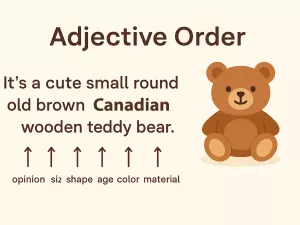
- Color: red apple, green shirt
- Size: tiny insect, enormous building
- Shape: round table, square window
- Age: ancient ruins, young child
- Material: wooden chair, silk scarf
- Origin: Italian cuisine, Australian bird
- Opinion: interesting book, boring movie
- Quantity: several students, few choices
- Condition: broken vase, healthy plant
- Purpose: sleeping bag, running shoes
- Temperature: hot coffee, cold weather
- Value: expensive watch, cheap souvenir
- Sound: loud noise, quiet room
- Shape: oval mirror, flat surface
Placement and Syntactic Function
Descriptive words of this kind typically appear directly before the noun they modify (“a bright lamp”), but can sometimes follow linking verbs (“The lamp is bright”). In both positions, they serve to characterize or define the noun, distinguishing it from others.
Contrasting Adjectives with Other Modifiers
Unlike adverbs, which typically modify verbs, adjectives focus on naming features of things, people, or concepts. If you want to comment on how an action is performed, adverbs are used instead. For instance, in “She sings beautifully,” “beautifully” describes the manner of singing, but in “her beautiful voice,” “beautiful” is an adjective describing the noun “voice.”
Examples of Adjective Use
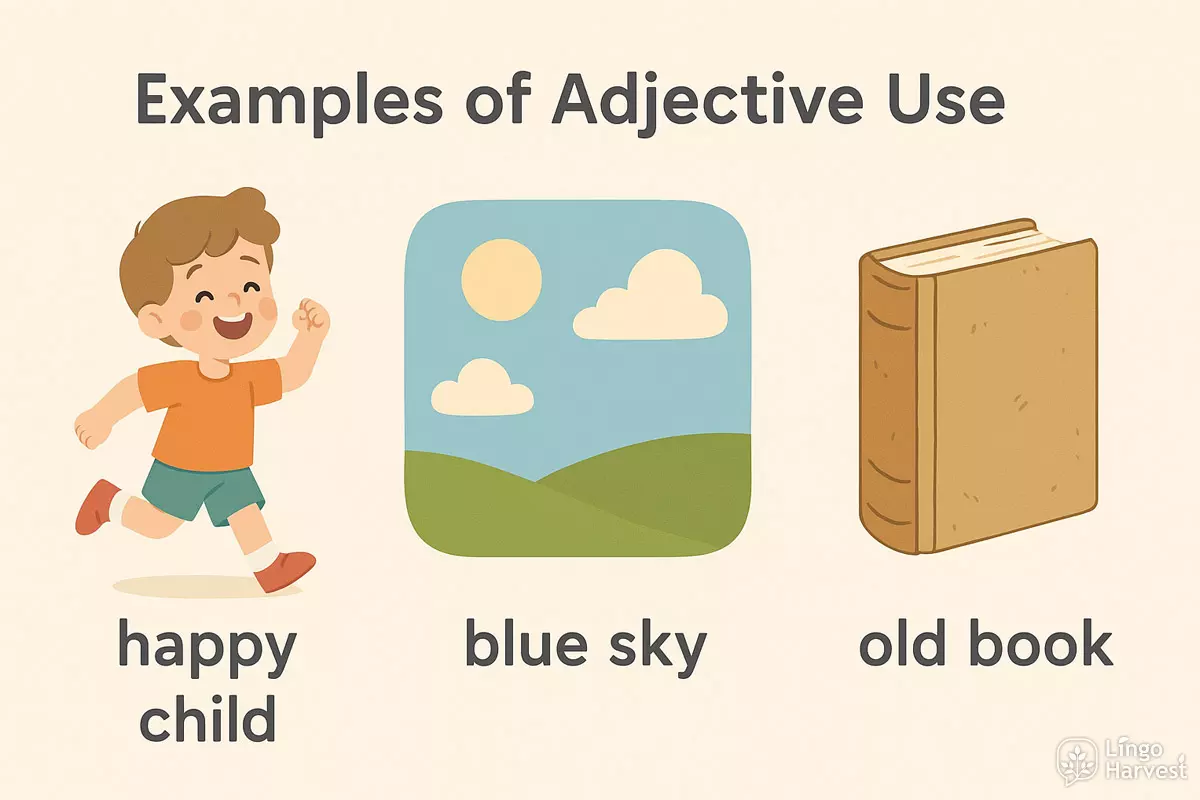
To illustrate, here’s a list of common adjectives and the kinds of nouns they might modify:
- happy child
- blue sky
- old book
- dangerous road
- soft pillow
- tall building
- delicious meal
- empty street
- famous artist
- shiny car
- quiet neighborhood
- strong wind
- messy desk
- polite guest
- happy ending
- rare coin
- brave firefighter
- modern technology
By modifying nouns in these ways, adjectives add detail, clarity, and nuance, helping us paint a more vivid picture in both spoken and written language.
What Adverbs Describe
Adverbs serve a core function in English: they provide additional detail about actions, qualities, or even entire sentences. Most often, they modify verbs, but their reach extends further. By describing how, when, where, or to what degree something happens, these words help clarify meaning and add nuance to communication.
Key Elements Modified by Adverbs
Adverbs typically modify the following parts of speech:
- Verbs: They explain manner, time, frequency, place, or degree of an action.
She sings beautifully. (manner) - Adjectives: They intensify or limit the quality expressed by an adjective.
The movie was incredibly exciting. (degree) - Other Adverbs: They can fine-tune another adverb’s meaning.
He answered very quickly. (degree) - Whole Clauses or Sentences: Some adverbs express the speaker’s attitude, connect ideas, or comment on the entire statement.
Fortunately, nobody was hurt.
Types and Functions of Adverbs
The scope of adverbs is broad. Here are categories illustrating what they can specify:
- Manner: how something happens (e.g., slowly, carefully, loudly)
- Place: where something happens (e.g., outside, nearby, everywhere)
- Time: when something happens (e.g., yesterday, soon, always)
- Frequency: how often (e.g., often, rarely, sometimes, never)
- Degree: to what extent (e.g., very, almost, completely, hardly)
- Focus: emphasizing or limiting (e.g., only, even, just)
- Attitude: expressing viewpoint (e.g., luckily, frankly, apparently)
- Linking: connecting ideas (e.g., however, therefore, moreover)
Examples of Adverb Use
To see the variety of contexts, here’s a list of adverbs in action:
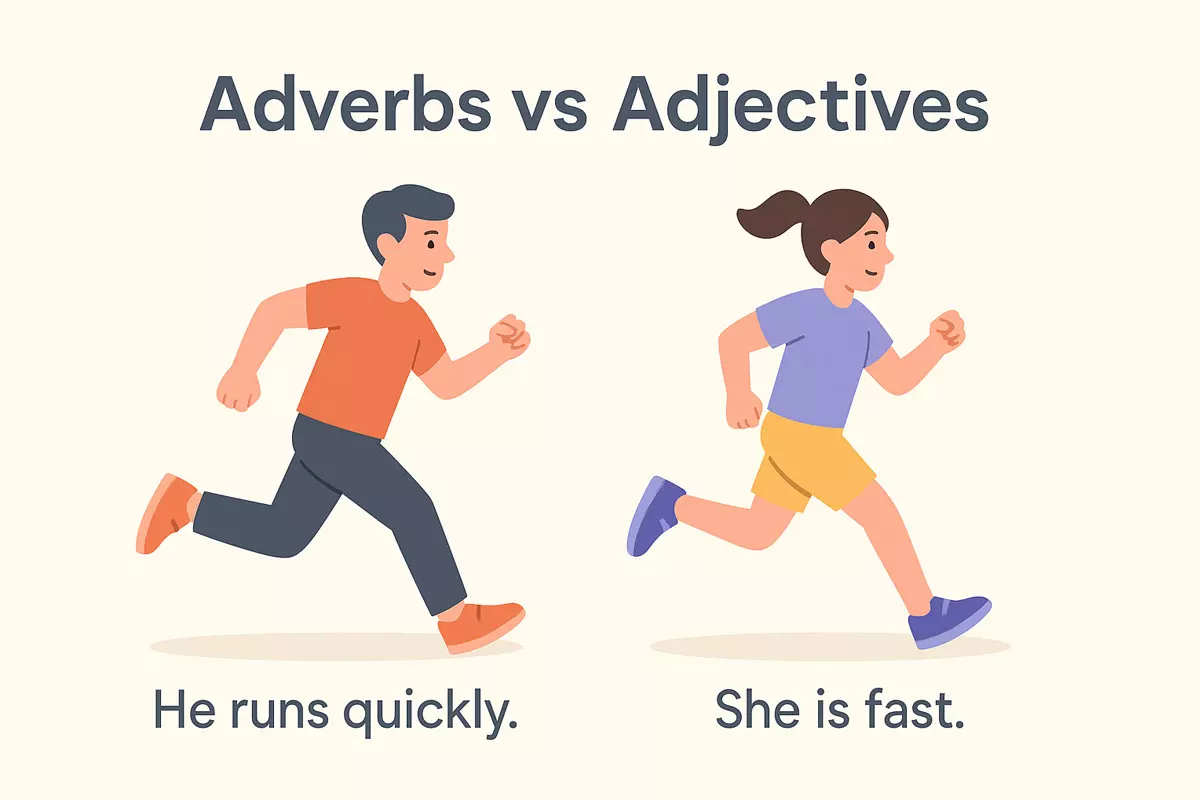
- She runs quickly.
- We will meet tomorrow.
- The solution is quite simple.
- He spoke softly.
- You are almost right.
- They arrived late.
- The cat is outside.
- She never eats meat.
- Honestly, I don’t know.
- Therefore, we decided to leave.
Adverbs are flexible, often shifting position in a sentence for emphasis or clarity. Their ability to describe not just actions, but also qualities and even the speaker’s stance, distinguishes them from adjectives and makes them essential for precise expression.
Form Differences
Understanding how adjectives and adverbs are formed and used makes it easier to distinguish their functions in sentences. Although both belong to the broader category of modifiers, their forms and endings often provide clear clues about their roles.
Adjectives typically modify nouns and pronouns. They usually appear in their base form and do not change to show tense. Many adjectives form the comparative and superlative by adding -er and -est (e.g., small, smaller, smallest). Longer adjectives instead use more and most.
Common Endings and Patterns
- Adjective endings: -ful (beautiful), -ous (dangerous), -ive (creative), -al (natural), -ic (dramatic), -y (sunny), -able (comfortable), -less (hopeless), -en (wooden), -ish (childish).
- Adverb endings: -ly (easily), -ward(s) (backwards), -wise (clockwise), -fold (twofold).
- Some words, like fast, hard, and late, serve as both adverbs and adjectives, so context is crucial.
Comparison of Typical Forms
| Adjective | Adverb | Example in Context |
|---|---|---|
| quick | quickly | He ran quickly. / A quick runner. |
| happy | happily | She smiled happily. / A happy child. |
| careful | carefully | He drove carefully. / A careful driver. |
| hard | hard | He works hard. / A hard task. |
| good | well | She sings well. / A good singer. |
Irregularities and Exceptions
Some modifiers do not follow the standard pattern. For example, well is the adverbial form of good, and fast remains unchanged whether it functions as an adjective or adverb. These exceptions highlight the importance of context and familiarity with common irregular forms. In summary, while endings like -ly or -ful offer useful guidelines, not all words fit the mold. Recognizing these morphological patterns is a key step toward accurate identification and usage.
Position Differences
Understanding where adverbs and adjectives typically appear in a sentence is essential for distinguishing their roles. Adjectives most often come immediately before the noun they modify, or after linking verbs like "be," "seem," or "become." Adverbs, in contrast, show far more flexibility: they might appear before or after the verb, at the beginning or end of a sentence, or even between auxiliary verbs and the main verb.
Common Placement Patterns
- Adjectives: before nouns (a quick fox), after linking verbs (The sky is blue).
- Adverbs: before main verbs (She quickly ran), after verbs (He spoke softly), at the sentence start (Suddenly, it rained), or at the end (He arrived late).
Comparing Typical Positions
| Modifier Type | Usual Locations |
|---|---|
| Adjective |
|
| Adverb |
|
Examples of Position Variations
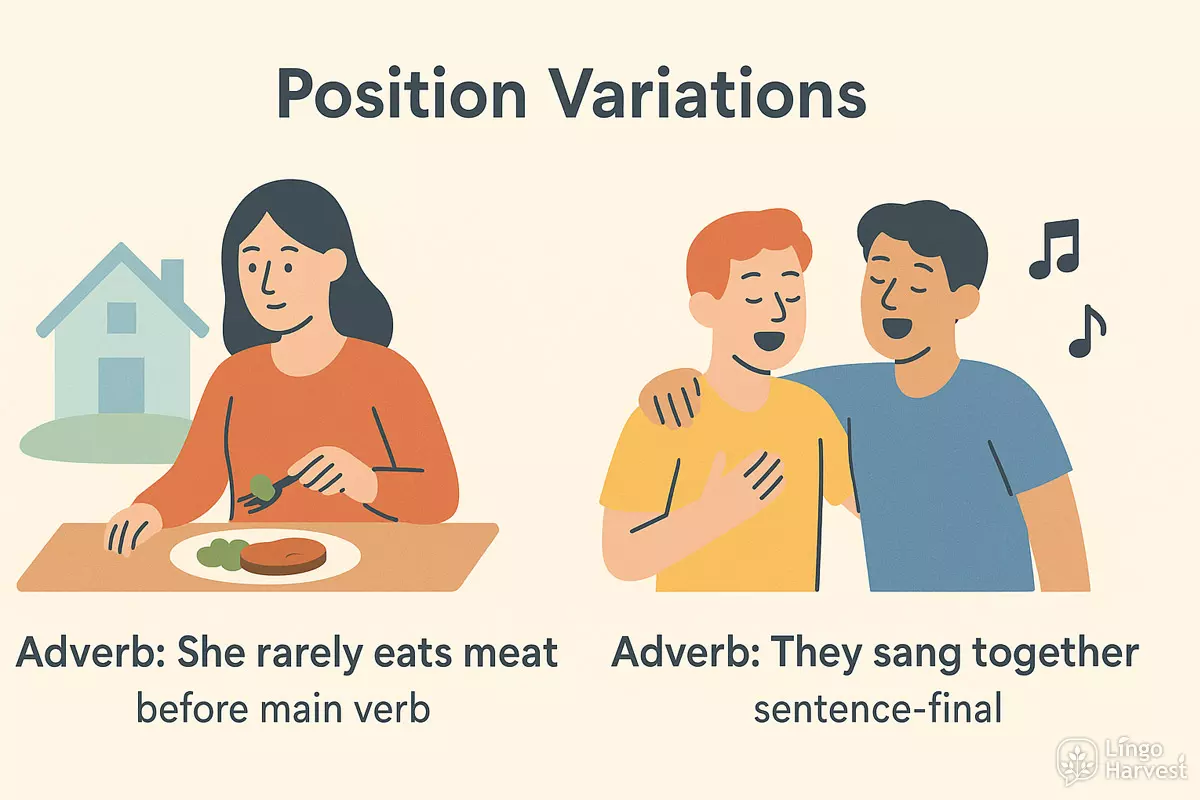
- Adjective: The happy child (before noun)
- Adjective: The flowers are beautiful (after linking verb)
- Adverb: She rarely eats meat (before main verb)
- Adverb: He finished the work quickly (after verb)
- Adverb: Honestly, I don't know (sentence-initial)
- Adverb: They sang together (sentence-final)
- Adjective: An interesting idea
- Adverb: She has already left (between auxiliary and main verb)
- Adjective: The answer seems correct
- Adverb: He can hardly wait
Placement is not just a matter of style—it signals the function of the word. If a word appears directly before a noun, it’s almost always an adjective. If it moves around the verb or even modifies an entire clause, it’s likely an adverb. This syntactic flexibility is a key theoretical distinction between the two categories.
Meaning Shifts
The distinction between adverbs and adjectives often goes beyond mere grammatical labeling. The choice between these two can alter the nuance of a sentence, shifting how actions, qualities, or states are interpreted. In many instances, using one form over the other doesn't just change the part of speech—it can subtly (or dramatically) affect the intended meaning.
Contextual Effects: How Function Influences Sense
When an adjective is used, it typically describes an inherent or enduring property of a noun. Adverbs, on the other hand, tend to modify verbs, adjectives, or other adverbs, influencing the manner, degree, or frequency of an action or state. This difference can lead to notable changes in interpretation. For example:
- She is a hard worker (describes her consistent trait)
- She works hard (describes how she performs the action)
- The early bird
- She arrived early
In the first pair, the adjective "hard" characterizes the person; the adverb "hard" describes the work.
Ambiguity and Double Meanings
Sometimes, the boundary blurs, or both forms exist but with different implications. Consider these pairs:
- He is a fast runner → He runs fast
- She's a late sleeper → She sleeps late
- A daily paper → The paper arrives daily
- A close friend → She stood close
- A friendly smile → She smiled friendly (incorrect: should be "in a friendly way")
- A safe driver → He drives safely
- A quiet room → The room is quietly decorated
- A sharp turn → The car turned sharply
- A deep thinker → She thinks deeply
- A quick response → He responded quickly
- A steady hand → She writes steadily
- A bright student → He learns brightly (awkward, better: "He learns quickly")
These shifts illustrate how meaning can change or even break down if the wrong form is substituted.
Semantic Contrasts: Table of Common Shifts
Sometimes, the transition from adjective to adverb results in a different nuance or even a contradiction. Here is a comparison of common cases:
| Adjective (Quality) | Adverb (Manner/Degree) |
|---|---|
| Hard (a hard task) | Hard (work hard) |
| Late (a late show) | Late (arrive late) |
| Near (a near miss) | Nearly (nearly missed) |
| Pretty (a pretty girl) | Pretty (pretty quickly) |
| Direct (a direct route) | Directly (come directly) |
| Deep (deep water) | Deeply (deeply concerned) |
| Short (a short break) | Shortly (shortly after) |
| High (a high jump) | Highly (highly recommended) |
| Free (a free seat) | Freely (freely available) |
| Fair (a fair deal) | Fairly (fairly simple) |
Special Cases and Fixed Expressions
In English, some expressions are frozen, allowing only one form. For example, "fast asleep" (not "fastly asleep") or "well done" (not "good done"). These collocations reflect historical usage and further complicate the relationship between these two word classes. Understanding how small changes in form can create larger shifts in meaning is essential for interpreting and producing precise language. Always consider both the grammatical role and the semantic effect when choosing between these modifiers.
Examples
Understanding the contrast between adverbs and adjectives is easier when looking at their function in sentences. Adjectives typically describe or modify nouns, giving more information about a person, place, or thing. In contrast, adverbs usually modify verbs, adjectives, or other adverbs, often telling us how, when, where, or to what extent something happens.
Typical Usage Patterns
- Adjective: She wore a beautiful dress. (Describes the noun "dress")
- Adverb: She sang beautifully. (Describes how she sang)
- Adjective: The quick fox jumps. ("quick" modifies "fox")
- Adverb: The fox jumps quickly. ("quickly" modifies "jumps")
- Adjective: He is a careful driver. ("careful" describes "driver")
- Adverb: He drives carefully. ("carefully" describes "drives")
- Adjective: The soup is hot. ("hot" modifies "soup")
- Adverb: The soup tasted strangely sweet. ("strangely" modifies "sweet")
- Adjective: She gave a friendly smile. ("friendly" modifies "smile")
- Adverb: He answered politely. ("politely" modifies "answered")
- Adjective: That is an easy task. ("easy" describes "task")
- Adverb: She finished easily. ("easily" modifies "finished")
- Adjective: The happy child laughed. ("happy" modifies "child")
- Adverb: The child laughed happily. ("happily" modifies "laughed")
- Adjective: He is a fast runner. ("fast" describes "runner")
- Adverb: He runs fast. ("fast" modifies "runs")
- Adjective: The loud music played. ("loud" modifies "music")
- Adverb: She spoke loudly. ("loudly" modifies "spoke")
Comparative Table: Adjective vs. Adverb Forms
| Adjective | Adverb |
|---|---|
| quick | quickly |
| careful | carefully |
| happy | happily |
| loud | loudly |
| polite | politely |
| easy | easily |
| strange | strangely |
| beautiful | beautifully |
Special Cases & Irregular Forms
Some words don’t follow the typical -ly pattern for adverbs. For instance, “fast” and “hard” serve as both adjectives and adverbs:
- He is a fast runner. (adjective)
- He runs fast. (adverb)
- She gave a hard look. (adjective)
- She worked hard. (adverb)
Recognizing these distinctions helps clarify how modifiers function within sentences, supporting accurate and expressive communication.
Practice Task
Understanding the difference between adverbs and adjectives is essential for accurate sentence construction. Below, you’ll find a mix of identification tasks, sentence completion, and a structured comparison to reinforce your grasp of these two parts of speech.
Identify the Word Type
Read each sentence and decide if the highlighted word functions as an adjective or an adverb.
- The quick rabbit jumped over the fence.
- She sang beautifully at the concert.
- This soup tastes delicious.
- He ran fast and won the race.
- The sleepy child yawned loudly.
- They finished the test easily.
Show answers
- 1. Adjective
- 2. Adverb
- 3. Adjective
- 4. Adverb
- 5. Adjective
- 6. Adverb
Complete the Sentences
Choose the correct form (adjective or adverb) from the word in brackets:
- The cat moved _____. (quiet/quietly)
- This math problem is _____. (easy/easily)
- She spoke _____ during the presentation. (confident/confidently)
- He wore a _____ suit to the interview. (smart/smartly)
- The players reacted _____ to the referee’s decision. (angry/angrily)
Show answers
- 1. quietly
- 2. easy
- 3. confidently
- 4. smart
- 5. angrily
Comparison Table: Main Features
| Feature | Adjective | Adverb |
|---|---|---|
| Typical Function | Describes a noun/pronoun | Modifies a verb, adjective, or another adverb |
| Common Endings | -y, -ful, -ous, -ive, -al | -ly, sometimes no ending (fast, hard) |
| Example | happy, green, careful | quickly, well, very |
| Sentence Example | She is happy. | She sings happily. |
Spot the Error
Find and correct the mistake in each sentence.
- He did good on the exam.
- The train arrived lately.
- She is a really singer talented.
- The dog barked loud at night.
Show answers
- He did well on the exam.
- The train arrived late.
- She is a really talented singer.
- The dog barked loudly at night.