What Are Prepositions? Complete Explanation

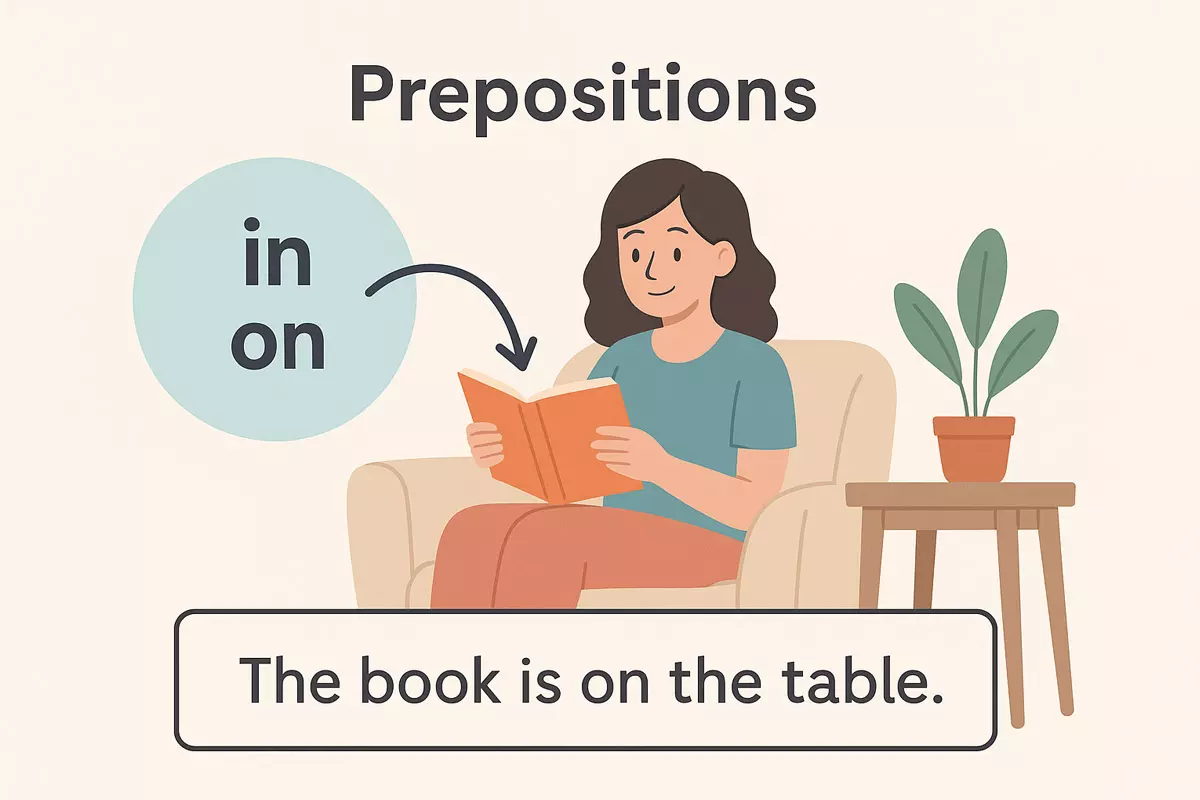 This article explains what prepositions show, their main functions, and common types. It covers typical sentence patterns, differences in meaning, example sentences, beginner mistakes, and ends with a short practice section.
Have you ever wondered how small words can completely change the meaning of a sentence? These connectors, such as prepositions and conjunctions, are often overlooked, yet they play a crucial role in describing relationships involving time, space, and direction. By learning to use them effectively, you can make your English communication clearer and more precise. Mastering these words not only helps you express complex ideas more easily but also enhances your overall language skills, making your speech and writing more engaging and accurate.
What Prepositions Show
Prepositions add important details by connecting nouns or pronouns to other words, revealing relationships such as place, time, direction, and more. These small words give context and meaning, helping sentences become clearer and more precise.
Types of Relationships Expressed
English prepositions typically indicate several kinds of relationships. Here are the main categories they cover:
- Location: Tells us where something happens or where someone/something is (e.g., in the room, on the table, under the bridge).
- Time: Specifies when something occurs (e.g., at noon, during the meeting, before sunrise).
- Direction or Movement: Shows movement or the path taken (e.g., toward the exit, into the building, across the street).
- Manner: Describes how something is done (e.g., by train, with care, in silence).
- Cause or Reason: Explains the reason for something (e.g., because of the rain, due to illness).
- Possession: Indicates ownership or association (e.g., of the city, with a friend).
- Agent: Shows who performs an action, usually in passive sentences (e.g., by the author).
Common Prepositions and Their Uses
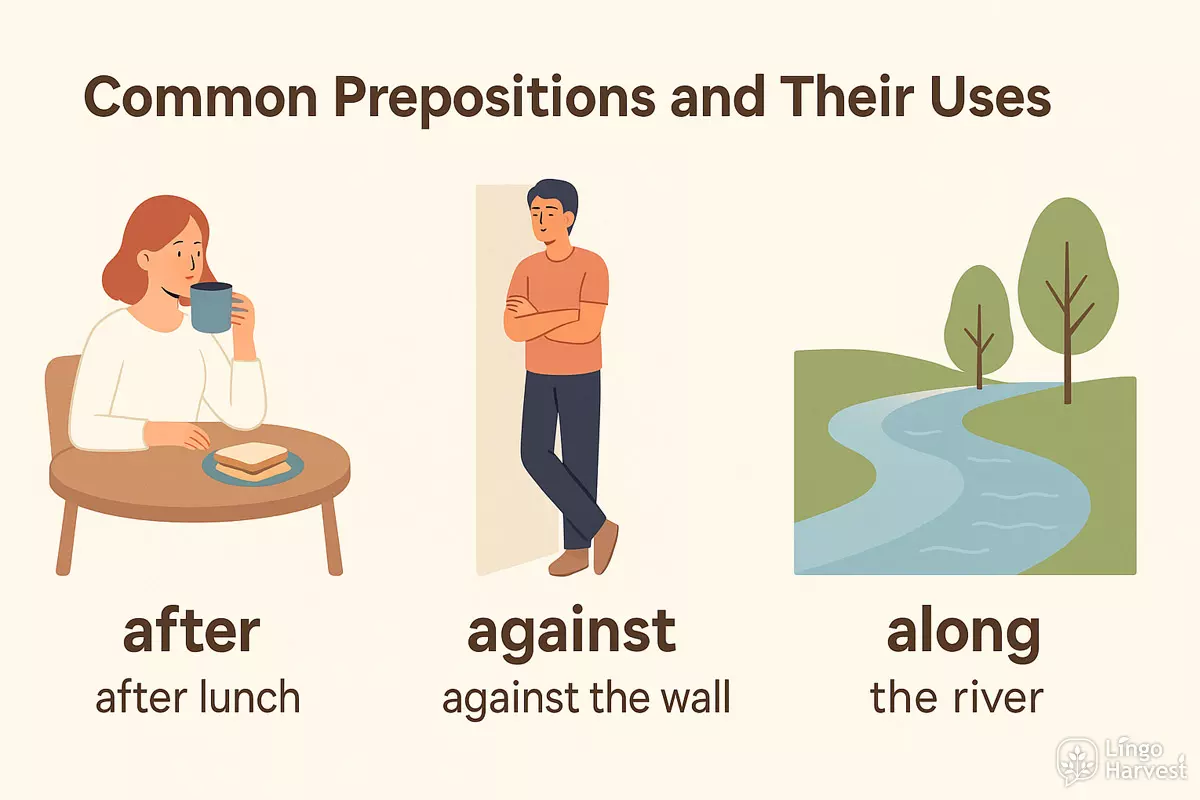
Here’s a selection of frequently used prepositions, each with a typical example:
- about – about the project
- above – above the clouds
- across – across the street
- after – after lunch
- against – against the wall
- along – along the river
- among – among friends
- around – around the world
- at – at the station
- before – before dawn
- behind – behind the door
- below – below zero
- beside – beside the window
- between – between the lines
- beyond – beyond the horizon
- by – by the river
- for – for a friend
- in – in the box
- on – on the roof
- over – over the bridge
- through – through the tunnel
- to – to the park
- under – under the table
- with – with a pencil
- without – without hesitation
Comparing Functions of Prepositions
Some prepositions are flexible and can express different types of relationships depending on context. The table below shows how a few common prepositions can indicate place, time, or direction:
| Preposition | Example of Place | Example of Time | Example of Direction |
|---|---|---|---|
| at | at the bus stop | at 3 PM | ❌ |
| in | in the garden | in April | ❌ |
| on | on the floor | on Monday | ❌ |
| to | ❌ | ❌ | to the store |
| by | by the window | by midnight | ❌ |
| over | over the hill | ❌ | over the fence |
| under | under the bed | ❌ | ❌ |
Understanding the relationships prepositions convey helps you use them with confidence and accuracy. Whether you’re describing a location, stating a time, or expressing movement, these words play a key role in making your meaning clear.
Core Functions
Prepositions are essential for expressing relationships between different elements in a sentence. They help clarify how nouns, pronouns, and phrases connect to one another, providing details about place, time, direction, cause, and manner. Without these linking words, communication would be vague or confusing.
Key Purposes
Prepositions primarily indicate:
- Location: Showing where something is (e.g., under the table, at the park).
- Time: Specifying when something occurs (e.g., before noon, during the meeting).
- Direction: Indicating movement or orientation (e.g., toward the door, into the box).
- Agency: Identifying the doer of an action, often with passive verbs (e.g., by the artist).
- Instrument: Explaining what is used to perform an action (e.g., with a pen, by train).
- Reason or Cause: Giving the motive or explanation (e.g., because of rain, for fun).
- Method or Manner: Describing how something is done (e.g., in haste, with care).
- Possession: Showing ownership or belonging (e.g., of the company, with blue eyes).
- Comparison: Drawing parallels or contrasts (e.g., as tall as, unlike her sister).
- Support or Opposition: Indicating alignment or disagreement (e.g., for the idea, against the rule).
Common Patterns and Examples
These linking words often appear in set phrases or follow certain patterns. Here are some typical usages:
- at home
- in the morning
- on the table
- over the bridge
- under pressure
- between friends
- after lunch
- before sunrise
- by car
- with a smile
- about the topic
- from school
- to the store
- without hesitation
- through the tunnel
- around the corner
- beside the river
- across the street
- during the event
- against the wall
How Prepositions Shape Meaning
Choosing the right linking word can subtly or dramatically change the meaning of a sentence. For example, “on the bus” suggests being inside the vehicle, while “by the bus” means standing next to it. These words are not always interchangeable, so attention to context is crucial.
| Relationship | Example Phrase | Typical Question Answered |
|---|---|---|
| Place | in the room | Where? |
| Time | at 5 o’clock | When? |
| Direction | to the station | Where to? |
| Cause | because of traffic | Why? |
| Manner | with enthusiasm | How? |
In summary, these small words perform big jobs, linking details and clarifying relationships throughout sentences. Mastering their use helps make your writing and speech more precise and natural.
Common Prepositions
Prepositions frequently appear in everyday English, connecting nouns and pronouns to other words in a sentence. They help clarify relationships involving location, time, direction, and more. Learning the most regularly used prepositions is essential for constructing clear, natural sentences.
Frequently Used Prepositions in English
Many short words function as prepositions, and some have multiple meanings depending on context. Here’s a list of prepositions that you’ll encounter often:
- in
- on
- at
- by
- with
- from
- to
- for
- about
- over
- under
- between
- through
- during
- after
- before
- without
- within
- across
- against
How Prepositions Work in Sentences
Prepositions typically come before a noun or pronoun to show how it relates to something else in the sentence. The choice depends on the relationship being described. For example, "in" can show position inside an area, while "on" indicates contact with a surface.
| Preposition | Example Sentence |
|---|---|
| in | She lives in the city. |
| on | The keys are on the table. |
| at | Meet me at the station. |
| by | The book was written by her. |
| with | He came with his friend. |
| from | She is from Canada. |
| to | We went to the park. |
| for | This gift is for you. |
| about | We talked about the movie. |
| over | The plane flew over the mountains. |
It’s helpful to practice these words in context, since some prepositions are tricky and their use doesn’t always translate directly between languages. Developing a good sense for which preposition fits comes from exposure and regular use.
Typical Sentence Patterns
Understanding how prepositional phrases fit into sentences helps clarify both their function and placement. Prepositions typically introduce information about time, place, direction, or method, and they almost always appear before a noun or pronoun (the object of the preposition). These structures can appear at the beginning, middle, or end of a sentence depending on what information is being emphasized.
Common Patterns Using Prepositions
Writers and speakers use prepositional phrases in a variety of ways. Below are some of the most frequent structures you’ll encounter:
- Subject + Verb + Prepositional Phrase: The cat slept on the sofa.
- Prepositional Phrase + Subject + Verb: After dinner, we went for a walk.
- Subject + Verb + Object + Prepositional Phrase: She put the book on the table.
- Verb + Prepositional Phrase: He looked at the painting.
- Subject + Verb + Prepositional Phrase (Time): They arrived at midnight.
- Subject + Verb + Prepositional Phrase (Place): The keys are in the drawer.
- Subject + Verb + Prepositional Phrase (Direction): She walked towards the park.
- Subject + Prepositional Phrase + Verb: The dog with the red collar barked loudly.
- Subject + Verb + Two Prepositional Phrases: He sat on the bench by the window.
- Question Word + Prepositional Phrase: Where did you leave the keys in the house?
Examples of Sentence Patterns with Prepositions
Placement and type of prepositional phrase can change what information is highlighted in a sentence. Review the table below for a comparison of different ways prepositions are used with other sentence elements:
| Pattern | Example |
|---|---|
| Subject + Verb + Prepositional Phrase (Place) | The children played in the garden. |
| Subject + Verb + Prepositional Phrase (Time) | She finishes work at five o’clock. |
| Prepositional Phrase + Subject + Verb | Before sunrise, birds start singing. |
| Subject + Verb + Object + Prepositional Phrase | He placed the vase on the shelf. |
| Subject + Verb + Multiple Prepositional Phrases | The letter arrived from my friend in Italy. |
Notes on Usage
Prepositional phrases are flexible: they can start a sentence for emphasis, or appear after the verb or object to provide context. They are never the main subject or verb but act as modifiers, giving extra detail. Some verbs require specific prepositions (e.g., “listen to,” “depend on”), so it’s useful to learn these combinations as fixed patterns. Mastering these structures allows you to add clarity and detail to your writing and speaking, making your communication more precise and vivid.
Meaning Differences
Prepositions often change the sense of a sentence in subtle but important ways. The choice of one preposition over another can affect the relationship between words, including time, place, direction, and even the overall nuance of the message. Understanding these distinctions is essential for clarity and precision in communication.
Common Shifts in Meaning
The same verb or noun can take different prepositions, resulting in changes to the intended meaning. For example, compare "look at" (to direct your gaze) and "look for" (to search).
- in vs. on: "in the box" (inside it) vs. "on the box" (on its surface)
- at vs. to: "smile at someone" (direct your smile) vs. "smile to yourself" (quietly, internally)
- by vs. with: "written by" (who wrote it) vs. "written with" (what tool was used)
- for vs. since: "for three years" (duration) vs. "since 2020" (starting point)
- about vs. of: "think about" (consider) vs. "think of" (imagine, recall)
- between vs. among: "between two friends" (specifically two) vs. "among friends" (in a group)
- to vs. towards: "go to school" (arrive there) vs. "go towards school" (in the direction of)
- over vs. above: "the lamp over the table" (directly overhead) vs. "the painting above the table" (higher up, not necessarily directly over)
- with vs. by: "painted with a brush" (the tool) vs. "painted by an artist" (the agent)
- on vs. upon: "on arrival" (when you arrive) vs. "upon arrival" (more formal, same meaning)
Comparing Prepositional Nuances
To see how different prepositions shift context or meaning, consider these examples:
| Expression | Meaning |
|---|---|
| interested in | Having curiosity or concern about something |
| interested by | Something causes your interest (less common) |
| angry at | Directing anger towards someone/something |
| angry about | Upset because of a situation or event |
| good at | Having skill in an activity |
| good for | Beneficial to someone or something |
| talk to | Speak with someone (one-way or two-way) |
| talk with | Emphasizes a two-way conversation |
Why These Differences Matter
Choosing the correct preposition is not just a matter of grammar; it directly impacts the accuracy of your message. Subtle shifts can lead to misunderstandings or even change the entire meaning of a sentence. Paying attention to the context and memorizing common combinations helps achieve natural, effective communication.
Example Sentences
Understanding how prepositions work is much easier when you see them in context. Below, you’ll find a variety of sample sentences that illustrate how these small but important words connect other parts of a sentence. Notice how each preposition gives more detail about time, place, direction, or relationship.
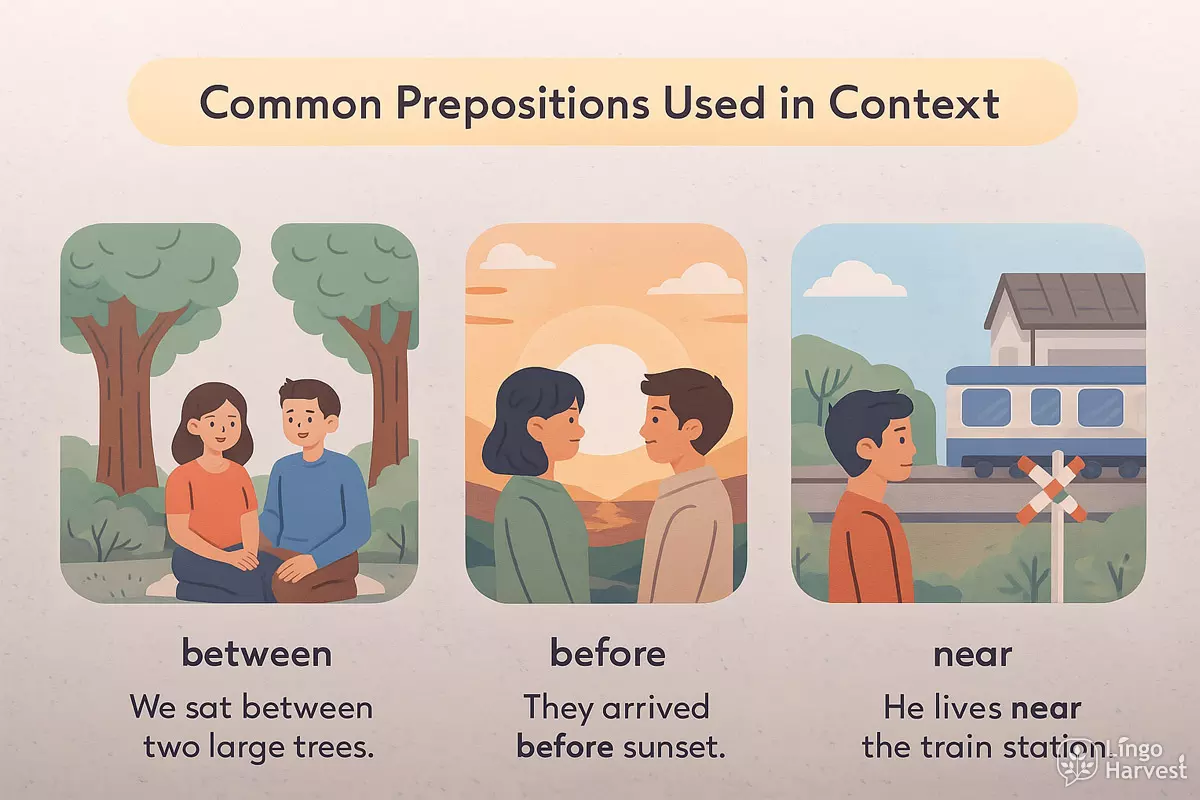
Common Prepositions Used in Context
- The cat is under the table.
- She walked to the store after lunch.
- We sat between two large trees.
- They arrived before sunset.
- He lives near the train station.
- The book is on the shelf.
- We will meet at noon.
- The dog jumped over the fence.
- I put the keys in my bag.
- She waited outside the building.
- The picture hangs above the fireplace.
- He was born in April.
- They traveled across the country.
- He stood beside his friend.
- We walked through the park.
- The letter is from my cousin.
- She sat behind me during the concert.
- The ball rolled into the street.
- The restaurant is next to the cinema.
- He hid among the bushes.
Comparing Prepositions of Place, Time, and Direction
| Place | Time | Direction |
|---|---|---|
| The cat is under the bed. | He left at 8 o’clock. | She walked towards the door. |
| My shoes are in the closet. | We meet on Mondays. | The ball rolled into the room. |
| The park is near our house. | He finished before lunch. | They drove through the tunnel. |
| She stood behind the curtain. | She arrived after dinner. | We walked across the bridge. |
Tips for Recognizing and Using Prepositions
Most prepositions are short and often come before a noun or pronoun, showing how it relates to another word in the sentence. Try looking for words that answer questions like “where?”, “when?”, or “how?” to spot them easily. Practicing with real sentences helps you develop a better sense for which preposition fits naturally.
Beginner Mistakes
Many English learners run into trouble with prepositions because they often don’t translate directly from other languages. The following issues frequently cause confusion when starting out with these small but important words.
Common Preposition Challenges
One major difficulty is choosing the correct word for time and place. For example, “in,” “on,” and “at” are all used with locations and times, but the rules for each are different and not always logical to beginners. Another pitfall is unnecessary repetition, such as saying “Where are you at?” instead of just “Where are you?”
Typical Problems Learners Face
- Leaving out prepositions entirely (“I go school” instead of “I go to school”)
- Using the wrong one for time or place (“I was born at May” instead of “in May”)
- Adding extra words (“discuss about” instead of “discuss”)
- Confusing pairs like “between” vs. “among”
- Forgetting that some verbs require certain prepositions (“listen to music,” not “listen music”)
- Using “in” for days (“in Monday” instead of “on Monday”)
- Mixing up “at,” “in,” and “on” for locations (“at the park,” not “in the park” when talking about a specific point)
- Attaching prepositions to verbs that don’t need them (“enter in the room” instead of “enter the room”)
- Direct translation from one’s native language (“married with” instead of “married to”)
- Pluralizing prepositions (“betweens,” “ins,” which are incorrect forms)
- Doubling up (“inside of” instead of just “inside”)
- Swapping expressions (“on the bus” versus “in the bus”)
- Using “for” instead of “since” with time (“for 2010” instead of “since 2010”)
- Forgetting necessary prepositions in phrasal verbs (“look forward meeting” instead of “look forward to meeting”)
- Overusing “about” (“explain about this” instead of “explain this”)
- Using “to” after “should” (“should to go” instead of “should go”)
- Omitting prepositions in questions (“Who are you talking?” instead of “Who are you talking to?”)
- Using “at” with home (“at home” is correct, but “at my home” is not always natural)
Choosing “In,” “On,” or “At” for Time and Place
Confusion around “in,” “on,” and “at” is especially common. Here’s a quick reference to clarify some typical uses:
| Usage | In | On | At |
|---|---|---|---|
| Time | in 2023, in June, in the morning | on Monday, on July 4th, on the weekend | at 7pm, at midnight, at lunchtime |
| Place | in Paris, in a room, in the building | on the table, on the bus, on the floor | at school, at the door, at a concert |
| Common Mistake | “at June” ❌ | “in Monday” ❌ | “in the table” ❌ |
| Correct Example | “in the city” ✅ | “on the bus” ✅ | “at the airport” ✅ |
Final Tips
Practice and exposure make it easier to spot and correct these errors. When unsure, check real-life examples or listen to native speakers to see which preposition fits the context. Over time, the patterns will become more natural.
Short Practice
Ready to check your understanding of how these small but mighty words work? Try these quick exercises to reinforce your grasp of prepositions and how they fit into sentences.
Identify the Preposition
Read each sentence and pick out the preposition:
- The cat slept under the table.
- She arrived after lunch.
- We walked through the park.
- He put the keys on the shelf.
- The dog ran across the street.
Show answers
- under
- after
- through
- on
- across
Choose the Correct Preposition
Fill in the blanks with the most suitable preposition:
- We will meet ___ noon.
- The painting hangs ___ the wall.
- The children hid ___ the bed.
- She lives ___ Paris.
- The bird flew ___ the window.
Show answers
- at
- on
- under
- in
- through
Common Prepositions at a Glance
Here’s a handy overview of frequently used prepositions and their typical uses:
| Preposition | Example Usage |
|---|---|
| in | in the room, in June |
| on | on the table, on Monday |
| at | at school, at 5 o'clock |
| under | under the bridge |
| over | over the fence |
| between | between the chairs |
| behind | behind the house |
| through | through the tunnel |
| after | after dinner |
| before | before sunrise |
| across | across the river |
| with | with a friend |
Spot the Error
Each sentence below contains one incorrect preposition. Find and correct it:
- She put the book in the table.
- We arrived on the airport.
- The cat jumped in the wall.
- He finished the work by two hours.
Show answers
- on (She put the book on the table.)
- at (We arrived at the airport.)
- on (The cat jumped on the wall.)
- in (He finished the work in two hours.)
Practice like this helps you spot patterns and avoid common mistakes with these essential connectors. Try making your own sentences or review the examples above to strengthen your skills.