Prepositions of Place: Structural Role

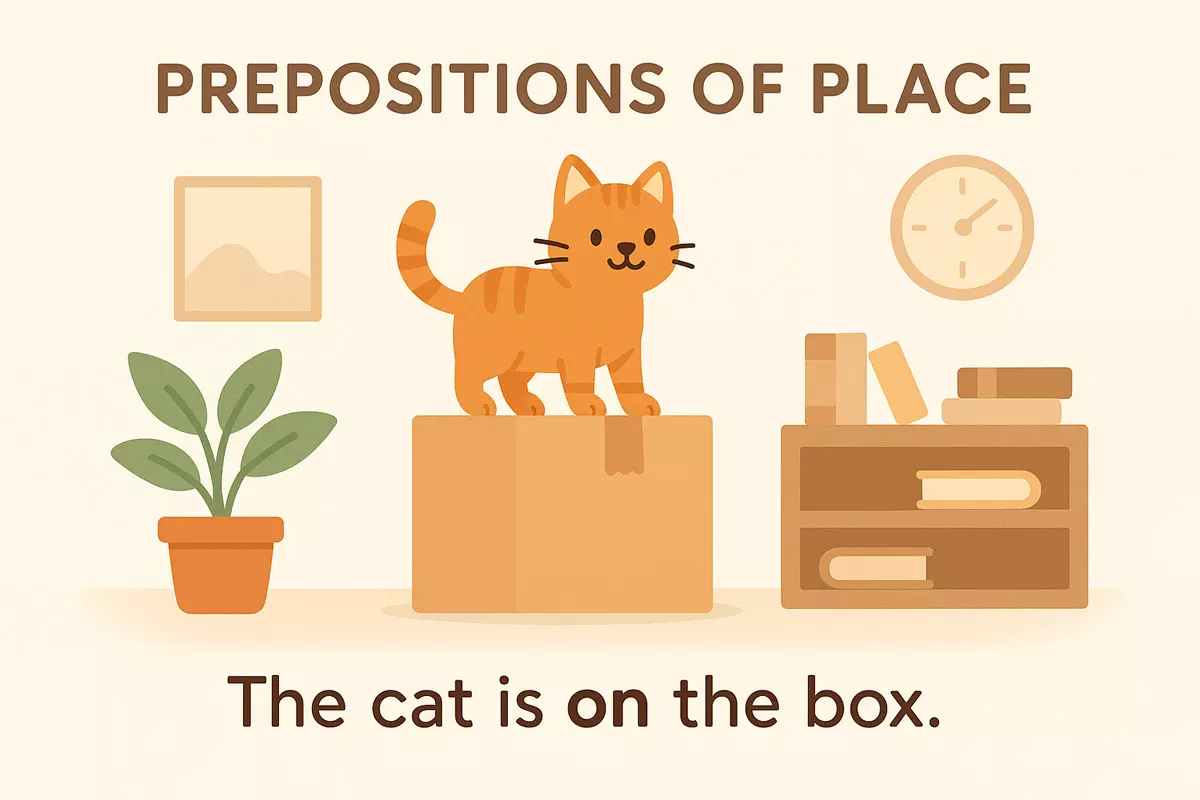 This article explains basic place prepositions, their position and structure in sentences, and common usage patterns. It includes visual examples, highlights typical errors, and ends with short practice to reinforce your understanding.
Understanding how words such as above, between, or within function in a sentence can significantly improve the clarity and precision of your communication. These small connectors, known as prepositions, play an essential role in expressing location, direction, and spatial relationships, helping to organize information and convey meaning more effectively. By mastering the use of these words, you can make your writing and speech clearer, more accurate, and easier for others to understand, ultimately enhancing your ability to communicate complex ideas with confidence.
Basic Place Prepositions
Understanding how to express location is a core skill in English grammar. Prepositions such as "in," "on," and "at" are used to describe where people, objects, and places are situated in relation to one another. These words help clarify spatial relationships, making communication more precise and effective.
Common Location Prepositions
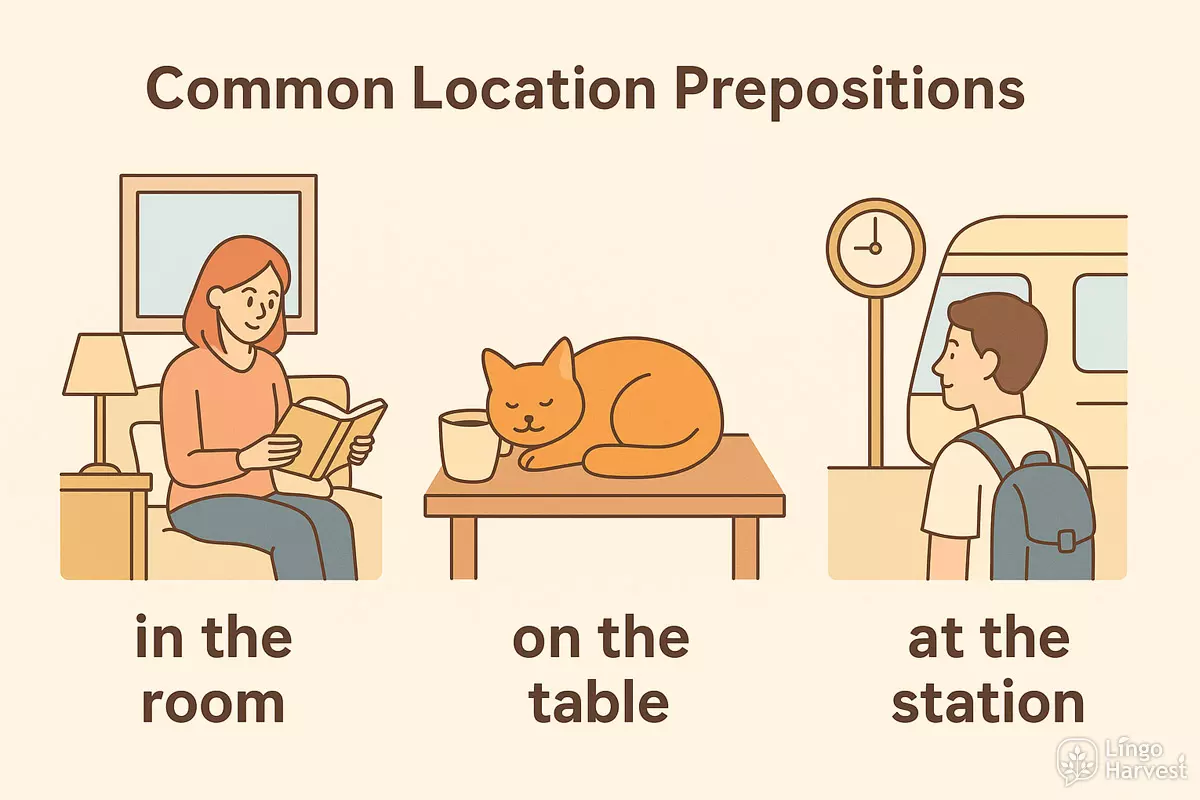
Several prepositions frequently appear when discussing spatial relationships. Here are some of the most widely used:
- in – inside an area or space (“in the room”)
- on – touching a surface (“on the table”)
- at – a specific point or place (“at the station”)
- under – below something (“under the bridge”)
- over – above and possibly covering (“over the bed”)
- between – in the middle of two things (“between the buildings”)
- among – surrounded by more than two (“among friends”)
- behind – at the back of (“behind the curtain”)
- in front of – before the face or main view (“in front of the school”)
- next to – immediately beside (“next to the door”)
- beside – at the side of (“beside the lake”)
- near – close to (“near the park”)
- above – higher than but not necessarily touching (“above the clouds”)
- below – lower than (“below sea level”)
- opposite – facing (“opposite the bank”)
- inside – within the boundaries (“inside the box”)
- outside – beyond the boundaries (“outside the gate”)
- around – surrounding or encircling (“around the park”)
- through – from one side to another inside something (“through the tunnel”)
- along – following the length of (“along the river”)
Comparing “in”, “on”, and “at” for Place
The prepositions "in," "on," and "at" often cause confusion because they all relate to the idea of location, but each has a distinct use. Here's a comparison to clarify their structural roles:
| Preposition | Typical Use | Example |
|---|---|---|
| in | Enclosed or surrounded spaces, countries, cities | in the car, in Paris, in a box |
| on | Surfaces, floors, public transport, streets | on the wall, on the bus, on Main Street |
| at | Specific points, addresses, events | at the door, at 15 King St, at the party |
Tips for Using Place Prepositions
To choose the right preposition, consider the context: Is it a surface, an enclosed space, or a precise point? For example, “in” is used for areas with boundaries, “on” for surfaces, and “at” for exact spots. Practice with real-life examples helps reinforce correct usage. Spatial prepositions clarify not just where things are, but how they relate to other objects and locations. Mastering their use is essential for clear, accurate communication.
Position and Structure
Understanding where prepositions of place appear in a sentence is essential for clear communication. These words usually come before a noun or pronoun to indicate a spatial relationship, such as "on the table" or "behind her." The noun following the preposition is called the object of the preposition, and together they form a prepositional phrase that tells us where something is located.
Typical Placement in Sentences
Most commonly, spatial prepositions are placed directly before the noun they modify. For example:
- The cat is under the bed.
- Books are on the shelf.
- She sat between her friends.
Occasionally, especially in questions or relative clauses, the preposition may appear at the end of the sentence:
- Which room are you in?
- This is the chair I was sitting on.
Common Patterns with Prepositions of Place
Prepositional phrases often appear:
- After the verb, describing location: "He lives near the station."
- At the beginning for emphasis: "In the garden, the children played."
- Between subject and verb is rare, but possible for poetic effect: "On the hill stood an old castle."
Examples of Prepositions of Place Used in Context
Here are some frequent prepositions of place, each with a brief example:
- above – The lamp hangs above the table.
- across – The bakery is across the street.
- against – The bike is leaning against the wall.
- along – Flowers grow along the fence.
- among – The letter was hidden among the books.
- around – She placed candles around the room.
- at – Meet me at the corner.
- behind – The dog is behind the sofa.
- below – The valley lies below the mountain.
- beside – Sit beside me.
- between – The ball rolled between the chairs.
- in – The keys are in my bag.
- inside – The bird flew inside the house.
- near – There’s a park near the school.
- on – The picture is on the wall.
- opposite – The bank is opposite the post office.
- over – The plane flew over the city.
- through – Walk through the gate.
- under – Look under the table.
- within – Stay within the boundaries.
Comparing Prepositional Use
Some prepositions might seem similar but have different nuances or are used in specific situations. The table below highlights key contrasts and usage notes:
| Preposition | Typical Use/Contrast |
|---|---|
| in | Enclosed space: "in the box" |
| on | Surface contact: "on the table" |
| at | Specific point: "at the door" |
| between | Space separating two items: "between the chairs" |
| among | Surrounded by a group: "among the trees" |
| over | Above with/without contact: "over the bridge" |
| under | Lower than something else: "under the desk" |
Grasping these structures helps you form accurate, natural sentences about location. The order and pairing of prepositions with nouns or pronouns is consistent in English, making them predictable once patterns are learned.
Common Usage Patterns
When it comes to describing spatial relationships in English, prepositions like "in," "on," and "at" play distinct roles. They help specify where something is located, whether it's inside a space, atop a surface, or at a precise point. The way these prepositional structures are used often depends on the physical context and the type of noun they modify.
Typical Contexts for Place Prepositions
Some prepositions are almost always paired with certain types of locations or settings. Understanding these tendencies makes it easier to choose the right form in conversation or writing. Here are some common ways these words are used to indicate position or direction:
- In a room, a building, a city, a country
- On a table, a wall, the floor, the roof
- At the door, the station, the top, the bottom
- Under the bed, the table, the bridge
- Over the hill, the river, the fence
- Between two buildings, the lines, the trees
- Among friends, the crowd, the flowers
- Behind the curtain, the house, the car
- In front of the school, the shop, the audience
- Next to the window, the lamp, the park
- Opposite the bank, the cinema, the post office
- Inside the box, the museum, the cave
- Outside the building, the garden, the stadium
- Above the shelf, the clouds, the mirror
- Below sea level, the balcony, the bridge
Contrasts and Nuances
Many spatial prepositions are similar, but their meanings are not interchangeable. For example, "in" generally implies being enclosed or surrounded, while "on" suggests contact with a surface. "At" is used for specific points or locations, often without reference to boundaries.
| Preposition | Typical Usage Example | Spatial Meaning |
|---|---|---|
| in | in the box | Inside, surrounded by boundaries |
| on | on the table | Touching a surface |
| at | at the door | Specific point or position |
| under | under the bridge | Directly below |
| between | between two chairs | In the space separating two objects |
| behind | behind the curtain | At the back of something |
Key Points for Effective Usage
- Choose "in" for enclosed spaces or volumes.
- Use "on" for surfaces or lines of contact.
- "At" works best for exact locations or events.
- Pay attention to set expressions (e.g., "at home," "in bed," "on holiday").
- Some nouns collocate with only one preposition ("on the bus," not "in the bus" for British English).
Grasping these patterns makes it easier to communicate spatial ideas naturally and clearly.
Visual Examples
Understanding how prepositions contribute to sentence structure becomes much easier with practical illustrations. Below, you’ll find a variety of sample phrases and sentences that highlight the different ways these words function to indicate spatial relationships. By examining these patterns, it’s possible to see how each preposition helps clarify the position of objects or people in relation to one another.
Common Spatial Prepositions in Context
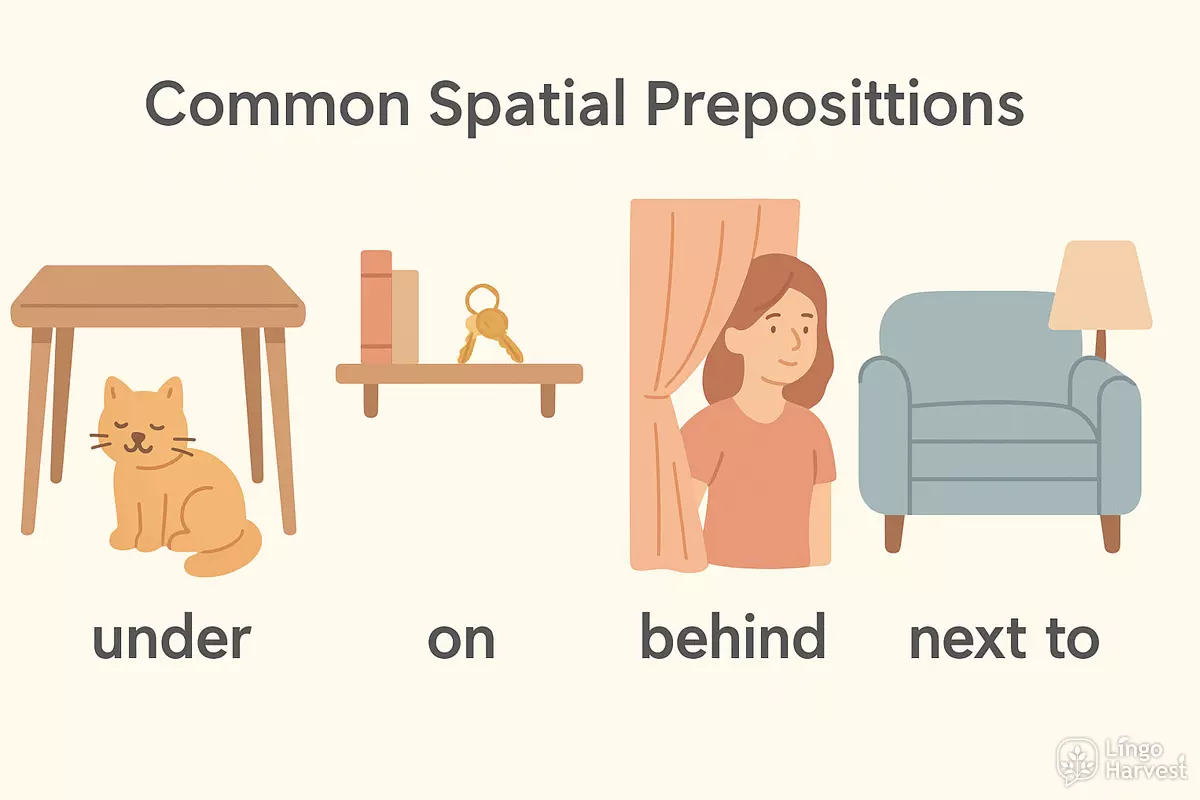
- The cat is under the table.
- The keys are on the shelf.
- She stood behind the curtain.
- The dog ran between the trees.
- The lamp is next to the sofa.
- The picture hangs above the fireplace.
- There’s a rug in front of the door.
- The ball rolled into the box.
- He hid inside the closet.
- The restaurant is across from the bank.
- The shoes are beside the bed.
- She sat at the desk.
- The bird flew over the lake.
- The park is near my house.
- The pencil fell off the table.
- He walked through the tunnel.
- The coin is underneath the cushion.
- The store is opposite the post office.
Comparing Prepositions in Structure
Some prepositions may seem similar, but their structural roles can yield subtle differences in meaning. Here’s a side-by-side look at a few often-confused options:
| Preposition | Example Sentence | Spatial Relationship |
|---|---|---|
| in | The apple is in the bowl. | Contained by something |
| on | The apple is on the table. | Resting on a surface |
| at | She is at the bus stop. | A specific point or location |
| between | The park is between two schools. | In the space separating two things |
| among | The child is among friends. | Surrounded by more than two |
Patterns in Usage
Notice how these function words consistently come before the noun or noun phrase that indicates location. Their placement within the sentence structure is predictable, making them a key element in expressing spatial relationships clearly and efficiently.
Typical Errors
Misusing prepositions that indicate spatial relationships is one of the most frequent challenges for learners. These small but significant words often don’t translate directly between languages, which can lead to confusion or awkward phrasing. Below, we explore common pitfalls and ways to avoid them when expressing location and position.
Common Mistakes with Specific Prepositions
Many errors stem from confusing similar prepositions or applying rules from a native language. Here are examples where misuse is particularly frequent:
- Using in instead of on: Saying "The picture is in the wall" ❌ instead of "The picture is on the wall" ✅.
- Confusing at and in: "She is at the school" (when talking about a student inside the building, "She is in the school" is correct).
- Using on instead of at: "Meet me on the station" ❌ should be "Meet me at the station" ✅.
- Mixing up above and over: "The lamp is over the table" (generally correct), but "The plane is above the clouds" is preferred for vertical distance.
- Using between instead of among: "Share the cake between the group" ❌ should be "Share the cake among the group" ✅.
- Omitting prepositions: "He sat the chair" instead of "He sat on the chair."
- Adding unnecessary prepositions: "Where are you at?" instead of "Where are you?"
- Using in for means of transport: "I am in the bus" (should be "on the bus").
- Incorrect use after verbs: "Arrive to the airport" (should be "Arrive at the airport").
- Confusing by and near: "The café is by the museum" (means next to, but "near" is more flexible for proximity).
- Wrong use of on for addresses: "She lives on Baker Street" (correct in English, but can be confused in other languages where "in" is used).
- Using in for surfaces: "The keys are in the table" ❌ instead of "The keys are on the table" ✅.
- Incorrect compound prepositions: "In the top of the page" (should be "At the top of the page").
- Direct translations: "He is to home" instead of "He is at home".
- Ambiguity in context: "She is in the corner" (inside a room) vs. "She is on the corner" (outside at a street intersection).
Overview: Frequently Confused Prepositions
| Preposition | Common Error & Correction |
|---|---|
| In vs. On | ❌ The cat is in the table ✅ The cat is on the table |
| At vs. In | ❌ She is at the school (student inside the building) ✅ She is in the school |
| Between vs. Among | ❌ Share the sweets between the class ✅ Share the sweets among the class |
| Arrive to vs. Arrive at | ❌ Arrive to the meeting ✅ Arrive at the meeting |
Why These Mistakes Happen
Interference from a learner’s first language is a leading cause of mistakes with spatial prepositions. Many languages use different structures or even omit prepositions where English requires them. Additionally, English prepositions of place often have idiomatic uses that must simply be memorized. Paying attention to context, memorizing common collocations, and practicing with real-life examples can help reduce these issues. Regular exposure to authentic language and targeted feedback are effective ways to build confidence and accuracy when using these structural words.
Short Practice
Understanding how location words work in sentences is essential for clear communication. Here, you can test your sense of structure and meaning by working with different spatial prepositions in context. The following exercises will help reinforce your grasp of their basic functions and how they shape the relationships between objects and places in English.
Identify the Correct Preposition
Choose the best spatial connector to complete each sentence below:
- The cat is ______ the table. (in / on / under)
- There is a picture ______ the wall. (at / on / behind)
- He sat ______ his friend during the movie. (between / under / beside)
- The bakery is ______ the corner. (at / in / behind)
- We found the keys ______ the couch cushions. (under / between / above)
Show answers
- on
- on
- beside
- on
- between
Common Prepositions and Their Typical Roles
Spatial connectors often indicate position, direction, or proximity. Review the list below for examples of their typical usage patterns:
- in – inside an area or volume (in the room, in the box)
- on – touching a surface (on the table, on the wall)
- under – lower than or beneath something (under the bed)
- between – in the space separating two things (between the chairs)
- behind – at the back of something (behind the curtain)
- in front of – before or ahead of something (in front of the house)
- next to – immediately beside (next to the lamp)
- above – higher than without touching (above the shelf)
- below – lower than without touching (below the window)
- at – a specific point or place (at the door, at the bus stop)
- over – directly upward, sometimes covering (over the city, over the tablecloth)
- opposite – facing, on the other side (opposite the building)
- inside – within the limits of something (inside the box)
- outside – on or to the outer part (outside the school)
- around – surrounding (around the park)
- along – following the length (along the street)
- through – from one side to another within (through the tunnel)
- across – from one side to another (across the river)
Spot the Error
Some sentences below use the wrong location word. Identify the error and suggest the correct form.
- The lamp is in the table.
- The children are at the garden.
- We walked in the bridge.
- Put the vase under the shelf, not above it.
Show answers
- Should be: on the table
- Should be: in the garden
- Should be: on the bridge
- Correct as is
Compare Usage: In, On, At
These three are often confused. Here is a quick comparison of their most typical roles in spatial expressions:
| Preposition | Example | Typical Use |
|---|---|---|
| in | in the room | Enclosed spaces or areas |
| on | on the table | Surfaces, flat areas |
| at | at the station | Specific points or locations |
| in | in the city | Geographical areas (cities, countries) |
| on | on the bus | Public transport, floors |
| at | at home | Fixed addresses or events |
Practicing these distinctions will help you form clearer, more precise sentences when describing locations or directions.