Prepositions of Direction: Grammar Theory

 This article explains movement prepositions, focusing on the differences between toward vs to and into vs in and onto vs on. It includes usage tips, clear examples, and a quick practice section to help you master these concepts.
Mastering how to express movement and orientation in English requires understanding the words that connect actions to destinations, such as prepositions and transitional phrases. These connecting words not only clarify the direction or location involved but also enhance the overall precision of your communication. By learning how to use them effectively, you can convey your intentions more accurately and make your speech or writing more understandable to others. Improved clarity in describing movement or position ultimately leads to stronger and more effective communication skills.
Movement Prepositions
Prepositions that describe direction or movement help us explain how something or someone travels from one place to another. These words often answer the question “where to?” and indicate a path, destination, or route. Understanding the different types and uses of these prepositions is essential for clear and accurate communication in English.
Common Directional Prepositions
Some of the most frequently used words to show direction include:
- to (moving towards a specific place: “She went to the park.”)
- into (movement from outside to inside: “The cat jumped into the box.”)
- onto (movement to a surface: “He climbed onto the roof.”)
- across (from one side to the other: “They walked across the bridge.”)
- through (from one side and out the other: “We drove through the tunnel.”)
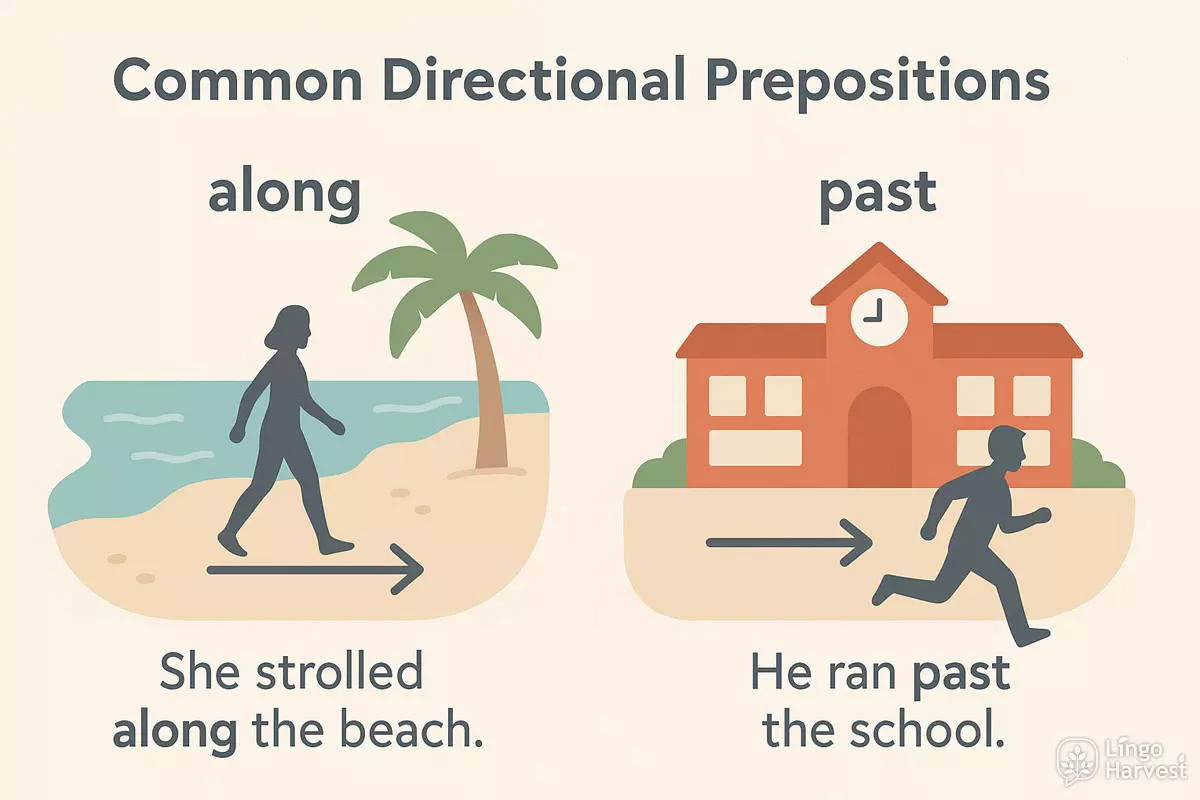
- along (following the length: “She strolled along the beach.”)
- past (going by something: “He ran past the school.”)
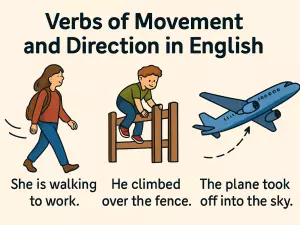
- over (above and across: “The plane flew over the city.”)
- under (below something: “The dog crawled under the table.”)
- around (in a circular route: “They moved around the statue.”)
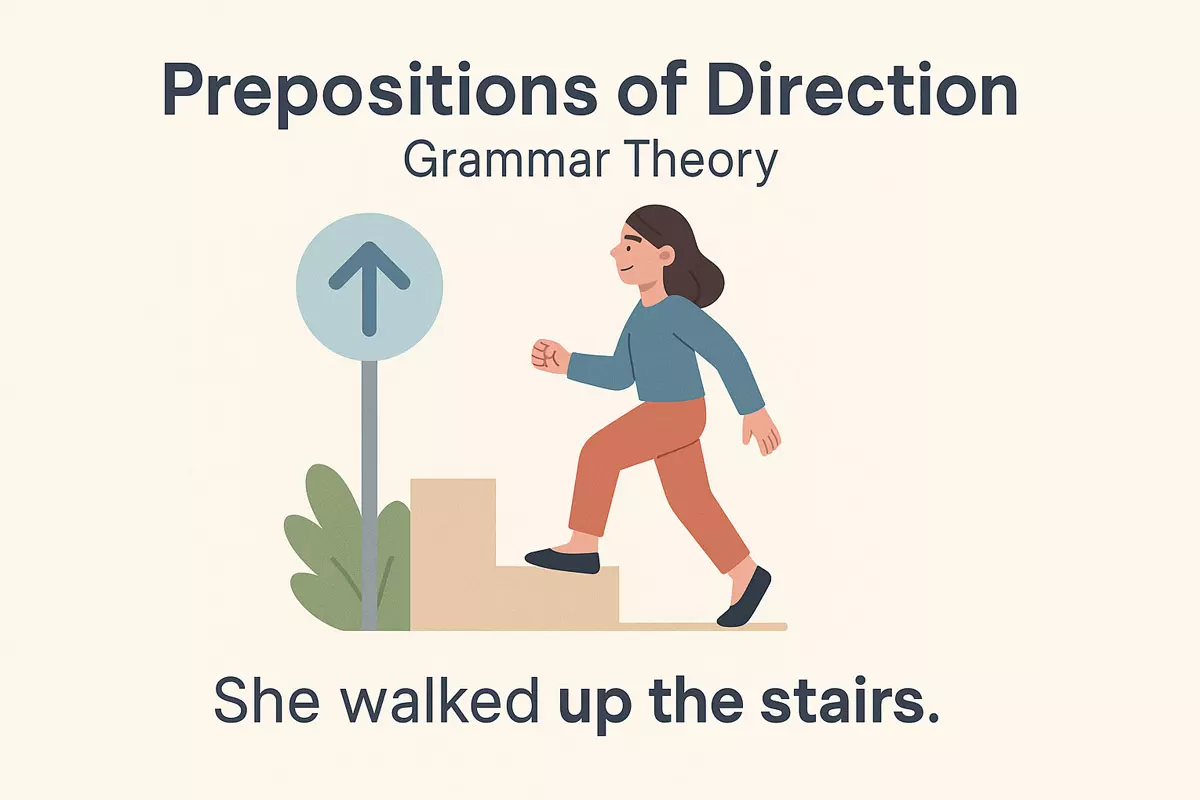
- up (from lower to higher: “She went up the stairs.”)
- down (from higher to lower: “He slid down the hill.”)
- off (away from a surface: “He jumped off the wall.”)
- towards (in the direction of: “She walked towards the exit.”)
- from (starting point: “They came from the airport.”)
Usage Patterns
Prepositions that indicate movement are usually paired with verbs of motion, such as go, run, walk, drive, and fly. The choice of preposition can change the meaning of a sentence. For example, “She walked into the room” (entered the room) is different from “She walked across the room” (traveled from one side to the other).
Direction vs. Position: Key Differences
It’s important to distinguish between prepositions that show direction (movement) and those that describe static position. For instance, “in” (already inside) is about location, while “into” (movement to inside) shows direction.
| Movement Preposition | Example Sentence |
|---|---|
| to | We are going to London for the weekend. |
| into | He poured the juice into the glass. |
| over | The ball bounced over the fence. |
| past | She hurried past the bakery. |
| through | They cycled through the park in the morning. |
| along | We walked along the riverbank. |
| up | The children ran up the hill, laughing. |
| down | He skated down the street. |
| off | The cat jumped off the counter. |
| around | They drove around the city for hours. |
Quick Tips
- Use to for a general destination, but into or onto when describing entering or going onto something.
- Choose across for moving from one side to the other, and through for passing within or inside something.
- Up and down describe vertical movement; along and around describe following a path or circling.
By mastering these directional prepositions, you can describe routes, movements, and travel with much greater precision.
Toward vs To
Both "toward" and "to" are prepositions that indicate direction, but they are not always interchangeable. The difference often lies in the sense of movement and whether or not the action is completed. "Toward" expresses movement in the direction of something, without necessarily reaching it. "To" usually implies movement all the way to a specific destination or endpoint.
Usage Patterns
- He walked toward the park. (He moved in the direction of the park, but we don't know if he arrived.)
- She walked to the park. (She reached the park.)
- We drove toward the mountains. (We headed in that direction, but arrival is not specified.)
- We drove to the mountains. (We arrived at the mountains.)
- The dog ran toward me. (Approaching, not necessarily arriving.)
- The dog ran to me. (The dog reached me.)
- He is leaning toward the window. (Direction, not contact.)
- He went to the window. (He arrived at the window.)
- They moved toward a solution. (Progress in a direction, may not have reached it.)
- They moved to a solution. (A solution was reached.)
Summary Table
| Preposition | Typical Use |
|---|---|
| toward | Indicates movement in the direction of something, without specifying arrival or completion. → He moved toward the door. |
| to | Specifies movement reaching a destination, endpoint, or goal. → He moved to the door. |
Common Errors and Tips
- Use "to" when the focus is on arrival or completion.
- Use "toward" when describing general direction or progress, without indicating arrival.
- With abstract nouns, "toward" often expresses gradual progress: She is working toward a degree.
- Some expressions require "to" for idiomatic reasons: go to school, send to jail.
In summary, choose the preposition that best matches whether you mean simply heading in a direction or actually reaching the destination. This subtle distinction can clarify your meaning in both literal and figurative contexts.
Into vs In
Understanding the difference between "in" and "into" is important for using prepositions of direction accurately. "In" is used to indicate a static position, where something or someone is already inside a space or area. "Into," on the other hand, shows movement from outside to the inside of a place. This distinction can sometimes be subtle, but it changes the meaning of a sentence.
When to Use "In"
Choose "in" when you are describing a location or state without any movement:
- The cat is in the box. (The cat is inside, no motion implied.)
- She works in an office.
- The keys are in my pocket.
- There is milk in the fridge.
- He lives in London.
These examples all focus on a position rather than a transition.
When to Use "Into"
Use "into" when movement from outside to inside is involved:
- The cat jumps into the box. (Movement from outside to inside.)
- She walked into the room.
- He threw the ball into the basket.
- Pour the juice into the glass.
- They drove into the city at night.
Here, the action is about entering or going inside, not just being there.
Comparison Table
| Usage | Example Sentence |
|---|---|
| Static location (in) | The dog is in the garden. |
| Movement to inside (into) | The dog ran into the garden. |
| State of being (in) | The book is in her bag. |
| Change of state (into) | She put the book into her bag. |
| Existing inside (in) | There are apples in the basket. |
| Action of entering (into) | She dropped the apples into the basket. |
Common Mistakes
It’s easy to confuse these prepositions, especially for English learners. Remember:
- ✅ Use "in" for locations or when no movement is implied.
- ✅ Use "into" to describe movement from outside to inside.
- ❌ Avoid using "into" when talking about static locations.
Quick Reference Examples
- He fell into the water. (motion)
- He is in the water. (location)
- She got into the car. (movement)
- She is in the car. (static)
- Birds flew into the room. (movement)
- Birds are in the room. (location)
- Put the pen into your bag. (action)
- The pen is in your bag. (result)
- Walk into the building. (entering)
- Wait in the building. (already inside)
Onto vs On
Understanding the difference between “onto” and “on” is essential for expressing direction and position correctly in English. Both words relate to location, but they are used in distinct ways that reflect movement or static placement.
Usage Overview
“Onto” usually implies motion from one place to a surface—something is moving and ends up on top of another object. In contrast, “on” describes a state in which something is already resting on a surface, with no movement implied. This distinction is subtle but important for accurate communication.
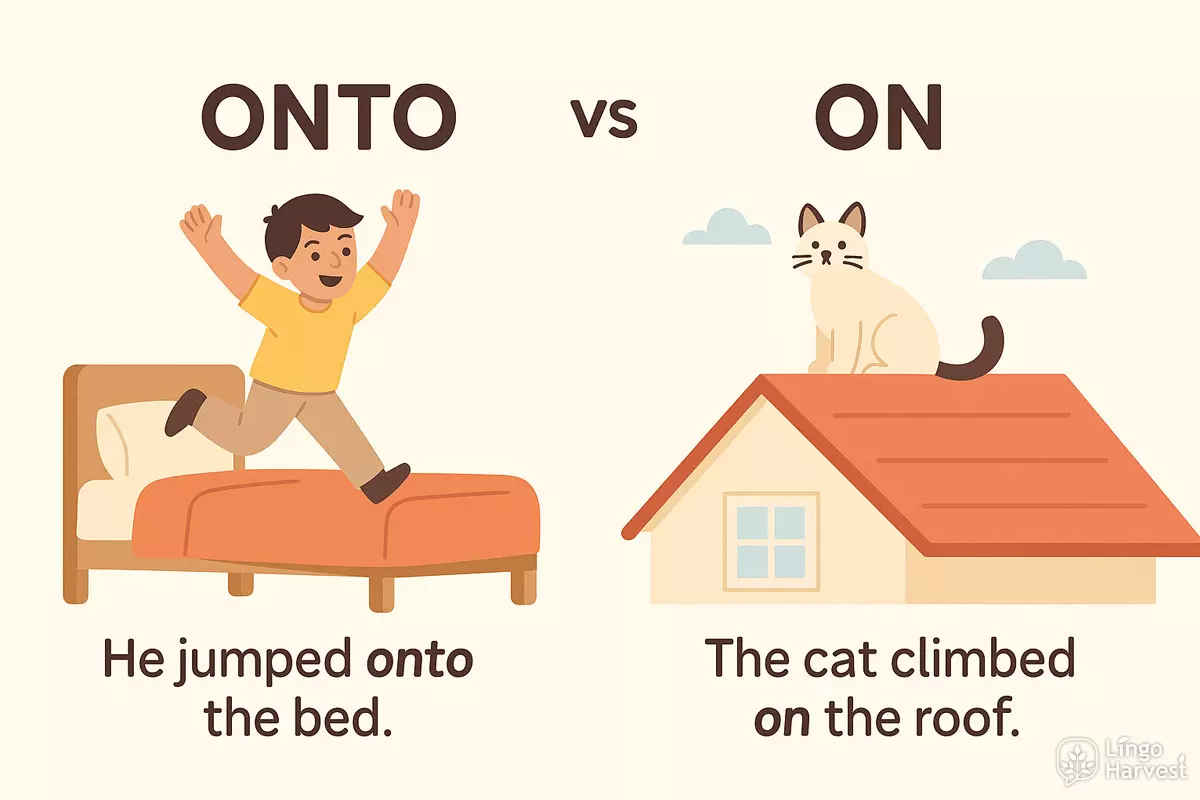
- He jumped onto the bed. (He moved from elsewhere and landed on the bed.)
- The book is on the table. (The book is resting there; no action of placing is emphasized.)
- The cat climbed onto the roof. (The cat moved up and arrived at the roof.)
- There is a vase on the shelf. (The vase is positioned there already.)
- She poured water onto the plants. (The water moved from the container to the plants.)
- He set his keys on the counter. (The keys now rest there.)
- Put your coat onto the hook. (Action of placing the coat.)
- The painting hangs on the wall. (It is attached and stationary.)
- Step onto the scale. (Move and stand there.)
- The lamp is on the desk. (Resting position.)
Common Mistakes and Tips
Choosing between these prepositions can be tricky for learners. A good rule is to ask: is there movement to a new position? If yes, use “onto.” If the object is already in place, use “on.”
| Preposition | Typical Usage & Example |
|---|---|
| Onto | Movement leading to a surface e.g., She climbed onto the chair. |
| On | Resting or located on a surface e.g., The mug is on the table. |
| Onto | Transferring something to another place e.g., Pour the juice onto the plate. |
| On | Describing attachment or fixed position e.g., The sticker is on the box. |
Summary
In summary, “onto” signals movement toward a surface or position, while “on” indicates a static location. Remember, if the sentence implies an action that results in something arriving at a place, “onto” is the natural choice; otherwise, “on” describes where something is. Recognizing this distinction helps clarify your meaning and avoids confusion in both spoken and written English.
Usage Notes
Understanding how to use prepositions that indicate movement or direction is crucial for clear and accurate communication. While these words often seem straightforward, their correct application depends on context, subtle differences in meaning, and sometimes even the verb they accompany. This section highlights important points for learners and provides concrete guidance for typical challenges.
Common Troublespots
- To expresses movement toward a specific destination: He walked to the park.
- Into signals entry from outside to inside: She jumped into the pool.
- Onto indicates movement to a surface: The cat leapt onto the table.
- Toward (or towards in British English) is about movement in the direction of something: They ran toward the station.
- Across shows movement from one side to another: He swam across the river.
- Over often means movement above something, sometimes with crossing: The bird flew over the lake.
- Through is used when movement happens inside something with boundaries: We walked through the tunnel.
- Along conveys movement following a line or path: She strolled along the beach.
- Up and down indicate vertical movement: He climbed up the ladder, then slid down.
- Off is for movement away from a surface: He jumped off the bus.
- Past means moving beyond a reference point: They drove past the school.
- Around can imply movement in a circular path or bypassing: They walked around the building.
- From marks the starting point of movement: She came from the library.
- Out of focuses on exiting: The dog ran out of the house.
Subtle Differences and Typical Mistakes
Some directional prepositions are easily confused because they describe similar actions but with different nuances. For example, in vs. into: use in for location, into for movement. Similarly, on is for position, while onto shows movement to a surface.
| Movement Preposition | Example Sentence |
|---|---|
| Into | She put the keys into her bag. ✅ |
| On / Onto | He placed the vase onto the shelf. He left the book on the table. |
| Across / Through | We walked across the street, then through the park. |
| To / Toward | She ran to the door. He moved toward the exit. |
Guidelines for Accurate Use
- Pair the preposition with a verb that clearly expresses movement.
- Check if the action is about entering, exiting, crossing, or following a path.
- Remember that some prepositions change meaning or are not interchangeable (into vs. in).
- In formal writing, avoid redundant pairs like "go to inside"—use "go inside" or "go into."
- American and British English may differ slightly in usage, especially with "toward/towards."
Mastering these forms helps convey precise directions and actions, making your statements clearer and more natural.
Examples
Understanding directional prepositions is much easier when you see how they function in context. These words and phrases often signal movement or a change in position relative to another object. Here, you’ll find sample sentences, common patterns, and typical uses to clarify how these forms work in real communication.
Typical Sentences Using Directional Prepositions
- She walked across the street to reach the park.
- He ran towards the finish line with determination.
- The cat jumped onto the table.
- They moved into the new apartment last week.
- The bird flew over the fence.
- We drove through the tunnel.
- She climbed up the stairs quickly.
- He rolled down the hill, laughing.
- The dog ran after the ball.
- Place the books beside the lamp.
- They walked along the riverbank at sunset.
- He put the letter under the door.
- The car drove past our house.
- She moved from Paris to Berlin.
- The train goes through the mountains.
- He cycled around the lake.
- She stepped off the bus.
- They walked toward the exit.
- He jumped over the puddle.
- The children ran out of the classroom.
Comparing Directional Prepositions
| Preposition | Example Sentence |
|---|---|
| to | She is going to the store. |
| into | The dog jumped into the car. |
| onto | He climbed onto the roof. |
| towards | They walked towards the station. |
| across | We swam across the river. |
| off | She got off the train. |
| through | The cyclist went through the park. |
| around | They walked around the city center. |
Notes on Usage
Some of these expressions indicate movement in a specific direction (to, into, towards), while others highlight the path taken (through, along, across). Choosing the right preposition often depends on whether you want to emphasize the destination, the starting point, or the route itself. Try to pay attention to these subtle differences when forming your own sentences.
Quick Practice
Test your understanding of how to use prepositions that show direction. The exercises below mix fill-in-the-blank and matching tasks, focusing on real-life contexts such as moving through places, describing motion, or giving directions.
Fill in the Blanks
Complete each sentence by choosing the correct preposition of direction from the options in parentheses.
- We walked ______ the park to get home. (across / along / under)
- The cat jumped ______ the table. (onto / into / from)
- She ran ______ the stairs when she heard the phone. (up / out / off)
- Throw the ball ______ me! (to / at / by)
- He cycled ______ the bridge to reach the other side. (over / through / under)
Show answers
- across
- onto
- up
- to
- over
Match the Meaning
Connect each preposition to its typical use or meaning.
- into → A. movement from outside to inside
- up → B. movement to a higher position
- across → C. movement from one side to another
- off → D. movement away from a surface
- towards → E. movement in the direction of something
Show answers
- into – A
- up – B
- across – C
- off – D
- towards – E
Common Prepositions of Direction: Examples
Here are some of the most frequently used prepositions that show movement. Notice how each one describes a different type of motion or target location:
- into (She went into the room.)
- onto (Put the book onto the shelf.)
- up (He climbed up the ladder.)
- down (They walked down the street.)
- across (We swam across the lake.)
- over (Jump over the fence.)
- through (Drive through the tunnel.)
- past (Go past the bakery.)
- towards (She moved towards the door.)
- away from (He ran away from the dog.)
- along (They strolled along the river.)
- off (Take your shoes off the table.)
- around (Walk around the building.)
- to (Send this to your friend.)
- from (He came from the library.)
Direction vs. Location: Comparison Table
Some prepositions can be used both for direction and for location, but their meaning changes. Compare these uses:
| Direction Use | Location Use |
|---|---|
| She walked into the house. → movement | She is in the house. ✅ position |
| He jumped onto the bed. | The cat is on the bed. |
| They ran across the street. | The shop is across from the library. |
| We walked past the school. | The bench is by the school. |
Practice using these forms in your own sentences to build confidence with prepositions that show movement or direction.