Verbs of Movement and Direction in English

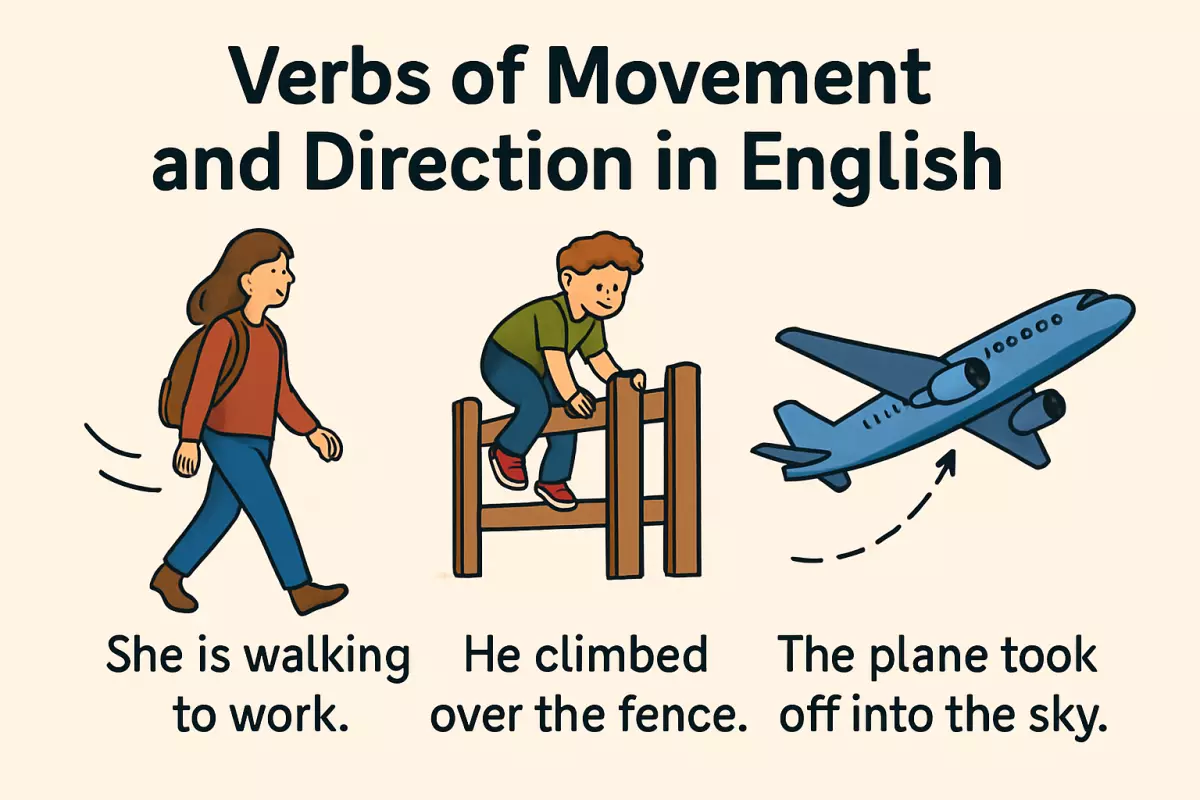 The article explains what movement and direction verbs express, with common motion verbs, direction and path expressions, and verb + preposition combinations.
Movement and direction verbs in English help you describe where you are going and how you get there, from strolling and walking to hurrying and rushing. You will learn the subtle differences that make your meaning clear in everyday conversation, travel situations, and when giving or following simple directions, so you can speak more naturally and avoid confusion when describing routes, turns, and changes in pace.
What movement and direction verbs express
These verbs show how someone or something changes location, which path it takes, and whether the speaker focuses on the start point, the route, or the destination. They also often carry information about manner (how you move) and direction (where you move).
1) Change of place: leaving one location and arriving at another
- go: neutral movement away from the speaker’s “here” (We went to the station.)
- come: movement toward the speaker or a reference point (Come into the office.)
- leave: focus on the starting point (She left home at 7.)
- arrive: focus on reaching a destination (They arrived at noon.)
- reach: emphasizes success in getting to a place (We reached the top.)
- return: movement back to an earlier place (He returned to London.)
2) Direction and path: where the movement is oriented
- approach: move closer to a target (The car approached the junction.)
- enter: move into an enclosed/defined space (She entered the room.)
- exit: move out of a place (Use the stairs to exit the building.)
- cross: go from one side to the other (Cross the road carefully.)
- pass: move beyond a point (We passed the museum.)
- follow: move behind/along the same route (Follow this path to the lake.)
- head: move in a chosen direction (Head north for two miles.)
- turn: change direction (Turn left at the lights.)
3) Manner of movement: how the motion happens
- walk: on foot, neutral pace (We walked home.)
- run: fast on foot (She ran across the street.)
- jog: steady, light running (He jogs around the park.)
- crawl: close to the ground, slow (The baby crawled under the table.)
- climb: upward effort (They climbed the hill.)
- slide: smooth movement along a surface (The box slid across the floor.)
- roll: turning over repeatedly (The ball rolled down the slope.)
- swim: through water (We swam to the shore.)
- fly: through the air (Birds flew over the field.)
- ride: on/in a vehicle or animal (She rode a bike to work.)
4) Goal vs. route: typical patterns with prepositions and particles
- Destination (end point): to is common with general motion: go to school, walk to the station.
- Arrival point: at is typical for specific points: arrive at the door; in for larger areas: arrive in Paris.
- Movement inside a space: into highlights crossing a boundary: run into the house; in often describes position rather than the boundary-crossing.
- Route/trajectory: through, across, along, past emphasize the path: walk through the tunnel; drive along the coast.
- Up/down orientation: climb up, walk down, fall down show vertical direction clearly.
- Particles that add direction: go out, come back, run away, walk in, move on often work without an object.
5) Common usage contrasts that affect meaning
- come vs. go: chosen by viewpoint (Call me when you come home → home is the reference point).
- bring vs. take: movement of an object with a person (Bring it here; Take it there).
- reach vs. arrive: reach focuses on achieving the endpoint; arrive focuses on the moment of arrival (We reached the village / We arrived in the village).
- enter (no preposition) vs. go into: both are possible, but enter is more formal (✅ She entered the building. ✅ She went into the building. ❌ She entered into the building.)
Common verbs of motion
English uses a core set of movement verbs to express how someone or something changes position (walking, running, flying) and, in many cases, where that movement is directed (into, out of, across). The same verb can sound natural or awkward depending on whether you add a destination, a path phrase, or a manner detail.
High-frequency movement verbs and how they typically behave

- go (general movement; destination-focused): often followed by to + place.
Examples: We went to the station. / Go home. - come (movement toward the speaker/listener): commonly used with here, over, back.
Examples: Come here. / She came back late. - walk (manner: on foot; can take a destination or a path phrase).
Examples: They walked to the park. / We walked across the bridge. - run (manner: fast on foot; also used for short errands).
Examples: He ran into the room. / I’ll run to the store. - drive (manner: using a vehicle; usually needs a destination or route).
Examples: She drove to work. / We drove along the coast. - ride (on/in a vehicle, bike, horse; often with to or through).
Examples: They rode to school. / We rode through the city. - fly (by air; can describe travel plans and routes).
Examples: He flew to Berlin. / The bird flew over the fence. - swim (in water; often with across, to, out to).
Examples: She swam across the river. / They swam out to the boat. - climb (upward movement using hands/feet; common with up, down).
Examples: We climbed up the hill. / He climbed down the ladder. - enter (formal; means “go into”; usually no into after it).
Examples: ✅ Enter the building. ❌ Enter into the building. - leave (movement away; often with a starting point, not a destination).
Examples: They left the office at six. / We left for the airport. - arrive (endpoint; use at for specific places, in for cities/countries).
Examples: Arrive at the hotel. / Arrive in Italy. - return (go back; slightly formal; often with to).
Examples: She returned to her seat. / They returned home. - bring (movement toward the receiver with an object/person): contrasts with take.
Examples: Bring your laptop to the meeting. / Bring the kids home. - take (movement away from the speaker/starting point; also “use transport”).
Examples: Take this to the front desk. / We took the train to London. - carry (manner: holding while moving; focuses on the effort/means).
Examples: She carried the boxes upstairs. / He carried the baby into the room.
Common patterns with direction and path
Many movement verbs combine with a path phrase (across, through, along) or a direction phrase (into, out of, up, down). This is where learners often choose the wrong preposition or add an unnecessary one.
- to + destination: walk to the station, drive to the airport
- into / out of + enclosed space: run into the house, come out of the elevator
- across + surface/area: walk across the street, swim across the lake
- through + inside/within a space: drive through the tunnel, walk through the park
- along + line/route: cycle along the river, walk along the wall
- up / down + vertical movement: climb up the stairs, run down the hill
- toward(s) + general direction (not necessarily reaching it): walk toward the exit
- away from + starting point: run away from the dog
Usage notes that prevent common errors
- Arrive needs a preposition for places: ✅ arrive at the station, ✅ arrive in Paris, ❌ arrive to the station.
- Enter is followed directly by the place: ✅ enter the room; if you prefer a preposition, use go into: go into the room.
- Go is neutral; add detail with an adverb or phrase: go quickly, go by bus, go through the gate.
- Bring vs take depends on viewpoint: bring toward “here/this person,” take toward “there/that place.”
Direction and path expressions
English often combines a movement verb with a small word or phrase that tells you where someone goes and how they get there. These add-ons can indicate a destination (goal), a route (path), a starting point (source), or a boundary (across/through), and they strongly affect which verb patterns sound natural.
Common building blocks
- Goal (destination): to the station, into the room, onto the platform, towards the exit, up to the counter.
- Source (starting point): from home, out of the building, off the bus, away from the crowd.
- Path (route/trajectory): along the river, through the tunnel, past the church, around the lake, over the bridge.
- Boundary crossing: across the street, through the doorway, into the courtyard.
- Vertical/horizontal orientation: up the hill, down the stairs, across the field.
Verb + preposition vs. verb + particle
A key pattern is the difference between prepositions (followed by an object) and particles (often used without an object, or in phrasal verbs). Many words can function as either, but the grammar changes.
- Preposition + object: “She walked into the room.” “They ran across the road.”
- Particle (no object): “Come in.” “He went out.” “The dog ran off.”
- Phrasal verb meaning (often more idiomatic than literal): “He ran into an old friend.” (met by chance, not physical impact)
- Object position with particles (when there is an object): “She took off her coat.” / “She took her coat off.” (both possible)
Choosing the right preposition for the scene
- in / into: use into for movement across a boundary (“He stepped into the lift”), and in for location (“He is in the lift”).
- on / onto: onto highlights movement to a surface (“She climbed onto the roof”); on is position (“She is on the roof”).
- to / towards: to implies reaching the endpoint (“We walked to the station”); towards focuses on direction, not arrival (“We walked towards the station”).
- over / across: across often emphasizes crossing from one side to the other (“swim across the river”); over can emphasize passing above or covering (“fly over the city,” “walk over the bridge”).
- through: movement within an enclosed space or from one side to another via an interior route (“drive through the tunnel,” “walk through the park”).
- along: following the line of something (“cycle along the canal”).
- past: passing a point (“go past the post office”).
- around: movement in a curve or avoiding an obstacle (“walk around the puddle,” “drive around the roundabout”).
- up / down: can mark slope or steps (“run up the hill,” “come down the stairs”).
Stacking path details (order and clarity)
More than one phrase can appear in the same clause. A common order is source → path → goal, especially when the speaker wants a clear route.
- “She ran out of the house across the garden to the gate.”
- “They drove from Manchester through the Peak District to Sheffield.”
- “He walked down the corridor into the office.”
- For brevity, speakers often keep only the most important element: “She ran to the gate.”
Typical usage pitfalls
- ✅ “She went home.” ❌ “She went to home.” (no to with home as an adverb)
- ✅ “He arrived in Paris.” / “He arrived at the hotel.” ❌ “He arrived to Paris.”
- ✅ “They entered the building.” ❌ “They entered into the building.” (in standard usage, enter takes a direct object)
- ✅ “She crossed the street.” ❌ “She crossed across the street.” (avoid doubling the crossing idea)
Verb + preposition combinations
Many movement verbs become more precise when they are followed by a preposition. The verb gives the basic action (move, travel, enter), while the preposition shows the route, destination, source, or position relative to something. Learning these pairings as patterns helps you choose the right form quickly in speaking and writing.
Common patterns and what they usually mean
- go to + place (destination): “We went to the station.”
- go into + enclosed space (enter): “She went into the shop.”
- go out of + enclosed space (exit): “He went out of the building.”
- go through + passage/space (from one side to the other): “They went through the tunnel.”
- go across + flat area/surface (cross): “Walk across the road.”
- go along + line/route (follow): “Go along this street for two blocks.”
- go up / go down + stairs/hill (vertical movement): “Go up the stairs and turn left.”
- come to + speaker’s location or meeting point: “Can you come to my office?”
- come from + origin: “She comes from Brazil.”
- come back to + return destination: “We came back to the hotel late.”
- arrive at + specific point (small place): “We arrived at the bus stop.”
- arrive in + larger area (city/country): “They arrived in Tokyo.”
- leave for + destination (start a trip): “I’m leaving for Paris tomorrow.”
- return to + destination (go back): “She returned to work after lunch.”
- walk to / run to + endpoint: “He ran to the door.”
- walk along / run along + route: “We walked along the river.”
- climb up + object/level: “They climbed up the ladder.”
- jump over + obstacle: “The dog jumped over the fence.”
- fall off + surface (down from): “The book fell off the table.”
Choosing the right preposition: quick usage notes
- to focuses on the endpoint; into adds the idea of entering an enclosed space. ✅ “She went to the kitchen.” / ✅ “She went into the kitchen.” (through the doorway)
- in is often used for location, not motion. ❌ “She went in the kitchen.” → ✅ “She went into the kitchen.”
- at is common for arrival at a point; in fits bigger areas. ✅ “Arrive at the airport” / ✅ “Arrive in Spain”
- across suggests crossing a surface/area; through suggests movement inside a space or passage. ✅ “across the field” vs. ✅ “through the forest”
- off shows separation from a surface; out of shows exiting a container-like space. ✅ “fall off the chair” vs. ✅ “get out of the car”
Word order with objects (especially with “go” and “come”)
- With a place noun, the preposition usually comes before the noun: “go to school,” “come from work.”
- With pronouns, the pattern stays the same: “go to it,” “come from there.”
- Avoid dropping the preposition when a destination is expressed. ❌ “We went the station.” → ✅ “We went to the station.”
Come vs go and perspective
Choose come or go based on viewpoint: are you describing movement toward a reference point (a person/place treated as “here”), or movement away from it (“there”)? This reference point is often the speaker, but it can also be the listener, the destination being discussed, or a shared “meeting point” in the conversation.
Core idea: toward vs away
- Come = movement toward the speaker’s/selected reference point (“to here”).
- Go = movement away from the speaker’s/selected reference point (“to there”).
- The “reference point” can shift during a conversation, especially when planning visits, meetings, or trips.
- In invitations and requests, English often uses come because the listener is being asked to move toward the speaker’s place or event.
Common patterns that decide the verb
- Invitations: “Come to dinner on Friday.” (toward the host’s place/event)
- Reporting someone leaving: “She went home early.” (away from the current location)
- Talking from the destination’s viewpoint: “When you come to the office, call me.” (the office is treated as the reference point)
- Meetings as a shared reference point: “Are you coming to the meeting?” (the meeting is “where we’ll be”)
- Phone/video calls: “I’m coming over now.” (toward the other person’s place, chosen as the reference point)
- Commands: “Come here.” vs “Go there.” (explicit direction words reinforce the choice)
- With back: “Come back” usually means return to the reference point; “go back” means return away from it or return to a previous place/situation from the current viewpoint.
- With in/out/up/down: “Come in” (toward where the speaker is) vs “go out” (away from where the speaker is).
Examples you can model
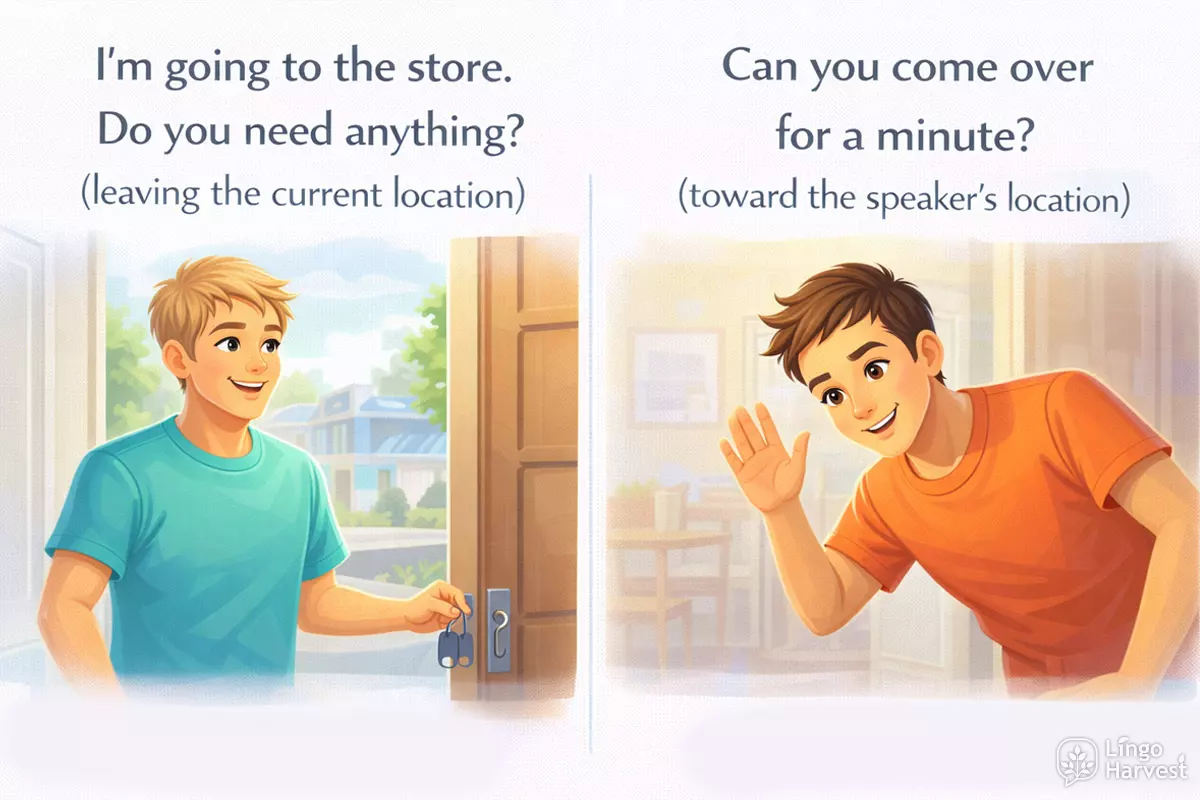
- “Are you coming to my place after work?” (toward the speaker’s home)
- “I can’t. I’m going to my parents’ tonight.” (away from the speaker’s current location)
- “Thanks for coming.” (the speaker is at the event/place)
- “I’m going to the store. Do you need anything?” (leaving the current location)
- “Can you come over for a minute?” (toward the speaker’s location)
- “I’ll go over to your place later.” (speaker frames it as leaving their current spot)
- “What time are you coming home?” (home is the shared reference point)
- “What time are you going home?” (common when the listener is not at home now; focus is departure toward home)
- “She’s coming to London next week.” (speaker positions London as the conversational “here,” often because they are there or will be there)
- “She’s going to London next week.” (neutral report; London is “there”)
- “I’m coming to your office at 3.” (listener’s place is treated as the reference point)
- “I’m going to your office at 3.” (also possible; sounds more like the speaker’s plan from their current location)
- ❌ “I’m going here.” → ✅ “I’m coming here.” (if “here” is the destination)
- ❌ “Come there.” → ✅ “Go there.” (if “there” is away from the reference point)
Quick decision checklist
- Ask: “Is the destination treated as here (toward us) or there (away from us)?”
- If you are hosting, waiting, or already at the destination, come is often the natural choice.
- If you are describing departure from your current place without adopting the destination as “here,” go is usually safer.
- If both sides share a future location (a party, class, meeting), come commonly signals joining that shared point.
Figurative uses of movement verbs
Movement verbs often describe change, progress, and relationships rather than physical travel. In these figurative patterns, the “direction” is usually abstract: toward a goal, away from a problem, into a new state, or through a process. Paying attention to common collocations and prepositions helps you choose natural phrasing.
1) Change and development (progress, decline, trends)
These verbs frame situations as if they were moving along a path. They are common in news, business, and academic writing.
- move forward / move ahead: “After the vote, the plan moved forward.”
- advance: “Research has advanced quickly in the last decade.”
- progress: “The project is progressing more slowly than expected.”
- head toward: “The company is heading toward bankruptcy.”
- drift: “The discussion drifted away from the main topic.”
- slide: “Sales slid in the second quarter.”
- fall: “Prices fell sharply overnight.”
- rise: “Confidence rose after the announcement.”
- climb: “Costs climbed throughout the year.”
- plunge: “The stock plunged on the news.”
- level off: “Inflation leveled off in May.”
- turn around: “They turned the business around.”
2) Starting, stopping, and continuing (process control)
Figurative motion is also used to manage actions and decisions. Many of these are phrasal verbs with fixed patterns.
- get going: “Let’s get going on the report.”
- set off: “That comment set off an argument.”
- kick off: “The meeting kicks off at 9.”
- carry on: “She carried on despite the setbacks.”
- keep moving: “We need to keep moving if we want to finish.”
- stall: “Negotiations stalled over funding.”
- grind to a halt: “Production ground to a halt.”
- wrap up: “Let’s wrap up and decide next steps.”
- back out (of): “He backed out of the agreement.”
- step down: “The CEO stepped down last week.”
3) Relationships and interaction (approach, avoidance, conflict)
English often treats communication and social behavior as movement toward or away from someone. Prepositions like to, from, at, and into shape the meaning.
- reach out (to): “I reached out to a mentor for advice.”
- come across: “He came across as confident.”
- run into: “I ran into an old friend.”
- get through (to): “It’s hard to get through to him.”
- push back: “Staff pushed back against the policy.”
- lash out (at): “She lashed out at her colleague.”
- back away (from): “They backed away from the proposal.”
- lean on: “Don’t lean on others to do your work.”
- close in on: “Competitors are closing in on their market share.”
- pull away: “One team pulled away in the final minutes.”
4) Thinking and understanding (mental “movement”)
Ideas can “travel,” “arrive,” or “shift.” These patterns are frequent in explanations and problem-solving.
- arrive at: “We arrived at a workable solution.”
- come to: “I came to the same conclusion.”
- work through: “Let’s work through the details.”
- go over: “We went over the data carefully.”
- move on (to): “We’ll move on to the next point.”
- circle back (to): “I’ll circle back to that question later.”
- veer off: “The argument veered off into speculation.”
- shift: “Public opinion shifted after the debate.”
- sink in: “It took time for the news to sink in.”
- jump to conclusions: “Don’t jump to conclusions.”
Common usage notes (prepositions and typical patterns)
- arrive at a decision/result, but arrive in a place and arrive on a day/date.
- head toward a goal/outcome; head for a destination: “head toward recovery” vs. “head for London.”
- move on to a new topic/task; move on from a past event: “move on to pricing” vs. “move on from the mistake.”
- drift into a topic/state (often gradual): “drift into an argument,” “drift into sleep.”
- fall into a category/habit; fall for a trick/person: “fall into a pattern” vs. “fall for a scam.”
- ✅ “The conversation drifted away from the issue.” ❌ “drifted from the issue” (possible, but less idiomatic in this meaning).
Typical learner errors
Problems with movement and direction verbs often come from mixing verb meaning (how something moves) with path expressions (where it moves), or from choosing the wrong preposition/particle. The patterns below highlight frequent mismatches and show the more natural alternatives.
1) Confusing go and come (speaker perspective)
- ❌ “I will come to the office tomorrow.” (said while at home, speaking to someone at the office) → ✅ “I will go to the office tomorrow.”
- ❌ “Can you go here for a second?” (speaker is at “here”) → ✅ “Can you come here for a second?”
- ❌ “She came to Paris last year.” (speaker is not framing Paris as the destination relative to “here/where we are”) → ✅ “She went to Paris last year.”
- Remember: come points toward the speaker/listener’s location or a shared “meeting point”; go points away.
2) Using the wrong preposition with direction (to/into/onto/across)
- ❌ “She walked to the room.” (focus is entering) → ✅ “She walked into the room.”
- ❌ “He jumped to the table.” (focus is landing on top) → ✅ “He jumped onto the table.”
- ❌ “We drove in the bridge.” → ✅ “We drove over the bridge.” / “We drove across the bridge.”
- ❌ “They ran over the street.” (often means ‘hit/knock down’ in other contexts) → ✅ “They ran across the street.”
- ❌ “He swam through the river.” (possible but suggests the river is like a tunnel) → ✅ “He swam across the river.”
3) Mixing up arrive, get, and reach
- ❌ “We arrived to the station.” → ✅ “We arrived at the station.”
- ❌ “I arrived in the bus stop.” → ✅ “I arrived at the bus stop.”
- ❌ “When we reached to the hotel…” → ✅ “When we reached the hotel…”
- ❌ “I reached at the airport late.” → ✅ “I reached the airport late.”
- Pattern reminder: arrive at (points/places), arrive in (cities/countries), reach (no preposition), get to (informal, common in speech).
4) Overusing go where a more specific verb is expected
- ❌ “He went upstairs quickly.” (not wrong, but vague) → ✅ “He ran upstairs.” / “He rushed upstairs.”
- ❌ “The car went into the wall.” (unclear cause) → ✅ “The car crashed into the wall.”
- ❌ “The boat went across the river.” → ✅ “The boat sailed across the river.” / “The boat crossed the river.”
- Choose verbs that encode the manner: walk, run, drive, fly, swim, crawl, climb, slide.
5) Particle/preposition confusion with phrasal movement verbs
- ❌ “Get in the car.” (BrE often prefers a different particle) → ✅ “Get in the car.” (AmE/neutral) / “Get into the car.” (emphasizes entering)
- ❌ “Get on the car.” → ✅ “Get in the car.” / “Get on the bus/train.”
- ❌ “He got down the bus.” → ✅ “He got off the bus.”
- ❌ “She went out the room.” → ✅ “She went out of the room.”
- ❌ “He came back to home.” → ✅ “He came back home.” / “He went back home.”
6) Using home with unnecessary prepositions
- ❌ “I went to home.” → ✅ “I went home.”
- ❌ “She arrived to home late.” → ✅ “She got home late.” / “She arrived home late.”
- ❌ “We returned back home.” (double marking) → ✅ “We returned home.” / “We went back home.”
7) Wrong verb choice for “borrowed movement” (bring/take)
- ❌ “Can you take me that file?” (toward the speaker) → ✅ “Can you bring me that file?”
- ❌ “I will bring this package to the post office.” (away from the speaker’s current location) → ✅ “I will take this package to the post office.”
- Rule of thumb: bring = toward the speaker/listener; take = away.
8) Leaving out required prepositions after certain verbs
- ❌ “We entered to the building.” → ✅ “We entered the building.”
- ❌ “He approached to me.” → ✅ “He approached me.”
- ❌ “She left from the house.” → ✅ “She left the house.” / “She left from London.” (possible when focusing on origin)
9) Confusing toward vs. to (direction vs. destination)
- ❌ “He walked to me, but stopped halfway.” (destination not reached) → ✅ “He walked toward me, but stopped halfway.”
- ❌ “The plane flew to the mountains for hours.” (unclear if it arrived) → ✅ “The plane flew toward the mountains for hours.”
Homework: movement verb practice tasks
Use these tasks to build accuracy with motion verbs, direction particles (in, out, up, down), and common prepositions (to, into, onto, across). Focus on the pattern first, then choose the verb that matches the meaning: manner (walk, run, crawl), path (enter, cross, approach), or change of position (rise, fall, sink).
Task 1: Choose the best verb (meaning first)
Complete each sentence with one verb from the box. Use the correct tense form.
Verb box: go, come, walk, run, drive, ride, fly, swim, crawl, climb, enter, leave, cross, approach, pass, return
- We usually ______ to work, but today we’re taking the bus.
- The dog ______ under the fence and escaped into the neighbor’s yard.
- Please ______ the building through the side door after 6 p.m.
- She ______ the street without looking and nearly got hit.
- A stranger ______ our table and asked a question.
- After the meeting, he ______ early to catch a train.
- They ______ home at midnight because the last movie ended late.
- I can’t ______ there; the road is closed, so I’ll take the train.
- We ______ across the lake every summer in a small boat.
- The children ______ to the car when it started raining.
- He ______ past me without saying hello.
- She ______ her bike to school when the weather is good.
Show answers
- walk
- crawled
- enter
- crossed
- approached
- left
- returned
- drive
- swim
- ran
- passed
- rides
Task 2: Preposition choice (to / into / onto / across / through)
Choose the best option for the movement pattern. Use only one preposition per blank.
- He walked ______ the room and sat down. (to / into)
- She jumped ______ the platform. (on / onto)
- We drove ______ the tunnel and saw the lights at the end. (through / across)
- They ran ______ the station, but the train had already left. (to / into)
- The cat climbed ______ the tree and wouldn’t come down. (to / up)
- He swam ______ the river in ten minutes. (across / through)
- She walked ______ the door, but didn’t go inside. (to / into)
- The child fell ______ the pool, so we pulled him out quickly. (in / into)
- We cycled ______ the bridge and took photos on the other side. (across / through)
- He pushed the cart ______ the store entrance. (to / into)
Show answers
- into
- onto
- through
- to
- up
- across
- to
- into
- across
- into
Task 3: Particle verbs (in/out/up/down/away/back) in context
Rewrite each sentence using the particle verb in brackets. Keep the meaning the same and adjust word order if needed.
- She entered the car quickly. (get in)
- They left the bus at the next stop. (get off)
- He returned to the office after lunch. (go back)
- The plane departed at 6:10. (take off)
- We continued walking after the break. (carry on)
- The thief escaped from the building. (get away)
- She removed her shoes before the lesson. (take off)
- He stopped by the shop on his way home. (drop by)
- The children exited the classroom quietly. (go out)
- She entered the room without knocking. (come in)
Show answers
- She got in the car quickly.
- They got off the bus at the next stop.
- He went back to the office after lunch.
- The plane took off at 6:10.
- We carried on walking after the break.
- The thief got away from the building.
- She took off her shoes before the lesson.
- He dropped by the shop on his way home.
- The children went out of the classroom quietly.
- She came in without knocking.
Task 4: Correct the pattern (common errors)
Each sentence has one problem with a movement verb, preposition, or direction expression. Rewrite each one correctly.
- We went in the bus and sat down.
- She entered to the room quietly.
- He arrived to the airport late.
- They crossed through the street at the lights.
- I came to home at 9.
- He got in the taxi and got out at the station. (intended meaning: he left the taxi at the station)
- The bird flew to the window and disappeared inside it. (intended meaning: it flew into the room)
- She went upstairs to the bus. (intended meaning: she boarded the bus)
Show answers
- ✅ We got on the bus and sat down.
- ✅ She entered the room quietly.
- ✅ He arrived at the airport late.
- ✅ They crossed the street at the lights.
- ✅ I came home at 9.
- ✅ He got in the taxi and got out at the station.
- ✅ The bird flew to the window and disappeared into the room.
- ✅ She got on the bus.
Task 5: Production (short writing with required patterns)
Write 8–10 sentences about a trip or commute. Include the following items at least once each:
- One verb of manner: walk, run, cycle, crawl, swim
- One verb of path: enter, leave, cross, approach, pass
- One particle verb: get in/out/off/on, take off, go back, come in
- One sentence with to (destination without entering)
- One sentence with into (movement inside)
- One sentence with across (from one side to the other)
- One sentence using home with no preposition (come home, go home)
Before finishing, check two things: (1) does your preposition match the direction meaning, and (2) did you choose a verb that fits the method of movement?