Prepositional Phrases: Structure and Function

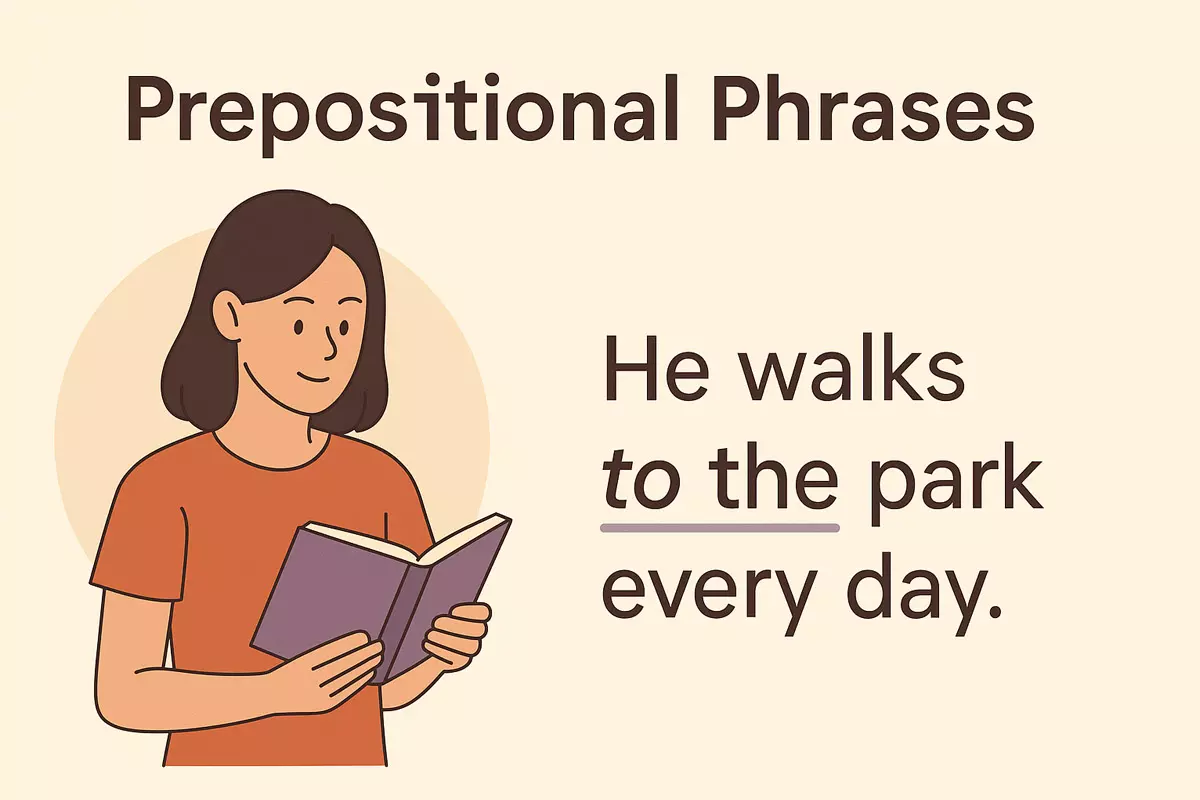 This article explains what a prepositional phrase is, outlines its key parts, and describes how it functions and modifies meaning in sentences. It covers position rules, provides examples, and includes a short practice section.
Understanding how groups of words that start with prepositions function can greatly enhance your comprehension of English sentences by highlighting important relationships and clarifying meaning. Examining their structure and purpose allows you to see how these phrases connect ideas, provide context, and contribute to clear and effective communication. By paying attention to how prepositional phrases are used, you can improve both your writing and reading skills, making your language use more precise and expressive.
What a Prepositional Phrase Is
A prepositional phrase combines a preposition with its object, usually a noun or pronoun, and any modifiers. These word groups function as a unit within a sentence, often acting like adjectives or adverbs. For example, in the sentence “The cat on the mat is sleeping,” the words “on the mat” form a prepositional phrase that tells us where the cat is.
Core Components
Every prepositional phrase has two essential parts:
- Preposition – the word that shows the relationship (such as in, on, under, by, with).
- Object of the preposition – the noun or pronoun the preposition refers to (the table, her, the city).
Modifiers, like adjectives or articles, can appear between the preposition and its object: “under the old wooden bridge.”
Common Examples
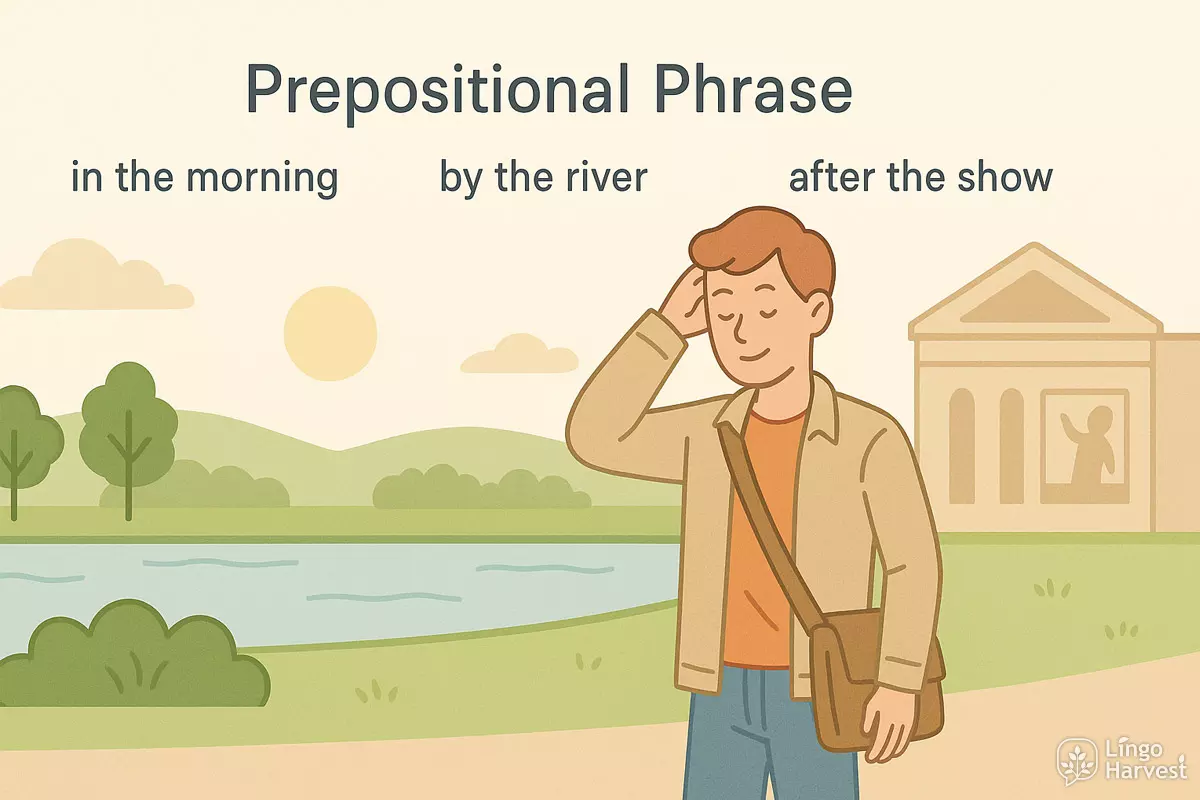
- in the morning
- by the river
- after the show
- with great enthusiasm
- during the night
- over the fence
- under the stars
- between the lines
- for the team
- at the station
- without a doubt
- from the beginning
- to the store
- about the author
- according to plan
- along the path
- within reach
- on top of the mountain
How Prepositional Phrases Function in Sentences
These constructions add detail by answering questions like where, when, how, or which one. For instance, “She arrived after midnight” explains when; “He sat beside his friend” shows where. They can also clarify meaning or reduce ambiguity.
Structure Overview
| Preposition | Object (with Modifiers) | Full Phrase |
|---|---|---|
| under | the old bridge | under the old bridge |
| with | a smile | with a smile |
| in | the blue car | in the blue car |
| for | the entire class | for the entire class |
| on | top of the hill | on top of the hill |
Recognizing and understanding these groups helps with sentence analysis and clearer communication. They’re versatile, concise, and essential for expressing relationships between different parts of a sentence.
Key Parts
Understanding the main elements that make up a prepositional phrase is essential for analyzing and constructing clear sentences. At its core, a prepositional phrase typically consists of a preposition followed by its object, often with additional modifiers. Let’s break down these components and see how they interact in different contexts.
The Basic Structure
Every prepositional phrase starts with a preposition—words like “in,” “on,” “under,” or “between”—and ends with the object of the preposition, which is usually a noun, pronoun, or noun phrase. Modifiers, such as adjectives or articles, can come between the preposition and its object to add detail.
- Preposition: Shows the relationship (e.g., “at,” “by,” “with”).
- Object of the Preposition: The noun or pronoun that completes the phrase (e.g., “the table,” “her,” “the blue car”).
- Modifiers: Words that describe the object (e.g., “the old house,” “a small group”).
Common Prepositions
English has a wide range of prepositions. Here’s a list of frequently used ones you’ll see in prepositional phrases:
- about
- above
- across
- after
- against
- among
- around
- at
- before
- behind
- below
- beneath
- beside
- between
- beyond
- by
- during
- for
- from
- in
- near
- of
- on
- over
- through
- to
- under
- with
- without
Examples of Prepositional Phrases
Here are a few sample phrases to show how these parts combine:
- in the morning
- under the old bridge
- with her friends
- between the lines
- on the shelf
- after dinner
- by the window
- across the street
- from the beginning
- into the dark forest
Comparing Simple and Complex Prepositional Phrases
Some phrases are straightforward, while others include multiple modifiers or compound objects. The table below highlights the differences:
| Type | Example | Notes |
|---|---|---|
| Simple | on the desk | Just a preposition and its object |
| With Modifier | under the heavy table | Includes an adjective |
| Compound Object | between you and me | Two nouns connected by a conjunction |
| Stacked Phrases | on the table by the window | Multiple prepositional phrases in sequence |
How to Identify Each Part
To spot the elements within a phrase, look for the preposition first. The following word or group of words, up to the next verb or punctuation, is typically the object, sometimes with modifiers in between. Recognizing these parts helps with both writing and interpretation, especially in longer or more complex sentences.
Function in Sentences
Prepositional phrases play several important roles within sentences, often providing details about time, place, manner, or other relationships. These groups of words typically begin with a preposition and end with a noun or pronoun, working together to add clarity and context.
Common Roles of Prepositional Phrases
Prepositional phrases can act as modifiers, giving more information about nouns, verbs, or even entire clauses. Here are some typical ways they function:
- Adjectival modifier: Describes or limits a noun (e.g., "the book on the table").
- Adverbial modifier: Tells how, when, where, or why something happens (e.g., "She ran through the park").
- Complement: Completes the meaning of certain verbs or adjectives (e.g., "He is interested in music").
- Clarifying relationships: Shows spatial, temporal, or logical connections (e.g., "before dinner," "next to the door").
Examples by Function
To see how these phrases operate in real sentences, here are several examples grouped by their function:
- Location: under the bridge, in the drawer
- Time: during the meeting, after lunch
- Manner: with enthusiasm, by hand
- Cause or reason: because of the rain, for safety
- Direction: toward the exit, into the room
- Possession: of the king, of my friend
- Accompaniment: with his dog, without a coat
- Comparison: like a champion, as a teacher
- Agent: by the committee, by her
- Purpose: for health, for fun
How Prepositional Phrases Affect Sentence Structure
Adding a prepositional phrase can shift emphasis or clarify meaning. Placement matters: at the start, middle, or end, a phrase can change the focus or flow. For example:
- After breakfast, we left the house. (emphasizes time)
- We left the house after breakfast. (places time information at the end)
Comparing Adjectival and Adverbial Uses
| Use | Example Phrase in a Sentence |
|---|---|
| Adjectival (modifies a noun) | The painting on the wall is new. |
| Adverbial (modifies a verb) | She danced with great energy. |
| Adjectival (identifies which one) | Please hand me the book beside the lamp. |
| Adverbial (describes when) | They arrived after the concert. |
Summary
Prepositional phrases offer essential details and connections within sentences, helping readers understand context and meaning. Whether modifying nouns or verbs, these phrases are versatile tools for expressing relationships and enhancing clarity.
Modification Roles
Prepositional phrases frequently act as modifiers, supplying additional detail about other elements in a sentence. These groups of words can answer questions such as where, when, how, or which one, directly affecting the meaning of verbs, nouns, and sometimes adjectives. Their placement and choice of preposition can subtly or significantly shift interpretation, making them essential for precise communication.
Adjectival and Adverbial Uses
One of the principal ways prepositional groups function is by modifying either nouns or verbs. When linked to a noun, they often specify or describe, working similarly to adjectives. When attached to verbs, they typically provide information about manner, time, place, or reason, acting as adverbs.
| Modifier Type | Typical Questions Answered | Example Phrase | Sample Sentence |
|---|---|---|---|
| Adjectival | Which one? What kind? | with the blue cover | The book with the blue cover is mine. |
| Adverbial | Where? When? How? Why? | in the morning | She jogs in the morning. |
| Adverbial | Where? | under the bridge | The cat slept under the bridge. |
| Adjectival | Which one? | of the three options | Choose one of the three options. |
Common Patterns for Modification
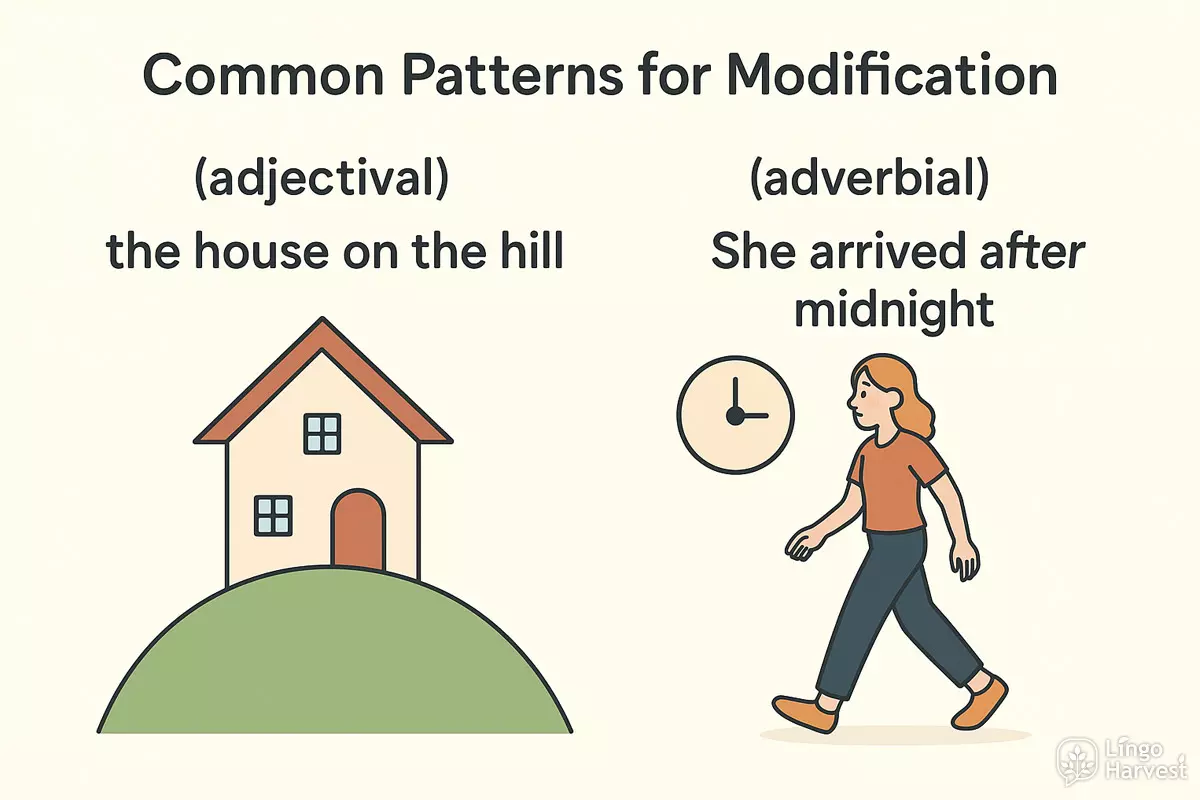
- After a noun (adjectival): the house on the hill
- Following a verb (adverbial): She arrived after midnight
- Attached to an adjective: proud of his work
- Between subject and verb for emphasis: The man in the red shirt approached
- Beginning a sentence for context: During the storm, we stayed inside
- Clarifying a pronoun: someone with experience
- Indicating purpose: for your safety
- Showing possession or association: the keys to the car
- Expressing cause: because of the delay
- Describing manner: with great care
- Marking time: at dawn
- Locating in space: near the entrance
- Specifying measurement: by the kilogram
- Demonstrating means: by train
- Expressing accompaniment: with her friend
- Indicating exception: except for Tom
- Providing comparison: in contrast to yesterday
- Explaining result: as a result of the meeting
Understanding how these phrases operate as modifiers enables writers and speakers to craft more nuanced and informative sentences. Their flexibility makes them a fundamental tool for adding clarity and precision to language.
Position Rules
Understanding where prepositional phrases fit within sentences is essential for clear and effective communication. Their placement affects not only the meaning but also the flow of your writing. Most commonly, these groups of words appear either before or after the main subject or verb, but there are several patterns and exceptions worth noting.
Initial, Medial, and Final Placement
Prepositional constructions can appear in various spots:
- At the beginning: To introduce context or background—After the meeting, everyone left.
- In the middle: Often between the subject and the verb for added detail—The book on the table belongs to Sam.
- At the end: Frequently the most natural place—She walked to the store.
Writers often choose the position based on emphasis or rhythm. Placing a phrase at the start can draw attention, while putting it at the end tends to sound more neutral.
Rules for Placement and Ambiguity
Some guidelines help avoid confusion:
- Keep prepositional elements close to the words they modify. ✅
- Be careful with phrases that could attach to more than one part of the sentence, leading to ambiguity. ❌
- When a phrase could modify more than one word, rewrite for clarity—She saw the man with a telescope can be confusing.
- Introductory prepositional phrases are often followed by a comma, especially if long or if two or more appear together.
Common Placement Patterns
Writers and speakers use prepositional constructions in a variety of ways. Here are frequent patterns:
- Before the subject: In the morning, the birds sing.
- After the verb: He waited at the corner.
- After the object: She put the keys on the shelf.
- Between subject and verb (less common): The man in the suit is my uncle.
- After adjectives: She is proud of her work.
- After nouns: The door to the garden is open.
- With infinitives: He wants to travel around the world.
- With gerunds: She is interested in learning languages.
- In passive sentences: The cake was eaten by the children.
- After adverbs: He ran quickly across the field.
- At the end for emphasis: This is the book I was talking about.
- With conjunctions: She went out before lunch and after the meeting.
Position and Emphasis: Comparison Table
| Position | Effect & Example |
|---|---|
| Initial (at the start) | Adds context, sets the scene Under the bridge, the water flowed quietly. |
| Medial (mid-sentence) | Adds detail, may interrupt subject-verb The painting on the wall is new. |
| Final (at the end) | Neutral, often most natural They arrived after midnight. |
| Multiple phrases | Can increase complexity or cause ambiguity if not clear He spoke to the students in the classroom about the test. |
Avoiding Misplaced Phrases
To maintain clarity, always position prepositional constructions as close as possible to the words they describe. Misplacing them can lead to awkward or confusing sentences. If a phrase seems unclear, try moving it or rephrasing. For example, compare:
- She served sandwiches to the children on plates. (Were the children on plates?)
- She served sandwiches on plates to the children. (Clearer meaning)
Careful placement ensures your intended meaning comes through every time.
Examples
Understanding how prepositional phrases work is easier when you see them in action. These constructions typically combine a preposition with its object, often providing extra detail about time, place, manner, or reason. Below, you’ll find practical illustrations that show how these structures function within sentences.
Common Patterns in Context
Prepositional phrases can appear in various positions. Sometimes they clarify location, while at other times they specify time or offer additional information. Here are several sample sentences, each highlighting a distinct use:
- She sat on the bench.
- The cat slept under the table.
- We will meet after the show.
- The letter arrived in the morning.
- He walked through the park.
- The keys are beside the lamp.
- They finished the project without any help.
- The picture hangs above the fireplace.
- She ran towards the finish line.
- The cookies are inside the jar.
- The dog barked at the stranger.
- We traveled by train.
- He spoke with confidence.
- The kids played during recess.
- Keep your phone within reach.
- The meeting is scheduled for tomorrow.
- The book is about ancient history.
- She completed the task in record time.
- He lives across the street.
- The answer is between the lines.
Comparing Placement in Sentences
The position of a prepositional phrase can affect the emphasis or clarity of a sentence. Sometimes these groups appear at the beginning, middle, or end. Here’s a structured comparison:
| Sentence | Function of Prepositional Phrase |
|---|---|
| Before breakfast, she jogs every day. | Shows time; placed at the start for emphasis |
| She jogs before breakfast every day. | Shows time; placed after the verb for clarity |
| The book on the table is mine. | Modifies "book" to specify which one |
| He spoke with a smile. | Describes manner; clarifies how he spoke |
Expanding on Structure
A typical prepositional phrase starts with a preposition followed by its object. Sometimes, additional modifiers expand the idea. For instance:
- Under the old wooden bridge (preposition + modifiers + object)
- At the very last minute
- In spite of the weather
These variations help writers and speakers express precise relationships and add detail to their communication.
Short Practice
Understanding how prepositional phrases work is easier when you see them in action. Try these brief activities to spot, analyze, and create your own examples. This will help you recognize how these phrases add detail and context to sentences.
Identify the Prepositional Phrase
Read each sentence. Underline the prepositional phrase and write which word it modifies (noun, verb, or adjective).
- The keys on the table are mine.
- She arrived after the meeting.
- We drove through the tunnel quickly.
- The book with the red cover is missing.
- He is interested in astronomy.
Show answers
- on the table (modifies "keys")
- after the meeting (modifies "arrived")
- through the tunnel (modifies "drove")
- with the red cover (modifies "book")
- in astronomy (modifies "interested")
Expand the Sentence
Add a prepositional phrase to each sentence to give more information. Try using different prepositions.
- The cat slept ________.
- He found his wallet ________.
- We waited ________.
- The children laughed ________.
- The picture hangs ________.
Show answers
- The cat slept under the sofa.
- He found his wallet in the car.
- We waited by the entrance.
- The children laughed at the joke.
- The picture hangs above the fireplace.
Common Prepositions and Their Use
Here is a quick overview of frequently used prepositions and example phrases:
- in the park
- on the bus
- at the office
- under the bridge
- near the lake
- with a friend
- between the buildings
- during the show
- after the storm
- about the story
- from the city
- to the station
- by the window
- over the fence
- through the woods
- against the wall
- without a doubt
- before dinner
Choose the Correct Preposition
Select the best preposition for each blank.
- She lives ___ a small village.
- The dog jumped ___ the fence.
- We met ___ lunch.
- He walked ___ the river.
- They arrived ___ time.
Show answers
- in
- over
- at
- by
- on