Prepositions vs Particles: Key Differences

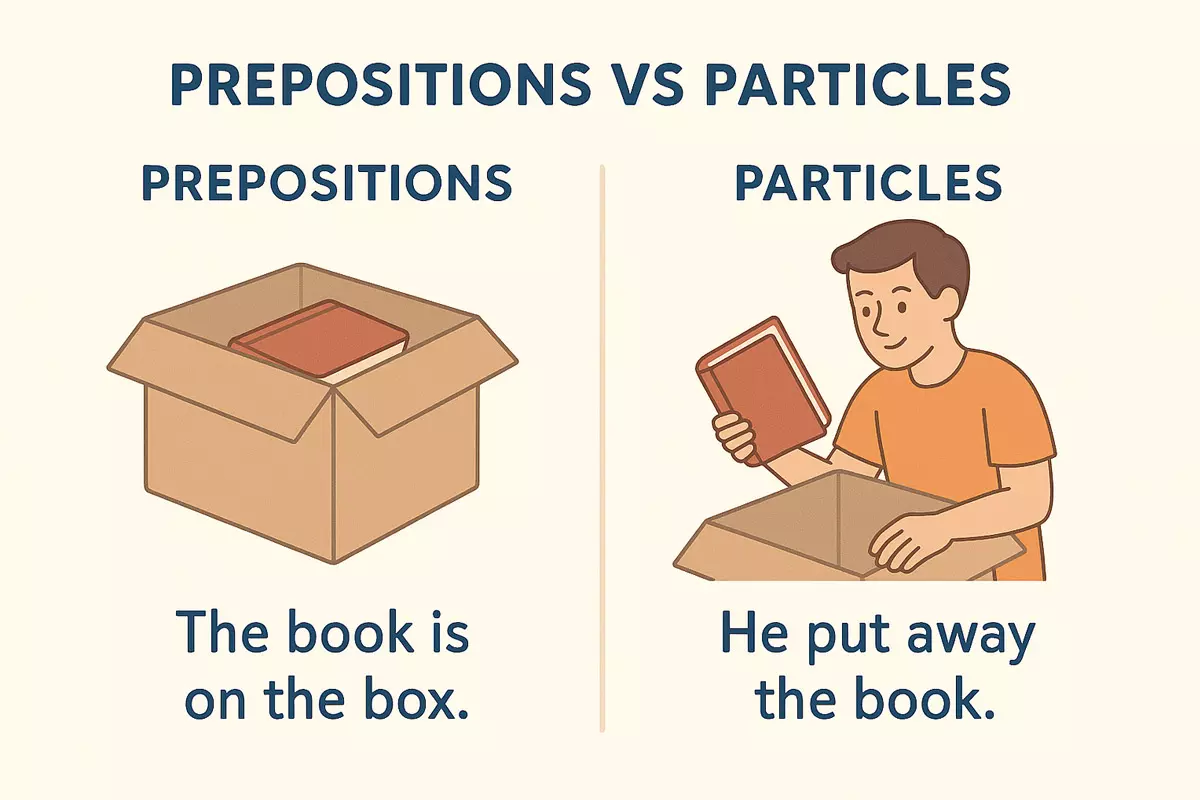 This article explains the roles of prepositions and particles, their forms, how phrasal verbs are structured, and the differences in meaning they create. It includes examples and a short practice section to help you understand these concepts.
Understanding how small words can shift meaning in English is essential for clear communication, especially because distinguishing between words that indicate relationships, such as prepositions, and those that complete phrasal verbs often causes confusion. Recognizing their unique roles allows you to use them more accurately and avoid misunderstandings. By practicing and paying attention to context, you can gradually improve your ability to choose the right words, leading to clearer and more effective communication in both writing and conversation.
What Prepositions Do
Prepositions act as connectors in sentences, showing relationships between other words—often linking nouns or pronouns to verbs, adjectives, or other nouns. Their main purpose is to indicate relationships like location, direction, time, and manner, helping to add clarity and detail to statements.
Expressing Relationships
These small words can clarify where something happens, when it takes place, or how it is related to another element. For instance, in “She sat on the chair,” the preposition “on” reveals the spatial relationship between “she” and “chair.” Similarly, “I arrived after dinner” uses “after” to clarify time.
Common Functions with Examples
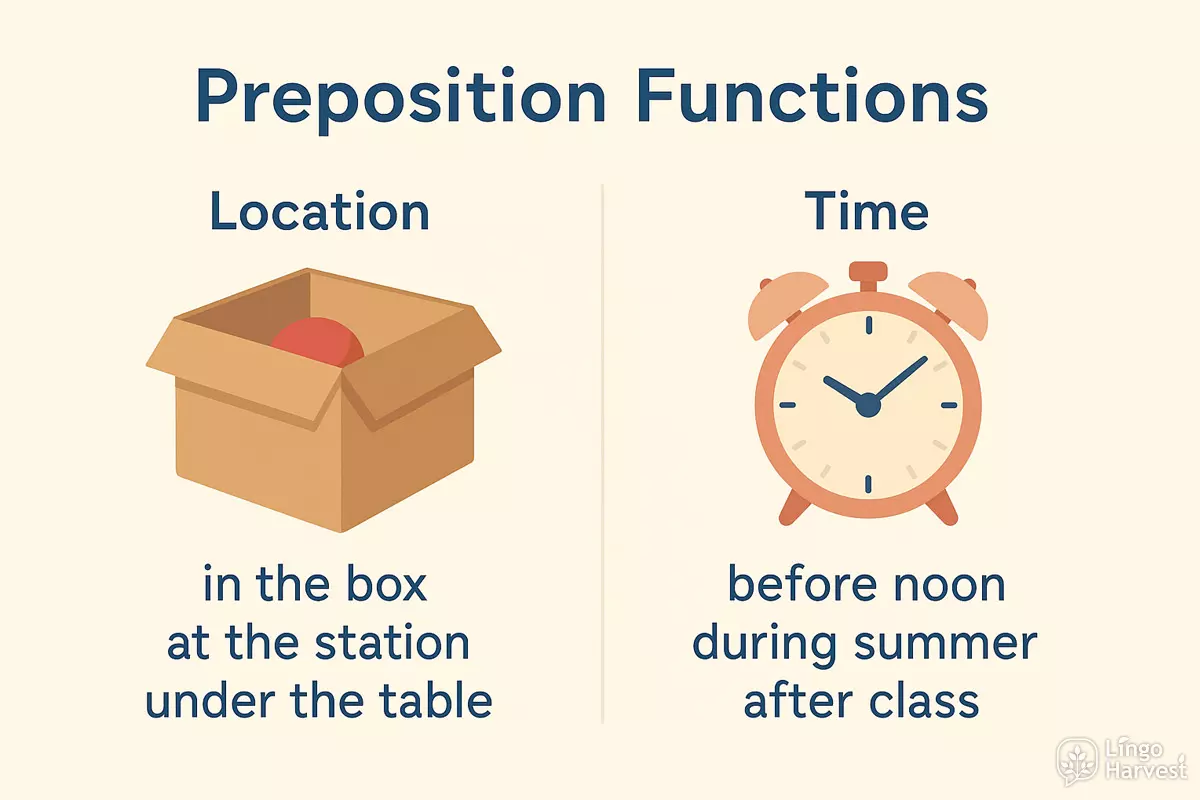
- Location: in the box, at the station, under the table
- Time: before noon, during summer, after class
- Direction: to the park, towards the exit, into the room
- Agent: by the artist, with a friend
- Cause: because of the rain, due to traffic
- Manner: with enthusiasm, by chance
- Possession: of the city, belonging to her
- Comparison: like a lion, as a leader
- Accompaniment: with my brother, along with her team
- Purpose: for fun, in order to win
Typical Placement and Structure
Prepositions are almost always followed by a noun phrase, forming what’s called a “prepositional phrase.” This phrase then functions as an adjective or adverb in the sentence. For example, in “on the table,” the phrase describes location.
| Preposition | Type of Relationship | Example |
|---|---|---|
| at | Place | at the corner |
| by | Agent | by the author |
| in | Time | in the morning |
| with | Manner | with care |
| for | Purpose | for health |
| to | Direction | to the store |
Key Takeaways
- These words clarify how different parts of a sentence are related.
- They always introduce a noun phrase, never stand alone.
- They don’t change form (are “invariable”).
- They add crucial detail to sentences, making meaning more precise.
What Particles Do
Particles play a crucial role in English, especially when combined with verbs to form phrasal verbs. Unlike prepositions, which primarily show relationships between nouns and other words, particles modify the meaning of verbs in subtle and sometimes unpredictable ways. Their main function is to alter or extend the verb’s sense, often creating idiomatic expressions that cannot be easily guessed from the meaning of the individual words.
How Particles Change Verb Meaning
When a verb is paired with a particle, the resulting phrasal verb can take on a completely new meaning. For example, "give" and "give up" have very different senses. Particles can indicate direction, completion, repetition, or even transform the verb into something idiomatic.
- Turn on (activate)
- Look up (search for information)
- Break down (stop functioning or analyze)
- Put off (postpone)
- Run into (encounter unexpectedly)
- Take off (depart or remove)
- Carry on (continue)
- Set up (arrange, establish)
- Bring up (mention)
- Get over (recover from)
- Call off (cancel)
- Back up (support or reverse)
- Fill in (complete information)
- Go over (review)
- Hand out (distribute)
- Pick up (collect or learn)
- Take over (assume control)
- Work out (solve or exercise)
Key Features of Particles
Particles are usually short words such as "up," "out," "off," "in," and "on." Their position is flexible: some phrasal verbs allow the object to come between the verb and the particle (e.g., "pick the book up" or "pick up the book"), while others do not.
- Non-literal meaning: The combined sense often isn’t obvious from the individual parts.
- Object placement: Some allow the object between verb and particle; others don’t.
- Stress and pronunciation: The particle is often stressed more than in a prepositional phrase.
- Cannot stand alone: Particles lack independent meaning in these verb combinations.
Particles vs. Prepositions: Distinct Functions
To clarify the difference between particles and prepositions, here’s a comparison of their main uses in phrasal verbs and regular phrases:
| Particle Example | Function | Preposition Example |
|---|---|---|
| Look up (a word) | Modifies verb meaning (search for) | Look up at the sky |
| Give in | Forms idiom (surrender) | Give in the box (location) |
| Take off | Verb becomes "depart" | Take off your shoes (removal) |
| Run into | Means "meet by chance" | Run into the house (direction) |
Summary
Particles are essential for creating multi-word verbs that enrich English expression. They shift, intensify, or transform meanings, often in ways that can’t be deduced by translating word-for-word. Recognizing how they interact with verbs—especially compared to prepositions—helps in mastering both understanding and usage of these structures.
Form and Function
Understanding how prepositions and particles behave in sentences is essential for grasping their distinct roles. Although both are small words often found near verbs, their grammatical behavior, position, and contribution to meaning set them apart. Let’s break down their typical forms and the functions they serve in English sentences.
Structural Differences
Prepositions are always followed by a noun, pronoun, or noun phrase, creating a prepositional phrase. Their job is to show relationships between other words, such as direction, location, or time. Particles, on the other hand, are often used with verbs to form phrasal verbs, and they can sometimes be separated from the verb by an object.
| Feature | Prepositions | Particles |
|---|---|---|
| Typical Position | Before a noun or pronoun (e.g., on the table) |
After a verb, sometimes separated (e.g., pick up the book / pick the book up) |
| Forms a Phrase With | Noun phrase | Verb (phrasal verb) |
| Movement/Flexibility | Fixed before its object | Can move after object in some cases |
| Main Function | Shows relationships (place, time, etc.) | Alters verb meaning |
Usage Patterns
- Preposition: She sat on the chair.
- Particle: Please turn off the lights. / Please turn the lights off.
- Preposition: The book is under the desk.
- Particle: He looked up the word. / He looked the word up.
- Preposition: We walked through the park.
- Particle: She gave in to their request. / She gave their request in.
- Preposition: Meet me at noon.
- Particle: They set up the equipment. / They set the equipment up.
Key Takeaways
- ✅ Prepositions always introduce a noun or pronoun (object).
- ✅ Particles are integral to phrasal verbs and may be separated from the verb by the object.
- ❌ Do not confuse position: prepositions never follow the object, but particles sometimes do.
- → Recognizing these patterns helps you use both correctly in speech and writing.
By observing these characteristics, you can more easily tell when a word is acting as a preposition or as a particle, and use them accurately in context.
Phrasal Verb Patterns
Understanding how verbs combine with small words like “up,” “off,” or “in” is crucial for mastering English expressions. These combinations can change meaning depending on whether the added word acts as a preposition or a particle. Recognizing these patterns helps you use such verbs naturally and avoid confusion.
Common Structures
English offers several ways to combine verbs with other words. Here are some frequent patterns:
- Verb + Particle (e.g., “give up,” “run out”)
- Verb + Preposition (e.g., “look after,” “believe in”)
- Verb + Particle + Preposition (e.g., “put up with,” “get away with”)
- Verb + Object + Particle (e.g., “turn the light off”)
- Verb + Particle + Object (e.g., “turn off the light”)
Word Order and Object Placement
The position of the object can depend on whether you’re dealing with a particle or a preposition. When the added word is a particle, you can often place the object between the verb and the particle (“pick it up”). With prepositions, the object usually follows the preposition (“look after her”).
| Pattern Type | Example |
|---|---|
| Verb + Particle | She gave up. |
| Verb + Preposition | He looks after his brother. |
| Verb + Particle + Object | Please turn off the radio. |
| Verb + Object + Particle | Please turn the radio off. |
| Verb + Particle + Preposition + Object | I put up with the noise. |
Expanded List of Frequently Used Combinations
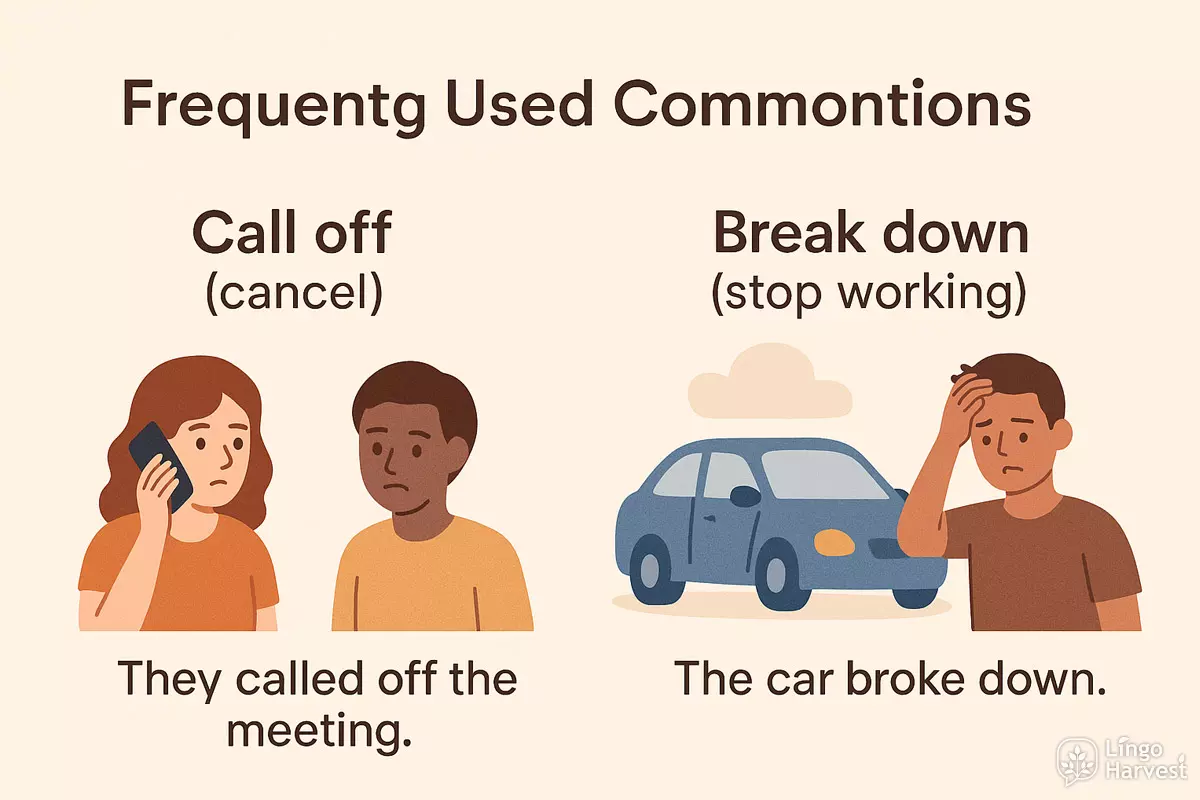
Here are some common multi-word verbs and their patterns:
- Call off (cancel): They called off the meeting.
- Break down (stop working): The car broke down.
- Carry on (continue): Please carry on with your work.
- Look into (investigate): We’ll look into the issue.
- Put off (postpone): She put off the appointment.
- Run out of (have none left): We ran out of milk.
- Look forward to (anticipate): I look forward to seeing you.
- Get over (recover): He got over the flu quickly.
- Make up (invent): Did you make up that story?
- Set up (arrange): They set up a meeting.
- Give in (surrender): He finally gave in.
- Take after (resemble): She takes after her mother.
- Turn down (refuse): He turned down the offer.
- Look up to (admire): Many look up to her.
- Pick up (collect): Can you pick up the kids?
- Back out of (withdraw): She backed out of the agreement.
- Go over (review): Let’s go over the details.
- Bring up (mention): He brought up an interesting point.
- Come across (find by chance): I came across an old photo.
- Look out for (be careful of): Look out for cars!
Key Takeaways
Recognizing these combinations and their word order rules makes your English sound more natural. Pay attention to whether you can separate the verb and the small word, and to the meaning shift that can happen with different patterns. This awareness is especially helpful when distinguishing between prepositions and particles in context.
Meaning Differences
Understanding how prepositions and particles function in English helps explain why similar-looking words can serve very different purposes in sentences. The key distinction lies in the type of relationship each element creates and how it affects the meaning of the phrase or verb.
Particles, in contrast, often form part of phrasal verbs and can dramatically change the meaning of the verb they accompany. Unlike prepositions, they do not create spatial or temporal relationships but instead modify or intensify the verb’s meaning, sometimes in idiomatic ways. For instance, “give up” (to quit) and “look out” (to be careful) include particles that alter the base verb’s meaning.
How Prepositions and Particles Affect Meaning
The core difference is that prepositions link nouns or pronouns to other words, while particles work closely with verbs to create new meanings. This can lead to confusion when the same word can function as both, depending on context.
- Prepositions: Express relationships (place, time, method, etc.)
- Particles: Change or intensify the verb's meaning, often as part of a phrasal verb
Examples Illustrating the Difference
Here are some common cases where the same word acts differently depending on its role:
- "She ran up the hill." (preposition: indicates direction)
- "She ran up a huge bill." (particle: forms the phrasal verb "run up," meaning to accumulate)
- "He looked after the baby." (particle: "look after" means to care for)
- "He arrived after dinner." (preposition: relates to time)
- "Put the book on the table." (preposition: location)
- "Put on your coat." (particle: "put on" means to wear)
- "She turned off the lights." (particle: "turn off" means to deactivate)
- "He jumped off the wall." (preposition: direction from a surface)
- "Take up yoga." (particle: "take up" means to start a new activity)
- "He sat by the window." (preposition: location)
- "Go on!" (particle: "go on" means to continue)
- "She walked through the park." (preposition: movement)
- "Carry on with your work." (particle: "carry on" means to continue)
- "He got over his fear." (particle: "get over" means to recover from)
- "The cat jumped over the fence." (preposition: movement across)
- "Pick up the phone." (particle: "pick up" means to answer)
- "She sat beside him." (preposition: location)
- "Break down the problem." (particle: "break down" means to analyze or separate into parts)
- "He walked down the street." (preposition: movement along a direction)
- "Give in to temptation." (particle: "give in" means to yield)
Summary Table: Meaning Impact
| Word as Preposition | Word as Particle |
|---|---|
| Connects nouns/pronouns to other words Shows relationship (time, place, etc.) Example: "at the park" |
Combines with verbs to create new meanings Often idiomatic or metaphorical Example: "give up" = quit |
| Has a clear, literal meaning | May change the verb’s meaning completely |
| Cannot be easily moved in the sentence | May appear after the verb or object ("pick up the phone" / "pick the phone up") |
| Answers "where?", "when?", "how?" | Answers "what is being done?" (action/result) |
In short, while both prepositions and particles might look similar, their impact on sentence meaning is distinct. Recognizing the role each plays helps avoid confusion and leads to more accurate communication.
Examples
To clarify the difference between prepositions and particles, let’s look at how each is used in actual sentences. Prepositions typically show relationships between words, while particles are often part of phrasal verbs, changing their meaning.
Common Usage Patterns
Prepositions usually answer questions like "where?", "when?", or "how?". Particles, on the other hand, are closely tied to verbs and often create a new meaning when combined.
- Preposition: She put the keys on the table. (Shows location.)
- Particle: She gave up smoking. (Forms a phrasal verb with a new meaning: to quit.)
- Preposition: The cat is under the bed.
- Particle: Please pick up your toys.
- Preposition: He arrived after lunch.
- Particle: Turn off the lights.
- Preposition: Walk through the park.
- Particle: The plane took off.
- Preposition: She sat beside her friend.
- Particle: We’ll work out the problem.
- Preposition: The letter is from John.
- Particle: The fire went out.
Side-by-Side Comparison
To see the distinction more clearly, here is a table contrasting similar-looking words functioning as prepositions and as particles:
| Preposition Usage | Particle Usage (Phrasal Verb) |
|---|---|
| She walked across the street. (Describes movement from one side to another.) |
He came across an old photo. (Means "found by chance".) |
| The picture is on the wall. | Please put on your jacket. |
| The kids ran around the playground. | Let’s look around before we decide. |
| The ball rolled under the couch. | She came under criticism. (Means "received criticism".) |
Quick Tips for Distinguishing
- If the word answers “where?” or “when?”, it’s likely a preposition.
- If the word is tightly linked to a verb and changes its meaning, it’s probably a particle.
- Try moving the word after the object: if the sentence still makes sense, it’s a particle (e.g., “pick up the book” → “pick the book up”).
This variety of sentence patterns and side-by-side contrasts should help you spot the difference in real-world English.
Mini Practice
Understanding how prepositions and particles function can be tricky, especially in phrasal verbs. Let’s work through some focused exercises to help you spot the difference and use each correctly in real sentences.
Identify: Preposition or Particle?
Read each sentence and decide if the highlighted word is a preposition or a particle.
- She looked after the children all evening.
- He ran up the hill quickly.
- They put the meeting off until Friday.
- She walked across the street.
- We turned down their offer.
Show answers
- 1. Particle (part of "look after")
- 2. Preposition (shows direction)
- 3. Particle (part of "put off")
- 4. Preposition (shows movement)
- 5. Particle (part of "turn down")
Practice: Match the Function
Below is a list of words that can serve as either prepositions or particles. Match each to a typical phrasal verb (particle use) and a standard prepositional phrase.
- on
- up
- off
- over
- in
- down
- out
- through
- around
- after
- by
- with
Show answers
- on: turn on (particle), on the table (preposition)
- up: give up (particle), up the stairs (preposition)
- off: take off (particle), off the shelf (preposition)
- over: get over (particle), over the bridge (preposition)
- in: break in (particle), in the box (preposition)
- down: slow down (particle), down the street (preposition)
- out: find out (particle), out the window (preposition)
- through: get through (particle), through the tunnel (preposition)
- around: come around (particle), around the park (preposition)
- after: look after (particle), after the movie (preposition)
- by: get by (particle), by the door (preposition)
- with: get on with (particle), with my friend (preposition)
Spot the Difference: Prepositions vs. Particles
Review the comparison below to reinforce your understanding of how these elements function in context.
| Particle Example | Preposition Example |
|---|---|
| She gave up smoking. (‘up’ is a particle, part of the verb) |
The cat jumped up the wall. (‘up’ is a preposition, shows direction) |
| He turned off the lights. (‘off’ is a particle, forms a phrasal verb) |
The book fell off the shelf. (‘off’ is a preposition, shows position) |
| They looked after the dog. (‘after’ is a particle, forms a phrasal verb) |
He ran after the bus. (‘after’ is a preposition, shows movement) |
| We got over the problem. (‘over’ is a particle, idiomatic meaning) |
The plane flew over the city. (‘over’ is a preposition, shows location) |
Try It Yourself: Make Sentences
Create two sentences for each word below: one where it acts as a preposition, and one as a particle.
- out
- down
- in
- over
Show answers
- out:
Preposition: The cat is out the door.
Particle: Please fill out this form. - down:
Preposition: The ball rolled down the hill.
Particle: Sit down, please. - in:
Preposition: The toys are in the box.
Particle: Come in! - over:
Preposition: The lamp is over the table.
Particle: Think over your answer.
By practicing these distinctions, you’ll develop greater confidence in recognizing and using both prepositions and particles in English. Review your answers and reflect on how the function changes the meaning and structure of each sentence.