Correlative Conjunctions: Paired Structure

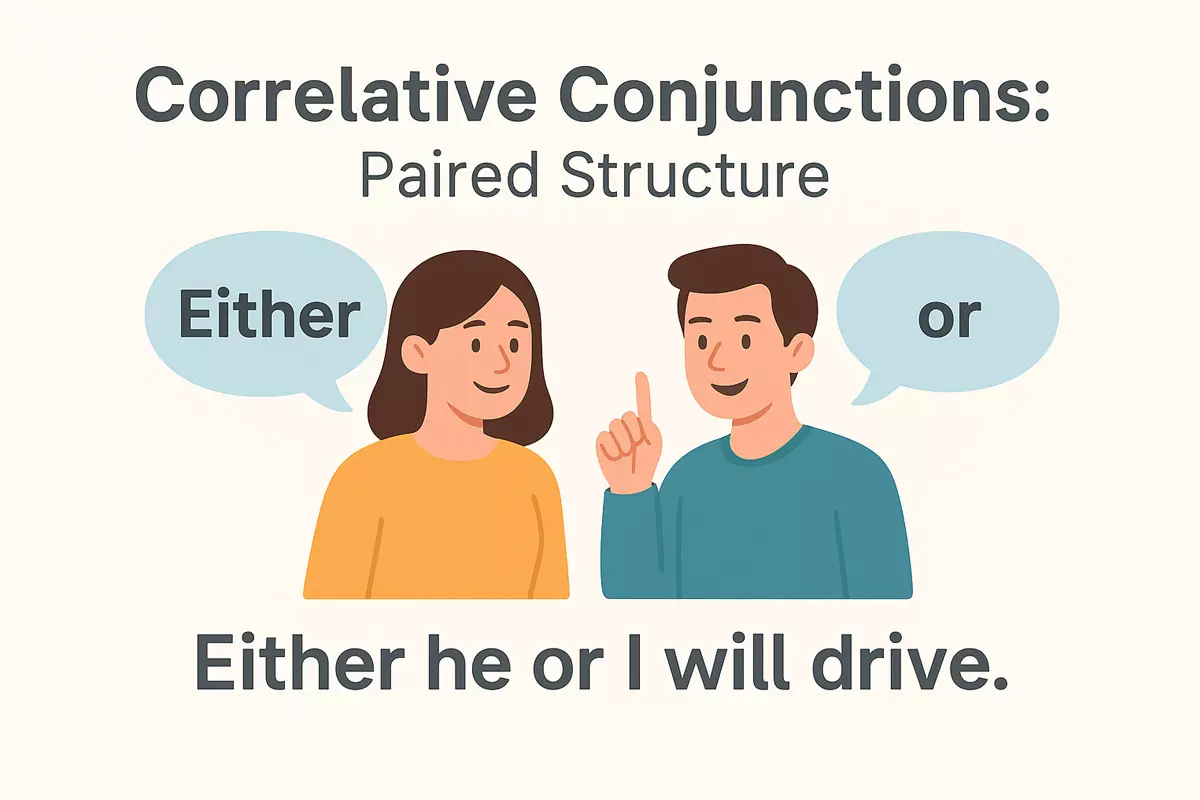 The article defines correlative conjunctions, lists frequent pairs, and explains their structure and meaning. It also covers where they appear in sentences, gives examples, and includes a brief practice section.
Mastering the use of paired linking words can significantly enhance your writing by making it more coherent and engaging for readers. These word combinations, such as both...and, either...or, and not only...but also, help you create balanced sentences that clearly connect ideas. By understanding how to use them correctly, you can improve the flow of your writing and ensure that your arguments or explanations are easy to follow. Ultimately, effective use of paired linking words adds clarity and sophistication to your communication.
What Correlatives Are
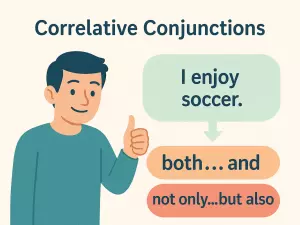
Correlative conjunctions are pairs of words that work together to connect elements in a sentence, showing that those elements have an equal or related relationship. These paired structures ensure clarity and balance, making the sentence smoother and more precise. Unlike single-word conjunctions, these always come in twos, creating a strong connection between words, phrases, or clauses.
How Paired Conjunctions Function
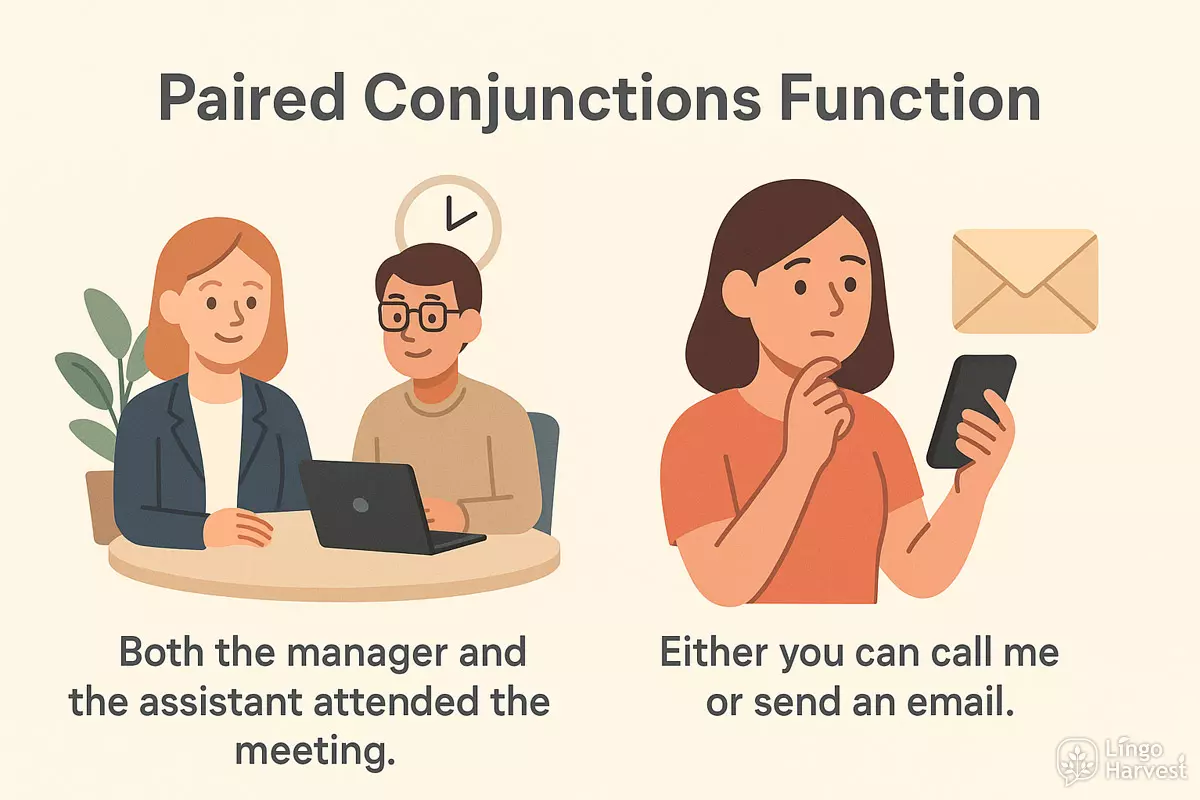
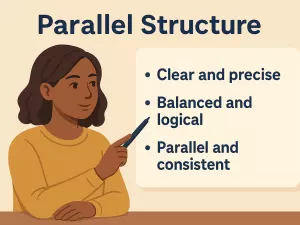
When using correlative pairs, each part of the pair must be followed by the grammatical structure it matches. For example, if a noun follows the first word, a noun should also follow the second. This parallelism is essential for both style and clarity.
- Both the manager and the assistant attended the meeting.
- Either you can call me or send an email.
- Not only did she win the prize, but also set a new record.
Common Correlative Pairs
These conjunctions appear in a variety of standard pairings. Here are some of the most frequently used:
- both ... and
- either ... or
- neither ... nor
- not only ... but also
- whether ... or
- as ... as
- such ... that
- no sooner ... than
- hardly ... when
- if ... then
- the more ... the more
- just as ... so
- rather ... than
- so ... as
- scarcely ... when
- as much ... as
- so ... that
- whether ... or not
- sooner ... than
- no less ... than
Why Use Correlative Conjunctions?
Paired conjunctions help create sentences that are more organized and balanced. They show relationships of choice, contrast, cause, or similarity. By pairing words or groups that play the same role, the sentence avoids confusion and redundancy.
Examples in Context
Below are examples showing how these pairs work within sentences:
- She wants either tea or coffee.
- Neither the movie nor the play interested him.
- Not only did he finish early, but also helped others.
- He is as tall as his brother.
- Whether you agree or not, the decision is final.
Key Features of Paired Structure
- Always appear in pairs
- Require parallel grammatical forms →
- Emphasize equality or alternative between elements
- Used for clarity, emphasis, and style
Common Pairs
When learning about paired conjunctions, it helps to focus on the most widely used sets in English. These word partnerships work together to connect ideas and show relationships between two parts of a sentence. Each pair has its own nuance, and mastering their usage adds both clarity and style to your writing.
Frequently Used Sets
Some combinations are especially prevalent in both spoken and written English. Here are several examples of these structures:
- either … or
- neither … nor
- both … and
- not only … but also
- whether … or
- just as … so
- such … that
- no sooner … than
- as … as
- rather … than
- the more … the more
- scarcely … when
- if … then
- as much … as
- so … as (often in negative sentences)
- from … to
- whether … or not
- hardly … when
Usage Patterns and Examples
These conjunctions are always used in pairs, meaning both elements are required for the sentence to make sense. For instance, “either” must be matched with “or,” and “neither” with “nor.” Here are some sample sentences to illustrate their structure:
- She will either call you or send an email.
- Both the manager and the assistant attended the meeting.
- Not only did he finish early, but also he helped others.
- Neither the rain nor the wind stopped the match.
- Whether you agree or not, the rules remain the same.
Comparison of Popular Structures
| Pair | Typical Use |
|---|---|
| either … or | Presents two alternatives or choices. Example: You can either stay here or come with us. |
| neither … nor | Shows that two things are not true or will not happen. Example: Neither the tea nor the coffee was hot. |
| both … and | Emphasizes that two elements are included. Example: She is both talented and hardworking. |
| not only … but also | Adds emphasis by introducing an additional, often surprising, element. Example: He not only sings but also dances. |
| whether … or | Indicates alternatives, often without much difference between them. Example: Whether you win or lose, try your best. |
| as … as | Used for comparisons. Example: She is as tall as her brother. |
| rather … than | Shows preference between two options. Example: I would rather read than watch TV. |
| no sooner … than | Describes two events happening in quick succession. Example: No sooner had we left than it started to rain. |
| such … that | Expresses cause and effect. Example: It was such a cold day that we stayed indoors. |
| scarcely … when | Highlights that one event follows another very closely. Example: Scarcely had she arrived when the phone rang. |
By familiarizing yourself with these pairings, you’ll be able to recognize and use them accurately, making your sentences more precise and expressive. Practice combining these structures in different contexts to improve fluency and comprehension.
Structure Rules
Understanding how to pair correlative conjunctions correctly is crucial for clear, logical writing. These conjunctions always work in pairs, and the sentence elements following each part of the pair must match in grammatical form. This parallel structure ensures your meaning is easy to follow and your writing sounds natural.
Maintaining Parallelism
When you use correlative pairs, the words, phrases, or clauses that follow each conjunction should be grammatically similar. For example, if you start with a noun after the first part, the second part should also be followed by a noun. The same goes for verbs, adjectives, or entire clauses. This parallel structure is not just a style choice; it prevents ambiguity and awkwardness.
- Correct: She wants either to travel or to study.
- Incorrect: She wants either to travel or a new job.
- Correct: Both the manager and the assistant attended.
- Incorrect: Both the manager and attended the meeting.
Common Correlative Pairs and Their Patterns
Some paired conjunctions are more common and follow predictable patterns. Here’s a guide to how these pairs typically structure sentences:
| Conjunction Pair | Typical Structure Example |
|---|---|
| both ... and | Both noun and noun |
| either ... or | Either verb or verb |
| neither ... nor | Neither adjective nor adjective |
| not only ... but also | Not only clause but also clause |
| whether ... or | Whether phrase or phrase |
| as ... as | As adjective as adjective |
| just as ... so | Just as subject + verb, so subject + verb |
| the more ... the more | The more adjective, the more adjective |
| no sooner ... than | No sooner auxiliary + subject + verb than clause |
| rather ... than | Rather verb than verb |
Tips for Consistency
- Check that both parts of the pair are present; omitting one breaks the pattern.
- Balance the grammatical forms after each conjunction to avoid errors.
- Be especially careful with longer or more complex sentences; parallelism can be harder to spot.
- When in doubt, read the sentence aloud to ensure it sounds balanced and clear.
Quick Reference: What to Avoid
- Mixing different grammatical structures after each conjunction (e.g., noun + verb).
- Forgetting to include the second part of the pair.
- Using a correlative pair with only one element.
By keeping these principles in mind, you can use correlative conjunctions to create well-structured, effective sentences.
Meaning Patterns
Correlative conjunctions create distinct relationships between paired elements in a sentence. Their structure not only links words or phrases but also shapes the logical connection: emphasizing similarities, contrasts, choices, or conditions. Understanding how these pairs work helps clarify meaning and improves flow in writing and speech.
Types of Logical Relationships
Some paired connectors draw attention to addition, while others signal alternatives, contrasts, or results. Here are common types of relationships expressed by these structures:
- Addition: both...and links two similar ideas or items.
- Choice: either...or presents alternatives.
- Negation: neither...nor excludes both options.
- Contrast: not only...but also highlights an unexpected or emphatic addition.
- Proportionality: the more...the more or the less...the less express degree.
- Conditional relationships: whether...or signals possibilities or uncertainty.
Examples of Paired Structure in Context
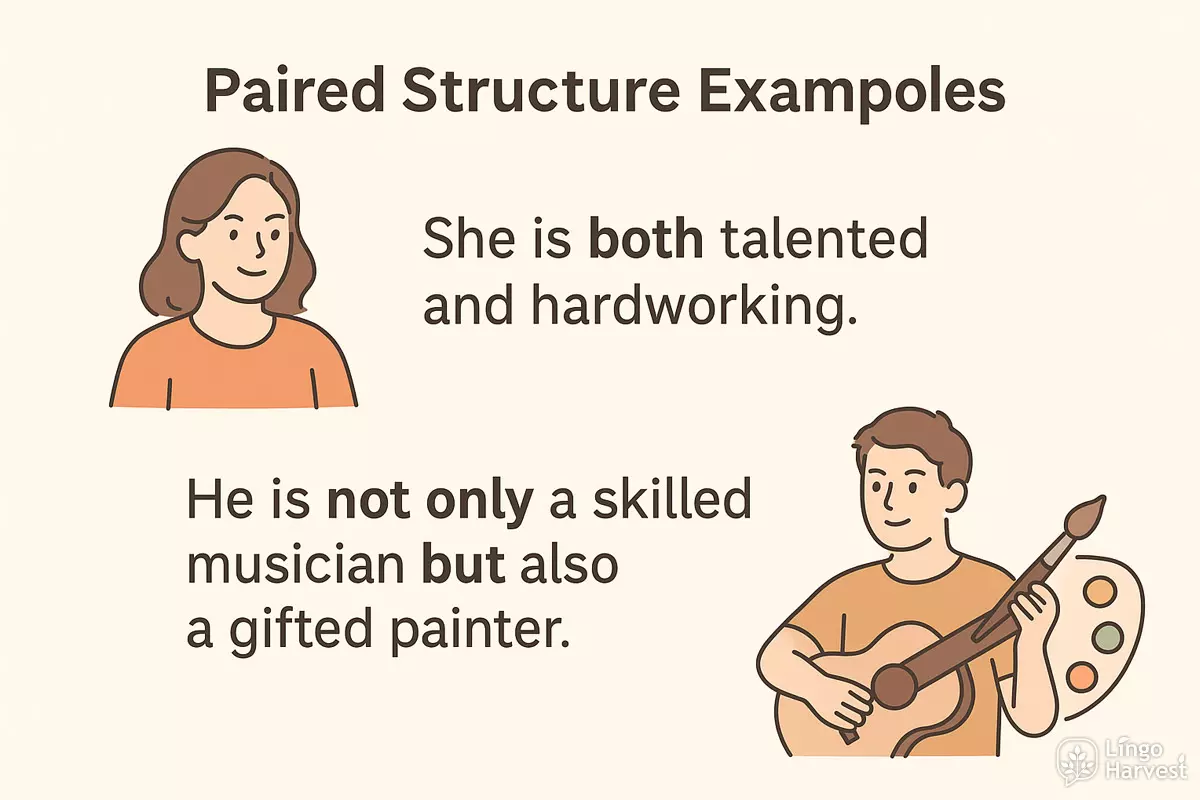
Writers use these connectors across a range of contexts. Notice how each pair shapes the sentence’s meaning:
- She is both talented and hardworking.
- You can either stay or leave.
- He is not only a skilled musician but also a gifted painter.
- We will neither confirm nor deny the rumors.
- Whether we win or lose, we will celebrate.
- The more you practice, the better you become. →
- Not this but that was the real reason.
- She scarcely had time to eat when the meeting began.
- He as much as admitted his mistake.
- Such was his excitement that he couldn’t sleep.
Comparison of Common Correlative Pairs
Below is a quick reference showing typical pairs and the relationships they express:
| Pair | Relationship/Use |
|---|---|
| both...and | Addition, combining elements |
| either...or | Choice between options |
| neither...nor | Excluding all options |
| not only...but also | Emphatic addition or contrast |
| whether...or | Uncertainty, conditional |
| the more...the more | Proportional increase |
| as...as | Comparison of degree |
| so...that | Result or consequence |
| such...that | Result or intensity |
| no sooner...than | Immediate sequence |
Summary
Pairing elements with these conjunctions clarifies relationships and avoids ambiguity. By mastering these patterns, speakers and writers create sentences with clear, logical connections, making communication more precise and engaging.
Position in Sentences
Correlative conjunctions always appear in pairs and typically frame the elements they connect. Their placement depends on the structure of the sentence and the type of words or phrases being linked. The paired words must directly precede the corresponding elements, ensuring clear parallelism and balance.
Typical Placement Patterns
These paired conjunctions generally sit before the words, phrases, or clauses they join. For example, in "either...or," "either" comes before the first element and "or" before the second. This pattern helps signal to the reader or listener that two items are being coordinated.
- Not only do I like tea, but also I enjoy coffee.
- She will either call you or send an email.
- Both the manager and the assistant attended the meeting.
- He is neither ready nor willing to participate.
- You can whether stay here or leave now.
- Such was her charm that everyone listened.
- As much as I try, I can’t win so easily.
- No sooner had he arrived than he left again.
- Rather than complain, she got to work.
- Scarcely had I sat down when the phone rang.
Maintaining Parallel Structure
When using correlative conjunctions, the grammatical form following each part of the pair should be the same. For example, if the first element is a noun, the second should also be a noun.
| Correlative Pair | Example (Parallel Elements Highlighted) |
|---|---|
| both ... and | Both singing and dancing were popular at the party. |
| either ... or | You can either call or text me. |
| not only ... but also | Not only did she win but also set a record. |
| neither ... nor | He is neither hungry nor thirsty. |
| whether ... or | Whether at home or at work, she stays busy. |
Common Pitfalls
Writers sometimes separate the paired conjunctions too far apart or mix mismatched grammatical forms. For clarity and correctness, always keep each part of the pair adjacent to the element it modifies, and ensure both elements are parallel in structure. By carefully arranging correlative conjunctions, sentences become clearer and more effective, helping readers easily follow the relationships between ideas.
Examples
Understanding paired conjunctions is easier when you see them in action. These structures connect words, phrases, or clauses, and always appear in matching pairs. Below, you’ll find a variety of sample sentences and patterns that demonstrate how these pairs function in different contexts.
Common Correlative Conjunction Pairs
- Both...and: She is both intelligent and hardworking.
- Either...or: You can either call me or send an email.
- Neither...nor: Neither the manager nor the staff were informed.
- Not only...but also: Not only did he finish early, but he also helped others.
- Whether...or: Whether you win or lose, try your best.
- No sooner...than: No sooner had we arrived than it started raining.
- As...as: She is as tall as her brother.
- Such...that: He spoke in such a quiet voice that nobody could hear him.
- Rather...than: I would rather walk than take a taxi.
- Scarcely...when: Scarcely had I sat down when the phone rang.
- Just as...so: Just as the sun rises, so does hope.
- So...as: She is not so skilled as her predecessor.
Sentence Patterns with Paired Structures
The structure of a sentence changes slightly depending on the correlative pair used. Here are some illustrative patterns:
- Both + noun/verb/adjective + and + noun/verb/adjective
- Either + option 1 + or + option 2
- Not only + clause 1 + but also + clause 2
| Correlative Pair | Sample Sentence |
|---|---|
| Both...and | Both the teacher and the students enjoyed the trip. |
| Either...or | We can either go hiking or stay at home. |
| Neither...nor | Neither the rain nor the wind stopped us. |
| Not only...but also | Not only is she a talented artist, but she also writes poetry. |
| Whether...or | Whether you agree or disagree, please share your opinion. |
| No sooner...than | No sooner had the show begun than the lights went out. |
| Rather...than | He’d rather read than watch TV. |
| Such...that | It was such a hot day that everyone stayed indoors. |
Usage Tips
For clarity, remember that the grammatical structures following each part of the pair should be parallel. For instance, if you use a noun after the first conjunction, use a noun after the second as well: She likes both apples and oranges (nouns), not She likes both apples and running (noun and verb). Consistency helps your writing sound natural and clear.
Short Practice
Let’s reinforce your grasp of paired conjunctions with some focused exercises. Below, you’ll find fill-in-the-blank sentences and a task to correct mistakes in sentence structure. These activities spotlight commonly used pairings, such as either…or and both…and. Pay attention to parallel structure, since both elements in a correlative pair should be grammatically similar.
Fill in the Blanks
- ________ the manager ________ his assistant were present at the meeting.
- You can ________ call me ________ send an email.
- She is ________ talented ________ hardworking.
- We will go hiking ________ it rains ________ it shines.
- He wants ________ to travel ________ to learn new languages.
Show answers
- Both the manager and his assistant were present at the meeting.
- You can either call me or send an email.
- She is both talented and hardworking.
- We will go hiking whether it rains or it shines.
- He wants not only to travel but also to learn new languages.
Identify the Error
Read each sentence. If there’s a mistake in the use of paired conjunctions or parallel structure, rewrite the sentence correctly.
- She wants either to study medicine or engineering.
- Both he likes swimming and running.
- Not only did he forget the keys, but he also lost his wallet.
- We can neither wait here nor at the café.
Show answers
- She wants to study either medicine or engineering.
- He likes both swimming and running.
- Correct as written.
- We can wait neither here nor at the café.
Common Correlative Pairs
Here are some frequent pairings to watch for. All require parallel structure for clarity and correctness.
- both … and
- either … or
- neither … nor
- not only … but also
- whether … or
- as … as
- no sooner … than
- just as … so
- the more … the more
- such … that
- hardly … when
Remember, using these constructions effectively means matching verb forms, noun types, or phrases on both sides of the pair. This attention to structure helps your sentences read smoothly and avoids common pitfalls.