What Are Determiners? Complete Guide

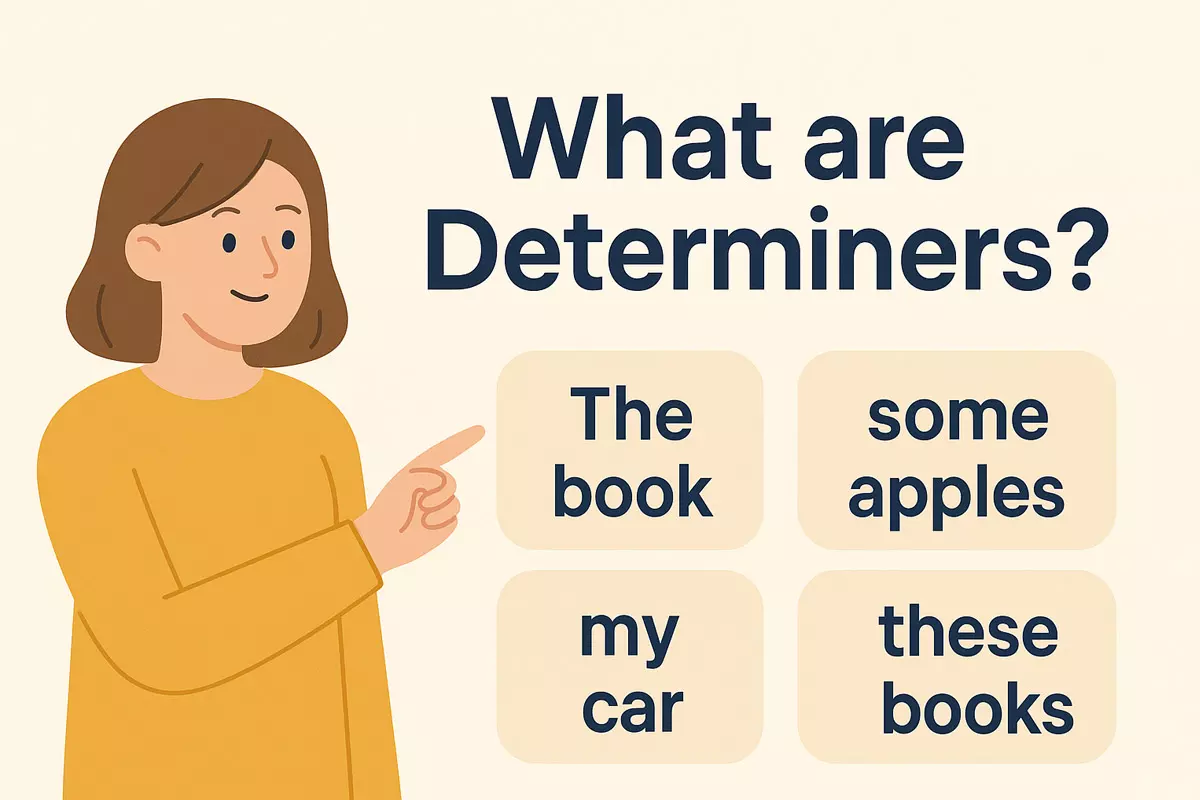 This article explains what determiners do, their main categories, and their position before nouns. It covers how determiners affect meaning and reference, outlines agreement rules, highlights common mistakes, and includes quick practice.
Have you ever considered how small words such as this, some, or her influence the meaning of sentences? These often overlooked words, called determiners, are essential for making our communication clear and specific. Determiners appear before nouns and help us identify which one we mean, how much or how many, or even who owns something. For instance, there is a difference between saying a book and the book, or her idea and their idea. Without determiners, our sentences would be much less precise and sometimes confusing.
What Determiners Do
Determiners play a key role in shaping the meaning of noun phrases. They provide context by specifying which thing or things you are talking about, helping listeners and readers understand exactly what is meant. Without them, sentences can become vague or ambiguous. These words work in tandem with nouns to answer questions like “which one?”, “how many?”, or “whose?”
How Determiners Function in Sentences
These words or phrases precede a noun and give details about its reference. For example, adding “that” before “book” (“that book”) shows you mean a specific book, not just any book. They can indicate possession, quantity, definiteness, or proximity, among other qualities. This allows speakers and writers to be precise and clear in communication.
- Defining reference: Tell us if something is known or unknown (the, a, an).
- Showing quantity: Indicate how many or how much (some, many, few, every).
- Expressing possession: Show ownership or relationship (my, your, their, whose).
- Demonstrating proximity: Point out things nearby or far away (this, that, these, those).
- Clarifying which one: Specify a particular item or group (each, either, neither, both).
- Limiting or generalizing: Make a noun phrase more specific or more general (all, any, no, several).
Examples of Determiners in Action
Here are several examples to illustrate how these words shape meaning in everyday sentences:
- The cat slept all day. (a specific cat)
- Some people like jazz. (an unspecified number)
- My car is new. (shows possession)
- Each student received a book. (every individual student)
- That movie was exciting. (refers to a particular film)
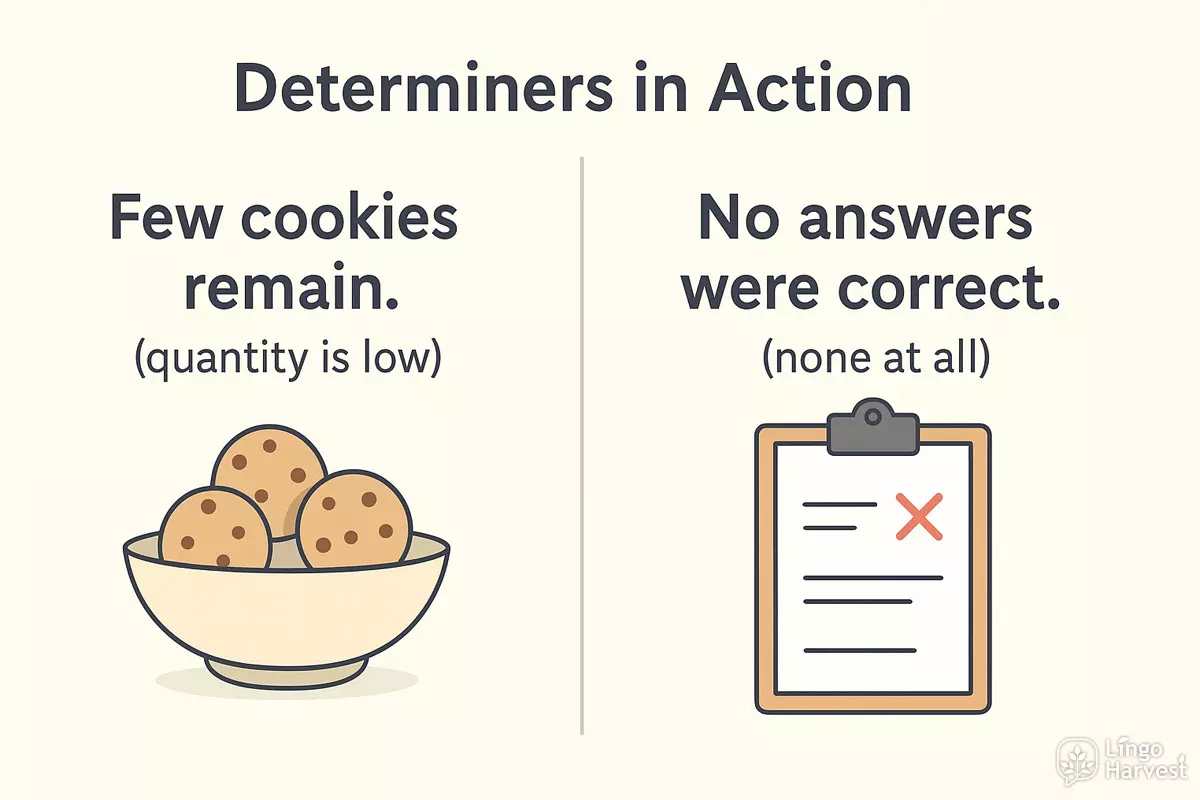
- Few cookies remain. (quantity is low)
- No answers were correct. (none at all)
- All roads lead to Rome. (every road)
- Whose phone is this? (asks about ownership)
- Another chance will come. (an additional one)
- Both options are good. (two choices)
- Any solution works. (no specific one)
Types and Effects
The type of word chosen can subtly or dramatically change the meaning of a phrase. For instance, “a car” suggests any car, while “my car” singles out one specific vehicle. The presence or absence of these words can even determine whether a phrase is grammatical in English.
| Type of Determiner | Example in a Sentence |
|---|---|
| Definite article | She saw the dog in the yard. |
| Indefinite article | He bought a book yesterday. |
| Demonstrative | Can you pass those papers? |
| Possessive | Her backpack is green. |
| Quantifier | We need more chairs. |
| Interrogative | Which route is faster? |
In summary, these small but essential words help specify, clarify, and limit nouns, making communication far more effective and precise. Their use is fundamental in building clear and meaningful sentences in English.
Main Categories
Understanding the main types of determiners helps clarify how they shape meaning in sentences. These words or phrases come before nouns to specify which one, how many, or whose. Each group has its own function, and knowing how they work makes reading and writing in English much smoother.
Articles
Articles are the most familiar determiners. They include "a," "an," and "the," and signal whether we're talking about something specific or something more general.
- Definite: the (e.g., the car, the idea)
- Indefinite: a, an (e.g., a dog, an apple)
Demonstratives
Demonstratives point out specific things or people. They show how close or far something is from the speaker.
- this (singular, near)
- that (singular, far)
- these (plural, near)
- those (plural, far)
Possessives
Possessive determiners indicate ownership or a relationship to someone or something. These words always come before the noun.
- my
- your
- his
- her
- its
- our
- their
- whose
Quantifiers
Quantifiers express amount or quantity. They answer questions like "how many?" or "how much?" and can refer to both countable and uncountable nouns.
| Countable Nouns | Uncountable Nouns | Both Types |
|---|---|---|
| many | much | some |
| few | little | any |
| several | less | no |
| each | enough | all |
| both | plenty of | more |
Numbers
Numbers as determiners specify exact amounts. Cardinal numbers (one, two, three, etc.) and ordinal numbers (first, second, third, etc.) both fall into this group.
- one, two, three...
- first, second, third...
Distributives
Distributives refer to members of a group separately rather than collectively.
- each
- every
- either
- neither
Interrogative Determiners
These are used in questions to ask about a specific noun.
- which
- what
- whose
The categories above cover most of the ways determiners function in English. Each type plays a unique role, whether it’s showing possession, quantity, or asking questions. Becoming familiar with these groups makes it easier to recognize and use them in context.
Position Before Nouns
In English, determiners are almost always placed directly in front of the noun or noun phrase they modify. This positioning helps to clarify which person, thing, or amount is being referred to in a sentence. Unlike adjectives, which can sometimes follow linking verbs, determiners never appear after the noun. Their primary role is to signal whether we’re talking about something specific or general, and to give more information about quantity, ownership, or other qualities.
Standard Placement of Determiners
You’ll notice that articles, possessives, demonstratives, and other types of determiners all share this rule: they come before any adjectives and before the noun itself. For example:
- The red car
- Some interesting books
- My favorite teacher
- Those apples
- Each student
The determiner is always the first word in the noun phrase, even if there are several adjectives.
Order When Multiple Words Are Used
Sometimes, more than one word functions like a determiner in a phrase. There’s a set sequence for these words:
- Quantifier (all, some, many, few)
- Article or demonstrative (the, a, this, those)
- Possessive (my, your, their)
- Noun and any adjectives
For example: All these my old books is incorrect. The correct order is All my old books.
Common Determiner-Noun Patterns
Here are some typical structures showing how determiners interact with nouns and adjectives:
- A new idea
- These large windows
- Every single answer
- His best friend
- No clear solution
- Several different options
- Our family holiday
- That old house
- Another quick question
- Each important detail
- Much fresh air
- Whose idea
Comparison: Determiner Placement vs. Adjective Placement
To clarify how determiners fit into noun phrases, here’s a simple comparison of word order:
| Example Phrase | Order of Elements |
|---|---|
| The small cat | Determiner + Adjective + Noun |
| Some delicious food | Determiner + Adjective + Noun |
| Her new phone | Determiner + Adjective + Noun |
| Those blue shoes | Determiner + Adjective + Noun |
| Every interesting idea | Determiner + Adjective + Noun |
Key Takeaways
- Words like “the,” “my,” “some,” and “each” always appear before the noun they describe.
- Adjectives come after the determiner but before the noun.
- Proper order is crucial for clear, natural-sounding English.
Understanding this word order makes it easier to build correct and fluent noun phrases in both writing and speech.
Meaning and Reference
Understanding how determiners function involves exploring the ideas of what they “mean” and how they point to things in the world. Determiners help us clarify which person, item, or amount we’re talking about in a sentence. They do this by signaling specificity, quantity, ownership, or generality. In other words, determiners guide the listener or reader to the intended “reference” of the noun—whether it’s a particular object, any object of a type, or something more general.
How Determiners Shape Meaning
The choice of determiner can drastically change the sense of a noun phrase. For example, saying “a cat” introduces any single cat, while “the cat” points to a specific feline known to both speaker and listener. Words like “some,” “every,” or “no” set up different expectations about quantity or existence. This specific function—helping us know if we mean a definite thing, something indefinite, a part of a group, or the whole group—is essential for clear communication.
Reference Types with Determiners
Determiners indicate different types of reference. Here are some common ways they do this:
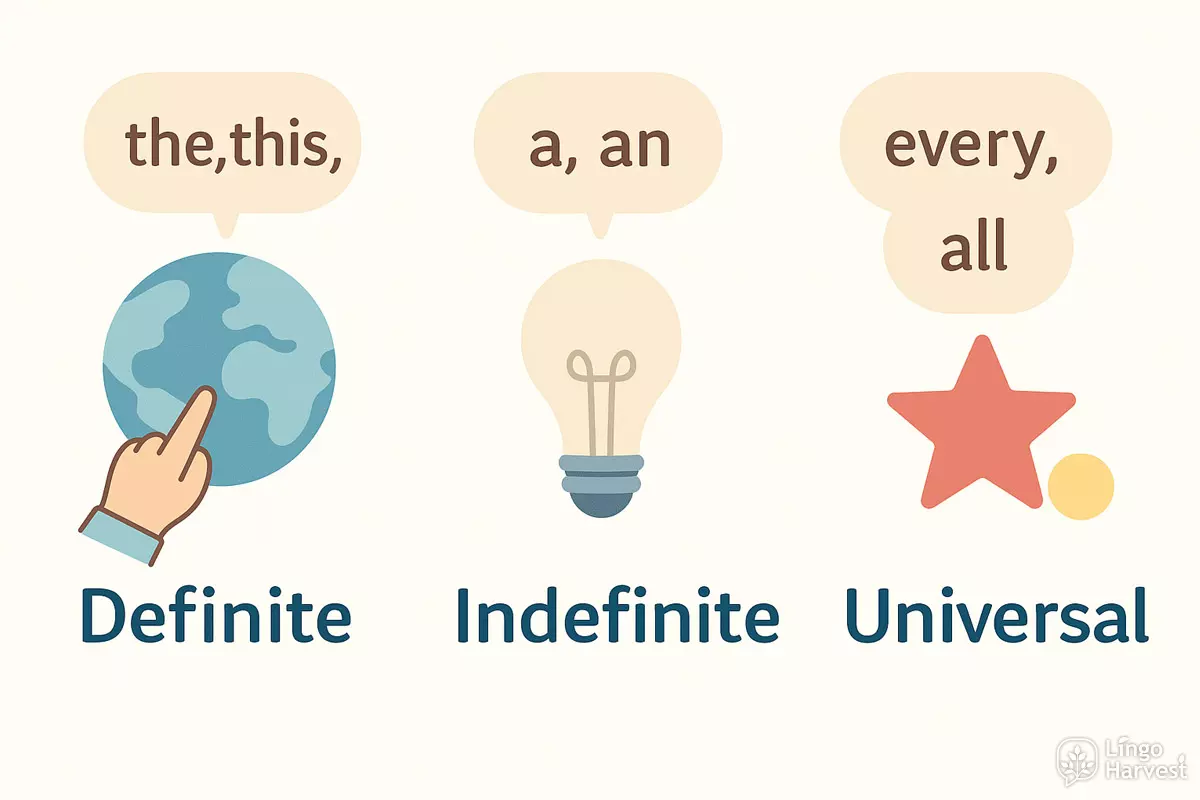
- Definite: “the,” “this,” “those” → refer to a specific or previously mentioned thing
- Indefinite: “a,” “an,” “some” → refer to any member of a group, not a specific one
- Universal: “every,” “all,” “each” → indicate the whole group or every member
- Negative: “no,” “neither” → indicate absence or exclusion
- Possessive: “my,” “your,” “their” → show ownership or association
- Interrogative: “which,” “what,” “whose” → ask about identity or selection
- Demonstrative: “this,” “that,” “these,” “those” → point to something near or far
- Quantifying: “many,” “few,” “several,” “much,” “little” → express quantity or amount
- Distributive: “each,” “every,” “either” → refer to members of a group individually
- Partitive: “some of,” “none of,” “all of” → refer to a part or whole of a specified group
Examples: Changing Reference with Determiners
Notice how swapping determiners alters the reference:
- a dog → any dog, not specified
- the dog → a particular dog, known to us
- my dog → the dog that belongs to me
- some dogs → an unspecified number of dogs
- every dog → all dogs, without exception
- no dog → not a single dog
- these dogs → specific dogs, close to the speaker
- which dog → asking about the identity of the dog
- each dog → every individual dog in a group
- few dogs → a small number of dogs
Summary Table: Types of Reference Indicated by Determiners
| Reference Type | Example Determiners |
|---|---|
| Definite | the, this, those |
| Indefinite | a, an, some, any |
| Universal | all, every, each |
| Negative | no, neither, none of |
| Possessive | my, your, their, whose |
| Quantifying | many, few, much, several |
| Demonstrative | this, that, these, those |
| Interrogative | which, what, whose |
Choosing the right determiner is crucial for expressing exactly what you mean, whether you’re talking about something specific, general, or unknown. By signaling reference and meaning, these words help listeners and readers understand exactly what is being discussed.
Basic Agreement Rules
When using determiners in English, it is important to ensure they agree correctly with the nouns they modify. This means paying attention to number (singular or plural), countability, and sometimes gender, though English is not a gendered language like some others. Getting these details right helps your sentences sound natural and avoids confusion.
Number Agreement
Some determiners are only used with singular nouns, while others work with plurals. For example, "this" and "that" are for singular nouns, while "these" and "those" are for plural nouns. Using the wrong form can make sentences ungrammatical.
- This book is new. ✅
- These books are new. ✅
- This books are new. ❌
Countable vs. Uncountable Nouns
Some determiners only work with countable nouns (things you can count), while others are used with uncountable nouns (things you can't count individually). For example, "many" goes with countable nouns, and "much" with uncountable ones.
- Many apples → countable
- Much water → uncountable
- Few chairs → countable
- Little sugar → uncountable
Common Determiner-Noun Patterns
To help clarify which determiners pair with which types of nouns, here is a quick-reference table:
| Determiner | Used With | Example |
|---|---|---|
| This/That | Singular countable | This car, That idea |
| These/Those | Plural countable | These books, Those houses |
| Much | Uncountable | Much water, Much information |
| Many | Plural countable | Many dogs, Many questions |
| Little | Uncountable | Little milk, Little hope |
| Few | Plural countable | Few options, Few students |
| Each/Every | Singular countable | Each student, Every moment |
| All | Plural countable or uncountable | All children, All time |
Other Agreement Tips
- Articles ("a" and "an") are only used with singular countable nouns: a cat, an apple.
- Some determiners, like "the" or possessives ("my," "her"), can be used with both singular and plural, as well as countable and uncountable nouns.
- Double determiners (e.g., "the my book") are not used in English.
- Quantifiers like "some" and "any" can often be used with both countable and uncountable nouns, but their meaning may shift slightly.
Paying attention to these agreement patterns makes your English clearer and more precise. With practice, choosing the right determiner will become second nature.
Common Mistakes
Learners often stumble over determiners due to their subtle rules and exceptions. Misusing these words can lead to awkward or unclear sentences, especially for those new to English grammar. Below, we’ll highlight typical pitfalls and show how to avoid them.
Mixing Up "a," "an," and "the"
Choosing the wrong article is a frequent error. "A" and "an" are used for non-specific, singular nouns, while "the" refers to something specific or already mentioned. For example:
- Incorrect: She bought an apple and the apple was tasty. (If it’s the same apple, use "the" both times after introducing it.)
- Correct: She bought an apple. The apple was tasty.
Omitting Determiners Where Needed
Some languages do not use articles, so speakers may forget them in English. This leads to sentences like:
- Incorrect: I have car.
- Correct: I have a car.
Using the Wrong Type of Determiner
Certain nouns require specific determiners, and mixing them up causes confusion. For example, "many" is for countable nouns, while "much" is for uncountable nouns.
| Incorrect Usage | Correction |
|---|---|
| He has much friends. | He has many friends. |
| There are less cars today. | There are fewer cars today. |
| She ate a rice. | She ate some rice. |
| I don’t have much apples. | I don’t have many apples. |
Redundant or Double Determiners
Adding more than one determiner to a noun phrase is a common slip-up, especially with possessives and articles:
- Incorrect: The my friend is here.
- Correct: My friend is here. or The friend is here.
Confusing Demonstratives and Articles
Using "this," "that," "these," or "those" together with articles can create unnecessary repetition:
- Incorrect: This the book is interesting.
- Correct: This book is interesting.
Forgetting to Use "Any" in Negatives and Questions
"Any" is typically used in negative sentences and questions, but sometimes learners mistakenly omit it:
- Incorrect: I don’t have apples.
- Correct: I don’t have any apples.
Summary List: Frequent Determiner Errors
- Using "a/an" with plurals (e.g., "a apples")
- Leaving out "the" where context requires specificity
- Using "these/those" with uncountable nouns ("these information")
- Placing a determiner before proper nouns unnecessarily ("the John")
- Confusing "each" and "every"
- Using "some" in affirmative statements only (it can also appear in polite offers/questions)
- Using "all" with singular nouns ("all student")
- Omitting "the" with superlatives ("He is tallest student")
- Mixing up "few" and "a few," or "little" and "a little"
- Using possessive determiners with names ("my Maria") when not needed
Paying attention to these trouble spots will help you sound more fluent and precise. When in doubt, double-check the noun type and context before choosing a determiner.
Quick Practice
Understanding how to use words like "the," "some," or "every" can make your sentences much clearer. Let's test your grasp of these small but important words by working through a few targeted exercises and examples.
Identify the Determiner
Read each sentence and pick out the word or words that help specify which noun is meant. These "specifier" words might show quantity, ownership, or point to something specific.
- Every student finished the assignment.
- My friends brought some snacks to the party.
- That car is very fast.
- Several books are missing from the shelf.
- Her idea was the most creative.
Show answers
- Every
- My, some
- That
- Several
- Her, the
Choose the Best Option
Select the most appropriate word to fill each blank. Each sentence needs a word that helps clarify the noun.
- _____ apples on the table are fresh. (these / an / much)
- _____ teacher is absent today. (A / The / Some)
- We don’t have _____ milk left. (many / any / few)
- _____ of my cousins live abroad. (All / The / Some)
- Is this _____ umbrella or yours? (an / your / the)
Show answers
- these
- The
- any
- Some
- your
Common Types of Determiners
Here’s a quick reference to help you recognize the main groups. Try matching each example to its type as you review.
| Type | Examples |
|---|---|
| Articles | the, a, an |
| Demonstratives | this, that, these, those |
| Quantifiers | some, any, many, much, few, several, all |
| Possessives | my, your, his, her, its, our, their |
| Numbers | one, two, three, etc. |
Spot the Error
Each sentence below has a problem with its noun specifier. Rewrite the sentence correctly.
- She doesn’t have much friends.
- This apples are delicious.
- He forgot his the keys.
- I have an homework to finish.
Show answers
- She doesn’t have many friends.
- These apples are delicious.
- He forgot his keys. / He forgot the keys.
- I have homework to finish.
Practicing with these short tasks will help you spot and use these helpful words more naturally in your own writing and speaking. Try making a few original sentences using different types of noun specifiers for extra practice.