Possessive Determiners: My, Your, Their

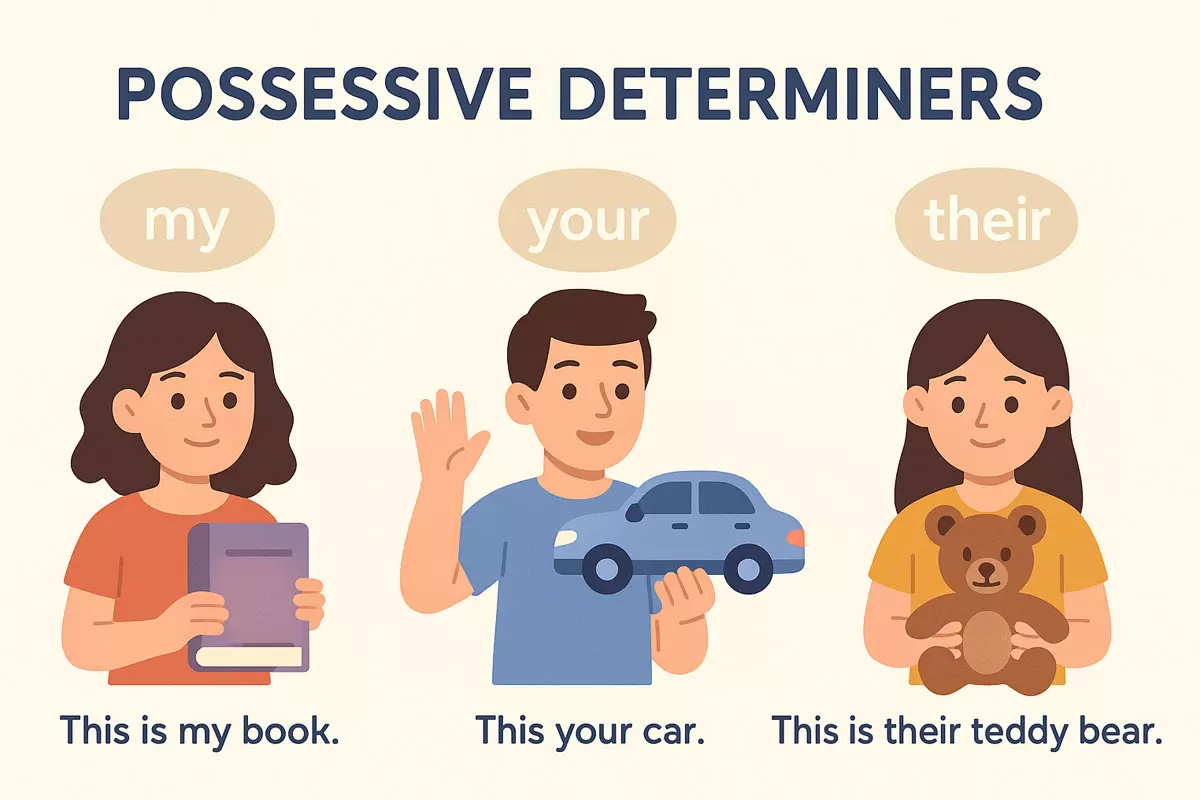 Here we how possessive determiners show ownership, their correct use before singular and plural nouns, tips to avoid confusing them with pronouns, common mistakes, and provides practice sentences.
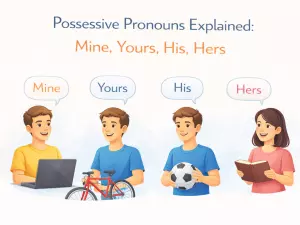
Understanding English grammar involves recognizing how we express ownership or relationships between people and things. Possessive pronouns such as mine, yours, and theirs play an important role in clarifying who something belongs to, which helps make our communication more accurate and effective. By using these words correctly, we avoid confusion and ensure that our meaning is clear to others, whether we are speaking or writing. Mastering this aspect of grammar is essential for anyone aiming to communicate confidently in English.
What Possessive Determiners Show
Possessive determiners give us information about who owns or is connected to something in a sentence. These words, like my, your, and their, always come before a noun. They help specify the relationship between a person (or people) and the thing being talked about, making it clear whose item, idea, or quality is being referred to. For example, in “her book,” the word “her” signals that the book belongs to a female person.
How Possessive Determiners Function
These determiners are used to answer questions like “Whose?” or to clarify which particular thing is meant. They are not used alone; a noun must follow them. Without a possessive word, listeners may not know who owns or is related to the noun in question.
| Possessive Determiner | Indicates... |
|---|---|
| my | belonging to the speaker (singular, first person) |
| your | belonging to the listener (singular or plural, second person) |
| his | belonging to a male person or animal (third person singular) |
| her | belonging to a female person or animal (third person singular) |
| its | belonging to a thing or animal (third person singular, neutral) |
| our | belonging to the speaker and others (first person plural) |
| their | belonging to several people or things (third person plural) |
Examples in Sentences
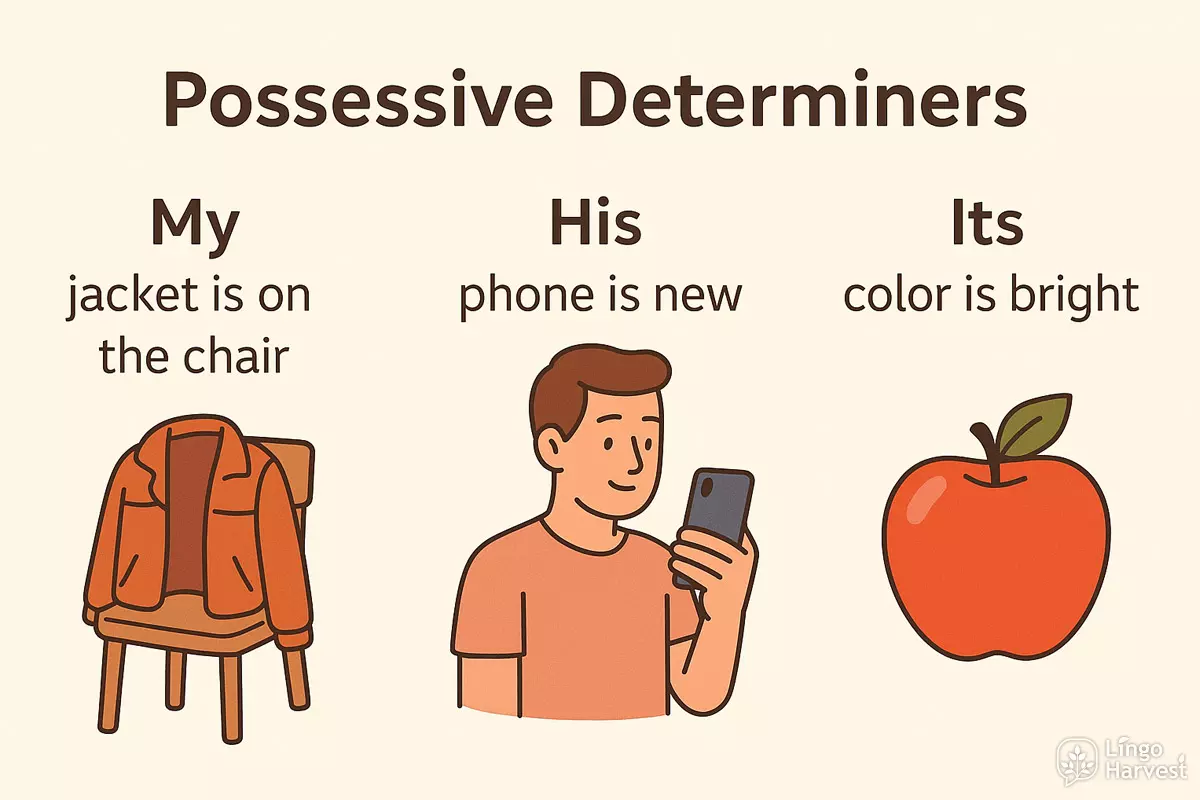
- My jacket is on the chair.
- Your ideas are interesting.
- His phone is new.
- Her cat sleeps a lot.
- Its color is bright.
- Our school is nearby.
- Their house is large.
Notice how each word points to a specific owner or group. This makes communication precise and avoids confusion. Whether speaking or writing, using the right possessive form helps listeners and readers quickly grasp who or what is involved.
Form and Use
Possessive determiners, sometimes called "possessive adjectives," are used before nouns to show ownership or relationship. Words like my, your, and their help specify who something belongs to, making sentences clearer and more precise. These determiners always come directly before the noun they modify.
How Possessive Determiners Work
In English, possessive determiners replace articles (like "a" or "the") when you want to indicate possession. For example, instead of "the book," you might say "my book" or "their book." The form of the determiner depends on the owner’s grammatical person and number:
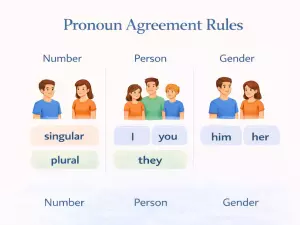
| Person/Number | Possessive Determiner | Example Phrase |
|---|---|---|
| First person singular | my | my idea |
| Second person singular/plural | your | your shoes |
| Third person singular (male) | his | his phone |
| Third person singular (female) | her | her bag |
| Third person singular (neutral/object) | its | its cover |
| First person plural | our | our project |
| Third person plural | their | their house |
Key Usage Points
- Possessive determiners always appear before the noun, never after: your keys ✅ / keys your ❌.
- They do not take apostrophes: its (possessive) is different from it’s (it is).
- They do not change for singular or plural nouns: my cat, my cats.
- Use them to show relationships as well as ownership: her brother, their teacher.
Typical Contexts and Examples
Possessive determiners appear in a wide range of everyday expressions. Here are some common patterns:
- my name
- your opinion
- their homework
- our meeting
- his decision
- her advice
- its color
- your family
- their car
- our friends
- my schedule
- her garden
- his laptop
- our apartment
- their results
- your job
- its meaning
- my answer
Common Mistakes
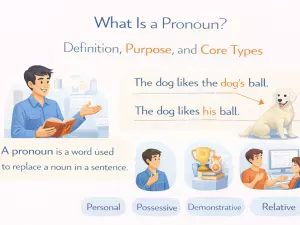
Learners sometimes confuse possessive determiners with possessive pronouns (like "mine," "yours," "theirs"). Remember, possessive determiners must always be followed by a noun. For example:
- This is my book. ✅
- This book is mine. ✅
- This is mine book. ❌
Understanding how and when to use these words ensures your meaning is clear and your sentences are grammatically correct.
Before Singular and Plural Nouns
Possessive determiners like my, your, and their are placed directly in front of nouns to show ownership or association. These words are flexible: you can use them with both singular and plural nouns without changing their form, which makes them easy to use in everyday conversation and writing.
Usage with Different Noun Numbers
Unlike some languages, English possessive determiners do not change depending on whether the noun is singular or plural. For example, you say my book (one book) and my books (several books). The same pattern applies to your and their. This consistency helps learners focus on the noun itself, not on adjusting the determiner.
- my car → my cars
- your friend → your friends
- their house → their houses
- my idea → my ideas
- your answer → your answers
- their solution → their solutions
- my child → my children
- your pet → your pets
- their team → their teams
- my plan → my plans
- your wish → your wishes
- their project → their projects
- my problem → my problems
- your phone → your phones
- their bag → their bags
Position in the Sentence
Possessive determiners always come before the noun they describe. They cannot stand alone; they must modify a noun. For example, you say their apartment, not just their (unless the noun is understood from context).
Quick Reference Table
| Possessive Determiner | Example with Singular Noun | Example with Plural Noun |
|---|---|---|
| my | my pen | my pens |
| your | your idea | your ideas |
| their | their dog | their dogs |
| our | our teacher | our teachers |
| his | his hat | his hats |
| her | her shoe | her shoes |
| its | its color | its colors |
This table shows how each possessive determiner pairs with both types of nouns. Notice that the determiner itself never changes, regardless of whether you’re talking about one thing or many.
Avoiding Pronoun Confusion
Understanding when to use possessive determiners such as "my," "your," and "their" can be tricky, especially when sentences involve multiple people or objects. Choosing the right word makes your meaning clear and prevents misunderstandings. It’s especially important in both spoken and written English, where a misplaced determiner can change the sense of the sentence.
Common Sources of Mix-ups
Some confusion arises because English pronouns and possessive determiners look and sound similar. For instance, "they" is a subject pronoun, while "their" is a possessive determiner. Mixing them up can lead to ambiguity. Consider these common pitfalls:
- Using "they" instead of "their": They car is red ❌ (should be Their car is red ✅)
- Swapping "your" and "you’re": Your welcome (should be You’re welcome)
- Confusing "its" (possessive) and "it’s" (it is): The dog lost it’s collar ❌ (should be its collar ✅)
- Using "my" when referring to another person’s things: My friend forgot my keys (should be his keys or her keys)
Clear Usage Patterns
To make your language precise, match the determiner to the possessor, not the item possessed. For example, if talking about something belonging to "them," use "their" regardless of what the object is.
| Possessor | Correct Determiner | Sample Sentence |
|---|---|---|
| I | my | This is my notebook. |
| You | your | Is this your coat? |
| He/She/It | his / her / its | She forgot her phone. |
| We | our | We love our school. |
| They | their | They brought their tickets. |
Quick Tips for Accuracy
- Always check who owns the object in your sentence—match the determiner to that person or group.
- If you’re unsure, replace the phrase with a name to test: Maria’s book = her book.
- Remember: possessive determiners come before the noun they modify.
- Avoid double possessives: not the my car, just my car.
- Practice by rewriting sentences with different possessors to see how the determiner changes.
Paying attention to these details helps you write and speak more clearly, making your intended meaning unmistakable.
Common Errors
Misusing possessive words like "my," "your," and "their" can change the meaning of a sentence or make it sound awkward. Learners often confuse these possessive determiners with pronouns or use them incorrectly with nouns. Understanding the typical pitfalls helps improve clarity and accuracy in both writing and speech.
Mixing Up Possessive Determiners and Pronouns
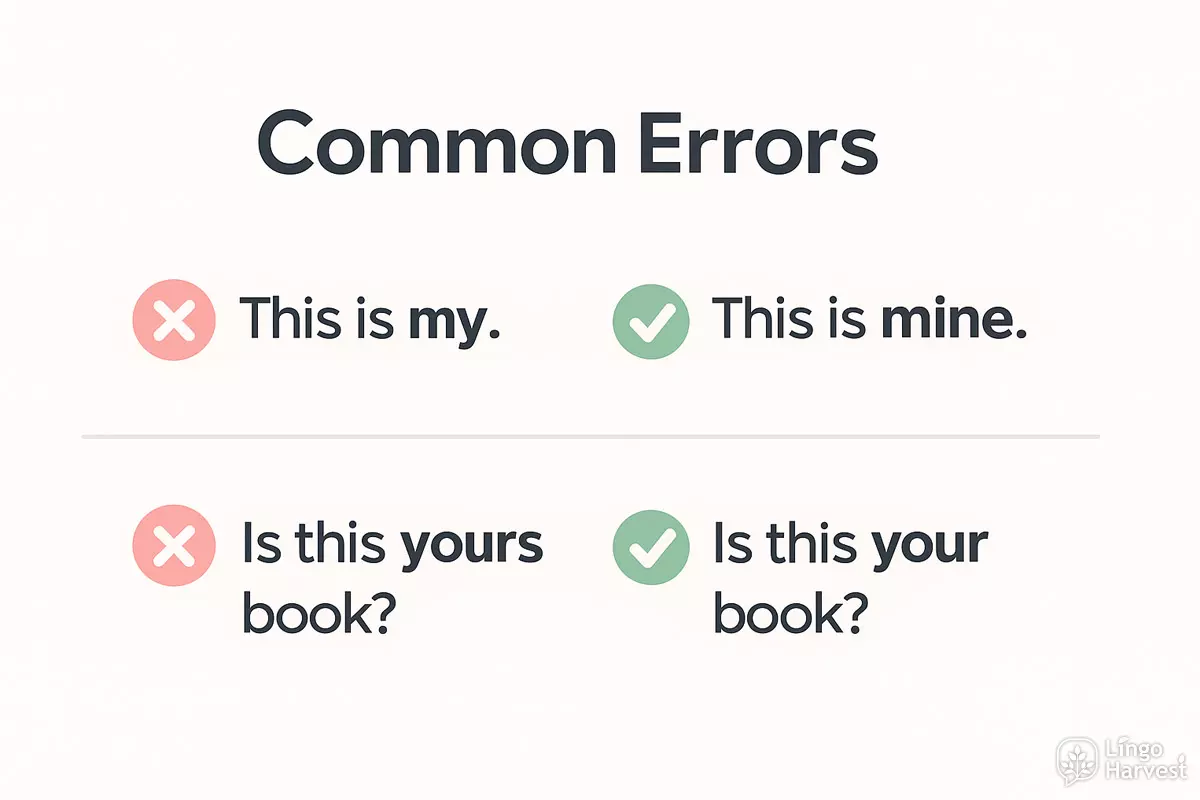
People sometimes use a possessive pronoun (like "mine," "yours," "theirs") where a determiner is needed, or vice versa. Remember, determiners are always followed by a noun, while pronouns stand alone.
- ❌ This is my. → ✅ This is mine.
- ❌ Is this yours book? → ✅ Is this your book?
- ❌ The cat chased their. → ✅ The cat chased them.
Using the Wrong Possessive Determiner
Another frequent mistake is choosing the incorrect word for the subject or owner. This can lead to confusion about who possesses what.
| Incorrect Example | Corrected Version |
|---|---|
| He forgot your keys. | He forgot his keys. |
| They lost our tickets. | They lost their tickets. |
| I can’t find their wallet. | I can’t find my wallet. |
| Is this my umbrella? | Is this your umbrella? |
Omitting the Noun After the Determiner
A possessive determiner should always be followed by a noun. If the noun is missing, the sentence feels incomplete.
- ❌ She took my. → ✅ She took my bag.
- ❌ Please bring your. → ✅ Please bring your notebook.
- ❌ They lost their. → ✅ They lost their tickets.
Plural and Singular Confusion
Sometimes, people use "their" for a single person when the subject is clearly singular and gender is known. While "their" is increasingly accepted as a singular pronoun in informal language, in formal contexts, matching the possessive with the subject is usually preferred.
- ❌ Every student should bring their book. (acceptable in modern usage, but:)
- ✅ Every student should bring his or her book.
List of Common Mistakes to Watch For
- Using "my" instead of "mine" when the noun is missing
- Writing "your's" instead of "your" (no apostrophe!)
- Confusing "their" with "there" or "they're"
- Using "his" for a female subject
- Using "her" for a male subject
- Leaving out the noun after the determiner
- Doubling possessives: "my friend's his car" (should be "my friend's car" or "his car")
- Using "its'" instead of "its" (no apostrophe for the possessive!)
- Mixing up "our" and "are"
- Using "their's" (should be "theirs" for the pronoun, "their" for the determiner)
- Using the wrong determiner for the subject ("She lost his keys" instead of "her keys")
- Repeating the noun after both a determiner and a pronoun ("This is my book mine")
Mastering these points helps avoid misunderstanding and makes your English sound more natural. Pay attention to which word fits the owner and whether you need a noun after the possessive.
Practice Sentences
To help internalize how possessive determiners like "my," "your," and "their" work, let's look at a variety of sample sentences and short exercises. These will show how these words clarify ownership or association in English.
Sample Sentences Using Possessive Determiners
- This is my favorite book.
- Did you see your keys on the table?
- They forgot their jackets at the restaurant.
- My dog loves to play in the park.
- Your idea sounds interesting.
- The children finished their homework quickly.
- I can't find my phone anywhere.
- Your friends are waiting outside.
- Their house is at the end of the street.
- Thank you for your help.
- My parents are visiting next week.
- The students handed in their assignments.
- Is this your umbrella?
- My brother likes to cook Italian food.
- They brought their own lunch.
- I washed my hands before dinner.
- Your answer was correct.
- The team celebrated their victory.
Quick Practice: Fill in the Blank
Choose the correct possessive determiner ("my," "your," or "their") for each sentence:
- ______ car is parked outside. (I own the car)
- Did you finish ______ project? (speaking to a friend)
- The children forgot ______ backpacks. (about the children)
- ______ coffee is too hot. (talking about my own coffee)
- Where is ______ classroom? (asking another student)
Show answers
- My
- your
- their
- My
- your
Comparison Table: "My," "Your," "Their" in Context
| Possessive Determiner | Example Sentence |
|---|---|
| My | My shoes are under the bed. |
| Your | Your phone is ringing. |
| Their | Their garden is beautiful in spring. |
| Their | The students forgot their books. |
| My | My sister is a doctor. |
Challenge: Make Your Own Sentences
Try creating three sentences for each word: "my," "your," and "their." Focus on different contexts, such as family, school, or daily routines. Practicing with real-life topics helps you remember how to use these determiners naturally.
Show answers
- Examples for "my": My cat is sleeping. My lunch is ready. My room is clean.
- Examples for "your": Your shoes are new. Your brother called. Your idea was great.
- Examples for "their": Their dog is friendly. Their car is fast. Their answers were correct.