Determiner–Noun Agreement Rules

 Here we the basics of determiner-noun agreement, rules for count and non-count nouns, and singular or plural forms. It also discusses restricted combinations, common mistakes, and includes practice tasks.
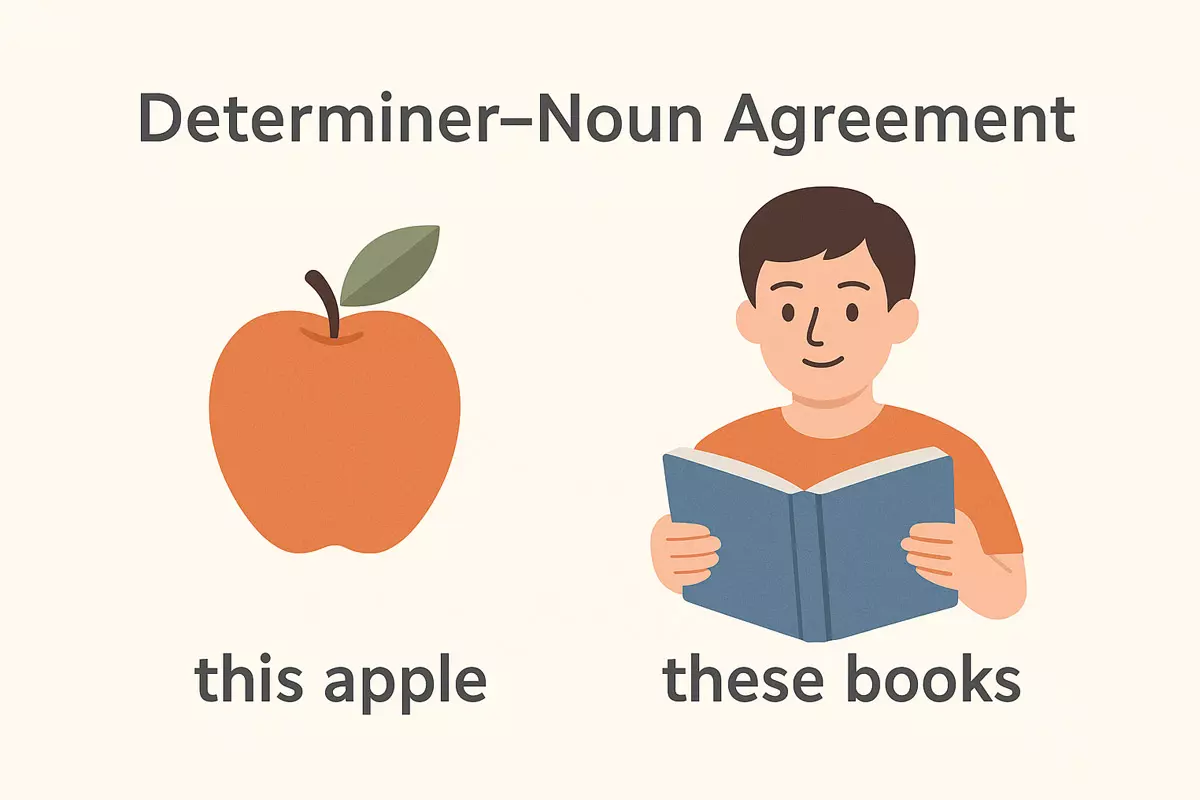
Understanding how words such as “this,” “some,” or “every” work with nouns is crucial for constructing clear and accurate sentences. These words, known as determiners, must match the nouns they describe in number and meaning. For example, “this” is used with singular nouns (“this book”), while “these” pairs with plural nouns (“these books”). By learning these matching rules, you can avoid common grammatical mistakes and communicate your ideas more precisely and effectively in both writing and speech.
Agreement Basics
Understanding how determiners and nouns work together is key to using English correctly. In most cases, a determiner must match the noun it introduces in certain grammatical features, such as number (singular or plural) and, less often, gender or countability. This matching process helps sentences sound natural and clear.
Core Principles of Matching
The main principle is that determiners and nouns should "fit" each other. For example, singular determiners go with singular nouns, and plural determiners pair with plural nouns. Countable and uncountable nouns also require different types of determiners. Some common rules include:
- A and an are only used with singular, countable nouns (e.g., a cat, an apple).
- Many is used with plural, countable nouns (e.g., many books).
- Much is used with uncountable nouns (e.g., much water).
- These and those pair with plural nouns (e.g., these shoes).
- This and that pair with singular nouns (e.g., this chair).
- Some can be used with plural or uncountable nouns (e.g., some oranges, some milk).
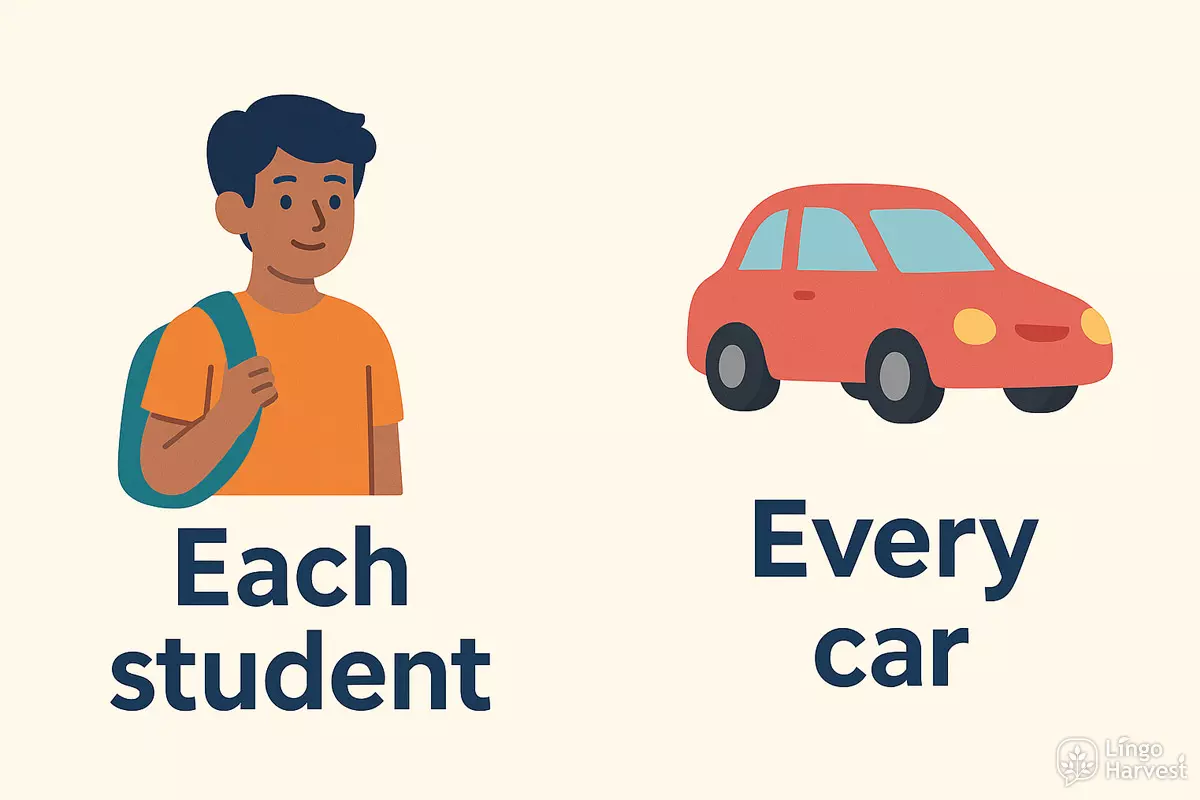
- Each and every are used with singular countable nouns (e.g., each student, every car).
- Few and a few are used with plural countable nouns (e.g., few friends).
- Little and a little are used with uncountable nouns (e.g., little time).
- All can be used with plural or uncountable nouns (e.g., all children, all information).
- Another is only for singular countable nouns (another idea).
- Other is used for plural or uncountable nouns (other options, other advice).
Common Matching Patterns
It helps to remember the typical pairings for determiners and nouns. Here’s a structured overview of some frequent combinations:
| Determiner | Noun Type | Example |
|---|---|---|
| A / An | Singular, countable | a book, an hour |
| Some | Plural or uncountable | some coins, some rice |
| Much | Uncountable | much sugar |
| Many | Plural, countable | many people |
| This / That | Singular | this car, that house |
| These / Those | Plural | these keys, those apples |
| Each / Every | Singular, countable | each answer, every moment |
| All | Plural or uncountable | all dogs, all furniture |
Key Points to Remember
Errors often occur when the wrong type of determiner is used with a noun. For example, saying much apples ❌ is incorrect, while many apples ✅ is correct. Always consider the noun’s countability and number before choosing a determiner. With practice, these patterns become more intuitive, helping your sentences sound natural and precise.
Count vs Non-Count Rules
Understanding how determiners interact with different types of nouns is crucial for accurate grammar. In English, nouns are generally divided into two categories: countable (count) and uncountable (non-count). Each category follows specific guidelines when it comes to which determiners can be used.
Countable Nouns
Countable nouns refer to items that can be counted individually (e.g., "book," "apple," "car"). These nouns can appear in both singular and plural forms, and they accept a wide range of determiners. For example:
- a book
- many apples
- several cars
- few ideas
- one chair
- these dogs
- each student
- those children
- another question
- every answer
Certain determiners like "a," "an," "many," "few," and numbers (one, two, etc.) are only compatible with countable nouns.
Uncountable Nouns
Uncountable nouns, sometimes called mass nouns, represent substances or concepts that cannot be counted individually (e.g., "water," "information," "sand"). They typically do not have a plural form and require different determiners. Examples include:
- much water
- some information
- a little sugar
- less time
- this advice
- that furniture
- a bit of rice
- enough money
- no knowledge
- plenty of bread
Using "a" or "an" with non-count nouns is generally incorrect (e.g., ❌ a water). Instead, quantifiers like "some," "much," and "a little" are appropriate.
Quick Comparison Table
| Determiner | Used with Countable Nouns | Used with Uncountable Nouns |
|---|---|---|
| a / an | ✅ (a cat, an apple) | ❌ |
| many | ✅ (many books) | ❌ |
| much | ❌ | ✅ (much water) |
| some | ✅ (some pencils) | ✅ (some rice) |
| few / a few | ✅ (few friends) | ❌ |
| little / a little | ❌ | ✅ (a little sugar) |
| each / every | ✅ (each student) | ❌ |
| all | ✅ (all cars) | ✅ (all information) |
Common Pitfalls
Learners often confuse which determiners can be paired with each noun type. For instance, saying "many information" or "a bread" is incorrect. When in doubt, check if the noun can be pluralized or counted individually. This will guide your choice of determiner. Mastering these patterns helps ensure that determiner–noun agreement is natural and error-free, whether dealing with singular, plural, or mass nouns.
Singular/Plural Forms
Understanding how determiners interact with both single and multiple nouns is essential for constructing accurate phrases in English. The form of the noun—whether it refers to one entity or more—determines which determiners are appropriate, and mistakes here can lead to confusion or ungrammatical sentences. When using determiners, some are specific to items that are counted as one (singular), while others are meant for more than one (plural). There are also determiners that can be used with both, but may change meaning depending on the noun’s number. Ensuring the determiner matches the noun in number is a key part of grammatical agreement.
Common Patterns of Agreement
Some determiners are strictly singular, some strictly plural, and others are flexible. Here are typical examples:
- This (singular): this book
- These (plural): these books
- That (singular): that car
- Those (plural): those cars
- Each (singular): each student
- Every (singular): every child
- Many (plural): many ideas
- Much (singular, uncountable): much information
- Few (plural): few options
- Little (singular, uncountable): little time
- Some (singular/plural/uncountable): some water, some apples
- Any (singular/plural/uncountable): any suggestion, any answers
- No (singular/plural/uncountable): no evidence, no reasons
Agreement Table: Determiner + Noun Number
| Determiner | Used With | Example | Notes |
|---|---|---|---|
| This / That | Singular countable | This apple, That idea | Never with plural nouns |
| These / Those | Plural countable | These apples, Those ideas | Do not use with singular nouns |
| Each / Every | Singular countable | Each person, Every moment | Require singular verb forms |
| Many / Few | Plural countable | Many students, Few opportunities | Used only with plural count nouns |
| Much / Little | Uncountable | Much energy, Little hope | Not for plural count nouns |
| Some / Any / No | Plural & uncountable | Some money, Any apples, No sugar | Flexible, check context |
Special Notes and Exceptions
Some determiners work with both singular and plural, but change meaning or nuance. For example, some can be used with uncountable or plural nouns, but not typically with singular countable nouns unless the noun is unspecified (“some person” is rare outside formal contexts). Similarly, any is versatile, but agreement with the noun is still necessary.
Key Agreement Tips
- Always match the number of the determiner and the noun.
- Check if your noun is countable or uncountable—this affects which words you can use.
- Remember irregular plurals (“child” → “children”, “man” → “men”).
- Watch for words that look plural but are singular in meaning (“news,” “mathematics”).
- Practice by pairing determiners and nouns in sentences to reinforce correct patterns.
Restricted Combinations
Some determiner and noun pairings in English are either disallowed or sound awkward, even if both words are grammatically correct on their own. These limitations often arise due to meaning, number, or idiomatic usage. Understanding these constraints helps avoid common mistakes and makes speech and writing sound natural.
Commonly Blocked Pairings
Certain determiners simply do not pair with specific types of nouns. For example, much is typically used with uncountable nouns, while many is reserved for countable ones. Some combinations clash in terms of definiteness or quantity, making them ungrammatical.
- Much informations ❌ (should be much information)
- Many furniture ❌ (should be much furniture or many pieces of furniture)
- Any the book ❌ (should be any book or the book)
- These water ❌ (should be this water or these bottles of water)
- Each apples ❌ (should be each apple)
- The all students ❌ (should be all the students or the students)
- Another cars ❌ (should be another car or other cars)
- This books ❌ (should be these books or this book)
- Fewer advice ❌ (should be less advice)
- Less people ❌ (should be fewer people)
- Some every student ❌ (should be every student or some students)
- All child ❌ (should be all children or every child)
- Much chairs ❌ (should be many chairs)
- Each bottles ❌ (should be each bottle)
- A informations ❌ (should be an item of information or some information)
- Those milk ❌ (should be that milk or those bottles of milk)
Summary of Determiner Limitations
Some restrictions are predictable based on countability, number, or definiteness. The table below illustrates typical patterns for a few determiners and noun types:
| Determiner | Allowed With |
|---|---|
| Much | Uncountable nouns (e.g., much water, much information) |
| Many | Countable plural nouns (e.g., many books, many ideas) |
| Each | Singular countable nouns (e.g., each student, each apple) |
| Another | Singular countable nouns (e.g., another car, another example) |
| These/Those | Plural countable nouns (e.g., these shoes, those children) |
| This/That | Singular countable or uncountable nouns (e.g., this chair, that advice) |
Idiomatic and Contextual Restrictions
Some restrictions are idiomatic and must simply be memorized. For instance, the both is generally avoided in favor of both the. Other restrictions may depend on dialect, register, or evolving usage, but the general patterns above will help you avoid the most common pitfalls.
Typical Mistakes
Missteps with determiners and nouns often stem from confusion about number, countability, or gender (in languages where relevant). Writers and speakers sometimes select articles or quantifiers that do not match the noun’s grammatical form, leading to awkward or incorrect phrases. These errors can affect clarity and even change meaning.
Frequent Agreement Errors
- Using "a" or "an" with plural nouns (e.g., a apples instead of an apple or apples).
- Pairing "many" with uncountable nouns (many information → much information).
- Choosing "much" for countable nouns (much books → many books).
- Using "some" with singular countable nouns (some cat instead of a cat).
- Leaving out articles where needed (I saw dog instead of I saw a dog).
- Adding unnecessary articles before proper nouns (the John instead of John).
- Using "these" or "those" with singular nouns (these car instead of this car).
- Mixing up "another" and "other" (another books instead of other books).
- Applying "each" or "every" to plural nouns (each students instead of each student).
- Using "all" with singular nouns (all information is correct, but all book is not).
- Combining "the" with general plural nouns unnecessarily (the cats like milk when talking about cats in general; just cats like milk is better).
- Placing "any" with definite nouns (any the books is incorrect).
- Using "few" or "a few" with uncountable nouns (a few furniture instead of a little furniture).
- Choosing "less" with countable nouns (less cars instead of fewer cars).
- Incorrectly using "no" with plural nouns in some languages (no informations in English is not correct; no information is standard).
- Confusing "some" and "any" in negative or interrogative sentences (I don't have some money instead of I don't have any money).
- Using "the" before abstract nouns unnecessarily (the happiness is important instead of happiness is important).
- Forgetting to change the determiner when switching singular/plural (this apples instead of these apples).
- Using double determiners (the my book instead of my book or the book).
- Placing possessives and articles together (a my friend instead of my friend).
Comparison of Correct and Incorrect Patterns
| Incorrect Usage | Correct Usage |
|---|---|
| She has much friends. | She has many friends. |
| I want an information. | I want some information. |
| These book is new. | This book is new. |
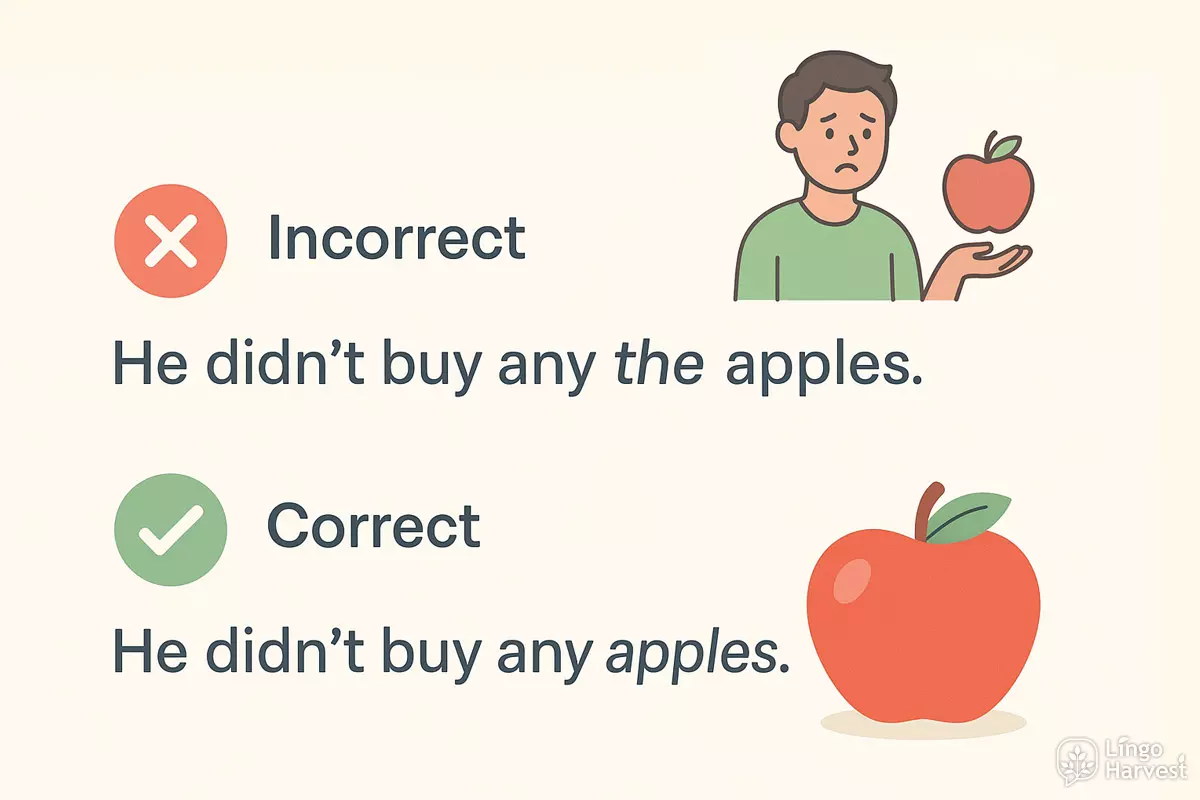
| He didn’t buy any the apples. | He didn’t buy any apples. |
| Each students must register. | Each student must register. |
| She has less problems now. | She has fewer problems now. |
| He is the John I told you about. | He is John I told you about. |
| I have a my friend here. | I have my friend here. |
How to Avoid These Issues
Pay close attention to whether a noun is countable or uncountable, singular or plural, and whether it needs an article or another determiner. Reading plenty of examples and practicing with real sentences helps to internalize the correct forms. When in doubt, consult trusted grammar references or language tools. Remember, these small details can make your writing clearer and more professional.
Practice Tasks
Test your understanding of how determiners and nouns must agree in number, specificity, and countability. The following activities will help reinforce the patterns and exceptions discussed in this topic. Work through the exercises and check your answers when you finish.
1. Choose the Correct Option
For each sentence, select the correct determiner to complete the phrase according to the noun’s type (countable/uncountable, singular/plural).
- ______ apple a day keeps the doctor away. (a / an / the)
- Can you pass me ______ salt? (a / any / the)
- I have ______ friends in Paris. (much / many / a)
- She doesn’t have ______ water left. (many / much / a few)
- ______ books on that shelf belong to Sarah. (This / These / That)
Show answers
- an
- the
- many
- much
- These
2. Error Correction
Each sentence below contains a mistake in determiner–noun agreement. Rewrite the sentence correctly.
- She has much books on her desk.
- I don’t have a informations about the event.
- Those child is playing in the park.
- There isn’t many sugar left.
Show answers
- She has many books on her desk.
- I don’t have any information about the event.
- That child is playing in the park.
- There isn’t much sugar left.
3. Determiner–Noun Agreement Table
Compare how different determiners pair with singular, plural, and uncountable nouns. This reference will help you spot patterns and exceptions more easily.
| Determiner | Singular Countable | Plural Countable | Uncountable |
|---|---|---|---|
| a / an | ✔✅ a cat, an apple | ❌ | ❌ |
| the | ✔✅ the book | ✔✅ the books | ✔✅ the water |
| some | ❌ | ✔✅ some apples | ✔✅ some milk |
| many / much | ❌ | ✔✅ many people | ✔✅ much time |
| this / these | ✔✅ this chair | ✔✅ these chairs | ❌ |
4. Fill in the Blanks
Insert the correct determiner in each blank so that it agrees with the noun.
- ______ information you gave was very helpful.
- ______ of the cakes were eaten at the party.
- ______ student in the class passed the test.
- How ______ sugar do you need?
- Are there ______ oranges left?
Show answers
- The
- Some
- Every
- much
- any
5. Spot the Odd One Out
In each set, choose the noun that does not agree with the given determiner. Explain why.
- a. an idea b. an apples c. an hour
- a. much bread b. much chairs c. much time
- a. these books b. these water c. these children
Show answers
- b. an apples — “an” is only for singular countable nouns.
- b. much chairs — “much” is not used with plural countable nouns.
- b. these water — “these” is not used with uncountable nouns.