Determiner Order in Noun Phrases

 The article outlines the principles for ordering determiners in English noun phrases and explains what to do when several determiners appear. It discusses common patterns, gives example phrases, notes typical mistakes, and includes a quick practice section.
Using words such as my, the, or some before nouns may appear straightforward, but their arrangement follows subtle rules that influence meaning and clarity in English. Mastering the order and combination of these elements allows speakers to construct phrases that sound natural and convey ideas more precisely. This understanding is essential for effective communication, as it helps avoid confusion and ensures that the intended message is delivered clearly to listeners or readers.
Order Principles
The arrangement of determiners within noun phrases follows a set of conventions that help clarify meaning and maintain natural flow in English sentences. Different types of determiners—such as articles, demonstratives, possessives, quantifiers, and numerals—each have a typical place before a noun, and their sequence is rarely interchangeable without sounding awkward or unclear.
General Sequence of Determiners
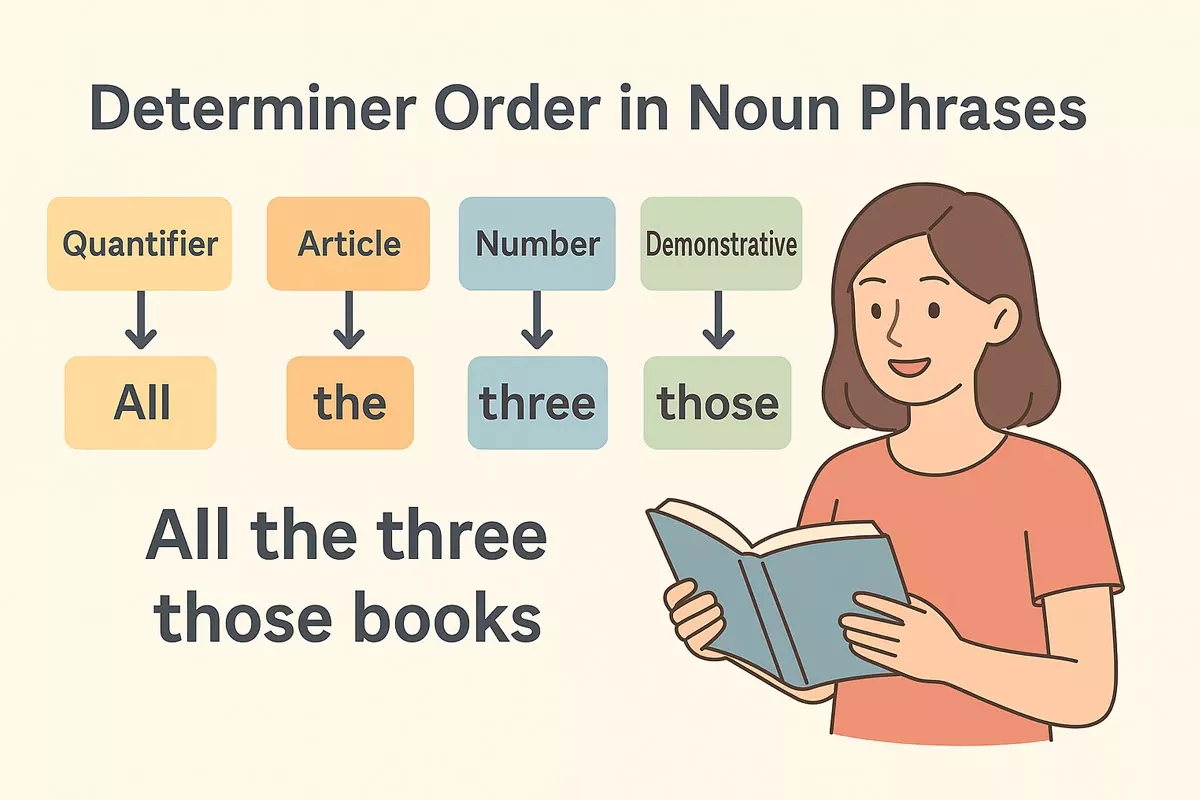
Within a noun phrase, there is a preferred order that speakers intuitively follow. When more than one determiner appears, they usually occur in the following sequence (from left to right, before the noun):
- Predeterminers (e.g., all, both, half)
- Determiners (articles: the, a/an)
- Demonstratives (this, those)
- Possessives (my, your, Anna's)
- Quantifiers (some, many, few)
- Cardinal numerals (two, five)
- Ordinal numerals (first, second)
This structure keeps the phrase clear and signals relationships between the noun and its modifiers.
Examples of Determiner Combinations
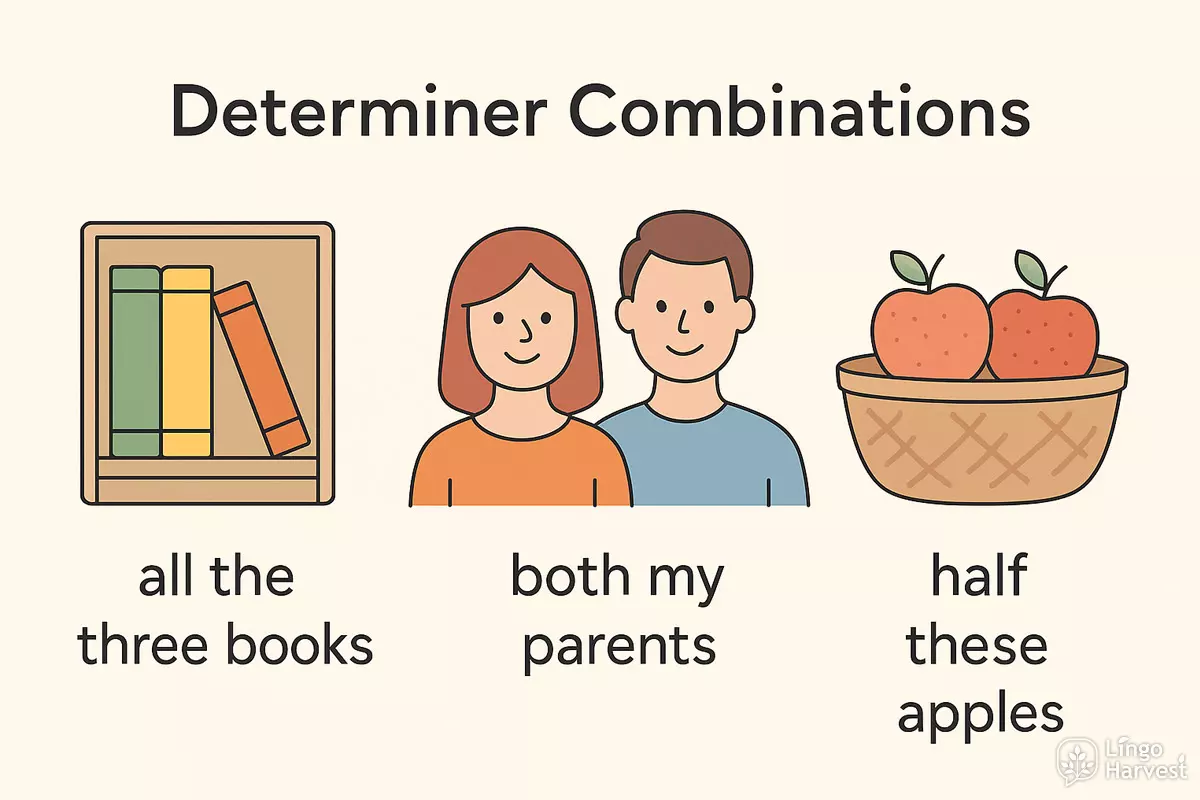
The following examples illustrate how different types of determiners combine and their typical order:
- all the three books
- both my parents
- half these apples
- the first two questions
- my three best friends
- those many problems
- some of his ideas
- each of these students
- every single day
- another five minutes
- this little cat
- our first meeting
- her two younger brothers
- the next available seat
- several of those options
- any other reason
- such a situation
- no clear answer
Constraints and Flexibility
Not all combinations are possible or natural. Some determiners are mutually exclusive, and certain sequences are rarely used. For instance, it is unusual to have both a possessive and a definite article together (e.g., the my book ❌). Similarly, demonstratives and articles do not typically co-occur (the this car ❌). When in doubt, native speakers often choose the most specific determiner and omit others.
| Determiner Type | Example Phrase |
|---|---|
| Predeterminer + Article + Noun | all the time |
| Demonstrative + Quantifier + Noun | these many options |
| Possessive + Numeral + Noun | my two cousins |
| Article + Ordinal + Noun | the first step |
| Quantifier + of + Demonstrative + Noun | some of those ideas |
Summary of Patterns
While there are exceptions, especially in informal or poetic language, following these preferences ensures clarity and idiomatic usage. Understanding the sequence of modifiers helps both learners and advanced users create natural-sounding noun phrases.
When Multiple Determiners Appear
In English noun phrases, it is possible for more than one determiner to be used together, but the sequence follows specific rules. Not every combination is allowed, and the order is not random. Certain words, such as articles, demonstratives, possessives, quantifiers, and numerals, each have their preferred slot if they appear together in a phrase.
Typical Determiner Sequence
The order of determiners is fairly fixed. For example, one might say all these three books but not these all three books. Here’s a commonly accepted order for multiple determiners in English:
- Predeterminer (e.g., all, both, half)
- Determiner (e.g., the, a, this, my)
- Postdeterminer (e.g., three, many, several)
Examples of Allowable Combinations
Some combinations are especially common, while others are rare or incorrect. Here are several examples demonstrating correct usage of multiple determiners:
- All the students arrived on time.
- Both my hands were cold.
- All these books are new.
- All his three attempts failed.
- Both those options seem good.
- All your many questions have answers.
- All their first three albums are classics.
- Half the cake is gone.
- All the many problems were solved.
- Both her two brothers live abroad.
- All these five reasons matter.
- All my few free days are booked.
- Both my old shoes are worn out.
Unacceptable Determiner Combinations
Some determiner pairings simply do not work. For instance, possessives and articles rarely combine (*the my car), and demonstratives do not mix with articles (*the this house). These constructions sound unnatural in English and should be avoided.
Summary Table: Common Determiner Combinations
| Predeterminer | Central Determiner | Postdeterminer & Example |
|---|---|---|
| All | the | students All the students |
| Both | my | hands Both my hands |
| All | these | books All these books |
| All | his | three attempts All his three attempts |
| Both | those | options Both those options |
| All | their | first three albums All their first three albums |
Key Points to Remember
- Not all determiners can be combined; some pairings are ungrammatical.
- The order is usually: predeterminer → central determiner → postdeterminer.
- Common predeterminers: all, both, half.
- Central determiners include articles, demonstratives, possessives.
- Postdeterminers are typically numbers or quantifiers.
Understanding these patterns will help you construct natural and correct noun phrases when more than one determiner is needed.
Common Patterns
Understanding how determiners are usually arranged within noun phrases helps clarify their function and meaning. In English, specific types of determiners tend to follow a predictable order, which is important for both clarity and naturalness in speech and writing.
Typical Sequencing in English
The regular structure for determiners in English noun phrases generally follows this sequence:
- Predeterminer (e.g., all, both, half)
- Central determiner (e.g., the, a, some, my)
- Postdeterminer (e.g., many, several, few, first, next)
- Adjectives and then the noun
Not every noun phrase will include all these elements, but when multiple determiners are present, this order is preferred.
Expanded Examples of Determiner Sequences
Here are some common combinations, showing how different determiners fit together:
- All the students (predeterminer + central determiner + noun)
- Both my friends (predeterminer + possessive + noun)
- Half a loaf (predeterminer + article + noun)
- Some other ideas (central determiner + postdeterminer + noun)
- Her three cats (possessive + numeral + noun)
- The first day (article + ordinal + noun)
- My several attempts (possessive + quantifier + noun)
- Each new proposal (central determiner + adjective + noun)
- These few moments (demonstrative + quantifier + noun)
- Our many questions (possessive + quantifier + noun)
- That last piece (demonstrative + ordinal + noun)
- Some five days (central determiner + numeral + noun)
- No other option (central determiner + adjective + noun)
Comparison of Determiner Placement
To illustrate the ordering more clearly, here’s a table with structured examples:
| Order | Example |
|---|---|
| Predeterminer + Article + Noun | All the books |
| Predeterminer + Possessive + Noun | Both my tickets |
| Article + Quantifier + Noun | The many reasons |
| Possessive + Numeral + Noun | Her two dogs |
| Demonstrative + Quantifier + Noun | These several occasions |
General Observations
When forming noun groups, keep in mind that some determiners are mutually exclusive (e.g., you cannot use the and my together: ❌ the my book). The arrangement also reflects emphasis and specificity. For example, placing a possessive before a numeral (my two cars) is more natural than reversing the order. Mastering these ordering tendencies helps in crafting fluent and idiomatic expressions, especially when multiple modifiers are needed before a noun.
Example Phrases
Understanding how different determiners combine in noun groups is best learned through practical illustrations. Below are a variety of sample constructions, arranged to show the typical sequence of elements such as articles, quantifiers, possessives, demonstratives, and adjectives before a noun. These help clarify how native speakers naturally order these components.
Common Determiner Sequences
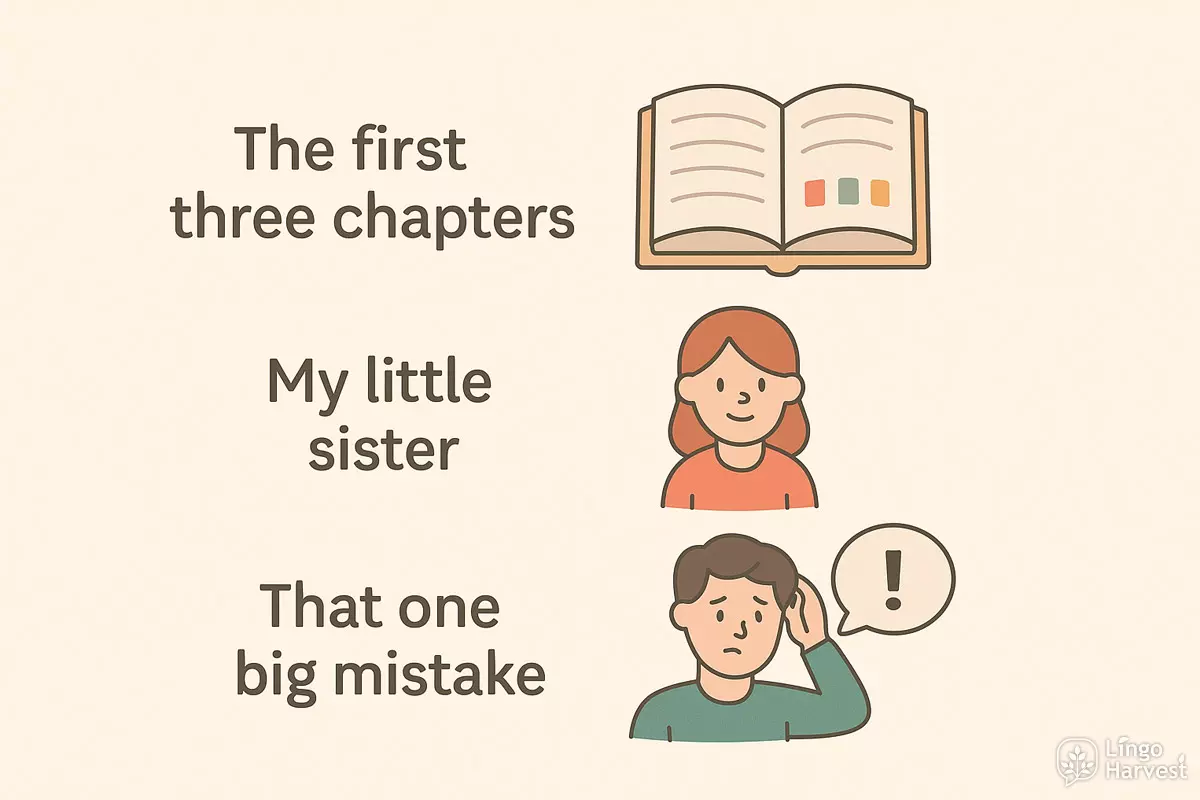
- All my old books (quantifier + possessive + adjective + noun)
- These two large dogs (demonstrative + numeral + adjective + noun)
- Her several interesting ideas (possessive + quantifier + adjective + noun)
- Every single opportunity (universal determiner + emphasizing adjective + noun)
- Some other possible solutions (indefinite quantifier + adjective + adjective + noun)
- The first three chapters (definite article + ordinal + numeral + noun)
- My little sister (possessive + adjective + noun)
- That one big mistake (demonstrative + numeral + adjective + noun)
- Many different approaches (quantifier + adjective + noun)
- No further information (negative quantifier + adjective + noun)
- Each new discovery (distributive + adjective + noun)
- Our last meeting (possessive + adjective + noun)
- This beautiful old house (demonstrative + adjective + adjective + noun)
- Several important decisions (quantifier + adjective + noun)
- Her only child (possessive + focusing adjective + noun)
- Few real options (quantifier + adjective + noun)
Comparison of Determiner Order Patterns
| Pattern | Example |
|---|---|
| Article + Adjective + Noun | The red car |
| Demonstrative + Adjective + Noun | Those tall trees |
| Possessive + Adjective + Noun | My favorite book |
| Quantifier + Noun | Many students |
| Numeral + Adjective + Noun | Three old coins |
By comparing these patterns, you can see how different types of determiners and modifiers are layered to create clear, natural noun groups. Practicing with varied combinations helps reinforce the typical order and improves fluency in both comprehension and production.
Mistakes to Avoid
When building noun phrases, it’s easy to slip up with the order of determiners. Even advanced learners sometimes mix up which words come first or accidentally double up on words that don’t go together. Paying attention to these common pitfalls can help you write and speak more naturally.
Mixing Up the Standard Sequence
The typical sequence in English is: quantity → opinion → size → age → shape → color → origin → material → purpose → noun. Determiners (articles, demonstratives, possessives, quantifiers, etc.) almost always come before adjectives and the noun. Switching this order can make phrases sound odd or confusing.
Common Errors with Determiner Placement
- Putting a possessive (my, her) after an article (the, a)
Incorrect: the my book
Correct: my book - Combining two determiners that don’t work together
Incorrect: this my friend
Correct: this friend or my friend - Placing a quantifier after a noun
Incorrect: cats many
Correct: many cats - Using both an article and a demonstrative
Incorrect: the these apples
Correct: these apples - Forgetting that some determiners cannot be combined (e.g., some any)
- Using “of” constructions incorrectly (many of the people, not many the people)
- Placing adjectives before determiners (red my car instead of my red car)
- Repeating determiners unnecessarily (her her shoes)
- Using an article with possessive pronouns (the my house)
- Misordering when both a quantifier and possessive are present (my some friends instead of some of my friends)
- Confusing “each” and “every” with plural nouns (each books instead of each book)
- Placing numbers after other determiners (the five cats, not five the cats)
Overview: Correct and Incorrect Orders
| Incorrect Example | Corrected Version |
|---|---|
| the my car | my car |
| this the book | this book |
| many the students | many students many of the students |
| red my shoes | my red shoes |
| cats some | some cats |
| her her bag | her bag |
| each books | each book |
| the these apples | these apples |
Tips to Remember
- Only one main determiner per noun phrase (unless using “of the” after a quantifier).
- Possessives, demonstratives, and articles are not used together.
- Quantifiers like some, many, all go before articles or possessives when combined.
- Adjectives and numbers follow determiners, but precede the noun.
With practice, these patterns become automatic. When in doubt, check if you’re using more than one determiner—if so, it’s often a sign to rephrase.
Quick Practice
Understanding how to sequence determiners in noun groups can be tricky, but focused exercises help you internalize the patterns. Below you'll find a range of activities to identify, order, and use determiners correctly in English noun phrases.
Ordering Determiners: Choose the Correct Sequence
Each sentence below contains several determiners. Rearrange them so they form a grammatically correct noun phrase.
- all / those / my / friends
- her / the / two / old / cats
- some / these / lovely / new / ideas
- whose / three / little / puppies
- that / delicious / first / slice / of / cake
Show answers
- all my friends
- her two old cats
- these lovely new ideas
- whose three little puppies
- that first delicious slice of cake
Spot the Error: Which Noun Phrase is Incorrect?
From each line, pick the noun phrase that doesn’t follow the standard determiner order.
- a) my three favorite books
b) three my favorite books
c) my favorite three books - a) those two big apples
b) two those big apples
c) those big two apples - a) her many old stories
b) many her old stories
c) her old many stories - a) each beautiful new flower
b) each new beautiful flower
c) beautiful each new flower
Show answers
- b) three my favorite books
- b) two those big apples
- b) many her old stories
- c) beautiful each new flower
Practice Table: Determiner Order Patterns
Review these example phrases to see how different determiners combine in typical noun phrases:
| Example Phrase | Determiners in Order |
|---|---|
| all my old friends | quantifier + possessive + adjective + noun |
| those two large dogs | demonstrative + number + adjective + noun |
| her many creative ideas | possessive + quantifier + adjective + noun |
| every single important detail | distributive + emphasizing adjective + adjective + noun |
| my first two attempts | possessive + ordinal + number + noun |
| these several difficult tasks | demonstrative + quantifier + adjective + noun |
Build Your Own Noun Phrases
Try creating full noun phrases using the following sets of determiners and nouns. Make sure to order them naturally:
- those / four / interesting / paintings
- my / every / attempt
- his / many / clever / solutions
- these / several / unusual / questions
- her / first / three / novels
Show answers
- those four interesting paintings
- my every attempt
- his many clever solutions
- these several unusual questions
- her first three novels
By practicing with a variety of determiner types—possessives, quantifiers, demonstratives, numbers, and more—you’ll develop a natural sense of how to combine them smoothly in English noun groups.