Demonstratives as Determiners: Theoretical Role

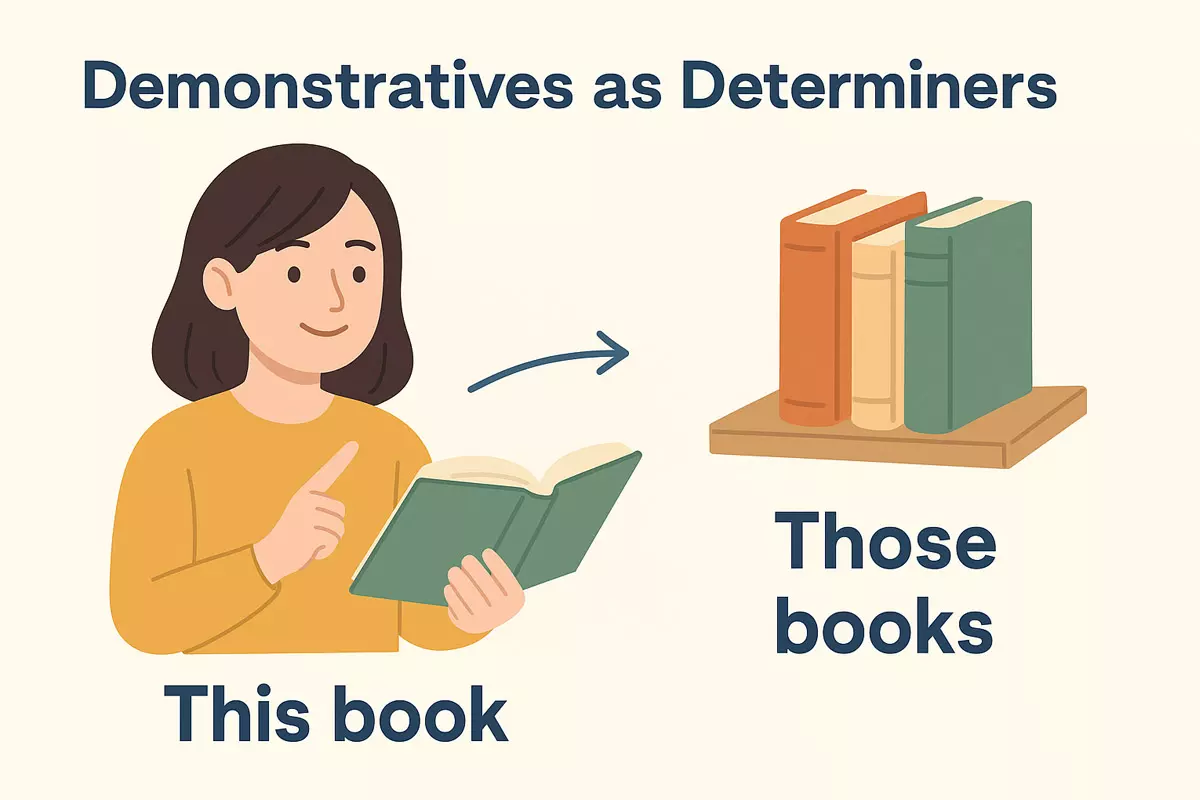 The article explains how demonstratives show distance and reference, highlights differences between singular and plural forms, and covers placement rules. It also includes real-world examples and a short practice section to help you master their use.
Pointing words such as "this" and "those" do more than just refer to objects; they play a key role in shaping how we understand and build meaning within noun phrases. By examining their grammatical function, we gain valuable insights into the underlying structure of language and how speakers use subtle cues to guide interpretation. These words help us specify and clarify what we are talking about, showing that even small elements of language can significantly influence communication and comprehension.
What Demonstratives Indicate
Demonstratives serve as linguistic pointers, drawing attention to specific entities within a context. Their primary function is to signal the spatial, temporal, or discourse-related proximity of a noun to the speaker or listener. By using forms like “this,” “that,” “these,” or “those,” speakers clarify which item or group is being referenced, often distinguishing between things that are near or far, recent or remote, or already mentioned versus newly introduced.
Dimensions of Reference
Demonstrative determiners encode several kinds of information:
- Physical distance from the speaker (e.g., near vs. far objects)
- Temporal relevance (current vs. past events)
- Discourse status (new vs. previously mentioned referents)
- Number (singular or plural entities)
- Sometimes, social or emotional closeness
Common Demonstrative Distinctions
Across languages, demonstrative determiners often reflect contrasts such as:
- Proximal: indicates closeness to the speaker (e.g., this, these)
- Distal: marks distance from the speaker (e.g., that, those)
- Medial: in some languages, denotes items near the listener
- Anaphoric use: refers back to previously mentioned elements in discourse
- Contrastive: highlights difference between two or more items
Examples of Demonstrative Usage
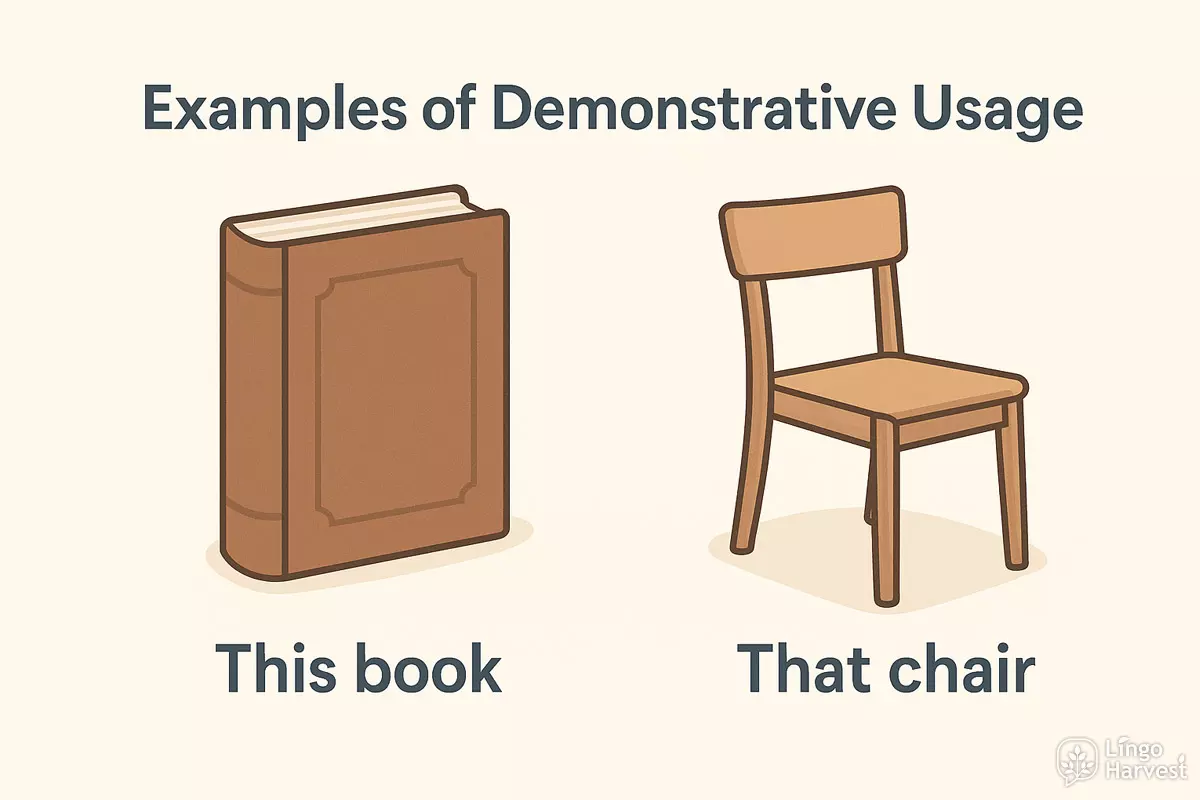
Here are some ways demonstratives clarify reference in English:
- This book (the one I am holding)
- That chair (the one across the room)
- These apples (the ones here in the basket)
- Those people (the group over there)
- This morning (today’s morning)
- That year (a year previously mentioned)
- This idea (the concept just stated)
- That solution (an alternative previously discussed)
- These reasons (just enumerated reasons)
- Those days (a period in the past)
Typological Variation in Demonstratives
Languages differ in how many contrasts they draw among demonstratives. Some languages feature more than two distinctions, like a three-way split (proximal, medial, distal). Others may encode additional features such as gender, case, or formality.
| Language | Demonstrative Forms | Contrasts Encoded |
|---|---|---|
| English | this, that, these, those | Proximity, Number |
| Spanish | este, ese, aquel | Proximity (three-way), Gender, Number |
| Japanese | kono, sono, ano | Speaker/Listener Distance (three-way) |
| Russian | этот, тот | Proximity, Gender, Number, Case |
| Arabic | هذا, تلك, هؤلاء | Proximity, Gender, Number |
In summary, demonstrative determiners are essential for specifying which entities are being discussed, clarifying both their position in space and their role within the conversation. Their forms and meanings can vary widely across languages, but their central role as markers of reference remains consistent.
Distance and Reference
The spatial and discourse roles of demonstrative determiners are central to understanding their function in language. Demonstratives like "this" and "that" (or their equivalents in other languages) help speakers indicate not just which entity is meant, but also how close it is to them—physically, mentally, or contextually. These words serve as linguistic pointers, anchoring nouns to specific locations or moments in the conversational space.
Physical and Psychological Proximity
Demonstratives often distinguish between near and far objects. In English, "this" typically refers to something close to the speaker, while "that" points to something more distant. Many languages expand on this, offering a three-way distinction (proximal, medial, distal), or even more nuanced systems. The choice of demonstrative can also reflect psychological closeness or emotional involvement, not just physical distance.
- This book (the one here, near me)
- That chair (the one over there, farther away)
- These apples (plural, close at hand)
- Those dogs (plural, farther from speaker)
- Spanish: este (near), ese (medium), aquel (far)
- Japanese: kono (near speaker), sono (near listener), ano (far from both)
- Russian: этот (this), тот (that)
- Portuguese: este (near), esse (medium), aquele (far)
- Turkish: bu (this), şu (that/medium), o (that/far)
- French: ce/cet/cette (this/that), with further distinction in speech by context
- Mandarin: zhè (this), nà (that)
- Greek: αυτός (this), εκείνος (that)
- Arabic: هذا (this), ذلك (that)
- Finnish: tämä (this), tuo (that)
Reference in Discourse
Beyond spatial relations, demonstratives help track reference in conversation or text. They can signal whether something is being introduced for the first time ("this idea") or has already been mentioned ("that point"). In narratives, speakers use them to manage attention, highlight new information, or recall previously discussed items.
| Demonstrative | Typical Reference | Example |
|---|---|---|
| This | Proximal (near speaker or just mentioned) | This pen is mine. (pen is close or newly introduced) |
| That | Distal (farther from speaker or previously discussed) | That story was amazing. (story told earlier) |
| These | Proximal plural | These cookies are fresh. (cookies nearby) |
| Those | Distal plural | Those mountains look beautiful. (mountains far away) |
Factors Affecting Choice
Several elements shape which demonstrative is used:
- Physical distance between speaker and referent
- Relative position to listener
- Previous mention in discourse
- Shared knowledge and common ground
- Emotional or psychological involvement
Demonstratives as determiners thus encode both spatial and referential information, guiding the hearer’s interpretation and clarifying which entities are under discussion. Their flexibility and sensitivity to context make them a key feature in the structure of nominal phrases and the flow of communication.
Singular/Plural Use
Demonstrative determiners adapt to the number of the noun they modify, making them sensitive to whether the reference is to a single entity or more than one. In English, for instance, "this" and "that" are paired with singular nouns, while "these" and "those" are used with plural nouns. This alignment is not arbitrary; it serves to clarify the scope of reference, especially when context alone might not be sufficient.
How Number Shapes Demonstrative Choice
Selecting the correct demonstrative depends on both the count and proximity of the noun. For example:
- this book (one item, near)
- these books (multiple items, near)
- that house (one item, distant)
- those houses (multiple items, distant)
Languages often display unique patterns or even irregularities in this area. Some may have distinct forms for dual (exactly two) or collective references, while others use the same word regardless of number, relying on the noun or context for clarification.
Number Agreement in Other Languages
Different languages handle this agreement in diverse ways:
- Spanish: "este" (singular, masculine), "estos" (plural, masculine)
- French: "cette" (singular, feminine), "ces" (plural, both genders)
- Russian: "этот" (singular, masculine), "эти" (plural, all genders)
- Japanese: "kono" (used with singular or plural, context-dependent)
- Arabic: "هذا" (singular, masculine), "هؤلاء" (plural, both genders)
- German: "dieser" (singular, masculine), "diese" (plural, all genders)
- Italian: "questo" (singular, masculine), "questi" (plural, masculine)
- Mandarin: "这个" (zhège, usually singular), "这些" (zhèxiē, plural)
- Greek: "αυτός" (singular, masculine), "αυτοί" (plural, masculine)
- Polish: "ten" (singular, masculine), "ci" (plural, masculine personal)
- Turkish: "bu" (used for both singular and plural)
Summary Table: Demonstrative Forms by Number
| Language | Singular Example | Plural Example |
|---|---|---|
| English | this/that | these/those |
| French | ce/cette | ces |
| Spanish | este/esa | estos/esas |
| Russian | этот/эта | эти |
| Mandarin | 这个 (zhège) | 这些 (zhèxiē) |
| German | dieser/diese/dieses | diese |
| Italian | questo/questa | questi/queste |
| Arabic | هذا/هذه | هؤلاء |
The ability of demonstrative determiners to reflect number is not just a matter of grammar—it directly impacts clarity and coherence in communication. When learning a new language, paying attention to these forms helps avoid misunderstandings and ensures that references are precise. In summary, number agreement in demonstratives is a key feature in many languages, but the details and forms can vary widely.
Placement Rules
In most languages, the exact spot where demonstrative determiners appear within a noun phrase is tightly regulated. Typically, these words—such as “this,” “that,” “these,” and “those” in English—precede the noun they modify. This positioning is important for both clarity and grammaticality, and often interacts with other determiners, adjectives, and modifiers in the phrase.
Standard Ordering in English
English requires demonstratives to come before adjectives and the noun. For example:
- This red book
- Those interesting articles
- That old house
Placing the demonstrative after adjectives or the noun would result in ungrammatical or unnatural phrases (e.g., “red this book” ❌).
Variations Across Languages
The position of these referential words can differ cross-linguistically. Some languages, like Romanian or Thai, allow or require demonstratives to follow the noun. Here are a few patterns:
- Noun + Demonstrative (e.g., “car this”)
- Demonstrative + Noun (e.g., “this car”)
- Demonstrative + Adjective + Noun
- Demonstrative + Numeral + Noun
These patterns influence not just word order, but also how emphasis and focus are conveyed in communication.
Demonstrative and Other Determiners
Demonstrative determiners usually cannot co-occur with other determiners like articles (“the,” “a”) in English:
- This book ✅
- The book ✅
- The this book ❌
However, some languages permit combinations with definite articles, creating structures such as “the this book” for added specificity.
Summary Table: Demonstrative Placement Patterns
| Language | Common Order | Example | Notes |
|---|---|---|---|
| English | Demonstrative + Noun | this book | Demonstrative precedes all modifiers |
| French | Demonstrative + Noun | ce livre | Agrees in gender/number |
| Romanian | Noun + Demonstrative | cartea aceasta | Demonstrative follows the noun |
| Thai | Noun + Demonstrative | nangsue lêe-níi | Post-nominal; no articles |
| Spanish | Demonstrative + Noun | este libro | Agrees in gender/number |
Key Takeaways
- Demonstratives generally occupy a fixed position relative to the noun and other modifiers.
- Word order may vary depending on the language, affecting interpretation and emphasis.
- Co-occurrence with other determiners is highly constrained, especially in English.
Understanding these patterns is essential for analyzing the syntactic role of demonstratives as determiners and their impact on meaning within noun phrases.
Real Examples
Demonstratives function as determiners by specifying which entity in a context is being referred to. In natural language, these words help speakers distinguish between items that are near or far, known or unknown, or previously mentioned. Their theoretical role becomes clearer when we look at authentic usage and contrast them with other types of determiners.
Demonstratives in Everyday Sentences

- This book is interesting. (refers to something close to the speaker)
- That car is expensive. (refers to something farther away)
- I like these cookies. (plural, near)
- Could you pass me those papers? (plural, distant)
- This idea seems promising, but that one needs work.
- Remember those days in college?
- Take this route for a faster drive.
- Look at these results from the experiment.
- Who owns that umbrella?
- Those shoes are on sale.
Comparing Demonstratives to Other Determiners
Demonstratives differ from articles (like "a" or "the") and possessives ("my," "your") by adding spatial or discourse-based specificity. For example, "the book" refers to a specific book, but "this book" singles out the one closest or most relevant to the speaker.
| Type | Example Phrase | Function |
|---|---|---|
| Demonstrative | this pen | Specifies a particular item near the speaker |
| Article | the pen | Refers to a known or previously mentioned item |
| Possessive | my pen | Indicates ownership or association |
| Quantifier | some pens | Expresses quantity without specifying exact items |
Variation Across Languages
Different languages may have more than two degrees of distance or encode additional distinctions. For instance, Spanish uses "este" (this, near), "ese" (that, medium distance), and "aquel" (that, farthest), while Japanese has "kore" (this, near speaker), "sore" (that, near listener), and "are" (that, far from both). This shows that the theoretical role of demonstratives as determiners can be quite nuanced depending on the language.
Contextual Nuance
Demonstratives also serve discourse functions: they can refer back to something just mentioned ("That was unexpected!") or anticipate what comes next ("This is what I mean: ..."). Their use is not just spatial but also contextual, helping listeners track references in conversation or text.
Mini Practice
To solidify your understanding of how demonstratives function as determiners, try applying your knowledge to the targeted exercises below. Focus on identifying and analyzing the role of these words within noun phrases, and consider how they interact with definiteness, deixis, and syntactic structure.
Identification Task
Read each sentence. Underline the demonstrative determiner and briefly describe its syntactic role.
- This book is very interesting.
- Those apples look fresh.
- I don’t like that idea.
- These students have finished the test.
- She wants those shoes over there.
Show answers
- This (determines "book")
- Those (determines "apples")
- That (determines "idea")
- These (determines "students")
- Those (determines "shoes")
Substitution Exercise
Replace the underlined word with an appropriate demonstrative determiner (this, that, these, those) based on the context.
- ____ (apples on the table) are for you.
- ____ (pen in my hand) doesn’t work.
- ____ (problems we discussed yesterday) were difficult.
- ____ (students near the door) are waiting for the teacher.
Show answers
- These
- This
- Those
- Those
Comparing Demonstratives
The table below illustrates how demonstratives distinguish between singular/plural and proximal/distal reference. Review the forms and their typical meanings.
| Form | Number | Proximity | Example |
|---|---|---|---|
| This | Singular | Near (proximal) | This chair |
| That | Singular | Far (distal) | That house |
| These | Plural | Near (proximal) | These books |
| Those | Plural | Far (distal) | Those cars |
Short Analysis
For each phrase, briefly explain how the demonstrative influences the definiteness and reference:
- these reports
- that solution
- those children
- this answer
Show answers
- these reports: Specifies particular reports close to speaker, definite reference.
- that solution: Points to a specific, more distant solution, definite reference.
- those children: Refers to certain children further away, definite group.
- this answer: Highlights an answer near in context or space, definite item.
Practicing with a variety of noun phrases and contexts helps clarify how demonstratives signal both number and distance, as well as their crucial role in marking definiteness within noun phrases.