Zero Article: When No Article Is Used

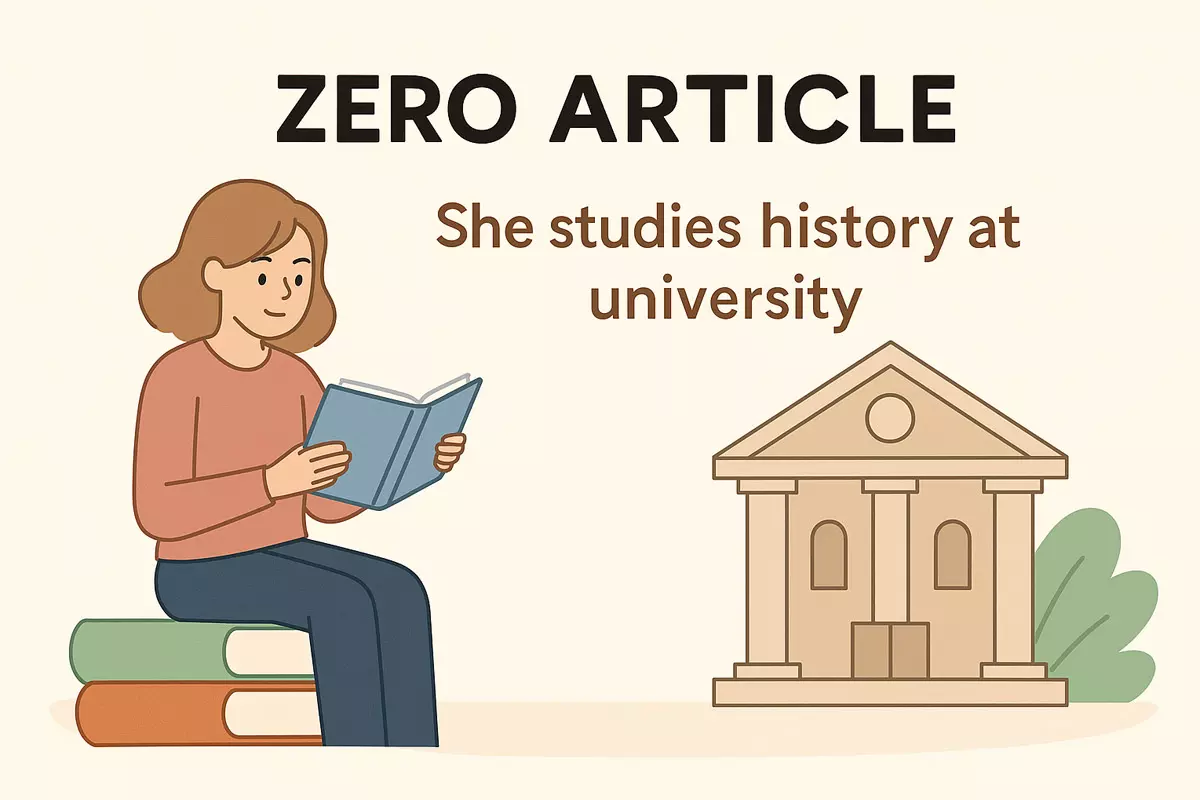 Here we when to use no article in English, focusing on general statements, languages, meals, places, plural and uncountable nouns, and common mistakes. It also provides practice tasks to reinforce your understanding of the zero article.
In English, omitting small words such as a, an, or the can be just as significant as including them, especially when striving for fluent and natural communication. Knowing when to leave out these articles is a subtle skill that often distinguishes advanced speakers from beginners. For example, we usually drop articles with plural or uncountable nouns when speaking generally, as in saying I like apples instead of I like the apples. Mastering this nuance helps create clear and authentic speech.
What Zero Article Means
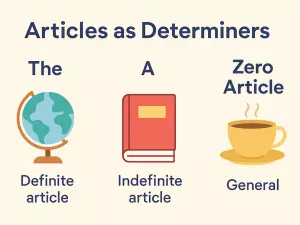
In English grammar, the term "zero article" describes situations where no article (neither "a/an" nor "the") is placed before a noun. This typically happens with certain categories of nouns, such as names of languages, meals, most countries, and abstract ideas. Using no article can signal that a noun is being used in a general sense, not referring to any specific or previously mentioned item.
Native speakers often leave out articles instinctively, but for learners, knowing when to omit them is essential for sounding natural. The absence of an article is not random—there are clear patterns and rules that dictate when this happens. Understanding these patterns helps avoid awkward or incorrect sentences.
Common Contexts with No Article
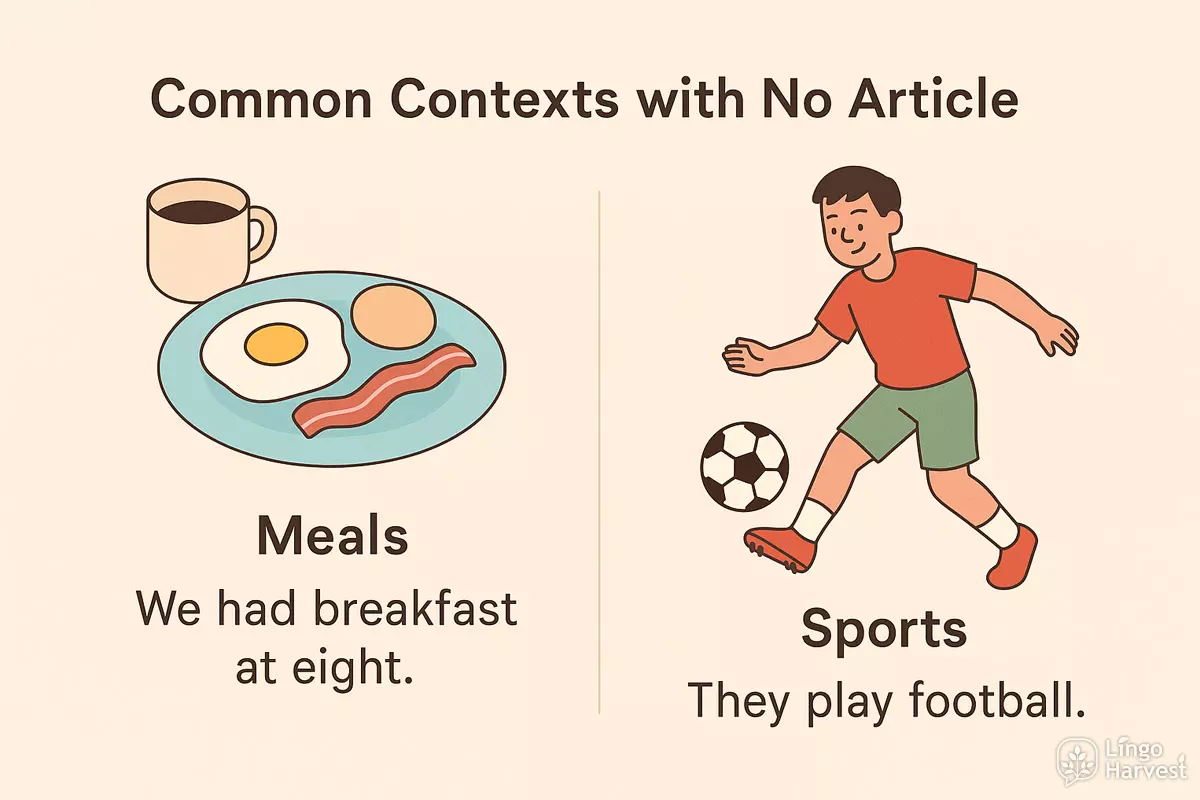
- Names of languages: She speaks French.
- Meals: We had breakfast at eight.
- Most countries and cities: He lives in Canada.
- Academic subjects: Math is difficult.
- Sports: They play football.
- Abstract concepts: Freedom is important.
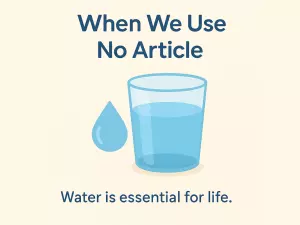
- Uncountable nouns when used generally: Water is essential.
- Plural nouns in a general sense: Dogs are friendly.
- Names of people: Maria arrived early.
- Most streets, parks, mountains, and lakes: He walked along Park Avenue.
- Days, months, holidays: School starts Monday.
- Transport with "by": She goes to work by bus.
- Institutions when used for their primary purpose: He is in prison.
- Bed, home, church, hospital, school, university (for their main function): She is at school.
General vs. Specific Reference
Omitting the article can change the meaning of a sentence. For instance, saying "Children need guidance" refers to all children in general. In contrast, "The children need guidance" points to specific children known to the speaker and listener. The zero form emphasizes generalization or categorization.
Quick Comparison: Article Use vs. Zero Article
| With Article | Zero Article |
|---|---|
| The water in this glass is cold. | Water is essential for life. |
| I met a student from Japan. | Students often study late. |
| He visited the hospital to see his friend. | She works in hospital. |
| The English spoken here is different. | English is spoken worldwide. |
Recognizing when to leave out the article is a key aspect of mastering natural English usage, especially in academic, professional, and everyday situations.
General Statements
In English, there are many situations where a noun appears without any article in front of it. This use—often called the "zero article"—follows clear patterns, especially when talking about things in a general sense. Understanding these patterns helps learners sound more natural and avoid common mistakes.
Typical Contexts Where No Article Is Used
The absence of an article most often occurs with plural countable nouns or uncountable nouns when referring to things in general, not to specific items or people. For example:
- Children like sweets.
- Books are expensive nowadays.
- Information is valuable.
- Water covers most of the earth.
Additionally, certain nouns never take an article in common expressions or set phrases. This frequently includes names of meals, languages, academic subjects, and modes of transport:
- We have dinner at seven.
- She speaks French fluently.
- He studies mathematics.
- I go to work by bus.
Zero Article: Quick Reference Patterns
Here are some of the most common scenarios where the zero article appears:
- With names of countries (unless the name includes words like "kingdom" or "states"): Canada, Brazil
- Before most names of cities, streets, parks, and mountains: London, Oxford Street, Central Park, Mount Everest
- In phrases with meals: have breakfast, eat lunch
- With languages and school subjects: learn English, study history
- With most sports and games: play football, chess
- With abstract nouns when used generally: Freedom is important. Love can be complicated.
- With professions in a general sense: Doctors help people.
- With transport using "by": by car, by train, by plane
- With seasons and days, when speaking generally: Spring is beautiful. Mondays are busy.
- In headlines, instructions, and labels: Push button. Add sugar.
- With institutions when used for their primary purpose: go to school, be in hospital, at university
General vs. Specific Reference
The zero article typically signals that the noun is being used in a general sense, not pointing to one particular thing. Compare:
- People need water. → (all people, water in general)
- The people in this room need the water on the table. → (specific people, specific water)
Summary Table: Article Use with Nouns in General Statements
| Noun Type / Example | Article Usage |
|---|---|
| Plural countable noun Dogs |
No article: Dogs are friendly. |
| Uncountable noun Music |
No article: Music relaxes me. |
| Meals Breakfast |
No article: We had breakfast. |
| Languages/Subjects English, Biology |
No article: She studies Biology. |
| Sports/Games Tennis, chess |
No article: He plays tennis. |
| Institutions (general use) School, hospital |
No article: She is in hospital. |
Recognizing when to use no article is essential for expressing general truths, habits, and universal statements in English. Practice with real examples helps build confidence and fluency.
Languages, Meals, Places
In English, certain nouns—especially those referring to world tongues, daily eating times, and many locations—do not require any article at all. This is known as the "zero article" usage. Recognizing these situations is important for sounding natural and fluent.
Speaking About Languages
When naming a language in general, skip both "the" and "a." For example, we say "She speaks Spanish," not "She speaks the Spanish." However, if you add a modifier, an article may appear: "the Spanish spoken in Argentina."
- French is difficult to master.
- Do you study German?
- They write in Arabic.
- He can read Chinese.
- English is widely used online.
- We are learning Italian.
- She teaches Russian.
- I want to improve my Japanese.
- He understands Portuguese.
- They watch films in Hindi.
Meals and Eating Times
Meal names also typically appear without any article when referring to them in a general or habitual sense. No article is used in expressions like "have lunch" or "before dinner." If you specify or describe the meal, then an article may be necessary: "the dinner we had yesterday."
- We have breakfast at 8 a.m.
- Lunch is served at noon.
- They enjoyed dinner together.
- She skipped breakfast today.
- He invited us to lunch.
- After dinner, we went for a walk.
- Brunch is popular on Sundays.
- They met for coffee after lunch.
- She makes tea before breakfast.
- We had dessert after dinner.
Common Places Without Articles
Certain place names and public locations regularly appear without "the" or "a." This includes institutions (when used for their primary purpose), modes of transport, and some geographical features. The zero article is usual in phrases like "go to school" or "by train," but notice how context can change the need for an article.
| Zero Article Used | When Article May Be Needed |
|---|---|
| go to school | visit the school (as a building, not as a student) |
| at university | the university I attended |
| in prison (as an inmate) | the prison was old (specific building) |
| go home | the home of a friend |
| travel by bus/train/plane | the bus was late (specific vehicle) |
| in bed (for sleeping) | the bed is comfortable |
| at sea | the sea is rough today |
| in class | the class starts at 9 |
Mastering when to omit articles with language names, mealtime words, and institutional or public places helps your English sound idiomatic. Remember, context and meaning can shift whether the zero article or a definite/indefinite article is appropriate.
Plural and Uncountable Patterns
When using English, certain nouns—especially plural and uncountable ones—typically appear without any article at all. This absence of a/an or the is known as the “zero article.” Understanding when to leave out articles is crucial for sounding natural and fluent.
General Rules
Plural nouns and uncountable nouns often do not need an article when speaking generally, rather than about something specific. For example, we say "Dogs are friendly" (not "The dogs are friendly" unless we mean specific dogs) and "Water is essential" (not "The water is essential" unless it refers to particular water).

- Plural nouns: "Books are expensive."
- Uncountable nouns: "Sugar dissolves in tea."
- Abstract ideas: "Happiness is important."
- Materials and substances: "Gold is valuable."
- Languages: "She speaks Spanish."
- Meals: "We have lunch at noon."
- Subjects of study: "He studies biology."
- Games and sports: "Tennis is popular."
- Means of transport (by): "She goes to work by bus."
- Most diseases: "He has flu."
- Seasons (in general): "Spring is my favorite season."
- Days and months: "Monday is busy."
- Institutions (when used generally): "Children go to school."
- Jobs and roles (in general context): "Doctors save lives."
Specific vs. General Contexts
Leaving out the article usually signals a general statement. If you want to talk about something specific, you may need the definite article. For instance, "Children need exercise" (all children) versus "The children need exercise" (specific group).
| Type of Noun | Zero Article Example | With Article (Specific) |
|---|---|---|
| Plural | Cats chase mice. | The cats are hungry. |
| Uncountable | Information is power. | The information is outdated. |
| Abstract | Love conquers all. | The love they shared was strong. |
| Material | Iron is heavy. | The iron on the table is hot. |
Common Mistakes
Learners often add articles where they are not needed. Watch out for these incorrect forms:
- ❌ "The music is relaxing" (when talking about music in general) → ✅ "Music is relaxing."
- ❌ "A children like ice cream" → ✅ "Children like ice cream."
- ❌ "The happiness is important" → ✅ "Happiness is important."
Summary
In summary, omit articles with plural and uncountable nouns when speaking in general terms. Use an article only when you want to focus on something specific. This approach will help your English sound more natural and accurate.
Common Mistakes
Understanding when to leave out articles can be challenging for English learners. Often, confusion arises because many languages use definite or indefinite articles differently—or not at all. Here are some frequent pitfalls and patterns to watch for when practicing zero article usage.
Leaving Out Articles Where They’re Needed
One issue is omitting an article where English requires one. For instance, saying "I have cat" instead of "I have a cat." The zero article is only correct in limited cases, such as with plural or uncountable nouns when speaking generally.
Adding Articles Where None Are Needed
Learners often insert "the" or "a" before nouns that actually require no article. This usually happens with:
- Meals: We have breakfast at 8. (not the breakfast)
- Languages: She speaks Spanish. (not the Spanish)
- Most countries/cities: He lives in Canada. (not the Canada)
- Abstract concepts: Freedom is important. (not The freedom is important.)
- Sports and games: She plays chess. (not the chess)
- Subjects: They study mathematics. (not the mathematics)
- Transport phrases: He goes to work by train. (not by the train)
- Shopping places: She went to school. (not the school, unless specifying)
- With titles: President Lincoln (not the President Lincoln)
- Times of day (in certain phrases): at night (not at the night)
Confusing Specific and General Meaning
It’s easy to mix up when to use articles for specificity. For general statements, no article is needed: "Dogs are friendly." If you mean specific dogs, use "the": "The dogs in the yard are friendly."
Zero Article with Proper Nouns
Another error is using "the" before most names of people, companies, or places where it isn’t needed: "the Microsoft," "the John," or "the London" are incorrect.
Comparison Table: Correct vs. Incorrect Use
| ❌ Incorrect | ✅ Correct |
|---|---|
| He went to the bed early. | He went to bed early. |
| She listens to the music. | She listens to music. |
| We have the lunch at noon. | We have lunch at noon. |
| I like the coffee. | I like coffee. |
| They visited the Paris. | They visited Paris. |
| He is the Doctor Smith. | He is Doctor Smith. |
| She speaks the English. | She speaks English. |
| We go to the school by bus. | We go to school by bus. |
Summary Tips
- Use zero article for plural or uncountable nouns in a general sense.
- Do not use articles with most proper nouns, languages, meals, or academic subjects.
- Check if you are talking about something specific; if not, the article is likely unnecessary.
Awareness of these patterns will help you avoid the most common errors with article omission in English.
Practice Tasks
Try these exercises to reinforce your understanding of when to leave out articles in English. Focus on recognizing contexts where English uses no article at all, especially with general concepts, plural nouns, and certain set phrases. Some tasks involve choosing between using no article or inserting "a/an" or "the." Others ask you to rewrite sentences or spot patterns.
Identify Where No Article Is Needed
Read each sentence. Decide if the blank should be left empty (zero article), or if "a/an" or "the" is needed. Write your answer in each blank.
- ___ Water is essential for life.
- She wants to become ___ engineer.
- ___ Dogs are friendly animals.
- I go to ___ school by bus.
- He plays ___ piano every evening.
- ___ Love is important.
- They had ___ dinner at eight.
- ___ Mount Everest is the highest mountain.
- ___ Children usually enjoy sweets.
- We visited ___ museum yesterday.
Show answers
- — (zero article)
- an
- — (zero article)
- — (zero article)
- the
- — (zero article)
- — (zero article)
- — (zero article)
- — (zero article)
- the
Common Situations for Zero Article
Review the following list, which shows typical scenarios where no article is used in English. Use this as a reference for your own writing and speaking:
- With plural nouns when speaking generally: Cats like milk.
- With uncountable nouns when referring to things in general: Information is power.
- Before names of meals: We had lunch at noon.
- Before most countries, languages, and cities: She lives in France.
- With most names of streets, parks, and squares: Central Park is in New York.
- With academic subjects: He studies chemistry.
- With sports: They play football.
- With days and months: School starts Monday.
- In set expressions: Go to bed, by car, at home.
- With titles when talking about people in general: President speaks.
- Before names of continents and most islands: Asia, Greenland.
- With most lakes and mountains: Lake Victoria, Mount Fuji.
Sentence Transformation
Rewrite each sentence to use the zero article where appropriate.
- The cats are friendly animals.
- The information is useful.
- I like the coffee in the morning.
- She goes to the work every day.
- The breakfast is ready.
Show answers
- Cats are friendly animals.
- Information is useful.
- I like coffee in the morning.
- She goes to work every day.
- Breakfast is ready.
Table: Article Usage Comparison
Compare when to use no article versus "the" or "a/an" in similar contexts. This table summarizes several patterns to help you see the difference at a glance.
| Zero Article | Article Used |
|---|---|
| Children like stories. (general, plural) |
The children in this room are quiet. (specific group) |
| Milk is healthy. (uncountable, general) |
The milk in the fridge is fresh. (specific milk) |
| He goes to school every day. (institution) |
He visited the school yesterday. (specific building) |
| She plays tennis. (sport, general) |
She bought a tennis racket. (one item) |
Focusing on these distinctions will help you develop a more natural sense of when to omit articles in English.