Articles with Countable and Uncountable Nouns (Theory Only)

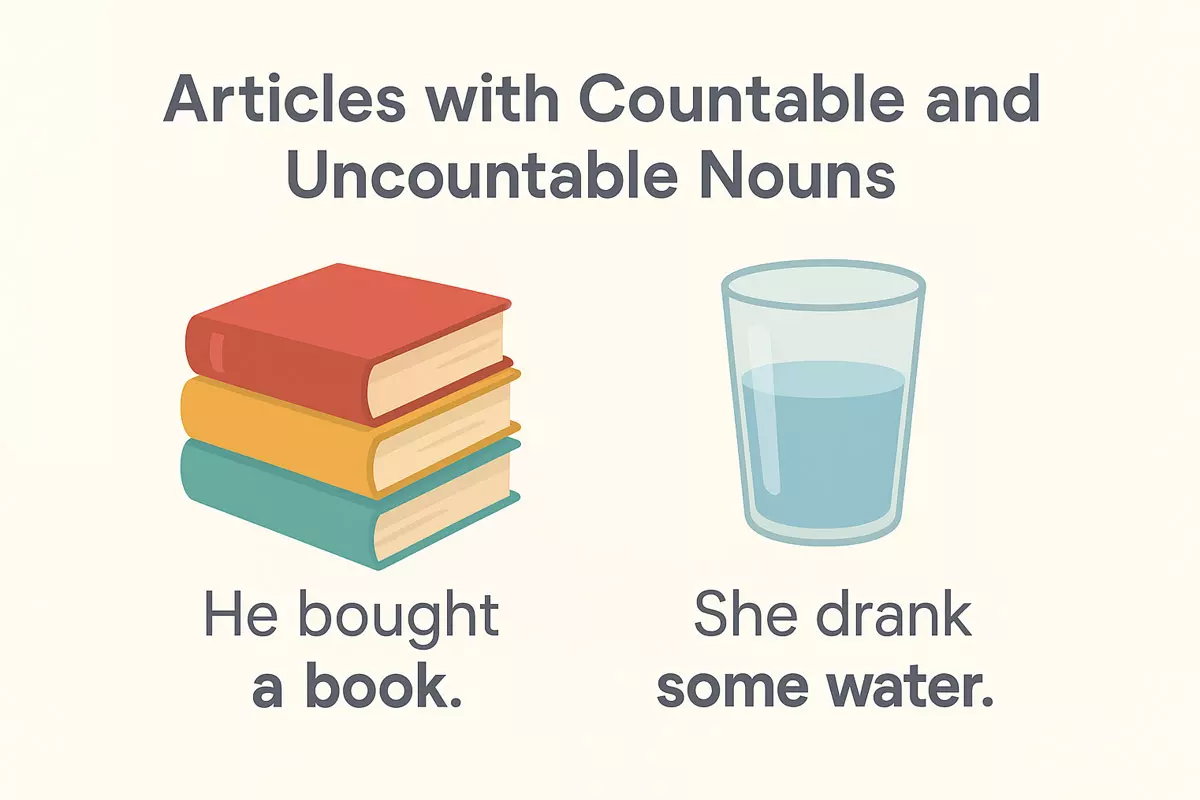 Here we rules for using articles with count and non-count nouns, explains how to select articles for general or specific meanings, discusses common problem cases, gives examples in noun phrases, and offers brief practice exercises.
Learning to use articles such as a, an, and the with both countable and uncountable nouns can be challenging for English learners, but understanding the rules makes it much easier. This article explains how to choose the correct article by clarifying when to use each one with specific types of nouns. By exploring examples and common usage patterns, it aims to help you feel more confident in selecting the right article for different situations, whether you are referring to individual items or general substances.
Article Rules for Count Nouns
Understanding how articles work with countable nouns is key to using English naturally. Count nouns, which refer to individual things you can count (like book, apple, chair), follow specific patterns with a/an, the, or no article at all. These patterns often depend on whether the noun is singular or plural, and whether you’re talking about something specific or general.
Using a and an with Singular Count Nouns
Singular count nouns almost always need an article or determiner. Use a before words that start with a consonant sound, and an before vowel sounds. This signals that you’re referring to one, non-specific item.
- a car
- an apple
- a university (because "university" starts with a "juː" sound)
- an hour (because "hour" starts with a vowel sound)
Using the for Specific Count Nouns
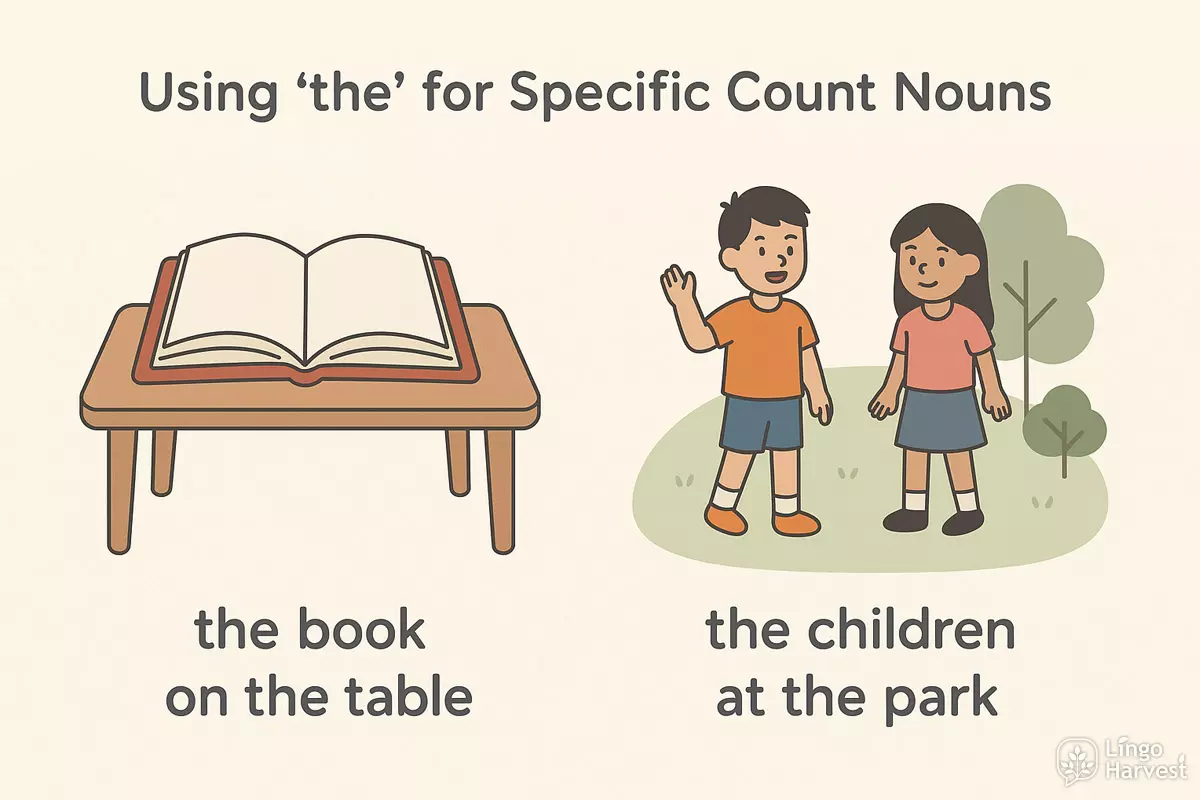
When both speaker and listener know which thing is meant, use the with countable nouns, whether singular or plural. This indicates something previously mentioned or uniquely identified.
- the book on the table
- the children at the park
- the answer to your question
No Article with Plural or General Count Nouns
Plural count nouns and general statements often appear without an article, especially when talking about things in general rather than specific items.
- Cats are independent animals.
- Books can be expensive.
- Cars pollute the air.
Summary Table: Articles with Count Nouns
| Form | Example | Usage |
|---|---|---|
| a/an + singular | a dog, an idea | Non-specific; any one item |
| the + singular/plural | the dog, the ideas | Specific; known to speaker/listener |
| Plural without article | dogs, ideas | General statements or categories |
| No article (with some determiners) | my dogs, some ideas | Possessives/quantifiers replace articles |
Quick Reference: Common Mistakes
- ❌ I have cat → I have a cat
- ❌ She wants apple → She wants an apple
- ❌ The books are interesting (if you mean books in general) → Books are interesting
Getting the article right with countable nouns helps your English sound natural and clear. Practice using articles in different situations, and note how the meaning changes depending on whether you use a/an, the, or no article at all.
Article Rules for Non-Count
When working with uncountable nouns in English, the use of articles follows specific patterns. Unlike countable nouns, non-count words represent substances, concepts, or masses that cannot be separated into individual units. This affects how we use "a," "an," and "the" with them.
General Guidelines
- No "a" or "an": Indefinite articles are not used with non-count nouns. For example, you would not say "an information" or "a rice."
- Use "the" for specificity: When you are talking about a particular instance or specific mass of something, "the" can be used (e.g., "the furniture in this room").
- Zero article for general meaning: Most of the time, uncountable nouns are used without any article when referring to them in a general sense (e.g., "Milk is healthy.").
Common Non-Count Nouns
Here are some typical examples of uncountable nouns that follow these article rules:
- advice
- furniture
- information
- rice
- bread
- music
- water
- money
- equipment
- news
- luggage
- progress
- traffic
- knowledge
- cheese
- work
- air
- weather
Examples in Sentences
- ✅ She gave me advice. (correct: no article)
- ❌ She gave me an advice. (incorrect: "advice" is uncountable)
- ✅ The information you sent was helpful. ("the" specifies particular information)
- ✅ Water is essential for life. (general statement; no article)
- ✅ Pass me the bread, please. ("the" for a specific item on the table)
Article Use with Non-Count Nouns: Summary Table
| Situation | Article Usage Example |
|---|---|
| General reference | Knowledge is power. (no article) |
| Specific reference | The cheese in the fridge is old. ("the" for specific cheese) |
| Indefinite article | ❌ a news, an equipment (never used) |
| Partitive structure | A piece of advice, a glass of water (correct with "of" phrase) |
Using "A/An" with Non-Count Nouns: The Exception
Indefinite articles can appear with uncountable nouns only when combined with a measure word or unit (a piece of, a bit of, a slice of). For instance, "a piece of information" or "a cup of tea" is correct, but "an information" is not.
General vs Specific Meaning
Understanding how articles work with countable and uncountable nouns often comes down to distinguishing between talking about things in general versus referring to particular examples. The use of "a," "an," and "the" changes depending on whether you’re making a broad statement or pointing to a specific instance.
When we talk about things in general, we usually leave out the article for uncountable nouns and use the plural form without an article for countable nouns. For specific things, we often use "the" for both types, or "a/an" for single, countable items.
Examples with Countable Nouns
- Dogs are friendly. (all dogs in general)
- I saw a dog in the park. (one, not specified)
- The dog next door is noisy. (a particular dog)
- Children like sweets. (children in general)
- The children at my school are polite. (specific group)
Examples with Uncountable Nouns
- Water is essential for life. (all water, in general)
- Could you pass me the water? (a specific glass or bottle)
- Music helps me relax. (music in general)
- The music in this movie is beautiful. (particular music)
Comparison: Article Use with General and Specific Reference
| General Reference | Specific Reference |
|---|---|
| Cars are expensive. (all cars, no article) |
The cars in this showroom cost a lot. (these particular cars) |
| Milk is good for you. (all milk, uncountable, no article) |
The milk in the fridge is fresh. (a certain milk, known to speaker/listener) |
| A cat makes a good pet. (any single cat, not specific) |
The cat on the sofa is sleeping. (a particular cat) |
| Information is power. (all information, uncountable) |
The information you gave me was helpful. (specific piece of information) |
| Books can be expensive. (books in general) |
The books on that shelf are new. (those particular books) |
Quick Summary
- Use no article for uncountable nouns in general statements (e.g., Happiness is important).
- Use plural countable nouns without an article for general meaning (e.g., Apples are sweet).
- Use "the" to refer to something already known or previously mentioned (e.g., The apples on the table).
- Use "a/an" for a single, non-specific countable item (e.g., She wants a cookie).
This distinction helps communicate whether you mean any example of something or a particular one, making your English clearer and more precise.
Typical Problem Cases
Learners often encounter confusion when deciding whether to use articles with certain nouns, especially when the distinction between countable and uncountable is not clear-cut. Some nouns can be both, depending on context, while others behave unexpectedly due to idiomatic usage or exceptions. Below are some of the most frequent challenges and error-prone scenarios.
Words That Change Meaning
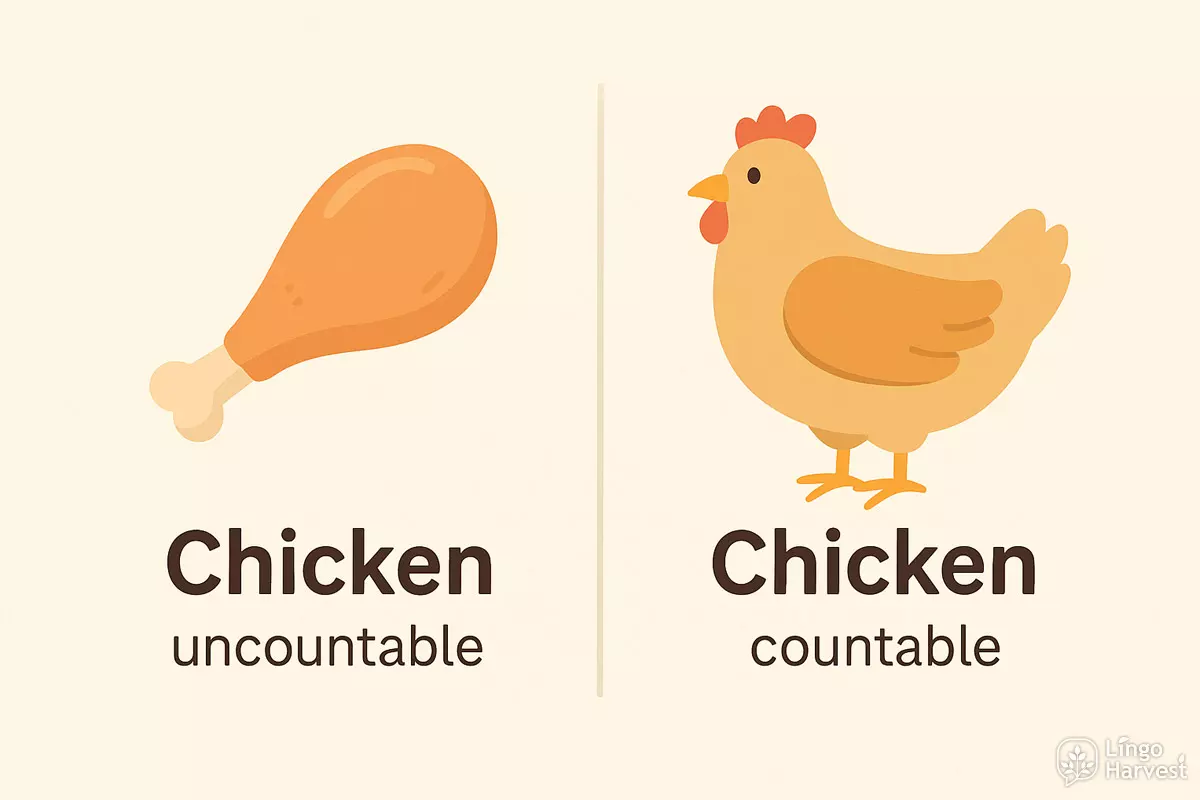
Many English nouns can be both countable and uncountable, but their meaning shifts depending on the usage. For example:
- Chicken (uncountable: the meat; countable: the animal)
- Paper (uncountable: material; countable: a newspaper or an essay)
- Glass (uncountable: substance; countable: a drinking vessel)
- Light (uncountable: illumination; countable: a lamp or light fixture)
- Time (uncountable: general concept; countable: an occasion or instance)
Abstract vs. Concrete Use
Abstract nouns are usually uncountable, but can sometimes be used in a more specific, countable way:
- Experience (uncountable: knowledge; countable: an event)
- Work (uncountable: employment; countable: a work of art)
- Life (uncountable: general existence; countable: a person’s life)
Common Uncountable Nouns Mistakenly Treated as Countable
Some substances and concepts are never used with a/an or in plural form:
- Information ❌ (not an information or informations)
- Advice ❌ (not an advice or advices)
- Furniture
- Luggage
- News
- Equipment
- Progress
- Traffic
- Research
If you need to specify an amount, use phrases like a piece of advice, an item of furniture, or a bit of information.
Article Use with Quantifiers and Expressions
Choosing the right article (or none) with quantifiers and expressions can be tricky. Here’s a quick comparison:
| Expression | Correct Usage |
|---|---|
| a piece of advice | ✅ Correct (countable unit for uncountable noun) |
| an advice | ❌ Incorrect (advice is uncountable) |
| many research | ❌ Incorrect (should be "much research" or "many research studies") |
| a furniture | ❌ Incorrect (furniture is uncountable) |
| a glass of water | ✅ Correct (glass = container, countable) |
| some water | ✅ Correct (uncountable noun) |
Plural-Only and Singular-Only Nouns
Certain nouns are always plural or singular, regardless of meaning. For example, scissors, trousers, news, and mathematics. Articles are generally not used with these, or require special phrases like a pair of scissors.
Mastering these patterns and exceptions requires attention to context and frequent exposure to authentic English usage. When unsure, check if the noun refers to something that can be counted individually, or if it represents a mass or abstract concept.
Examples in Noun Phrases
When we use articles with nouns, the patterns change depending on whether the noun is countable or uncountable. Let’s look at how articles (a, an, the, or zero article) combine with different types of nouns in real phrases. This helps clarify which forms are possible and which are not.
Using Articles with Countable Nouns
Countable nouns can take both definite and indefinite articles. Here are some typical ways articles appear with singular and plural forms:
- a book (one book, any book)
- an apple (one apple, any apple)
- the chair (a specific chair)
- the cars (specific cars, plural)
- books (no article, general plural)
- the books (specific group of books)
Articles with Uncountable Nouns
Uncountable nouns generally do not use the indefinite article, because they refer to substances or abstract ideas, not individual items. Here are common patterns:
- water (no article, general reference)
- the information (specific information)
- advice (general, uncountable)
- the furniture (specific set of furniture)
Side-by-Side Comparison
To clearly see the difference in article use between countable and uncountable nouns, review the table below:
| Countable Noun Phrase | Uncountable Noun Phrase |
|---|---|
| a cookie | some sugar |
| the letter | the news |
| an idea | information |
| the apples | the water |
| books | music |
Common Mistakes ❌ and Correct Usage ✅
Learners often mix up when to use articles with mass nouns or forget them with plural countables.
- ❌ a furniture → ✅ furniture or the furniture
- ❌ an advice → ✅ advice or some advice
- ❌ the apples (when talking generally) → ✅ apples
- ❌ water (when you mean a specific one) → ✅ the water
Understanding these patterns helps you choose the right article for both countable and uncountable nouns in phrases, making your English more natural and precise.
Short Practice
Understanding how to use articles with countable and uncountable nouns can be tricky, so let’s look at some quick exercises and examples. This will help you recognize patterns and typical mistakes learners make.
Choose the Correct Article
For each sentence, choose the best article (a, an, the, or no article) to complete the blank. Some nouns are countable, others uncountable.
- Could you pass me ____ salt, please?
- She bought ____ umbrella yesterday.
- There is ____ information on the website.
- I had ____ apple for breakfast.
- ____ water in this glass is cold.
- They saw ____ interesting movie last night.
- We need ____ bread for dinner.
- He doesn’t have ____ time to finish the work.
- ____ books on that shelf are mine.
- She wants to buy ____ new shoes.
Show answers
- the
- an
- no article
- an
- The
- an
- no article
- no article
- The
- no article
Spot the Error
Identify and correct the article mistakes in the following sentences. Some sentences are correct as they are.
- I need a advice about my project.
- The bread is delicious here.
- Can you give me an information?
- She has a car.
- He drank a milk this morning.
Show answers
- a advice → advice (no article with uncountable nouns)
- Correct
- an information → information (no article with uncountable nouns)
- Correct
- a milk → milk (no article with uncountable nouns)
Common Countable and Uncountable Nouns
This reference highlights some typical examples. Notice which nouns take articles and which do not.
| Countable Nouns (can use a/an, numbers) |
Uncountable Nouns (no a/an, no numbers) |
|---|---|
| book, apple, chair, idea, coin | water, advice, information, bread, money |
| car, bottle, dog, song, friend | rice, furniture, music, air, homework |
| child, egg, question, letter, city | sand, news, coffee, knowledge, equipment |
| pen, ticket, student, message, room | cheese, luggage, progress, sugar, traffic |
Quick Practice: Make Sentences
Write a sentence using the correct article (if needed) for each noun below:
- car
- milk
- umbrella
- music
- egg
- advice
- student
- coffee
- pen
- bread
Show answers
- I bought a car last year.
- She drinks milk every morning.
- He forgot his umbrella at home.
- Music helps me relax.
- Would you like an egg?
- He gave me good advice.
- The student is reading in the library.
- May I have some coffee?
- Can I borrow a pen?
- Bread is fresh today.