Articles in Noun Phrase Structure

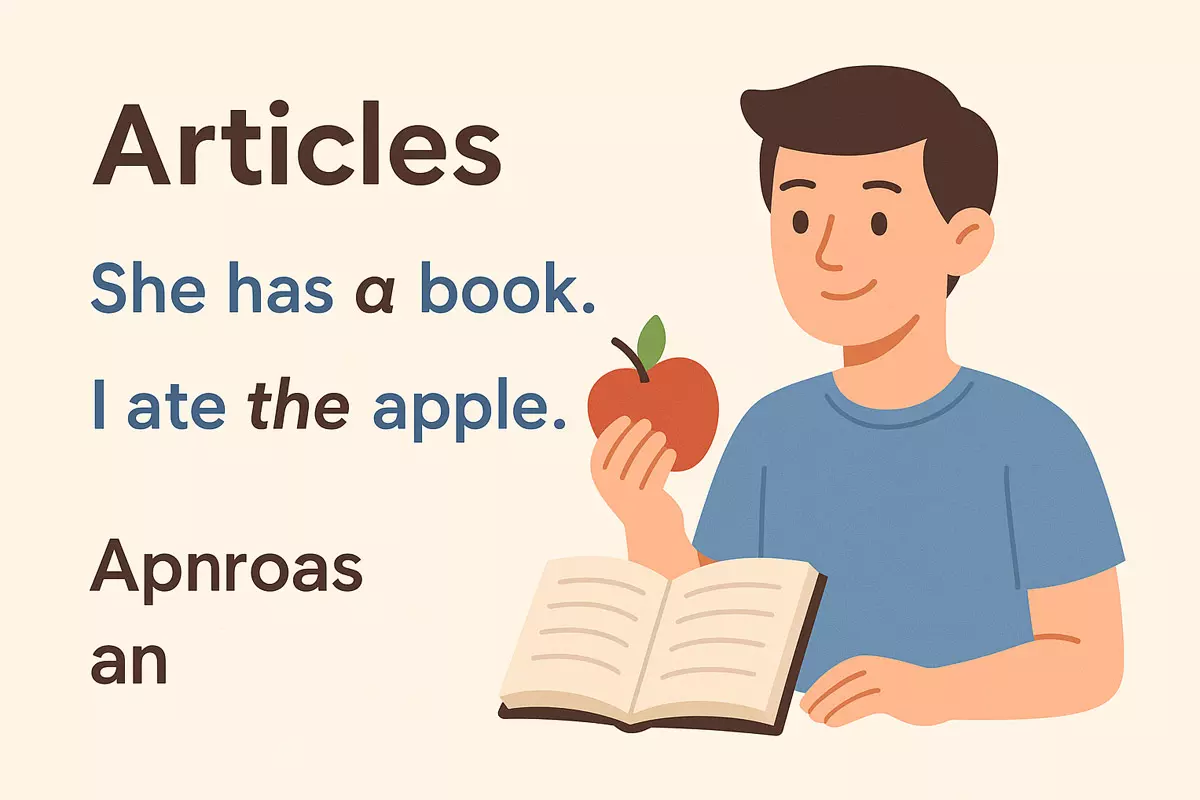 The article shows where articles fit in noun phrases, how to use them with adjectives and modifiers, and the right word order. It also covers common errors and offers practice phrases for mastering article use.
Have you ever considered how small words like "a," "an," and "the" influence our understanding of nouns? These articles, though easy to overlook, are essential for expressing whether we are talking about something specific or something more general. For example, saying "a cat" could refer to any cat, while "the cat" points to a particular one. By using articles appropriately, we make our sentences more precise and easier for others to follow, demonstrating how even the simplest words can have a significant impact on communication.
Where Articles Fit
Articles play a crucial role in the structure of noun phrases in English. They usually appear at the very beginning of a noun phrase, directly before any adjectives or the noun itself. By marking definiteness, specificity, or quantity, articles guide the listener or reader in identifying which person or thing is being discussed.
Position in the Noun Phrase
Within a typical noun phrase, articles occupy a fixed slot. They precede descriptive words (adjectives) and the noun, acting as the first element. For example, in “the big red ball,” “the” comes before both “big” and “red.” This consistent placement helps make noun phrases clear and predictable.
- the old house
- a beautiful painting
- an interesting idea
- the tallest mountain
Relationship to Other Determiners
Articles interact with other determiners but rarely appear together. Instead, they often replace or are replaced by words like “this,” “my,” or “some.” Only one determiner usually appears at the start of a noun group.
| Determiner Type | Example with Noun Phrase |
|---|---|
| Definite Article | the park |
| Indefinite Article | a student |
| Demonstrative | this book |
| Possessive | my friend |
| Quantifier | some water |
Examples of Article Placement
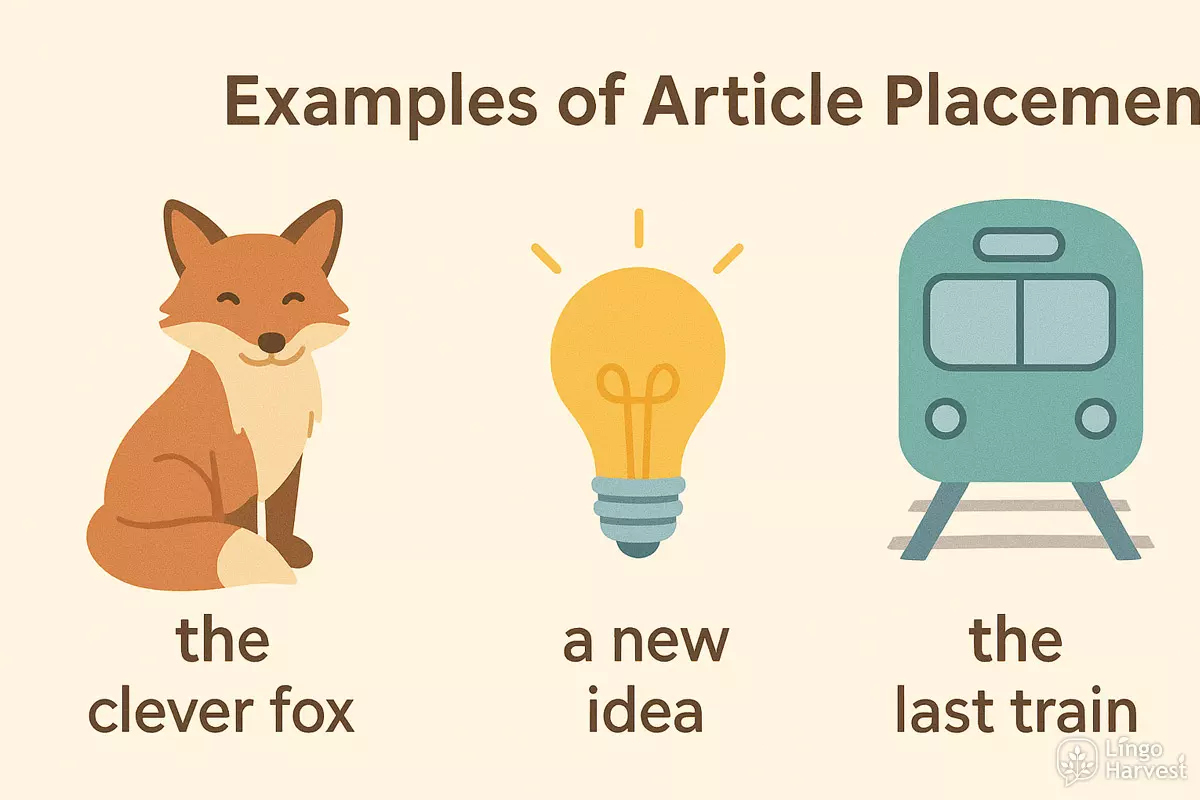
The following examples illustrate how articles fit into different noun phrase structures:
- the clever fox
- an apple a day
- a new idea
- the last train
- an unusual question
- the blue sky
- a sudden noise
- the only answer
- an exciting opportunity
- the main reason
- a helpful suggestion
- an early start
- the same mistake
- a different approach
- the next step
Summary
In summary, articles always precede adjectives and nouns within a phrase, rarely combining with other determiners. Their position and function are essential for clear and natural-sounding English noun phrases.
Article + Adjective + Noun
This structure is a core element of English noun phrases. It combines a grammatical marker (the article), a descriptive word (the adjective), and the main subject (the noun). This order helps listeners and readers quickly understand what is being referred to, as well as any qualities or characteristics attached to it. When using this pattern, the article always comes first, followed by one or more adjectives, and finally the noun.
Common English Examples
- the red car
- a small house
- an old book
- the beautiful garden
- a delicious meal
- the new student
- an interesting idea
- a broken window
- the tall building
- an empty room
- a noisy street
- the green apple
- a friendly dog
- an expensive gift
- the happy child
- a long journey
- an important question
- the quiet park
How the Parts Work Together
Articles indicate whether something is specific or general. Adjectives add detail, describing qualities like size, color, or age. The noun tells us what is being discussed. The order is not flexible: the article must come before the adjective(s), and adjectives always precede the noun.
Using Multiple Adjectives
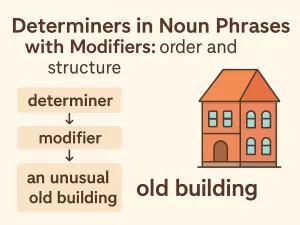
It is possible to use several adjectives in this construction. When doing so, adjectives usually follow a preferred order: quantity, quality, size, age, shape, color, origin, material, and purpose. For example: “a small round wooden table” or “an old French painting”.
| Article | Adjective(s) | Noun | Full Example |
|---|---|---|---|
| a | green | apple | a green apple |
| an | honest | answer | an honest answer |
| the | old | bridge | the old bridge |
| the | beautiful | view | the beautiful view |
| a | delicious Italian | pizza | a delicious Italian pizza |
| an | unusual | idea | an unusual idea |
| the | quiet little | town | the quiet little town |
Key Points to Remember
- Always place the article first, before any adjectives.
- Adjectives directly precede the noun they describe.
- Use “a” before words starting with a consonant sound, “an” before vowel sounds, and “the” for specific references.
- When using more than one adjective, follow the standard order for clarity.
Mastering this pattern makes your English more precise and natural. It is especially useful in both spoken and written descriptions, allowing you to add relevant details efficiently.
Modifiers and Order
How words like adjectives, quantifiers, and determiners are arranged around a noun greatly affects the meaning and clarity of a noun phrase. English follows a fairly predictable sequence for these elements, but subtle shifts can change emphasis or even the phrase’s acceptability.
Types of Modifiers in Noun Phrases
Several types of words can modify a noun. These include:
- Articles – "a," "an," "the"
- Demonstratives – "this," "those"
- Possessives – "my," "our," "their"
- Quantifiers – "some," "many," "few"
- Numbers – "two," "several"
- Adjectives – "big," "red," "interesting"
- Participles – "running," "broken"
- Prepositional Phrases – "of chocolate," "with stripes"
- Relative Clauses – "that I bought," "which is new"
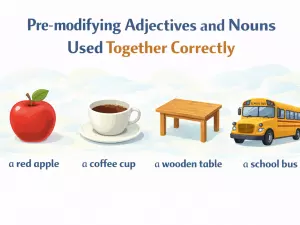
- Classifiers – "coffee" in "coffee cup," "soccer" in "soccer ball"
Typical Sequence of Elements
The usual order of elements in an English noun phrase is as follows:
- Determiner (article, demonstrative, possessive, quantifier)
- Number
- Adjective(s)
- Classifier (if any)
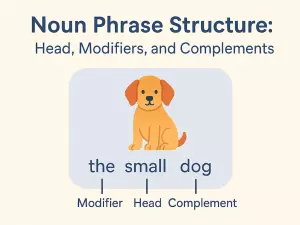
- Noun (head)
- Modifiers after the noun (prepositional phrases, relative clauses, participles)
For example: those three large chocolate cakes on the table
Comparing Modifier Placement
| Element | Example Phrase |
|---|---|
| Determiner + Adjective + Noun | the old house |
| Quantifier + Number + Adjective + Noun | many five-legged chairs |
| Possessive + Adjective + Classifier + Noun | my blue coffee mug |
| Determiner + Noun + Postmodifier | a book with a red cover |
| Number + Adjective + Noun + Relative Clause | two interesting stories that I heard |
Things to Remember
- Not every noun phrase will include every possible type of modifier.
- Some modifiers, like participles or prepositional phrases, usually follow the noun rather than precede it.
- Changing the order can make phrases ungrammatical: "red two cars" ❌ vs. "two red cars" ✅.
- Articles (a/an/the) nearly always come first, before other modifiers.
- Order reflects both grammar rules and typical patterns of emphasis in English.
Patterns to Follow
Understanding the typical arrangements of articles within noun phrases helps clarify both meaning and grammatical correctness. Articles (such as "a," "an," and "the") combine with modifiers, quantifiers, and adjectives in predictable sequences. These arrangements are not random; rather, they follow established conventions in English that aid clarity and flow.
Common Article Placement Patterns
English noun phrases often start with an article, followed by quantifiers, descriptors, and the noun itself. Here are some widely used structures:
- Article + Adjective + Noun (e.g., the red apple)
- Article + Quantifier + Noun (e.g., a few options)
- Article + Adjective + Noun + Prepositional Phrase (e.g., an interesting book on history)
- Article + Noun (e.g., the city)
- Article + Adjective + Compound Noun (e.g., a large conference room)
- Article + Superlative + Noun (e.g., the best solution)
- Article + Ordinal + Noun (e.g., the first time)
- Zero Article + Plural Noun (e.g., books when speaking generally)
- Article + Noun + Relative Clause (e.g., a person who knows)
- Article + Adjective + Noun + Infinitive (e.g., a good place to start)
- Article + Adjective + Quantifier + Noun (e.g., an old few coins — rare, but possible in poetic or emphatic contexts)
- Article + Only + Noun (e.g., the only option)
Order of Elements in Noun Phrases
In English, the order of modifiers around the noun is important. Articles typically precede adjectives and other modifiers, and quantifiers usually come before the article if both are present. For example, "all the interesting books" (not "the all interesting books"). This sequence supports natural, fluent expression.
| Pattern | Example |
|---|---|
| Article + Adjective + Noun | the tall building |
| Article + Quantifier + Noun | a few minutes |
| Article + Superlative + Noun | the oldest tree |
| Article + Noun + Prepositional Phrase | an answer to the question |
| Zero Article + Uncountable Noun | water is essential |
| Article + Adjective + Compound Noun | a beautiful mountain landscape |
Exceptions and Special Cases
While these patterns are reliable, there are exceptions. For example, proper nouns usually omit articles ("Canada," not "the Canada"), but groups of islands or rivers may take one ("the Netherlands," "the Amazon"). Idiomatic phrases may defy the usual order, so it's helpful to notice these when reading or listening. Mastering these constructions helps writers and speakers convey precise meanings and maintain grammatical accuracy. Noticing the sequence and presence of articles in noun phrases is a useful habit for anyone aiming to improve their English.
Common Errors
Missteps in structuring noun phrases often lead to confusion or awkwardness in both written and spoken English. These issues can involve article misuse, incorrect word order, or missing elements. Recognizing typical mistakes helps improve clarity and fluency.
Typical Problems with Articles
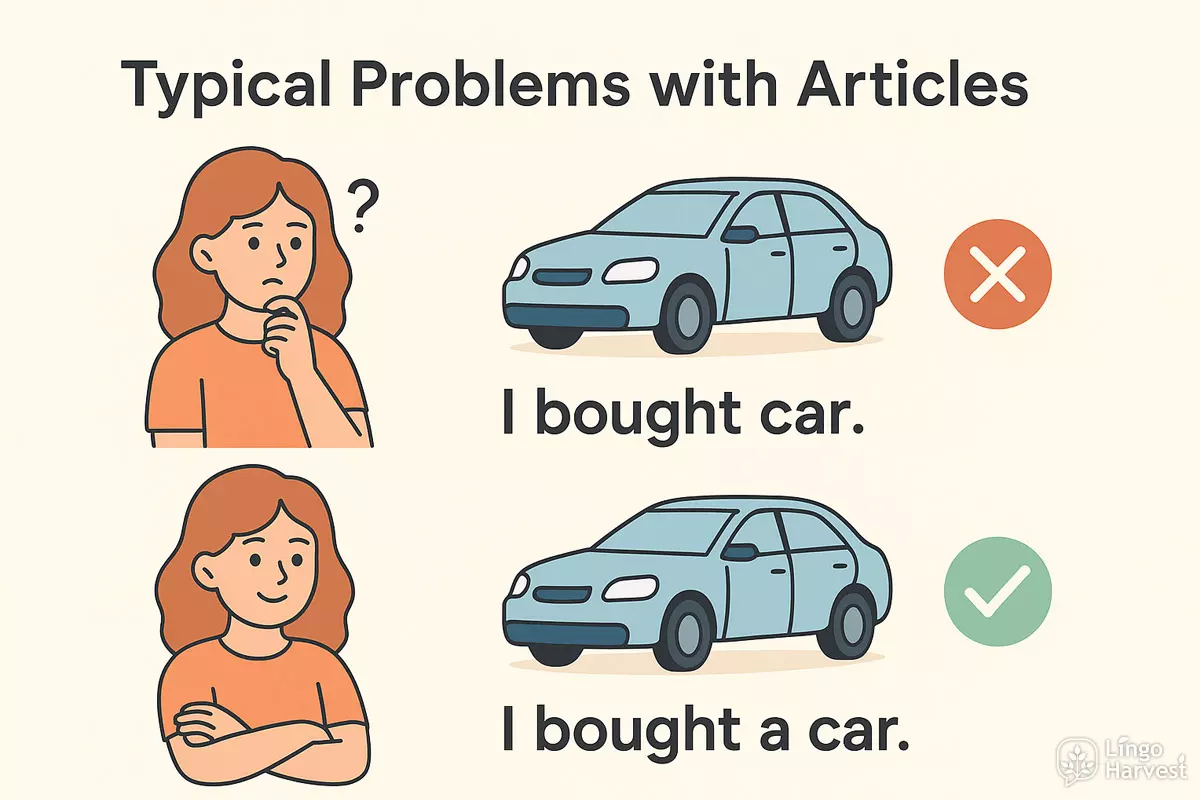
Articles ("a," "an," "the") are frequently omitted or used incorrectly within noun phrases. This can cause sentences to sound unnatural or change the intended meaning. Some common patterns include:
- Leaving out an article: "I bought car." ❌ (Should be: "I bought a car." ✅)
- Using "the" with general nouns: "The dogs are friendly animals." (For a general statement, drop "the": "Dogs are friendly animals.")
- Incorrect choice between "a" and "an": "He is an honest man." (Correct, because "honest" starts with a vowel sound.)
- Using "a" with plurals: "A apples are tasty." ❌ (Should be: "Apples are tasty." ✅)
- Omitting "the" for specific references: "Book on table is mine." (Should be: "The book on the table is mine.")
Word Order Mix-Ups
The sequence of words in a noun phrase matters. Adjectives, determiners, and nouns have a set order. Mixing this up can make a phrase sound odd. For example:
- "A red beautiful car" ❌ (Correct: "A beautiful red car" ✅)
- "My two old friends" (Correct: "My two old friends")
- "Book interesting this" ❌ (Should be: "This interesting book" ✅)
Confusing Quantifiers and Determiners
Learners often confuse quantifiers (some, many, few) and determiners (this, that, these, those). This leads to redundancy or missing elements:
- "Many the students" ❌ (Should be: "Many students" or "The students")
- "Some this information" ❌ (Should be: "Some information" or "This information")
Incorrect Use of Prepositional Phrases
Adding or omitting prepositional phrases in noun phrase structure can also cause errors. For example:
- "The hat of John" (Correct in some contexts, but more natural: "John's hat")
- "A cup coffee" ❌ (Should be: "A cup of coffee" ✅)
Comparison of Correct and Incorrect Noun Phrases
| Incorrect Form | Corrected Version |
|---|---|
| This blue beautiful car | This beautiful blue car |
| I have a informations | I have information |
| She bought an umbrella red | She bought a red umbrella |
| He is teacher | He is a teacher |
| The most of people | Most people |
| My friend’s the house | My friend’s house / The house of my friend |
| Those informations are useful | That information is useful |
| A advices | Some advice |
| Book interesting | Interesting book |
| The both answers | Both answers |
Practice Phrases
Understanding how articles work within noun phrases is essential for correct sentence formation. To solidify your grasp, try analyzing and creating noun groups with various article types: definite, indefinite, and zero article. This section provides structured tasks, sample phrases, and a comparison table to reinforce these concepts in practical contexts.
Common Noun Phrase Patterns
Review these typical structures that combine articles with other noun phrase elements. Notice the position of the article and how it interacts with adjectives and quantifiers:
- the red apple
- a beautiful painting
- an interesting idea
- the old wooden chair
- an hour-long discussion
- the only solution
- a few books
- the best answer
- an honest person
- the tallest building
- a new opportunity
- the last train
- an unusual event
- the most expensive option
- a quick response
- the main entrance
- an apple a day
- the first step
Comparing Article Usage
The following table contrasts how definite, indefinite, and zero articles can change the meaning or reference of a noun phrase:
| With Definite Article (the) |
With Indefinite Article (a/an) |
No Article (zero) |
|---|---|---|
| The dog barked loudly. (specific dog) |
A dog barked loudly. (any dog, not specified) |
Dogs bark loudly. (dogs in general) |
| The book on the table is mine. | A book is on the table. | Books are important. |
| The information is accurate. | An idea came to me. | Information is power. |
| The teacher explained the lesson. | A teacher explained the lesson. | Teachers explain lessons. |
Tasks: Identify and Rewrite
Try these exercises to check your understanding of article placement in noun phrases. For each sentence, identify the noun phrase and specify the article used. Then, rewrite the phrase with a different article (if possible) and note the change in meaning.
- The child in the red coat smiled.
- An umbrella is useful in the rain.
- Books can be expensive.
- The only answer was silence.
Show answers
- 1. Noun phrase: the child in the red coat (definite article)
Rewritten: a child in a red coat (indefinite article) – refers to any child, not a specific one. - 2. Noun phrase: an umbrella (indefinite article)
Rewritten: the umbrella (definite article) – refers to a specific umbrella known to the listener. - 3. Noun phrase: books (zero article)
Rewritten: the books (definite article) – refers to specific books already mentioned or known. - 4. Noun phrase: the only answer (definite article)
Rewritten: an answer (indefinite article) – refers to one possible answer, not the unique one.
Quick Challenge: Choose the Correct Article
Fill in the blanks with a, an, the, or leave blank (zero article):
- I saw ___ cat in the garden.
- ___ water in this glass is cold.
- ___ honesty is important.
- He is ___ engineer.
Show answers
- a cat
- The water
- Honesty
- an engineer