Past Simple Passive: Was Done, Were Made

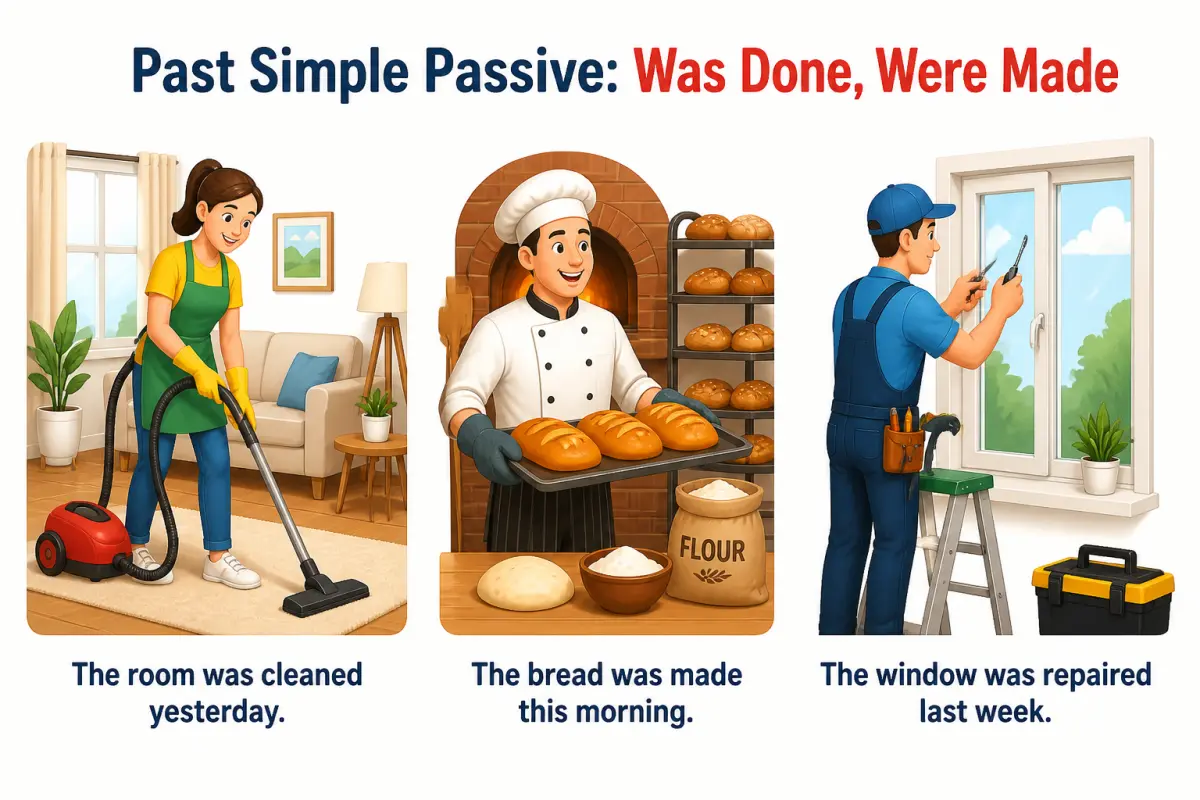 Here we the past simple passive: what it means, when to use it for finished past actions, and how to form it with was or were plus regular and irregular past participles. It also explains statements, negatives, questions, active vs passive examples, common mistakes, homework practice, and an FAQ.
- What the past simple passive means
- When to use passive voice for finished past actions
- Was and were with singular and plural subjects
- Past simple passive with regular and irregular participles
- Affirmative, negative, and question forms in the past
- Using past simple passive for history, news, and reports
- Active vs passive examples in past simple
- Common errors with was, were, and past participles
- Homework: rewrite past simple sentences in passive voice
- FAQ: past simple passive voice
English often uses forms like was completed or were built when talking about past events where the action matters more than who did it. This pattern is common in daily life: a road was repaired, a meal was prepared, a mistake was noticed. Seeing it in real situations makes it feel more natural and easier to understand, helping you learn not only how the form is made, but also why speakers choose to use it.
What the past simple passive means
The passive voice lets us focus on the person, thing, or result that received an action. In the past simple passive, the action is finished and happened in the past. The basic pattern is was/were + past participle. For example: The email was sent yesterday. The windows were cleaned this morning.
Compare these two ideas: Maria sent the email and The email was sent. In the first sentence, the subject does the action. In the second sentence, the subject receives the action. The passive is useful when the result is more important than the person who did it, when the doer is unknown, or when we simply do not want to mention the doer.
That is why you often see sentences like these:
- My bag was stolen on the train.
- The documents were printed before the meeting.
- The road was closed after the accident.
- The problem was solved in one afternoon.
Notice that the sentence is still about a completed past event. The passive does not change the time; it changes the focus. If you say The cake was made at 6 p.m., you are still talking about one finished action in the past.
When to use passive voice for finished past actions

We usually choose this form when the action is complete and the receiver of the action matters more than the person who performed it. This is very common in everyday English. If your phone was repaired, your real message is often about the phone, not about the technician.
Here are the most natural situations for this grammar:
- the doer is unknown: My bike was taken from outside the café.
- the doer is obvious: The patient was examined at 9 a.m. We know a doctor probably did it.
- the doer is not important: The room was cleaned before check-in.
- the writer wants a more formal style: The request was approved last week.
- the result matters more than the action itself: The package was delivered on Friday.
You can also add the doer with by if it matters: The mural was painted by local students. But in many real sentences, we leave that part out.
Look at the difference in focus:
- The manager canceled the meeting. Focus: the manager.
- The meeting was canceled. Focus: the meeting and the result.
- Someone damaged the gate during the storm. Focus: someone.
- The gate was damaged during the storm. Focus: the gate.
- The school built the new library in 2015. Focus: the school.
- The new library was built in 2015. Focus: the library.
Teacher note: Many learners use the passive too little because they think it is only for formal writing. In fact, it is very common in ordinary speech: “My car was hit,” “The seats were reserved,” “The bill was paid.”
Was and were with singular and plural subjects
The choice between was and were depends on the subject of the passive sentence, not on the person who did the action. Singular subjects usually take was. Plural subjects take were.
This point sounds simple, but learners often look at the original active sentence and get confused. Do not ask, “Was the action done by one person or two people?” Ask, “Is the subject in my passive sentence singular or plural?”
| Subject | Correct form | Example |
|---|---|---|
| singular noun | was | The letter was delivered at noon. |
| plural noun | were | The letters were delivered at noon. |
| uncountable noun | was | The information was shared yesterday. |
| compound plural idea | were | The chairs and tables were moved. |
Examples with singular subjects:
- The door was locked after class.
- The report was finished on Monday.
- The milk was kept in the fridge.
Examples with plural subjects:
- The doors were locked after class.
- The reports were finished on Monday.
- The files were kept in a safe place.
Be careful with nouns that feel plural in meaning but are grammatically singular. For example:
- The news was reported quickly.
- The furniture was delivered late.
- The equipment was tested yesterday.
And with clearly plural subjects:
- The clothes were washed last night.
- The scissors were found under the desk.
- The stairs were painted in June.
Past simple passive with regular and irregular participles
After was or were, you need the past participle of the main verb. With regular verbs, that form usually ends in -ed: cleaned, opened, closed, painted. With irregular verbs, the participle may look very different: made, built, written, taken, found.
This is one of the most important areas to master because learners often mix the past simple form and the past participle. For example, made is both past simple and past participle, but wrote is past simple while written is the participle. In the passive, you need written, not wrote.
| Verb | Past simple | Past participle | Passive example |
|---|---|---|---|
| clean | cleaned | cleaned | The kitchen was cleaned after dinner. |
| make | made | made | The chairs were made by hand. |
| write | wrote | written | The note was written in pencil. |
| build | built | built | The bridge was built in 1998. |
| take | took | taken | The photos were taken at sunset. |
| break | broke | broken | The screen was broken during the move. |
Regular participles are usually easier:
- The walls were painted white.
- The forms were signed yesterday afternoon.
- The shop was closed early.
Irregular participles need more attention:
- The ring was found in the garden.
- The answer was given by email.
- The tickets were bought online.
- The cake was eaten before I arrived.
A useful habit is to learn irregular verbs in three forms: write – wrote – written, take – took – taken, see – saw – seen. That makes passive sentences much easier to build correctly.
Teacher note: If your passive sentence sounds wrong, check the participle first. In class, this is often the real problem, not the passive structure itself.
Affirmative, negative, and question forms in the past
Once you know the pattern, the forms are straightforward. In affirmative sentences, use subject + was/were + past participle. In negative sentences, add not after was or were. In questions, move was/were before the subject.
These forms are especially common in work emails, news reports, spoken explanations, and simple descriptions of past events. Try to notice the position of not and the word order in questions.
Affirmative examples:
- The room was booked last month.
- The invitations were sent on Tuesday.
- The computer was repaired yesterday.
Negative examples:
- The room was not booked in advance.
- The invitations were not sent on Tuesday.
- The computer was not repaired yesterday.
Question examples:
- Was the room booked in advance?
- Were the invitations sent on Tuesday?
- Was the computer repaired yesterday?
Short answers follow the normal pattern:
- Was the parcel delivered? — Yes, it was.
- Were the lights turned off? — No, they weren't.
Wh-questions are also common:
- When was the order placed?
- Where were the keys found?
- Why was the flight delayed?
- How were the samples tested?
Be careful not to use did with passive questions in the past simple. We say Was it delivered?, not Did it delivered? or Did it be delivered?
Using past simple passive for history, news, and reports

This form is very common in formal and semi-formal writing because it helps writers focus on events, results, and facts. In history, the important point is often what happened, when it happened, and to whom or what. In news and reports, the doer may be unknown at first, or it may be less important than the event.
That is why you read sentences like these:
- The castle was built in the 12th century.
- Several people were injured in the explosion.
- The missing documents were found late last night.
- A new policy was announced after the meeting.
In history writing, passive sentences help create an objective tone:
- The city was destroyed by fire in 1666.
- The first vaccine was developed after years of research.
- The agreement was signed in Paris.
In news reports, passive forms are useful when the doer is not known yet:
- A painting was stolen from the museum overnight.
- Two roads were closed because of flooding.
- A suspect was arrested this morning.
In business or academic reports, they can sound neutral and professional:
- The data was collected over six months.
- The samples were stored at low temperatures.
- The final decision was made by the board.
Teacher note: In speaking, too much passive can sound distant. In reports, that distance is often useful. In conversation, choose it mainly when the result matters more than the person.
Active vs passive examples in past simple
The clearest way to understand this grammar is to compare active and passive versions of the same idea. The meaning stays close, but the focus changes. In the active voice, the subject does the action. In the passive voice, the subject receives it.
When you transform a sentence, the object of the active sentence becomes the subject of the passive sentence. Then you add was or were and the past participle. If you want, you can include the original subject with by.
Compare these pairs:
- The chef prepared the meal. → The meal was prepared by the chef.
- The staff checked the passports. → The passports were checked by the staff.
- The storm damaged the roof. → The roof was damaged by the storm.
Now compare the effect:
- My brother fixed the printer. → focus on my brother.
- The printer was fixed. → focus on the printer and the result.
- The company launched the product in May. → focus on the company.
- The product was launched in May. → focus on the product and the date.
- The police questioned three witnesses. → focus on the police.
- Three witnesses were questioned. → focus on the witnesses.
Sometimes the active version sounds better, especially when the doer is important and clear:
- Our teacher explained the rule very clearly.
Sometimes the passive version sounds better, especially when the result matters more:
- The rule was explained at the start of the lesson.
Use active when the doer is the real topic. Use passive when the receiver or result is the real topic.
Common errors with was, were, and past participles
Most mistakes in this area come from three sources: choosing the wrong form of be, using the wrong verb form after it, or mixing active and passive patterns. These errors are normal, but they are easy to fix if you know what to check.
Start with subject agreement. The passive verb must match the subject of the passive sentence.
Wrong and correct examples with was/were:
- ❌ The photos was taken yesterday.
✅ The photos were taken yesterday. - ❌ The message were sent at noon.
✅ The message was sent at noon. - ❌ The furniture were moved upstairs.
✅ The furniture was moved upstairs.
Next, check the past participle. After was or were, do not use the base form or the past simple form if it is different from the participle.
Wrong and correct examples with past participles:
- ❌ The essay was wrote last night.
✅ The essay was written last night. - ❌ The window was broke during the game.
✅ The window was broken during the game. - ❌ The patient was give new medicine.
✅ The patient was given new medicine.
Another common problem is mixing active and passive structures.
Wrong and correct examples with mixed patterns:
- ❌ The manager was approved the plan.
✅ The manager approved the plan.
✅ The plan was approved. - ❌ The students were completed the task.
✅ The students completed the task.
✅ The task was completed. - ❌ The email was sented this morning.
✅ The email was sent this morning.
Learners also sometimes put by where it is unnecessary or awkward:
- ❌ My passport was found by yesterday.
✅ My passport was found yesterday. - ❌ The bill was paid by last week.
✅ The bill was paid last week.
Remember that by introduces the doer, not the time.
Teacher note: When checking your own writing, do it in this order: 1) singular or plural subject? 2) was or were? 3) correct past participle? This simple routine catches many mistakes.
Homework: rewrite past simple sentences in passive voice
Below are three homework blocks. Each one trains a different skill. Do them slowly and say the answers aloud if possible. That helps you notice agreement, word order, and past participles more clearly.
In the first block, choose the correct passive form. In the second, rewrite active sentences in the passive. In the third, find and correct the mistake. Do not worry if some irregular participles feel difficult at first; that is exactly where good practice helps.
Block 1: Choose the correct form
- The package (was delivered / were delivered) before lunch.
- The tickets (was sold / were sold) in one hour.
- The bridge (was built / were built) in 2004.
- The keys (was found / were found) under the sofa.
- The information (was shared / were shared) with the team.
- The photos (was taken / were taken) at the wedding.
- The museum (was closed / were closed) on Monday.
- The sandwiches (was made / were made) this morning.
- The homework (was finished / were finished) after dinner.
- The lights (was turned off / were turned off) at midnight.
Show answers
- was delivered
- were sold
- was built
- were found
- was shared
- were taken
- was closed
- were made
- was finished
- were turned off
Block 2: Rewrite in the passive
- The company emailed the receipt.
- Someone cleaned the classroom after the lesson.
- The chef prepared the soup this morning.
- The police stopped the car near the station.
- My aunt made these curtains by hand.
- The students decorated the hall for the event.
- The mechanic repaired my brakes yesterday.
- The storm destroyed several trees in the park.
- The receptionist printed our boarding passes.
- They announced the results on Friday.
Show answers
- The receipt was emailed by the company.
- The classroom was cleaned after the lesson.
- The soup was prepared this morning by the chef.
- The car was stopped near the station by the police.
- These curtains were made by hand by my aunt.
- The hall was decorated for the event by the students.
- My brakes were repaired yesterday by the mechanic.
- Several trees were destroyed in the park by the storm.
- Our boarding passes were printed by the receptionist.
- The results were announced on Friday.
Block 3: Spot and correct the error
- The letter were sent last night.
- The report was wrote in a hurry.
- The boxes was moved into the garage.
- The problem was solve yesterday.
- The windows were broke during the storm.
- The room was not cleaneded properly.
- Were the form signed by the client?
- The answer was gave in class.
- The invitations was not printed on time.
- Was the photos taken indoors?
Show answers
- The letter was sent last night.
- The report was written in a hurry.
- The boxes were moved into the garage.
- The problem was solved yesterday.
- The windows were broken during the storm.
- The room was not cleaned properly.
- Was the form signed by the client?
- The answer was given in class.
- The invitations were not printed on time.
- Were the photos taken indoors?
FAQ: past simple passive voice
1. Can I use the passive if I know who did the action?
Yes. You can add the doer with by when that information matters: The mural was designed by a local artist. But if the doer is not important, leave it out: The mural was designed last year. Both are correct; they just focus differently.
2. Is “was done” different from “did” in meaning?
The time can be the same, but the focus is different. Tom did the work focuses on Tom. The work was done focuses on the work and the result. Choose the version that matches what you want to emphasize.
3. Can I use past simple passive with time expressions?
Yes, very naturally. You can say The payment was made yesterday, The forms were collected last week, or The door was painted in April. Time expressions work the same way they do in other past simple sentences.
4. Do I always need “by” in a passive sentence?
No. In fact, many passive sentences do not use it. We usually add by only if the doer is important, surprising, or necessary for clarity. For example, The novel was written by my grandmother gives useful new information. But The floor was cleaned is often enough.
5. How can I know whether I need “was” or “were”?
Look only at the passive subject. If it is singular, use was: The file was deleted. If it is plural, use were: The files were deleted. Ignore the original active subject when choosing.
6. Why is “The email was wrote” wrong?
Because after was or were, you need a past participle, not the past simple form. The verb is write – wrote – written, so the correct sentence is The email was written. This is a very common irregular-verb mistake.
7. Is the passive more formal than the active?
Often yes, but not always. In news, reports, and official writing, it can sound more formal or neutral. In everyday speech, it is still common when the result matters: My flight was canceled, The order was delayed, The window was broken.
8. Can I make every active sentence passive?
No. Usually only verbs with an object can become passive, because the object becomes the passive subject. She opened the door can become The door was opened. But a sentence like He slept has no object, so it normally cannot be turned into a passive sentence.