Passive Voice with Verbs: Forms, Uses, and Examples

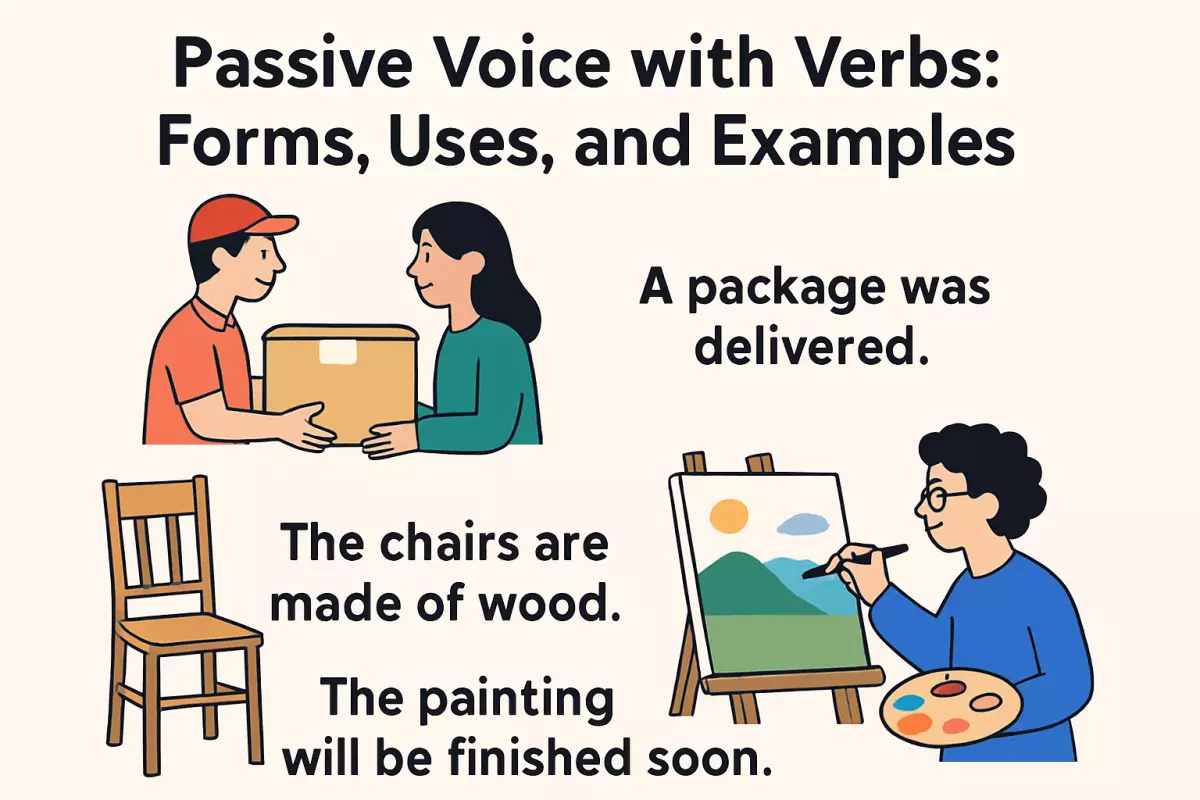 This article explains what passive voice is, how to form it with be plus a past participle, when to use it, and how agents and by-phrases work. It covers passive across tenses, common mistakes, active vs passive meaning, and practice homework.
Passive verbs can shift emphasis in a sentence, moving attention from who performed an action to what occurred. In everyday English, the passive is useful when the doer is unknown, irrelevant, or better left unstated, and it can also sound more polite or neutral. Used carefully, it keeps writing clear by highlighting results, processes, or events rather than the person responsible.
What the passive voice is
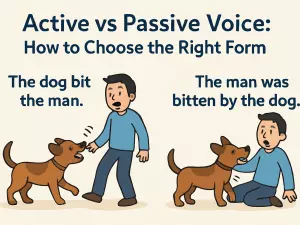
The passive voice is a way of building a sentence where the receiver of an action becomes the subject, and the doer (the agent) is optional. This shifts attention from “who did it” to “what happened” or “what was done.” It is especially common when the agent is unknown, unimportant, obvious from context, or deliberately left unstated.
In active voice, the subject performs the action. In passive constructions, the subject undergoes the action, and the verb phrase is typically formed with be (or sometimes get) plus a past participle.
| Active pattern | Passive pattern | Example (active → passive) |
|---|---|---|
| Subject + verb + object | Object + be + past participle (+ by + agent) | The chef cooks the meal → The meal is cooked (by the chef). |
| Modal + base verb | Modal + be + past participle | They will finish the report → The report will be finished. |
| Perfect: have + past participle | Perfect passive: have + been + past participle | Someone has repaired the phone → The phone has been repaired. |
| Progressive: be + -ing | Progressive passive: be + being + past participle | They are interviewing candidates → Candidates are being interviewed. |
| Reporting verbs (say, believe, think) | It + be + past participle + that… / Subject + be + past participle + to… | People say he is honest → It is said that he is honest / He is said to be honest. |
Key features to notice
To recognize this structure quickly, look for a form of be (or get) followed by a past participle. The agent, if included, usually appears in a by-phrase. Not every sentence with “be + past participle” is passive, though; some are simply descriptions (states) rather than actions.
Passive vs. adjective (state) uses
A useful test is whether you can add an agent naturally. If you can, it is likely a passive action; if you cannot, it is often an adjective describing a condition.
- Action-like: The window was broken (by someone).
- State-like: The window was broken for weeks (describes condition; the “by someone” detail may feel less central).
When the agent appears (and when it doesn’t)
Including the doer with by is most helpful when it adds important information or prevents ambiguity. Leaving it out is common when the focus is on the result, process, or outcome.
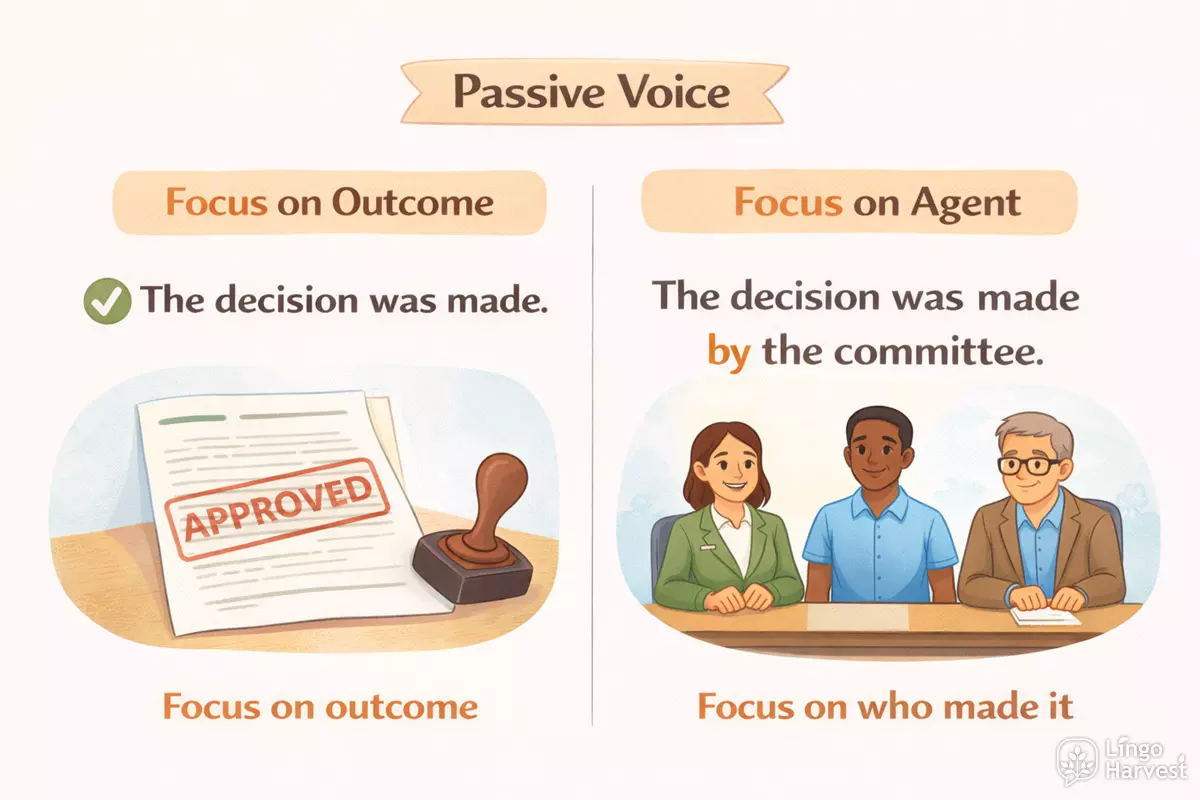
Compare:
- The decision was made. (focus on outcome)
- The decision was made by the committee. (focus on who made it)
Forming the passive with be and past participle
The most common passive pattern uses a form of be plus the verb’s past participle. This shifts attention to the receiver of the action (the subject) rather than the doer. The basic shape is: subject + be (in the needed tense) + past participle, with an optional by-phrase to name the agent.
Core pattern and word order
Build the passive by keeping the tense and agreement on be, then adding the past participle. Any objects, complements, and adverbials usually stay after the participle. If you include the agent, place it at the end with by.
- Active: The committee approved the plan. → Passive: The plan was approved (by the committee).
- Active: They are repairing the road. → Passive: The road is being repaired.
- Active: Someone has stolen my bike. → Passive: My bike has been stolen.
Choosing the correct form of be
To form a clear passive, match be to the time, aspect, and number you need. The participle does not change for tense; it stays in the past participle form (regular -ed or irregular forms like written, built, seen).
| Tense / aspect | Passive form | Example |
|---|---|---|
| Present simple | am/is/are + past participle | The reports are filed every Friday. |
| Past simple | was/were + past participle | The window was broken during the storm. |
| Present continuous | am/is/are being + past participle | Dinner is being prepared right now. |
| Past continuous | was/were being + past participle | The documents were being reviewed all morning. |
| Present perfect | has/have been + past participle | The email has been sent. |
| Past perfect | had been + past participle | The tickets had been sold before noon. |
| Future (will) | will be + past participle | The results will be announced tomorrow. |
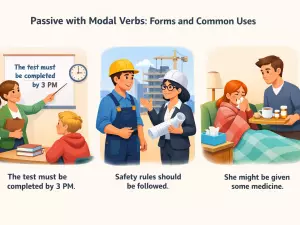
| Modal (can/must/should, etc.) | modal + be + past participle | The form must be signed today. |
When to include the agent (the by-phrase)
The agent is optional. Include it when the doer is important, unknown but relevant, or needed for clarity. Omit it when the doer is obvious, unimportant, or intentionally not mentioned.
- ✅ Include it for clarity: The samples were labeled by the lab assistant, not by the researcher.
- ✅ Include it when it adds key information: The novel was written by Toni Morrison.
- ❌ Omit it when it is generic: The package was delivered (by someone).
- ❌ Omit it when the focus is the result: The door was locked.
Common participle and meaning issues
Many past participles also work like adjectives, so context matters. Compare a true passive (an action) with a stative meaning (a condition). Both can look similar, but adverbs and context often signal the difference.
- Action passive: The door was closed at 6 p.m. (someone closed it)
- State: The door was closed all night. (it remained shut)
- Action passive: The audience was surprised by the ending.
- State-like description: I’m interested in architecture. (describes a feeling)
High-utility passive examples (varied patterns)
- The meeting is scheduled for Monday.
- Your request was approved yesterday.
- The files are being uploaded at the moment.
- The product has been tested for safety.
- The room had been cleaned before guests arrived.
- The contract will be renewed next quarter.
- The password must be changed regularly.
- The patient can be discharged this afternoon.
- The painting was restored by specialists.
- Several errors were found in the report.
- The announcement is being translated into three languages.
- All seats have been reserved.
- The server was being monitored overnight.
- The instructions should be followed carefully.
- The issue will be investigated promptly.
When to use the passive voice
Choose this construction when the sentence should highlight the receiver of the action (the thing affected) rather than the doer. It is especially useful when the agent is unknown, unimportant, obvious from context, or intentionally left out. In many cases, the passive helps you keep a consistent topic across sentences, which can make explanations and reports easier to follow.
Common situations where it works well
- The agent is unknown: The window was broken last night.
- The agent is unimportant: The forms are processed within 24 hours.
- The agent is obvious: He was arrested at the scene. (by the police is understood)
- You want to focus on results: The problem was solved.
- You want an objective tone (common in academic/scientific writing): The samples were heated to 80°C.
- Instructions and processes: The device is connected to the router.
- Formal notices and announcements: The meeting has been postponed.
- To avoid blaming someone directly: Mistakes were made during the calculation.
- To keep the same topic as the subject across sentences: The manuscript was submitted on Monday. It was reviewed on Thursday.
- To emphasize what happened to someone/something: Several homes were damaged by the storm.
- To report events in news style: Two people were injured in the accident.
- To describe rules and policies: Personal data is stored securely.
- To foreground the object in a narrative: The treasure was hidden beneath the floorboards.
- To match a question that asks about the receiver: How was the decision made?
- To avoid repeating the same subject (e.g., “we” or “they”) in consecutive sentences: The report was drafted, revised, and approved.
Patterns that signal a good fit
Look for these cues in your draft. If several apply, the passive voice is often the clearer choice.
- The most important noun is the thing affected (product, patient, document, decision).
- You do not know who did it, or you cannot verify the agent.
- The agent would be a vague subject like someone, people, they.
- You are describing a procedure with steps, conditions, and outcomes.
- You want a neutral, report-like tone rather than a personal one.
- The sentence naturally ends with the key information (often the result or the by-phrase).
When to prefer the active voice instead
- Clarity depends on the agent: The technician replaced the valve is clearer than The valve was replaced if responsibility matters.
- You need direct, energetic style: narratives and persuasive writing often benefit from active verbs.
- The passive creates ambiguity: The policy was changed may raise the question “by whom?”
- Sentences become wordy: repeated was/were + past participle can slow the pace.
- You must assign accountability: instructions, safety notes, and incident reports may require naming the actor.
Including or omitting the agent (the by-phrase)
Add a by-phrase when the doer is necessary for meaning or contrast; omit it when it is unknown, obvious, or distracting. Compare:
- The contract was signed. (focus on completion; agent not needed)
- The contract was signed by the supplier. (agent matters)
- The painting was restored by experts. (agent adds credibility)
- The files were deleted. (agent unknown or intentionally not stated)
Agent and by-phrases explained
In passive clauses, the focus moves to the receiver of the action, and the “doer” can be added separately. That doer is called the agent, and it is most often introduced with a by-phrase (by + noun/pronoun). This optional phrase helps when the performer matters for meaning, responsibility, or clarity.
What the agent is (and where it goes)
The agent is the person, group, or thing that performs the action. In a typical passive pattern, it appears at the end of the clause:
Object (new subject) + be/get + past participle + (by + agent)
Examples:
- The proposal was approved by the committee.
- The window was broken by someone.
- The patient was examined by Dr. Khan.
- The email was sent by my assistant.
When to include a by-phrase
Add the agent when it contributes information the reader needs. Common reasons include assigning responsibility, identifying a source, or avoiding ambiguity.
- ✅ Responsibility matters: The safety rules were ignored by the contractor.
- ✅ The agent is surprising or important: The portrait was painted by a child.
- ✅ Clarifying “who did what”: The files were deleted by an administrator.
- ✅ Credit and attribution: The theory was developed by two researchers.
- ✅ Multiple possible actors: The decision was reversed by the court (not by the manager).
- ✅ Formal reporting: The samples were analyzed by the lab.
When to omit the agent
Leaving out the doer is common and often preferred when the actor is unknown, obvious, unimportant, or intentionally not mentioned.
- ✅ Unknown agent: My bike was stolen.
- ✅ Obvious agent (context supplies it): The suspect was arrested. (by the police)
- ✅ Unimportant agent: The forms are processed within 24 hours.
- ✅ General truth/process: The product is assembled in two stages.
- ✅ Polite or tactful wording: A mistake was made in the invoice.
- ❌ Clunky repetition: The meeting was attended by employees. (Often better: Employees attended the meeting.)
Choosing the right preposition: by vs. with vs. through
Not every phrase after a passive verb is an agent. Use by for the performer, but use other prepositions for tools, methods, or channels.
- by = the doer: The cake was baked by Lina.
- with = the instrument/material: The cake was decorated with fresh berries.
- using = method/tool (often clearer than with): The data was processed using a script.
- through = channel/means: The request was submitted through the portal.
- in = medium: The report was written in plain language.
Common patterns and example bank
These patterns show how the by-phrase behaves with different passive forms and typical agents.
- Simple passive: The contract was signed by both parties.
- Continuous passive: The issue is being investigated by the IT team.
- Perfect passive: The shipment has been delayed by customs.
- Modal passive: The form must be completed by the applicant.
- Get-passive (often more informal): He got promoted by his manager.
- Agent as pronoun: The decision was made by them.
- Agent as organization: The guidelines were issued by the ministry.
- Agent as device/system (acceptable when it “acts”): The alert was triggered by the sensor.
- Agent as natural force: The coastline was damaged by the storm.
- Agent with modifiers: The manuscript was edited by an experienced copyeditor.
- Two passives, different agents: The plan was approved by the board and implemented by the operations team.
- Passive question: Who was the message sent by?
- Passive relative clause: The scientist by whom the method was developed later revised it.
- Short agent for emphasis: The final call was made by me.
- Agent omitted to foreground result: The system was upgraded overnight.
Passive in different tenses
To form the passive across time frames, keep the same core pattern and change only the tense of be: subject + be (in the needed tense) + past participle. Add a by-phrase only when the doer matters; otherwise, it is usually omitted.
Quick form guide by tense
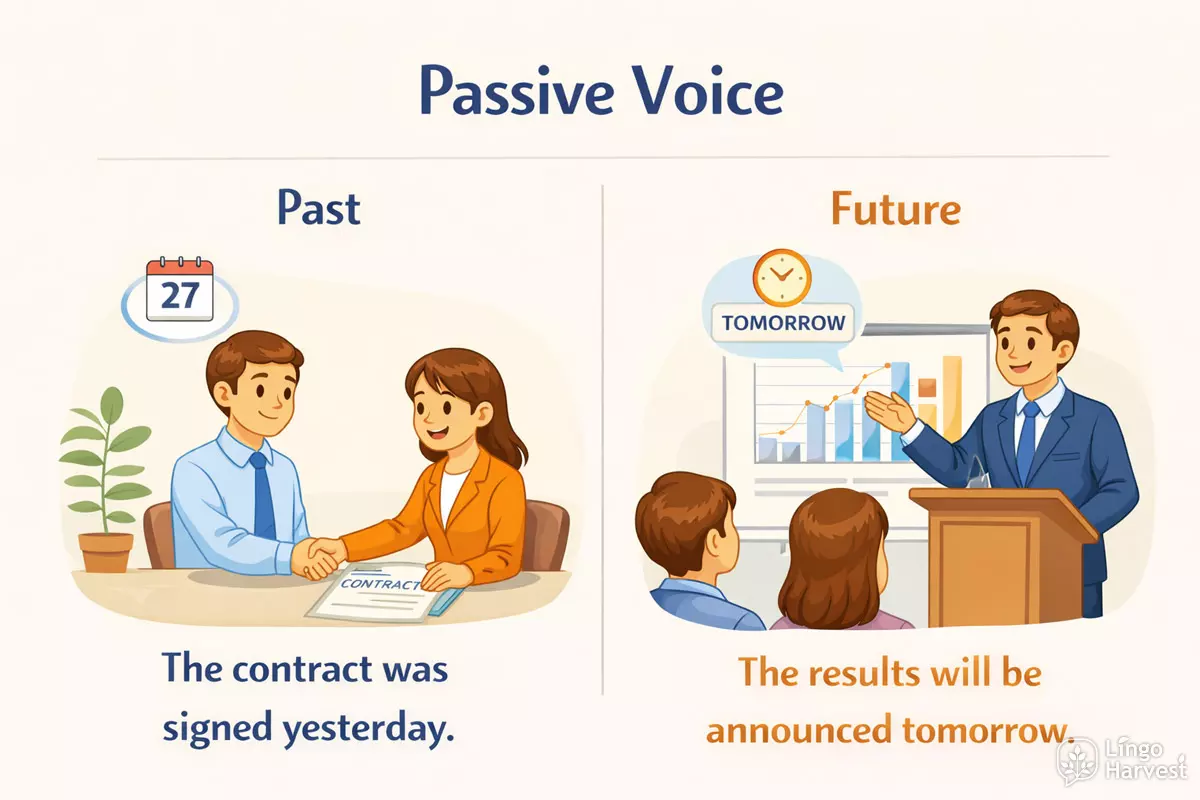
| Tense / form | Passive pattern | Example |
|---|---|---|
| Present simple | am/is/are + past participle | The reports are filed every Friday. |
| Past simple | was/were + past participle | The contract was signed yesterday. |
| Future (will) | will be + past participle | The results will be announced tomorrow. |
| Present continuous | am/is/are being + past participle | The road is being repaired this week. |
| Past continuous | was/were being + past participle | The guests were being seated when the lights went out. |
| Present perfect | has/have been + past participle | The email has been sent. |
| Past perfect | had been + past participle | The tickets had been sold before noon. |
| Future perfect | will have been + past participle | By Friday, the system will have been updated. |
| Modal verbs | modal + be + past participle | The form must be completed today. |
| Modal perfect | modal + have been + past participle | The file may have been deleted by mistake. |
Usage patterns to remember
Choose the tense based on when the action happens, not on who does it. The passive simply shifts focus to the receiver of the action (the thing affected).
Use these practical checks to build accurate forms:
- Step 1: Pick the tense you would use in the active sentence (present, past, perfect, continuous, etc.).
- Step 2: Conjugate be in that tense (is/was/has been/will be/was being).
- Step 3: Add the past participle of the main verb (made, taken, written, delivered).
- Step 4: Add by + agent only if it adds needed information (by the technician, by a storm).
Common limits and fixes
- ✅ Continuous passive forms exist mainly for present and past: is being built, was being built.
- ❌ Some combinations are rare or awkward in real use (for example, future continuous passive). Writers usually rephrase: The team will be working on it instead of It will be being worked on.
- ✅ With modals, keep the modal unchanged and shift only the passive structure: can be opened, should be checked, might have been stolen.
- ✅ For questions and negatives, treat be as the auxiliary: Is the package delivered? / The package isn’t delivered yet.
Common mistakes in passive forms
Errors with passive constructions usually come from two places: choosing the wrong auxiliary pattern, or keeping active-voice word order when the subject changes. Fixing them is mostly about checking the verb form (be/get + past participle) and confirming what the grammatical subject really is.
Frequent pattern problems (with quick fixes)
- Using a past tense instead of a past participle: ❌ The window was broke. → ✅ The window was broken.
- Forgetting the auxiliary be: ❌ The email sent yesterday. → ✅ The email was sent yesterday.
- Mixing active and passive forms: ❌ The report was wrote the manager. → ✅ The report was written by the manager.
- Wrong tense on be: ❌ The documents are signed last night. → ✅ The documents were signed last night.
- Wrong perfect form: ❌ The work has finished. (if passive meaning) → ✅ The work has been finished.
- Wrong continuous form: ❌ The bridge is building. → ✅ The bridge is being built.
- Using being when it is not needed: ❌ The tickets were being sold out in an hour. → ✅ The tickets were sold out in an hour.
- Overusing the passive where an active verb is clearer: ❌ Mistakes were made by me. → ✅ I made mistakes.
- Confusing passive with adjectives: The door is closed can mean a state (adjective) or an action (passive). If you mean the action, add context: ✅ The door was closed by staff at 10 p.m.
- Leaving out the agent when it matters: ❌ The decision was made. (unclear responsibility) → ✅ The decision was made by the committee.
- Using by with things that are not agents: prefer other prepositions when appropriate: ❌ The room was filled by smoke. → ✅ The room was filled with smoke.
- Trying to passivize intransitive verbs: verbs without an object generally cannot form a passive: ❌ He was arrived at 8. → ✅ He arrived at 8.
- Passivizing stative verbs that do not work well: ❌ The answer is known by me. → ✅ I know the answer.
- Misplacing adverbs: keep adverbs in natural positions: ❌ The package was delivered only yesterday by courier. → ✅ The package was delivered by courier only yesterday. (or rewrite for clarity)
- Pronoun case errors after by: ❌ by he → ✅ by him; ❌ by I → ✅ by me
Double-object verbs: choosing the right passive subject
With verbs like give, send, and offer, learners often keep the indirect object in the wrong place. In passive voice, you can usually promote either object, but the structure must stay grammatical.
- ✅ She was given a refund. (indirect object becomes subject)
- ✅ A refund was given to her. (direct object becomes subject)
- ❌ A refund was given her. (possible in some styles, but often avoided; use to her for clarity)
- ❌ She was given to a refund. (wrong object roles)
Get-passive vs be-passive confusion
Get + past participle is common in informal speech and often suggests change, accident, or responsibility. A typical mistake is using it in formal writing where a neutral be-passive is expected, or using it with verbs that sound unnatural in this pattern.
- ✅ Informal/change: He got injured during the match.
- ✅ Neutral/formal: He was injured during the match.
- ❌ Awkward pairing: The policy got implemented in 2010. → ✅ The policy was implemented in 2010.
Active vs passive meaning differences
Choosing an active or passive construction changes what the sentence highlights: the doer (agent) or the receiver (patient) of the action. The core event can stay the same, but the focus, information flow, and what sounds “most important” to the reader often shifts.
How focus and emphasis change
In active voice, the subject typically performs the action, so the sentence naturally emphasizes who is responsible. In passive voice, the subject receives the action, so the sentence emphasizes what happened to something or someone, sometimes leaving the agent unstated.
If you want to spot passive constructions quickly, you can use an online passive voice checker to analyze your text and see where passive forms reduce clarity.
- Active foregrounds the agent: “The manager approved the budget.”
- Passive foregrounds the result/receiver: “The budget was approved (by the manager).”
- If the agent is unknown, irrelevant, or obvious from context, passive often sounds more natural: “My bike was stolen.”
- If responsibility matters, active is usually clearer: “The contractor damaged the pipe.”
Meaning shifts: what changes and what stays the same
Active and passive forms can describe the same real-world action, but they are not always interchangeable. Passive voice can change the implied responsibility, the level of certainty about the agent, and the sentence’s “topic” (what the sentence is mainly about).
- Information structure: passive helps keep the same topic across sentences (useful for coherence).
- Agency and responsibility: omitting by + agent can reduce emphasis on who did it.
- Unknown agent: passive allows you to report events without naming a doer.
- Politeness and diplomacy: passive can soften blame: “A mistake was made” (less direct than “You made a mistake”).
- Objectivity/formality: passive is common in reports and procedures when the process matters more than the person.
- Verb limitations: only transitive verbs (with an object) can form a true passive: “They slept” cannot become a normal passive.
- Agent inclusion is optional: adding by + agent restores the doer when it matters.
Comparison examples (same event, different spotlight)
| Active (agent-centered) | Passive (receiver/result-centered) |
|---|---|
| The committee rejected the proposal. | The proposal was rejected (by the committee). |
| Someone has leaked the documents. | The documents have been leaked. |
| The storm damaged several roofs. | Several roofs were damaged in the storm. |
| Researchers will publish the results next week. | The results will be published next week. |
| The technician is installing the software. | The software is being installed. |
| The company introduced a new policy. | A new policy was introduced. |
When the passive changes the reader’s interpretation
Because passive voice can hide or downplay the agent, it can subtly change how readers assign responsibility or interpret intent. This is not “wrong,” but it is a real usage effect to be aware of.
- ✅ Neutral reporting: “The window was broken during the night.” (focus on the event; agent unknown)
- ❌ Unhelpfully vague: “The deadline was missed.” (who missed it is unclear; active may be better)
- ✅ Process-focused writing: “The samples were heated to 80°C and then cooled.”
- ❌ Avoiding accountability: “Your request was not approved.” (may sound evasive if the decision-maker matters)
Practical pattern: deciding which voice to use
- Use active when the agent is important, responsibility must be clear, or you want direct, energetic phrasing.
- Use passive when the receiver/result is the main topic, the agent is unknown/unimportant, or you want to keep continuity with the previous sentence’s subject.
- If you choose passive but the doer matters, add it with by + agent → “The contract was signed by both parties.”
Homework: passive voice practice tasks
Use these exercises to build accuracy with passive structures across tenses, modals, questions, and common reporting patterns. Focus on two habits: (1) choose the correct form of be (or get where appropriate), and (2) use the past participle of the main verb. Add the agent with by only when it is important or unclear.
Task 1: Change active to passive (keep the tense)
Rewrite each sentence so the object becomes the subject. Keep the original time reference and meaning.
- The technician repairs the elevators every month.
- They are reviewing your application now.
- Someone has stolen my bicycle.
- The committee will announce the results tomorrow.
- They sent the package yesterday.
- The storm damaged several roofs last night.
- The company is going to launch a new app next week.
- People speak Spanish in many countries.
- The chef had prepared the sauce before we arrived.
- They have been monitoring the patient for two hours.
- The editor can change the headline.
- You must follow these safety rules.
Show answers
- The elevators are repaired every month (by the technician).
- Your application is being reviewed now.
- My bicycle has been stolen.
- The results will be announced tomorrow.
- The package was sent yesterday.
- Several roofs were damaged last night.
- A new app is going to be launched next week.
- Spanish is spoken in many countries.
- The sauce had been prepared before we arrived.
- The patient has been monitored for two hours.
- The headline can be changed.
- These safety rules must be followed.
Task 2: Choose the correct passive form
Select the best option to complete each sentence.
- The report (a) is written (b) is being written (c) was being written right now.
- My keys (a) have found (b) have been found (c) are found in the kitchen.
- The meeting (a) will hold (b) will be held (c) is held at 3 p.m. tomorrow.
- When I arrived, the room (a) cleaned (b) was cleaned (c) was being cleaned.
- All guests (a) must be checked in (b) must checked in (c) must be check in at reception.
- The suspect (a) is questioned (b) is being questioned (c) has being questioned at the moment.
- By next Friday, the software (a) will have been tested (b) will be tested (c) is tested.
- This medicine (a) should take (b) should be taken (c) should be took with food.
- The files (a) are stored (b) are being stored (c) were stored on the server every night (routine).
- My phone (a) got stolen (b) got stealing (c) was get stolen on the bus.
Show answers
- (b) is being written
- (b) have been found
- (b) will be held
- (c) was being cleaned
- (a) must be checked in
- (b) is being questioned
- (a) will have been tested
- (b) should be taken
- (a) are stored
- (a) got stolen
Task 3: Passive questions and negatives
Rewrite each item as instructed. Keep meaning and tense.
- (Question) They deliver the furniture on Fridays. → ?
- (Question) Someone has canceled the reservation. → ?
- (Negative) They didn’t approve the budget. → .
- (Negative) People are not using this entrance today. → .
- (Question) They will sign the contract this afternoon. → ?
- (Question) The manager is interviewing candidates. → ?
Show answers
- Is the furniture delivered on Fridays?
- Has the reservation been canceled?
- The budget wasn’t approved.
- This entrance is not being used today.
- Will the contract be signed this afternoon?
- Are candidates being interviewed?
Task 4: Decide whether passive is appropriate (and rewrite if needed)
Some sentences sound natural in passive; others are better in active. For each one, choose the clearer option and rewrite.
- My friend was arrived late to the station.
- The email was received by me at 9:02.
- Three new cafés have been opened near the office.
- The concert was happened in the park.
- The window got broken during the game.
- English is spoken here.
- The homework was done by the students.
- A mistake was made in the invoice.
Show answers
- My friend arrived late to the station.
- I received the email at 9:02.
- Three new cafés have opened near the office. (Also possible: have been opened, if you want to emphasize the action.)
- The concert happened in the park.
- The window got broken during the game. (Also: The window was broken during the game.)
- English is spoken here.
- The students did the homework.
- A mistake was made in the invoice.
Task 5: Build passive sentences from prompts
Create a complete sentence. Choose the most natural passive tense for the time expression.
- (documents / check / currently)
- (new policy / announce / next week)
- (your order / ship / already)
- (the bridge / repair / for months)
- (the lights / not turn off / last night)
- (the final decision / make / by Friday)
- (the meeting / postpone / because of weather)
- (the password / reset / yesterday)
- (the bill / must pay / within 10 days)
- (the problem / solve / before the update)
Show answers
- The documents are being checked currently.
- The new policy will be announced next week.
- Your order has already been shipped.
- The bridge has been being repaired for months. (More natural: They have been repairing the bridge for months.)
- The lights were not turned off last night.
- The final decision will be made by Friday.
- The meeting was postponed because of the weather.
- The password was reset yesterday.
- The bill must be paid within 10 days.
- The problem had been solved before the update.