Common Passive Forms: Born, Called, Supposed To

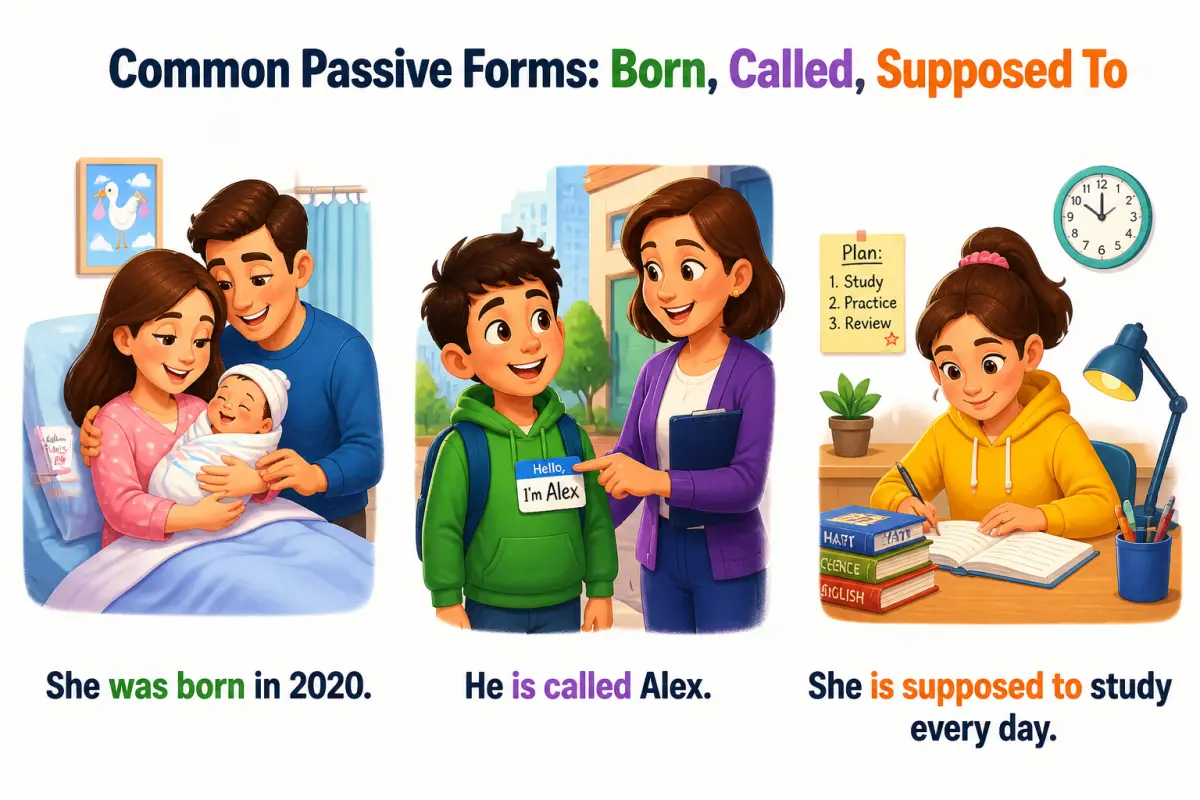 This article explains why forms like be born, be called, and be supposed to act more like fixed expressions than regular passives. It covers meanings, common patterns, everyday American English examples, typical mistakes, practice, and an FAQ.
- Why some passive forms behave like fixed expressions
- Be born for birth, origin, and life events
- Be called for names, labels, and titles
- Be supposed to for expectations and rules
- How these forms differ from normal passive sentences
- Common patterns with born, called, and supposed to
- Natural examples in everyday American English
- Mistakes with born, called, named, and supposed to
- Usage practice: complete common passive expressions
- FAQ: born, called, and supposed to
Some English patterns may look passive, but they are often more natural and common than the full forms many students learn first. This is especially true with expressions like born, called, and supposed to. People use them all the time when talking about names, expectations, and basic facts, so understanding them makes everyday conversations easier to follow. This article explains how these expressions work, what they mean, and how to use them confidently.
Why some passive forms behave like fixed expressions
Many learners first meet the passive as a clear grammar pattern: be + past participle. For example, The window was broken or The report was sent. In those sentences, the focus is on an action and its result. But some very common expressions look passive without behaving like ordinary passives in daily use. Be born, be called, and be supposed to are the best examples.
These forms are so frequent that native speakers usually process them as ready-made chunks. We do not usually stop and think, “Who performed the action?” We simply use them to talk about birth, names, expectations, and social rules. That is why students often understand the grammar on paper but still make mistakes in real conversation. The solution is to learn the grammar and the common situations where each form naturally appears.
Think of them this way:
- be born tells us about coming into the world, and sometimes about origin or a talent developing very early.
- be called tells us the name or label people use.
- be supposed to tells us what is expected, planned, or considered the correct thing.
Although each one contains a past participle, they do not feel as flexible as normal passive sentences such as The room was cleaned. You can often change an ordinary passive back into an active sentence easily: Someone cleaned the room. That kind of change is not usually the main point with born, called, and supposed to.
Teacher note: When students translate word by word from their first language, they often try to “build” these expressions every time. In real English, it helps much more to memorize them as complete patterns.
Be born for birth, origin, and life events

We use be born to talk about birth. This is the standard English form. We do not usually say I borned or My mother born me when talking about a person’s birth in everyday English. Instead, we say things like I was born in 1998 or She was born in Chicago.
This pattern is used for date, place, family background, and sometimes important life details connected to birth. It is one of the most basic biographical expressions in English, so learners need it early and need it accurately. It also appears in fixed expressions like born and raised and in figurative uses such as He was born to teach.
| Pattern | Meaning and example |
|---|---|
| be born + year/date | I was born in 2001. / She was born on May 14. |
| be born + place | They were born in Seattle. / He was born at St. Luke’s Hospital. |
| be born into + family/class/religion | She was born into a military family. |
| be born to + infinitive | Some people say he was born to perform. |
| born and raised | I was born and raised in Texas. |
Notice the prepositions. We say born in a city, state, country, or year; born on a day or date; and sometimes born at a hospital. These small words matter a lot in natural English.
- I was born in Brazil.
- My son was born on July 3.
- She was born at Mercy Hospital.
- He was born into a large family.
Be born also appears in more expressive language:
- She was born to lead.
- That idea was born out of frustration.
- The company was born in a garage.
Those uses are more figurative, but the core meaning still connects to origin or beginning.
One important point about tense: for your own birth, English almost always uses the past simple because the event happened once in the past: I was born in 1995. For a baby born very recently, the present perfect is possible when the time is connected to now: The baby has just been born. That sounds natural because the event is brand new and still current news.
Be called for names, labels, and titles
We use be called when we give the name, label, or title that people use for someone or something. This can refer to a personal name, a nickname, a technical term, a job title, or even what a meal or holiday is known as in a certain region.
In everyday speech, What is it called? is extremely common. So are He’s called..., It’s called..., and This is called.... Sometimes learners avoid this structure because they think it sounds too passive, but it is one of the most natural ways to ask for or provide a name.
Here are common uses:
- My teacher is called Ms. Evans. This gives a name.
- The dish is called clam chowder. This gives the name of a thing.
- That symbol is called an ampersand. This gives a label or term.
- He was called “Red” in high school. This gives a nickname.
- The position is called customer success manager. This gives a title.
There is also a difference between be called and call someone something. Compare these:
- She is called Ana. Focus on her name.
- People call her Ana. Focus on the people who use the name.
For many situations, both are possible, but the choice changes the focus. If the speaker does not care who uses the name, be called is often more natural.
Be called is also useful when talking about variation:
- In the U.S., this is called a stroller; in the U.K., it is called a pram.
- That dessert is called different things depending on the region.
- The class used to be called Home Economics.
Teacher note: Students often memorize vocabulary as isolated words. A better habit is to learn new terms with a naming question, such as “What’s this called in English?” That makes the phrase active and usable right away.
Be supposed to for expectations and rules
Be supposed to is one of the most useful expressions in spoken English because it covers several related ideas: expectation, plan, duty, rule, and what other people believe is correct. It often means “this is the arrangement,” “this is the expectation,” or “this is what should happen.”
For learners, the challenge is that this expression is not exactly the same as should, must, or be expected to, although it overlaps with all of them. The tone is usually practical and social. It often refers to normal procedure, instructions, or what people think is true.
Look at these common meanings:
- Expectation: You’re supposed to call when you arrive.
- Rule: Employees are supposed to wear their badges.
- Plan/arrangement: We’re supposed to meet at 6:30.
- General belief: This cream is supposed to help with dry skin.
It is especially common in these patterns:
- am/is/are supposed to + base verb: I’m supposed to finish this today.
- was/were supposed to + base verb: They were supposed to leave early.
- be not supposed to + base verb: You’re not supposed to park here.
- be supposed to have + past participle: He was supposed to have sent the email already.
Now compare the tone:
- You should apologize. This is advice.
- You’re supposed to apologize. This is the expected thing in that situation.
- You must apologize. This sounds much stronger and more forceful.
Negative forms are very common in speech:
- You’re not supposed to use your phone during the test.
- We’re not supposed to open that door.
- I’m not supposed to share client information.
Past forms often express a plan that did not happen:
- I was supposed to go to the dentist, but I had to reschedule.
- We were supposed to have class online, but the system crashed.
- She was supposed to call me last night.
That last example may suggest disappointment, excuse, or complaint depending on tone.
How these forms differ from normal passive sentences
A normal passive sentence usually describes an action done by someone or something, even if the agent is not mentioned: The package was delivered, The cake was baked, The mistake was corrected. We can often add by: The package was delivered by a courier.
With be born, be called, and be supposed to, that kind of thinking is much less useful. These forms have become standard expressions with their own functions. Sometimes they still connect to an original action, but in real use the expression matters more than the “hidden agent.”
Compare these pairs:
- The door was closed at 9. Normal passive action.
- The baby was born at 9. Fixed expression about birth.
- The essay was written by Maya. Normal passive action.
- The baby was called Maya. Naming expression.
- The equipment was checked before use. Normal passive action.
- You are supposed to check the equipment before use. Expectation or instruction, not a simple passive event.
Now look at three useful contrasts:
- Someone broke the window. → The window was broken.
- Someone invited us. → We were invited.
- Someone printed the forms. → The forms were printed.
Those are classic active-passive transformations. But these are different:
- I was born in Miami. We do not normally teach this as a practical active transformation.
- It is called a wrench. The point is the name, not who says it.
- You are supposed to sign here. The point is the expectation, not the passive of another full sentence.
Another difference is meaning stability. Normal passive sentences are flexible. You can change many verbs into passive forms when needed. But be born and be supposed to are highly fixed. Learners should treat them as complete grammar units.
| Expression | Main focus | Natural question behind it |
|---|---|---|
| was born | birth/origin | When or where did this life begin? |
| is called | name/label | What do people call it? |
| is supposed to | expectation/rule | What is expected to happen or be done? |
| was repaired | completed action | What happened to it? |
This is why these forms often feel closer to vocabulary plus grammar than to ordinary passive sentence building.
Common patterns with born, called, and supposed to

Once learners understand the meaning, the next step is pattern control. These expressions repeat in very predictable shapes. If you master the pattern, speaking becomes much easier and much faster.
Here are the most useful patterns to keep ready.
- subject + be born + time/place
I was born in Denver.
She was born on a Sunday.
They were born in the early 2000s. - subject + be born into + group/background
He was born into poverty.
She was born into a bilingual family. - subject + be called + name/label/title
The file is called “Final Budget.”
Our dog is called Peanut.
The role is called shift supervisor. - What is/are ... called?
What is this tool called?
What are those marks called? - subject + be supposed to + base verb
You’re supposed to wait here.
I’m supposed to submit the form by noon. - subject + be not supposed to + base verb
We’re not supposed to feed the animals.
He’s not supposed to lift heavy boxes yet. - subject + was/were supposed to + base verb
She was supposed to join us later.
They were supposed to deliver it yesterday. - subject + be supposed to have + past participle
The train was supposed to have arrived by now.
You were supposed to have finished this last week.
Notice that supposed to is followed by the base verb, not an -ing form and not a full infinitive with another be unless the meaning requires it.
Compare:
- ✅ You are supposed to arrive early.
- ❌ You are supposed to arriving early.
- ✅ I was supposed to call you.
- ❌ I was supposed called you.
- ✅ This plant is called rosemary.
- ❌ This plant is calling rosemary.
Teacher note: I often tell students to learn one “frame sentence” for each form: “I was born in…”, “It’s called…”, and “You’re supposed to…”. Those three frames cover a huge amount of real conversation.
Natural examples in everyday American English
Grammar becomes much easier when you hear how these forms sound in ordinary situations. Below are examples from conversations, school, work, travel, family life, and common instructions. These are the kinds of sentences American speakers use all the time.
With be born:
- I was born in Phoenix, but I grew up in Nevada.
- My twins were born at 34 weeks.
- She was born on Christmas Eve.
- He was born into a family of musicians.
- I’m a New Yorker, born and raised.
With be called:
- This neighborhood is called Old Town.
- What’s that app called again?
- My grandfather was called Jack, even though his real name was John.
- The class is called Introduction to Public Health.
- In my family, that kind of soup is called Sunday soup.
With be supposed to:
- You’re supposed to check in online before your flight.
- We’re supposed to bring our own lunch tomorrow.
- I’m supposed to meet my advisor after class.
- Guests are supposed to sign the visitor log.
- The package was supposed to arrive by Friday.
Now notice how tone changes the meaning of supposed to in speech:
- You’re supposed to be here at eight. This may sound like a reminder.
- You were supposed to be here at eight. This often sounds like a complaint.
- Am I supposed to print this? This asks for procedure or instructions.
And here are some short dialogue-style examples:
- A: Where were you born?
B: I was born in San Diego. - A: What’s that sandwich called?
B: It’s called a patty melt. - A: Are we supposed to turn this in today?
B: No, it’s due Monday.
These forms are especially common because they answer practical questions: Where are you from?, What’s the name?, and What should I do here?
Mistakes with born, called, named, and supposed to
Most mistakes with these forms come from three problems: using the wrong verb pattern, mixing up called and named, and treating supposed to like a regular modal. Let’s go through the big ones carefully.
1. Mistakes with born
Learners sometimes leave out be or use the wrong verb entirely.
- ❌ I born in 2004.
✅ I was born in 2004. - ❌ She born in Toronto.
✅ She was born in Toronto. - ❌ They are born in April 1999.
✅ They were born in April 1999.
Another problem is incorrect prepositions:
- ❌ I was born on Canada.
✅ I was born in Canada. - ❌ He was born in Monday.
✅ He was born on Monday. - ❌ The baby was born in City Hospital.
✅ The baby was born at City Hospital.
2. Mistakes with called and named
Called and named are close, but they are not always used in exactly the same way. Be called is very common for the name people use. Be named often sounds a little more formal or specific, especially when the name was officially given.
- ✅ The baby was called Emma.
✅ The baby was named Emma. - ✅ The street is called Maple Avenue.
Less natural: The street is named Maple Avenue. - ✅ The award was named after her grandfather.
❌ The award was called after her grandfather.
Common learner errors:
- ❌ My friend calls David.
✅ My friend is called David. - ❌ What this is called?
✅ What is this called? - ❌ It called a screwdriver.
✅ It is called a screwdriver.
3. Mistakes with supposed to
The most common issue is forgetting that supposed to needs a form of be.
- ❌ I supposed to leave now.
✅ I am supposed to leave now. - ❌ We supposed to submit this online.
✅ We are supposed to submit this online. - ❌ She supposed to call me tonight.
✅ She is supposed to call me tonight.
Another issue is using the wrong verb form after to:
- ❌ You are supposed to studying tonight.
✅ You are supposed to study tonight. - ❌ He was supposed to went home early.
✅ He was supposed to go home early. - ❌ They’re supposed to being quiet.
✅ They’re supposed to be quiet.
And some learners confuse it with certainty:
- ❌ He is supposed to at home now.
✅ He is supposed to be at home now. - ❌ The movie is supposed good.
✅ The movie is supposed to be good. - ❌ This medicine is supposed help.
✅ This medicine is supposed to help.
4. Confusing meaning: expectation versus obligation
Sometimes learners use must when they really mean a social or procedural expectation. Compare these:
- Students are supposed to submit the form online. Normal rule or procedure.
- Students must submit the form online. Stronger, more official, more forceful.
And compare:
- I was supposed to meet him at lunch. It was the plan.
- I had to meet him at lunch. It was necessary or required.
If you choose the wrong form, your meaning may become too strong, too weak, or simply unnatural.
Usage practice: complete common passive expressions
These exercises focus on the forms learners actually need to produce: choosing the right fixed expression, building the pattern correctly, and correcting common mistakes. Try to answer before opening the key. Each practice block checks a different skill.
Practice block 1: choose the correct form
- I was born ___ 2010.
- What is this machine ___?
- You are supposed ___ your shoes off at the door.
- My parents were born ___ Ohio.
- The movie is ___ “Summer Road.”
- We were supposed ___ at 5:00, but the meeting ran late.
- She was born ___ March 12.
- Guests are not supposed ___ in this area.
- That condition is called ___ deficiency.
- I was born ___ Memorial Hospital.
Show answers
- in
- called
- to take
- in
- called
- to leave
- on
- to park
- iron
- at
Practice block 2: rewrite the sentence
- I born in Atlanta. Rewrite correctly.
- People call this dessert peach cobbler. Rewrite using is called.
- You should be here by nine according to the schedule. Rewrite with supposed to.
- My brother born on Friday night. Rewrite correctly.
- What people call this in English? Rewrite correctly.
- It was the plan for us to meet after class. Rewrite with were supposed to.
- The official name of the course is Business Ethics. Rewrite using is called.
- The rule says employees do not use personal phones here. Rewrite with are not supposed to.
- I came into the world in Mexico City in 1997. Rewrite naturally with was born.
- The report should already be finished according to the timeline. Rewrite with was supposed to have.
Show answers
- I was born in Atlanta.
- This dessert is called peach cobbler.
- You are supposed to be here by nine.
- My brother was born on Friday night.
- What is this called in English?
- We were supposed to meet after class.
- The course is called Business Ethics.
- Employees are not supposed to use personal phones here.
- I was born in Mexico City in 1997.
- The report was supposed to have been finished already.
Practice block 3: spot and correct the error
- She is born in Seattle in 2002.
- That tool is named a wrench in American English.
- We supposed to send the invoice today.
- He was born in Sunday morning.
- What is called this neighborhood?
- Passengers are supposed wearing seat belts during takeoff.
- My aunt was born on New York.
- The baby called Noah after his grandfather.
- I was supposed finished the training last week.
- This product is supposed to good for sensitive skin.
Show answers
- She was born in Seattle in 2002.
- That tool is called a wrench in American English.
- We are supposed to send the invoice today.
- He was born on Sunday morning.
- What is this neighborhood called?
- Passengers are supposed to wear seat belts during takeoff.
- My aunt was born in New York.
- The baby was called Noah after his grandfather. / The baby was named Noah after his grandfather.
- I was supposed to finish the training last week.
- This product is supposed to be good for sensitive skin.
FAQ: born, called, and supposed to
These short answers deal with questions learners often ask after they understand the basic grammar.
1. Can I say “I am born in 2000”?
Normally, no. For your birth date or birthplace, English uses the past simple: I was born in 2000. The event happened once in the past. The present form sounds unnatural in standard English.
2. What is the difference between “called” and “named”?
Called is usually the everyday choice for the name people use: The restaurant is called Blue Bird. Named often sounds more official or more connected to the act of giving a name: They named the baby Elena. Also remember the special pattern named after: He was named after his uncle.
3. Is “be supposed to” the same as “should”?
Not exactly. Should often gives advice: You should rest. Be supposed to usually refers to an expectation, rule, or plan: You’re supposed to clock in by 8:00. In real life, they can overlap, but the feeling is different.
4. Can “supposed to” talk about the past?
Yes, very often. Was/were supposed to commonly describes a plan or expectation in the past: We were supposed to fly out yesterday. It often suggests the plan changed or was not completed.
5. Why do people say “born and raised”?
That phrase means someone was born in a place and also grew up there. For example: She was born and raised in Detroit. It is a very common way to describe hometown identity.
6. Can I ask “How is it called?”
In standard natural English, the usual question is What is it called? English asks for the name, not the “way” of calling it. So use what, not how, in this pattern.
7. Do native speakers really use “supposed to” a lot?
Yes, constantly. You hear it in families, schools, offices, stores, airports, and customer service. It is one of the most common ways to talk about instructions, social expectations, and arrangements: Am I supposed to sign here? or We’re supposed to bring ID.
8. Can “supposed to” express doubt about whether something is true?
Yes. In conversation, it can mean “people say” or “it is said.” For example: This restaurant is supposed to be really good or He’s supposed to be moving to Denver. In that use, the speaker is not fully confirming the information; they are reporting a belief or rumor.