Chunking Techniques for Fluency at B2

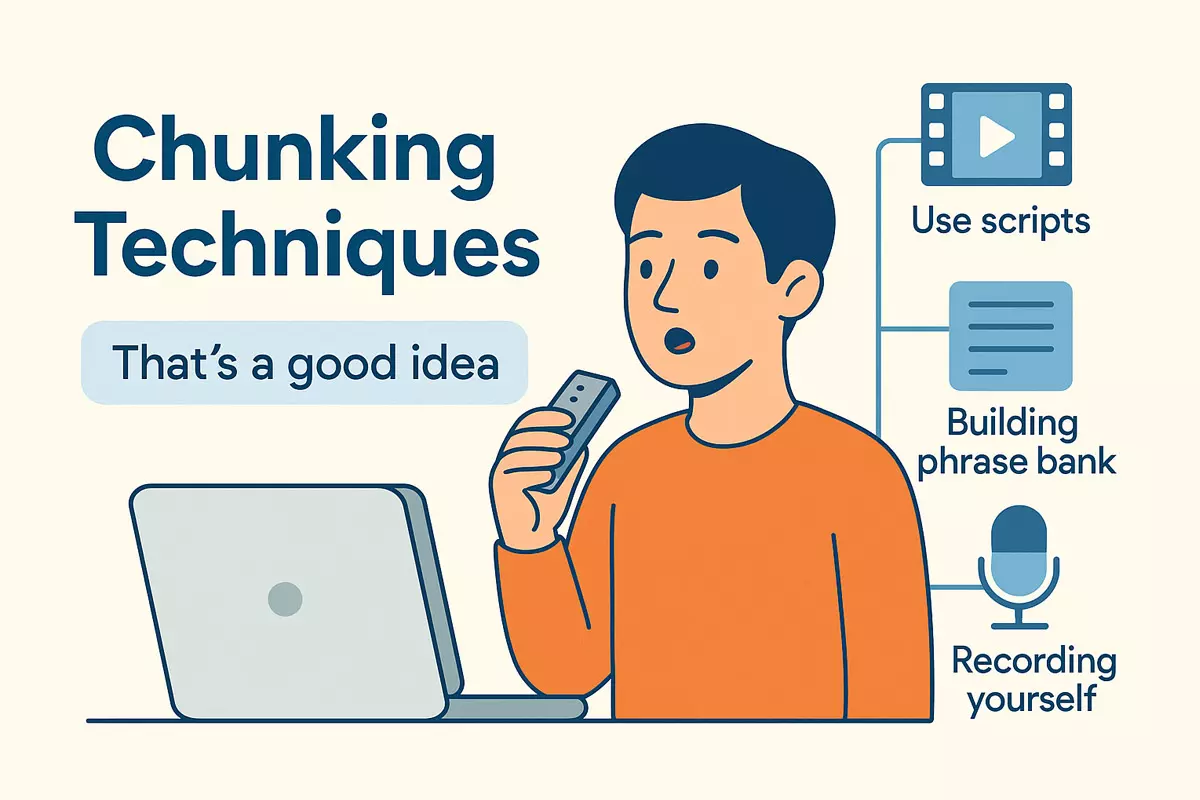 Here we what chunking in speaking is, why it boosts fluency and confidence, the main types of chunks, and practical ways to spot, practice, and use them—like using scripts, recording yourself, and building a personal phrase bank.
Achieving a comfortable flow in English at the upper-intermediate level can be challenging, but focusing on learning groups of words as meaningful units can significantly improve your skills. Instead of memorizing individual words, practicing commonly used phrases and expressions allows you to process language more naturally and respond more quickly during conversations. This approach not only builds your confidence but also helps you understand native speakers more easily, making your communication smoother and more effective overall.
Definition of Chunking in Speaking
When discussing ways to improve spoken fluency, “chunking” refers to grouping words together into meaningful units, rather than speaking word by word. Instead of focusing on individual vocabulary items or isolated grammar structures, speakers at the B2 level benefit from recognizing and using typical word combinations, or “chunks,” that native speakers use naturally. This approach helps create smoother, more natural speech and reduces hesitation.
How Chunking Works in Communication
In spoken English, chunking involves breaking sentences into logical segments, such as phrases, collocations, or common expressions. These multi-word groups are easier for the brain to process quickly, which is vital for real-time conversation. For example, the phrase “on the other hand” is treated as one unit rather than three separate words.
- Collocations (e.g., make a decision, take a break)
- Fixed expressions (by the way, as far as I know)
- Sentence starters (in my opinion, to be honest)
- Common questions (What do you mean?, Could you repeat that?)
- Discourse markers (well, actually, so)
- Polite requests (Would you mind…?, Could you please…?)
- Functional chunks (I’d like to, I’m not sure if)
- Responses (That sounds great, I see what you mean)
- Connectors (however, in addition)
- Clarifications (What I mean is, Let me explain)
Why This Matters for Fluency
Grouping language into chunks streamlines the process of forming sentences, allowing speakers to focus on conveying their ideas rather than constructing each phrase from scratch. This is especially important at intermediate and upper-intermediate levels, where fluency demands both speed and accuracy. By practicing with set phrases and frequent combinations, learners can sound more confident and less hesitant.
| Type of Chunk | Example in Conversation |
|---|---|
| Collocation | “Take responsibility” |
| Discourse Marker | “On the other hand” |
| Polite Request | “Would you mind helping me?” |
| Response | “That makes sense” |
| Connector | “In addition” |
Ultimately, thinking in chunks helps learners process and produce language in real time, making their speech both more fluent and more natural-sounding.
Why Chunking Increases Fluency and Confidence
Understanding and using chunks—groups of words that naturally go together—helps learners move from translating word by word to speaking more smoothly. When you know common phrases and set expressions, you spend less time searching for the right words and more time communicating your ideas. This shift is especially helpful at the B2 level, where the goal is to express yourself with greater ease and sound more natural.
How Chunking Reduces Hesitation
Chunking allows you to recall language in larger units. Instead of pausing to build every sentence from scratch, you can retrieve ready-made segments. This means fewer awkward silences and more confidence when speaking or writing. For example, using expressions like "as far as I know" or "on the other hand" lets you connect ideas fluidly.
Building Automaticity With Chunks
With regular practice, chunks become automatic. This frees up your mental resources for focusing on meaning rather than grammar or vocabulary. It also prevents mistakes that come from word-for-word translation, since chunks are often idiomatic and don’t always follow literal patterns.
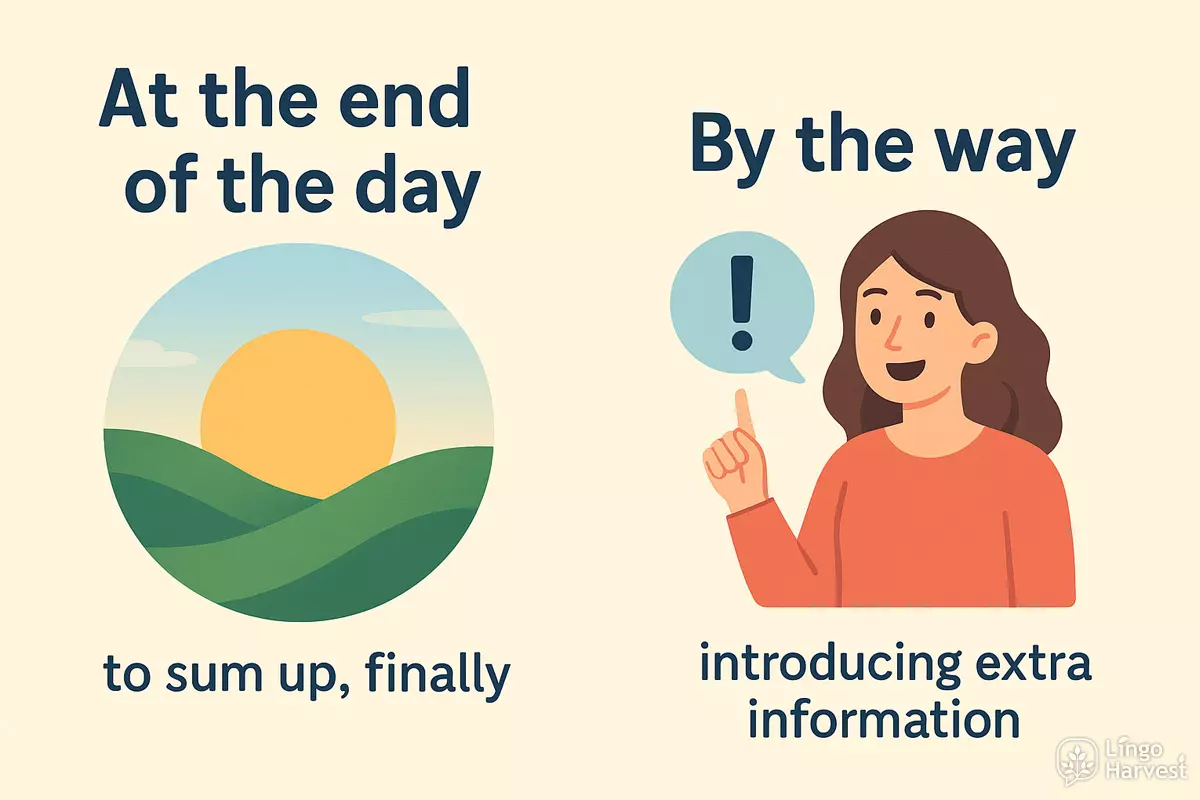
- At the end of the day – to sum up, finally
- Make up your mind – decide
- By the way – introducing extra information
- As a matter of fact – actually
- Take into account – consider
- On the other hand – contrast
- It depends on – conditional response
- For the time being – temporarily
- In my opinion – personal view
- To be honest – showing sincerity
- So far – until now
- Look forward to – anticipate
- As far as I know – to my knowledge
- Keep in mind – remember
- Come up with – invent or suggest
- Get in touch with – contact
- From time to time – occasionally
- Out of the blue – unexpectedly
Confidence Through Predictability
Knowing how to use frequent expressions reduces anxiety and boosts self-assurance. When you have a mental “toolkit” of reliable chunks, conversations feel more predictable and less stressful. This is especially useful in exams, presentations, or spontaneous discussions.
Chunking vs. Word-by-Word Construction
| Word-by-Word | Chunk-Based |
|---|---|
| How you say this in English? | How do you say this? |
| I very like it. | I really like it. |
| According my opinion… | In my opinion… |
| He is in home. | He is at home. |
In summary, mastering chunks leads to more natural conversations and greater self-assurance. By focusing on these multi-word units, B2 learners can communicate ideas smoothly, make fewer errors, and feel more at ease in any situation.
Types of Chunks: Phrases, Collocations, Patterns
Understanding different chunk types is essential for reaching greater fluency at B2. Language “chunks” can be grouped into several categories, each with a slightly different function and structure. Recognizing these categories helps you identify and practice useful expressions, making your speech more natural and automatic.
Phrases: Ready-Made Expressions
Phrases are fixed groups of words commonly used together as a single unit. They can be greetings, social formulas, or set responses. These are especially useful in conversation since they save processing time and help you sound more fluent. Examples include:
- How are you doing? → I haven’t seen you in a while.
- That sounds interesting → That sounds interesting — tell me more.
- It’s up to you → It’s up to you whether we meet today or tomorrow.
- By the way → By the way, did you get my message?
- As far as I know → As far as I know, the meeting starts at 3 p.m.
- On the other hand → On the other hand, we could wait and decide later.
- To be honest → To be honest, I’m not ready to commit yet.
- At the end of the day → At the end of the day, quality matters more than speed.
- Let me think → Let me think — I’ll get back to you in a minute.
- If I were you → If I were you, I’d double-check the details.
- What do you mean? → What do you mean? I don’t understand the last part.
- Sorry, I didn’t catch that → Sorry, I didn’t catch that — could you repeat it?
- Don’t worry about it → Don’t worry about it — it’s not a big deal.
- Give me a second → Give me a second, I’m finishing this email.
- That makes sense → That makes sense, given the new information.
- I completely agree → I completely agree with your point.
- Do you know what I mean? → It’s a bit risky, do you know what I mean?
- I’m not sure about that → I’m not sure about that — can you show me the data?
- Let’s get started → Let’s get started before we run out of time.
- I’ll think about it → I’ll think about it and let you know tomorrow.
- It doesn’t matter → It doesn’t matter which option we choose.
- Let me know → Let me know if you need any help.
Collocations: Natural Word Partnerships
Collocations are typical word combinations that native speakers use naturally. Mastering these helps you avoid awkward phrasing and increases your credibility in conversation or writing. At B2, it’s important to notice both verb-noun and adjective-noun collocations, among others.
- Make a decision → She needs to make a decision by the end of the day.
- Take a break → Let’s take a break before continuing the meeting.
- Strong coffee → He drinks strong coffee to stay focused at work.
- Heavy rain → Heavy rain caused delays across the city.
- Do homework → The students do homework every evening.
- Pay attention → Please pay attention to the safety instructions.
- Catch a cold → She caught a cold after walking in the rain.
- Break the news → He didn’t know how to break the news to his team.
- Fast food → Fast food is convenient but not very healthy.
- Keep in touch → We still keep in touch after all these years.
- Miss the point → You’re missing the point of the argument.
- Get rid of → She wants to get rid of old files on her computer.
Patterns: Flexible Structures for Expression
Patterns are reusable sentence frames or grammar constructions. Unlike fixed phrases, they allow you to substitute elements and create new sentences. These are especially valuable for expressing opinions, making suggestions, or describing actions at B2. Here are some useful examples:
- It’s (adjective) to (verb): It’s important to practice regularly.
- If I had (noun), I would (verb): If I had more time, I would travel.
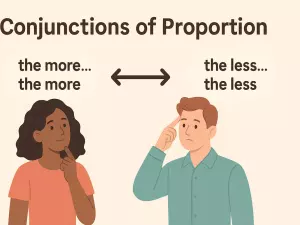
- The (comparative), the (comparative): The more you read, the better you write.
- Not only (auxiliary + subject + verb), but (subject + also + verb): Not only did he finish early, but he also helped others.
- Subject + is likely to + verb: She is likely to succeed.
- As soon as + subject + verb: As soon as I arrive, I’ll call you.
- I’m looking forward to + verb-ing: I’m looking forward to meeting you.
- Would you mind + verb-ing?: Would you mind opening the window?
- It depends on + noun/phrase: It depends on the weather.
- There’s no point in + verb-ing: There’s no point in arguing.
Comparing Chunks: Examples and Features
| Type | Example | Typical Use |
|---|---|---|
| Phrase | On the other hand | Transitioning between ideas |
| Collocation | Take a break | Describing an action |
| Pattern | If I were you, I would… | Giving advice |
| Pattern | It’s important to… | Expressing opinions |
| Collocation | Heavy rain | Describing the weather |
| Phrase | Let me think | Pausing in conversation |
Using Scripts and Dialogues to Notice Chunks
Reading and listening to real-life scripts or dialogues is a practical way to spot and internalize common language patterns at the B2 level. By observing how native speakers combine words naturally, learners can identify multi-word expressions—often called “chunks”—that make speech flow more smoothly.
Why Dialogues Matter for Chunking
Authentic conversations and well-written scripts showcase how phrases are used in context. This helps you recognize set expressions, collocations, and fixed phrases that are often difficult to translate word-for-word. For example, instead of focusing on individual words, you start to notice phrases like “at the end of the day” or “I’m afraid I can’t.”
How to Extract Useful Chunks from Scripts
To make the most out of scripts and dialogues, try these steps:
- Read or listen to a short exchange, pausing after each sentence.
- Underline or highlight groups of words that seem to go together naturally.
- Note down repeated phrases or responses that sound automatic.
- Practice saying these expressions aloud, mimicking rhythm and intonation.
- Use the chunks in your own speaking or writing to reinforce memory.
Examples of Common Chunks in Everyday Dialogues
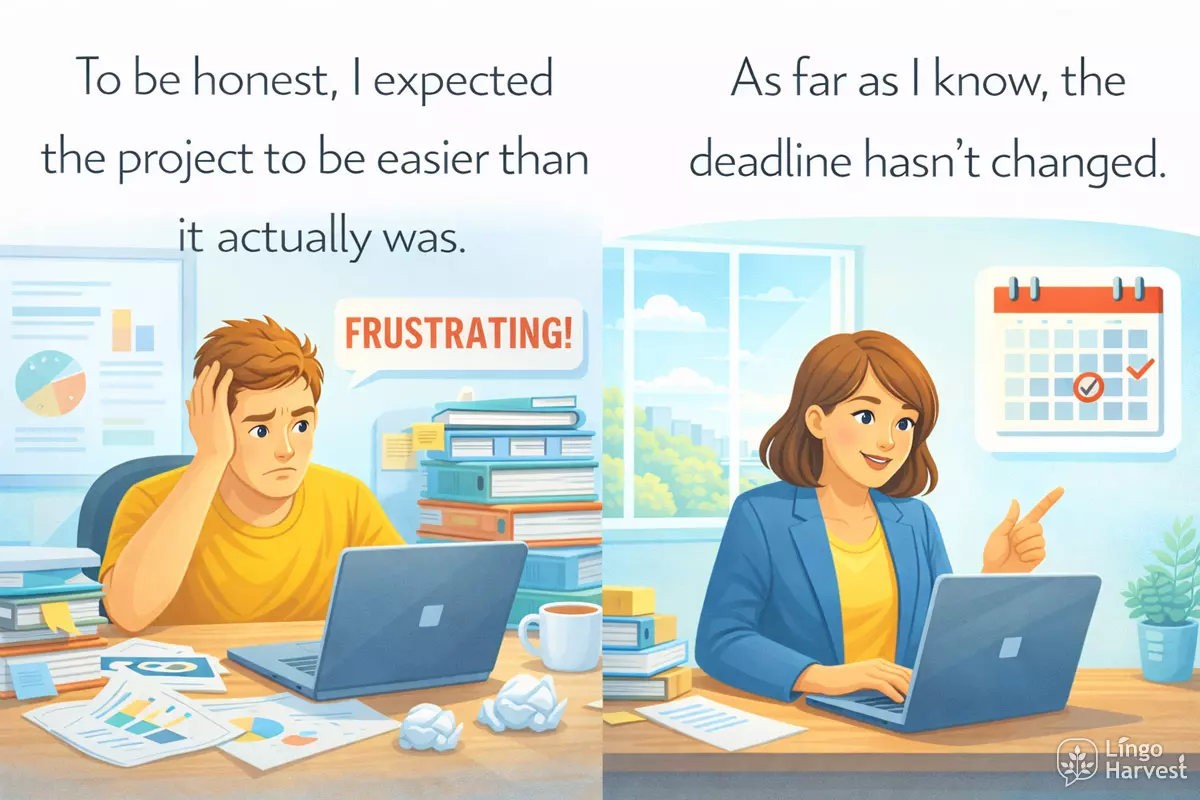
B2 learners can benefit from recognizing and practicing expressions like:
- To be honest, I expected the project to be easier than it actually was.
- As far as I know, the deadline hasn’t changed.
- I’d rather not say. It’s a personal matter.
- It doesn’t make any sense. The figures don’t match the report.
- You’ve got a point. We should test it before launching.
- That’s not quite what I meant. I was talking about the long-term plan.
- Let me get this straight. You want us to start over from scratch?
- I’m not sure I follow. Could you explain that last step again?
- What do you mean by “high priority” in this context?
- Sorry for interrupting, but we’re running out of time.
- If I were you, I’d back up the files before updating the system.
- I see what you’re saying, but I don’t think it will work in practice.
- On the other hand, delaying the decision could cost us more.
- How come you didn’t mention this earlier?
- That reminds me of the first time we tried a similar approach.
- Let’s agree to disagree. We’re not going to convince each other today.
- I’m afraid I don’t know. I haven’t seen the latest update.
- It’s up to you. Choose whichever option fits your schedule.
- No worries. I can handle it myself.
- What’s the matter? You seem upset.
Comparing Single Words vs. Chunks
Recognizing the difference between isolated vocabulary and natural expressions is key to fluency. Here’s a comparison of how single words and chunks function in context:
| Single Word | Natural Chunk |
|---|---|
| interesting | That’s interesting. |
| understand | I see what you mean. |
| problem | What’s the matter? |
| agree | I couldn’t agree more. |
| suggest | May I make a suggestion? |
| think | If you ask me, … |
By focusing on how language is naturally grouped in authentic material, you’ll gradually build a mental library of ready-to-use expressions. This approach helps you sound more fluent and confident, making your English both more accurate and more automatic.
Recording Yourself and Checking Flow
Capturing your spoken English and listening back is a practical way to evaluate how smoothly your chunks and phrases connect. By hearing your own speech, you gain a new perspective on your fluency, noticing patterns, hesitations, or unnatural pauses that you might miss during live speaking. This technique is especially useful at B2 level, where you already have a wide range of vocabulary but may still struggle to sound natural and cohesive.
How to Use Recordings for Chunking Practice
Start by selecting a short text, dialogue, or list of common expressions you want to master. Speak naturally, focusing on linking words and keeping your rhythm steady. After recording, play it back and listen for these aspects:
- Are your pauses at logical places (not mid-phrase)?
- Do you blend words within chunks smoothly?
- Is your intonation rising and falling naturally?
- Can you hear hesitations or repeated self-corrections?
Make notes on any areas that sound choppy or unclear, then repeat the process, aiming to improve each time.
Common Signs of Chunking Problems
Sometimes, issues with fluency are easier to spot when you have a checklist. Here are typical signs that your chunking may need work:
- Frequent, unnatural pauses inside familiar phrases
- Over-pronouncing each word instead of blending
- Flat or monotone delivery, with little variation in stress
- Inconsistent speed—rushing through some parts, slowing on others
- Uncertainty with collocations or idiomatic expressions
Sample Useful Chunks to Practice
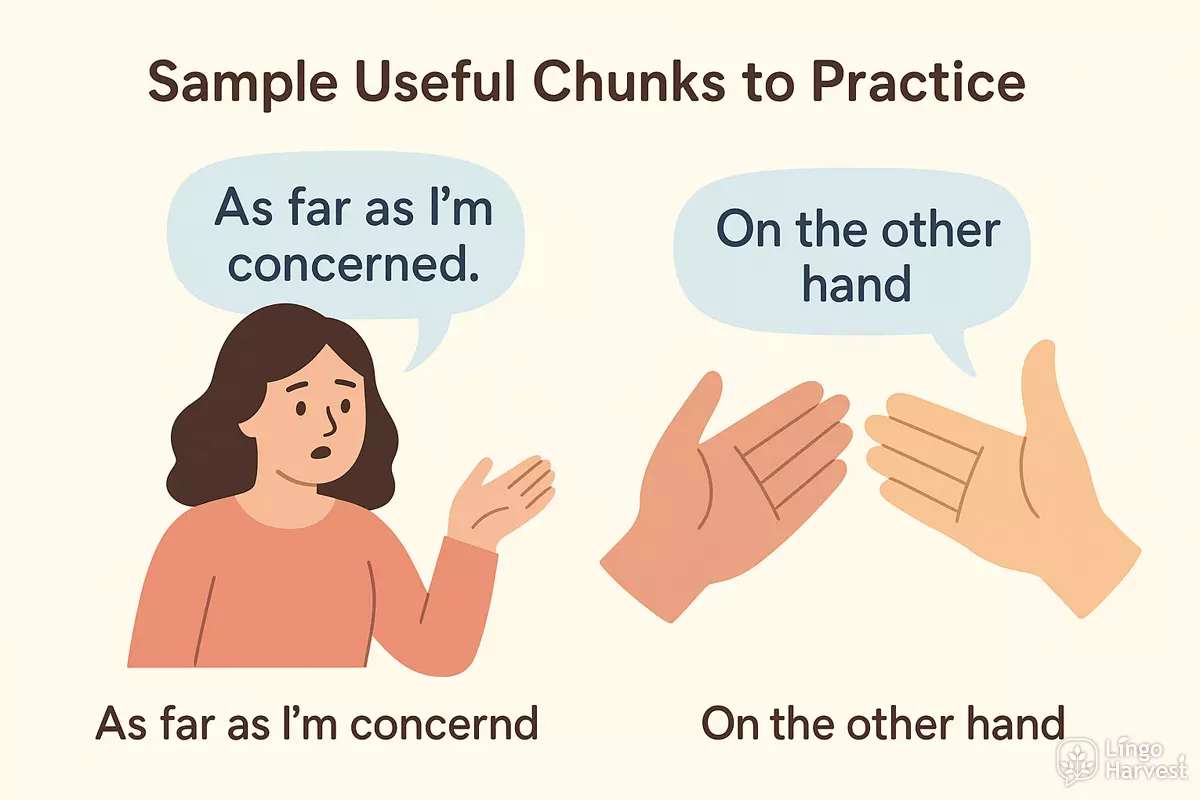
To make your speaking more automatic, it helps to practice with ready-made building blocks. Here’s a list of common conversational chunks that can boost flow at B2 level:
- As far as I’m concerned, we should focus on quality rather than speed.
- On the other hand, waiting too long could create new problems.
- That’s a good point. We haven’t considered the costs of maintenance.
- If I’m not mistaken, we agreed to review the results next week.
- To be honest, I don’t think this plan is realistic.
- At the end of the day, the decision depends on what our customers need.
- For instance, we could start with a small pilot project.
- It seems to me that the main issue is communication.
- From my perspective, the risks are manageable.
- I’d like to point out that the data is incomplete.
- Let me think for a moment. I want to choose the best option.
- To sum up, we need a clearer timeline and better coordination.
- As I was saying, we should confirm everything in writing.
- Correct me if I’m wrong, but the budget was already approved.
- That reminds me, we still need to follow up with the supplier.
- What I mean is that we should simplify the process.
- By the way, did you see the latest update?
- All things considered, this is the safest choice.
- In other words, we need to start over with a new approach.
- To make a long story short, the deal fell through.
Practicing these in context and listening back helps you internalize them as single units, rather than separate words.
Self-Assessment Table: Flow and Chunking
Here’s a simple way to analyze your recordings and track your improvement over time:
| Criteria | Questions to Ask Yourself |
|---|---|
| Pausing | Are your breaks between natural thought groups/chunks? |
| Linking | Do you connect words smoothly within phrases? |
| Intonation | Is your voice rising and falling appropriately for emphasis? |
| Automaticity | Do common chunks come out without hesitation? |
| Correction | Are you self-correcting in mid-sentence or hesitating often? |
Regularly recording and assessing your speech with these criteria can accelerate your progress towards fluent, chunk-based communication.
When practicing chunking with short scripts or prepared texts, it’s helpful to control their length and reading pace. This allows you to keep a natural flow without rushing or dragging. You can estimate reading time for your text and adjust it to match comfortable B2-level fluency.
Integrating Chunks into Everyday Speech
To sound more natural and fluent at the B2 level, it’s essential to blend fixed expressions and common phrases into your daily conversations. This means not just learning chunks in isolation, but also practicing how to use them in real-life contexts, whether you’re chatting with friends, taking part in meetings, or writing emails. The more you encounter and use these ready-made language blocks, the more automatic they’ll become.
Strategies for Using Chunks in Conversation
- Notice and collect: Pay attention to how native speakers use set phrases and idioms. Jot down useful expressions you hear or read.
- Practice aloud: Repeat these expressions out loud, insert them into role-plays, or use them in your daily routines.
- Substitute words: Modify chunks by changing key words to fit your topic. For example, “I’m not sure if…” becomes “I’m not sure if this plan will work.”
- Mix and match: Combine different chunks to form longer, more complex sentences.
- Reflect: After conversations, think about which chunks worked well and which you need to practice more.
Common Types of Chunks to Use Daily
- Polite requests: “Could you possibly…?”
- Clarifying: “What do you mean by…?”
- Giving opinions: “As far as I’m concerned, …”
- Agreeing: “That’s a good point.”
- Disagreeing: “I see what you mean, but…”
- Asking for repetition: “Sorry, could you say that again?”
- Changing topic: “By the way, …”
- Expressing uncertainty: “I’m not sure, to be honest.”
- Making suggestions: “How about we…?”
- Stalling for time: “Let me think for a second…”
- Showing interest: “Really? That’s interesting!”
- Summing up: “So, what you’re saying is…”
- Offering help: “Do you need a hand with…?”
- Giving reasons: “The main reason is that…”
- Expressing preference: “I’d rather…”
- Requesting clarification: “Could you clarify what you mean?”
- Finishing a conversation: “Anyway, I’d better get going.”
- Making comparisons: “Compared to last year, …”
- Expressing surprise: “I didn’t expect that!”
- Apologizing: “Sorry for the mix-up.”
Adapting Chunks to Different Contexts
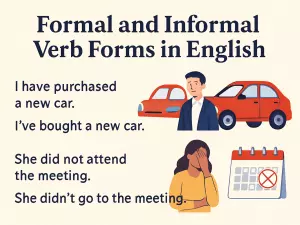
One advantage of mastering these multi-word units is the ability to adjust them for formal or informal situations. For example, you might say, “Would you mind if I…?” in a business setting, but “Is it okay if I…?” with friends. Practicing such variations helps you sound both fluent and appropriate.
| Context | Typical Chunk Examples |
|---|---|
| Informal Conversation | “No way!”, “You know what I mean?”, “Hang on a sec”, “Guess what?” |
| Business/Meetings | “Let’s move on to the next point”, “I’d like to add something”, “From my perspective…” |
| Emails/Writing | “I am writing to inform you…”, “Please let me know if you have any questions”, “Looking forward to your reply” |
| Presentations | “First of all…”, “To sum up…”, “Let’s take a closer look at…” |
Experiment with incorporating these expressions into your spoken and written English. As you become more comfortable with them, your communication will not only be more fluent but also more natural and effective in a variety of situations.
Practice: Build and Reuse Personal Phrase Banks
Developing fluency at the B2 level hinges on having a ready supply of useful expressions for different situations. Creating a personal phrase bank means collecting and organizing language chunks you find practical, memorable, and easy to adapt. This approach helps you move beyond individual vocabulary items and focus on whole phrases that sound natural and save thinking time in conversation.
How to Start Your Phrase Bank
Begin by noting down phrases you often hear or read in conversations, films, podcasts, or articles. Focus on expressions that fill real communication gaps for you—greetings, opinions, agreement, disagreement, clarification, and so on. Keep your phrase bank digital (notes app, spreadsheet) or handwritten, but make sure it’s easy to update.
- Choose authentic phrases from real-life contexts.
- Organize by topic or function (e.g., giving opinions, making suggestions).
- Review and add to your bank regularly.
- Practice using new expressions in your speaking and writing.
Sample Chunks for Everyday Fluency
Below are practical examples of chunks you can add to your own phrase bank. These help you connect ideas smoothly and express yourself more naturally during discussions or writing tasks.
- To be honest, I think we underestimated how long this task would take.
- As far as I’m concerned, this approach is the most practical one.
- It seems to me that we need clearer priorities.
- On the one hand, the proposal is cost-effective; on the other hand, it may reduce quality.
- Frankly speaking, I wasn’t convinced by the presentation.
- I’m not so sure about that. The data doesn’t fully support this claim.
- Would you mind if I asked a few clarifying questions?
- That’s a good point, but we still need to consider the risks.
- Let me put it another way. This solution saves time but increases costs.
- If I were you, I would review the contract more carefully.
- Sorry, could you repeat that? I didn’t catch the last part.
- In my experience, clear communication prevents most problems.
- I completely agree with you. This change is long overdue.
- Actually, I have a different opinion. I think we should wait.
- Can I add something here? There’s one detail we haven’t discussed.
- What do you mean by “flexible working hours”?
- Let’s move on to the next point. We’re running short on time.
- That reminds me of a similar issue we faced last year.
- I’ve never thought about it like that before. That’s an interesting perspective.
- To sum up, we need a clearer plan and better coordination.
Organizing for Reuse
Group your collected phrases by function or theme for quick access. This makes it easier to retrieve the right chunk in conversation or writing. Regular review and targeted practice—such as using selected phrases in dialogues or journal entries—will reinforce your memory and confidence.
Practice Task: Expand and Personalize
Read the following situations and write at least two chunks from your own phrase bank (or the list above) that would fit each context:
- Expressing polite disagreement during a meeting.
- Asking someone to clarify something you didn’t understand.
- Giving your opinion on a controversial topic.
- Summing up your point at the end of a discussion.
- Interrupting politely to add a comment.
- Showing agreement with someone’s idea.
- Buying time to think before answering.
- Rephrasing your idea to make it clearer.
- Changing the topic during a conversation.
- Admitting uncertainty or lack of knowledge.
Show answers
- Polite disagreement: “I see your point, but…”; “I’m not so sure about that.”
- Asking for clarification: “Sorry, could you repeat that?”; “What do you mean by…?”
- Giving an opinion: “As far as I’m concerned, …”; “It seems to me that …”
- Summing up: “To sum up, …”; “At the end of the day, …”
- Polite interruption: “Sorry to interrupt, but …”; “Can I add something here?”
- Showing agreement: “I completely agree with you.”; “That’s a good point.”
- Buying time: “Let me think for a moment.”; “Give me a second.”
- Rephrasing: “Let me put it another way.”; “What I mean is …”
- Changing the topic: “By the way, …”; “That reminds me of …”
- Expressing uncertainty: “I’m not sure about that.”; “I’m afraid I don’t know.”
By consistently building, reviewing, and using your phrase bank, you’ll notice your fluency and confidence improving as you rely on ready-made chunks rather than assembling sentences word by word.