The Verb “To Do”: How to Use It in Sentences and Questions

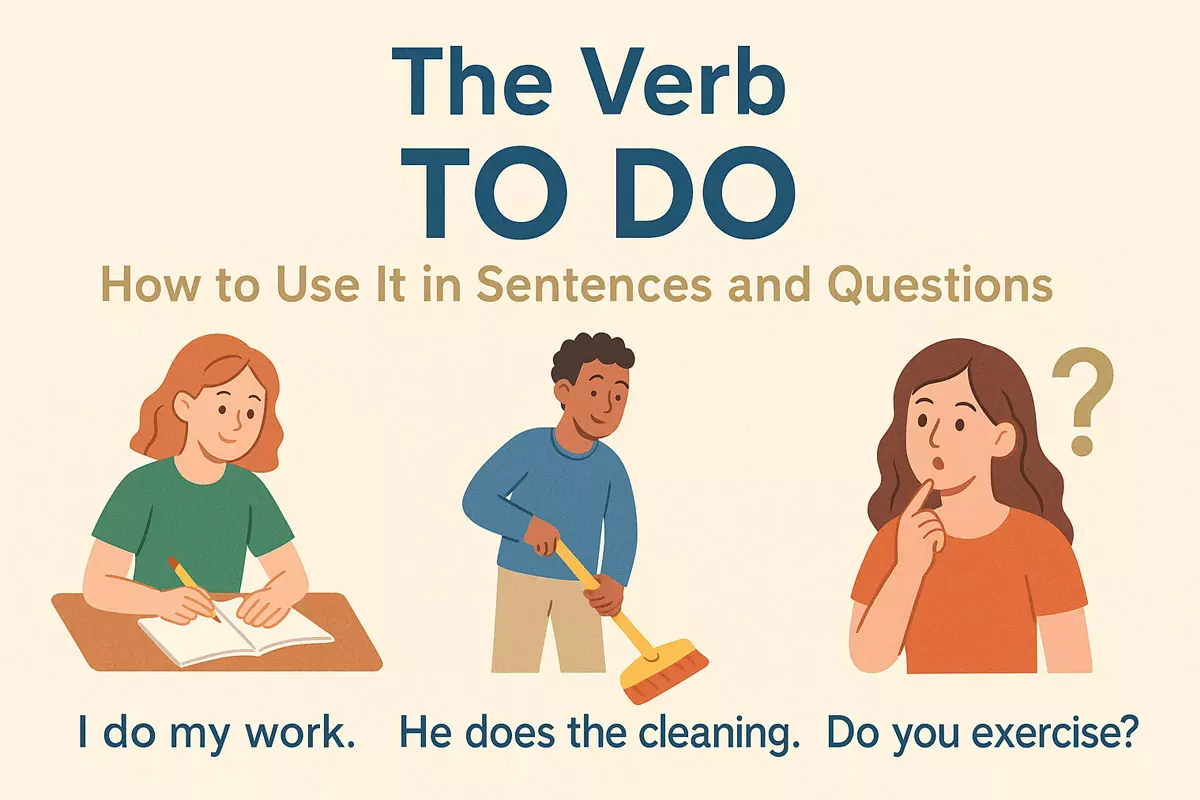 This article explains the functions of do in English, covering its use as a main verb, auxiliary verb, and in forming questions or negatives. It also discusses how do adds emphasis, common expressions, and offers sentence practice.
Mastering the use of “do” can make your English clearer and more dynamic, whether you are forming questions, giving answers, or emphasizing a point. The word “do” acts as an auxiliary verb in many situations, such as when you ask, Do you like coffee? or when you answer, Yes, I do. It also helps add emphasis, as in I do understand your concerns. By learning how to use “do” correctly, you can communicate more effectively and sound more natural in everyday conversations.
Functions of Do
The verb "do" has several important roles in English grammar, often acting as both a main verb and an auxiliary. Its uses range from forming questions to adding emphasis or simply replacing other verbs to avoid repetition. Understanding the different ways "do" appears in sentences can help make both your speaking and writing more natural.
Main Uses of “Do” in English
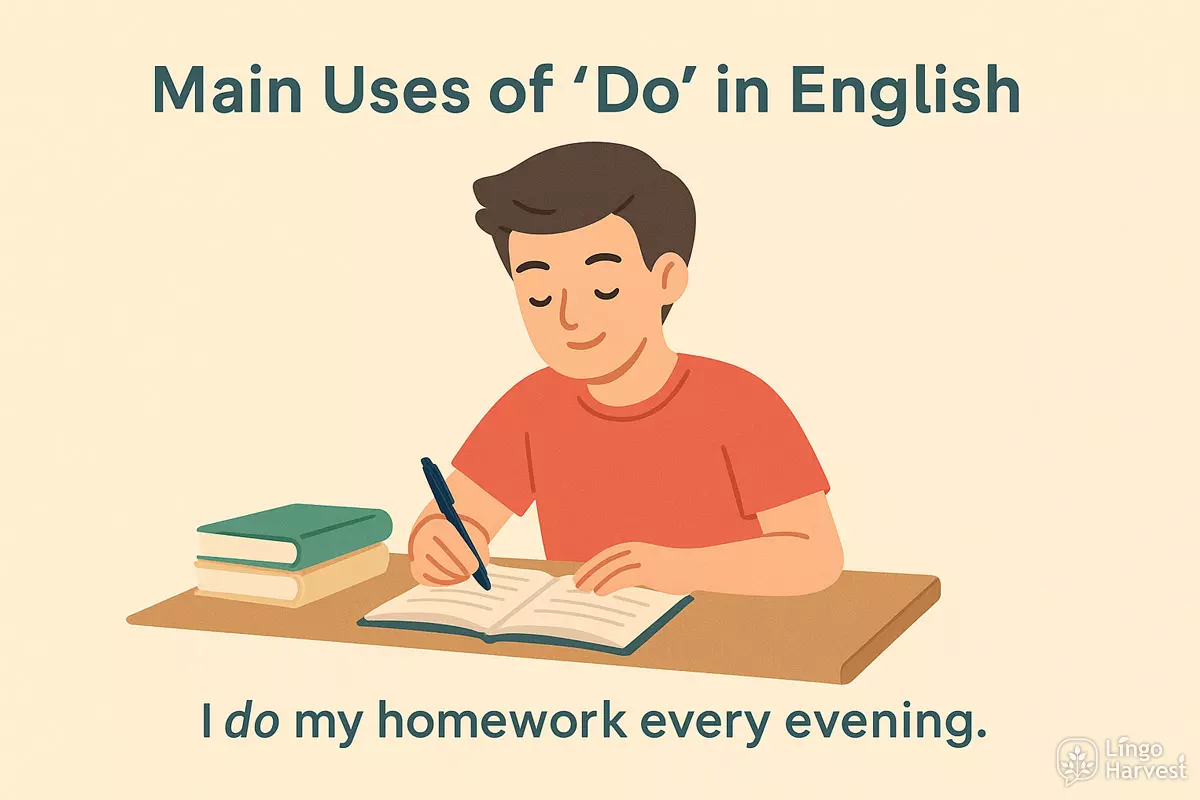
- Main verb: "Do" stands alone to describe actions or tasks. Example: "I do my homework every evening."
- Auxiliary verb (helping verb): It assists in making negatives, questions, or emphatic statements. Example: "Do you like coffee?"
- Emphasis: Sometimes "do" is used to stress the action. Example: "I do want to help!"
- Short answers: Used to avoid repeating the main verb. Example: "Do you play tennis?" "Yes, I do."
- Imperatives: "Do" can add politeness or urgency to commands. Example: "Do come in!"
How “Do” Works as a Main and Auxiliary Verb
When "do" is the main verb, it usually refers to performing an activity or task. As an auxiliary, it helps form questions and negatives in the present simple and past simple tenses.
| Function | Example Sentence |
|---|---|
| Main Verb | They do their chores every Saturday. |
| Auxiliary (Question) | Do you understand? |
| Auxiliary (Negative) | I do not agree with you. |
| Emphasis | He does love his job! |
| Short Answer | "Does she cook?" "Yes, she does." |
| Imperative | Do be careful! |
Common Ways “Do” Appears in Sentences
Here are some typical patterns and examples to illustrate its range:
- Do your best.
- Do you need any help?
- She does not like spicy food.
- Why did you do that?
- We do appreciate your feedback.
- Do be quiet, please.
- Did he call you?
- I don’t know the answer.
- You do look tired today.
- No, I don’t.
- Do as I say.
- They did their homework.
- He doesn’t drive to work.
- Do let me know if you need anything.
These examples show how versatile "do" is, functioning across different sentence types and contexts. Recognizing these patterns will help you use "do" more effectively in both spoken and written English.
As a Main Verb
The verb “do” serves as a full verb in sentences where it means “perform,” “carry out,” or “accomplish” an action or task. In these cases, “do” stands alone and is not just an auxiliary helping another verb. It often refers to work, chores, or unspecified actions, making it very flexible in everyday conversation.
Common Uses and Examples
You’ll see this verb used to describe daily routines, responsibilities, or general activities. Here are some typical patterns and examples:
- I do my homework every evening.
- She does the laundry on weekends.
- They did a great job on the project.
- We are doing our best to finish on time.
- Who will do the dishes tonight?
- He never does his chores without complaining.
- Did you do your exercises today?
- My brother does the shopping for our family.
- I did everything you asked.
- What are you doing right now?
- She does nothing all day.
- Let me do it for you.
- We did our homework together.
- He’s doing a favor for his neighbor.
- They do what they can to help.
- You did well in the exam.
- Don’t do that!
- Have you done your reading assignment?
Verb Forms
Like most English verbs, “do” changes form based on tense and subject. Here’s a quick overview of its main forms:
| Form | Example |
|---|---|
| Base | I do my work. |
| Third person singular | She does her homework. |
| Past simple | We did our chores yesterday. |
| Past participle | They have done enough. |
| Present participle | He is doing the shopping. |
Typical Expressions with “Do”
Some phrases are especially common with this verb. Instead of naming each action specifically, English often uses “do” with nouns related to tasks or duties:
- do the laundry
- do the dishes
- do homework
- do business
- do your best
- do a favor
- do the shopping
- do research
- do a job
- do good/bad/well
- do nothing
When “do” acts as a main verb, it’s usually about actions, tasks, or efforts, rather than simply forming questions or negatives. This makes it one of the most versatile and useful verbs in English conversation.
As an Auxiliary Verb
The verb “do” plays a crucial supporting role in English grammar, especially when forming questions, negatives, and emphatic statements. Instead of carrying its own meaning, “do” helps other verbs express tense, mood, or emphasis. This usage is particularly common in the simple present and simple past tenses for all verbs except “be,” modal verbs, and “have” as a main verb.
Forming Questions and Negatives
To turn a statement into a question or a negative, “do” steps in as a helper. For example, “You like pizza.” becomes “Do you like pizza?” for a question, or “You do not like pizza.” for a negative. This structure is essential for clear communication in English.
- Do you speak French?
- She does not watch TV.
- Did they finish their homework?
- He did not call me.
Emphatic Use for Affirmation
Sometimes, “do” is used to add emphasis to positive statements, showing certainty or correcting someone.
- I do want to help!
- She does know your name.
- We did see the movie.
Summary of Auxiliary “Do” Forms
| Form | Person | Tense | Example |
|---|---|---|---|
| do | I/you/we/they | Present | Do they play chess? |
| does | he/she/it | Present | Does he live here? |
| did | all persons | Past | Did you enjoy it? |
| do/does/did + not | all persons | Present/Past | She does not eat meat. |
Common Patterns with “Do” as a Helper
- Do you understand?
- Does it work?
- Did we win?
- They do not agree.
- He does not remember.
- She did not answer.
- I do appreciate your help.
- We did finish on time.
- Do not worry about it.
- Does anyone know?
- Did she call you?
- He does like chocolate.
Do in Questions and Negatives
When forming English questions and negative sentences in the present simple and past simple, the verb “do” (along with its forms “does” and “did”) plays a crucial supporting role. Instead of simply rearranging the main verb or adding “not,” English relies on “do” to build these structures, except with the verb “to be” and modal verbs, which do not require this helper.
How “Do” Functions in Questions
To ask questions in the present simple, use “do” or “does” before the subject, followed by the base form of the main verb. In past simple questions, “did” is used for all subjects. This pattern helps clarify that a question is being asked, especially when there is no auxiliary verb present.
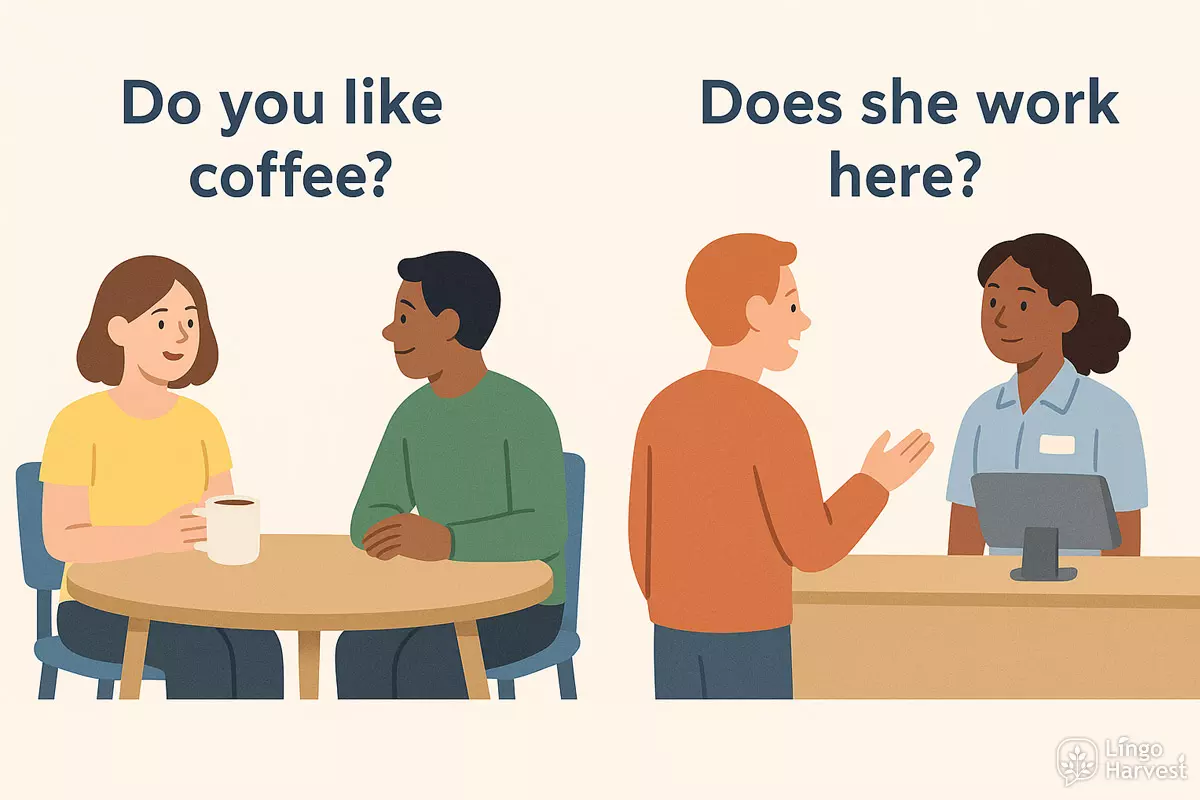
- Do you like coffee?
- Does she work here?
- Did they finish the project?
- Do we need tickets?
- Does it rain often?
- Did he call you?
- Do cats sleep a lot?
- Did you understand the lesson?
- Does he play tennis?
- Do I have to go?
Building Negatives with “Do”
Negatives in the present and past simple use “do not” (don’t), “does not” (doesn’t), or “did not” (didn’t) plus the base form of the main verb. This construction signals a negative meaning without changing the main verb’s form.
- I do not (don’t) like spinach.
- She does not (doesn’t) drive.
- We do not (don’t) agree.
- He does not (doesn’t) know the answer.
- They do not (don’t) understand.
- It does not (doesn’t) rain much here.
- You did not (didn’t) call me.
- She did not (didn’t) finish her homework.
- We did not (didn’t) see the movie.
- I did not (didn’t) receive your message.
Comparison Table: Forms of “Do” in Questions and Negatives
| Tense | Question Example | Negative Example |
|---|---|---|
| Present Simple (I/you/we/they) | Do they work here? | They do not work here. |
| Present Simple (he/she/it) | Does he play guitar? | He does not play guitar. |
| Past Simple (all subjects) | Did you see that? | You did not see that. |
| Short Answers | Yes, I do. / No, I don’t. | → Not applicable |
Key Points to Remember
- Do/does/did are only used as helpers in questions and negatives for main verbs (not with “to be” or modals).
- The main verb stays in its base form after “do,” “does,” or “did.”
- Short answers often repeat “do,” “does,” or “did” (e.g., “Yes, we do.”).
Understanding these patterns makes it easier to form clear questions and negatives in English, and helps avoid common mistakes like omitting the auxiliary or using the wrong verb form.
Emphasis with Do
Using "do," "does," or "did" can add strength to a statement in English. This technique is common in both spoken and written language when you want to underline the truth or importance of what you’re saying. Rather than simply stating a fact, including a form of "to do" makes the message more forceful or heartfelt.
How Emphatic "Do" Works
Normally, "do" is used to form questions or negatives, but it can also appear in affirmative sentences for emphasis. This doesn’t change the meaning, but it does highlight the action. For example, rather than just saying "I like chocolate," you might say "I do like chocolate" to stress your genuine preference.
- I do want to help. (Adds conviction to a simple offer.)
- She does know the answer. (Contradicts someone who doubts her knowledge.)
- They did call you. (Insists the action happened, possibly against disbelief.)
- He does enjoy classical music. (Emphasizes enjoyment, perhaps in surprise.)
- We do appreciate your effort. (Expresses sincere gratitude.)
- It does make a difference. (Stresses the impact.)
- You did finish the project on time! (Highlights a successful outcome.)
- I do remember your birthday. (Counters an assumption of forgetfulness.)
- He did see the movie. (Corrects a misconception.)
- She does speak French. (Supports a claim about her skills.)
- We do need more time. (Emphasizes urgency.)
- They did invite me. (Affirms the truth of an invitation.)
When to Use Emphatic "Do"
This form works best when you want to:
- Contradict a negative statement ("You don't care." "I do care!")
- Reassure someone ("You do have talent.")
- Express surprise or correct a misconception ("He does know her!")
- Show strong feelings or polite insistence ("I do insist!")
Emphatic "Do" in Different Tenses
The verb form changes to match the tense and subject. Here’s a quick overview:
| Subject | Present (do/does) | Past (did) |
|---|---|---|
| I/You/We/They | I do agree | I did agree |
| He/She/It | She does agree | He did agree |
Remember, emphatic "do" is only used in the simple present and simple past forms—not with continuous or perfect tenses. Use this structure to make your statements stand out, clarify misunderstandings, or add a touch of emotion to your English.
Common Expressions
Many everyday phrases rely on forms of "do" to clarify actions, reinforce meaning, or create emphasis. Understanding these set patterns will help you sound more natural and confident when speaking or writing. Below you'll find a variety of ways this verb appears in familiar contexts.
Typical Ways “Do” Appears in Everyday Speech
- Do your best → Try as hard as you can.
- Do someone a favor → Help someone by doing something for them.
- Do the dishes → Wash the plates and utensils after eating.
- Do your homework → Complete school assignments.
- Do business → Engage in commercial activities.
- Do the right thing → Make the ethical or correct choice.
- Do harm → Cause damage or injury.
- Do good → Perform helpful or kind actions.
- Do your hair → Style your hair.
- Do time → Serve a prison sentence.
- Do a job → Complete a task or assignment.
- Do without → Manage in the absence of something.
- Do up → Fasten, renovate, or decorate.
- Do well → Succeed or perform admirably.
- Do your nails → Paint or care for fingernails.
- Do a double take → Look twice in surprise.
- Do the laundry → Wash clothes and linens.
- Do a number on (someone/something) → Cause harm or damage.
“Do” in Short Answers and Emphasis
The verb "do" is often used for emphasis and in short responses. See the structured examples below to compare common uses:
| Pattern | Example |
|---|---|
| Emphatic affirmation | I do like coffee! (stronger than “I like coffee”) |
| Short positive answer | — Do you play chess? — Yes, I do. |
| Short negative answer | — Does she drive? — No, she doesn’t. |
| Tag question | You know him, don’t you? |
Fixed Phrases and Idioms
There are also idiomatic expressions where "do" carries a special meaning. A few to remember:
- Do away with (eliminate)
- Do the trick (work or succeed)
- Do your bit (contribute effort)
- Do a 180 (completely change direction or opinion)
Familiarity with these patterns will make your English sound more fluent and help you recognize subtle differences in meaning and tone.
Practice: Rewrite Sentences with Do
When mastering the verb “to do,” it’s important to practice changing statements into questions and negatives using the correct form. This exercise will help you recognize how “do,” “does,” and “did” function in sentences.
Instructions
Below you’ll find a set of affirmative sentences. Your task is to rewrite each one in two ways:
- As a question (using “do,” “does,” or “did” as needed)
- As a negative statement (again, with the right form of “to do”)
Take care to match the subject and tense. For example, “She plays tennis.” becomes “Does she play tennis?” and “She does not play tennis.”
Rewrite These Sentences
- He likes chocolate.
- They watch TV every night.
- You finished your homework.
- She goes to school by bus.
- We need more time.
- I remember his name.
- The dog barks loudly.
- Anna speaks French.
- Tom visited his grandma last week.
- Birds sing in the morning.
- My friends arrive early.
- The children play outside.
- She called you yesterday.
- We like spicy food.
- He reads books every day.
- You enjoyed the movie.
- It rains here often.
- The teacher explains the rules.
- They went to the park.
- I help my parents at home.
Show answers
- Does he like chocolate? / He does not like chocolate.
- Do they watch TV every night? / They do not watch TV every night.
- Did you finish your homework? / You did not finish your homework.
- Does she go to school by bus? / She does not go to school by bus.
- Do we need more time? / We do not need more time.
- Do I remember his name? / I do not remember his name.
- Does the dog bark loudly? / The dog does not bark loudly.
- Does Anna speak French? / Anna does not speak French.
- Did Tom visit his grandma last week? / Tom did not visit his grandma last week.
- Do birds sing in the morning? / Birds do not sing in the morning.
- Do my friends arrive early? / My friends do not arrive early.
- Do the children play outside? / The children do not play outside.
- Did she call you yesterday? / She did not call you yesterday.
- Do we like spicy food? / We do not like spicy food.
- Does he read books every day? / He does not read books every day.
- Did you enjoy the movie? / You did not enjoy the movie.
- Does it rain here often? / It does not rain here often.
- Does the teacher explain the rules? / The teacher does not explain the rules.
- Did they go to the park? / They did not go to the park.
- Do I help my parents at home? / I do not help my parents at home.
Common Patterns with “To Do”
It’s useful to see how “to do” changes for subject and tense. Here’s a quick reference:
| Subject | Present Simple | Past Simple |
|---|---|---|
| I / you / we / they | do / do not (don’t) | did / did not (didn’t) |
| he / she / it | does / does not (doesn’t) | did / did not (didn’t) |
| question form | Do/Does + subject + verb? | Did + subject + verb? |
| negative form | Subject + do/does not + verb | Subject + did not + verb |
Tips for Using “To Do”
- Use “do” and “does” in the present; “did” in the past.
- Remember: The main verb after “do/does/did” is always in its base form.
- Don’t add “-s” to the main verb when using “does.”
- For negatives, place “not” after “do/does/did.”
- In questions, “do/does/did” comes before the subject.