Infinitive with “to”: Basic Rules and Common Verbs

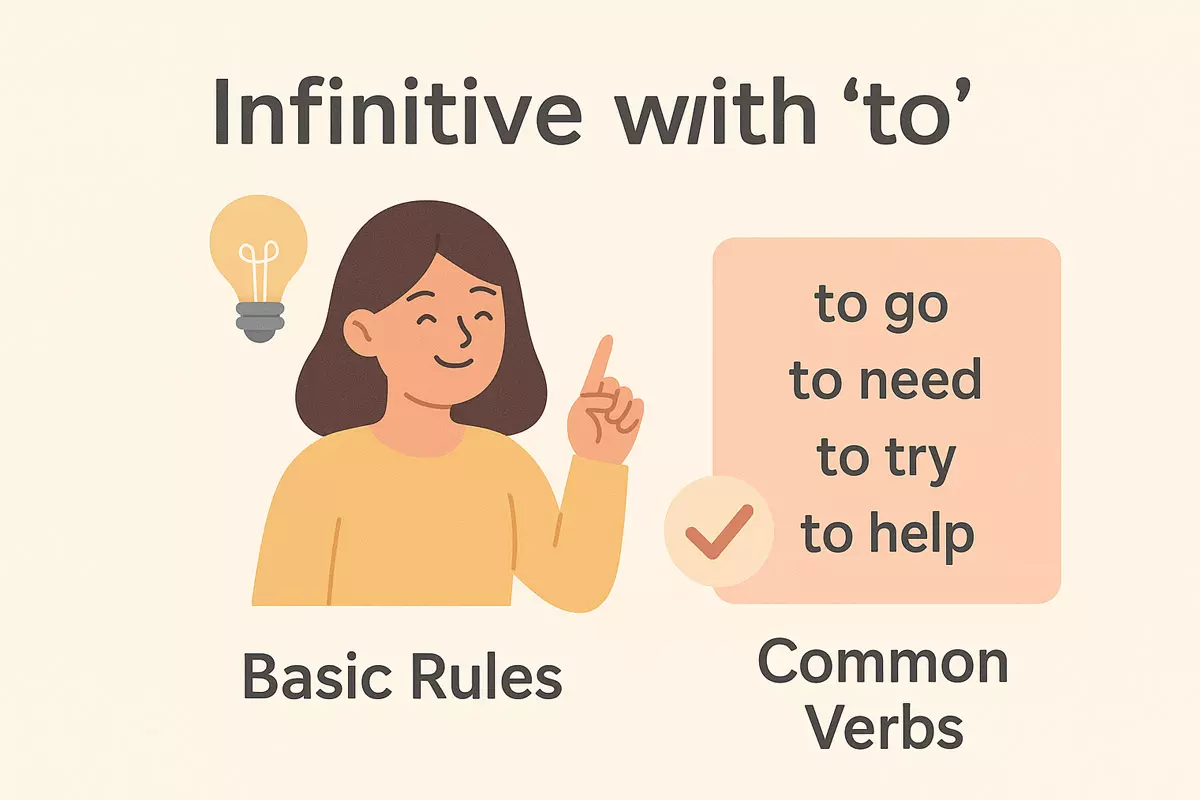 The article defines infinitives, lists common verbs that take to, explains their use for showing purpose, covers verb plus to plus verb patterns, points out typical mistakes, and provides practice sentences for you to complete.
Knowing when to use the base form of a verb after “to” is important for making your English sound natural and clear. This structure, called the infinitive, often follows certain verbs like want, need, hope, and plan. For example, you say “want to go,” “need to study,” or “plan to travel.” Becoming familiar with these common verbs and practicing them in sentences will help you communicate more effectively and confidently in everyday situations.
What Is an Infinitive
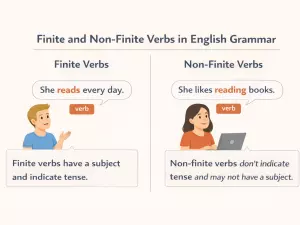
In English grammar, an infinitive is the base form of a verb, usually preceded by the word to. This construction—to + verb—acts as a non-finite verb form and can function in a sentence as a noun, adjective, or adverb. While it does not show tense or agree with a subject, it often expresses purpose, intention, or potential action.
For example, in the sentence “I want to learn Spanish,” the phrase “to learn” is an infinitive. It does not indicate who is learning or when the learning takes place; instead, it identifies an action connected to the verb “want.” Infinitives are not limited by subject or time, making them versatile building blocks in English sentences.
Basic Structure and Function
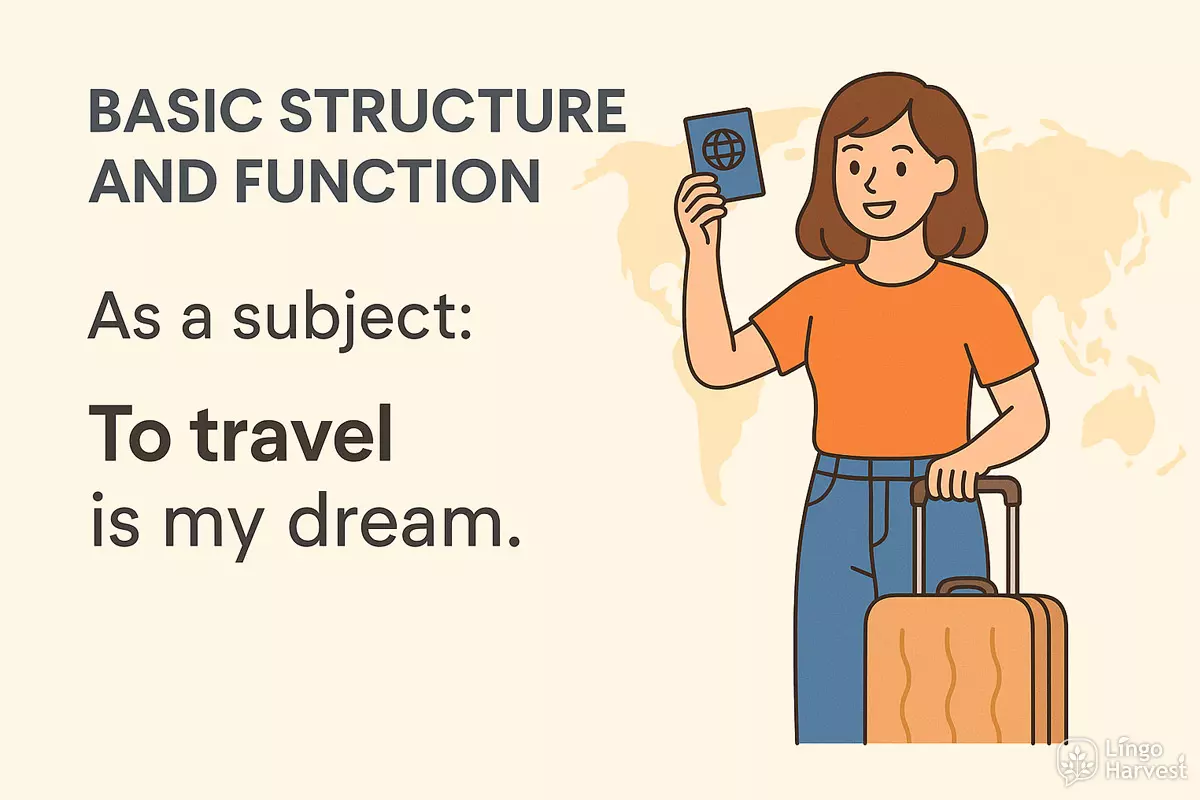
The most common way to form an infinitive is by placing to in front of the base verb. This is called the “to-infinitive.” It can serve multiple functions:
- As a subject: To travel is my dream.
- As an object: She hopes to win the prize.
- To express purpose: He went to the store to buy bread.
- After certain adjectives: It’s easy to see why.
- Following specific verbs: They decided to stay.
Common Verbs Followed by “to” + Infinitive
Some verbs are frequently followed by a to-infinitive. Here are several typical examples:
- agree
- plan
- decide
- hope
- offer
- refuse
- learn
- promise
- fail
- expect
- manage
- afford
- choose
- forget
- arrange
- prepare
- seem
- threaten
Infinitive vs. Base Verb
It’s important not to confuse the infinitive with the bare verb form. The infinitive nearly always includes to (except after modal verbs and a few special cases). For example:
- I want to go (infinitive)
- I can go (bare verb after modal “can”)
Overall, the to-infinitive is a flexible tool in English, used for expressing actions in a general, timeless, or hypothetical way, and it’s especially common after certain verbs and adjectives.
Common Verbs Followed by To
Some verbs in English are almost always followed by the infinitive form with to. Recognizing these verbs will help you build sentences more naturally and avoid common mistakes. These verbs often express intentions, desires, plans, promises, or preferences.
Typical Verbs That Take the "To" Infinitive
Below is a selection of frequently used verbs that are usually followed by an infinitive. Learning these will help you communicate intentions and future actions more clearly:
- agree (e.g., She agreed to help.)
- decide (e.g., We decided to leave early.)
- hope (e.g., I hope to see you soon.)
- learn (e.g., He is learning to swim.)
- offer (e.g., They offered to drive.)
- plan (e.g., She plans to study abroad.)
- promise (e.g., He promised to call.)
- refuse (e.g., She refused to cooperate.)
- want (e.g., I want to eat now.)
- wish (e.g., We wish to travel together.)
- expect (e.g., I expect to finish soon.)
- manage (e.g., He managed to solve the problem.)
- fail (e.g., They failed to notice the sign.)
- seem (e.g., She seems to understand.)
- prepare (e.g., We are preparing to launch.)
- offer (e.g., He offered to help.)
- afford (e.g., I can't afford to buy this.)
- forget (e.g., Don't forget to lock the door.)
- choose (e.g., She chose to ignore the advice.)
- attempt (e.g., They attempted to escape.)
Patterns and Sentence Structure
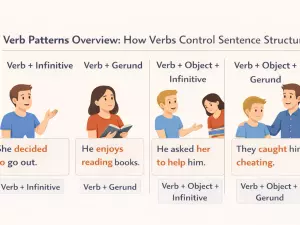
When using these verbs, the infinitive with to typically follows the main verb directly. The structure is: subject + verb + to + base verb. For example: They hope to win. Sometimes, an object can appear before the infinitive: She asked him to stay.
| Verb | Example Sentence |
|---|---|
| plan | We plan to visit London. |
| promise | She promised to return soon. |
| decide | He decided to change jobs. |
| want | I want to learn Spanish. |
| offer | They offered to help us. |
| refuse | He refused to answer the question. |
| hope | We hope to meet again. |
| manage | She managed to finish on time. |
Memorizing the most common verbs that require the infinitive will make your English more precise and natural. With practice, these patterns become automatic, helping you express intentions, plans, or preferences smoothly in conversation and writing.
Purpose and Intention Use
When you want to express why someone does something or what they aim to achieve, the infinitive with “to” is a common and clear way to show purpose or intention. This construction is especially useful for explaining reasons behind actions, both in spoken and written English. For example, after verbs of movement and certain expressions, the "to"-infinitive helps answer the question “Why?” Consider sentences like: “She went to the store to buy milk,” or “He called to ask a question.” In both cases, the infinitive phrase explains the motivation behind the action.
Common Patterns for Expressing Purpose
There are several patterns where the "to"-infinitive naturally fits when indicating motivation or intention:
- After verbs of movement: come, go, run, walk (e.g., “They ran to catch the bus.”)
- With “in order to” or “so as to” for emphasis or formality (e.g., “She left early in order to avoid traffic.”)
- After certain verbs that imply intent: try, hope, plan, decide, promise (e.g., “He promised to help.”)
- To answer “why?” questions: “Why did you visit?” → “To see my friend.”
- In negative purpose: “so as not to” or “in order not to” (e.g., “He whispered so as not to wake the baby.”)
Examples of Verbs and Phrases Used to Show Intention
Here’s a list of verbs and expressions commonly followed by the "to"-infinitive when explaining aims or motives:
- go (to do something)
- come (to see, to help)
- leave (to catch, to study)
- call (to ask, to confirm)
- visit (to meet, to learn)
- study (to become, to pass)
- save (to buy, to travel)
- try (to understand, to fix)
- work (to earn, to gain experience)
- exercise (to stay healthy, to lose weight)
- move (to find a new job, to be closer to family)
- arrive (to see the show, to start on time)
- bring (to share, to contribute)
- write (to inform, to explain)
- invite (to join, to participate)
- prepare (to succeed, to impress)
- study (to improve, to qualify)
- train (to compete, to improve skills)
- practice (to master, to get better)
Comparing Infinitive Structures for Purpose
Sometimes, English offers more than one way to express intent. The following table summarizes common forms and their usage:
| Structure | Example Sentence |
|---|---|
| to + infinitive | She went to the gym to exercise. |
| in order to + infinitive | He studied late in order to pass the exam. |
| so as to + infinitive | They whispered so as to not disturb others. |
| for + noun/gerund | She went out for a walk. |
Using the infinitive in these ways helps make your communication clear and concise when you need to state objectives or motivations. Whether you’re writing formal instructions or chatting with friends, this structure offers flexibility and precision.
Verb + To + Verb Patterns
Many English verbs are commonly followed by another verb in the infinitive form, using “to” before the base verb. This structure is an essential part of English grammar, helping speakers express intentions, plans, preferences, and more. Understanding which verbs take this pattern is key to forming natural and correct sentences.
Common Verbs That Take “to” + Infinitive
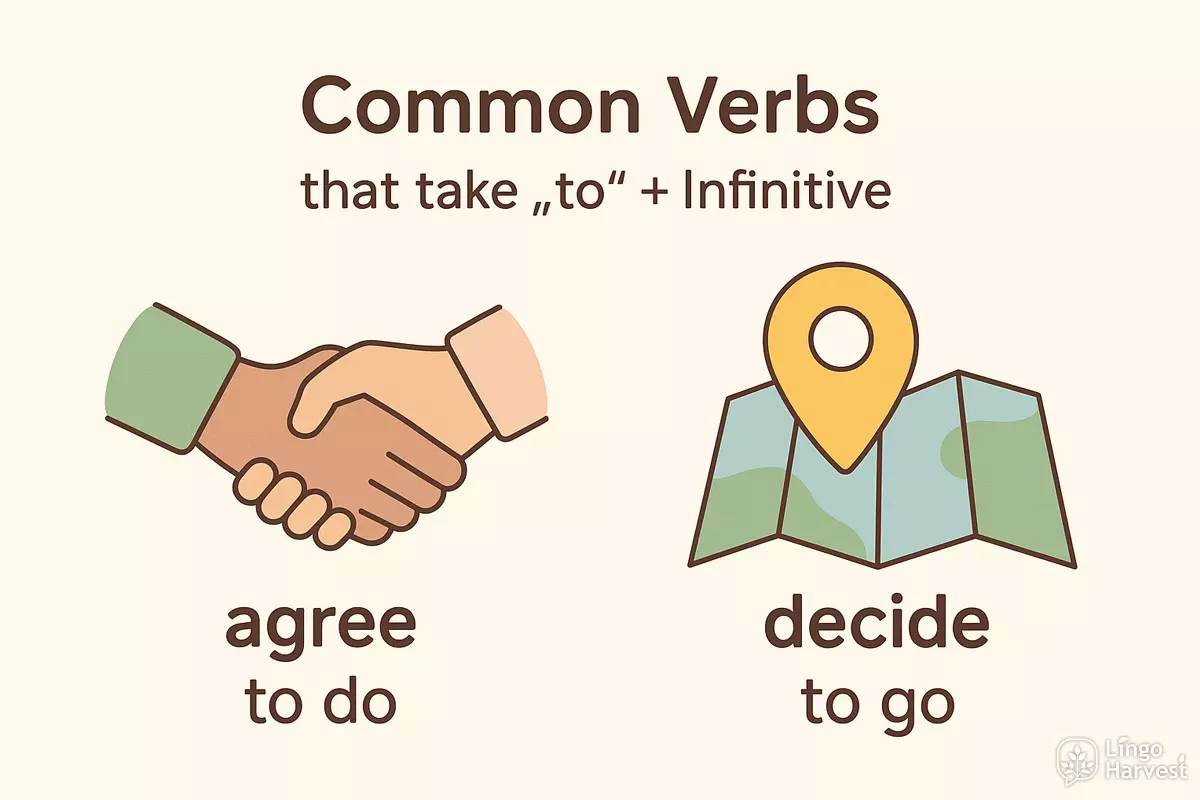
Some verbs are almost always followed by “to” and the base form of another verb. Here are frequent examples:
- agree to do
- decide to go
- hope to see
- learn to swim
- plan to travel
- promise to help
- offer to pay
- refuse to answer
- forget to call
- manage to finish
- need to leave
- expect to arrive
- fail to notice
- pretend to understand
- want to try
- wish to participate
- choose to stay
- attempt to fix
How the Pattern Works in Sentences
The main verb sets up the meaning, and the infinitive verb explains what action is involved. For example:
- She decided to visit her friend.
- They offered to help with the project.
- I hope to meet you soon.
This construction is useful for talking about purpose, intention, and willingness.
Comparing Similar Patterns
Some verbs are followed by a gerund (the -ing form) instead of “to” plus the base verb. Others can use both forms, but with different meanings. Here is a comparison for clarity:
| Verb | With “to” + Infinitive | With Gerund (-ing) | Notes |
|---|---|---|---|
| remember | remember to lock | remember locking | “to lock” = don’t forget future action; “locking” = recall past action |
| stop | stop to rest | stop resting | “to rest” = pause for a new action; “resting” = end the action itself |
| try | try to lift | try lifting | “to lift” = attempt with effort; “lifting” = experiment with an action |
| forget | forget to bring | forget bringing | “to bring” = fail to do something; “bringing” = forget a past event |
Tips for Mastering Infinitive Patterns
- Learn common verbs that use this structure by heart.
- Notice the difference in meaning when verbs can take both “to” + verb and -ing forms.
- Practice by making your own sentences with new verbs you learn.
- Check a dictionary or grammar guide if you’re unsure which pattern to use.
Mastering these combinations will greatly improve your fluency and confidence in expressing complex ideas.
Typical Mistakes
Misusing the infinitive with "to" is surprisingly common, especially for learners who are already comfortable with basic sentence structure. One of the most frequent issues is confusing when to use the infinitive form and when to use the gerund ("-ing" form) after certain verbs. This can lead to awkward or incorrect sentences.
Mixing Up Gerunds and Infinitives
Many verbs are followed by the infinitive with "to," while others require the gerund. For example, "decide to go" is correct, but "enjoy to go" is not. Learners often swap these forms by accident. Here are some verbs that commonly cause confusion:
- forget to do / forget doing
- remember to do / remember doing
- stop to do / stop doing
- try to do / try doing
- like to do / like doing
- begin to do / begin doing
- continue to do / continue doing
- prefer to do / prefer doing
- intend to do
- promise to do
- offer to do
- refuse to do
- fail to do
- seem to do
- hope to do
- plan to do
- agree to do
- decide to do
- want to do
- wish to do
Omitting "to" After Certain Verbs
Some verbs are followed directly by an infinitive without "to" (the bare infinitive), while others always require "to." Confusing these patterns is a classic slip-up. For instance, "help do" is less common than "help to do" (both are accepted in modern English, but "to" is safer). However, "let do" is correct, not "let to do."
Incorrect Negative Forms
Another area of difficulty is forming negatives. Remember, "not" comes before the infinitive: "I decided not to go," not "I decided to not go." While both are sometimes heard, the first is more natural in formal English.
Misplacing Objects with Infinitives
When using verbs like "ask," "tell," or "want," students often forget the required object before the infinitive: "She asked me to help" (not "She asked to help"). Skipping the object changes the meaning or makes the sentence unclear.
Comparison Table: Correct and Incorrect Usage
| Incorrect Example | Correct Example |
|---|---|
| I enjoy to swim. | I enjoy swimming. |
| He suggested to try it. | He suggested trying it. |
| She made me to cry. | She made me cry. |
| They asked go. | They asked to go. |
| We decided not go. | We decided not to go. |
| Let’s to start. | Let’s start. |
| I want that you to come. | I want you to come. |
| He hope to see you. | He hopes to see you. |
| She refused going. | She refused to go. |
| They promised help us. | They promised to help us. |
Summary
Paying attention to which verbs require "to" plus infinitive, which take the gerund, and where objects are needed will help you avoid the most common pitfalls. Review these patterns regularly, and check reference lists when in doubt.
Practice: Complete the Sentences
Applying infinitives with “to” is essential for expressing intentions, preferences, and plans. Below, you’ll find exercises to help you use this construction naturally in sentences. Fill in each blank with the correct infinitive form using “to” and the verb in parentheses.
Fill in the Blanks
Write the correct infinitive (“to” + verb) for each sentence.
- She promised _______ (help) me with my homework.
- We decided _______ (go) to the museum on Saturday.
- He forgot _______ (buy) milk at the store.
- I would like _______ (learn) how to play the piano.
- They hope _______ (see) you at the party tonight.
- It’s important _______ (exercise) regularly.
- My parents want me _______ (be) happy.
- She refused _______ (answer) the question.
- He needs _______ (finish) his project before Friday.
- We plan _______ (visit) our grandparents soon.
Show answers
- to help
- to go
- to buy
- to learn
- to see
- to exercise
- to be
- to answer
- to finish
- to visit
Common Verbs Used with “to” + Infinitive
Here are some verbs that are frequently followed by “to” and the base form of another verb. Study these to become more comfortable with the structure:
- agree
- decide
- expect
- hope
- learn
- need
- offer
- plan
- promise
- refuse
- seem
- want
- would like
Choose the Correct Verb
Select the best infinitive verb to complete each sentence.
- Do you want _______ (to eat / to sleep) now?
- I forgot _______ (to call / to walk) her yesterday.
- She promised _______ (to help / to run) after school.
- They hope _______ (to travel / to paint) next year.
Show answers
- to eat
- to call
- to help
- to travel
Quick Review of Patterns
Some verbs require “to” before the next verb. Here’s a summary of typical patterns with common verbs:
- Verb + to + verb: She wants to leave.
- Verb + object + to + verb: He told me to wait.
- It’s + adjective + to + verb: It’s easy to understand.
Regular practice helps you remember which verbs use this form. Try making your own sentences using the verbs listed above to reinforce your understanding.