Infinitive without “to”: When to Drop It and Why

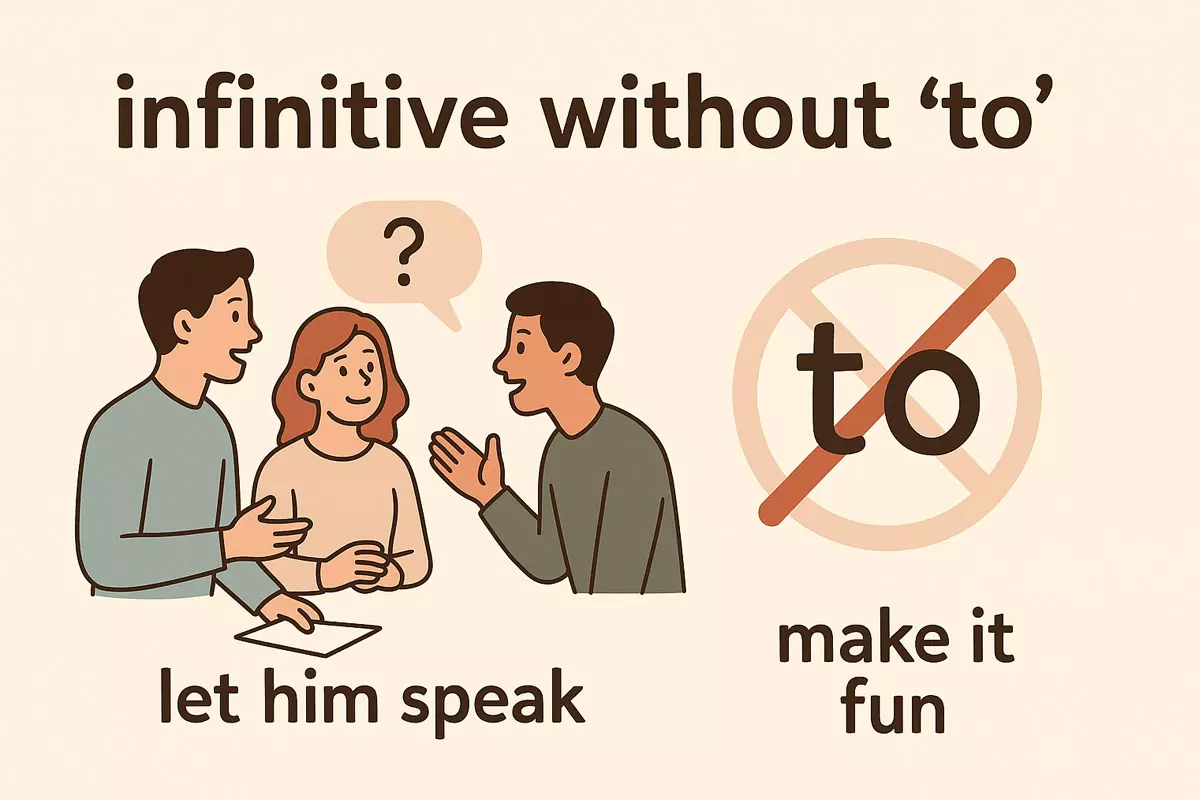 This article explains the bare infinitive, showing how it works with modal verbs, causative verbs like let and make, and verbs such as help and see. It also highlights common mistakes and provides fill-in-the-blank practice.
Have you ever wondered why we sometimes say help me find instead of help me to find? This subtle difference in English, where the small word to is often left out before a verb, can be confusing even for advanced learners. Generally, both forms are correct, but omitting to after verbs like help, let, and make is more common in everyday speech, making your English sound more natural and fluent. Understanding this nuance can boost your confidence and help you communicate more effectively in real-life conversations.
Definition and Meaning
When we talk about the infinitive form of a verb in English, most people think of “to” plus the base verb, like “to eat” or “to go.” However, there’s a special case called the “bare infinitive,” which is simply the verb’s base form without “to.” This structure appears in specific grammatical patterns, especially after certain verbs, modal verbs, and expressions.
What Is the Bare Infinitive?
The bare infinitive is the simplest form of the verb, with no “to” in front. For example, in the sentence “She made me laugh,” “laugh” is a bare infinitive. It’s not the same as the present tense; it’s the verb’s root form used in certain constructions.
Where Does the Bare Infinitive Appear?
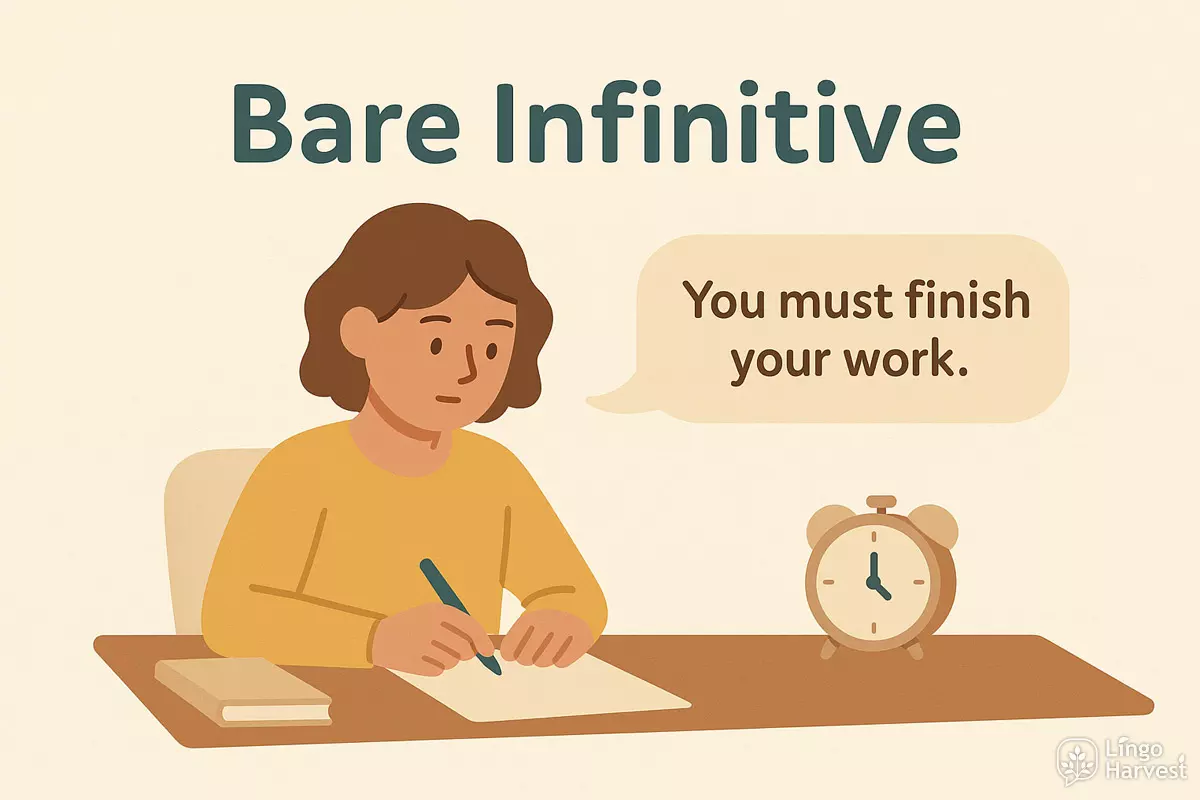
You’ll find this form in a few common situations:
- After modal verbs (can, must, should, will, etc.): “You must finish your work.”
- After verbs of perception (see, hear, feel, etc.): “I saw him leave.”
- After ‘make’ and ‘let’ (when followed by an object): “They let her go.”
- After ‘help’ (in informal English): “He helped me carry the bags.”
- In some fixed expressions and idioms: “All I did was ask.”
Comparing Infinitive Forms
Sometimes, both the “to” infinitive and the bare form are possible, but the meaning or context changes. Here’s a structured look at how the two forms differ in usage:
| Pattern | Example Sentence | Infinitive Type |
|---|---|---|
| After modal verbs | She can swim. | Bare infinitive |
| After “to” as a preposition | He wants to swim. | Full infinitive |
| With “let” + object | Let them decide. | Bare infinitive |
| After “decide” | They decided to stay. | Full infinitive |
Key Points to Remember
- The bare infinitive is not used randomly; it follows specific verbs and patterns.
- Using “to” or dropping it changes the construction and sometimes the meaning.
- Modal verbs always require the bare infinitive, never the “to” form.
- After causative verbs like “make” and “let,” use the bare form, but with “allow,” use “to.”
Understanding when to omit “to” helps you sound more natural and accurate in English, especially in speech and concise writing.
Modal Verbs and Bare Infinitives
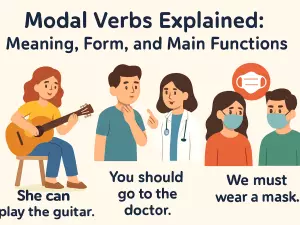
When using modal verbs in English, the verb that follows typically appears in its base form, without the word “to.” This structure is known as the bare infinitive. Recognizing this pattern is essential for forming correct sentences, especially when expressing possibility, necessity, permission, or ability.
Common Modals Requiring the Bare Infinitive
Standard modal verbs always pair with the base form of the main verb. Here are some examples of how this looks in practice:
- can: She can swim very well.
- could: You could try again later.
- may: He may join us tonight.
- might: We might find a solution.
- shall: Shall we begin?
- should: You should call your mom.
- will: They will help you.
- would: I would prefer tea.
- must: You must stop here.
- need (modal use): You need not worry.
- dare (modal use): Dare you speak up?
Why Drop "to" After Modals?
The reason for omitting “to” is rooted in grammar rules: modal verbs directly govern the bare infinitive, making the sentence more concise and straightforward. Adding “to” would sound unnatural and is grammatically incorrect in these cases (e.g., She can to swim ❌).
Exceptions and Special Cases
While the structure is consistent, it’s helpful to be aware of verbs that sometimes work as modal-like expressions (such as “ought to” or “have to”). These require “to” before the infinitive and are exceptions to the usual bare infinitive rule after modals.
| Modal Expression | Example Sentence |
|---|---|
| can | You can leave now. |
| must | We must finish this today. |
| should | You should eat more vegetables. |
| ought to | You ought to see a doctor. ✅ (uses "to") |
| have to | I have to work late. ✅ (uses "to") |
Key Takeaways
- After true modals, always use the base form without “to.”
- Verbs like “ought to” and “have to” are not pure modals and require “to.”
- This rule helps keep English sentences clear and grammatically correct.
Understanding when to use the simplest verb form after modals is fundamental for speaking and writing naturally.
Let and Make Constructions
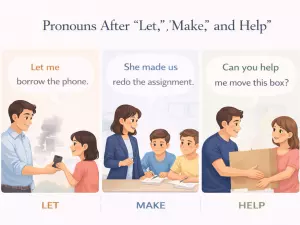
When using verbs like "let" and "make," English drops the "to" before the following verb. This grammatical pattern is a classic example of the bare infinitive in action. Instead of saying "let him to go" or "make her to study," native speakers simply use "let him go" and "make her study." The omission of "to" is not random—it's a rule after these causative verbs.
How Bare Infinitives Work After "Let" and "Make"
With these verbs, the structure is: subject + "let"/"make" + object + base form of the verb. The base form (bare infinitive) is used because "let" and "make" directly cause the action, making "to" unnecessary and ungrammatical in standard English.
- Let me explain.
- Let them try.
- Let us finish.
- Let him answer.
- Let her decide.
- Let the children play.
- Make me laugh.
- Make them wait.
- Make him pay.
- Make her smile.
- Make the dog sit.
- Make the team practice.
Comparing "Let/Make" with Other Verbs
Most other verbs that take another verb as a complement require the full infinitive ("to" + verb). Only a handful, like "let," "make," and "help" (sometimes), take the bare form. This difference can be confusing for learners, so let's compare:
| Verb Pattern | Example |
|---|---|
| let + object + base verb | Let her leave early. |
| make + object + base verb | Make them clean up. |
| help + object + base verb / to + verb | Help me (to) carry this. |
| ask/tell/allow + object + to + verb | Ask him to wait. / Allow her to join. |
Why No "To" After "Let" and "Make"?
The omission of "to" after these verbs is rooted in English syntax: both "let" and "make" serve as causative verbs, directly linking the subject to the action. Adding "to" would separate the cause from the result, which is not the intended structure. This grammatical shortcut signals an immediate, direct effect.
Common Mistakes to Avoid
Learners often mistakenly insert "to" after these verbs, especially by analogy with other verbs that require the full infinitive. To avoid this:
- ❌ Don’t say: Let him to go
- ✅ Correct: Let him go
- ❌ Don’t say: Make her to study
- ✅ Correct: Make her study
Remember, the bare infinitive is the rule after "let" and "make" in active constructions.
Help and See Verbs
When certain verbs are followed by another verb, the “to” is sometimes omitted before the base form. Two of the most important groups where this happens are those involving assistance and perception—like “help,” “see,” “hear,” and “watch.” Knowing when to drop “to” with these verbs is key for sounding natural in English.
Assistance Verbs: “Help” and Its Patterns
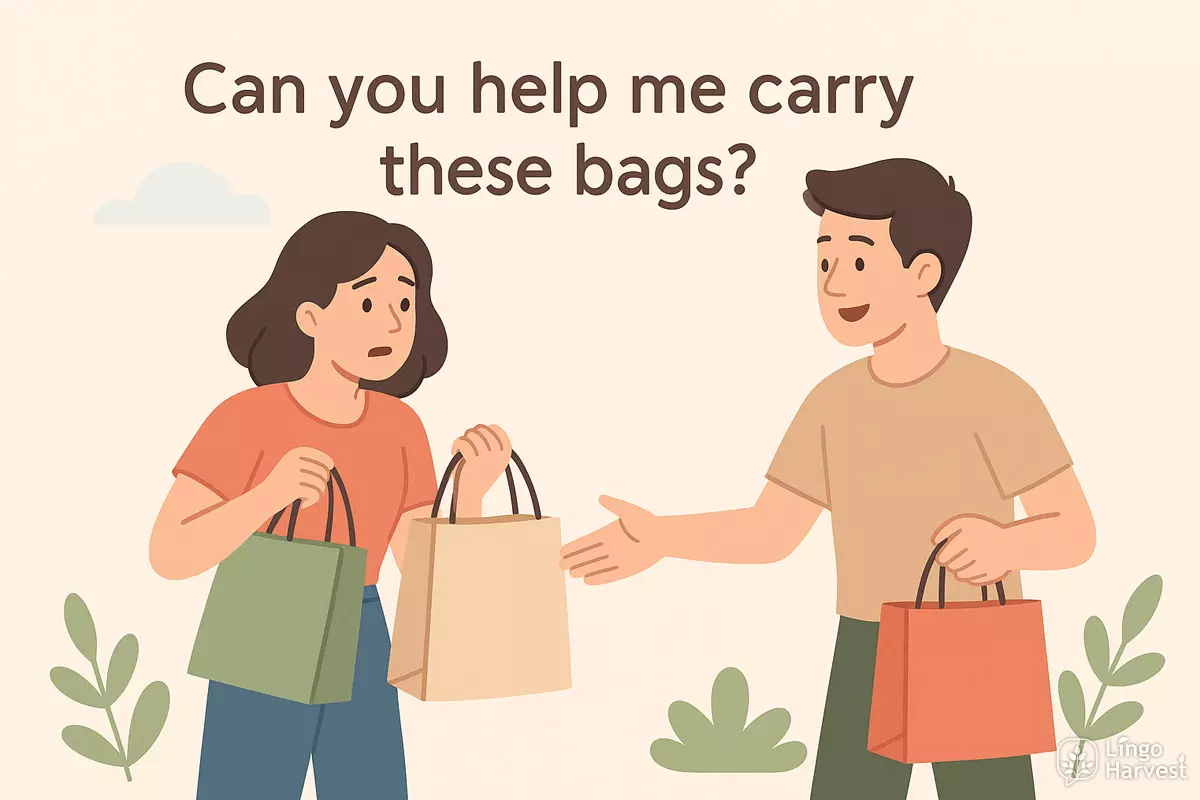
With “help,” there’s flexibility. You can say either “help someone do” or “help someone to do,” but the version without “to” is very common in both British and American English. For example:
- Can you help me carry these bags?
- She helped him finish his homework.
- They helped us move the furniture.
- Will you help me solve this problem?
Including “to” is also correct (“help me to carry”), but dropping it is more direct and frequently used in speech.
Perception Verbs: “See,” “Hear,” and Others
Verbs of perception—such as “see,” “hear,” “watch,” “feel,” and “notice”—typically take the bare infinitive (the base form without “to”) when describing a complete action. This construction is used to indicate that someone witnessed or experienced the entire event.
- I saw him cross the street. ✅
- We heard the dog bark last night.
- She watched them play football.
- Did you feel the ground shake?
- They noticed the door open.
- I heard her sing at the concert.
- You saw me leave the room.
- He felt the rain start.
- We watched the sun rise.
- I noticed him hesitate.
However, if you use the continuous form (verb+ing), it emphasizes the action in progress: “I saw him crossing the street.”
Common Patterns: Bare Infinitive vs. “To” Infinitive
The following table highlights the difference in structure between these verbs and others that do require “to”:
| Verb Pattern | Example Sentence |
|---|---|
| Help + object + bare infinitive | She helped me pack my bags. |
| See/Hear/Watch + object + bare infinitive | I heard them sing. |
| Want + to-infinitive | I want to leave now. |
| Ask + object + to-infinitive | He asked her to help. |
Summary of Usage
Dropping “to” after verbs like “help,” “see,” and “hear” is a natural part of English grammar, especially when describing completed actions or direct assistance. Understanding these patterns will help you use more fluent and idiomatic English in everyday communication.
Common Mistakes to Avoid
It’s easy to get tripped up when deciding whether to use the bare infinitive or the full infinitive form. Learners often mix them up in certain patterns, especially when dealing with verbs that can take both forms or with set expressions. Understanding where the “to” is necessary and where it should be dropped is key to sounding natural in English.
Mixing Up Verb Patterns
Many verbs require the infinitive without “to” after them, but others need “to.” Confusing these patterns can lead to awkward or incorrect sentences. For example, after modal verbs like can, must, or should, you should never use “to.” However, after certain other verbs (like want), “to” is required.
| Verb/Expression | Correct Usage | Incorrect Usage |
|---|---|---|
| Modal verbs (can, must, should, etc.) |
I can swim. | I can to swim. ❌ |
| Let / make / help (causative verbs) | She let him go. | She let him to go. ❌ |
| After “to” (full infinitive) | I want to eat. | I want eat. ❌ |
| After “had better” / “would rather” | You had better leave. | You had better to leave. ❌ |
Forgetting Set Phrases and Expressions
Some fixed expressions in English always require the bare form. Learners sometimes overgeneralize and insert “to” where it doesn’t belong. Watch out for these:
- Help can be followed by either form, but “help do” is common in American English: She helped me carry the bags.
- Let and make always use the bare infinitive: Let her try.
- Hear/see/watch/feel + object + bare infinitive: I heard him sing.
- Had better and would rather: They would rather stay home.
Overusing “to” After Certain Verbs
Sometimes, students insert “to” after verbs that require the bare form, especially when translating from their native language. This is particularly common with modals and causative verbs. Always double-check which verbs need the bare infinitive.
Summary Checklist
- Never use “to” after modal verbs (can, could, may, might, must, shall, should, will, would).
- Omit “to” after let, make, and, in informal American English, help.
- Use the bare form in expressions like “had better,” “would rather,” and “sooner than.”
- Don’t drop “to” where it is required (e.g., after want, need, decide, promise).
- Remember that verbs of perception (see, hear, feel) often use the bare infinitive when followed by an object.
By paying attention to these areas, you’ll avoid the most frequent pitfalls and use the bare infinitive where it actually belongs.
Practice: Fill in the Correct Form
Understanding when to omit "to" with the infinitive is crucial for using English naturally. Below, you'll find a mix of fill-in-the-blank sentences and a pattern-matching task to help you master this skill. Focus on verbs and expressions that commonly require the bare infinitive, especially after modal verbs and certain causative or perception verbs.
Fill in the Blank: Use the Correct Infinitive Form
Complete each sentence by writing the correct form of the verb in parentheses—either with or without "to".
- She made me (apologize) for being late.
- You must (be) careful with these chemicals.
- Let him (finish) his story before you interrupt.
- They heard the car (arrive) outside.
- He helped me (move) the furniture.
- We watched the birds (fly) away.
- She can (solve) this problem herself.
- Did you see him (leave) the room?
- They let us (use) their car for the weekend.
- My parents made me (clean) my room every Saturday.
Show answers
- apologize
- be
- finish
- arrive
- move
- fly
- solve
- leave
- use
- clean
Recognizing Patterns: When to Drop "to"
Identify which of the following verbs are typically followed by the bare infinitive (without "to").
- make
- let
- help
- allow
- see
- hear
- should
- want
- can
- decide
Show answers
- make
- let
- help (can be both with or without "to")
- see
- hear
- should
- can
Comparison Table: Bare Infinitive vs. To-Infinitive
Some verbs change meaning or structure depending on whether you use the bare infinitive or the "to" form. Review the table to see which verbs follow which pattern:
| Verb/Expression | Correct Form After (Example) |
|---|---|
| can, must, should, may, will, would (modal verbs) | bare infinitive (She can dance.) |
| let, make, see, hear, feel (causative/perception) | bare infinitive (They made me wait.) |
| want, decide, agree, hope, plan | to-infinitive (I want to go.) |
| help | bare or to-infinitive (She helped me move / to move.) |
Take time to notice which verbs drop "to" and which do not. This will help you sound more fluent and confident in your everyday English.